Category: Norwich

  • Norwich – Berstrete Gates (Two Julians)

    Norwich – Berstrete Gates (Two Julians)

    20250212_153257

    Next in the Two Julians Norwich series is the Berstrete Gates which, as a disclosure, has been one of my favourite pubs for some time. I accept it’s not a craft beer haven, but many years ago a group of us used to go to the Berstrete Gates every Friday and the lovely owner, Hang Pham, merrily cooked for us every week.

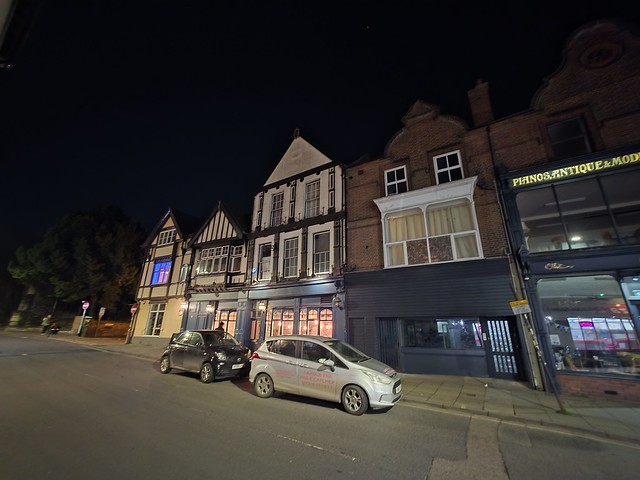
    Located on Ber Street, the history of this pub is complex and long, starting with when it was known as the King’s Arms in the early eighteenth century. A few weeks ago, I found an old theatre group mention in a newspaper from nearly 300 years ago and I think they were performing here. Above is the auction details of the pub when it was put up for sale in June 1879 and it had also been auctioned in January 1867 when it was known as “the old King’s Arms”. There have been twelve pubs in Norwich city centre with the name King’s Arms (including another one on Ber Street), so some form of differentiation was necessary. The current building is from the mid to late nineteenth century (I think from around 1870s from maps) and it isn’t listed, with many of the interior features hidden behind some paint, although it retains some charm. Although Nikolaus Pevsner said that the building was “uninteresting”, so don’t come here expecting beautiful pub architecture.

    The pub took its current name of Berstrete Gates in June 1937 as it’s very near to the site of where the Ber Strete Gates entrance to the city was located. The gate had been pulled down in 1808, although it dated from the early twelfth century, as part of the destruction of the walls and gates in the city. There’s more about the history of the gate at https://www.norwich.gov.uk/site/custom_scripts/citywalls/29/29.html.

    20250212_153321

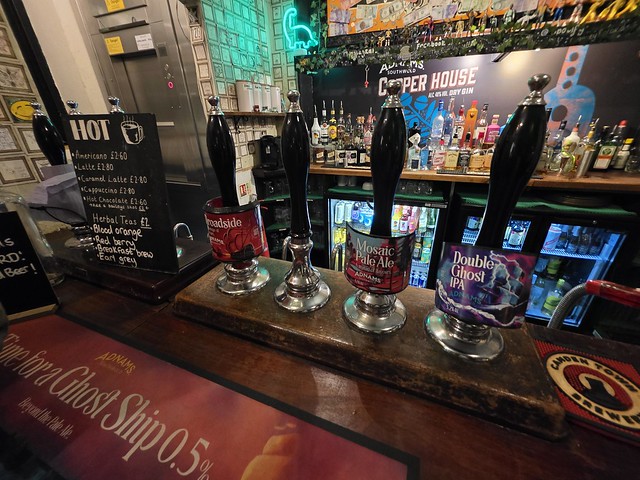
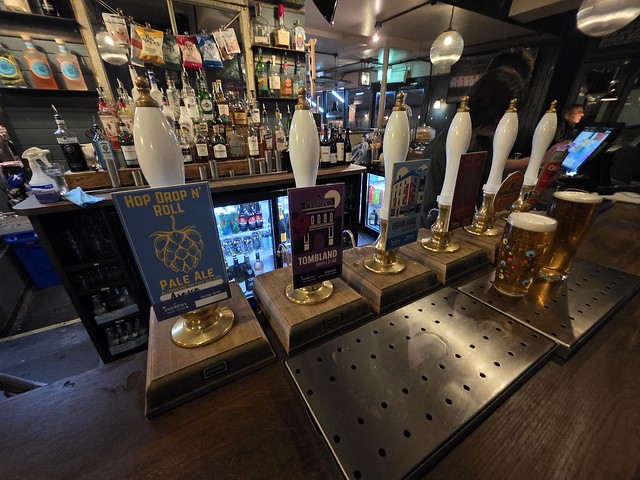
    The beer board which is visible when entering the pub and it tells its own story. This is a cheap and cheerful venue, the beer comes in cans and bottles, the product range is limited and the service is exquisite. In more recent history, this was taken over just before Covid by Gary Harvey and I think the timing of his taking over was all a bit unfortunate with a global pandemic ongoing. My friend James and I did go there in that period and the welcome was friendly, personable and immediate. I remember we were offered sausage casserole they had left over from a wake and we promptly then went about four times in that week as they were closing relatively soon after. The furniture layout was unusual to say the least, everything was based around a large central table that looked a little bit more meeting-like than pub-like. I think that the plan was to create a pub where people would talk to others when they entered, but on our final visit there a number of rather young looking girls were scrawling on the walls and so it felt best to retreat back to an adult’s pub. Since January 2024, Hang Pham has taken over behind the bar once again.

    20250212_153725

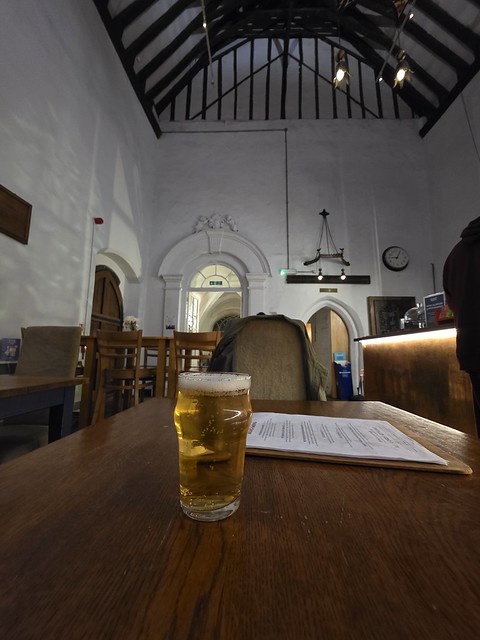
    The Guinness cost £2.50, a perfectly reasonable price. To add some variety to our visit, Julian went for a can of Holsten Pils, also priced at £2.50. Does beer drinking get much more decadent?

    20250212_154912

    The bar. In not trying to be on-trend, I think it’s strangely become more authentic. It’s quite a stark design and the back room doesn’t seem much used, but it is what it is.

    20250212_161233

    The signage outside and it’s fair to say that it could do with a little of bit of exterior repair work.

    20250212_161244

    The mural was created by John Moray-Smith (1889–1958) in 1938 when the pub was owned by Morgans Brewery. They had purchased it in the 1920s from George May brewery and through acquisition it became part of Bullards, Watney Mann, Brent Walker, Pubmaster and then finally free trade in 2002. George Plunkett, a photographer who has recorded so much of Norwich’s history which might otherwise have been lost, took a photo of it soon after the mural was installed.

    This is not a destination pub, it feels much more like an estate pub that just happens to be relatively near to the city centre. It’s got some considerable charm to it and although there’s a chance that it’ll end up as an on-trend craft beer bar in a few years if it doesn’t work out in its current iteration, I rather like what it currently is and the little bit of a local institution that it has become.

  • Food from Every Stall on Norwich Market (2025 Edition) – Week 1 and Indian Feast

    Food from Every Stall on Norwich Market (2025 Edition) – Week 1 and Indian Feast

    20250212_130716

    Thanks to James agreeing to help with this project, here we go again with the 2025 edition of eating food from every stall at Norwich Market and first up was the vegan Indian stall, Indian Feast. And here’s what happened when we visited in 2023.

    20250212_125428

    The menu board. My plan is to always have something different compared to last time, although it required some quick checking at the market stall to remember what we had last time. I quite fancied the samosa chat, but that’s what I went for last time (this is going to happen a lot this year I suspect), so this time it was the Aloo Tikki Chat. There’s no real change to the menu other than the addition of the vegan chicken curry, with the price increases being £1 on all the meals and 50p on all the snacks. One element that will be evident this year is how much food price inflation has gone on at the market and whether or not that is likely to put customers off going to stalls.

    20250212_125608

    One of the food displays which doesn’t necessarily look overly appetising in terms of the presentation, but there we go. What is more important is that the service was timely and friendly, the payment process was efficient and the stall accepts cash and card.

    20250212_125743

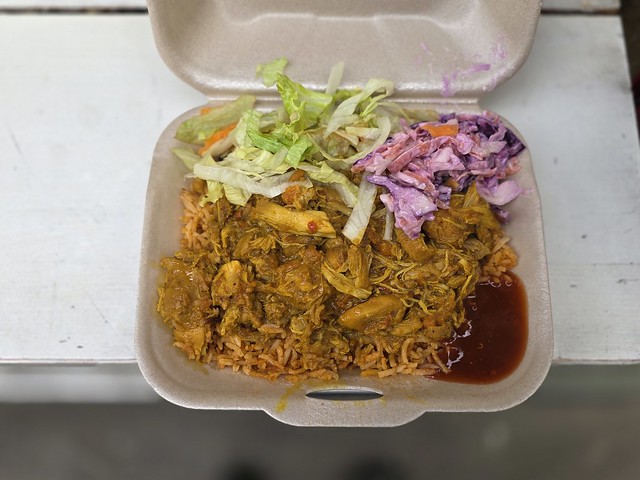
    The Aloo Tikki Chat and I went with all the options that came with it including the coriander, the mint chutney and the tamarind sauce. The mixed vegetable cake added texture to the dish and there was plenty of chickpeas in the whole arrangement which bulked matters out. There was some spice to it and the pieces of onion also added texture with the food having a depth of flavour to it.

    20250212_125810

    There’s a seating area which overlooks the kitchen. Only a limited number of the stalls at the market have a seating area and it’s always helpful so that I don’t have to worry about a seagull swooping down and stealing my vegetable cake.

    20250212_130359

    The Covid sign is still visible saying that the track and trace is in operation. That felt something of a throwback.

    IMG-20250212-WA0001

    Eagle eyed readers might guess that this is the photo that James took given he’s got an eye for this sort of thing and I accept this does look better than mine. James went for the Aloo Gobi, which he enjoyed but thought was a bit wet. I think that was the summary of the matter.

    It’s a light and tasty meal, the stall was clean and the service was friendly, with the prices seeming reasonable for the quality and quantity.

  • Norwich Market Food – Let’s Do It Again in 2025

    Norwich Market Food – Let’s Do It Again in 2025

    ****** 2025 NOW FINISHED – Here are the results *****

    Thanks to all the stall holders for so much marvellous food and drink throughout 2025. We got it down to six stalls (with great difficulty) and they’re listed in the above link.


    One of my more popular series of blog posts, often attracting extra visitors beyond my two loyal readers, was when I visited every food stall at Norwich market across 2023. Given that, my friend James and I have decided that we’ll do it all again. The excitement of it all! Last time the top three we decided were:

    3rd : Cocina Mia

    2nd : Lucy’s Fish and Chips

    1st : Bodega (in photo above)

    The rules are the same, the visit will be randomly drawn and we’ll work through all of the market stalls. I will attempt to have something different food wise to what I had before, to make a vague attempt at variety. It’s positively scientific this…. There have been some changes since 2023 with some stalls closing and some opening, but that all adds to the excitement. There are still, I think, 29 locations to visit, but we’ll also add a Toby’s visit at some stage as they’re the beer stall supplying craft beer options. They might get multiple visits and we’ll likely pop to Brick as well. It will be a challenge to get around 29 locations in 2025 (NB – it transpired to be 32), but where there’s a will then there’s a way.

    2025 VISITS

    A Taste of Punjab (Week 19)
    And Eat It (Week 31)
    B’s T’s (Week 28)
    Bodega (Week 25)
    Bread Source (Week 15)
    Buka Street (Permanently closed)
    Bun Box (Week 13)
    China Wok (Week 7)
    Cocina Mia (Permanently closed)
    Chocolate Bar Baker (Week 29)
    Churros for the People (Week 17)
    City Taco (Week 18)
    Coral Bay (Week 6)
    Crunch (Week 20)
    Deb’s (Week 10)
    Falafel and Friends (Week 5)
    Go Crepes (Week 11)
    Henry’s Hog Roast (Week 8)
    Indian Feast (Week 1)
    Italian Street Food (Week 16)
    Jacket Spuds & More (Week 9)
    Little Red Roaster (Week 30)
    Lucy’s Chips (Week 2)
    Lucy’s Fish and Chips (Week 12)
    Norwich Fresh (Week 4)
    Papa Mombassa (Week 22)
    Rabbits Salad Bar (Week 32)
    Reggies (Week 24)
    Ron’s Chips (Week 3)
    Ruby’s (Week 26)
    Taste of Shanghai (Week 21)
    Tasty House South East Asian Street Food Emporium (Week 27)
    Thai Bubble (Week 14)
    The All Electric Banger Stop (Week 23)
    Walsingham Farm Shop (Permanently closed)


    2023 VISITS

    A Taste of Punjab (Week 4)
    And Eat It (Week 18)
    Bodega (Week 15)
    Bread Source (Week 27)
    Bun Box (Week 16)
    Chimneys (Week 3) [now closed]
    China Wok (Week 1)
    Churros for the People (Week 7)
    Cocina Mia (Week 12)
    Coral Bay (Week 20)
    Deb’s (Week 17)
    Delight (Week 9)
    Falafel and Friends (Week 25)
    Feast (Permanently closed)
    Go Crepes (Week 29)
    Henry’s Hog Roast (Week 5)
    Indian Feast (Week 13)
    Italian Street Food (Week 24)
    Jacket Spuds & More (Week 14)
    Lucy’s Chips (Week 22)
    Lucy’s Fish and Chips (Week 26)
    Meat and Co (Permanently closed)
    Norwich Fresh (Week 10)
    Reggie’s (Week 19)
    Ron’s Fish and Chips (Week 2)
    Ruby’s (Week 6)
    Taste of Shanghai (Week 8)
    Tasty House South East Asian Street Food Emporium (Week 21)
    Thai Bubble (Week 23)
    The All Electric Banger Stop (Week 11)
    Walsingham Farm Shop (Week 28)

  • 200 Years Ago in Norwich : Body Snatching in Hethersett (Thomas Able)

    200 Years Ago in Norwich : Body Snatching in Hethersett (Thomas Able)

    Another in my little series of posts from the Norwich Mercury 200 years ago this month.

    “Sirs,

    A great sensation has been occasioned in this neighbourhood, by a body recently being taken from the church-yard of Hethersett. This, though so distressing to the feelings of surviving relations, is an evil which will never be prevented, unless a sufficient number of human bodies can by other means be obtained, for the purpose to which this, no doubt, has been applied, and which, for the advancement of a science, the most important to the welfare of the human race, is indispensably requisite. I have long been of opinion, that the bodies of ALL malefactors who are executed should be delivered to the surgeons: this would operate as a two-fold good—for I am persuaded it would tend greatly to the prevention of crime.

    Hardiment, who was executed here about two years ago for murder, felt, as I have been credibly informed, a much greater horror at that part of his sentence which subjected his body to dissection, than at death itself. Two men were condemned at the same Assizes, for having set on fire some premises in or near Diss. A short time before their execution they expressed a strong desire to see their prosecutor; told him they felt persuaded, that if buried at Norwich, their bodies would be taken up, and requested him to make them a promise that they should be taken to a church-yard they named, at the distance of about twenty miles, which being granted, they became comparatively easy. This account I received from a professional gentleman who had been employed on their trials.

    I would not, however, stop here: I would also give up to the surgeons the bodies of all who execute themselves, excepting those only, who it should be clearly proved, had been under restraint from imputed insanity or lunacy. This would, I have no doubt, greatly tend to prevent self-murder, and I have, almost under my own eye, a much stronger proof in print, than that in the case above stated.

    In the Spring, 1821, R. residing in a neighbouring village, cut his throat, though not so as to occasion death. In the Spring, 1822, L. residing in another neighbouring village, hanged himself: an inquest was held, and, as usual in such cases, it was adjudged that he was at the time insane. Immediately after this, R. said to some of his neighbours, “though L. hanged himself they buried him in the church-yard.” The next morning the body of R. was found hanging and dead.

    Feb 8th, 1825. Your’s, &c. &c. A.B.”

    The church where the body snatchers struck was St Remigius in Hethersett. I was able to find out that the burial was of a “poor old man” on Sunday 30 January 1825 and his body taken on the Wednesday.

    He wasn’t named at the time in the media, but there was only one burial that day at the church which was Thomas Able, a 73 year old man from the village and this fits the description of an “old man”. His wife died on 23 December 1846 and was later buried at the same church, so she must have suffered terribly. At the time, it was thought that a body going to be dissected wouldn’t go to heaven, which is why it was an extra punishment for those condemned to death by the courts and why the letter writer suggested people who committed suicide should have their bodies taken, something which happened in Germany at the time. The theft of a body wasn’t a criminal offence in 1825, as long as any clothing or other items weren’t taken away at the same time, which is why they were left at the site. The matter was mostly resolved by the passing of the Anatomy Act in 1825, legislation which was long overdue as fear of a loved one’s body being removed became a slight national obsession.

  • 200 Years Ago in Norwich : Sentenced to Three Months Tread Wheel for Non-Performance of Bastardy Order

    200 Years Ago in Norwich : Sentenced to Three Months Tread Wheel for Non-Performance of Bastardy Order

    In my little series of posts from 200 years ago, there’s a one line article on the court reports for 1825 that reads:

    “By the decision of magistrates, Charles Smith, for non-performance of an order of bastardy – three months tread wheel”.

    The tread wheel was a relatively new invention at this time, having been designed by Sir William Cubitt and introduced in the prisons of Bury St Edmunds and Brixton. The punishment varied, but Charles was likely on the tread wheel for around six hours a day, which must have been healthy but also tiring and probably rather annoying to say the least.

    The concept of bastardy orders has roots in English common law, where children born to unmarried parents were deemed filius nullius, meaning “child of no one”, which does feel a slightly harsh way for a youngster to start their life. These children lacked legal standing in society and were prohibited from inheriting property from their father unless legitimised, which could be done rather more easily for the landed gentry. These children could not claim support from their parents, and the responsibility for their care initially fell upon monasteries and local councils. The Poor Law of 1733 in England stipulated that the putative father was responsible for maintaining his illegitimate child. Local authorities would issue public funds to maintain the mother and child until the father could assume responsibility.

    The 1834 New Poor Law in England introduced a Bastardy Clause, representing something of a significant shift in social and legal approaches to illegitimacy. This clause shifted the responsibility for illegitimate children from the parish to the mother and this change aimed to deter illegitimacy and reduce the cost of poor relief by placing the burden on unmarried mothers . The Bastardy Clause was rooted in the principle of “less eligibility”, which sought to make workhouse conditions less desirable than even the lowest paying jobs, thereby discouraging reliance on poor relief. A Royal Commission into the changes that became the 1834 Poor Law stated that the existing system gave generous payments for illegitimate children and indemnified the mother against failure to marry, noting:

    “The effect has been to promote bastardy; to make want of chastity on the woman’s part the shortest road to obtaining either a husband or a competent maintenance; and to encourage extortion and perjury.”

    Charles Smith is too common a name for me to be able to work out much about him, but the parish officials would have made an Order which required him to pay for his child and it’s evident that he didn’t make those payments.

  • 200 Years Ago in Norwich : Conman in 1825

    200 Years Ago in Norwich : Conman in 1825

    Back to my little series of posts about the Norwich Mercury from 200 years ago. It’s hardly a surprise that there were conmen operating in Norwich 200 years ago, but it must have been a lot harder back then to actually spot such deceit when it happened. The Earl of Caithness at the time was Alexander Campbell Sinclair, 13th Earl of Caithness, with the fraudulent man pretending to be his son. He was perhaps unfortunate to have discovered a naval officer who was able to ask penetrating questions about the Earl of Caithness, otherwise he might have gotten away with his little scam. It’s a nice little phrase from the newspaper though, “preparing for the execution of a master-stroke of swindling”, as there are some politicians that could be said about today.

  • Norwich in 1727 – Don Quixote at the King’s Arms Playhouse

    Norwich in 1727 – Don Quixote at the King’s Arms Playhouse

    As I’m up at 02:00 waiting for security to open at Rome Fiumicino airport, I thought I’d look at some newspapers from 1727 as that’s great entertainment for an early morning. It’s one of the earlier editions of the Norwich Mercury, which was printed from the early 1720s until May 1949.

    “Never play’d Here.

    By the Norwich Company of Comedians:

    At the King’s-Arms Playhouse on Monday next, being the 20th of this Instant February, will be Acted a COMEDY call’d,

    DON QUIXOTE.

    With the Comical Humours of Sancho Pancha his Esq; Teresa Pancha his Wife, and Mary the Buxom his Daughter.

    The Parts to be perform’d as follow, viz.

    MEN.

    Duke, Mr. Duckworth.
    Cardenio, Mr. James.
    Ambrofio, Mr. Frisby.
    Bernardo, the Chaplain, by Mr. Collier.
    Mannel, the Civility Maſter, Mr. Green.
    Pedro Rezzio, Mr. Morris.
    The Page, Mr. Buck.
    Don Quixote, Mr. Marshal.
    Sancho Pancha, his Esq; Mr. Paul.

    WOMEN.

    Dutchefs, Mrs. Paul.
    Marcella, Mrs. Frisby.
    Rodriquez, by Mrs. Green.
    Teresa Pancha, Mrs. Plomer.
    Mary the Buxom, Mrs. Buck. With Dresses and Entertainments proper to the Play.

    To begin at Six a Clock. Vivat REX.

    And on Thursday next, being particularly desired, will be Acted the Provok’d Wife.”

    Firstly, the King’s Arms Playhouse is something of a mystery and doesn’t come up on any searches. There have been ten pubs in Norwich with this name, but there’s only one which seems to have been open at this time and it’s a pub still in existence, now called Berstrete Gates. Don Quixote had been written just over 100 years before, so was an old favourite even back nearly three hundred years ago.

    It’s rather sub-optimal that no first names were given, it’s too hard to work out who any of these early actors and actresses were. They were a touring company, as their names appear in locations across the region. Fortunately, a little more is known about the Norwich Company of Comedians, who between 1731 and 1757 made the White Swan Inn, near Peter Mancroft, their home. This pub started trading in the early 1600s, but the building was pulled down in the 1960s to make way for car parking. A sub-optimal decision…. Anyway, despite more being known about the company, there’s still no link between the names of the performers in this production and the history of the comedians, so that didn’t help much.

    Despite my failures of research, it’s still a rather lovely little piece of Norwich history, a theatre company performing 300 years ago to surprise and delight the locals….

  • 200 Years Ago in Norwich : The Norfolk, Suffolk and Essex Rail Road Company

    200 Years Ago in Norwich : The Norfolk, Suffolk and Essex Rail Road Company

    And just one more post from the Norwich Mercury of 200 years ago this week…..

    “NORFOLK, SUFFOLK, AND ESSEX Rail Road Company.

    At the request of several Gentlemen of influence and respectability of Norwich, the Committee of Management have consented to receive SUBSCRIPTIONS for SHARES until the 1st February, before which time all Tenders must be made, to Messrs. Gurney, Messrs. Tompson, Barclay, & Ives, Messrs. Onley, Hudson, and Harvey, and Messrs. Day, Bankers; Messrs. Unthank and Foster, Solicitors, at Norwich; Messrs. Brown and Co. Messrs. Oakes & Co. and E. Squire, Esq. Bankers, at Bury St. Edmund’s; Messrs. Borton, Solicitors, Bury St. Edmund’s; or to Messrs. Sir W. Kay, Price, Marryatt, and Coleman, Bankers, Mansion House-street, London; Messrs. Morland & Co. Pall Mall; Messrs. Wolfe and Edmunds, Brokers, ‘Change Alley, Cornhill; and Messrs. Wilks and Verbeke, Solicitors, 36, New Broad-street.

    But all parties so making Tenders must remit the amount of deposit of £1 per Share, on the Shares for which they may tender, to one of the above-named Bankers, otherwise the Tender cannot be received.

    London, 13th Jan. 1825. WM. SIM, Sec. Pro-Tem.”

    I’ll ignore that Oxford Comma in the first line…. I can’t find any substantial reference to this company, although I like the early use of the words rail road, so I’m not entirely sure what happened to it. However, this must have been one of the earliest attempts to create a rail company in East Anglia, but it took over a decade for any line to appear in the region. However, I suspect I’ll start to see a lot more journalism and adverts about the rail network from 200 years ago, as in 1826 there was an Act of Parliament that authorised the Liverpool and Manchester Railway.

  • 200 Years Ago in Norwich : Theft from the Castle Inn

    200 Years Ago in Norwich : Theft from the Castle Inn

    And (yet) another post in my series of things that I thought intriguing from the Norwich Mercury of 200 years ago this week. The article reads:

    “On Thursday night, or early on Friday morning, some persons broke into the bar of Mr. Blackley, at the Castle Inn, by breaking the window over the porter-room door, and slipping the bar lock, and stole from thence a musical snuff-box, a silver snuff-box, four pictures, double-bitted bridle, pair of shoes, boots, silver wine strainer, and several other articles. The pictures are portraits of Mr. Blackley and some of his family. A person sleeping near the room imagined that he heard their attempt, but did not rise to ascertain the fact.”

    It’s the last line that I thought of note and I can almost imagine the annoyance of William Henry Redhead Blackley, who was the landlord of the pub between 1823 and 1833, that the person mentioned didn’t attempt to stop what was going on. This was also a large venue (known over the time as the Castle Inn, the Castle Hotel, the Castle & Lion and just the Castle), it had been trading since the mid seventeenth century and it remained open until 1989, which seems like quite a decent run to me. Unfortunately, the building was lost in the 1990s as part of the Castle Mall development, but it had been a sizeable building.

    As some other asides, it was quite a little haul that the thieves got away with, taking horse related kit, shoes and photos of the landlord. I had to look up what a porter room was and it’s apparently a Norfolk thing, it’s a reference to the posh bar or I suppose the lounge bar of its day.

    As for the landlord, William died on 1 March 1833 and is buried at the Rosary Cemetery, although I’m not sure if his gravestone is still there.

  • 200 Years Ago in Norwich : Surgeon and Mechanical Dentist in Pubs

    200 Years Ago in Norwich : Surgeon and Mechanical Dentist in Pubs

    And another in my series of posts that caught my eye from the Norwich Mercury of 200 years ago.

    “MR. WOODCOCK, SURGEON AND MECHANICAL DENTIST, OF LYNN,

    RESPECTFULLY informs his Friends and the Public, that he may be consulted in the several branches of his profession,

    At the Hoste Arms, Burnham Market, on Monday and Tuesday, the 24th and 25th January inst.

    At the Fleece, Wells, on Wednesday, the 26th.

    And at the Red Lion, Fakenham, on Thursday and Friday, the 27th and 28th.

    Lynn, January, 1825.”

    A mechanical dentist is a phrase that was used for over 100 years and this is someone who made dentures and other dental appliances. But, what I rather like is that he wasn’t operating from a dental office, but was instead travelling to different towns and meeting patients in various pubs. I rather like this glimpse into what healthcare looked like in rural England in the early nineteenth century, for those with at least a little money at least. And meeting patients in a pub seems a quite marvellous idea to me.

    What is also rather positive is that the three pubs mentioned are all still operating 200 years on. The Fleece is better known now as the Golden Fleece and the Red Lion closed in 1974 and was turned into council offices, but then reopened as a bar around twenty-five years ago. There’s something reassuring knowing that 200 years on, these pubs are all still there (although the Red Lion seems to be a little tentative at the moment) although I don’t think that they have anyone going around offering tooth repair.