Category: Norfolk

  • Matlaske – St. Peter’s Church (Exterior)

    Matlaske – St. Peter’s Church (Exterior)

    As I was back in Norfolk for the weekend in between London visits, I took the opportunity to visit three churches with Richard all of which very much had their own character. This is St. Peter’s Church in Matlaske (also known in the past as Matlask), with its round tower which dates to the Saxon period. By any definition, that’s a remarkable survival, especially as sections of the nave are from the same period. More on the interior of this church in another post, there’s a fair amount to write about here as it is.

    I mentioned how rather lovely it is that this church’s tower and nave survive from the Saxon period. The chancel was less fortunate, as it fell down. And it didn’t just fall down, it fell down during a service on 19 March 1726. No-one was hurt, but that does feel like a message from God if you’re preaching and a chunk of the building collapses. A decision was made not to rebuild it (probably by the vicar who was likely considerably put off by the circumstances he faced), so it was just walled off.

    The join section is still visible, the section to the left and the buttress is original and the section to the right is the walled off part following the collapse.

    A really good decision was made, although I’m not sure when, to preserve some of the stone from the collapsed chancel. On top of the churchyard’s wall, which seems much more recent, are chunks of stone from the old building.

    There’s a section of lead which once held a piece of stained glass in the window. I very much like that these stones remain, a connection with the past.

    The southern side of the church, with a helpfully located bench for the tired to rest on. Or just the lazy, no-one will judge…. The south aisle was roofed in 1710, which was handily noted on the building, although the entire church was restored to some degree in 1878 and the current roof is more recent.

    This drawing is from the early nineteenth century (I think around 1825) and shows the building from the same angle as the above photo. Some things puzzle me, such as the window in the chancel end has been replaced, perhaps in the 1878 restoration. It looks quite a simple window here, perhaps as things were financially limited at the beginning of the eighteenth century when the repairs were needed following the chancel collapse. Also, at this point the south porch wasn’t blocked.

    The original Saxon tower has now been modified, but I still find it quite special to know that parts of this were here around 1,000 years ago. The top octagonal section dates from the fourteenth century. God was on the side of Arthur Boulton, a plumber from Great Yarmouth, in 1904 who was engaged in covering the church’s roof with lead. He managed to fall off the scaffolding, a distance of 41 feet, but was remarkably nearly unharmed by his little disaster.

    There were once three bells inside the tower, but financial issues (mostly relating to a fear that the tower might collapse) meant that in 1731 two of them were sold. In the little guidebook in the church, it notes that the remaining bell was cast in around 1480. I find that equally remarkable, that the bell was raised to the top of this church when it was still Catholic.

    The blocked up porch. I’m not sure why this was ever deemed necessary, as although I suppose the space was repurposed for clerical reasons, it seems a bit final to block the entrance up. Maybe a nice sturdy door would have been a little more attractive here.

    Anyway, more on the interior of this church in another post. It’s a beautiful building in such a quiet place and I’m very grateful that it was unlocked so that visitors could go inside.

  • National Express : Norwich to London Victoria Coach Station

    National Express : Norwich to London Victoria Coach Station

    Tonight I’m offering some variety to my usual Greater Anglia stories about my trips from Norwich to London and back. Indeed, I haven’t bothered even writing those up recently unless something has annoyed me. I’m not really a coach person, not least because people like Liam will make an Inbetweeners reference. Anyway, the cheapest rail ticket to get from Norwich to London were £15 today and I’m not made of money, so I looked for alternatives. I discovered that National Express have got rid of booking fees for those with an account (I like this, as booking fees annoy me), and they were offering this journey for just £4.60. I think that’s a bargain, so I bought it.

    Gone are the days when customers needed to print out National Express tickets, it’s possible now just to show the driver your phone with the ticket on it (or print it out if you want). And I have some words about the driver today. He was simply brilliant and was just one of those personable and warm people that could lift the journey of a customer. Someone wanted to board without a ticket and they didn’t have time to buy it. He suggested they buy a ticket online from Thetford to London when onboard the coach so that they didn’t have to wait a few hours for the next service. He didn’t have to do that, but he made someone’s day much easier and National Express got some money for the trip that they might have lost. The driver engaged with enthusiasm and, as might be evident, I thought he was a shining role model of customer service. I did post on Twitter about the friendly driver and National Express have at least liked what I put, so I’m pleased they’re aware of the whole situation (specifically their friendly driver rather than me being happy, which I imagine isn’t at the top of their corporate list of worries).

    Then I had to choose a seat after boarding. This is tricky, the two with the most legroom are at the back. But, they’re near the toilets. That’s a convenience for me in some ways (no pun intended), but also a danger if the toilets don’t smell too fresh. Fortunately, the gamble paid off today, all was pleasant and lovely. The bus set off on time and the air conditioning worked. The power sockets didn’t, but I was content as the coach wasn’t too hot and everything was clean. The service runs from Great Yarmouth to London (NX491) and it was relatively empty throughout, maybe 15 people on board at its busiest.

    I liked the emergency exit seats where I was located, they reminded me that I might be on an aircraft in a couple of months. Now, that’s a nice thought for me.

    This is the best photo I could get after arriving into Victoria Coach station. We arrived pretty much on time and I could hear the driver was still being friendly. I remember a Megabus a few years ago where the driver spent most of his time in London shouting at other road users and I’m surprised he didn’t give himself a heart attack or similar with the level of anger he had. The driver today seemed calm, even when confronted by idiotic other drivers, including one in Thetford who seemed perplexed on how to deal with an oncoming bus on a narrow road.

    It would be hard to fault a service that only cost £4.60 and achieved its aim of getting the customer to their destination. But, National Express did this with style, with a clean coach, easy to book service and a driver who was simply a decent guy doing a job he gave the impression that he loved. This was an impeccably run coach service, and I’m very impressed at National Express. How very lovely.

  • Southrepps – St. James’s Church

    Southrepps – St. James’s Church

    Southrepps is a small village in the north of Norfolk, which we visited when marshalling the LDWA 100 and we’ve also used it as a checkpoint during events. However, although the church remains today a large structure, it was once a much more substantial building with side aisles and there was clearly some wealth here in the past.

    The Grade I listed church dates from the fourteenth and fifteenth centuries, although it was constructed on the same site as an earlier building. The four-stage tower, which is grand and rather beautiful, dates from the middle of the fifteenth century. There are scallop shells in the stone, as the church is dedicated to St. James of Compostella.

    The font, which is from the fourteenth century (and has recently been restored), and the base of the tower. There are six bells in the tower, with one dating to fifteenth century, four of them dating to 1641 and the other one is more recent, from 1988.

    The side aisles were removed in 1791 although the arcading is still visible on the side of the nave. I assume that the structural situation and lack of finances at the time meant that the removal of the aisles was inevitable, but I wonder if the congregation of the time were somewhat saddened at the situation. There wouldn’t have been much of a congregation by the end of the eighteenth century and funding a church of that size would have been of some considerable burden to the locals. The impressive roof is a more recent addition, having been reconstructed at the beginning of the twentieth century.

    The medieval screen with its oak panels, which I assume were painted over following the Reformation as there isn’t much imagery remaining.

    The church’s grand chancel, much restored in the nineteenth century.

    It’s fair to say that the window arrangement in the chancel allows a considerable amount of light into the church.

    What I assume is a piscina in the wall of the chancel, perhaps original to here or perhaps from the end of one of the removed aisles.

    There isn’t much left from the medieval chancel, as nineteenth century modernisations swept most of that away, but these sections remain.

    Unfortunately, it seems that the stone here is still crumbling (but on the bright side, the church was granted some restoration funds a few weeks ago), but I like the touches of medieval history that remain here.

    This is a rather beautiful church and an effort is made to keep it open which is really lovely. The tall tower, one of the highest in the county, is a reminder of the wealth which once existed in Southrepps, despite the impact that the Black Death had in the area.

  • Norwich – The Leopard

    Norwich – The Leopard

    I’m not sure how I haven’t written about the Leopard before, so it’s time to resolve that omission now as this is in the Good Beer Guide. Although I wasn’t intending to write about the pub when I was there (as I thought I had), so excuse the limited amount of photos.

    The Leopard was a pub which was a little, well, unexciting several years ago and because of that it was one that I rarely visited. It found itself new landlords six or so years ago, although they’ve now moved on, but not before leaving a modernised and vibrant pub behind them. The Leopard also won the CAMRA branch pub of the year in 2019, a considerable achievement given the competition. The new landlords are welcoming and personable, so I’m sure that the pub will continue going from strength to strength.

    This is informative and useful, there’s an ales/keg beer list, alongside the bottles and cans list. Nicely done, I like it. There isn’t the depth of choice that is offered at the nearby Artichoke, but there’s still plenty available and it’s far beyond what most pubs offer. The staff admitted themselves there was a slight lack of dark beers on the ales list at the moment, although this seems to be an availability issue. I’m sure they’ll be back later on in the year, but there was still a dark option to choose from, the Ampersand Forenoon (although I thought that had a thin mouthfeel, but the taste was pleasant). Having so many bottles and cans adds some variety and depth though, so it caters for pretty much any taste.

    The staff members were knowledgeable as well, I like the welcome offered here and the service is attentive and warm. This is also one of my preferred pubs for working in during the day, I came here with my laptop several times last year and it’s a peaceful and calm environment with a sizeable beer garden. Not that I sit in the beer garden much, I think wasps are naturally attracted to me and that annoys me. The pub itself was clean and I liked that they’ve made it easy to understand the Covid-19 arrangements, with clear signage throughout.

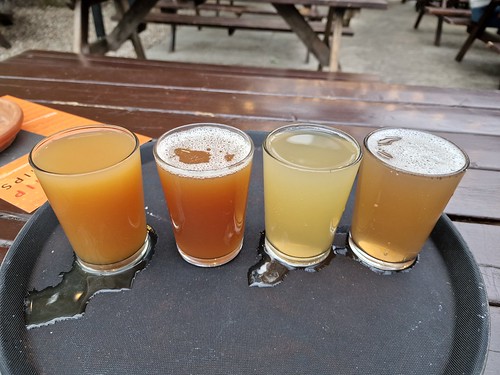
    I managed to try several drinks during the evening, although for anyone interested they can be seen at https://untappd.com/user/julwhite. I’m not sure there was anything I noted as exceptional, but I did enjoy the Peach Melba Sour from Pilot. I’m getting into sours now, although I still think that they’re something of an acquired taste for many drinkers (myself included in the past).

    This is a photo from last year when Bev was trying to talk to the pub’s dog as if she was Doctor Dolittle. This is appropriate as she was here on this visit as well, we had arrived at the Leopard earlier on to have a long gossip about Gordon (it’s OK, he won’t read this) and the camping weekend of last week, before Steve and Rob came to join us later on. It was useful to hear Rob’s perspectives on future 100s, he’s another of those LDWA walkers that I think will just take part every year. I’m not sure that I entirely understand it, but I’m very impressed by it. I’m not entirely sure that Steve and Bev are that tempted into walking 100 miles, but they’re certainly becoming better at these longer distances   🙂

    Anyway, I’ve started writing about the 100 again, which wasn’t my intention here. The Leopard is a decent pub which is one of my favourites in Norwich and I’d say that the service from the staff is perhaps one of the best of any pub in the city. So, all really rather lovely and I look forwards to many more visits (and its closeness to the Artichoke makes it easy to pop to both).

  • LDWA 100 – Norfolk and Suffolk LDWA

    LDWA 100 – Norfolk and Suffolk LDWA

    As I’ve mentioned on at least 72 occasions on this blog, I completed the LDWA 100 a few weeks ago. Which it has been widely and universally acknowledged was very brave. And it has also become apparent that nearly no-one actually thought I’d finish, and it seems a few bets were lost. I like being understated and unpredictable though   🙂

    But, enough about me. There were two walks that I was visiting this weekend, the one along Peddars Way and the North Norfolk Coast path which was being walked by Jayne and Malcolm. There was another in Suffolk being walked by Jane, Simon H, Simon C, Paul, Michael, Hilary, Roger and Yvonne. The first of those two walks I was visiting on both days, the second of the two walks I was visiting on the Sunday.

    Susanna kindly escorted me along to see Jayne and Malcolm, and by chance it was agreed that it best to meet them near to the McDonald’s at Swaffham, which is next to the Peddars Way. Dave Morgan mutters and moans about Peddars Way as a trail, but I ignore that, as if he hasn’t got some mountain to climb he gets temperamental and doesn’t appreciate the beauty of flat fields. Us hardened walkers don’t need mountains, we level-headed Norfolk folks just require one level. Although actually, Liam and I cycled all 49 miles of Peddars Way in one day once, and I complained for most of it, although that’s primarily because 49 miles is a very long way to cycle.

    The end of that bike ride in 2009…..

    Anyway, I digress.

    Susanna and I found a spot to wait along one of the lovelier parts of the Peddars Way, which is namely a section that wasn’t in the bright sun. And Malcolm and Jayne swept by, in far too healthy a state for my liking given they’d already walked nearly 30 miles.

    This is a little further along the Peddars Way, just before Castle Acre. I remember this as Liam likes cycling through this…..

    And there we are, from 11 years ago…… A little trip down memory lane there. I’ve digressed again.

    The route that Jayne and Malcolm took wasn’t entirely dissimilar to this, starting from Peddars Way near Thetford, then going north, popping into Hunstanton to add distance, before walking back along the coast path.

    It was a very hot day, which I think I mentioned on a few occasions….. Malcolm seemed to like the blazing heat, but I think it might have exhausted some walkers as it can sap energy if it’s too hot.

    Here they are walking into one of the little checkpoints organised by the quite incredible Dawn, who was running their support team. This was me done for day one, with thanks to Heather for getting Susanna and myself back to the car, all much appreciated. Although our attempt to find the shoe that had gone flying off Heather’s bag at some point was unsuccessful.

    Here we are in North Norfolk on Sunday morning, with many thanks to Richard for taking me. In the background, looming high about the landscape, is the mountain of Beeston Bump. This mountain strikes fear into the heart of Norfolk walkers, towering above the footpath. And, Jayne and Malcolm decided that they’d summit this. Tough people…..

    I was busy taking photos of the beach and sea, promptly nearly missing Jayne and Malcolm walk by. It’s that kind of care and attention that I can offer to events…..

    The salubrious surroundings of the West Runton car park, listening to the car park attendant shouting at visitors. He scared me and I don’t even have a car…. There’s nothing like the welcome to the North Norfolk coast of an official shouting and gesticulating at a visitor “come back here, don’t you dare park there, come back” because a poor driver had got confused as to the admittedly confusing arrangements there were in place. Anyway, that has little to do with this post.

    Jayne had a deserved little sit down, whilst worrying if I had eaten enough. I’m not sure that’s quite how the marshalling support system works, but I had a lovely custard tart, sixteen cheese straws and eight date balls. Jayne took a croissant to eat at an unstated future point of the walk.

    Whilst moving to the next checkpoint set-up, Richard and I popped to McDonald’s in Cromer en route, which is one that I’ve never visited before. They’ve got one of the worst Covid-19 handling arrangements I’ve seen, involving more touchpoints and corralling customers towards each other than they had before the outbreak. Very bizarre set-up. Anyway, it’s a relatively new McDonald’s and I rarely go to them in the UK (other than twice this weekend), as pubs are usually too tempting. Staff were friendly though and the food was brought out promptly, which was useful as the confusing ordering set-up had put us in danger of missing Jayne and Malcolm in Overstrand.

    More of the coastline, it was a beautiful route which they were walking.

    I think this is Overstrand, and it’s somewhere around the 95 mile mark for our brave entrants. Brian and Kathleen had joined the walk to help, and they’d been assisting overnight, and it was a delight to see them given they’d helped me just a few weeks before. The LDWA has some really lovely people in it.

    And there they are in Southrepps, going past the church which is often used as a checkpoint in the Winter Poppyline challenge event that the Norfolk & Suffolk group hold. That was the end of Jayne and Malcolm’s walk, 100 miles successfully completed in a very good time that I think was just over 32 hours. That is an excellent pace, showing what sort of times are achievement when entrants walk on the flat, something for us to consider when Norfolk & Suffolk group hold the event in 2025 at the AYCE 100.

    The timing of this walk ending was very convenient, as it meant we could then go and see the group that was still walking near Ipswich. Thanks to Richard for his assistance in getting there, his support was much appreciated by the LDWA, and myself.

    This is Sproughton church which is near to Ipswich, a countryside setting which is surprisingly near to a built-up urban area. On this walk, Hayley and Yvonne had dropped out before we could get there, but not before posting some huge distances themselves. Still going were Jane, Roger, Simon, Michael, Hilary and Paul, with Simon C having walked a shorter distance. I had thought that Hayley and Jane were only ever walking 60 miles or so, which is a massive walk in itself. However, Jane was still going. I was impressed.

    It would be impossible not to single out Jane for one of the bravest walks that I’ve seen. Despite being in pain at 90 miles (and indeed before, but that’s when I saw her) she still persisted with the walk. I couldn’t have done that, huge credit to her for achieving that. And of course, the others were doing marvellously as well, with Simon struggling slightly, but that wasn’t a surprise as he had clearly pushed himself to match my time of a few weeks ago.

    I’ve never walked along this stretch of the River Gipping, but it’s quite beautiful and we saw very few other people. It was lovely also to see Chelle and Fred for the last few miles, as unfortunately Chelle’s foot didn’t allow her to take part in the event this year. I heard a rumour that instead she’s walking the 100 twice next year.

    Simon had a wait and a think by the river. He’d sort of agreed to take Jane on nine holidays if she could walk the last nine miles in, so he had a lot to think about, especially if they were camping holidays.

    Richard and I had time to pop into the Sorrel Horse Inn, which was rather pleasant, but I’ll write about that separately as to not to distract myself writing about the appropriate temperature of beer in the middle of a walking post. It was a refreshing stop, as all this walking had worn me out. It was also another opportunity to try and update LDWA social media about the event, something I had been trying to do all weekend. It was a challenge, given just how many walks were taking place and seeing just how many photos were coming in. Thanks to Michael and Dave for their support with this, much appreciated.

    And look at the bravery as Jane battles on. She was at around the 95 mile mark at this point. She’s going to have to win some sort of award.

    The sun was slowly starting to set, it really was a beautiful evening. It was sunny throughout much of the country during the weekend, even in South Wales, where I was told it always rains. And, at that point, I’d like to thank South Wales for their quite wonderful organising of this event. The national pandemic meant they didn’t get to hold the event in 2020 or 2021, a real blow given their years of planning to host the national LDWA 100. Their volunteers have been so warm and helpful, I do hope there’s another event held there in the future. Also, Jeremy and Chris from Norfolk & Suffolk group were walking the planned route in Wales as their LDWA 100 effort, and they got over 60 miles in, another marvellous achievement.

    Something like 96 miles done now and although Jane was struggling, the pace remained steady.

    Jane was surprised and delighted to see a hill, but there were steps up it.

    This isn’t exactly a photo that will win a prize to go on the LDWA membership card next year, but here are Jane and Simon walking in for the final stretch. At this point, I’d say that Jane was looking quite energetic and ready to go. Unfortunately, she still had to walk another 0.5 miles around the garden when we got to the finish point, just to tick the distance off as being over 100 miles. It seems ridiculous to see people walking around a garden, but it’d be soul destroying to walk the event and then find you’d actually only gone 99.8 miles. To the outside world, it’d make little difference perhaps as it’s still such an amazing distance, but to a walker, it really isn’t ideal.

    And in! Roger, Simon, Jane, Hilary, Paul and Michael all completed the walk, so it was a delight for me to see them all come in having finished the LDWA 100. It was nice to see Yvonne as well who was fortunately still in good shape, although I’m not sure yet on her thoughts about walking the event in future. Maybe best to ask in a few weeks.

    And then they were all safely home. I’m not sure that I was much use in the whole arrangement, but I wanted to be present given the help that others had given to me on my 100 walk a few weeks ago. I think it’s also becoming apparent which of us are retiring from walking 100 events and which of us are just going to keep taking part every year.

    As the outgoing chair of Norfolk & Suffolk group (what a marvellous two years it has been for everyone!) I’m incredibly proud of everyone who took part in our area. To Hayley and Yvonne on their 60 mile achievements (or around that, sorry if it was longer!) and to Jayne, Malcolm, Jane, Simon, Roger, Paul, Michael and Hilary for their 100 mile achievements. And, not to forget my 100 achievement of course, as I haven’t mentioned that for a few paragraphs. It was quite emotional to see so many completions locally, and also to hear of how entrants had been getting on around the country. The LDWA community came together, whether it was walking or supporting the walkers. How very lovely.

  • Norwich – The End of Debenhams

    Norwich – The End of Debenhams

    That’s the end of Debenhams in Norwich, they’ve been boarding up (or metalling up, whatever the phrase is) the entrances of this large building all week. It’s not somewhere that I’ve been for years, it has felt old fashioned and under-resourced for a long time.

    This boarding up has meant that the recessed areas where the homeless have been sleeping have been made inaccessible, with the tents just moved to the outside now. I’m not sure that this is entirely ideal.

    It’s a far cry from 1955 when this building was being built, then known as Curls (or Curl Brothers) and replacing a war damaged building. There’s a photo on Photo Norfolk of what the site looked like following the end of the Second World War, with Debenhams now being located where that pool of water is.

    Debenhams purchased Curls in the 1960s, but it continued to trade under its old name until the 1970s. What will happen to the building is anyone’s guess, but I suspect part will be turned into residential flats and there will likely be some coffee shop or the like added to it. The future for large department stores doesn’t look entirely bright, although I suppose this will be useful for nearby Jarrolds who might benefit from the trade.

  • Norwich – Old Library Wood Accident

    Norwich – Old Library Wood Accident

    This is the approach to Old Library Wood in Norwich (where I’ve written about the rather excellent sculptures before) just after I returned from my rather brave camping adventure this weekend. Visible at the rear of the photo is an Openreach van, located there as a Royal Mail van managed to plough into the wood’s wall yesterday and destroy a chunk of it.

    The wall from inside Old Library Wood, a situation I’d suggest isn’t entirely ideal. I hadn’t realised before, but there was a mural at this spot, now nearly entirely demolished. But, no-one was hurt and that’s the main thing.

  • Greater Anglia : Norwich to London Liverpool Street

    Greater Anglia : Norwich to London Liverpool Street

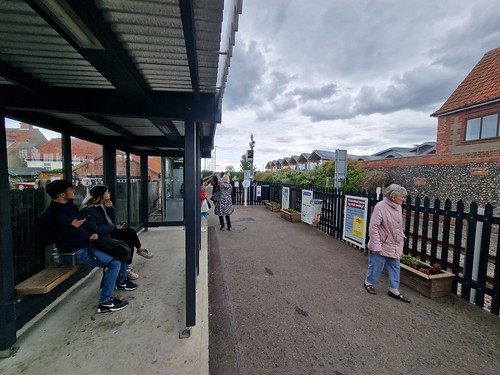
    This is my first rail journey of 2021 and it’s certainly a step-up from the bus travel that I’ve been limited to for the last few months. It wasn’t busy at Norwich railway station with just a few people walking around the concourse, a couple peering into the M&S that has remained closed since March 2020. I still think that should have been a Greggs, but I don’t go on about it…..

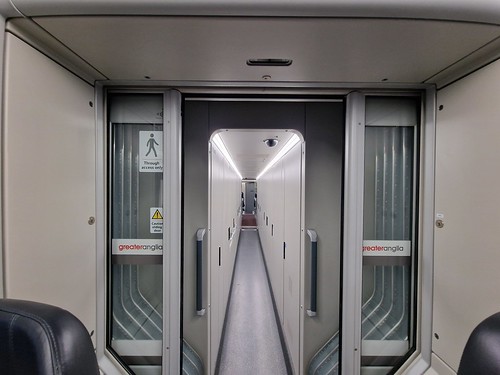
    This is one of the Greater Anglia fleet that has no tables, as passenger surveys have apparently told them that customers don’t like them. I make no comment….. Anyway, the train was clean, shiny and nearly completely empty. Everything on the train was working though, including the power and even all the toilets were functional. How lovely.

    One of the slight problems with the rail journey into London is that it stopped at Witham, one of the few towns in Essex that I haven’t visited. I looked at TripAdvisor to see the top four rated attractions in the town and they are (i) a walk by the river, (ii) the library, (iii) the statue of Dorothy L Sayers and (iv) the town hall information centre. Given that, and with respect to the denizens of the town, I might wait just a little longer before making a proper visit.

    Anyway, there were plenty of Greater Anglia staff to guide customers onto the buses which would take us to Newbury Park. I’m not sure where Greater Anglia had found these staff, but they were particularly friendly and engaging, all a really organised effort.

    I try not to complain about things, but on my bus travels in recent years I’ve discovered that just about every vehicle has no more than four seats across. This is because there is only space for four seats and an aisle between them. But, no, this bus company has decided that more is better and have crammed in five seats across. I accept that if all the passengers were five years old, then this would be a perfectly sensible transportation move. But, the rail passengers were all above 18, which presented me with an interesting time watching them try to fit into the space provided, which was made more exciting as the bus company have given customers no real amount of leg room either. One man looked positively annoyed. I’d add that wasn’t me.

    I moved to the back of the bus to get some space, and I’m pleased to say that unlike the Inbetweeners, I wasn’t moved off those seats by anyone. The fortunate thing is that social distancing means that customers are kept apart, so there were only about 12 of us on the vehicle. About 105 seats, but only 12 people sitting on them.

    The rail replacement bus arrived into Newbury Park, where we were politely told to get on the Central Line into London. I asked the gateline staff if I was allowed to continue travelling down the Central Line to Oxford Circus, or whether I needed to get off at London Liverpool Street. To cut a long story short, he told me that I should really get off at London Liverpool Street, but that wasn’t what he recommended I should do. He suggested winging it with the gateline staff at Oxford Circus as that would be much quicker. He mentioned though that this was all at my own risk. Indeed, he mentioned that three times.

    I worry if I don’t have the right ticket, so I decided not to spend an hour worrying and I got off at London Liverpool Street. That also meant I didn’t have to try and enter into protracted negotiations with the gateline staff at Oxford Circus, which didn’t sound an exciting game to play. I had to faff about finding a member of gateline staff to let me out of London Liverpool underground station, and he looked slightly annoyed to watch me then go back through from where I had come from around thirty seconds later. But, my journey was now fully compliant with railway rules and I didn’t have to fear any TFL ticket inspectors. And more excitingly, I was back in London after way too many months.

  • Hopton – St. Margaret’s Church

    Hopton – St. Margaret’s Church

    This is the ruined church of St. Margaret’s in Norfolk, although until 1974 this was actually in Suffolk (they moved the county boundaries, not the church). What remains of the structure is primarily from the fourteenth century, but there was an earlier church on this site, from somewhere around 1050 and there’s some documentary evidence that there might have been a wooden Saxon church here as well.

    The church was lost in 1865, following a devastating fire. Smoke was spotted coming from the church shortly after the congregation had left from their service, but the fire took hold quickly and there was little that they could do to save it. The thatched roof was ablaze and was chucking lumps of hot thatch on those below (which wasn’t ideal), although huge attempts were made to save the organ from within the building. The organ had been presented to the church by Mrs Orde of Hopton Hall, but it was soon realised that they couldn’t fit it through the porch and so efforts were abandoned quickly.

    The local press noted that:

    “The fire originated either from the overheating of the stove, the funnel of which led through the roof, or from a spark lighting on the roof from the pipe, and igniting the thatch”.

    Following the fire, it was decided not to repair the structure, but to instead build a replacement church nearby with the £500 insurance money. The decision to move the church was to ensure that it was located nearer to the centre of population that had built up, although it seemed a shame to abandon a site that had remained in religious usage for over a millennium.

    It is only recently that the site has been tidied up and made secure so that people can visit and walking inside the surviving structure. They’ve done a really good job here, they’ve added benches, information boards and give the whole site a peaceful feel rather than the huge “keep out” signs and fences that were here for decades. George Plunkett has a photo of the site from 1998.

    Inside the church, looking towards the tower.

    Inside the church, looking towards the altar and chancel.

    The remain of the porch. During the restoration work on the church the archaeologists found 29 pieces of medieval floor tile, 2 fragments of roof tile, an early brick fragment and a Caen limestone sundial fragment.

    A blocked doorway in the base of the tower.

    The tower section is still closed off, but it’s still in surprisingly decent condition given what its gone through. The tower is likely a little later than the rest of the church, dating from the early fifteenth century.

    Although the destruction of old buildings is unfortunate, it has though allowed the history of the church to show through in other ways. The location of old niches, stoops and piscinas has become more evident, although most of the memorials and tablets were destroyed during the fire.

    The remains of an old window at the chancel end of the church.

    The base of what I assume were the rood stairs, although there appears to have been minimal other separation between the nave and the chancel.

    A rather beautiful plaque, which reads:

    “Be still, for this is sacred ground,

    A place to stand and pause. Reflect

    Upon the pathway here

    The lesson learned, the gifts received

    Be still, and listen to God’s voice

    That sings a song of unity,

    Blessing the journey still to come

    With love and deep humility”

  • Weston Longville – All Saints Church

    Weston Longville – All Saints Church

    It started to pour with rain when Richard and I arrived at All Saints church in Weston Longville, which was unfortunately locked and even the porch wasn’t accessible. Perhaps it was just the rain, but it all felt a little stark and unwelcoming. Hopefully I will be able to visit the interior of this Grade I listed church in the future, as there are medieval wall paintings, a painted screen and a memorial to Parson Woodforde.

    The tower is the oldest part of the church, dating from the thirteenth century. It once had a steeple as well, but it fell off in 1602, which I can imagine annoyed the locals.

    The nave and the chancel are from the fourteenth century, when the previous structure was substantially rebuilt, but it’s likely that there was a church on this site during the late Saxon period.

    The church is perhaps best known for Parson James Woodforde, who was rector here between 1776 and 1803 and wrote numerous diaries which are a snapshot of rural England in the late eighteenth century.

    The fifteenth century porch, with the shield above the empty niche being that of the Company of French Merchant Adventurers.

    The porch was modernised in the 1970s and this plan is in the Church of England archives.

    The priest’s door.

    The window at the end of the aisle was blocked up before 1718, which is the date of the memorial tablet on the other side of the wall.

    This stone on the exterior of the porch is in a poor state of repair and I can’t imagine that it’ll last for that much longer. It’s a shame that it can’t somehow be preserved.

    This illustration is by Robert Ladbrooke and is from the middle of the nineteenth century, with the now damaged stone visible on the exterior of the porch.

    The extensive graveyard is neat and tidy, with some efforts being made to support those stones which it’s fair to say aren’t all exactly standing upright.

    The sun started to shine through the rain just as we were leaving. George Plunkett took a photo of the church in 1939, but not much has really changed in the intervening period.