Category: Norfolk

  • 200 Years Ago in Norwich : The Vital Spark had Fled

    200 Years Ago in Norwich : The Vital Spark had Fled

    This newspaper article was in the Norwich Mercury 200 years ago this week, reporting that Mr Snasdell had died from drowning. Not only do I like the word se’nnight, meaning a seven day period, but I particularly like the “the vital spark had fled” to describe his death.
    The individual was Thomas Snasdell and he was buried in Mundesley on 7 August 1826, although he lived in Norwich. He had been born in 1782 and although not mentioned in the article, he married Ann Clarke on 6 September 1824. I will have to work out how to put the phrase “the vital spark had fled” into this blog somehow, it’s a phrase that I feel needs to return.

  • 200 Years Ago in Norwich : Lewd Woman

    200 Years Ago in Norwich : Lewd Woman

    This article appeared in the Norwich Mercury 200 years ago this week and relates to the court cases that had been heard in Walsingham. I can’t find out anything about Rose Crask, she doesn’t appear in any records that I can find.

    As for the details of this case, this was a period of different moral values, although the court cases at the time show that breaches were not uncommon. At the time a woman described or charged as a “lewd woman” was usually being treated as sexually immoral, disorderly or involved in prostitution, although it can relate to any of them.

    The label might be applied to a woman found soliciting, keeping company with known prostitutes or criminals, living outside accepted domestic arrangements, behaving indecently in public or repeatedly coming to the attention of parish officers and magistrates. It was a broad and highly moralistic description, reflecting a period when poor and unmarried women were closely policed and could be punished as much for their reputation and way of life as for any clearly identified criminal act. Indeed women in general at this time could be invisible, which has transpired to be the case for finding out anything more about Rose.

  • 200 Years Ago in Norwich : The Wells-next-the-Sea to Fakenham Turnpike Road

    200 Years Ago in Norwich : The Wells-next-the-Sea to Fakenham Turnpike Road

    This notice was posted in the Norwich Mercury 200 years ago this week and it relates to the newly established turnpike road between Wells-next-the-Sea and Fakenham. This notice relates to a regular meeting of the trust, but the turnpike was new having been created by an Act of Parliament earlier in 1826, and this belonged to the final generation of turnpike trusts established in England. The period often described as ‘turnpike mania’ had largely taken place between the 1750s and the 1770s, while the last completely new English turnpike trusts would be authorised in the 1830s. In other words, Wells was something of a latecomer to a transport revolution that had already transformed much of the country, which perhaps seems fitting for this quieter corner of Norfolk.

    The trust was more complicated than its name suggests. Rather than simply improving a single road between Wells and Fakenham, it administered a small network of connected highways. There were two principal routes from Fakenham to Wells, the western road passing through Egmere and the eastern route through Little Walsingham. A further branch ran from Walsingham through Great Snoring to Langor Bridge, where it joined the existing Norwich to Fakenham Turnpike. Early mapping also shows a branch westwards from Fakenham towards Hillington via Sculthorpe, although this appears never to have become an important part of the trust and later largely disappeared from its records. I’ve resisted vanishing completely down this rabbit hole, although I suspect there’s an entire series of blog posts waiting to be written about the trust.

    Like every turnpike trust, its powers came from Parliament. The trustees could levy tolls, improve existing highways, acquire land where necessary and borrow money against future toll income. Unlike parish-maintained roads, which depended upon local labour obligations that varied enormously in quality, turnpikes introduced a more centralised and professional system of highway management. The trustees themselves were unpaid local gentlemen, merchants and landowners, but they appointed paid officers including surveyors, clerks and treasurers to administer the roads.

    One particularly fascinating aspect of the Wells trust is that its minute books survive from the very first meeting. These reveal that deciding where to place tollgates proved surprisingly contentious. Bryant’s 1826 map shows the initial gates at Wells, Warham, Kettlestone and on the Sculthorpe road approaching Fakenham, broadly reflecting the trustees’ original decisions. However, almost as soon as toll collection began in the spring of 1827, travellers demonstrated an impressive enthusiasm for avoiding payment and that was considered most sub-optimal. By July the trustees were recording “very frequent evasions” and they were busy ordering additional gates across side roads to block alternative routes around the toll bars. Human ingenuity, it would appear, has always been remarkably effective when faced with paying road charges and judging by the repeated attempts to stop people avoiding the tolls, the trustees probably spent rather more time discussing human inventiveness than road engineering.

    The arrival of the railways gradually undermined the economic justification for many turnpike trusts across Britain, and Wells was no exception. As traffic patterns changed during the second half of the nineteenth century, the toll system became increasingly difficult to justify. The Wells to Fakenham Turnpike Trust was finally wound up in 1881, ending fifty-five years of independent management. Responsibility for the roads returned to public authorities, while the tollgates disappeared into history.

    Today, the milestones remain the easiest evidence that the trust ever existed and I wouldn’t at all be surprised if I decide that I need a friend to drive me to them to have a look. But they tell only a small part of the story. Behind them lay decades of meetings, arguments over gate locations, complaints about toll evasion, financial management and continual maintenance of roads that were vital to the economy of north west Norfolk. I’m fairly sure that these meetings would have been quite vibrant, but a bit of drama is good for the soul.

    As an aside, I won’t say any more about the Fleece Inn in Wells, where the turnpike meeting was held, as it was one of the ten pubs that Roy, Jen and I visited a couple of weeks ago and those posts remain in the increasingly well-populated unwritten post blog queue.

  • Norwich – Bar Billiards (Game 6 – Artichoke Hearts vs International Brigade)

    Norwich – Bar Billiards (Game 6 – Artichoke Hearts vs International Brigade)

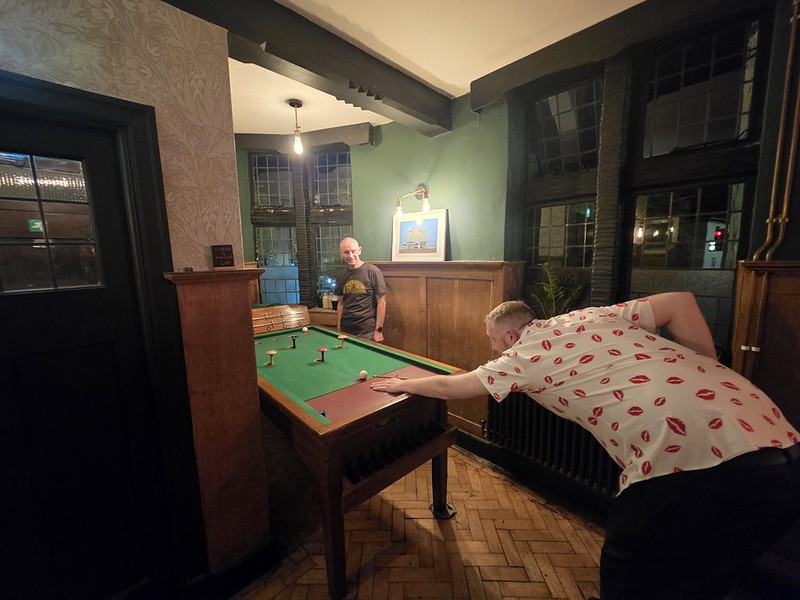
    After a little break in proceedings, and I would like the pun there to be properly acknowledged, it was time for another league match and we were playing the International Brigade in the sauna area of the King’s Head. We had a new strategy that we were deploying, namely Ivan, to beat them thoroughly in practice so that their confidence was damaged. Our advanced sporting psychology is what will set us apart from the other teams in the league, although the results so far have been reluctant to support that theory.

    The teams had arrived, so it was time to think about doing the draw.

    Somehow we managed to have PJ kicking off proceedings for us again, this seems to be a regular thing.

    And off we go!

    Cool, calm and confident. Anyway, we lost that game.

    I was up second so thought I’d better get a quick pint to ensure that I was at peak performance levels in the sauna area.

    It was a close second game and I decided to do a very brave 200 shot in the middle of the game as I kept sitting just a bit behind. I saw Luke’s face of horror and that wasn’t quite the look of encouragement I had wanted. But my thunderbolt shot worked so I surprised and delighted myself, before reminding myself I would now just settle for 10s. It remained close though, going down to the final ball which I’m pleased to note I got in, but the peg wobbled just a little more than I would have liked.

    Ivan, our new head coach, came over with marshmallows that we could allocate to all the players fairly. I ate most of them if I’m being honest, but leadership sometimes requires difficult resource decisions. Ivan was also the referee for two games and he was entirely competent, not smashing up the table like he did last time he was referreeing.

    Here’s me waiting to referee whilst hoping the marshmallows didn’t melt in the extreme heat. I queried with Oli that perhaps, as a team captain, she could have made a contribution towards getting air conditioning in the King’s Head, especially as she’s one of the top four staff members that they have. She shouted back in a jovial manner that she didn’t feel obliged to pay for air conditioning. This was disappointing, although at least the pub’s climate policy is now clear.

    Luke found himself 900 down after the first shot, which is a sub-optimal place to be.

    It was Luke’s birthday this week (the same night as Julian hit 70, although Luke didn’t fall over) and so we celebrated with cake and strawberries. We had assumed that John would arrange to throw some of the games to allow Luke to have an enjoyable birthday, but he didn’t. Luke and I didn’t say anything of course about this lack of sporting behaviour.

    Let’s just say that we were 5-1 down after the singles, so we had lost the match. I had a little sit down outside for the fourth time to cool down and reflect on whether we just didn’t have enough chalk. There is always a technical explanation available……

    Back to the doubles, and Vaughan and I were successful in a very good game, so I was hopeful of turning this round to be a loss of just 5-4.

    We lost 7-2, but look at those scores, but Luke put up a valiant performance against big shot Marcel, with Kirsty and Terri getting closer than their score looks. But losing 7-2 is not that bad in such hostile weather and I was saddened not to be able to take Ivan up on his offer of a game, but I had to rush to the Weaver’s to check that Julian didn’t have another fall. I’ve very much realised that bar billiards captaincy does sometimes involve wider pastoral responsibilities.

    But, the main thing about all of this is having fun and it was a very enjoyable evening and the International Brigade are a lovely team. No game next week, but then we have two in a row after that in the Artichoke, so what could possibly go wrong?

    And, in other news, we have our next cup game confirmed, which is against the Lionhearts. Nathan, their captain, and I would never comment on this ourselves as we’re very modest and entirely free from competitive vanity, but it is hard to deny the evidence that this will be a game featuring the two best captains in the league. Between us, we have certainly had enough experience of challenging bar billiards encounters so this is a proper battle of the titans and I know there’s a chance of it being a major motion picture on YouTube. And, I might have mentioned, I’ve beaten Dave Brewer so I’m ready to take on Oscar as I have a score to settle. But, it’s just a game obviously, although I’m hoping Nathan is bringing his worst players.

  • Sheringham – Sheringham Bus Shelter Debacle

    Sheringham – Sheringham Bus Shelter Debacle

    This is what I consider to be one of the more ridiculous local Government debacles to have taken place in North Norfolk, and it has not exactly enhanced the reputation for competence of some of the politicians involved. This is the old bus shelter that a fair number of residents wanted to keep, which is an entirely reasonable position to take. It is, after all, a bus shelter rather than a nuclear facility, although the administrative response has occasionally suggested otherwise.

    Norfolk County Council was going to demolish it with the support of Sheringham Town Council, then Sheringham Town Council decided they wanted to keep it. But now, Sheringham Town Council have decided that they don’t want to keep it and Norfolk County Council are going to demolish it next week. So after all that expense, unnecessary meetings and damaging public confidence, Sheringham Town Council has ended up at the decision they made initially.

    The whole matter could have been resolved rather more sensibly by extending the pavement into the road and changing how cars move through Sheringham. There are far too many vehicles using the main street, and reducing that traffic would not be especially difficult without removing access for those who genuinely need it. Instead, there appears to have been a deep institutional attachment to preserving a wide carriageway and a narrow pavement, as though the primary purpose of a town centre is to ensure that cars remain emotionally comfortable.

    So there will now be a new bus shelter, which is at least better than the nonsensical and exposed arrangement they constructed in Cromer, and this one will be demolished all at a huge expense. Perhaps Count Binface might be available to unveil the replacement.

  • Cromer – Cromer Museum (Catherine Buxton – Views Along Cromer Cliffs and Beach)

    Cromer – Cromer Museum (Catherine Buxton – Views Along Cromer Cliffs and Beach)

    This watercolour is Views Along Cromer Cliffs and Beach by Catherine Buxton, painted in around 1860, and the artist was the daughter of Catherine Gurney (1814-1911) and Sir Edward North Buxton (1812-1858). This meant that she was brought up in the wealthy and very well-connected Quaker family, so she would have had access to education, travel and money.

    The painting shows the coastline looking down towards Cromer, with the church tower rising above the town and the jetty built in 1845 stretching out into the sea. It also shows a Cromer that has expanded slightly, but the rapid growth wasn’t until after 1877 when the railways reached the town. This was from a time when the town wasn’t burdened by hotels and people trying to eat fish and chips in a strong wind. It was also before Greggs reached Cromer, which makes the whole scene look calm, elegant and faintly deprived.

    But what I found the most interesting is that in the foreground is the ruined tower of the old lighthouse, built in the early eighteenth century and already looking as though the cliff had begun making firm plans for its removal. The lighthouse finally disappeared over the cliff in 1866, only a few years after this painting was completed, with Trinity House having more information about the structure.

  • Cromer – Cromer Museum (Kola Champagne Bottle)

    Cromer – Cromer Museum (Kola Champagne Bottle)

    This bottle of Kola Champagne was one of the smaller exhibits at Cromer Museum, but it immediately caught my attention because “Kola Champagne” sounds like the sort of drink invented by someone who had access to both sugar and optimism. It’s a bit like Greene King saying that they’ve made a craft beer, the words are all technically present but I’d suggest a degree of caution.

    The label describes it as “a tonic and restorative drink”, as well as “refreshing and pleasing”, which is quite a lot of responsibility to place on one bottle and I have a sense that it might have been a disappointment. Despite the name, it was not champagne and almost certainly had no meaningful connection with France and it would fall foul of labelling laws today.

    The “kola” element would have referred to kola nut flavouring or extract, an ingredient associated with stimulant and tonic drinks long before cola became dominated by international brands and advertisements involving improbably happy people near swimming pools. It’s one of those bottles which has an internal closure arrangement at the neck, possibly with a little glass ball.

    The local link is that this was sold by W. Everett of Bond Street in Cromer and they produced a range of soft drinks for supply locally. What I didn’t realise before writing this is that there is a drink still produced in the UK which has the same taste, namely KA Karibbean Kola, with Champagne Cola still being a thing in parts of Latin America. I wonder if I’d be restored after drinking one…..

  • Cromer – Cromer Museum

    Cromer – Cromer Museum

    I had a little time to spare in Cromer and so I went to the museum, which I’m not sure that I’ve visited before. There’s usually an admission charge of £5.30 for adults and £4.80 for children, but I had my national Art Pass card so I got in free. There was a friendly welcome from the staff member at the entrance who explained what there was to see at the site and didn’t seem alarmed by the prospect of me photographing most of it.

    Cromer Museum is housed in a group of former fishermen’s cottages beside the parish church, so behind the modern frontage there’s an authentic yard. Inside, the rooms have been used to recreate aspects of life in a Victorian fisherman’s home, while the wider displays explore the history of the town, its fishing industry, its development as a seaside resort, the constant local difficulty of preventing parts of Cromer from entering the North Sea without permission and a mammoth. It is important not to forget the mammoth, as museums rarely improve by having fewer mammoths.

    There’s a new room that has opened up this year and I feel that this might need some rethinking. It did though at least have the only cooling that I found in the entire museum, that fan in the corner which was struggling to be effective and more of a symbolic struggle against the reality that it was too hot in Cromer.

    And it certainly is in the shadow of the town’s church.

    There will now be a flurry of posts about the museum until I either run out of photographs or become distracted by another old building or a cheap Wizz Air flight. The museum is a rather lovely little place with a genuine sense of authenticity, although the displays felt slightly erratic in places, but there is a great deal of local history to cover and not much space in which to cover it, so some compression is inevitable. The welcome was friendly and the staff seemed genuinely keen to engage with visitors and explain the history, which always makes a small museum feel more alive.

    I can’t help thinking that the admission charges are at the top of what is reasonable though, as it would cost a family over £20 to get in here. As someone who tends to spend far longer in a museum reading everything than is necessary (although not as much as my friend Susanna who it’s hard to prise out of the museum and staff normally end up turning off the lights around her) I would have been hard pushed to spend more than forty minutes here. But, it was a handy use of my Art Pass and, as I mentioned in my last post, it will allow me to surprise and delight my two loyal blog readers for a little while yet.

  • Cromer – Cromer Museum (1845 Painting of West Cliff and the Beach)

    Cromer – Cromer Museum (1845 Painting of West Cliff and the Beach)

    This watercolour on display at Cromer Museum is titled West Cliff and the Beach and was painted by an unknown artist in 1845. It shows Cromer before the cliff was properly defended, when the town’s approach to coastal erosion appears to have involved driving wooden piles into the sand and hoping the North Sea would respect local initiative so that they didn’t have the sub-optimal situation of all the buildings falling into the sea. Actually, more on that in another post about Shipden, the lost village near Cromer.

    The wooden posts were intended to slow the sea and prevent the cliff from being steadily eaten away, but they were not a particularly effective long-term solution. The year after this painting was completed, Cromer’s first effective sea wall was built, together with a narrow promenade. This was a significant improvement on the previous arrangement of timber and optimism which really wasn’t very sustainable as the North Sea has never really especially good at respecting boundaries.

    It’s another rather charming look at old Cromer, those buildings were later replaced by hotels and lodging houses as the town became connected to the railways and the tourists flooded in. I quite like the slightly precarious nature of this scene, with the large property above looking entirely self-assured despite the fact that the geology beneath it appears to have had reservations.

  • Cromer – Cromer Museum (Caroline Gray – East Beach)

    Cromer – Cromer Museum (Caroline Gray – East Beach)

    This one visit to Cromer Museum has helpfully produced enough material to sustain the blog for a couple of days. Museums are useful like that, they organise all the exhibits and history and I merely have to stand nearby taking photographs before later presenting the whole arrangement as organised cultural research. All rather lovely.

    Anyway, this is a watercolour of East Beach by Caroline Gray, painted in 1829, and it shows Cromer’s shoreline with the town rising behind it. The church tower is immediately recognisable and the jetty built between 1822 and 1823 is visible. This was Cromer before all the tourists came for the day to eat their fish and chips before meandering along the pier and commenting negatively on the parking charges.

    The back of the painting carries the inscription: “‘Twas here my careless Childhood stray’d, a stranger yet to pain”, although the museum notes that it’s not clear whether the artist wrote those words, but it’s a nice little addition. But it shows Cromer from another age and I rather like that.