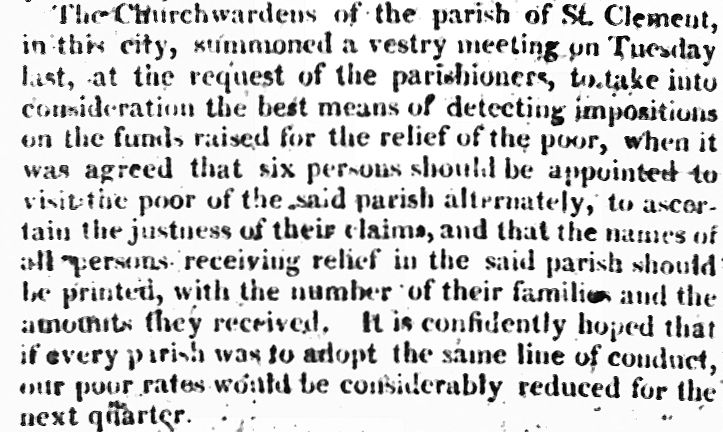
“The Churchwardens of the parish of St. Clement, in this city, summoned a vestry meeting on Tuesday last, at the request of the parishioners, to take into consideration the best means of detecting impositions on the funds raised for the relief of the poor, when it was agreed that six persons should be appointed to visit the poor of the said parish alternately, to ascertain the justness of their claims, and that the names of all persons receiving relief in the said parish should be printed, with the number of their families and the amounts they received. It is confidently hoped that if every parish was to adopt the same line of conduct, our poor rates would be considerably reduced for the next quarter.”
This short report appeared in the Norwich Mercury in September 1826 and describes what we might now call an attempt to investigate benefit fraud. Parishioners in St Clement had asked for a vestry meeting to consider possible “impositions” upon the money raised for poor relief. It was agreed that six people would take turns visiting recipients to assess whether their claims were justified. This was effectively a small team of local investigators, although without computers, central records or the opportunity to spend several months designing an official logo. But they had a mission to ensure that no-one was defrauding them.
The parish also proposed printing the names of everyone receiving relief, together with the size of their family and the amount they received. The methods would perhaps present certain difficulties under modern ideas about privacy and dignity, but the underlying combination of eligibility checks, home visits and a desire to reduce welfare expenditure feels remarkably familiar two centuries later.
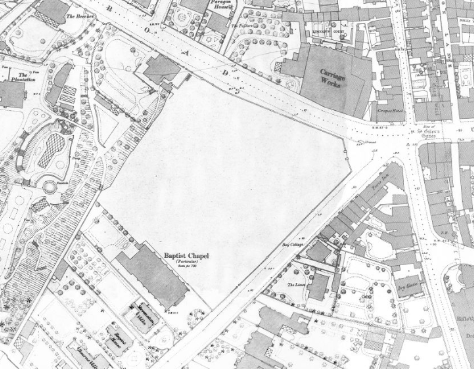
This map shows the empty site in 1884, shortly after Norwich City Gaol was demolished. The land on what is now Earlham Road is today occupied by the city’s Roman Catholic cathedral, but 200 years ago this month the newly completed gaol was at the centre of a substantial argument reported by the Norwich Mercury. The dispute concerned alleged departures from the building contract, work that had apparently not been completed and thousands of pounds in additional charges.
The article reads:
“At the adjourned Sessions, on Wednesday last, Alderman Crisp Brown, we are given from authority to understand, spoke nearly as follows:—He said he had a painful task to perform; but as justice had been denied him in another place, he was obliged to bring it before the Court. Many tradesmen in the city had informed him there was something very improper going forward at the new gaol, with respect to deviations from the contract. He had at various times recommended that a surveyor of eminence, and a stranger, should be employed to survey the works and report to the committee—but this was always strongly opposed by the chairman. In the month of June last he (Alderman Brown) sent for Mr. Richard Brown, the real architect, who formed the plan for our new gaol, and he was accompanied by Mr. Thos. Bird, a surveyor.
They pointed out great deviations, examined the bill of extras, amounting to 2300l. and discovered many things charged as extras which were positively included in the contract: amongst them were twelve iron doors, charged 72l. The iron frames to the cell windows, which by the contract were to have the outer rims and horizontal bars made of hammered iron, were all cast in one piece, which enabled the contractors to execute them at little more than half the expence, and yet not a shilling was deducted. The locking stones to the cell doors, 14 inches long, 14 inches wide, and 9 inches thick, were all left out and no deductions made, &c. &c. &c. He had these gentlemen in attendance upon the spot, with the plans and specifications in their hands, and ready to point out the various deviations, and he begged they might be admitted into the committee-room—but this request was refused. Subsequently he (Ald. Brown) gave a copy of Brown and Bird’s remarks upon the extra charges, & an order was entered in the book that enquiry should be made as to their correctness.—A most extraordinary plan however was pursued. They were sent to Messrs. Mears and Blyth, the contractors, to answer the observations—but they refused to give any answer, although the charges were heavy against them; nor could he (Mr. B.) get any answer whatever from the chairman. There was another glaring imposition, in the deductions for work not executed, with respect to 24 sets of iron louvre blinds to prison wings, and 8 iron doors, 54l. The doors amounted to 48l. leaving only 6l. for the louvre blinds, which the contractors themselves had estimated, when they made the contract, at 64l. 8s. making a difference of 58l. 8s. There were other extraordinary charges, such as 441l. for extra locks, and 284l. for extra brick-work. He had frequently requested to be informed where this extra brick-work was to be found, but could never obtain an answer.
All he wanted was that equal justice should be done to the contractors and to those who were to raise the money. But how was he treated? Why instead of going into the enquiry to ascertain the correctness of the charges, or receiving answers as promised him, the chairman told him (Ald. Brown) that the charges are not correct, and used very unbecoming language, with the evident design of deterring him from pursuing the enquiry. He therefore was compelled to stand up now in Court, in defence of his own character and in defence of his fellow citizens, who were called upon to raise 15,000l. this quarter for the maintenance of the poor, and therefore great care should be taken that they did not pay more for the new gaol than the contractors were entitled to.
The gaol was now finished, and besides the 2300l. for extras already claimed, there were more coming forward to the amount of about 2000l. He should therefore strongly recommend that they follow the example of the justices in the county, who had the whole work of the castle surveyed by a stranger; and therefore he moved that a surveyor of eminence, and a stranger, be employed to survey the new gaol. This was seconded by Alderman Bolingbroke; but in consequence of several magistrates having left the court to attend a committee, the debate was adjourned.”
I’m quite amused by the “he had frequently requested to be informed where this extra brick-work was to be found, but could ever obtain an answer”, which sums up the whole sorry story.
The contractors were playing fast and loose, but just as things were getting excited a number of magistrates left to attend another committee, so the debate was adjourned. Even £4,300 in disputed building charges was apparently no match for the gravitational pull of another meeting, but perhaps they had better snacks at that one. It’s a sign that public contracts have long since proved challenging to keep under control and I do wonder whether they found the missing brickwork.
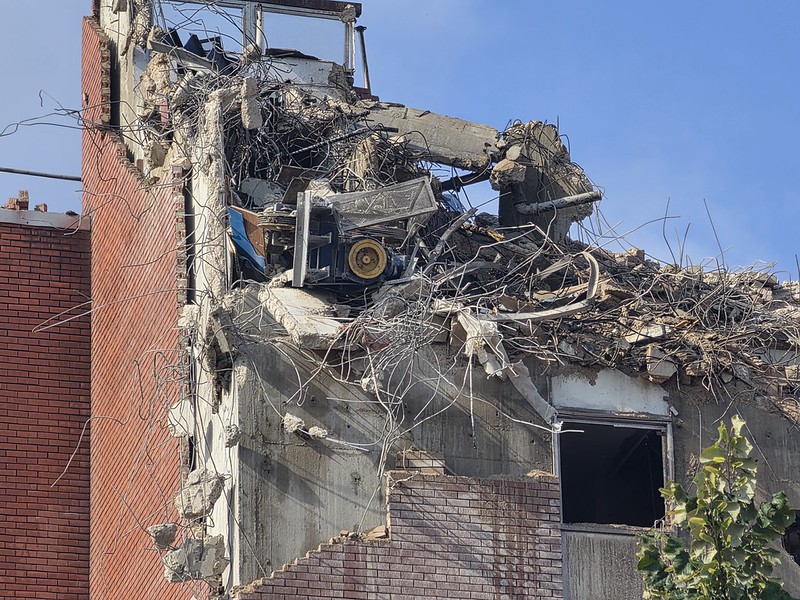
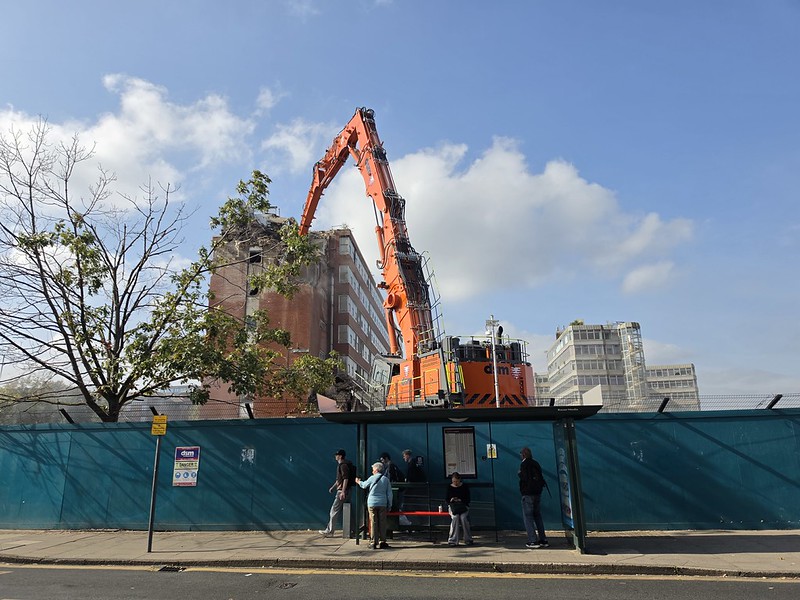
I haven’t posted much about the Anglia Square demolition recently as not much has happened. However, as I was walking by today there was finally some more action. And here are some photos of all the excitement.
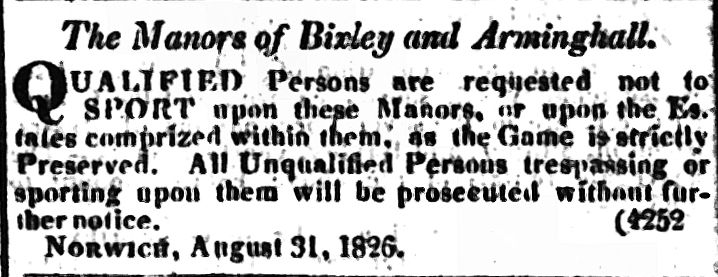
This notice appeared in the Norwich Mercury in September 1826 and relates to the manors of Bixley and Arminghall, immediately south of Norwich. It announced that game on the two estates was being strictly preserved and warned people against hunting or shooting there. In the language of the period, “sporting” meant pursuing animals such as hares, pheasants and partridges rather than participating in an especially vigorous game of bar billiards.
What makes the notice more interesting is the distinction it draws between “qualified” and “unqualified” people. Under the Game Laws then in force, the right to kill game was largely restricted to men with substantial property interests, certain long-term leaseholders and the eldest sons of esquires or men of higher social rank. Merely possessing a gun and finding a conveniently positioned pheasant was therefore insufficient in the eyes of the wealthy.
Those legally qualified to shoot were politely “requested” to stay away from the estates, while unqualified people were warned that they would be prosecuted without further notice. Being qualified did not give anyone the right to enter another person’s land, but the difference in tone is revealing. Wealthy sportsmen received a courteous announcement, while everyone else was informed that the authorities would be dealing with them and prosecution was likely.
The property qualification was abolished by the Game Act 1831, just five years after this notice appeared, although shooting still required the appropriate permission and certificate. It is a small snapshot of a different time, when hunting rights were determined by wealth, property and the apparently vital matter of whether someone’s father was sufficiently grand. You don’t get that in bar billiards.
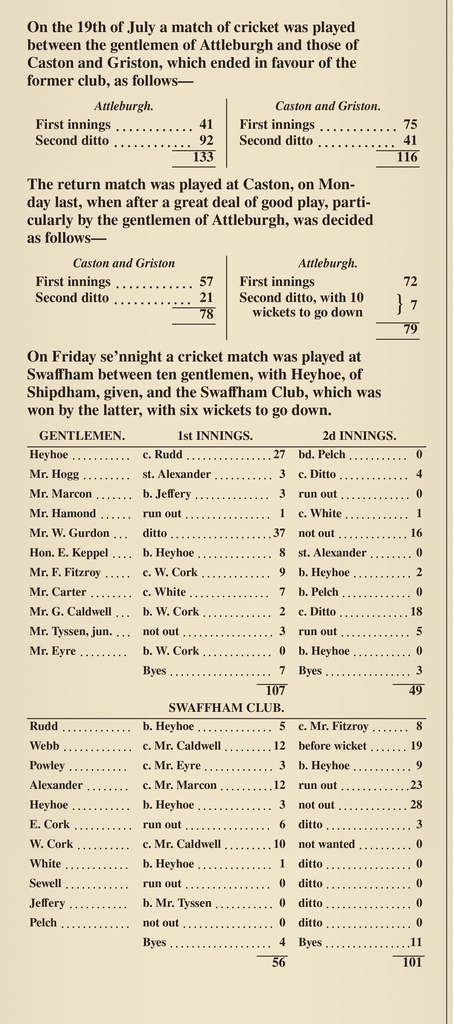
This isn’t revolutionary stuff, but it is some of the earliest reporting of cricket scores that I’ve encountered, appearing in the Norwich Mercury in September 1826. Three separate matches are reported, including two between Attleburgh and a combined Caston and Griston side, followed by ten gentlemen, joined by Heyhoe of Shipdham, playing against Swaffham Club. I’m not a cricket expert, but the totals seem rather low by modern standards. Perhaps the quality of the bowling was exceptionally high in early nineteenth century Norfolk.
The newspaper uses the historical spelling Attleburgh, although the town is now generally known as Attleborough. The former has always made more sense to me, as that is how it is pronounced. The Swaffham game was likely played at the Racecourse Ground, which has some importance in the history of Norfolk cricket, with a tradition of the game being played in the town as early as 1700. Matches were recorded at the Racecourse Ground from 1797, while Norfolk teams played there between 1844 and 1850. Wikipedia notes that the location has now been lost, although I suspect it could be identified using older maps. That is a rabbit hole I won’t enter today, but I don’t think it would be a particularly deep one.
I now rather fear that historic cricket scores will start accumulating on this blog, as though it doesn’t already contain enough random piffle.
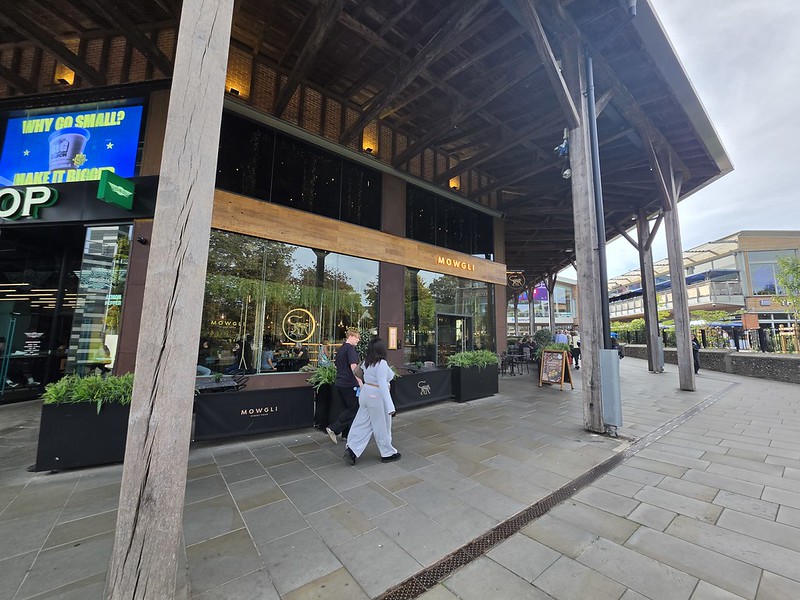
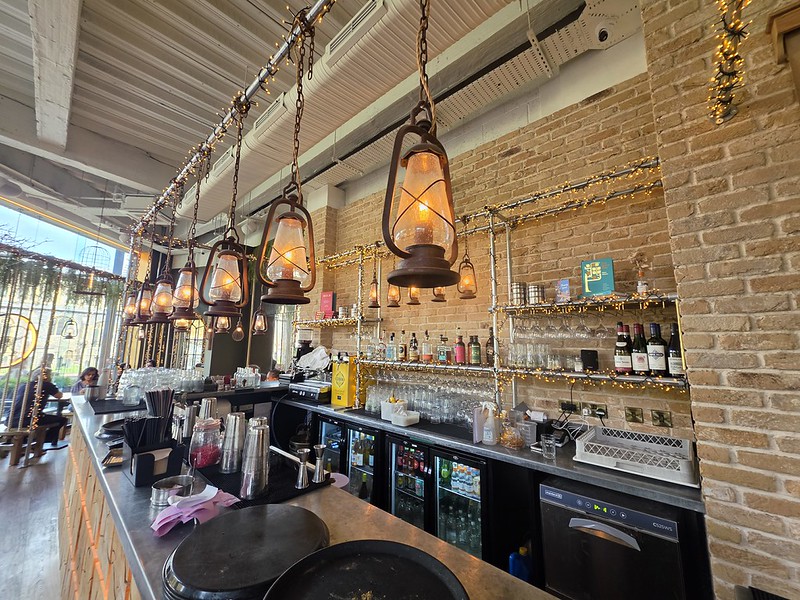
Moving away from the Balkans for a few posts, I’ve been trying to find someone to take me to Mowgli for a while. After discovering the half-price curry offer running on Mondays this month, I was able to convince my friend James to come along for one of our executive lunches. It’s good practice in advance of the 2027 Norwich market expedition and also a precursor to my new monthly Indian meal which I’m pleased to see has a decent-sized group going this week.
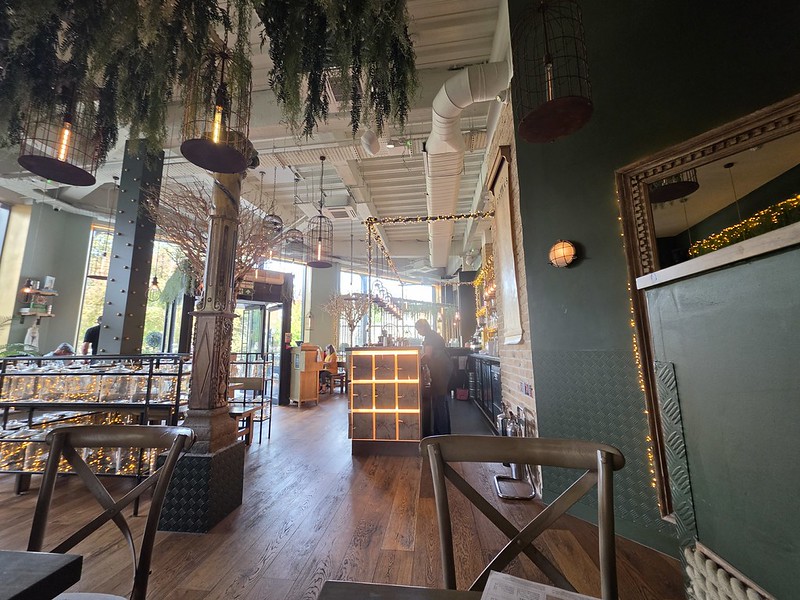
It has a smart, contemporary interior and reminded me of the Dishoom chain, which frequently surprises and delights me.
It was clean and comfortable, but the tables are perhaps a little too close to each other which does take away from the ambience a little.
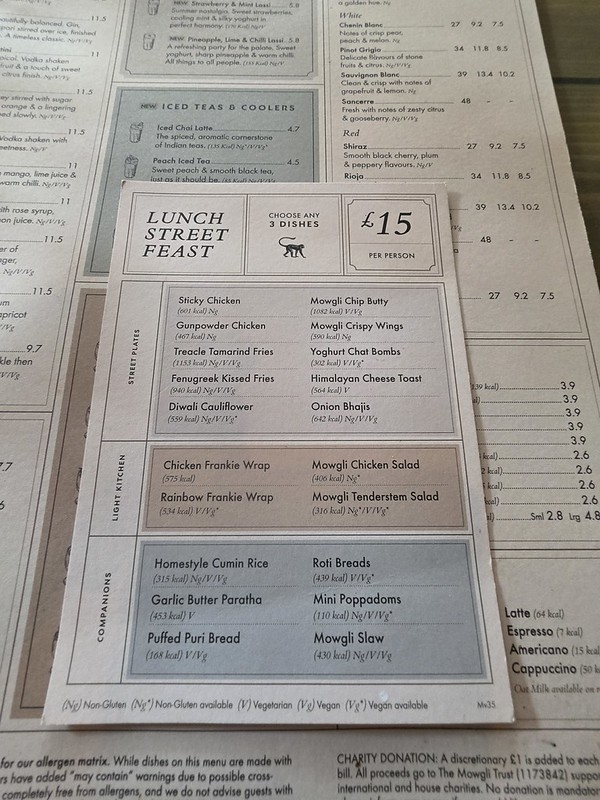
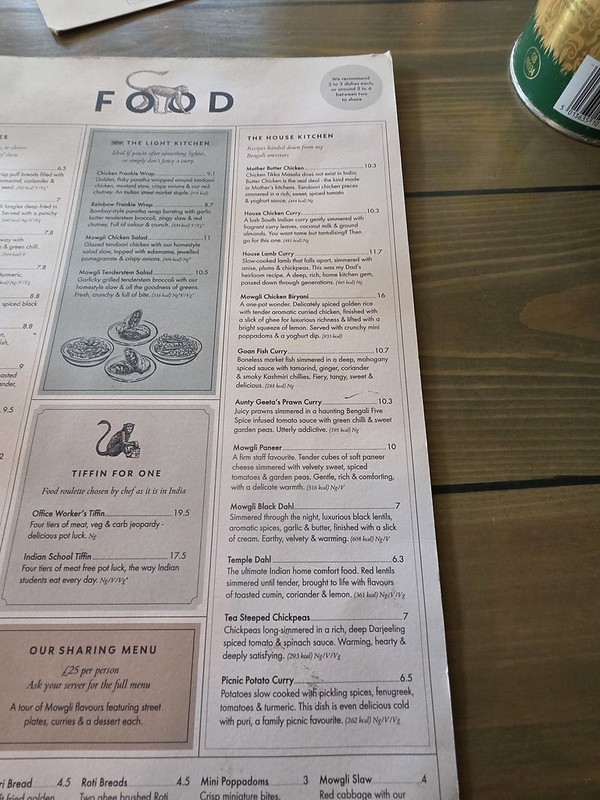
The lunchtime special menu.
The deal was that any of the curries in this section on the right, other than the biryani, were included in the half-price offer. Unfortunately, the half-price offer was not applied automatically, meaning that customers had to know about it and ask for the reduction. I’m never especially impressed when restaurants operate promotions in this way.
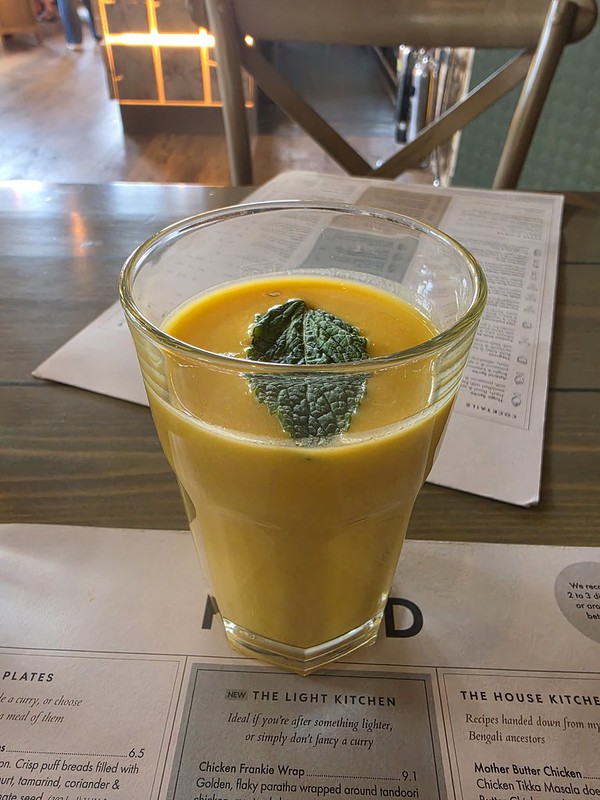
I ordered the mango lassi and it was a small serving for the price, although it looked attractive when presented. Its consistency was thinner than I had expected and neither the yoghurt nor the mango had enough presence to provide the usual richness and freshness.
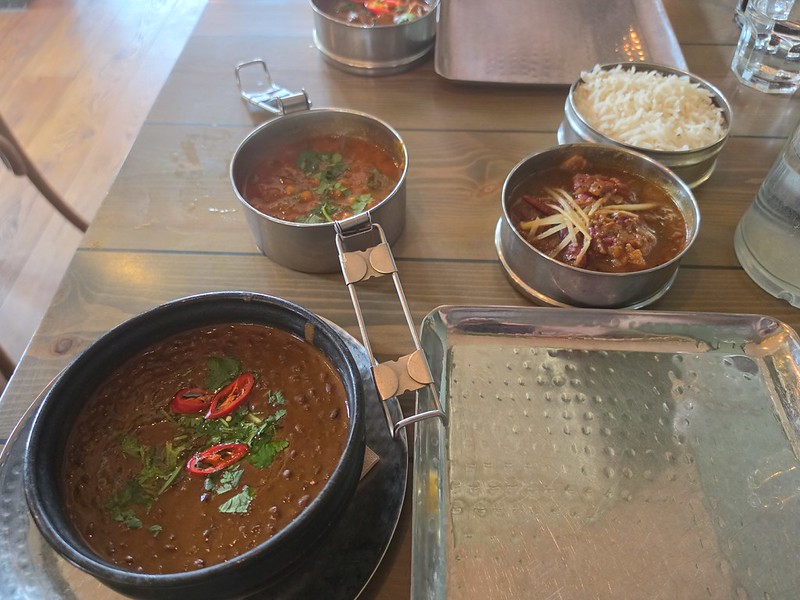
The main curry I ordered was the Goan fish curry and I opted for that as the menu stated that it was “fiery, tangy, sweet and delicious” but this was devoid of any depth of flavour that I could identify. The fish was tender and served in a generous quantity of sauce, but this element didn’t have any fiery dimension to it. I tried a bit of James’s butter chicken, just visible at the rear of the photo, and the chicken was tender but again there was no discernible complexity to the flavours. Although the two curries were different dishes, neither established a particularly distinctive flavour of its own.
The Mowgli Black Dahl was served as a generous portion, but its consistency was loose and watery rather than rich and velvety. It also lacked the slick of cream promised on the menu, which might have provided some much-needed richness. The Tea Steeped Chickpeas perhaps fared better texturally, with the chickpeas retaining a pleasant firmness, but the flavours again needed greater seasoning. I’m not necessarily expecting a huge punch in terms of spice, but I do want some complexity.
I would say that the dishes were all competent, they were well presented, hot and the server named them carefully when placing them on the table. Nothing tasted bad and I enjoyed all the food, but perhaps they had oversold the experience that I was expecting.
The service was friendly and timely, although I’m not convinced by the need to add both a charity donation and service charge automatically to the bill. The price was reasonable given the half-price main courses, but the quality wasn’t there for me. Indian food needs greater depth and complexity. Overall, it was all too mild and I felt that the food sat closer to supermarket microwave quality than to anything authentic or richly flavoured. I have mentioned before that there is something perhaps a little wrong that JD Wetherspoon, who make no claim of authenticity relating to Indian street-food, are rolling out curries that have a greater depth of taste than a restaurant that is meant to be specialising in Indian cuisine.
Having noted all that, I was pleased to have visited and it’ll be interesting to see how the chain manages its rollout of restaurants across the UK. And James, my external food consultant, who has been before and apparently ordered nearly the entire menu, deserves some praise for taking me as we planned the third biennial tour of every food stall at Norwich Market.
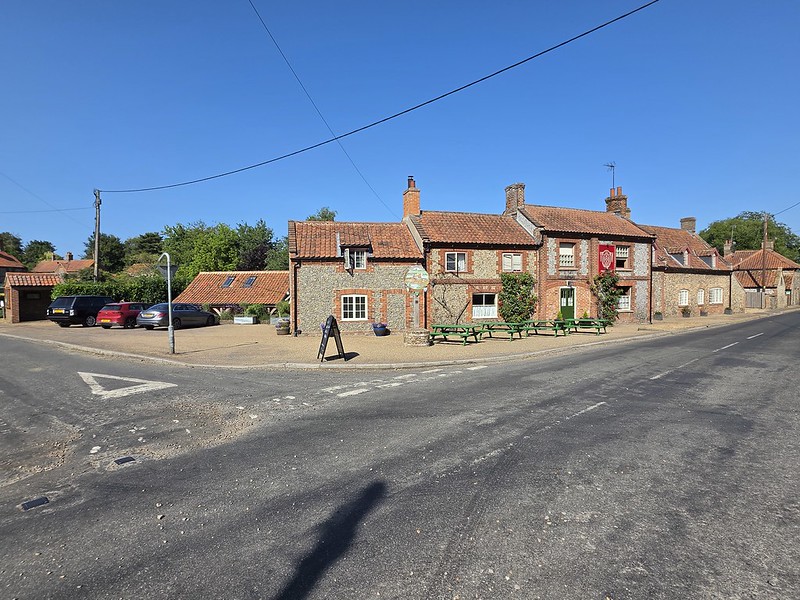
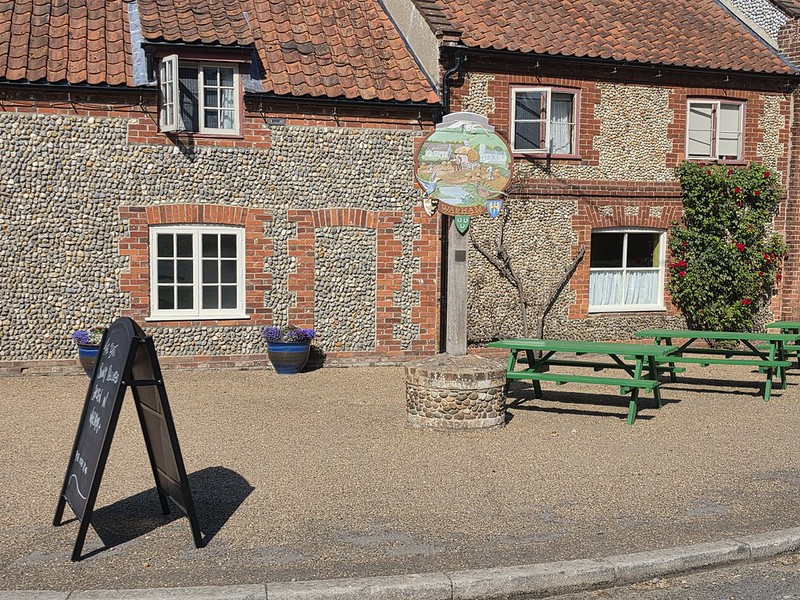
The next pub on my day out with Jen and Roy was in Warham, a village that I’m not entirely sure that I’d ever heard of before. It seems to be an interesting village, it still has two medieval churches (of which I managed to visit one quickly) and it used to have a third, but that was pulled down. It also has a railway station, well railway stop, as part of the Wells and Walsingham Light Railway, but this is a relatively new innovation from 1982 and there wasn’t historically a station here.
The pub has been a licensed premises since the late eighteenth century and it is now something of a sizeable building. The Three Horseshoes was once part of the Steward & Patteson estate, but has long since been free trade and that might be a reason that it’s actually survived.
As an aside, this traditional pub name is associated with blacksmiths and farriers, whose historic emblem depicts three horseshoes. One explanation for the apparently sub-optimal total is that the fourth shoe was being repaired or replaced while its owner waited nearby drinking a beer. It feels like an early roadside recovery scheme, providing refreshment for horse and owner.
There was some excitement in the Downham Market Gazette in November 1919 when it reported that the landlord, Herbert Barker, was summoned to the court in Fakenham charged with working a mare in an unfit state. There was a long argument about whether there had been cruelty or not, mainly relating to whether the horse had warts or sores, which sounds a glamorous debate but it was decided in the end that Barker was not a troublemaker and the case was dismissed.
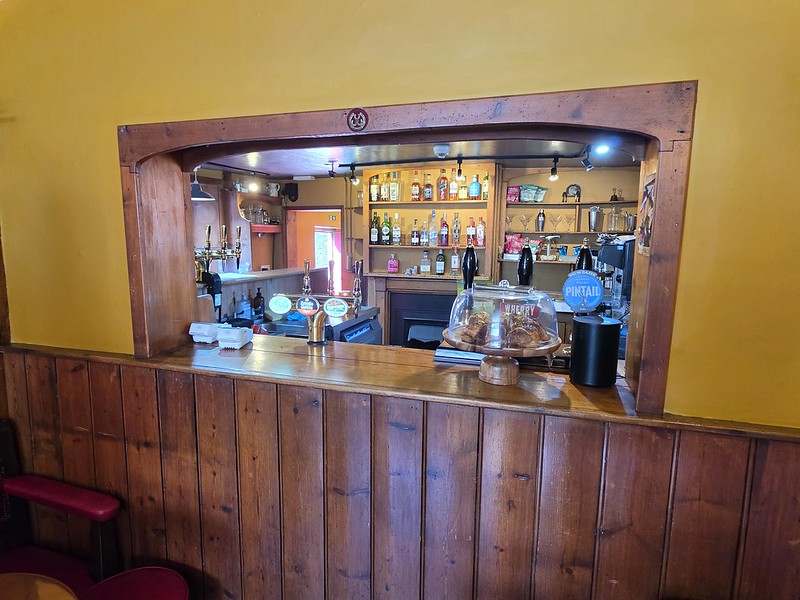
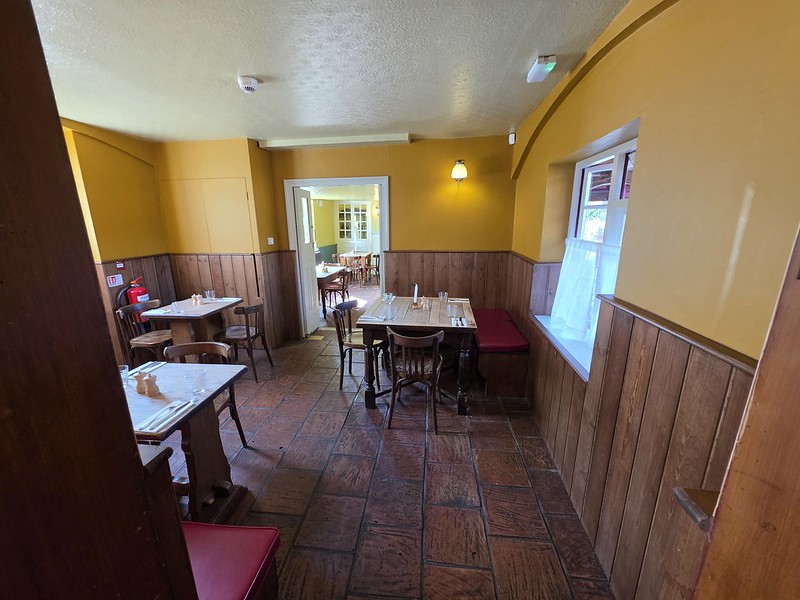
I didn’t know what to expect when we entered, but there was a lovely old bar, a choice of real ales and a friendly welcome from the member of bar staff. It’s fair to say that I was surprised and delighted.
The interior is impressive as it hasn’t been knocked about or needlessly opened up, so it feels clean and tidy, but it hasn’t lost its heritage. Looking at the online reviews, the pub is very well reviewed, although one customer was outraged that a high chair was not immediately available. The pub has survived since the eighteenth century, but this was evidently its sternest test yet.
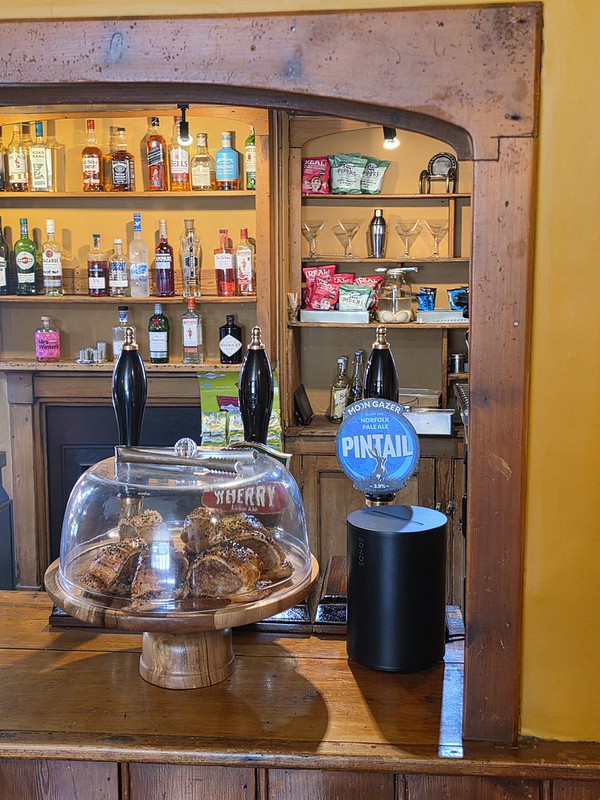
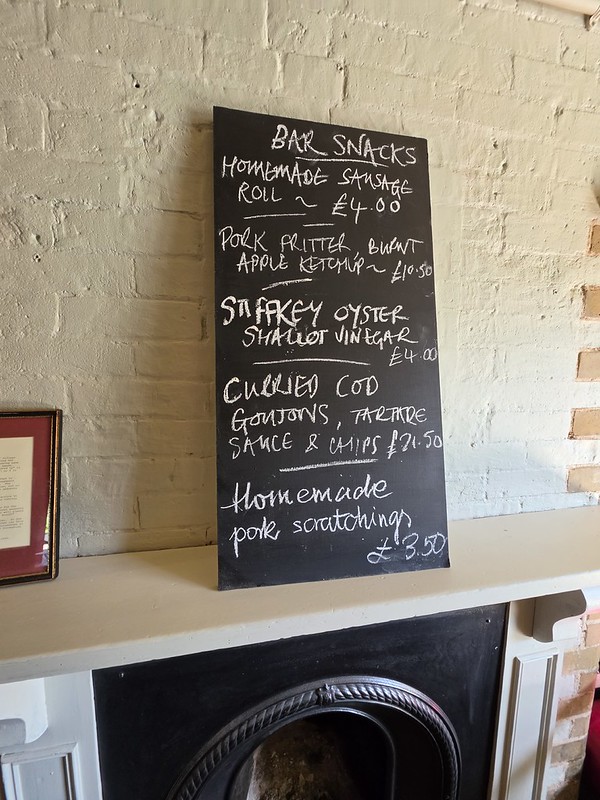
Some tempting sausage rolls, but we had started to debate going to an Indian soon afterwards and so I managed to restrain myself.
There were some other food options which certainly cut across the price range, from a sausage roll costing £4 to curried cod goujons costing £21.50.
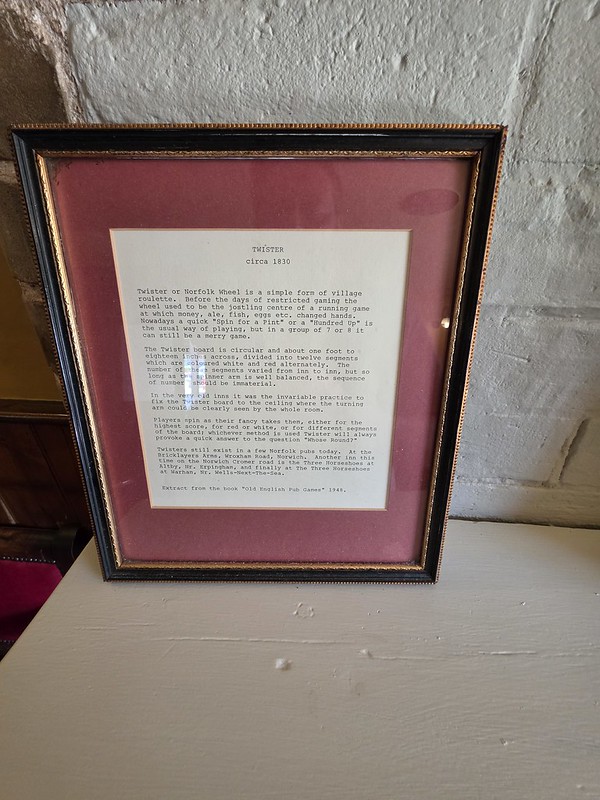
And a little bit of history about pub games in the dark days before bar billiards was more commonplace….. Although I managed not to take a photo of the Twister board on the ceiling, this reads:
“TWISTER circa 1830
Twister or Norfolk Wheel is a simple form of village roulette. Before the days of restricted gaming the wheel used to be the jolling centre of a running game at which money, ale, fish, eggs etc. changed hands. Nowadays a quick “spin for a pint” or a “hundred up” is the usual way of playing, but in a group of 7 or 8 it can still be a merry game.
The Twister board is circular and about one foot to eighteen inches across, divided into twelve segments which are coloured white and red alternately. The number of the segments varied from two to ten, but so long as the turning arm is well balanced, the sequence of numbers should be irregular.
In the very old inns it was the invariable practice to fix the Twister board to the ceiling where the turning arm could be clearly seen by the whole room.
Players spin as their fancy takes them, either for the highest score, for red or white, or for different segments of the board; whichever method is used Twister will always provide a quick answer to the question “Whose Round?”
Twisters still exist in a few Norfolk pubs today. At the Blickling Arms, Wroxham Road, Norwich. Another inn this time on the Ipswich–Cromer road is the Three Horseshoes at Alby, nr. Aylsham, and finally at the Three Horseshoes at Warham, nr. Snetterton–Thetford.
Extract from the book “Old English Pub Games”, 1949.”
It’s probably not the Twister game that some kids might be expecting though.
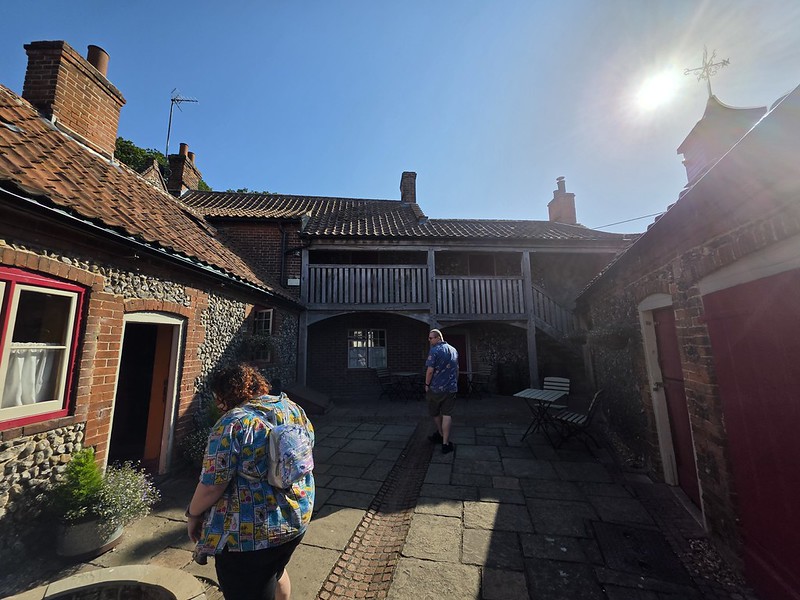
There were numerous outbuildings and those steps up to the lodgings reminded me of how many of the old coaching inns used to look. There is still accommodation available today, which is perhaps what is supporting the pub financially in these trying times.
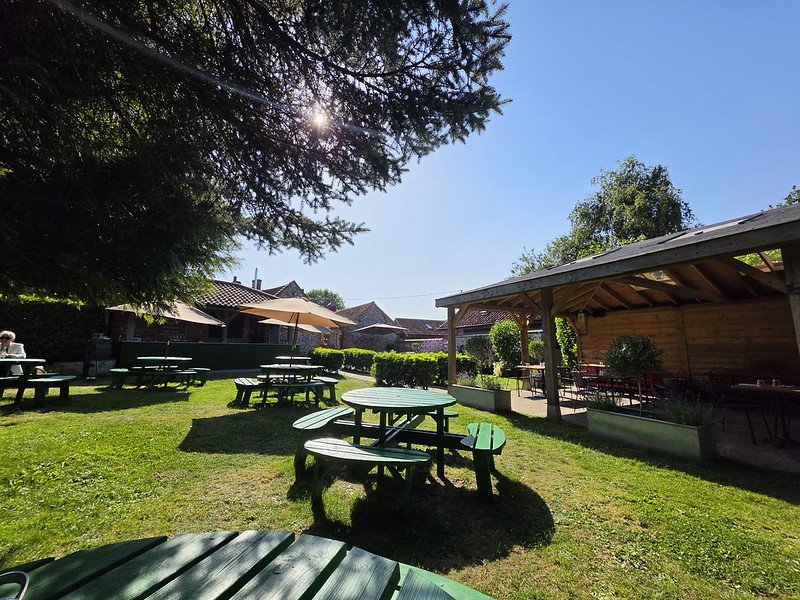
The beer garden was substantial and there is a large covered area as well. There’s an outside bar and I imagine that this would make a fine space for a wedding or family gathering.
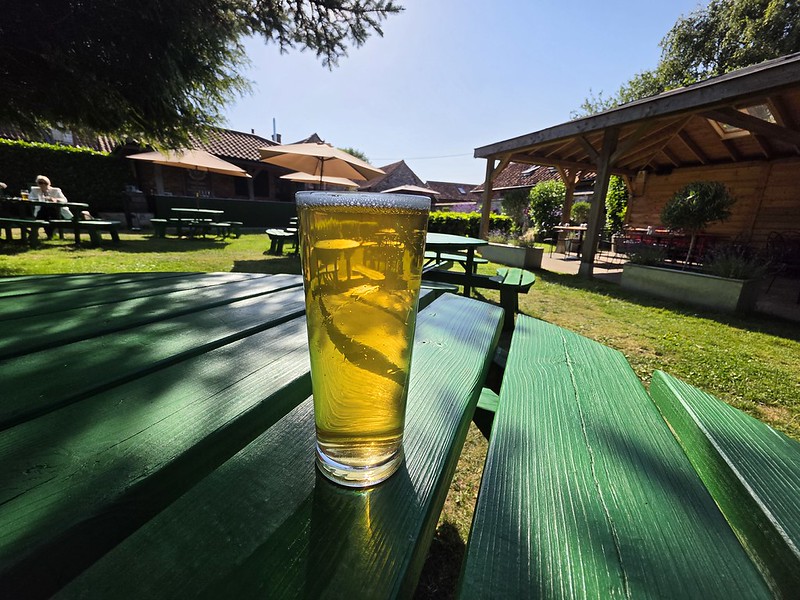
I found a shady spot in the garden as I didn’t want to overdo it. The beer is Pintail from the marvellous Moon Gazer brewery and it was clean, light, hoppy and well kept. There was also Woodforde’s Wherry available and the prices were reasonable.
I very much liked this country pub, it’s doing well to keep going and it is offering food, real ale, accommodation and keeping open for long hours, so this is a proper little community asset. I’m a little surprised that it hasn’t managed to get into the Good Beer Guide, but maybe there’s a lot of competition locally. The pub was quiet when we were there, but I hope the locals support it to ensure that it lasts for at least a few more generations and it’s also one that I’d pro-actively look to return to.
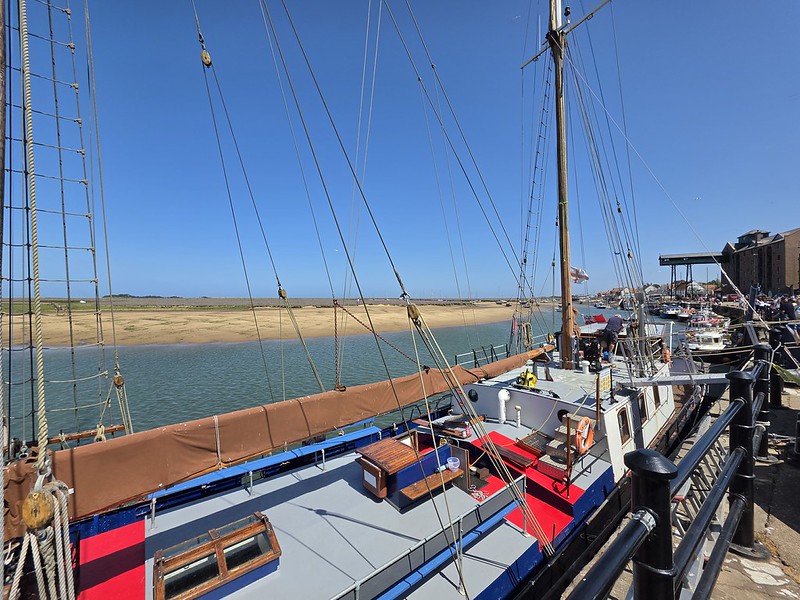
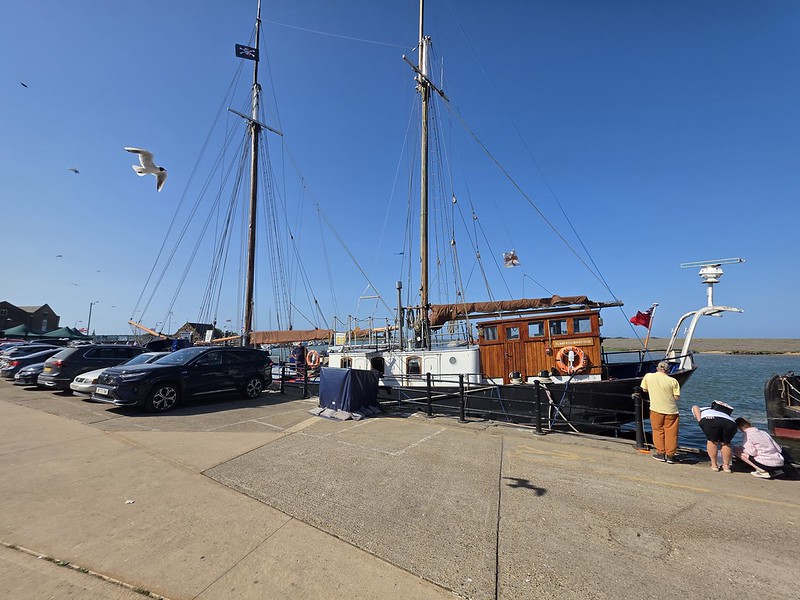
Moored alongside the quay at Wells-next-the-Sea, the Albatros is rather more interesting than the average boat parked in the harbour. The Dutch North Sea clipper was built in 1899 at Capelle aan den IJssel, near Rotterdam, and spent much of its working life carrying cargo around northern Europe. Between 1990 and 1996 it became a regular visitor to Wells, bringing more than 100 cargoes of soya bean meal from the Continent. In September 1996 it sailed from Wells after delivering 100 tonnes from Rotterdam, marking the end of its career as a freight carrier and, remarkably, the final commercial voyage of a sail-driven cargo ship in Europe.
The Albatros later returned to Wells and acquired a rather gentler existence, becoming a floating bar, restaurant, music venue and accommodation, particularly known for Dutch pancakes and real ale. It left the town in 2020 for an extensive restoration at Maldon in Essex, finally returning to Wells in July 2023 after three years of work. As I know from Charters in Peterborough, there’s something rather exciting about having a real ale on a floating boat. For some years it was listed in the Good Beer Guide and was known for stocking a selection of beers from Woodfordes brewery.
Quite what’s happening now, I’m not sure. Jen offered to try and go and talk to the people on the boat, but Roy and I recoiled at that ridiculous level of social interaction so we meandered off quickly. It means this post ends without the benefit of investigative journalism, but with considerably less risk of having to introduce ourselves to strangers.
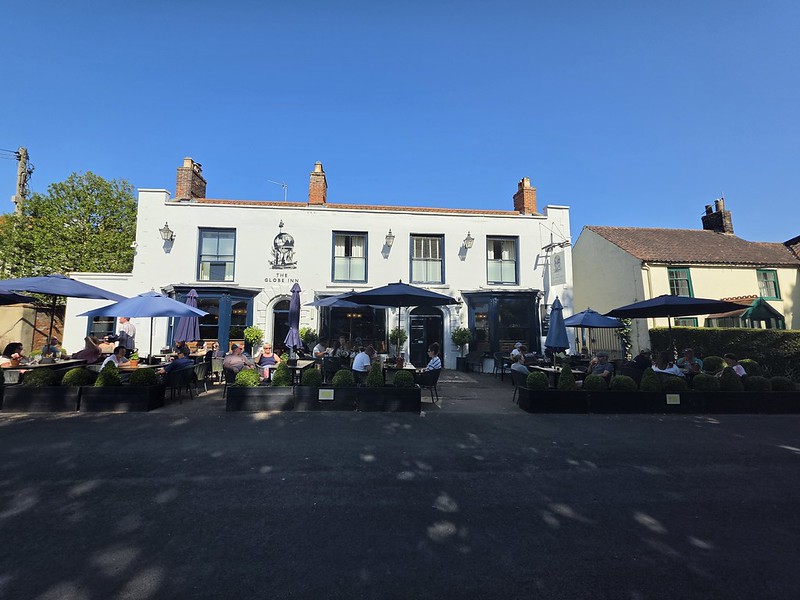
The next pub on our meanderings around Norfolk was the Globe in Wells-next-the-Sea which is one of a growing number operated by the Chestnut Group. It has been a licensed premises since around the 1830s and was a locally owned venue before Greene King acquired it in the late 1960s, but they sold it in around 2010 which is probably for the best.
In 1947, Graham Cawdron (who I think was the same landlord as Herbert Graham Cawdron) who was a former Flight Lieutenant in the RAF who had won the DFC announced that he planned changes to the venue. His family owned the pub and they proposed demolishing the original bar to give more space for the entrance, adding rooms to the rear and also adding a balcony to the first floor giving access to the billiards room and a lounge. As a side note, the landlord applied for a special licence to open until 23:30 on a Saturday evening to host the annual dinner dance of the Royal Air Forces Association. There doesn’t seem much decadence in the opening hours that were normally allowed if they had to get special permission to open until 23:30, the nightlife of Wells was evidently operating under fairly strict constitutional arrangements.
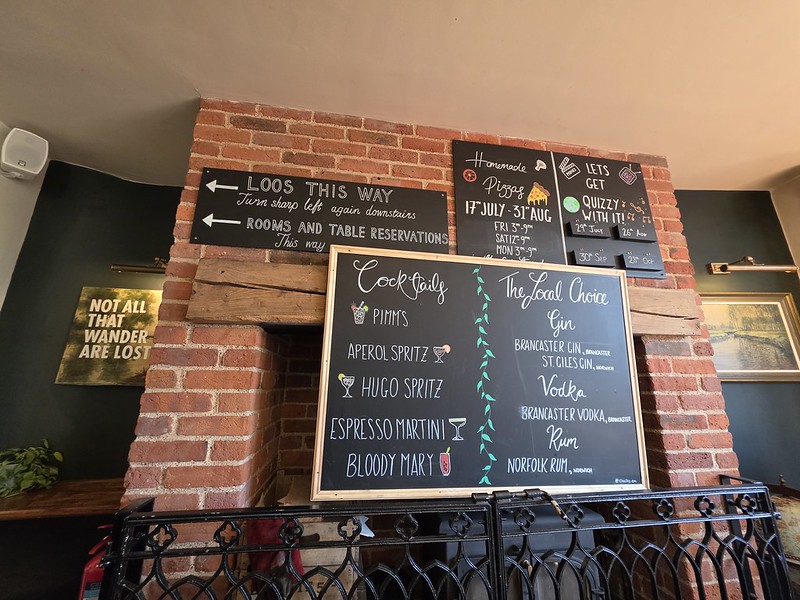
All nice and clear signage with details of some future events. There’s a front bar to the arrangement, with a restaurant area to the rear and there are also rooms available, priced at a level which suggested I would not be conducting further research.
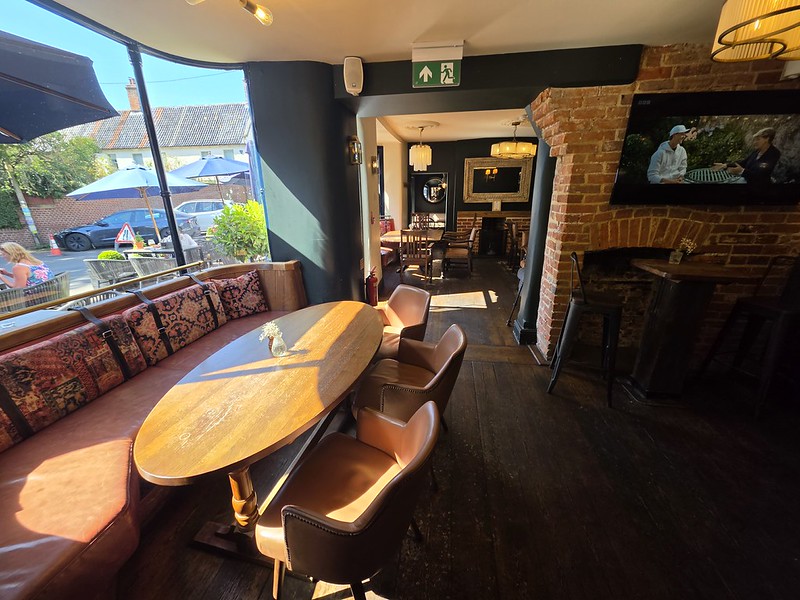
The interior which all seemed welcoming and comfortable, with a sizeable beer garden outside. The venue was much busier than these images suggest, I took the opportunity to take these photos when customers had just left.
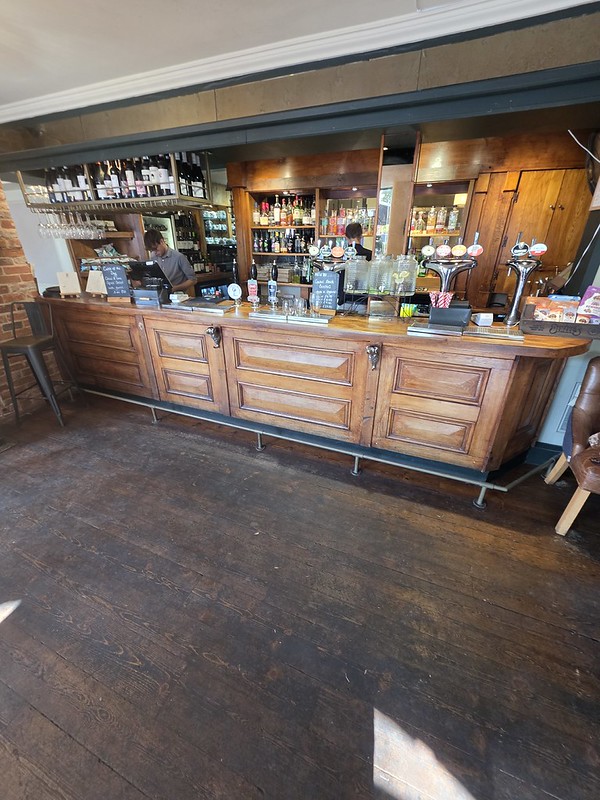
The bar area and there were three real ales, with two from Barsham. The venue is very well reviewed online and although the food prices were towards the higher end of the scale, the drinks prices were reasonable. The team members at the bar were friendly and served us promptly enough despite there being quite a queue when we arrived.
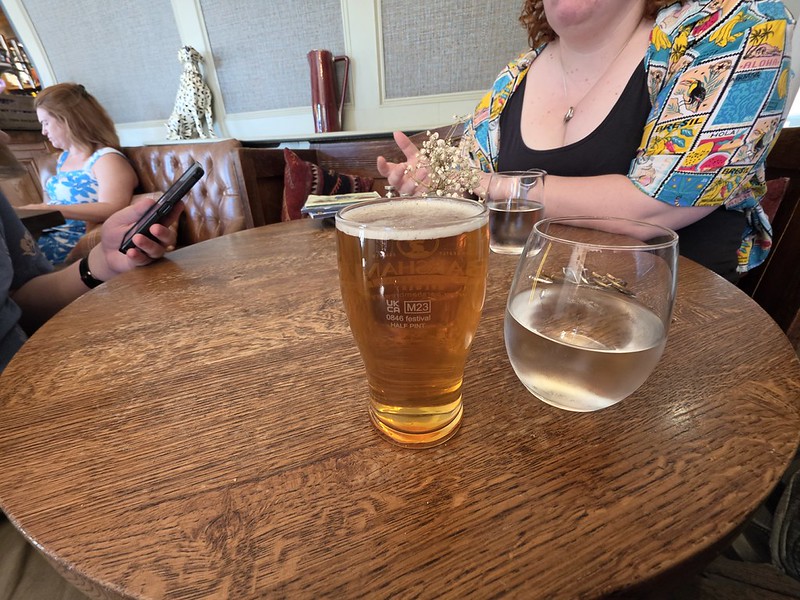
I went for the Eastern Gold from Barsham Brewery which had a fruity edge and was nicely rounded in terms of the flavour. It was also at the appropriate slightly chilled temperature, despite the extremely hot weather outside which I hardly mentioned, so this pleased me. And I also got some free tap water infused with cucumber or something adding an unexpected spa element to proceedings. I’m not sure that’s what actually happens at spas, but I’ve never been so I’m just guessing.
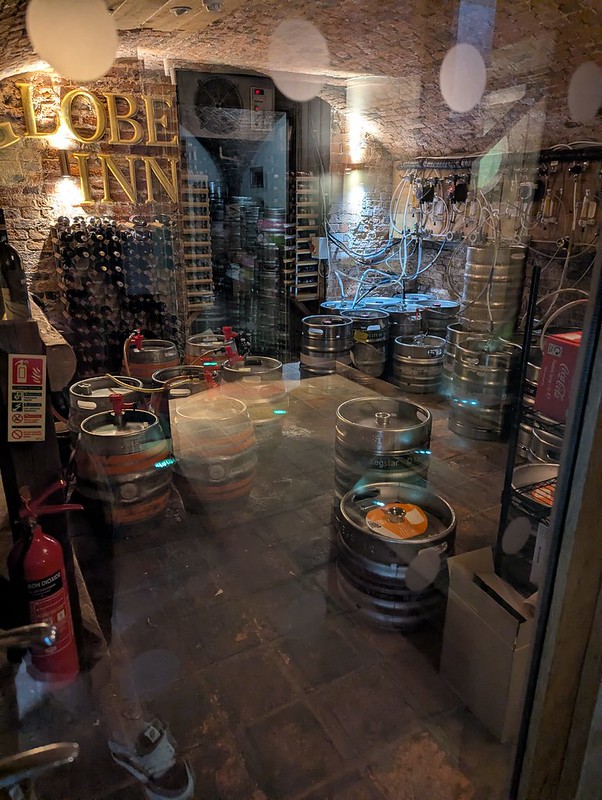
I wanted to take a photo of the cellar but there was a team member working in it when I walked by. Fortunately, Jen took a photo, so I’ve used that one as I rather like seeing open cellars.
I’d note at this stage that there are no Good Beer Guide pubs in the town, which feels a little sub-optimal, but I’d say that this one must have been a close contender. There was a friendly welcome, it had an upbeat atmosphere, the beer was well-kept and there was an air of style about it. All really rather lovely.
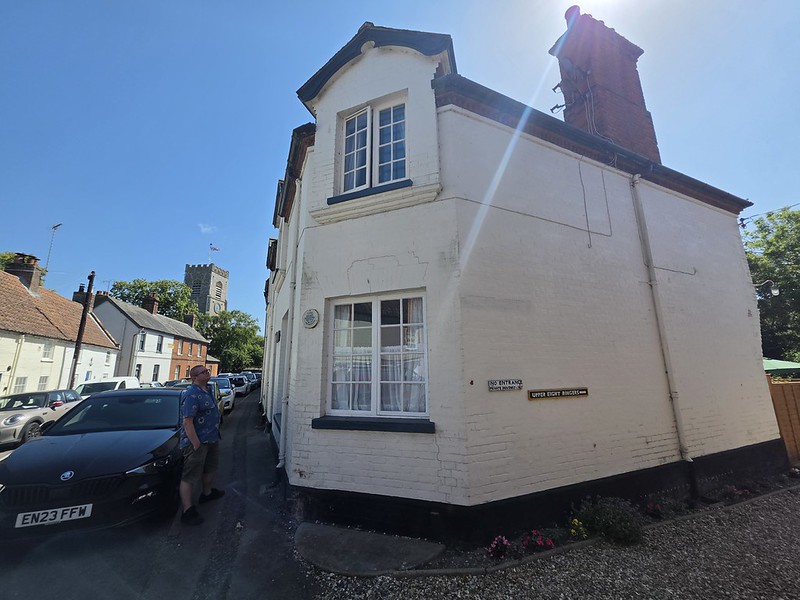
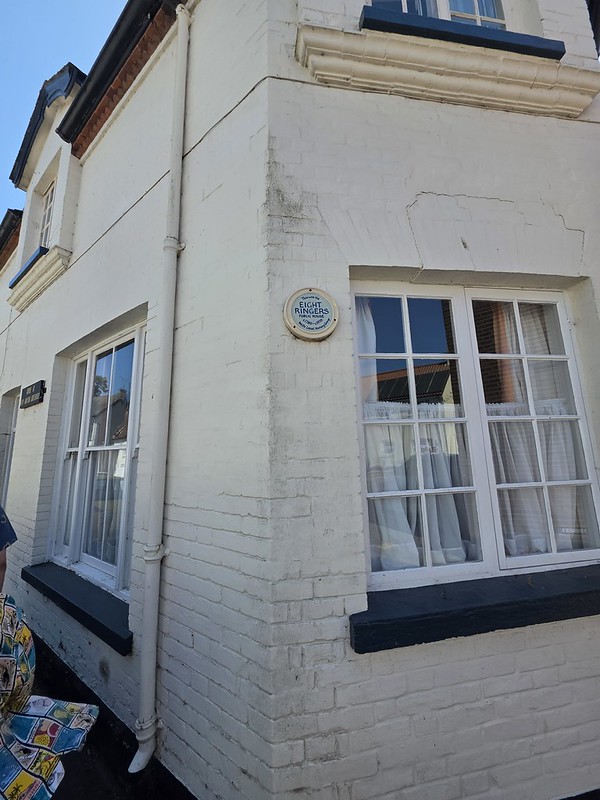
This was once the Eight Ringers pub in Wells which was a licensed premises between the late eighteenth century and 1971 when it finally closed. It was initially a free trade pub before becoming part of Bullards and then Watney Mann, but they didn’t feel that the venue was viable and it is now split up into flats.
It came up for sale in 1904 and it was advertised as being:
“A fully licensed public house with large yard, good stable and outbuildings, suitable for any trade”.
The landlord between 1905 and 1909 was Frederick Powell and he seems to have been something of a character. He was charged of being drunk in his own licensed premises and then using bad language to a police officer who was investigating the matter, with the fine for the bad language alone being 9 shillings including the costs.
The pub seems to have struggled with their landlords as the long-standing Eleanor Cross was at the premises for over thirty years and was found guilty of adding water to whiskey. The situation seems complex, she claims that the inspector made her open a bottle which she never tried to serve from and she claimed that was her own whiskey as “her heart was bad” but the court didn’t believe it.
The landlord between 1947 and 1961 was Frank Moore and then his wife managed the house between 1961 and 1966. She attracted the interest of the national newspapers in 1962 when her 40 year old cactus bloomed with nine buds. She was so excited that she moved it to the bar and customers could see the buds blooming in front of them. They then all died overnight, so that was the end of that excitement.
There’s a plaque on the building from a local history group, otherwise I would have known that this used to be a pub. As for the name, a traditional English ring of church bells can consist of eight bells, each with its own ringer, which presumably explains the Eight Ringers. There were periods in the pub’s early history when it was instead known as the Six Ringers, so goodness knows what happened to the other two. Perhaps they had been barred.