And we’re off in Richard’s rickety old car, but I was very positive about it by talking about my friend Liam’s decadent car which does massages for the passenger seat…. I think Richard feels better when he hears about positive things.
Safely at the car park at Stratford with none of Richard’s eggs being broken on the journey. Richard reassured me that all the cars sounding their horns at him was just typical London behaviour.
There were some cancellations on the Elizabeth Line, but we had a wait of just a few minutes. Most of the delays were because Richard has bought a suitcase bigger than me that he’s trailing behind him, whereas I have my backpack to allow for efficient travel. I didn’t say anything though.
Top travel tip, don’t use the Elizabeth Line to go to Heathrow Airport if you can avoid it, it’s around four times more than going to Hayes and Harlington on the Elizabeth Line.
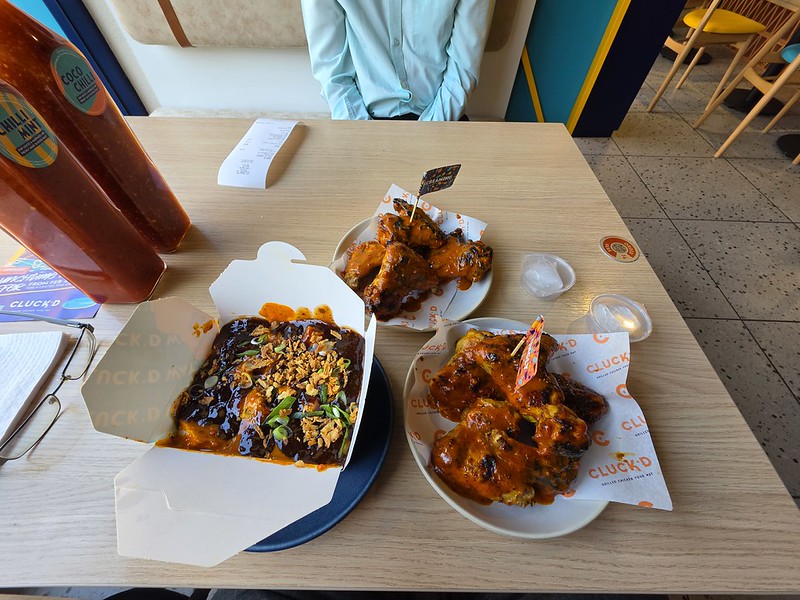
And safely into Hayes and Harlington where I had found a little restaurant for us to eat our evening meal in. But more of that in the next post….
And just some more photos to remind myself of what was demolished and when at Anglia Square…. They’re making good progress, although it’ll be interesting to see the cinema when the side is taken off of that.
Back to my series of posts from 200 years ago, I think it might be useful to touch upon the brewery arrangement run by Thomas Massey. He advertised in the Norwich Mercury in March 1825 with this text:
“Thomas Massey, Ale and Table Beer Brewer and Maltster, St. Stephen’s Gates, Norwich. Most deeply impressed with a sense of gratitude for the support which he has received & which he continues daily to receive from his many Friends in the city of Norwich and county of Norfolk, begs thus publicly most respectfully to offer them his sincere and heartfelt thanks, at the same time assuring them his constant endeavours shall be to vend a beverage genuine in quality and pleasing to the palate. Families supplied with Malt and Hops.”
This was the St. Stephen’s Brewery which Massey operated and it was trading from the 1820s. He was still going into the early 1840s and by then he was brewing from the newly opened Champion pub (which is still there and I visited last year), which he appeared to own. In 1844, he decided that he would sell his entire operation off and that included the brewery, malting house, surrounding buildings and some land as well.
In 1899, following the death of Charles Crawshay, there was an interesting article in the local press which touched upon this brewery.
“It is with deep regret that we record the death of Mr Charles Crawshay, of Hingham, who passed away on Wednesday evening, after a very brief illness. The deceased was in his usual health on Tuesday, and enjoyed a long drive in his carriage in the forenoon, but shortly after his return he was suddenly seized with paralysis, which terminated fatally. Mr Crawshay was in his 85th year. Born at Rowfant, Surrey, the deceased gentleman, at the age of 18, went to the London firm of Messrs Charrington, Head, and Co., to undergo a three years training in all that pertains to a brewer’s business. In 1845 he took charge of his father’s St Stephen’s Brewery, Norwich, and in 1850 entered into partnership with Mr John Youngs (Youngs, Crawshay, and Youngs).
In 1876 by a maiden bid of £30,000 at auction he secured the Diss Brewery, which has since proved a valuable adjunct to the Norwich Crown Brewery, which latter has been recently converted in a limited liability company. For the greater part of the century Mr Crawshay has been a familiar figure in the county, and the older inhabitants of Norwich well remember his style and dash. He was one of the best “whips” in the neighbourhood, and the manner in which he handled his four-in-hand team was indeed a sight to witness. He subsequently turned his attention to yachting, and in 1852 his boat, the Kestral, won prizes at Cantley and Coldham Hall regattas and at Yarmouth water frolics. In 1856 he married Miss Cubitt, a relative of Sir William Cubitt, who constructed Lowestoft Harbour. The following year he served the office of Sheriff of Norwich, and received the thanks of the city for his services and hospitality.
On removing to Hingham in 1858 Mr Crawshay went in for farming, and gained considerable fame as a breeder of Southdown and cross-bred sheep. A keen sportsman, he was a big preserver of game. His love of sport is inherited by members of his family. His connection with politics was but slight, but he held that a parson should under no circumstances take part in magisterial affairs. By his death the poor of the district have lost a generous friend.”
I’ve written already about the excitement at the bus shelter in Sheringham and how politicians have managed to throw a heap of money away on a muddled and confused project. Well, here it is now, boarded up for the summer as a little treat for tourists. They don’t want to start the work until the autumn, but they want to start the boarding up now. Makes sense…
The new plan is to widen the pavement and keep a bit of the old bus shelter that so many residents wanted to retain. They decided that they’d sleep in it for over a week to show their love for it. The argument is that the pavement needs to be widened, but as cars are king, they’re going to encroach on the public space and the old bus shelter is in the way of that.
Well, the pride of north Norfolk.
I can’t see the point in keeping half of this shelter, it loses its meaning, relevance and integrity. Although I very much wanted to keep the shelter, I’d personally just pull it down now. It’s either worth saving or it isn’t, it’s like saving the facade of a building and knocking the rest down.
It’s entirely unclear to me why they couldn’t build the new bus shelter next to this one, leaving this one intact but not in the way of anything or anyone. Or, they could have been radical and made this road one-way and narrowed it so that they didn’t need to fiddle with anything.
But, if this is what the residents of Sheringham want, who am I, as a former resident, to comment…. I wonder what Ralph Howell would have done.
In the early 1820s, the British public was gripped by a peculiar form of gambling fever orchestrated by Thomas Bish, someone who seemed quite a character to say the least. The advert above was in the Norwich Mercury from 200 years ago, although the lottery arrangement was a national one.
Bish was the most prominent lottery contractor of his day and he turned the sale of state lottery tickets into a massive marketing spectacle. Operating out of offices at 4 Cornhill and 9 Charing Cross in London he managed to get his whole lottery system sanctioned by the state. He put bold ads in newspapers, such as the Norwich Mercury, he created eye-catching handbills and used humour in his adverts. He was ahead of his time.
The era of these grand lotteries came to a close in 1826 when the Government finally abolished the state lottery as it didn’t suit their needs. Bish did not go quietly as he campaigned vigorously against the ban and even managed to get himself elected as an MP for Leominster twice although his first win was unseated because of his Government lottery contracts. Bish advertised that it would be the last ever lottery conducted in the Kingdom, but then in the 1990s, John Major came along and introduced the National Lottery once again.
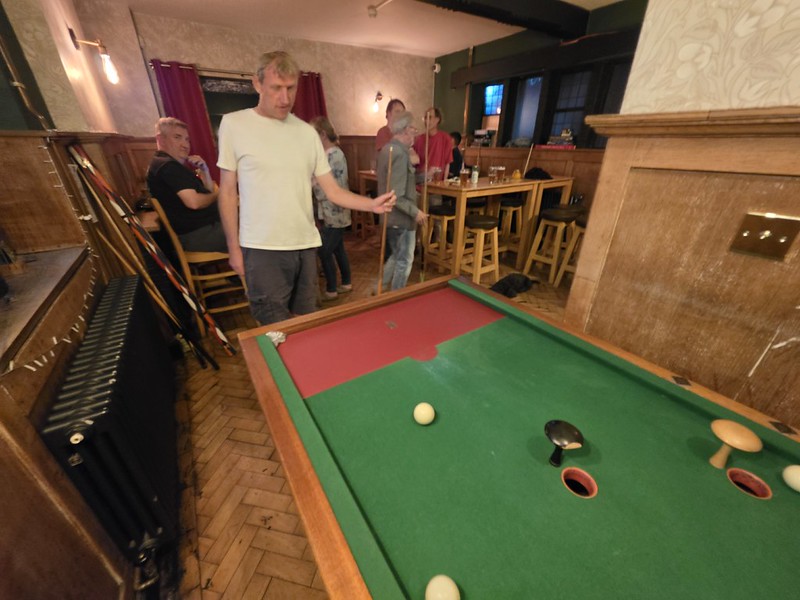
This is the final bar billiards table in the Norwich league that I haven’t played on, with the exception of the table out in South Walsham. It’s the table at the Rose and since Zak was planning to practice and Nick had a game from the singles competition at the pub, this felt the ideal time to try it.
Before Nick’s match, we had time for one game, and it transpired that neither of us had ever played at the table. He won, but not by many.
I did have a couple of victories in the evening and here’s Nick after beating his opponent 3-0. He now gets to play Oscar, who annoyingly beat me a few days ago…. Sub-optimal, I could have beaten Nick and I might have mentioned that to him 🙂
This was the second singles tournament game I’ve refereed in a week, I’m hoping that some of the talent will come to me via some form of osmosis.
Anyway, back to the table, it’s a robust arrangement and it’s quite fast off the back cushion. The pockets aren’t very forgiving, it requires some accuracy to get them in. It feels like a relatively low scoring table, I think it’s hard to build big breaks, but it’s nicely looked after. It’s the only table that’s £1 a play in the league, although I suspect the others will catch up at some point.
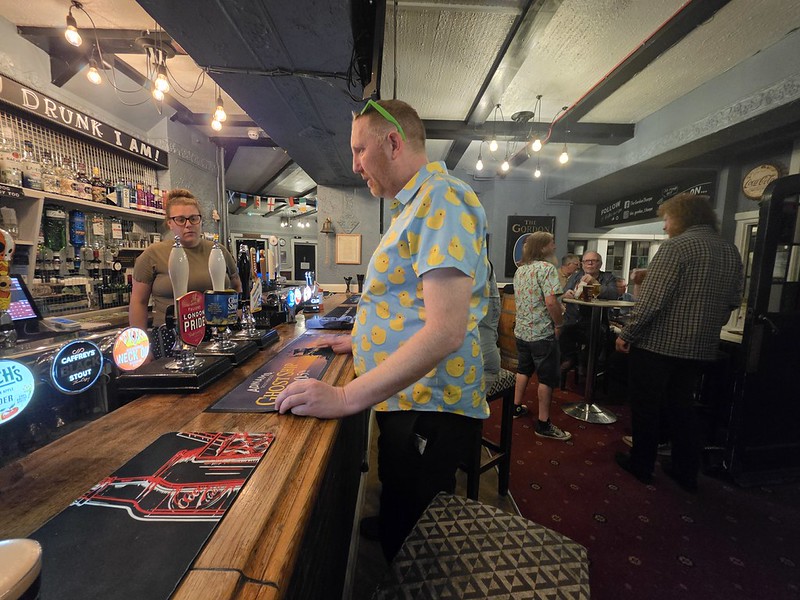
And, the Rose is a really lovely pub, a suitable range of cask and keg beers, friendly staff and it was also good to see my friend Emma over there, now back brewing Boudicca again.
This is a court case from 21 July 1886, when John Gayford, a 19-year old labourer, was tried in the Guildhall in Norwich with the judge being Baron Pollock.
The crime was sexually assaulting a six year old girl for which he was found guilty and sentenced to six months hard labour for his offences. This seems unduly lenient to me from today’s standards, but one substantial change is that they were merrily naming the poor girl who had been assaulted. To give some context, and although it was a repeat offender, the court the same week gave a criminal twelve months hard labour for stealing 14lbs of plums.
The victim was Nellie Baldwin and in an earlier hearing it was decided that although the only witness to the crime was a five year old boy, the courts accepted that they would take his evidence into account. Nellie, aged six, her five year old friend and a baby in a pram all went out together for the day. When the group returned home, Nellie explained what had happened and a police doctor was called. Some of the case relied upon it must have happened as she was physically hurt and how else would a little girl be able to describe what had happened.
John Gayford went on to become a self-employed gardener, he married Rosanna and they had two children, Rosa and Florence. Someone guilty of his crime today would have likely left the area after they were released, but at the 1921 census he was living at 20 Northumberland Street in Norwich, just a short walk from where the crime took place. He lived there until his death in 1942 and I imagine that just about everyone not directly impacted by the crime had forgotten about it, in those days when searching for information was somewhat harder.
Another another article from 200 years ago this week in the Norwich Mercury from 1826.
“Sir, In no part of the kingdom is careless driving carried on to so great an extent as in the neighbourhood of this city—and permit me (through the medium of your widely circulating paper) to caution the public against such dangerous practices, as I am determined, as far as lies in my power, to put a stop to them. As a single proof of the extent to which careless driving is carried to, I can assure you, Mr. Editor, that in the short distance of one mile and a half, in the parish of Wymondham, I saw no less than five men riding in their waggons, out of which number four were at full trot. I am determined to lay informations against every person I find offending.
Your most obedient Servant, W. WILSON.
Bank Place, Norwich.”
Some things never change, whether men have access to carts or cars, some will speed…..
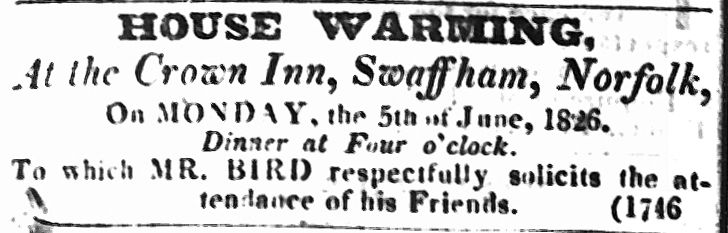
200 years ago there was a lot of crime in Norfolk and until 1823, there were 200 different crimes that could lead to execution if found guilty. The policy didn’t work and so was scrapped in 1823 to start to allow more prison sentences rather than executions. This wave of liberalism didn’t please everyone.
The newspaper reported this serious crime:
“On Saturday evening as Mr. Caddiwold, of Kimberley, was returning home from our market, he was stopped and robbed near the Forehoe Wood by three men, who to accomplish their diabolical object, fixed a rope across the road, and as soon as Mr. C. came in contact with it, one of the villains jumped up behind his gig and passed over Mr. C.’s head a piece of wood, with a joint in the middle, so as to form a gripe, in the shape of a pair of compasses; between which the robber held his head so fast that he was unable to stir, and at the same time demanded his money. Mr. C. alarmed at being thus suddenly placed in a situation where it was impossible for him either to escape or resist, begged to be let at liberty, and said he would give them what money he had. Upon which, another of the fellows who was standing at the horse’s head, called out “let a little looser,” which being done, Mr. C. gave them his pocket book, containing five pounds, and was then suffered to proceed home.—These daring villains made an attempt the same evening to stop Mr. J. Smith, of Kimberley, in the same way, but the rope fortunately was placed rather too high, and caught his hat, which flew off, and he escaped.—A man has been taken into custody, in whose possession this new invented apparatus was found, and has since been discharged.”
The incident took place at Forehoe Wood which is on the Norwich Road towards Kimberley, near to Carleton Forehoe. This area had seen incidents similar to this from the 1780s and so there must have been some terror for those travelling in this area.