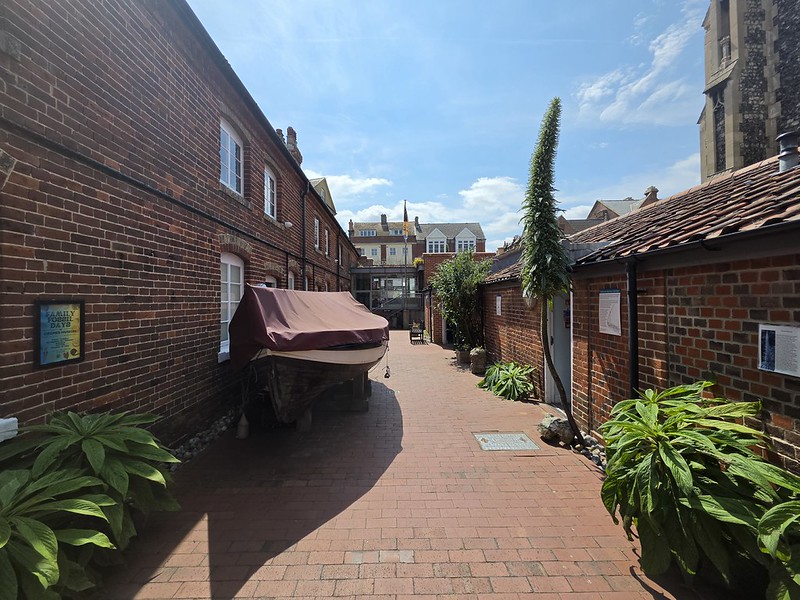
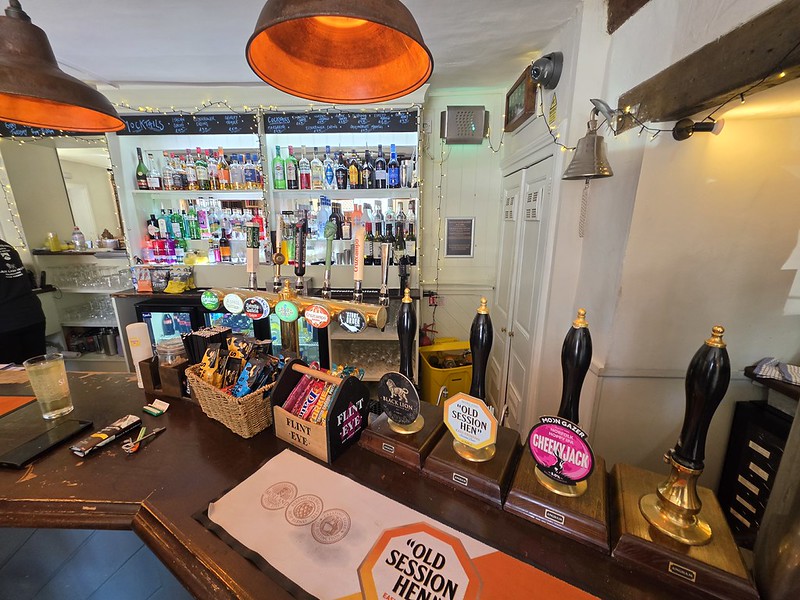
This one visit to Cromer Museum has helpfully produced enough material to sustain the blog for a couple of days. Museums are useful like that, they organise all the exhibits and history and I merely have to stand nearby taking photographs before later presenting the whole arrangement as organised cultural research. All rather lovely.
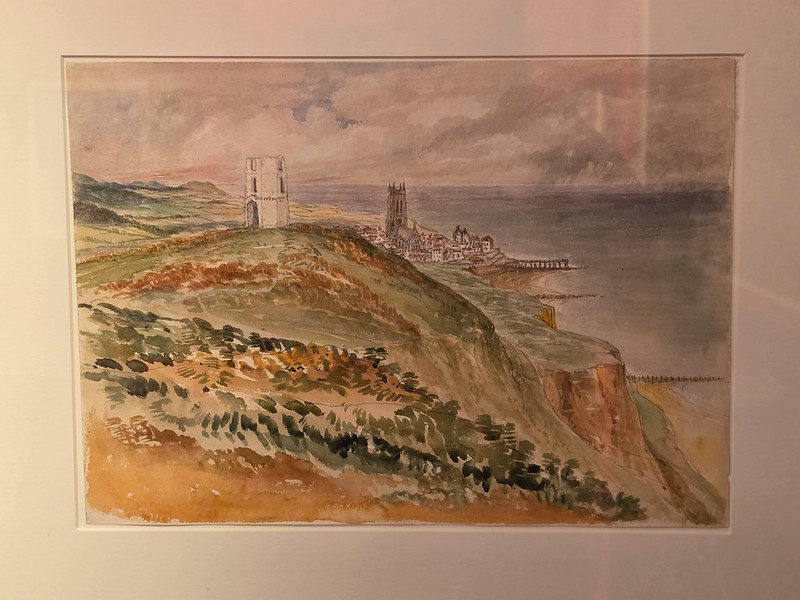
Anyway, this is a watercolour of East Beach by Caroline Gray, painted in 1829, and it shows Cromer’s shoreline with the town rising behind it. The church tower is immediately recognisable and the jetty built between 1822 and 1823 is visible. This was Cromer before all the tourists came for the day to eat their fish and chips before meandering along the pier and commenting negatively on the parking charges.
The back of the painting carries the inscription: “‘Twas here my careless Childhood stray’d, a stranger yet to pain”, although the museum notes that it’s not clear whether the artist wrote those words, but it’s a nice little addition. But it shows Cromer from another age and I rather like that.
This photograph, which I thought was one of the more evocative in the museum, shows a group of Cromer fishermen in 1900, standing beside their boats, ropes and traditional crab or lobster pots on the beach. These would have been hard times and being a fisherman was a dangerous and rather unglamorous job. There weren’t many safety arrangements, certainly no risk assessments and no-one popping around from the council to check the electrical safety certificates.
Cromer did not have the protection of a proper harbour, so fishing boats had to be launched directly from the beach and brought back through the surf. The small open boats in the photograph were practical working craft rather than anything designed for comfort and the fishermen caught crabs and lobsters, but also worked for herring, cod, plaice and other fish depending on the season.
The photograph appears to have been posed, but it still gives a strong impression of the working beach. Some of the men look directly at the camera, while others seem slightly less convinced that photography is an adequate reason to stop what they are doing, something which I have a lot of sympathy for. There are a range of expressions suggesting that nobody had been instructed to look cheerful for tourism purposes, but I imagine that it would have been an interesting distraction. The central figure has the air of a man who has spent many years dealing with both the sea and other people, and has reached no particularly flattering conclusions about either.
I’ve been thinking more about the west frontage of Norwich Cathedral, although I suppose there are worse things to overthink. Some people worry about careers, pensions and the long-term future of civilisation, but I have been thinking about where the spirelets of Norwich Cathedral have gone. The problem began when I found Daniel King’s seventeenth-century print of the west front, which shows a much more elegant and symmetrical arrangement than the one visible today.
I therefore asked AI to help create a modern photographic impression of what the cathedral might look like if the frontage had retained more of the arrangement shown in King’s engraving. This took a little persuasion. AI understood “Gothic cathedral” very confidently, but was rather less enthusiastic about counting statues correctly, which is a minor drawback when the entire point is having two figures on each side of the doorway. Several attempts produced one statue either side, extra figures in odd places or something that looked like a confident cathedral that most certainly wasn’t from Norwich. It still has the main portal wrong as the door has been shrunk right down, but there’s a limit to how much time I want to spend debating the matter.
I’ve decided I definitely like it more as it was. But I feel that I’ve exhausted this line of worry now and I’ll just have to accept what’s there.
This is a photo of the west frontage of Norwich Cathedral that I took in May 2020, but it’s a view that I’ve seen thousands of times over the last few decades. And I’ve thought on many occasions that the design feels quite odd in places, but I’ve never given it much more thought than that because apparently even I have limits on how much time I can spend worrying about medieval masonry. Those limits have now been tested.
I’ve now found this image which is of the west frontage and although the date isn’t known, it’s between 1655 and 1725 and is from a print by Daniel King. This has surprised and delighted me, because this is in my view a much more beautiful frontage than what we have now.
I’ve pondered before, as I obviously don’t have enough sensible things to worry about in life, about why the windows in the flanking pillars aren’t symmetrical, but they originally were. And there were once two statues under the main window, but they knocked one of those out on each side when widening the pillar which means that the portal looks quite chunky. Inside the cathedral though, there are still two niches either side of the main door so they haven’t changed that.
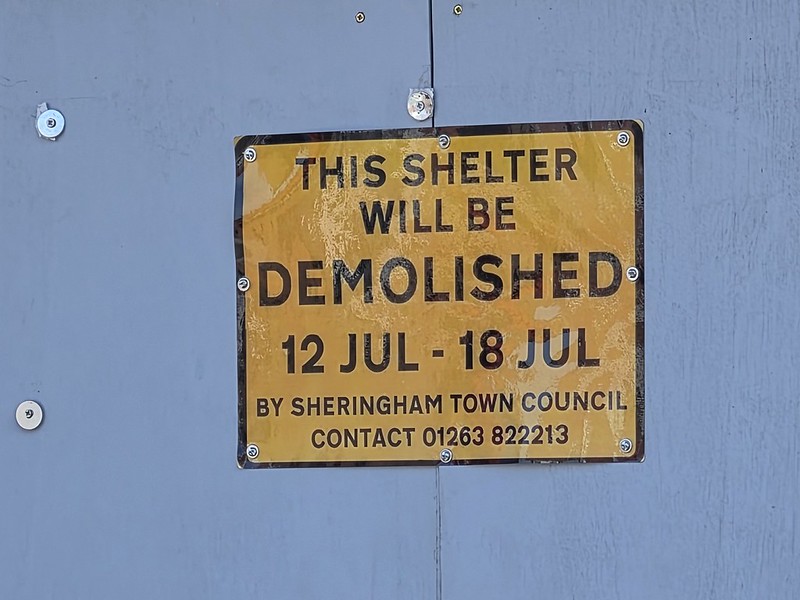
And, both sides of the flanking towers were once similar designs, but they’ve faffed about with one of them. Not to mention where the nice little spirelets have gone. Probably the same way as Sheringham bus shelter, but that’s a different matter.
All told, I’m reassured that the designers of the original building had attention to detail and liked symmetry. I can’t work out exactly when they mauled the frontage about as there have been a few periods of change, but I’m going to blame the Victorians. This may not be entirely fair as some of the changes do predate that period, but I’ve found that it is often a productive starting point.
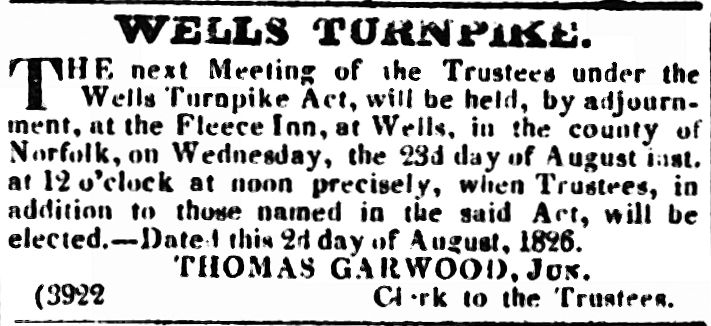
I rather liked this advertisement which was placed in the Norwich Mercury 200 years ago this month. It reads:
“TO THE LOVERS OF THE FINE ARTS.
THE Nobility, Gentry, and Public of Norwich and Norfolk, are respectfully informed, that a
Splendid Collection of ANCIENT PICTURES
Will be opened for Exhibition during the Assize Week and a short time succeeding, at the Assembly Rooms, Norwich.
The Paintings are selected from the Works of the most esteemed Masters of the Italian, Dutch, and Flemish Schools. — Among the former will be found a splendid Picture by Titian, in his early style, with others by Caracci, Pietro da Cortona, Canaletti, &c. &c. The latter will include fine Specimens of the most pleasing character, and of Cabinet size, of the following Masters: — Rubens, Rembrandt, Both, Pynacker, Netscher, Cuyp, Decker, Zorg, Schweikhart, B. Gael, P. Potter, Poelemburg, Stoik, Snyers, De Vlieger, &c. &c.
The Exhibition will be opened from Ten in the morning till Four in the afternoon.
ADMITTANCE — ONE SHILLING.”
The exhibition was aimed at “the Nobility, Gentry, and Public of Norwich and Norfolk” and I think it’s evident that they were expecting really only people from what they might have called at the time the educated and wealthy classes. And even within that the nobility came first, the gentry were safely in the middle and the public were graciously permitted to bring up the rear, provided they had a shilling and behaved themselves near the Titian.
This feels like an early art gallery type set-up, there are some quite impressive artists in that list and the Assembly Rooms would have been quite the cultural hotspot that week. A shilling would have been approximately the equivalent of £7 today. I also went to look into the etymology of the word ‘ancient’ and have ascertained that in the art world of the time, it just meant ‘Old Masters‘ as the paintings weren’t that old at the time.
The Assembly Rooms are still there and they have long been part of the city’s cultural centres, so in that respect not much has changed. It’s a shame I can’t find a list of what artworks were displayed though, it all sounds rather decadent.
The below article appeared in the Norwich Mercury 200 years ago.
“Doctrines of the New Jerusalem Church.
ON Sunday, July 9th, THREE DISCOURSES will be delivered at Crook’s Place Chapel, by the Rev. W. Mason, in which it will be shewn what are the views of the New Church in regard to the Quality of that Faith which justifies, and the true nature of Justification — Who the Lord’s Sheep are, and the Goats contrasted with them — and The Nature of the Christian’s Conquest, and the Rewards promised to the Conqueror.
Service to commence in the morning at half-past Ten, Afternoon at half-past Two, and Evening at half-past Six o’clock.”
The New Jerusalem Church was the Swedenborgianism religion and some of this story links to the St Mary the Less church on Queen Street which I’ve written about before. In short, that church was closed during the Reformation, then given to the religious refugees from the Netherlands to use as a cloth hall, with the building being used for services given in French until 1832. It was then leased to the New Jerusalem church of Swedenborgians who remained here until 1852 and they then moved to Park Lane to a building constructed for them. The church was already though in decline at this stage which is rarely the ideal moment to embark on a new building project and in the 1920s they transferred the building to the Mormons and although it was used by another religious group, it was then sold to become a private residential building. It was never fully converted into a home but is no longer used for religious purposes.
This article from 200 years ago tells a little of the story before the Swedenborgians moved to St Mary the Less, it appears that they were using Crook’s Place Chapel. This is in an area of the city that was changed heavily following the Second World War, but Crook’s Place Chapel appears to have been demolished in the 1880s. And back to the article, it’s an interesting look back that there would have been three services held that day for those interested in finding out more about the church. Those attending would have been no doubt fascinated by the discussions about faith, sheep, goats and conquest, but they probably got to have a nice little sit down.
There were concerns nationally about the stability of the Church of England, with the Church Building Acts of 1818 and 1824 trying to fund new Anglican churches. The Norwich Mercury article captures quite nicely this period of religious competition and general anxiety about picking the right religion.
200 years ago this week the Norwich Mercury printed this article:
“On Monday, during the election, Samuel Chenery, a lad of 16, was detected in picking the pocket of a gentleman, in the market, and lodged in the Vagrant Room in the Hall, where he soon after cut his throat. He was conveyed to the Hospital, and died on Wednesday morning.—Verdict, insanity.”
I’ve written numerous times about how Norwich 200 years ago was a city troubled with crime, poverty and mental instability. I assume that he was taken to St. Andrew’s Hall, which was the city’s workhouse at this time, which is where Samuel Chenery killed himself.
The lad was Samuel Haywood Chenery who was born on 19 March 1810, the son of Thomas Chenery and Elizabeth Chenery (nee Haywood). He was baptised on 25 March 1810 at St. Paul’s church in the city, a war damaged building unnecessarily pulled down in the 1970s for the flyover.
Samuel was buried at St. Augustine’s Church in Norwich on 25 June 1826, although those who died through suicide often weren’t buried in Church of England graveyards. I’m not entirely sure that there would have been a grave to him if the family were poor, but if there was, it’s not there now. Samuel’s Dad, Thomas, died on 12 April 1821 at the age of just 49 and is also buried at St. Augustine’s Church. Samuel’s Mum, Elizabeth, died on 16 May 1852 at the age of 80 and is also buried at the same church.
I do wonder how many times Samuel has been thought of over the last 200 years, whether he has been included in other family trees or his memory has been recorded elsewhere. But it appears from the information available that he was desperate financially and was unable to cope with what life had given him. At 16 years old, he was just a child.
The late night arrival of my flight meant that I knew I’d have to stay at Luton Airport for a couple of hours and then cross over to Stansted Airport by coach before getting a direct train to Norwich. That was the cheapest option and Pret was clean, warm and had power points. Thanks to the staff member for giving me a decadent coffee for a price of a filter coffee, much appreciated.
I was very tempted to book this, all I would have to do is go through security and then a few hours later I’d be in the great city of Tallinn. I showed enormous restraint not to book this £8.99 flight as it would have been easy to get muddled up.
I went outside to look at the coach station and it was still there.
The Stansted Airport coach pulls in.
It was a slightly odd arrangement, the driver said hello and disappeared into the coach. He seems surprised I was still obediently waiting at the door a few minutes later and he didn’t bother checking tickets. This rather made the whole operation feel less like formal transport and more like a man with a coach had agreed to take us somewhere broadly useful, but I’m easy going (well, generally) and so I didn’t query him.
I have a theory that National Express is going into a permanent decline, this service was a third full and was one of the busiest I’ve been on in a while. I looked at some of their prices, and they’re charging ridiculous amounts in some cases where they have a monopoly. That’s great for a while, but Flixbus is going to steal that trade and I can’t see how they’ll get it back. National Express also have fiercely uncomfortable seats with very limited leg room, it’s fortunate that they do shuttle about nearly empty a lot of the time. Incidentally, I didn’t get my usual emergency exit row seat here, which is likely why I forgot about how poor the leg room was in the other seats. Nothing says ‘premium national transport network’ like quietly folding a passenger into a seating position not found in nature, but we shall see what the future holds…..
Safely at Stansted Airport.
I had a few hours to kill so I went looking for bargains and found some in Boots. Note the number of reduced prawn sandwiches which is either a sign of my impeccable timing or a troubling commentary on airport seafood confidence.
Another breakfast of champions. The quality of Boots Meal Deal has declined a lot over the years, that’s another example of greed and then noticing that rivals have stolen a march on them. Still, it was edible, portable and reduced, which is sometimes the holy trinity of travel catering.
I then went down to Stansted Airport’s railway station to get the direct rail service to Norwich. There were no delays which meant no delay repay, but at least I’d be getting home in a timely manner. Punctuality is good, but it’s also rather lovely to have a little financial gesture when things go slightly wrong.
It was relatively quiet all the way to Norwich.
Cambridge South had opened the previous day and it was rather lovely to see it in operation, even if only from the passing train, which is exactly the sort of niche infrastructure excitement that keeps my two loyal blog readers on edge.
I, and the rest of the train, arrived back into Norwich on time and that’s another journey finished. I may or may not post more random stuff about the trip, I’ll leave that as a surprise because suspense is important in travel writing.
Incidentally, it was too hot in Norwich when I arrived.
When in the airport lounge, I could see the Ryanair aircraft arriving into Norwich.
The flight to Faro was the last one of the day and so all felt orderly and well managed. It’s somehow a little better to be in the calmness of an operation about to close down rather than in the midst of chaos and overcrowding. And I don’t think that Norwich Airport is often overcrowded…
We waited outside ready to board the aircraft. I do wonder if they might have covered this area, but maybe now they’ve stopped collecting their £10 departure tax perhaps that investment will have to wait. A new roof is all very well, but one must not rush into these decadent infrastructure commitments I suppose.
Ready to board and it was aircraft 9H-VUJ, which I don’t think I’ve been on before.
I rather like these little steps at the front and these are the ones that fold-up into the aircraft. This is really clever, it saves airport fees, it’s quicker and it allows them to land in more places.
It’s a rather move convoluted affair to board using the rear steps, which definitely do not fold back into the aircraft.
The seating Gods gave me an aisle seat and I was slightly annoyed to find someone sitting in it. He willingly moved, his logic was that he thought the flight would be quiet and so he would sit in the aisle seat rather than the window seat. I did rather think he could have just sat in his actual seat and moved later on, but I kept those thoughts to myself.
As for the flight, the aircraft was a little grimy, but there is a limit to what the cabin crew can do in the 25 minute handover. The crew were friendly and helpful, but they appear to knock into the chairs with their trolleys more than Wizz Air crew. It seems that the Ryanair aircraft are slightly narrowed, as they use Boeing and Wizz Air using Airbus, so I suspect it’s just that. Or perhaps I was just in the trolley danger zone, which would be very on-brand for my travel arrangements.
And safely in Faro. It was too hot.
All of the European Entry System (EES) machines were on and the set-up here is that passengers go through the process using the kiosks and then a member of border force checks the passport but doesn’t stamp it. The whole process took around fifteen minutes which felt reasonable.
The queue for EU citizens was longer but they only had to go through the EES machines and didn’t need to see a member of border control.
There was one of the worst altercations I’ve seen at border control when two people at the neighbouring counter were told that they needed to step aside and wait for someone else to look at their passports. I don’t know why, but the two refused to move. The member of border control shouted at them to move back, then the border control officer who was serving me ran out of his counter and warned that they would be immediately deported. This rather raised the temperature of the room, which was already too hot in Portugal (as I may have mentioned) and therefore did not need further assistance.
The younger of the two women cried and said that she was confused and didn’t know what was happening. I did feel some sympathy, as border control is not the ideal environment in which to become confused or muddled up, especially when the staff are now discussing deportation with the energy of people who very much mean it. But I also quite liked this little bit of excitement, in the limited and selfish sense that it was happening near me rather than to me. My own border control officer then came back and was lovely, which was reassuring. It is always pleasant when someone returns from threatening deportation elsewhere and then smiles at you.
And here is the list of arrivals, because I remain committed to documenting the full glamour of international travel. Aircraft, queues, signage, crisps and border control tension: the modern European journey has everything.
The whole flight was entirely agreeable and it was £20 which is more expensive than my Wizz Air arrangements, but I didn’t have to pay to go to Luton. In terms of efficiency, this worked out well as the Luton rail line was closed after the crash, so this saved a bus replacement service and allowed me to enter the European Union cheaply. A smooth Ryanair flight from Norwich, a local beer beforehand and only a modest amount of border control theatre at the other end. That is about as much excitement as I require from budget aviation. So, all rather lovely.
I haven’t been to Norwich Airport lounge before, or I’ve forgotten if I have. It is a relatively small affair, but it was clean and organised. I do not need a champagne bar, rainfall shower and someone silently folding towels in the corner. I mostly need somewhere to sit, plug something in and eat cheese with the quiet dignity of a person who has walked to the airport, so my expectations were based around that rather than anything too decadent.
The staff here are particularly helpful and engaging, but I think that they know a fair number of the visitors so I imagine that they are commuting to Amsterdam or similar. My first impressions were positive given the friendly welcome and it didn’t look too busy. The lounge remains open for all the flights and there’s the usual rule that there’s a maximum three hour stay.
The food is mainly cheese, mugshots, croissants, cakes and the like.
As well as crisps and fruit.
The view over the airport apron.
There’s a limit of two alcoholic drinks per customer, although I only wanted one and that was an agreeable chilled Woodforde’s Wherry. It’s nice when lounges make some effort to provide local beers and they also had Heineken for those who aren’t fussy about what beer they drink.
On the limited number of alcoholic drinks, I’ve some sympathy for the lounge as some airports are struggling with the number of customers who are treating it as an all you can drink affair. That isn’t quite what lounges were really designed for and it’s forcing the cost of them up, so controversial as it might be, I’d be happy if every lounge limited customers to two alcoholic drinks.
I had a quick espresso although there were some issues with cleaning the coffee machine which I decided that I didn’t want to know more about. There are moments in life when curiosity is a virtue, and other moments when one should accept the coffee, drink it and not ask too many questions.
Dr Pepper, Cathedral city cheese and Mini Cheddars, this is what travel is all about.
This lounge was included in my annual Priority pass card, but walk-up availability can be purchased for £27.50. That’s possibly pushing it a little bit, but the surroundings are comfortable, the staff members were friendly and I was able to have as many crisps, cake and cheese snacks as I wanted. I think that’s a result.