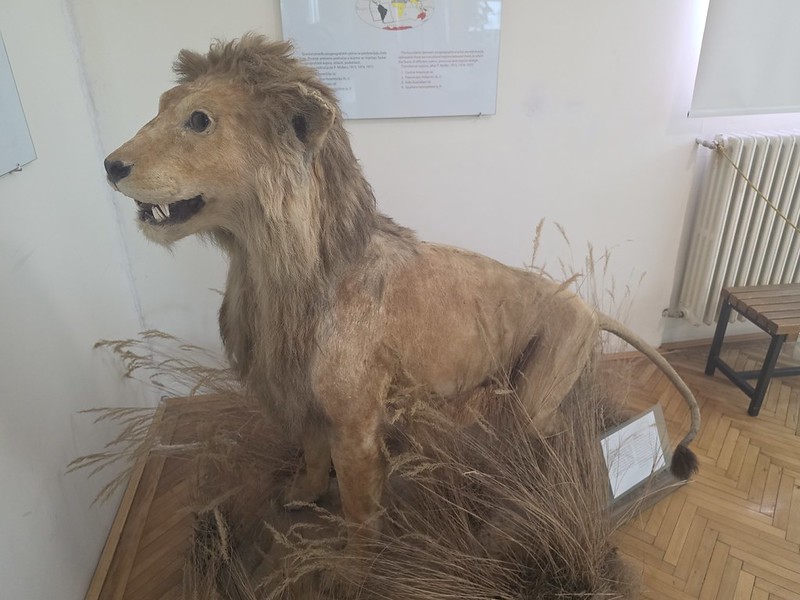
Among the exhibits in the natural history galleries of the National Museum of Bosnia and Herzegovina was this lion, although it appeared to have been assembled by someone working from a description supplied over the telephone. The elongated face, wide eyes and unexpectedly modest mane gave it less the commanding presence of the king of the beasts and more the expression of a slightly startled dog that had just heard someone opening a packet of biscuits.
Taxidermy is an unforgiving business, particularly when the finished specimen is expected to represent an animal normally associated with strength and dignity for decades to come. This lion may not communicate quite the intended degree of menace, but it was certainly memorable and quickly became one of my favourite exhibits. There is something rather endearing about a museum lion that looks as surprised to be there as the visitors are to find it.
This photograph will also be a useful addition to my collection of Artichoke Hearts bar billiards memes, particularly for those occasions when Luke the Lion performs rather more like Luke the Mildly Alarmed Labrador.
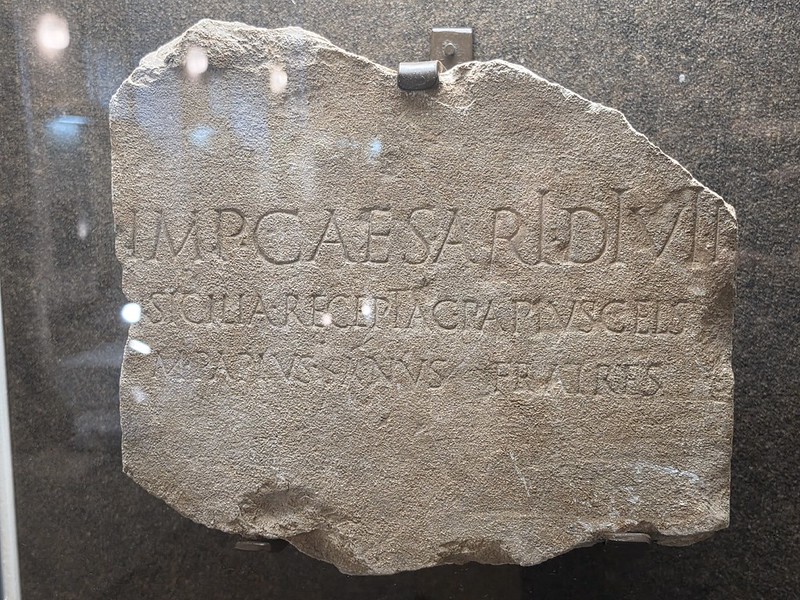
This fragment of stone in the National Museum of Bosnia and Herzegovina came from the base of an honorary monument discovered at Tasovčići, near Čapljina in southern Bosnia and Herzegovina. It was erected to celebrate Octavian’s victory over Sextus Pompey in Sicily in 36 BC, although that perhaps rather understates the amount of fighting involved. I got rather muddled up with all these Caesars, but Octavian styled himself Imperator Caesar Divi Filius, meaning something like “Commander Caesar, son of the divine one”. The divine one was Julius Caesar, who had adopted Octavian as his son and heir and was officially declared a god after his death. Rather nice really.
The monument was erected by two brothers, Gaius Papius Celsus and Marcus Papius Canus. Researchers believe that they were probably merchants associated with nearby Narona, an important Roman settlement and trading centre on the River Neretva. Publicly honouring Octavian may have expressed gratitude or political loyalty, although it probably did the brothers no harm to advertise that they had supported the emerging winner. Some things never change.
Only part of the inscription survives, but there is still enough to preserve the names of the brothers and the ruler they wanted to impress. Octavian would go on to become one of the most famous people in history, while the Papius brothers are remembered largely because they paid for what was effectively a very durable press release.
As for why I stared at this for far too long, I liked the thought that it was erected more than 2,000 years ago, survived everything that followed and is now safely displayed in a museum. Admittedly, a few pieces have fallen off, but after that length of time it is entitled to have developed some minor structural concerns.
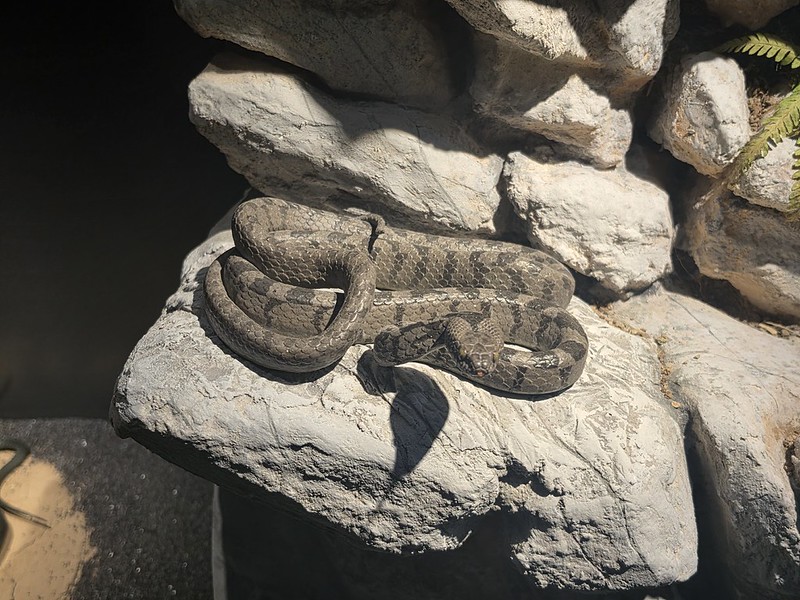
I don’t like snakes. It’s nothing personal, it’s just that they seem very scary to me, so I do my best to stay well away from them. Unless they’re in zoos or dead ones in museums, then I’m quite intrigued by them. The National Museum of Bosnia and Herzegovina had quite a collection of them, so, for the sake of completeness, I thought that I’d take a photo of them all.
Here are a couple of grass snakes playing. Grass snakes are strong swimmers and the name of their genus, Natrix, comes from the Latin for a water snake, probably influenced by the word natare, meaning to swim so this means that even entering the water is no guarantee of escaping them, which seems like a serious design flaw.
A dice snake. Its scientific name, Natrix tessellata, means something like tiled or mosaic-patterned, referring to the square markings which give the snake its dice-like appearance. It spends much of its time in or near water and feeds mainly on fish.
Two Balkan whip snakes. The word whip refers to their long, slender bodies and considerable speed rather than any tendency to whip passing museum visitors. They are non-venomous, which is a modest source of reassurance.
A Caspian whip snake playing with a mouse. This is one of Europe’s largest snakes and particularly substantial individuals can exceed two metres in length. The mouse appears to be having a less enjoyable game.
A Dahl’s whip snake. Its name honours the Austrian naturalist Georg Dahl, who collected the specimen used to describe it in Dalmatia in 1824.
Two smooth snakes which take this name because their scales lack the raised central ridges found on many other snakes. Their scientific name, Coronella, means little crown and probably refers to the dark marking on the top of the head.
An Aesculapian snake which is named after Aesculapius, or Asclepius, the ancient god of medicine whose staff entwined by a snake remains a medical symbol today. These snakes are also excellent climbers so the bloody things can lunge off trees if necessary.
A European rat snake which is also known as the leopard snake because of its blotched markings. It is non venomous and feeds on rodents, hence its name.
A four-lined snake and the name comes from the four dark stripes running along the bodies of adults, although younger snakes begin life with blotches.
A European cat snake and this takes its name from its vertical pupils, which resemble those of a cat. It is rear fanged and mildly venomous, because having unsettling eyes was evidently not considered enough.
An eastern Montpellier snake. The Montpellier part of the name was inherited from its western relative, whose scientific name refers to the French city. It is another rear fanged snake, although serious encounters with humans are uncommon when both parties behave sensibly.
Two nose-horned vipers and the horn is made from soft scales and is not a weapon, although the rest of the venomous snake remains quite sufficient.
Two European adders. The name developed when the old expression ‘a nadder’ was gradually redivided into ‘an adder’. It is the only venomous snake native to Britain, although Bosnia appears to offer a considerably wider selection for anyone dissatisfied with that.
A meadow viper and its scientific name, Vipera ursinii, honours the Italian naturalist Antonio Orsini. Unlike many vipers, it feeds heavily on insects such as grasshoppers and crickets, making it slightly less alarming provided that you are not a grasshopper.
There seem to be an awful lot of snakes in this region and I’m glad that I only visited the museum after walking around the countryside, where it appears that all these reptiles are slithering about without supervision. I accept that most snakes are probably perfectly well behaved, but it is the troublesome minority that concerns me.
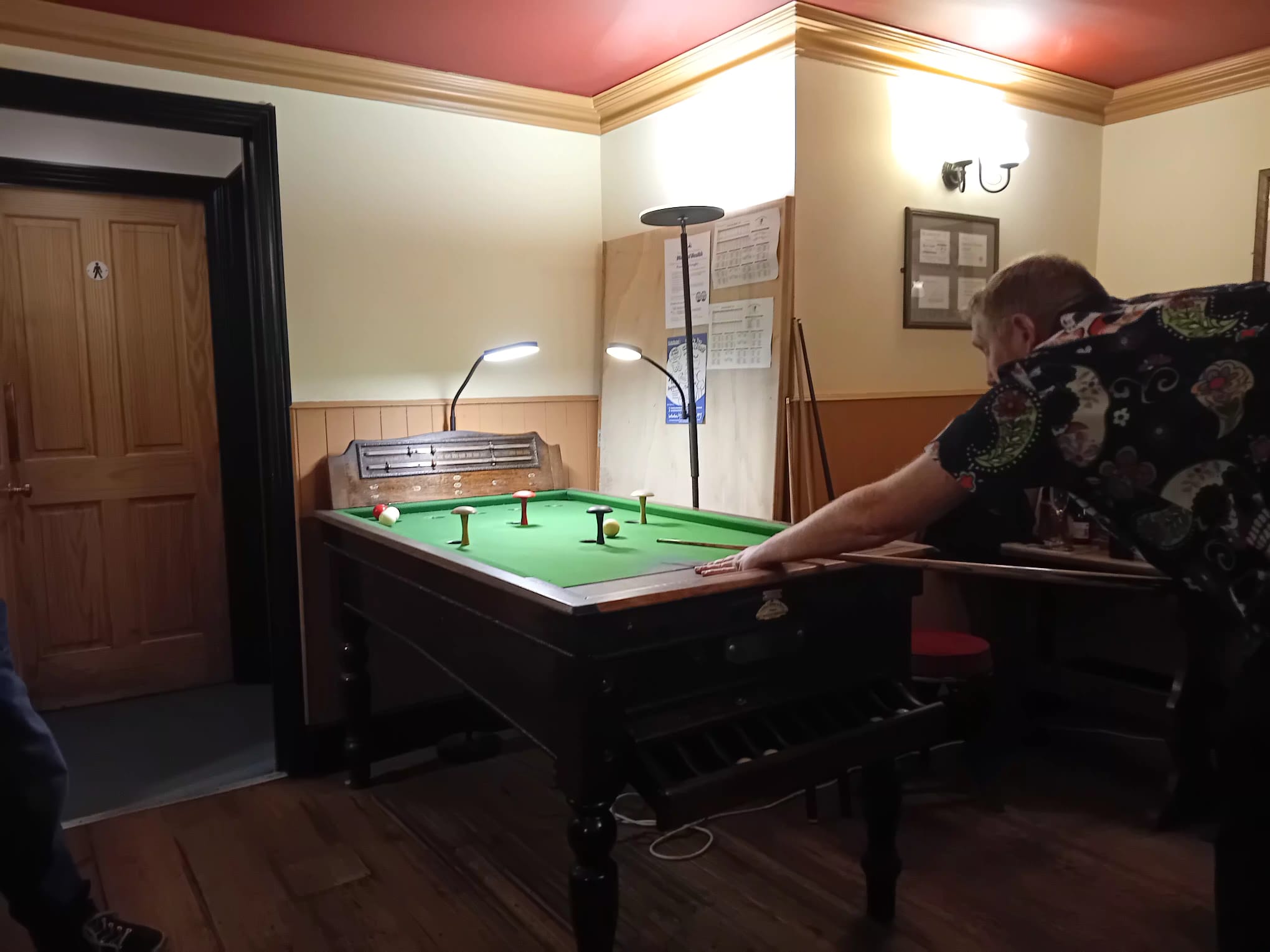
Just a brief post for this game, as I wasn’t there. The team therefore had to manage without me, which they appear able to do with alarming ease. Here’s Ivan preparing for his latest approach of attempting increasingly risky shots. I’m not entirely sure that I approve, although this has never stopped him before.
Here’s Vaughan on his way to a win during a set of singles results that weren’t entirely optimal. I’d also like to welcome Ian to the team, as it’s always good to acquire some new talent. I should probably mention that Ivan won his singles game too, since he has already mentioned it to me more than once.
Luke said that Face was surprised by just how unlucky we were. This is reassuring, as it means the result can be attributed to misfortune rather than any possibility that the other team played better.
It finished in a 5–4 defeat, but that is close enough that we cannot complain too much. Well, I can complain to Luke, but experience suggests that this will achieve very little. I’m told that it was a fun evening, which is the main thing. If nothing else, we beat the Black Stars this year, and I intend to keep mentioning that for as long as necessary.
On the bright side, it looks as though we’re going to finish just outside the play offs. This conveniently removes the danger of being promoted at the end of the year, a burden for which few of us are emotionally prepared. I’m told that everyone contributed to another excellent evening of bar billiards. More importantly, I’ll be back for the next one, which will no doubt be a relief to Luke who I think struggled without me.
After our excitement at the former bobsleigh track at Mount Trebević, I put food to the front of my mind, once again, and I thought that Trio Cuisines would be a marvellous choice. There was a nice outside area that Jonathan was eyeing up, but we somehow ended up sitting inside.
It was quite busy when we entered, but I took this photo towards the end of the meal when it was a little quieter. The surroundings were clean and modern, the team members were friendly and they had air conditioning. After trudging around the city in the heat, this was most welcome.
The restaurant serves three different styles of cuisine, hence its name, including Middle Eastern, Italian and I think Bosnian, although it wasn’t entirely clear to me. Calling a chicken biryani Middle Eastern is perhaps pushing culinary geography to its limits, but there are historical trade links if I’m being generous.
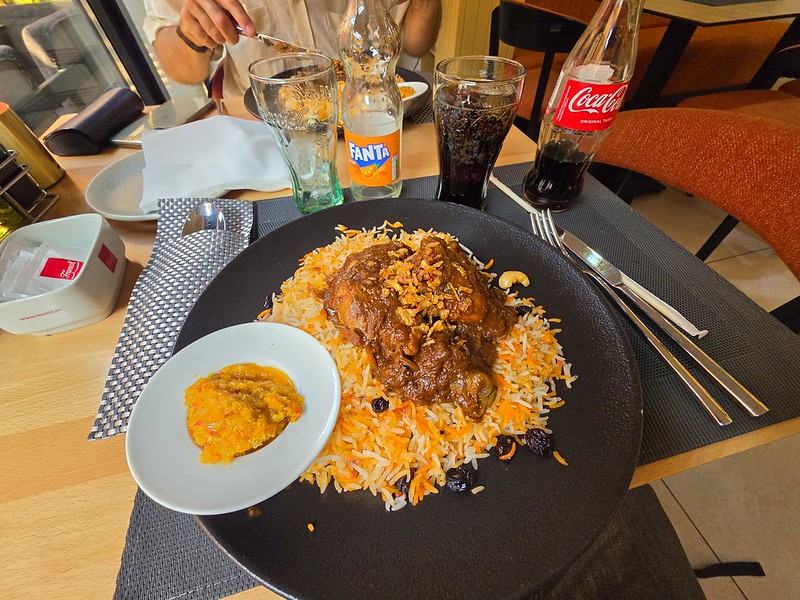
I went for the chicken biryani and that inspired Jonathan to have the same which I privately thought was a bit sub-optimal, but I didn’t say anything. The Fanta and Coke are both mine, I’m not sure how Jonathan ploughed through all of that without a drink. Anyway, the basmati rice was light and fluffy, looking suitably colourful and appetising. The chicken was on the bone, which I think is a slight faff, but that minor poultry grievance aside, the chicken was tender and the sauce was rich in flavour. It was served as a large portion, with a side dish of mango achar to add some extra taste.
I liked it here, the prices were reasonable, the food was decent and it was a comfortable place to sit before we hiked up the hill to find our next apartment. I’m the last person to complain about hot weather and hills, but I wasn’t entirely looking forward to the next part of our adventure.
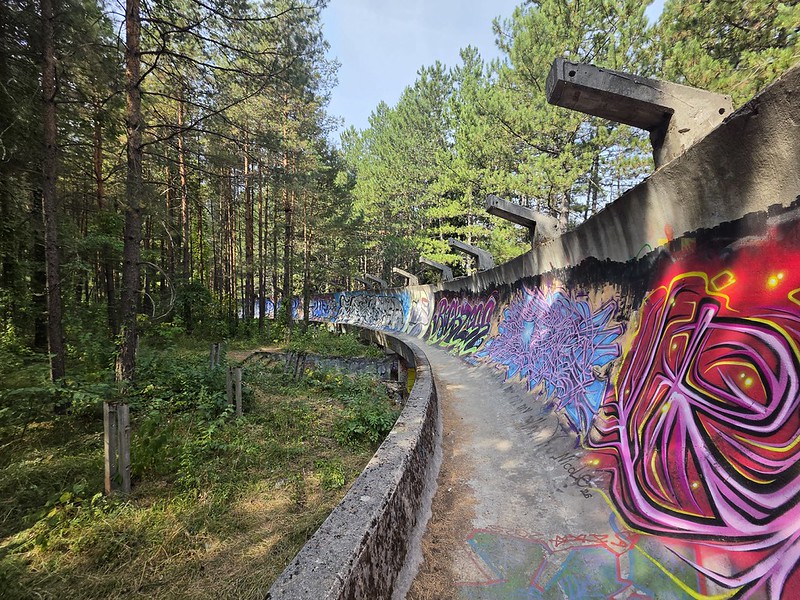
After travelling up Mount Trebević by cable car rather than tiring ourselves out, Jonathan and I walked to the remains of Sarajevo’s Olympic bobsleigh and luge track. The reinforced-concrete course was built after Sarajevo won the right to host the 1984 Winter Olympics, with construction beginning in 1981 and finishing the following year. It runs for approximately 1,300 metres through the forest and contains thirteen bends, which looked interesting enough at walking speed and presumably rather more consequential when approached in a bobsleigh. I like to think that this is something that I would have been good at, but, realistically, I would have tried to go down as slowly as possible and I’m not sure how practical that is.
The track staged the 1983 European Bobsleigh Championships as a rehearsal before hosting the bobsleigh and luge events at the 1984 Winter Olympics. Around 30,000 spectators attended the Olympic bobsleigh competition and another 20,000 watched the luge, while East Germany dominated the bobsleigh events by winning both gold medals. The Games are still remembered with considerable affection in Sarajevo, making it rather strange to see one of their principal venues standing silent and covered in graffiti only a few kilometres from the city centre.
The concrete visible today was never intended to be the actual racing surface. Refrigeration pipes embedded beneath it cooled the course before workers repeatedly sprayed it with water, gradually building and shaping a smooth layer of ice. The bends then guided the sleds around the course at speeds which made accurate steering rather important. Without the refrigeration system, the track is simply a long concrete channel, although this had the considerable advantage of allowing us to walk along its entire length and I am barely capable of walking on ice at the best of times.
Some of the concrete sections appear to shoot away from the main course, but these were apparently part of a particularly clever feature of the original design. Mechanical switching blocks allowed the track to be divided into three shorter, independent courses for training and recreational use. The first could leave the main run after bend three, the second after bend seven and the third continued through the fastest lower portion, including bends known as Omega, the Hairpin and the Labyrinth. Different starting points were also used for bobsleigh and the various luge events, as it was considered unnecessary to give every competitor the full opportunity to terrify themselves. I’m not sure that I can visualise how all this worked as the bits of concrete are in opposite directions, but I’m sure it made sense once.
After the Olympics, the track continued to host international competitions, but that sporting future ended during the Bosnian War. Mount Trebević became a strategically important position during the Siege of Sarajevo and Bosnian Serb forces used parts of the track as artillery and defensive positions overlooking the city. Holes were cut through the concrete walls and the start buildings, refrigeration plant, pipes and switching equipment were badly damaged or destroyed. Limited restoration began in 2014 after the surrounding area had been cleared of mines, allowing the surviving course to be used for summer luge training, which uses wheels rather than ice, as well as walking and mountain biking.
The concrete structure remains sufficiently intact that complete restoration is technically possible, and several proposals have been made to return it to competitive use. Unfortunately, replacing the refrigeration system, start houses and switching equipment while meeting modern safety standards would amount to an expensive reconstruction rather than a modest repair. Plans connected with a possible Barcelona-Pyrenees bid for the 2030 Winter Olympics did not progress after that bid fell away, so for now the track remains an extraordinary mixture of Olympic venue, war ruin, street-art gallery and woodland footpath.
For anyone wanting to see the track as it was in 1984, this is quite an exciting video. I hadn’t realised that it was possible to walk the entire length of the track, which surprised and delighted me. Given that, I wanted to include quite a few photos which I’m sure is a treat of sorts for my extensive readership of about three. Apologies that I haven’t captioned every photo, but it’s going to be hard to come with unique commentary for random bits of luge track.
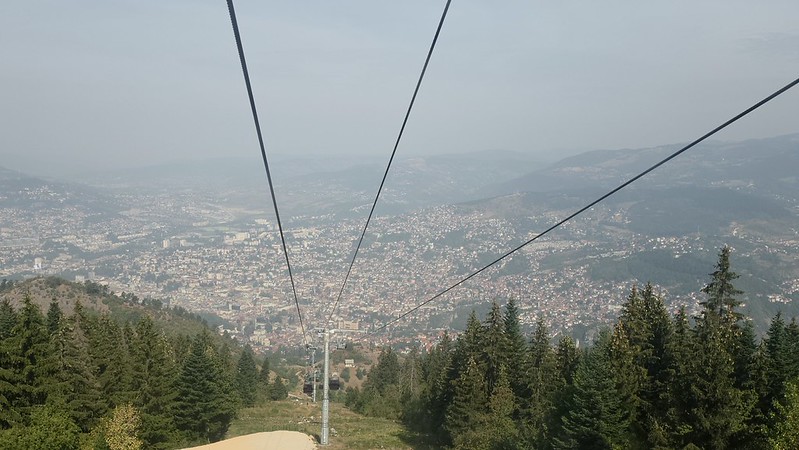
Jonathan and I decided that it would be a good idea to get a better view over Sarajevo, something the city makes remarkably easy by providing a cable car up the slopes of Mount Trebević. The Sarajevo Cable Car carries passengers from its lower station in Bistrik to the slopes of Mount Trebević, climbing from the city to more than 1,100 metres above sea level. Our journey lasted for over ten minutes, rather longer than I had expected, although the spectacular views meant that I was in no hurry for it to end. I videoed the entire journey and that footage will soon become available for particularly fortunate readers of this blog. Unfortunately, it must first undergo the demanding technical process of me remembering to upload it, so that will have to wait.
The original cable car opened on 3 May 1959, following a route of just over two kilometres between Sarajevo and Trebević. It became one of the city’s best known attractions and carried generations of residents into the mountain air, later providing access to the area used for the 1984 Winter Olympics. The original journey took around twelve minutes, so our slightly leisurely ascent was historically authentic. Years of wear eventually took their toll and the system was closed on safety grounds in 1989, before the outbreak of the Bosnian War.
During the Siege of Sarajevo, the cable car and its stations were extensively damaged and the system was left unusable for more than two decades. A complete reconstruction finally began in 2017, with 33 modern gondolas installed along the historic route, and the cable car reopened on 6 April 2018, Sarajevo City Day. The reconstruction received crucial support from Dutch born American businessman Edmond Offermann and his Sarajevo born wife Maja Serdarević, who donated around US$3.9 million towards bringing the cable car back into service. Offermann had travelled on the original cable car with Maja in 1991, shortly before the war, and later became one of the driving forces behind its restoration.
Its return represented considerably more than the restoration of a tourist attraction, reconnecting the city with a mountain that had once represented leisure, then war and finally recovery. It now provides an exceptionally scenic journey and, more importantly, allows visitors to climb several hundred metres without undertaking any of the traditional and deeply unnecessary uphill effort. This suited me perfectly, as mountains are things I prefer to admire rather than ascend manually.
Until the full cinematic production becomes available, here are some stills from the journey.
The rooftops of Sarajevo gradually receded beneath us as the gondola climbed away from Bistrik.
The higher we climbed, the clearer the city’s position within its surrounding mountains became.
Approaching the upper station, the dense city gave way to the wooded slopes of Trebević.
Perhaps the only lingering mystery here is how the Communications Officer of the Long Distance Walkers Association has constructed a personal definition of walking which apparently excludes anything going upwards.
Few patches of pavement have had such disproportionate consequences for world history and this was also the site that I most wanted to see in Sarajevo. This plaque marks the street corner in the city where Gavrilo Princip shot Archduke Franz Ferdinand, heir to the Austro-Hungarian throne, and his wife Sophie on 28 June 1914. Princip fired twice at close range after their car stopped beside him, fatally wounding Sophie in the abdomen and Franz Ferdinand in the neck. The assassination triggered the July Crisis, which drew Europe’s competing alliances into the First World War just over a month later.
The site also has a connection with Adolf Hitler as a different plaque erected here in 1930 celebrated Gavrilo Princip as a herald of freedom, but it was removed after German forces occupied Sarajevo in April 1941. The plaque was presented to Hitler for his 52nd birthday and a photograph survives of him examining his new and rather historically loaded gift. It was later displayed in a Berlin museum before disappearing in 1945, adding yet another political interpretation to a street corner which has repeatedly been redesigned according to whoever happened to be in power.
The car displayed outside the museum is a replica rather than the vehicle in which the couple were travelling. Earlier that morning, another conspirator had thrown a grenade at the procession, injuring members of the following party. Franz Ferdinand later decided to visit the wounded in hospital, but the change of route was not properly communicated and his driver turned into the wrong street beside the Latin Bridge. The car stopped while attempting to correct the mistake, placing the couple almost directly in front of Princip. The original Gräf & Stift car is preserved at the Museum of Military History in Vienna, which I naturally failed to visit when I was there. It has now been added to the increasingly unmanageable list of places requiring a return journey.
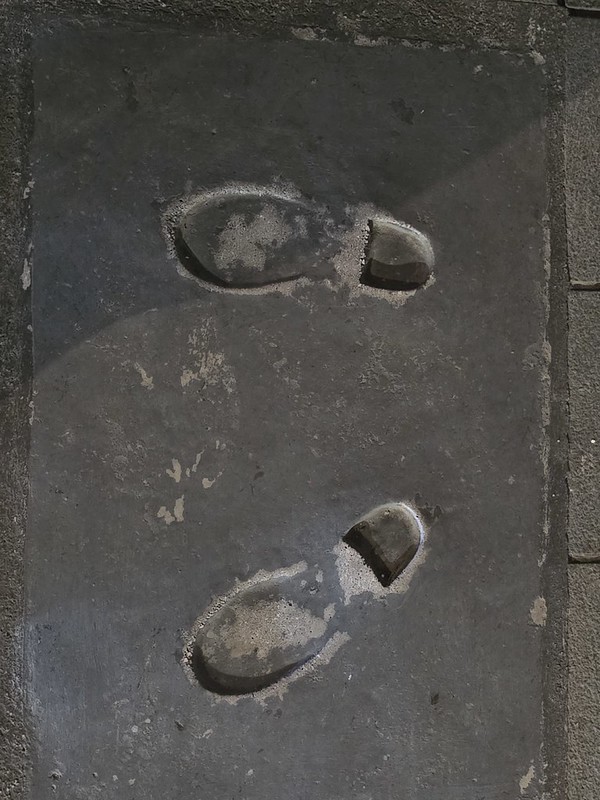
The footprints are intended to mark the position from which Princip fired, although these are modern recreations rather than impressions surviving from 1914. Concrete footprints were first installed here in 1949, when socialist Yugoslavia presented Princip as an anti-imperialist freedom fighter. They were removed at the beginning of the Siege of Sarajevo in 1992 as interpretations of Princip and his legacy changed once again. The footprints were restored in 2022 and it was a strange sensation to stand in the marked position, looking at what is now an ordinary and busy street corner but also one of the most consequential locations in twentieth century history.
The building behind the plaque now houses the Museum of Sarajevo 1878–1918, but in 1914 it was occupied by Moritz Schiller’s delicatessen. We didn’t get a chance to visit this museum, but it’s one that I’ll likely pop into if I return to Sarajevo in the future. Anyway, it might not be the site that many people have on their bucket list to visit, but I’m pleased to get the chance to see this.
The previous post ended with the sub-optimal news that we had been deposited at East Sarajevo Bus Station, rather farther from the city centre than we had expected. My mobile plan had included data roaming in Montenegro but not Bosnia and Herzegovina, leaving us without an easy way to work out how to fix the situation. It was too far to walk, particularly in the considerable heat, so we needed a plan.
Our plan involved walking until we found somewhere with shops and, ideally, Wi-Fi. Fortunately, we soon encountered the universal sanctuary of the stranded traveller, a shopping centre. It had Wi-Fi, a supermarket and somewhere to change money, so all our immediate requirements were met.
Jonathan changed some money, I acquired snacks and, using the shopping centre’s Wi-Fi, I plotted a route into the city centre. I was pleased to discover what appeared to be a direct journey on the 103 trolleybus.
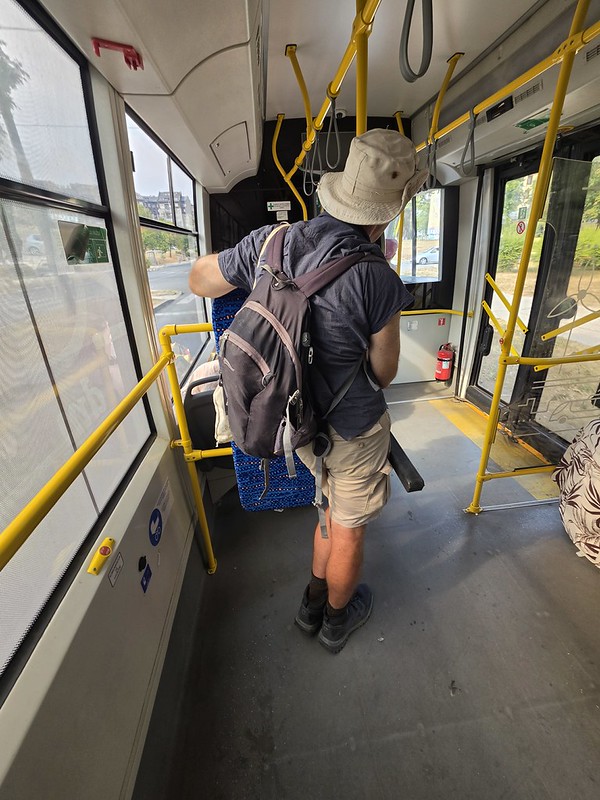
We waited for the 103 trolleybus, but it never appeared. Several 108s passed instead and we were just about to abandon the plan and return to the shopping centre in search of another one when a driver noticed our confusion. He asked whether we needed help, which we very much did, and kindly told us to get aboard. He would make sure that we reached the tram line into the centre and we were very grateful for his assistance.
Jonathan managed to look remarkably casual while neither of us had much idea what was happening. The driver was also helping another passenger and eventually dropped us at the main tram line into central Sarajevo. His kindness made an otherwise confusing journey considerably easier.
At the tram stop, we discovered that tickets needed to be purchased with cash from the driver. The process felt slow and clunky, particularly after Belgrade had made its entire public transport network free. The tram was also extremely crowded, apparently because of a football match that evening, and we encountered some impressively determined use of elbows from our fellow passengers that was absolutely not ideal. By the time we escaped, hot, slightly battered and grumpy (well, I was grumpy, Jonathan wasn’t), my first impressions of Sarajevo’s public transport were not especially charitable. Admittedly, arriving at the wrong bus station without mobile data and then attempting the journey during a football crowd may not have constituted the fairest possible assessment, butI was confident that I would calm down eventually, probably within a few days.
Whatever I thought of the transport system, the driver who noticed our confusion and went out of his way to help us had been exceptionally kind. And given that Jonathan was still cheery, I did debate that Sarajevo’s principal public transport difficulty may have been one particular British passenger.
We were back on the road after the first part of the expedition and I was pleased to see the driver demonstrating his ability to multitask by driving while using his phone.
Following the formalities at the Montenegrin checkpoint, we climbed back into our increasingly adventurous minibus and continued across the border into Bosnia and Herzegovina. We had another short wait at the Hum border checkpoint while the Bosnian authorities checked our passports. Hum is located within Republika Srpska, one of the two political entities which make up Bosnia and Herzegovina. They did not need to inspect us individually, as the driver simply carried a job lot of passports into the office. It was an efficient system, provided everyone eventually received the correct identity back and I’m pleased to say that they did, although we did have an extra passport for a while.
Around ten minutes after crossing the border, we entered Foča, an attractively situated town beside the River Drina with an exceptionally dark recent history.
Foča was the scene of some of the worst atrocities committed during the Bosnian War. Bosnian Serb forces conducted a campaign of ethnic cleansing against the town’s Bosniak population, involving killings, forced displacement, unlawful imprisonment, torture and systematic sexual violence. Several of those responsible were subsequently convicted of crimes against humanity by the International Criminal Tribunal for the former Yugoslavia.
We stopped in Foča for a short while, allowing passengers to visit the café or use the facilities. I tend to regard these interruptions as an unnecessary delay to the important business of arriving, whereas Jonathan considered them a welcome part of the journey. One of us was clearly better suited to coach travel.
During the later part of the journey, the driver opened the passenger door while we were moving to provide some improvised air conditioning. I appreciated the sudden flow of cool air, although Jonathan had to ensure that neither his bag nor he followed it out of the vehicle. I was very pleased with the whole arrangement.
I had visions of Final Destination 2. The countryside that we went through was beautiful once again, although photographing it whilst holding on for dear life in the front seat was more challenging, so I concentrated on road photos.
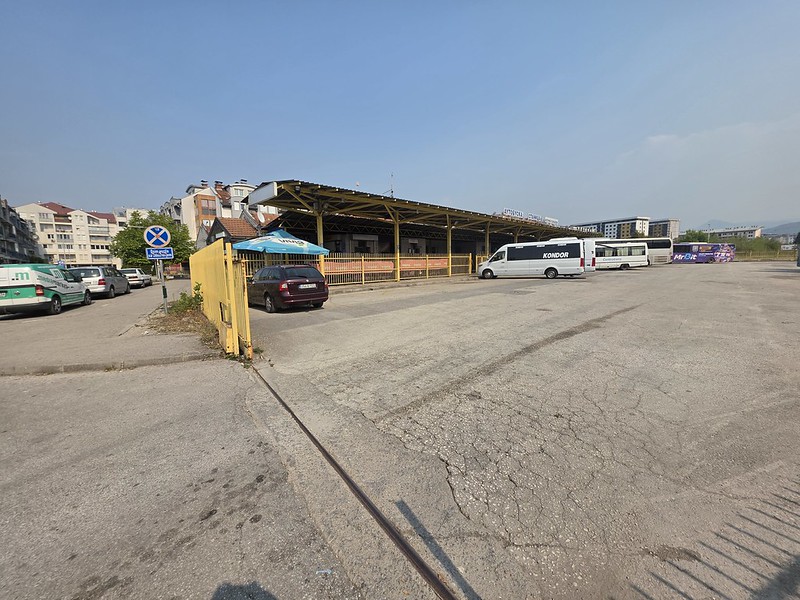
Against several reasonable expectations, we arrived safely at East Sarajevo Bus Station in Lukavica. The safe arrival was welcome, but the location was not, as we had assumed that the service would terminate at Sarajevo’s central bus station. East Sarajevo turned out to mean a separate city within Republika Srpska rather than merely the eastern side of central Sarajevo. Resolving that little geographical misunderstanding will feature in the next blog post. Oh, the anticipation once again.
As a final note, I would add that the bus journey was a very enjoyable one, the driver was engaging and personable, the bus didn’t fall apart and we got there in time. So all rather lovely.