
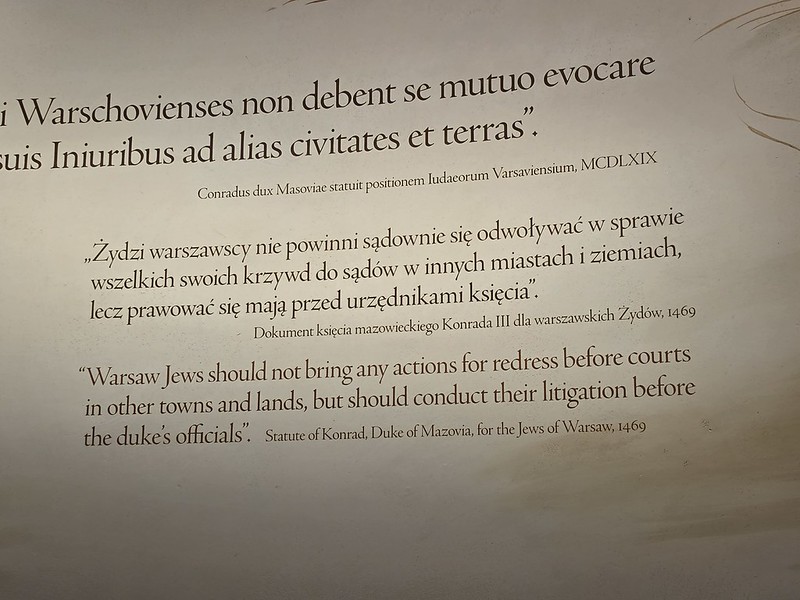
“Warsaw Jews should not bring any actions for redress before courts in other towns and lands, but should conduct their litigation before the duke’s officials.”
I photographed this quotation at Warsaw’s POLIN Museum, where it is attributed to a 1469 statute of Konrad III, Duke of Mazovia. In practical terms, it forced Warsaw’s Jews to seek justice through the duke’s officials rather than taking their grievances to courts in other towns and territories. This did not deny the Jewish community access to justice altogether, and ducal jurisdiction could offer protection against hostile local authorities. However, the wider provisions restricted Jewish communal rights, reinforcing the duke’s control over how the community managed its affairs. It is perhaps best understood as a restriction on Jewish rights within a system where protection depended heavily on the ruler, rather than on equal rights shared by all inhabitants.
The quotation belongs to a history in which coexistence and exclusion existed alongside one another in the city. Jewish and Christian residents of fifteenth-century Warsaw traded, conducted business and appeared in court together, but economic rivalry and religious hostility increasingly strained those relationships. In 1527, a royal privilege prohibited Jewish residence in Old and New Warsaw and their suburbs, formally excluding a community that had already been part of the town’s life for generations.
Jews were still permitted into Warsaw while the Sejm (the Polish parliament) was in session, and some secured temporary stays by other means, such as a ticket allowing a fortnight in the city. It meant that permanent residence wasn’t a right for the Jewish community and controls were tight. By the middle of the eighteenth century the community had built their own self-governing structures, although the authorities did not formally recognise a Jewish community in Warsaw before the Prussian takeover and recognised the one in Praga only in 1775 and in the main part of the city on the west bank after 1795. The situation remained strained to say the least. There were partial expulsions accompanied by street attacks in 1775 and 1790, and in 1792 the town’s burghers had Jews driven out as the Sejm went into recess.
It’s a reminder that anti-Jewish prejudice had a long history before the twentieth century. That history was neither uniform nor an inevitable progression towards the Holocaust which ultimately nearly entirely destroyed the Jewish community in Warsaw, but it repeatedly meant that Jewish residents had to negotiate rights and protections that their neighbours could more routinely take for granted.