
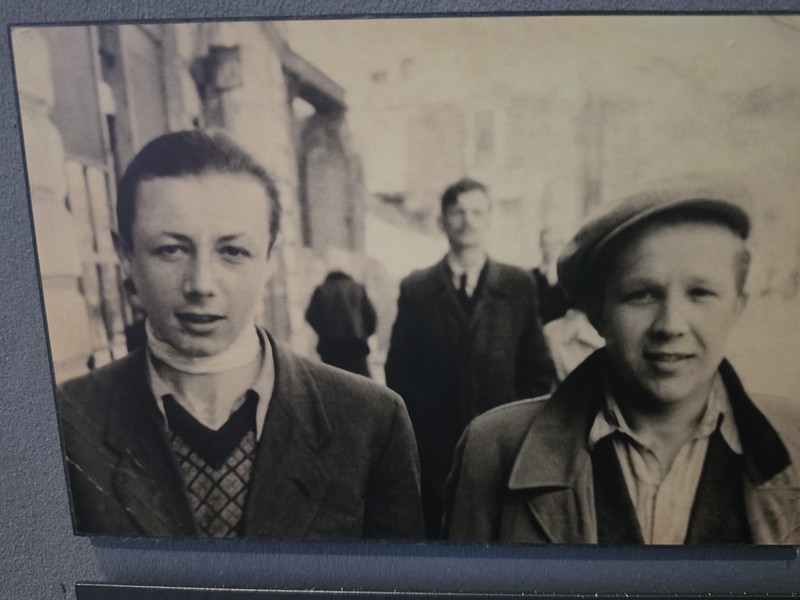
As we were in Warsaw on a Thursday, it seemed a sensible time to take Roy, Jen and Richard to some museums as it was free admission day. One of those was the POLIN Museum which I’ve visited numerous times before, which is the museum of the history of Polish Jews.
At first glance, this photograph at Warsaw’s POLIN Museum looks like a fairly ordinary street scene, with two young men close to the camera and another walking behind them. It was taken on Krakowskie Przedmieście in May 1943, however, placing it during the destruction of the Warsaw ghetto. On the left is the Jewish resistance fighter Simcha Rotem, known as “Kazik”, with the Polish Stefan Sawicki, also known as Siewierski, on the right. Behind them is Yitzhak Zuckerman, known as “Antek”, another important figure in the Jewish underground.
Anyway, this all interests me as Rotem has a fascinating talk which is available on Youtube.
In the video he talks of being in Warsaw when the Germans entered the city and he mentioned that for a while there was some sort of normality. Then the attacks on the Jews came with considerable force, but he says that some of the community thought that it would pass, as they remembered the respectful way that the German forces treated Jews in the First World War. He talks about how the ghetto was about breaking their spirit and their will of resistance.
He then talks about the bravery shown all around the ghetto in smuggling in food, in maintaining education, securing weaponry and trying to hold things together. Then in July 1942 the Germans promised three kilograms of bread and one kilogram of marmalade for anyone who met at what transpired to be a deportation point. Enough people believed them to make the transportation easy for the occupiers and Rotem talks about how it became known in the ghetto about what was happening at Treblinka concentration camp which is where the transportation was going. He said that despite this, there was still a feeling amongst some that surely the Germans wouldn’t kill everyone. There was then a debate about a revolt, even though this would likely mean the death of everyone in the ghetto due to reprisals. It was a moral quandary, but they felt that they had to revolt and this began on 19 April 1943.
I won’t recount all of Rotem’s story about how he bravely fought in the uprising, but in short, as German forces burnt the ghetto, Rotem helped organise an escape for surviving fighters. He reached the city outside the walls and made contact with Zuckerman, before returning through the sewers in an effort to find people still alive. On 10 May, several dozen fighters emerged through a manhole on Ulica Prosta and were taken by lorry towards Łomianki, outside Warsaw. Incredible bravery and a story that I wouldn’t have known without the POLIN museum photo.
Rotem was one of the last two surviving fighters of the Warsaw Ghetto Uprising and he died in 2018 at the age of 94.