
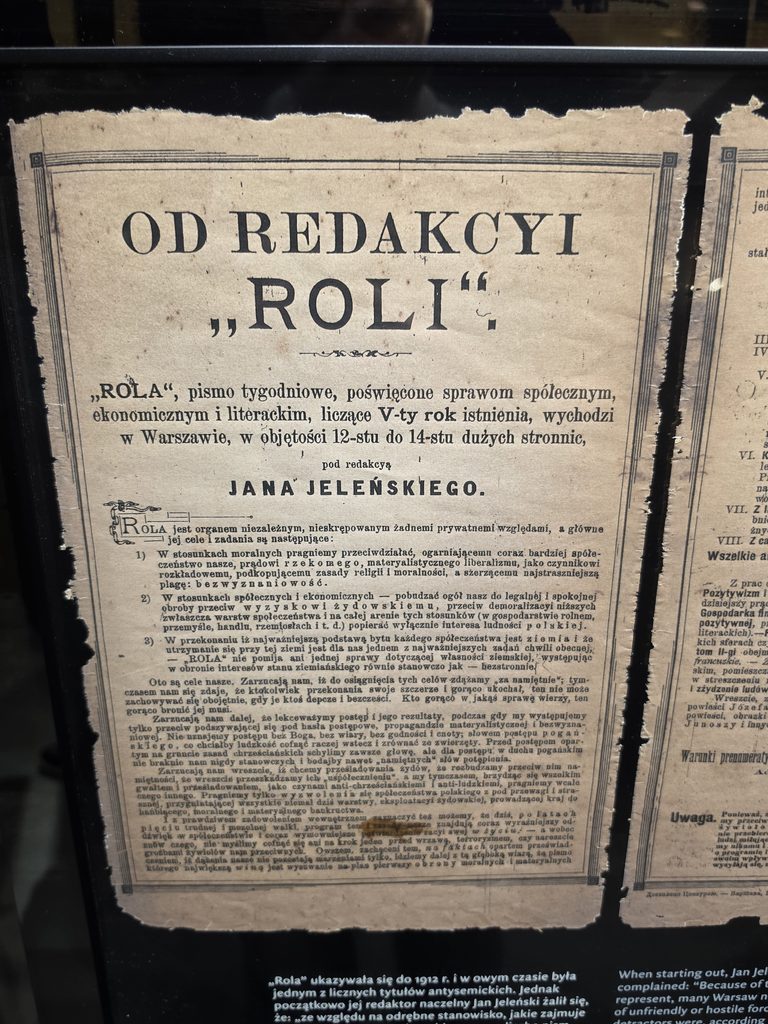
These two pages on display at Warsaw’s POLIN Museum set out the aims of Rola, a weekly publication first published in 1883 and edited by Jan Jeleński. Its introduction sounds conventional enough, describing a periodical covering society, economics and literature. Reading further, however, reveals an explicitly antisemitic programme, presented alongside fiction, agricultural advice and commercial information. The following extracts are translated from the Polish, retaining the publication’s prejudiced language.
“Rola”, a weekly periodical devoted to social, economic and literary matters, now in its fifth year, is published in Warsaw, comprising twelve to fourteen large pages, under the editorship of Jan Jeleński.
Rola is an independent organ, unconstrained by any private considerations, and its principal aims and tasks are as follows.
- In moral matters, we seek to counteract the increasingly pervasive current of supposedly materialistic liberalism in our society, as a disintegrating force undermining the principles of religion and morality and spreading the most terrible plague — religious unbelief.
- In social and economic matters, to encourage our society towards lawful and peaceful defence against Jewish exploitation, against the demoralisation of especially the lower strata of society, and throughout these relations — in agriculture, industry, trade, crafts and so on — to support exclusively the interests of the Polish population.
- In the conviction that land is the most important foundation of every society’s existence, and that retaining possession of that land is one of our most important tasks at the present moment, “Rola” neglects no matter concerning landed property, defending the interests of the landowning estate as firmly as it does impartially.
It’s not hard to see here the equivalents used in politics today and also the persistent undercurrent of hatred that was directed at the Jewish community. The editors presented their campaign as a response to a supposed threat, inviting readers to understand discrimination as protection of their own community. The distinction between Jewish interests and those of the “Polish population” also placed Jewish residents outside the national community as the publication defined it. A later passage, translated approximately, develops the same argument.
Finally, we are accused of wishing to persecute Jews, of inciting hatred against them, and ultimately of obstructing their “social integration”; yet, abhorring above all violence and persecution as anti-Christian and anti-humanitarian acts, we desire nothing other than the liberation of Polish society from the crushing predominance and terrible exploitation which enslaves almost all its classes and leads to shameful moral and material bankruptcy.
Having denied promoting hatred or persecution, the editors immediately repeated sweeping accusations against Jews as a group. They described their own position as Christian and humanitarian while depicting Jewish economic activity as a source of national degradation. Still today there are politicians who talk about their Christianity whilst espousing views that don’t appear very Christian to me.
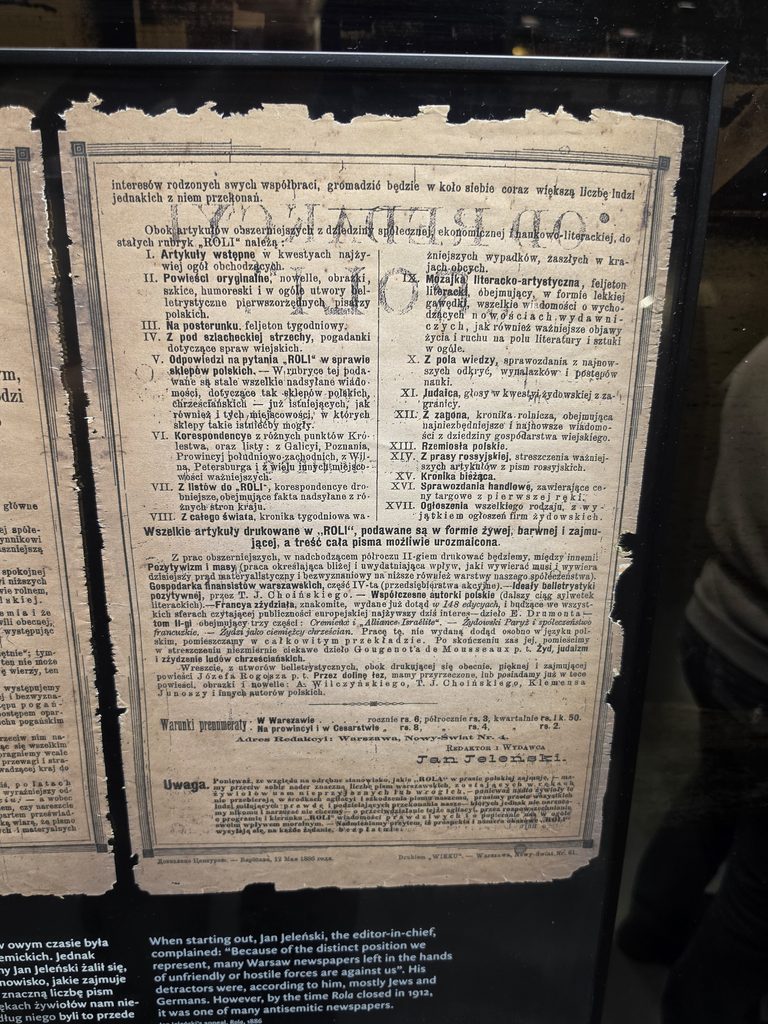
The publication’s programme also extended beyond arguments on the printed page into decisions about where readers should spend their money. Among its regular features were leading articles, fiction, a weekly column called “On Guard”, rural affairs, correspondence, foreign news, literature, art, scientific developments and commercial reports. Alongside these came a section encouraging the development of specifically Christian businesses, while the advertising policy excluded Jewish firms altogether.
V. Answers to questions addressed to “Rola” concerning Polish shops. This section regularly publishes all information received concerning both existing Polish, Christian shops and places where such shops might be established.
XVII. Advertisements of every kind, with the exception of advertisements from Jewish firms.
It also advertised forthcoming publication of antisemitic works, including Édouard Drumont’s La France juive, or “Jewish France”, and a work by Gougenot des Mousseaux.
Subscription terms
In Warsaw — six roubles annually, three roubles for six months, one rouble fifty kopecks quarterly.
In the provinces and the Empire — eight roubles annually, four roubles for six months, two roubles quarterly.
Editorial address — Warsaw, Nowy Świat No. 4.
Editor and publisher — Jan Jeleński.
POLIN places the document within the subsequent growth of the antisemitic press, explaining how Jeleński initially presented himself as facing hostile opposition.
When starting out, Jan Jeleński, the editor-in-chief, complained: “Because of the distinct position we represent, many Warsaw newspapers left in the hands of unfriendly or hostile forces are against us”. His detractors were, according to him, mostly Jews and Germans. However, by the time Rola closed in 1912, it was one of many antisemitic newspapers.
These pages preserve the choices made by an editor who helped give that prejudice a regular place in his readers’ lives and the publication clearly had an audience as it lasted for 29 years, with its final issue published in 1912.