Finding lunch was slightly more challenging than anticipated, as many venues in Mostar either did not accept card payments or claimed that they did before revealing otherwise. This was all a little sub-optimal. Milo Food and Bar advertised that it accepted cards and, after checking when we arrived, all was well as they confirmed that they did. The welcome from the team member was friendly, so it seemed a sensible choice from first impressions.
It was all suitably decorative inside, which we admired briefly before abandoning it to sit outside with the insects.
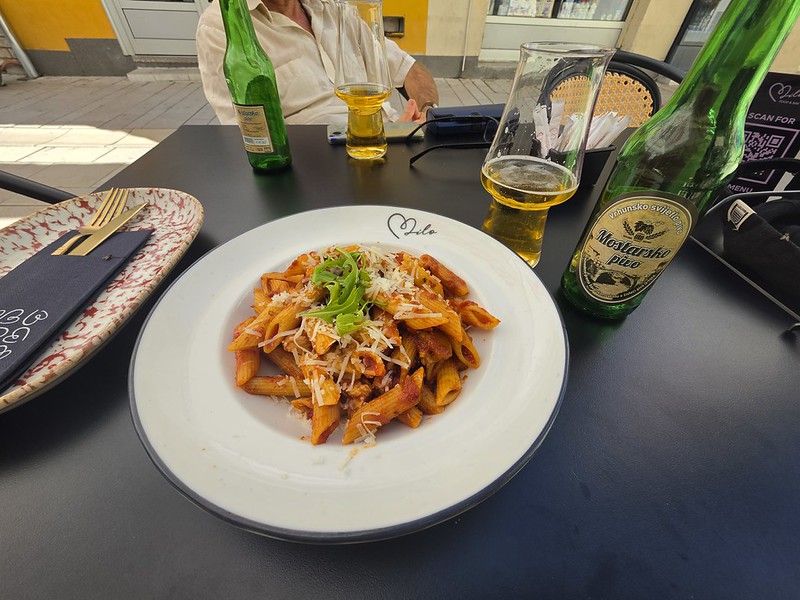
As I had been stomping around Mostar looking for food and drink, I accepted Jonathan’s request to sit outside as I can occasionally be very agreeable. Jonathan was content at this point with just a beer and some quiet, whereas I was deciding how many courses I needed. The drink was Mostarsko Pivo from Hercegovačka Pivovara. It was malty, bland and a little unexciting, but trying the local beer seemed only responsible.
I ordered the chicken pasta. It wasn’t especially complicated, but the portion was generous, it arrived properly hot and a reassuring quantity of chicken was hidden at the bottom. It was sometimes a little difficult to get the attention of the server, but we were in no rush and he was always friendly when he arrived at the table.
One of the restaurant’s specialities is their fried ice cream and although I’m not really a dessert person, this felt sufficiently tempting to give it a try. I rather liked it, the exterior was crispy giving it some bite, the ice cream was smooth and still nearly frozen and the fruit in the sauce gave it some extra flavour.
Overall, I was very pleased with the restaurant. It satisfied my need for sustenance, the welcome was friendly, the food and drink met my expectations and everything was reasonably priced. I left refreshed and ready to find new things to be annoyed about, so I regarded that as a success. I’m not sure that Jonathan obtained his quiet as I was there, but he did at least have a beer.
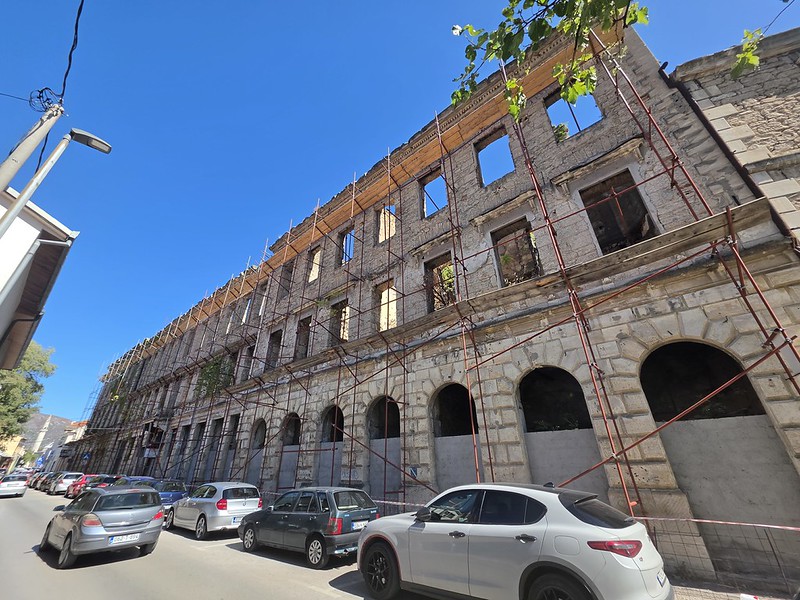
One of the most striking things about walking around Mostar is the way restored buildings stand immediately beside roofless shells, bullet marked walls and properties which appear to have been abandoned halfway through their destruction. I initially wondered why so much had been left, but it became apparent that an enormous amount has already been rebuilt. Much of that work has focused on the Old Bridge and historic centre, while many of the remaining ruins are concentrated in areas which suffered the worst fighting.
Mostar was damaged during two distinct phases of the Bosnian War. In 1992, the city was attacked by the Yugoslav People’s Army and Bosnian Serb forces, with extensive shelling damaging homes, public buildings, industries and infrastructure. Bosnian Croat and Bosniak forces initially fought together against that attack, but their alliance collapsed the following year. During 1993 and early 1994, the Croatian Defence Council and the Army of the Republic of Bosnia and Herzegovina fought one another, dividing Mostar between a predominantly Croat west and a besieged Bosniak east. Buildings around the Bulevar stood directly on the front line, while artillery, fire and close range fighting caused further devastation across the city.
The scale of destruction meant that everything could not be repaired at once. Across Bosnia and Herzegovina, more than a third of the prewar housing stock was partly or completely destroyed and over half the population had been displaced. The urgent priorities after the conflict were restoring water, electricity, roads, hospitals, schools and habitable homes. International funding also supported culturally important projects such as the reconstruction of Stari Most and the historic area around it. Those investments were enormously valuable, but inevitably left less prominent apartment blocks, offices, factories and commercial buildings waiting much longer.
Ownership has provided another obstacle, and I had seen similar evidence of these problems among the ruined buildings of Belgrade. Some private properties had owners who were killed or displaced, while others belonged to people now living abroad. Still other sites accumulated competing claims, unresolved inheritance questions or numerous co-owners who all needed to agree on what should happen. Bosnia created a substantial property restitution process after the war, but returning legal ownership did not necessarily provide people with the money required to rebuild. A ruined property with six owners, three legal disputes and no commercially viable use is not an especially tempting proposition for an investor.
Mostar’s political structure has made progress slower as well. Post-war government was divided between different administrative levels and political interests, while parallel Croat and Bosniak institutions remained influential. Disagreement over electoral rules meant that Mostar held no local elections between 2008 and 2020, leaving the city without a normally renewed council for twelve years. This was, to put it mildly, rather sub-optimal for making complicated decisions about reconstruction. Buildings along the former front line are particularly sensitive because they occupy both valuable land and contested historical space.
There is also the less dramatic problem that many of these structures are extremely expensive to save. A building which has lost its roof, windows, services and internal walls may require complete structural reinforcement before restoration can even begin, particularly when a tree is growing through the middle of it. Demolition can also be costly, particularly in a busy city centre, and the cleared site still needs an economically realistic new use to make redevelopment financially viable. It’s hard to see what can realistically be done about properties such as this without entirely demolishing them and perhaps using some of the stone in the reconstruction, but then it might just be easier to build something new elsewhere.
The future is therefore likely to involve a mixture of restoration, redevelopment, demolition and deliberate preservation. Mostar has already demonstrated through the Old Bridge, historic centre and numerous individual buildings that major reconstruction is possible when ownership, funding and political agreement come together. Some ruins may eventually become hotels, offices, housing or cultural spaces, while others could be retained as properly interpreted memorials rather than unofficial urban exploration sites. The difficult question is how much physical evidence of the war should remain. Repairing everything risks making the destruction invisible, but leaving dangerous shells throughout a living city is not a sustainable form of remembrance.
This reminded me of the Frauenkirche in Dresden, whose ruins were deliberately retained as a war memorial for decades before reconstruction began after German reunification. Cities can apparently become accustomed to living around their damaged buildings, until a later generation decides that their meaning or future should change.
On a more positive note, I found this piece of installation art inside one of the ruined buildings. It was encouraging to see an abandoned space being used creatively, even if the building itself remained some distance from troubling a conventional estate agent. We also saw several buildings which were finally being reconstructed during our meanderings, so the situation is gradually improving.
Jonathan and I ventured into the lower levels of the building generally known as Mostar’s Sniper Tower, beginning with this substantial concrete stairwell. Its less dramatic local name is the Staklena Banka, or Glass Bank, and architectural records identify it as a project for Privredna Banka Sarajevo designed by Mostar architect Dragan Bijedić. Work began during the final years of Yugoslavia, but the building had not opened before war reached the city.
It wasn’t immediately obvious whether visitors were supposed to enter. It plainly wasn’t encouraged, but a section of the wooden boarding had been moved aside, leaving a reasonably straightforward way inside. Once inside, the stairs offered an obvious route upwards, although the absence of handrails quickly established the limits of my enthusiasm for urban exploration.
The interior has been stripped back to its concrete frame, with hanging cables, missing fittings and large openings where the exterior walls and windows once stood. The original building was intended to be one of Mostar’s most striking modern developments, with approximately ten storeys enclosed by blue glass held in an aluminium frame. That sleek late Yugoslav appearance has almost entirely vanished, leaving a structure which now looks as though exposed concrete had been the architect’s rather bleak intention all along.
I must admit that I hadn’t realised it was a bank while we were walking around it. I had assumed that it was a multi-storey car park or something similar. This probably says something about my architectural knowledge, but there we go.
Its height and position beside the Bulevar made the unfinished bank militarily valuable when Mostar was divided during the Croat–Bosniak fighting. The road became part of the front line between Bosnian Croat controlled western Mostar and Bosniak controlled territory to the east. Bosnian Croat forces occupied the tower and used its upper levels as sniper positions, gaining extensive views across the surrounding streets. The building was consequently shelled and its glass exterior destroyed, leaving the concrete skeleton that survives today.
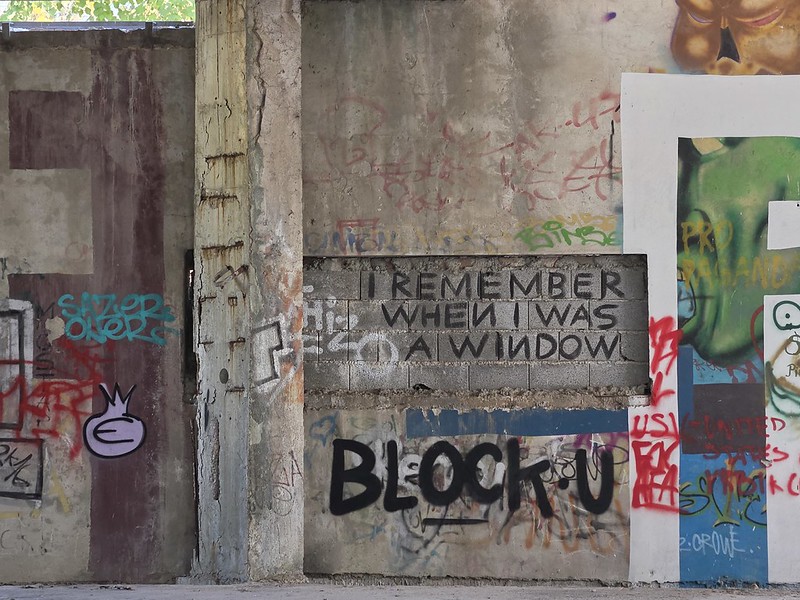
Among the layers of graffiti is the message “I remember when I was not a window”, painted across what appears to be a blocked opening. This was my favourite piece of graffiti in the building as I like a little bit directness and dry humour. Nearly everything in the tower has changed purpose, with former offices becoming firing positions, ruins becoming canvases and blocked walls remembering when they provided views across the city. There are many reminders of war in Mostar, but this one is perhaps one of the most obvious.
Since the war, the lower floors have developed into an unofficial street art gallery, with large murals competing against tags, political messages and several decades of general decay. There is no formal exhibition or historical interpretation inside, which makes the experience rather different from visiting a preserved memorial. It remains an abandoned and potentially dangerous building rather than an attraction, something I continued reminding myself whenever Jonathan appeared more confident about the whole arrangement than I was.
These dark openings appear to be where the lifts were once located. The shafts are now unprotected drops, surrounded by damaged floors, and there was no compelling evidence that anyone had recently completed a reassuring health and safety inspection. I was pleased to have explored part of the tower, but felt no pressing need to reach the roof, even though it was accessible to those with substantially greater reserves of courage.
The larger mural provides a flash of colour within an otherwise grey and hollow interior. Much of the artwork has no direct connection to the war, but collectively it has given the building another stage in its history. The tower has shifted from an ambitious modern bank to a military position, then to a ruin and finally to an unofficial creative space. Jonathan and I spent longer looking at the artwork than I had expected, although this may partly have been an elaborate way of avoiding the increasingly unsafe stairs.
Seen from outside, the scale of the tower becomes much clearer and so does its former military value. Its long horizontal openings overlook central Mostar and the former front line, while almost nothing remains of the blue glass façade which gave the building its original name. Plans to rehabilitate the structure have circulated for years, but it continues to stand as one of the city’s most visible war ruins. Our cautious exploration of the lower floors was quite sufficient for me, leaving the higher levels to people with greater courage, poorer judgement or indeed both. By my standards, I had already been exceptionally brave once again.
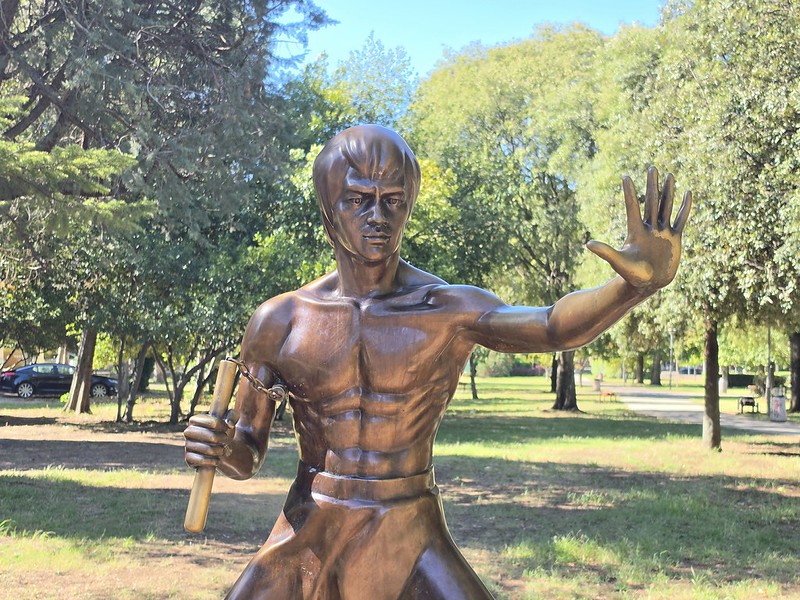
Perhaps one of Mostar’s more unexpected monuments is this bronze statue of Bruce Lee in Zrinjevac Park. I’m not sure if this was on Jonathan’s list of things to see, but it was on mine and he likes films, so that all worked out nicely. The wider view shows Lee standing above the words “Bruce Lee, Your Mostar” which is all very positive.
Created by Croatian sculptor Ivan Fijolić and unveiled on 26 November 2005, it was proposed by the Mostar Urban Movement as a shared hero for a city still divided after the war. Bruce Lee was distant from local political and ethnic arguments, while his films had been enormously popular throughout Yugoslavia. It was also the first public monument to him anywhere in the world, beating the unveiling of Hong Kong’s statue by one day and giving Mostar a victory in a competition that Hong Kong probably had not realised was taking place.
These things are never entirely easy though and even his orientation proved politically sensitive, as residents complained that his fighting stance appeared to be directed towards their side of the divided city. He was consequently positioned to face a more neutral direction, which must be one of the few occasions when municipal reconciliation has involved carefully rotating Bruce Lee.
Although a symbol of unity, his time in the park has not been entirely peaceful. The statue was vandalised soon after its original unveiling and later spent several years away being repaired. It was stolen in March 2024 and recovered after being cut into pieces for sale as scrap metal, which was all a little sub-optimal. Following extensive restoration, Bruce returned to his pedestal in December 2025, making these photographs evidence that Mostar’s unifying action hero has survived vandalism, theft and dismemberment and remains impressively difficult to defeat.
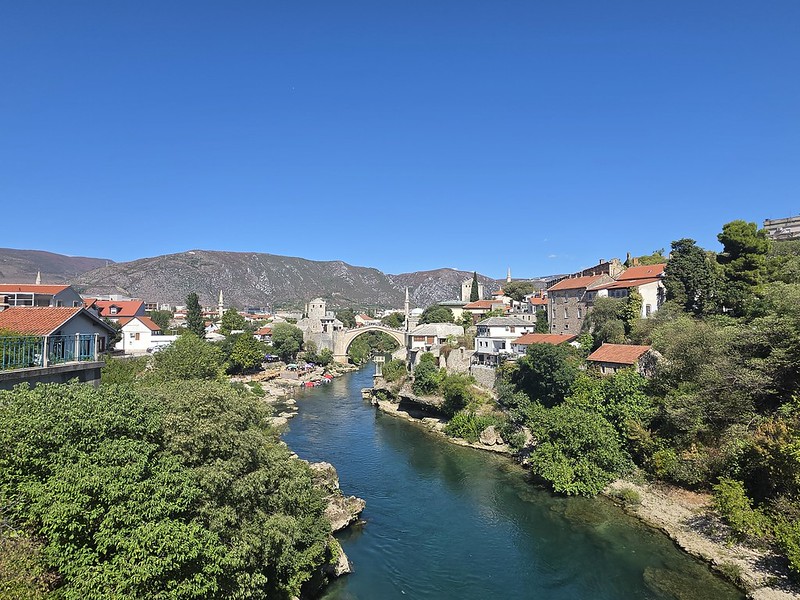
I took this photograph from farther down the River Neretva, primarily because I had forgotten to take one while walking across the bridge itself when it was extremely busy. This is the Stari Most, looking rather delicate against the surrounding mountains. The bridge was commissioned by the Ottoman sultan Suleiman the Magnificent and constructed between 1557 and 1566 under the direction of Mimar Hayruddin. Its single stone arch connected the two sides of Mostar for more than four centuries and became so closely associated with the city that Mostar itself takes its name from the mostari, the bridge keepers who guarded the crossing.
The bridge visible today is a reconstruction. The original survived earthquakes and centuries of political change before being destroyed by Bosnian Croat forces on 9 November 1993 during the Croat–Bosniak conflict. Images of the arch collapsing into the river became one of the most powerful symbols of the damage done to cultural heritage during the Bosnian War and I watched the video on YouTube of the destruction.
And since I’ve mentioned it, here’s the video.
This closer view shows the remarkable height and steeply curved profile of the bridge. The reconstruction was undertaken as an international project coordinated with UNESCO and the World Bank, using traditional building methods and locally quarried Tenelija limestone chosen to match the original masonry. Stari Most reopened on 23 July 2004 and the bridge and surrounding Old City were inscribed on UNESCO’s World Heritage List the following year. It was intended not simply as an architectural restoration, but as a symbol of reconciliation in a city that remains divided in numerous ways. More on that theme in a future blog post though, this was certainly a complex city.
The metal platform in the river belongs to Mostar’s long tradition of bridge diving. Local divers leap from the top of the arch into the exceptionally cold Neretva approximately 24 metres below, although this requires training rather than merely an excess of holiday confidence. Organised competitions have taken place for generations and the spectacle has become almost as closely associated with the bridge as the architecture itself. Jonathan and I weren’t tempted.
From this angle, the bridge can be seen with the fortified towers that once controlled access to it. The Tara Tower stands on the eastern bank and the Halebija Tower on the western side, both forming part of the historic defensive complex surrounding the crossing. The buildings climbing the riverbanks help explain why the bridge feels like part of the old town rather than an isolated monument. Its arch links two dense groups of stone buildings and narrow streets, just as the original was designed to do in the sixteenth century.
Although this is technically a twenty-first-century bridge, it has been reconstructed closely enough to restore one of Europe’s most recognisable Ottoman views. It was always busy with tourists when we walked over it and I’m not sure that I would have realised it was a modern replacement, it feels like an authentic reconstruction.
Having arrived in Mostar and wanting food, I noticed that this venue, Burger Beg, was well reviewed and so thought I’d quickly pop in. They’ve got this on-trend looking arrangement on the main street in Mostar, but they previously had a smaller back street venue, so it seems that they’ve done well.
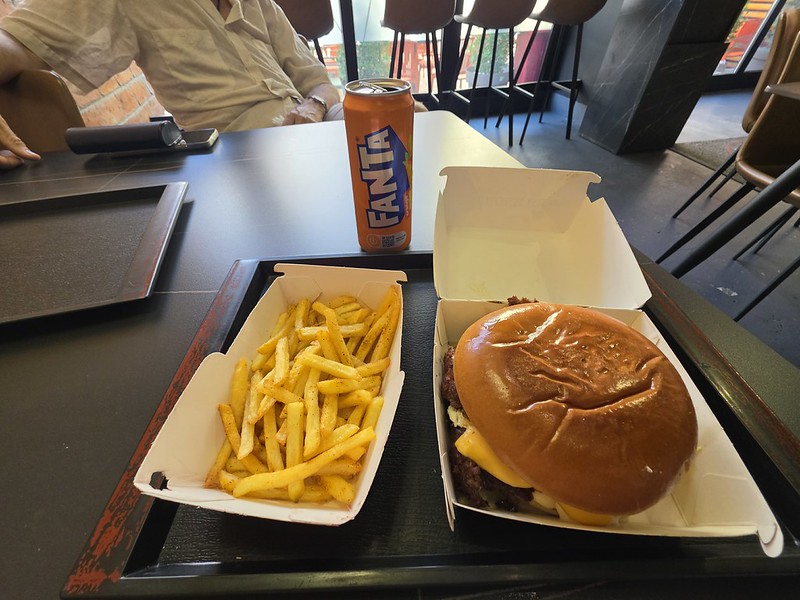
Jonathan went off to buy a sandwich from somewhere, which I understand wasn’t very appetising, but I thought that the options here looked shiny and interesting. I opted for the Beg Burger, which didn’t seem overly decadent as I’m not Richard, along with fries and a Fanta. Customers order at the counter and are given a device which vibrates when their food is ready for collection. The venue was clean and I liked the branded wet wipes which were very useful.
All rather rather lovely for the equivalent of around £7 for the meal. The burger was meaty, the fries were served as a large portion, and everything was hot, other than the Fanta of course.
I liked it here, there was Wi-Fi which was most useful, plenty of seating inside and outside, friendly service, quick service and the food tasted of a decent quality. Mostar had now provided me with food and internet access, so my earlier mood was beginning to lift.
In an attempt to move on this blog, I will leave Sarajevo behind in a bid to get to Mostar and indeed perhaps one day to the end of this trip. Anyway, this is Sarajevo coach station and it probably needs a little bit of updating.
Our coach pulled in at platform 11 and a number of passengers invited themselves on board. I remained cautious as I didn’t have permission and I believe in a rules-based society. Anyway, the driver came over from the cafe and threw all these passengers off and I felt validated. There was a minor moment of concern when the driver asked for the slip that came with our paper tickets and I had separated that thinking it was a card receipt. Fortunately, I had kept them otherwise Jonathan and I might not have been going very far.
Safely boarded and the bus was nearly full, but at least it was spacious and not some rickety little minibus that the coach company had found from somewhere.
I had acquired a healthy drink from the bus station shop.
And some healthy crisps. Well, maybe not entirely healthy. Fortunately, I had purchased two packs as I managed to eat one whilst waiting for the coach to leave Sarajevo.
The town of Konjic.
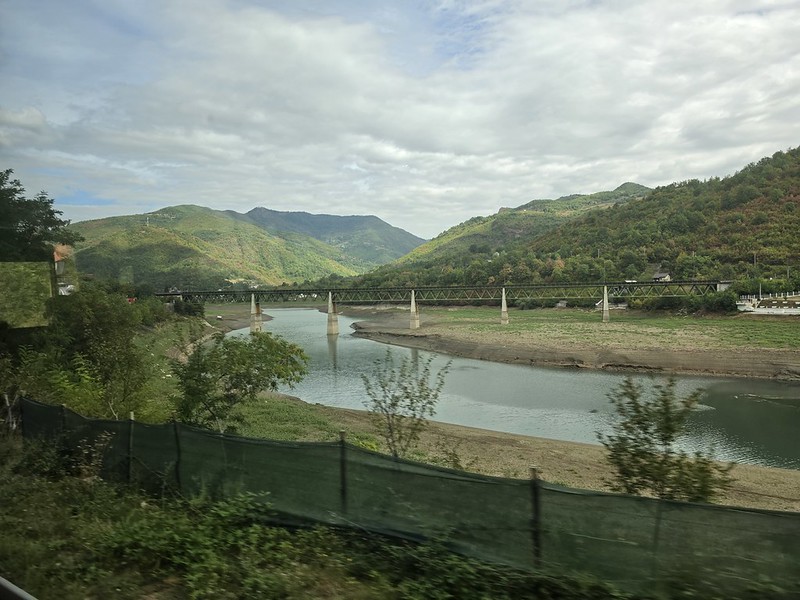
Lake Jablanica, an artificial reservoir created in 1953 during the construction of Jablanica Dam.
The village of Ostrožac.
A little further down the valley.
The village of Jablanica.
This really was a beautiful coach journey and I was fortunate to have picked the right side of the vehicle to sit on to get the best views. To excite and delight my loyal blog readers, there are numerous videos that I took so I’m sure that’ll be the highlight of many people’s days for weeks to come.
And safely into Mostar where we promptly discovered that there was no Wi-Fi, so I was in an immediate mood. I accept that the tourist board of Bosnia and Herzegovina might think that I should focus on the view, but sometimes the Internet is too important not to focus on.
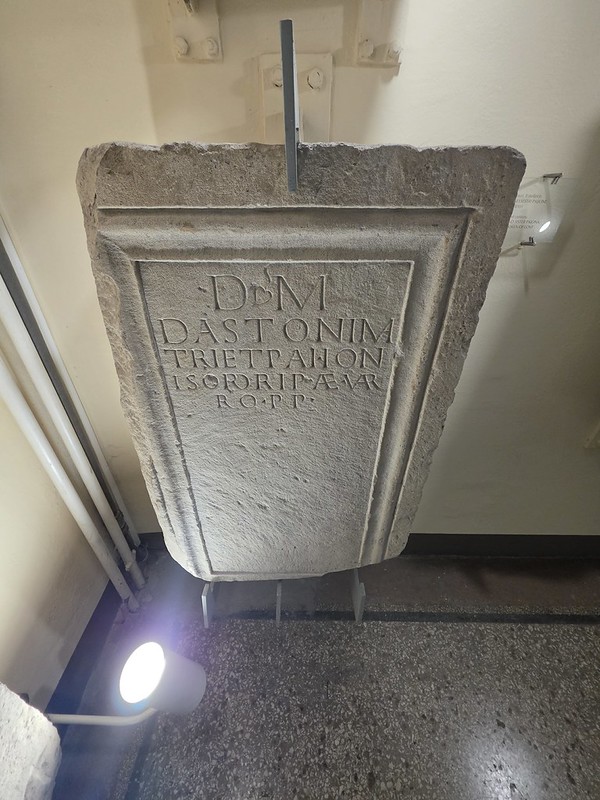
One of the Roman exhibits at the National Museum of Bosnia and Herzegovina is this limestone funerary monument, discovered at Borčani near modern Tomislavgrad. It dates from around AD 130 to 170, when the area formed part of the Roman province of Dalmatia. I take photos of every gravestone in churchyards from before 1800, so I couldn’t find a reason not to take a photo of this and witter on about it.
The inscription begins with the letters D M, an abbreviation of Dis Manibus, meaning “to the spirits of the dead”. It records that Publius Aelius Varro dedicated the monument to his mother Dasto and his sister Paiio. Publius does not tell us what his mother or sister were like, unfortunately, although even the Romans presumably recognised that there was only so much room available on the stone. He simply states that it was erected as a token of affection and, in fairness, it’s lasted remarkably well.
Without being morbid, I don’t want a gravestone. My friend Liam will instead be busy scattering me around the world in a list of locations that I regularly update, requiring him to undertake an extensive international tour which I hope he doesn’t moan about. But if I did had a gravestone, I’d be very pleased if it survived for nearly 2,000 years. I hope he realises that even death will apparently not release Liam from the administrative burden of being my friend……
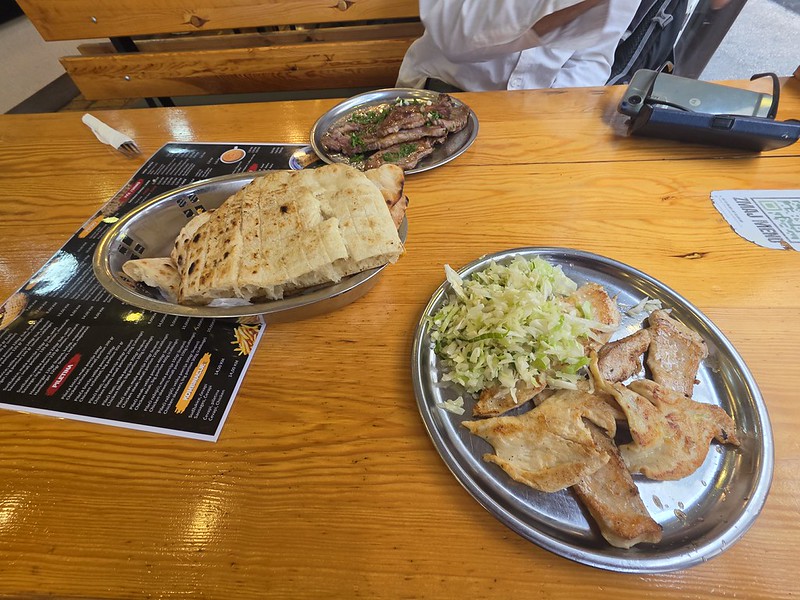
When looking for lunch in Sarajevo after a busy morning of museum visiting, we thought that we’d pop into this restaurant, Ćevabdžinica Zmaj Stanica, located near the coach station as it was well reviewed and looked interesting. We were told that we could sit anywhere and a waiter came to take our order promptly, so we weren’t left waiting for long.
There was a reasonable selection on the menu and I went for the large chicken schnitzel with a bottle of Coke.
This isn’t really what is usually called chicken schnitzel, even in Bosnia, but it was hot, filling and inoffensive. I’m not sure that this was much of a taste sensation, but it wasn’t expensive and it seemed healthy and freshly prepared. Jonathan had some sort of decadent steak as it was keenly priced so not an option that he’d order at home and he was surprised and delighted at the whole arrangement. There was some bread supplied to the table, although I found the combination a little dry.
My Coke never arrived so I chased that up and the whole ordering and payment system was perhaps a little erratic. It seemed to be going wrong in a few places, although the food was served promptly. It’s nice to see this sort of open kitchen set-up so that we could watch our food being prepared. The team members were always polite and friendly, although they were often quite rushed when it got busy.
Birds playing on the table outside, seemingly having a lovely time. Another advantage of the restaurant is that they have plenty of seating, both inside and outside. I think Jonathan was planning to sit outside, but we somehow ended up inside when he wasn’t looking. I’d also add that everything was clean and tidy, with team members busily cleaning down surfaces on a regular basis.
This restaurant has been here for decades, it’s welcoming, it’s open for very long hours and it was reasonably priced, so I’d actually come here again. It’s a bit like a fast food option, the quality might not be impeccable, but it feels sufficiently reliable to visit. It also seems that there has been a new development that the restaurant has started to take cards, which made payment rather easier.
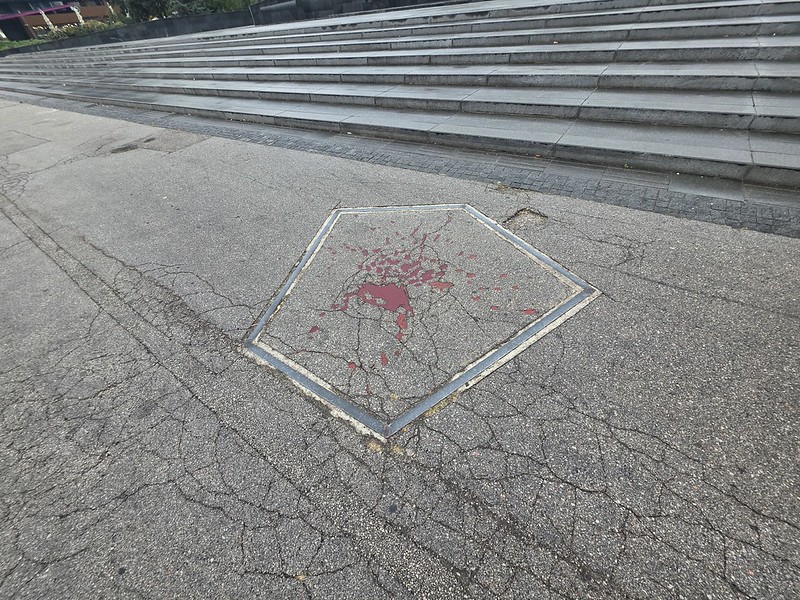
Scattered across Sarajevo are around 200 memorials embedded in the pavement, known as Sarajevo Roses. Each preserves the scar left when a mortar shell exploded during the Siege of Sarajevo between 1992 and 1996. The crater was later filled with red resin, preserving the damage rather than removing it and turning part of the ordinary pavement into a memorial.
The name comes from the pattern produced when a mortar shell struck concrete or asphalt, sending cracks and fragments outwards in a shape resembling the petals of a flower. Officially marked roses generally identify places where at least three people were killed, with the red filling representing the bloodshed. Many have faded, been damaged or disappeared during later resurfacing, while others have been restored and protected.
It was Jonathan that pointed these out to me and they are a strikingly visual reminder of the suffering Sarajevo endured during the siege. What felt quite powerful about these memorials is that they are not separated from everyday life behind railings or inside a museum. They remain beneath people’s feet, quietly forcing the violence of the past into the present day and for visitors, that can come at quite unexpected times when exploring the city.