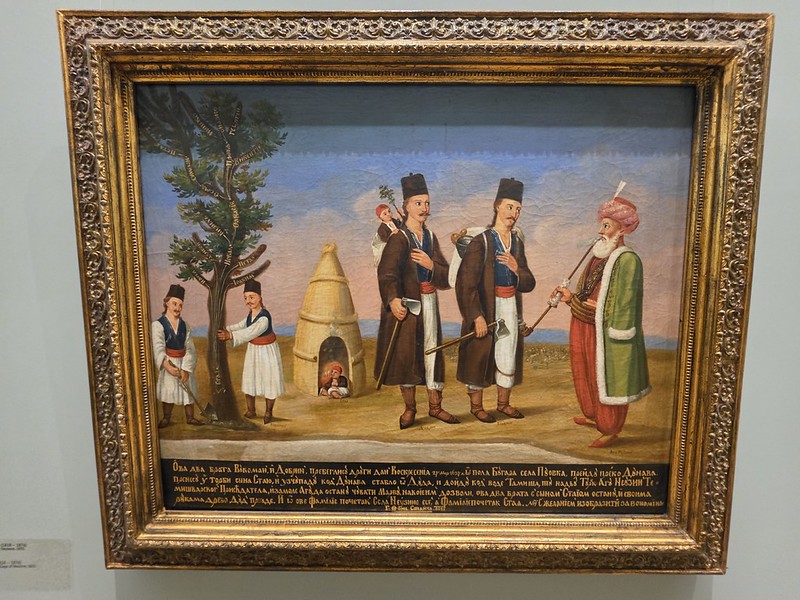
This detailed historical scene is Founding of the Village of Neuzine, painted by Pavle Simić in 1835 using oil on canvas. Simić was born in 1818, meaning that he was only around seventeen when he completed it, a remarkable achievement for an artist of that age.
Neuzine is now a small village in the Banat region of northern Serbia, although its foundation was apparently a rather formal occasion. According to local tradition, Neuzine took its name from a Turkish agha called Neus, who employed two Serbian shepherds named Staja and Nikola. The two young men in the centre may represent these traditional founders, while the older figure appears to be their Ottoman landowner. The two younger men look remarkably enthusiastic about building their new village, although the extent of the work required may not yet have been fully explained to them.
Simić was born in Novi Sad and received his early artistic training in the workshop of the Italian painter and decorator Alojzije Kastanji. He painted this work while staying in the Banat region and before moving to Vienna in 1837 to study at the Academy of Fine Arts. He later became known principally for his religious paintings, church iconostases and portraits. His career eventually spanned around four decades and included commissions across what is now Serbia and neighbouring countries. Founding of the Village of Neuzine offers an early indication of his interest in presenting historical subjects through carefully arranged figures and recognisable narrative details.
I rather liked this painting, partly because it records a very specific local story rather than a grand military victory or an important royal occasion. Most villages emerge gradually without anybody commissioning an oil painting of the process, so Neuzine did well to secure the services of an unusually productive teenager. There cannot be many artists represented in national museums by work they completed at the age of seventeen.
Moving away from the Balkans for a few posts, I’ve been trying to find someone to take me to Mowgli for a while. After discovering the half-price curry offer running on Mondays this month, I was able to convince my friend James to come along for one of our executive lunches. It’s good practice in advance of the 2027 Norwich market expedition and also a precursor to my new monthly Indian meal which I’m pleased to see has a decent-sized group going this week.
It has a smart, contemporary interior and reminded me of the Dishoom chain, which frequently surprises and delights me.
It was clean and comfortable, but the tables are perhaps a little too close to each other which does take away from the ambience a little.
The lunchtime special menu.
The deal was that any of the curries in this section on the right, other than the biryani, were included in the half-price offer. Unfortunately, the half-price offer was not applied automatically, meaning that customers had to know about it and ask for the reduction. I’m never especially impressed when restaurants operate promotions in this way.
I ordered the mango lassi and it was a small serving for the price, although it looked attractive when presented. Its consistency was thinner than I had expected and neither the yoghurt nor the mango had enough presence to provide the usual richness and freshness.
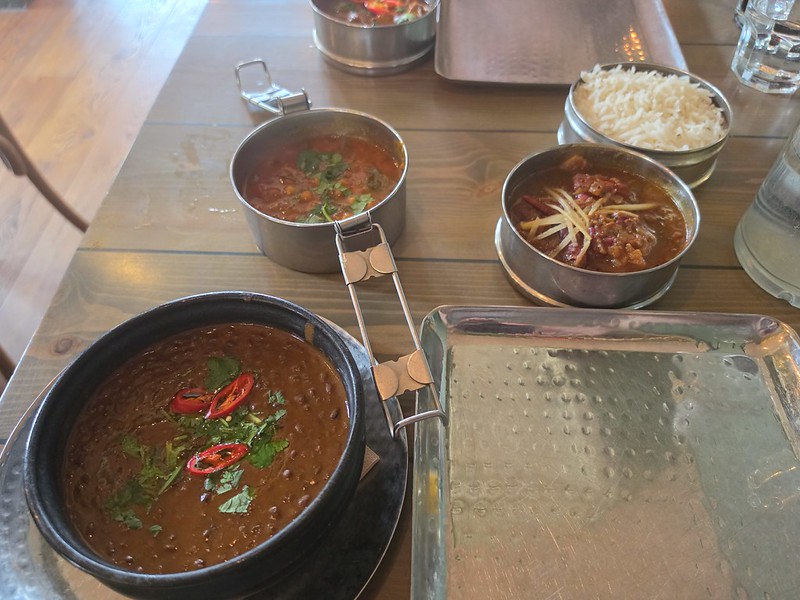
The main curry I ordered was the Goan fish curry and I opted for that as the menu stated that it was “fiery, tangy, sweet and delicious” but this was devoid of any depth of flavour that I could identify. The fish was tender and served in a generous quantity of sauce, but this element didn’t have any fiery dimension to it. I tried a bit of James’s butter chicken, just visible at the rear of the photo, and the chicken was tender but again there was no discernible complexity to the flavours. Although the two curries were different dishes, neither established a particularly distinctive flavour of its own.
The Mowgli Black Dahl was served as a generous portion, but its consistency was loose and watery rather than rich and velvety. It also lacked the slick of cream promised on the menu, which might have provided some much-needed richness. The Tea Steeped Chickpeas perhaps fared better texturally, with the chickpeas retaining a pleasant firmness, but the flavours again needed greater seasoning. I’m not necessarily expecting a huge punch in terms of spice, but I do want some complexity.
I would say that the dishes were all competent, they were well presented, hot and the server named them carefully when placing them on the table. Nothing tasted bad and I enjoyed all the food, but perhaps they had oversold the experience that I was expecting.
The service was friendly and timely, although I’m not convinced by the need to add both a charity donation and service charge automatically to the bill. The price was reasonable given the half-price main courses, but the quality wasn’t there for me. Indian food needs greater depth and complexity. Overall, it was all too mild and I felt that the food sat closer to supermarket microwave quality than to anything authentic or richly flavoured. I have mentioned before that there is something perhaps a little wrong that JD Wetherspoon, who make no claim of authenticity relating to Indian street-food, are rolling out curries that have a greater depth of taste than a restaurant that is meant to be specialising in Indian cuisine.
Having noted all that, I was pleased to have visited and it’ll be interesting to see how the chain manages its rollout of restaurants across the UK. And James, my external food consultant, who has been before and apparently ordered nearly the entire menu, deserves some praise for taking me as we planned the third biennial tour of every food stall at Norwich Market.
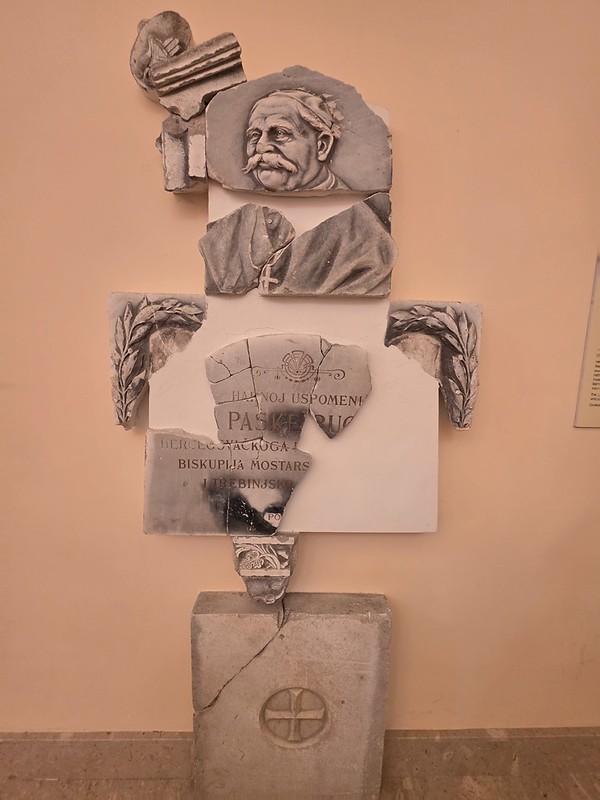
Preserved inside the Franciscan Church of Saints Peter and Paul is this shattered memorial to Paškal Buconjić, a Franciscan friar who became the first bishop of the newly established Diocese of Mostar-Duvno in 1881. Following his death in 1910, he was buried inside the church and the Croatian sculptor Ivan Rendić created a memorial incorporating a portrait relief of the bishop, an inscription and elaborate decorative stonework.
The memorial was broken apart when the original church was shelled and burned during the fighting in Mostar on 9 May 1992. Its surviving pieces have been mounted together inside the replacement church, with the large gaps and fractured edges deliberately left visible rather than disguised by reconstruction.
I liked that it had been presented in this way, with the accompanying information explaining what had happened. Within a church rebuilt after wartime destruction, the fragmented monument provides a permanent reminder of what was lost and ensures that the violence inflicted upon the original building is not entirely obscured by its replacement.
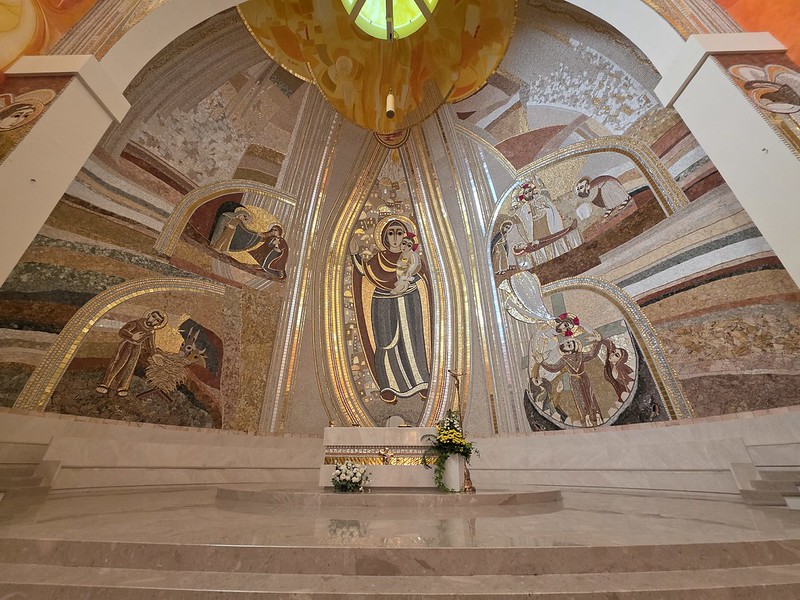
During our wanderings around Mostar, Jonathan and I visited the Franciscan Church of Saints Peter and Paul, where the modern interior proved substantially more colourful than I had expected. The enormous mosaic covering the apse was completed in 2021 and extends across more than 600 square metres. At its centre is the Virgin Mary holding the infant Jesus. The work was installed in just fourteen days by a team of 24 artists, which rather exposes my continued inability to put up a single picture successfully. I said at the time I was there that this was one of the most beautiful church installations I had ever seen, and it remains a genuinely impressive sight.
Looking back towards the entrance reveals the scale of the nave, the organ above the doors and the brighter orange artwork running beneath the upper windows. The original church was constructed under Ottoman rule, with its foundation stone laid in 1866 and the building completed six years later. A Franciscan monastery followed during the 1890s, but the church was destroyed by shelling in May 1992 during the Bosnian War. The new church has an unmistakably contemporary appearance, but its extensive biblical imagery ensures that it remains firmly connected to the traditions of the building it replaced.
The central view towards the sanctuary brings together the church’s pale stone, simple wooden seating and extensive mosaic decoration. It’s open, bright and feels functional.
The baptismal area stands near the entrance and looks directly along the nave towards the image of Mary and Jesus. Outside, the church is dominated by its 107-metre bell tower, the tallest in Bosnia and Herzegovina, but the interior was the more memorable element for me. This really was a striking church and the most memorable from our Balkans trip and even I remained quietly impressed for several minutes, which perhaps represented a minor miracle of its own. And more in the next post about a damaged memorial in the church.
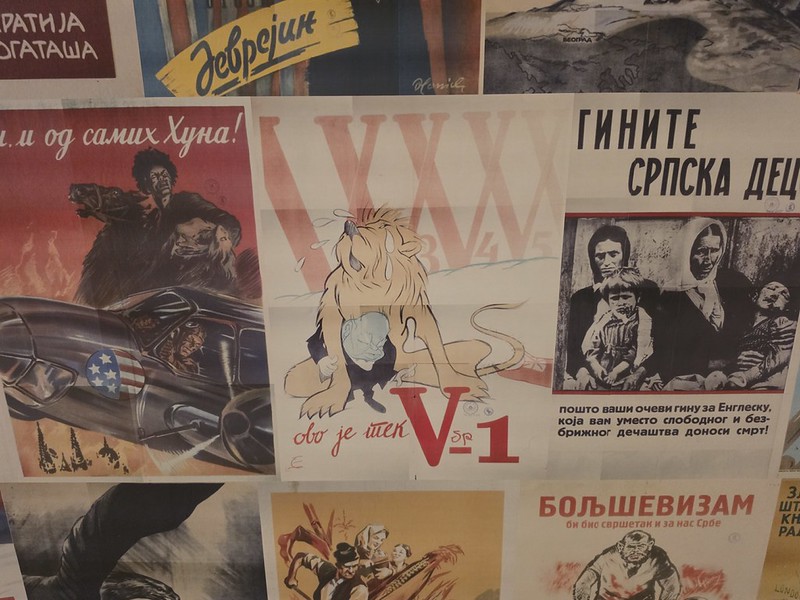
Among the exhibits at the SASA Gallery of Visual Arts and Music in Belgrade was this collection of Serbian-language propaganda posters from the Second World War. The exhibition, Even in Captivity – Freedom!, explored the art produced during the occupation of Serbia and demonstrated that creative work could serve as a means of survival, resistance or propaganda.
As some background to proceedings, Serbia was then part of Yugoslavia, whose Government joined the Tripartite Pact in March 1941 before an anti-Axis coup took place just two days later. Germany invaded and occupied the country, installing a collaborationist administration in Serbia while resistance movements fought both the occupiers and one another. The Serbian-language poster was therefore propaganda aimed at people living under occupation, intended to maintain confidence in an eventual German victory.
The wording on the central poster reads Ovo je ipak V br. 1, which translates literally as “This is, after all, V No. 1”, although “And this is only V No. 1” better conveys the intended threat. The distressed and perspiring lion represents Britain, while the globe incorporated into its body appears to refer to the British Empire. Approaching from the right is a V-1 flying bomb, surrounded by large Vs in case anyone had somehow failed to understand the principal theme of the messaging.
The V-1 was the first of Nazi Germany’s so-called vengeance weapons and attacks on London began in June 1944, but although the weapon was damaging it had rather limited accuracy. By this time things were of course going very wrong for Germany and events were turning decisively against it. This messaging was all intended to frighten Britain while reassuring audiences in occupied Serbia that Germany still possessed weapons capable of transforming the war. Ultimately, the V-1 caused substantial death and destruction, but it could not reverse Germany’s military position and Belgrade was liberated on 20 October 1944.
I photographed several of the other posters in this exhibition because I had never encountered them before and I’ll likely return to some of the others in the future.
While searching for craft beer in Mostar, this was one of the best reviewed venues in the city and so it seemed only polite to pop into Pub Beer ti&ja. It is next to a shopping centre and probably receives a fair amount of passing trade, but the centre was closed when we visited on Sunday, which perhaps explained why the pub was so quiet.
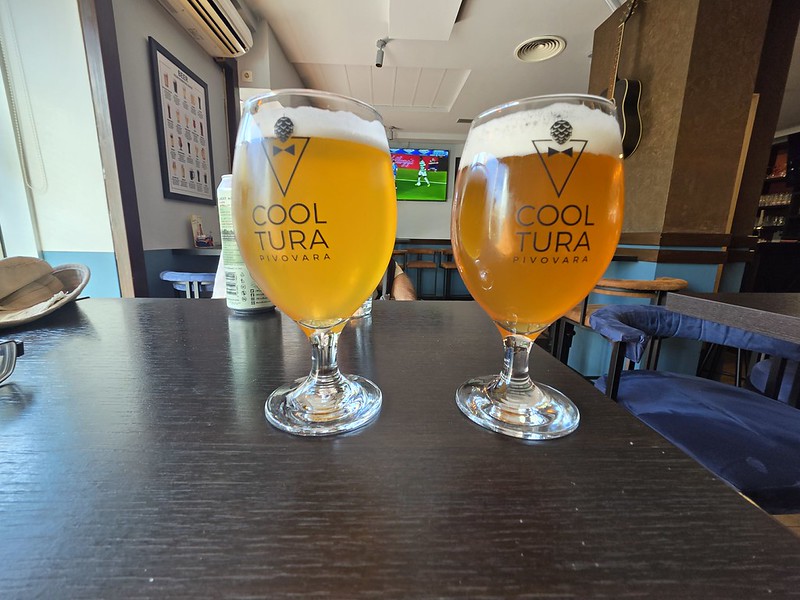
The bar area had the four keg options from Cooltura (the APA, the Amber, the Blonde Ale and the IPA) and there was signage about the craft beer available in cans. The welcome was immediately friendly and it felt an inviting location.
As I mentioned, it wasn’t the busiest but I still liked the atmosphere and general vibe.
I ordered two beers from Cooltura Pivovara, whose beers appear to be brewed at the venue. On the left was Prirodna Plavuša, a malty and bready beer with light notes of honey and toffee. On the right was the APA, which I cannot describe in any detail because it transpired that I had forgotten to record it on Untappd. Sub-optimal in terms of my recording efforts, although I remember it being a decent beer.
There was also a pleasant outside area, while the staff appeared to be coping admirably with the considerable pressure of serving Jonathan and me.
I rather liked Beer ti&ja. It offered interesting local beers, friendly service and, importantly, accepted cards at a moment when neither of us had any Bosnian marks. That prevented me from visiting Craft Beer Garden Ima i Može, which accepted cash only and might otherwise have been one of my favourite bars of the trip judging by its Untappd selection. Beer ti&ja was therefore technically the alternative, although it was a thoroughly enjoyable one.
I admit that forgetting the flavour of one of only two beers does rather undermine my claim to be conducting serious international beer research. Fortunately, nobody has ever mistaken this blog for a peer reviewed academic journal, which is probably just as well.
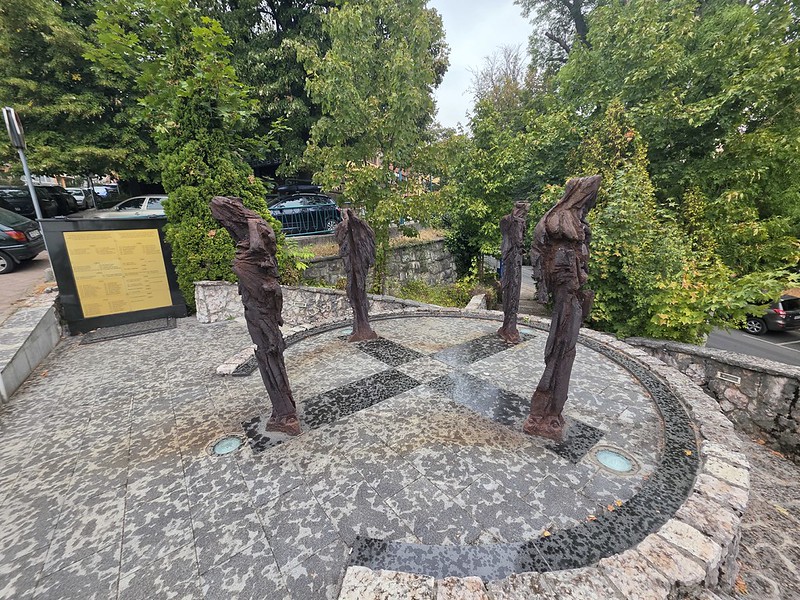
We encountered this unusual memorial while walking through Sarajevo and it commemorates the French military personnel who died while serving in Bosnia and Herzegovina. The work is Les Gardiens de l’Espace by the French sculptor Xavier Dambrine and consists of five distorted cast-iron figures arranged around a circular platform. It is not an especially comforting work, but it is a reminder of the tragedy that unfolded across Bosnia and Herzegovina in the 1990s.
Seen from the other direction, the figures appear almost to be gathered in a circle while remaining isolated from one another. I’m not entirely sure what interpretation Dambrine intended, but this didn’t feel like a representation of military figures so much as one of more general sorrow. That ambiguity, at least to me, made the work all the more powerful.
Sarajevo has no shortage of monuments connected with the conflict, although this comparatively secluded memorial acknowledges a group of casualties who can be overlooked among the much greater suffering experienced by the people of Bosnia and Herzegovina. Its location is also appropriate, standing opposite the French Embassy and beside a peaceful park.
The adjoining plaque lists the dead by year, beginning in 1992 and continuing beyond the end of the Bosnian War as French personnel remained involved in international peacekeeping operations. It records that the memorial was inaugurated by President Jacques Chirac on 7 April 1998 and erected at its present location on 12 April 2005. The plaque made the purpose of the work considerably clearer to me and turned what had initially seemed like an intriguing collection of figures into something much more sombre.
It’s fair to say that I’m not entirely convinced by apartments when travelling overseas. In many cities they’re doing some damage to the local housing market so that locals can’t afford to live in their community which feels entirely sub-optimal. I always prefer hotels where I can check in without some complex sequence of messages, access instructions and attempts to locate the entrance. However, as Jonathan correctly pointed out, for much of Bosnia and Herzegovina there was a shortage of hotels and so apartments were our only real option. That also proved to be the case in Croatia, where again the number of hotels was often relatively low.
In the main, it all went OK for us, with Jonathan in charge of getting in touch with the property owners. We had a wait or two to get in some places, and one we couldn’t initially find, but it did work out. It was also inexpensive, with an entire apartment often costing less than £30 for the night between us.
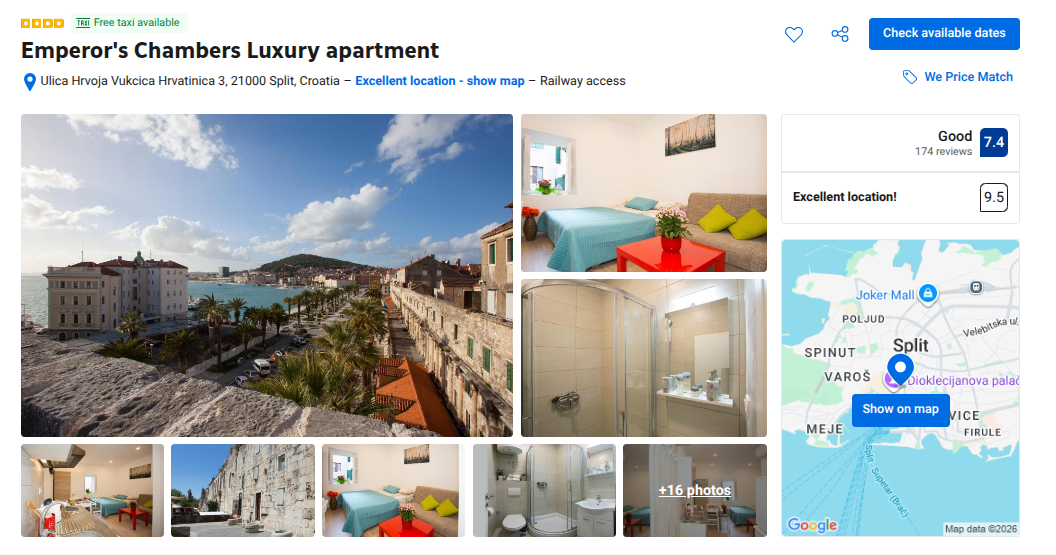
Matters did not go well in Split, where we were already short on time because we had only one evening in the city. We had deliberately booked centrally, paid more for the convenience and found the property relatively easily. On arrival, however, we were given a tiny alternative which did not match the more expensive accommodation shown in our reservation. When we raised the discrepancy, the owners refused to provide the accommodation we had booked or offer an acceptable solution, despite having the opportunity to do so. It felt very much like a bait and switch, and I was not prepared to stay there and simply accept the situation.
Booking.com handled the situation very positively. Its customer service team agreed that the accommodation did not match the reservation, arranged a full refund and helped us secure an alternative at short notice. The replacement was not entirely flawless, but it was a substantial improvement and allowed us to continue with our evening in Split rather than spending it engaged in increasingly detailed accommodation negotiations. Indeed, there were nearly no hotels available in the city, so we were quite dependent on Booking.com coming up with some solution.
I subsequently found reviews from other guests describing similar experiences, which suggested that this was not an isolated mistake. The moral of this little story is to reject inadequate accommodation immediately and raise the discrepancy with Booking.com. In my experience, the company has traditionally been effective at protecting customers and its platform when a property does not match the listing. On this occasion, the owners refused to provide what we had paid for, but Booking.com ensured that they did not benefit financially from doing so. With the problem finally resolved, we were able to explore Diocletian’s Palace and enjoy the delights of Split rather than spending our only evening arguing about accommodation.
As for me, I switched to hotels for the rest of my trip and I’m pleased to say that there were no disasters.
I’ve finished the chronological run of my Balkans posts, but there is still plenty that I feel the need to witter on about. This news will no doubt excite all three regular readers.
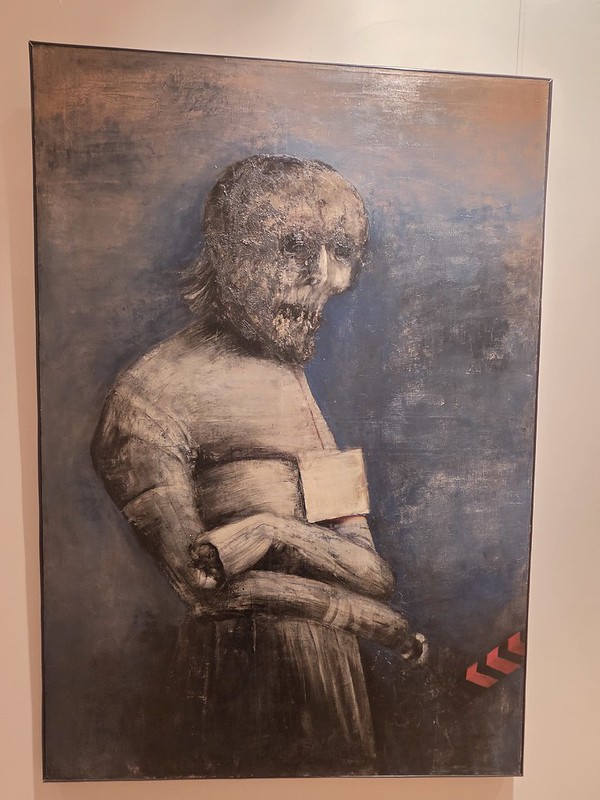
This work at the National Museum of Serbia, which I found moderately unsettling, is Portrait of an Unknown Man, painted by Vladimir Veličković (1935–2019) in 1963 using oil and tempera on canvas. The unidentified figure stands in profile with his arms folded around what appears to be a book or rectangular board of some sort. His body remains recognisably human, but his face has been rubbed, scraped and darkened until much of his identity appears to be disintegrating. This isn’t the sort of thing that I’d hang on my wall, even if I had the ability to put artwork up, which it’s not entirely clear that I do.
Veličković was born in Belgrade in 1935 and originally trained as an architect before establishing himself as an artist. This painting dates from the beginning of his professional career and the year of his first solo exhibition. He became known for paintings involving violence, fear and the vulnerability of the human body, which doesn’t feel like an entirely optimistic artistic direction.
The painting comes from the endowment collection of Dr Jakov Smodlaka and is an example of the unexpectedly challenging modern art displayed among the museum’s more traditional portraits. I wasn’t especially keen on it, nor could I find a meaning that spoke to me. That perhaps says more about my expectation that every artwork should communicate something recognisable than it does about Veličković’s intentions. Museums and galleries would become exhausting if I felt obliged to understand and enthusiastically admire everything, although that has never previously stopped me writing about it.
Part of the reason for my Balkans trip was to fill some gaps in my travels. I had previously visited Belgrade, but nowhere else in Serbia, while Montenegro and Bosnia and Herzegovina were entirely new countries for me.
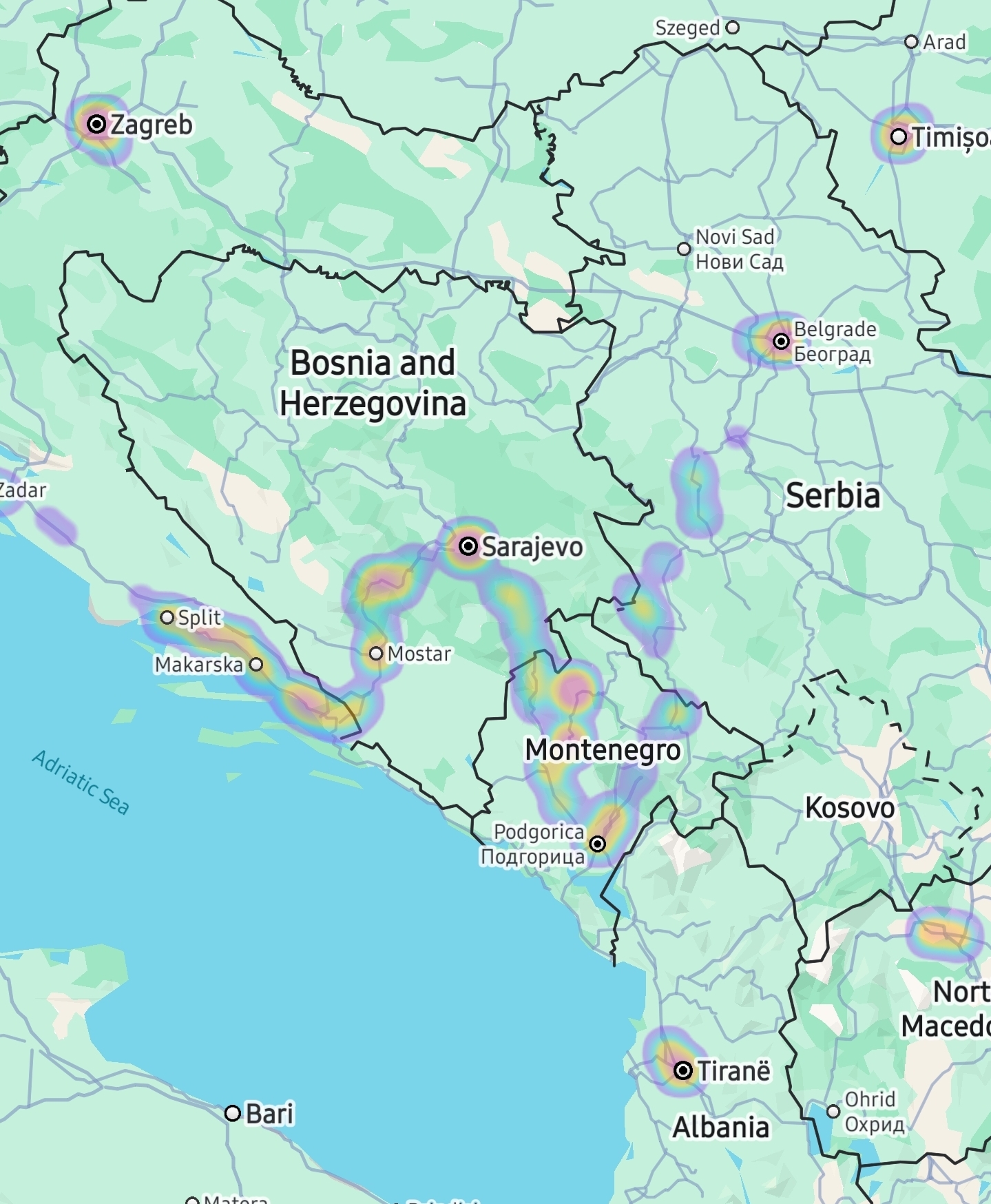
The map shows the route we followed and the locations where my photographs were taken. But as something of a reminder for those who haven’t bothered reading any of my previous blog posts, after two preliminary nights in Luton, which remained stubbornly outside the Balkans despite the title of the series, I flew to Belgrade in Serbia. I spent several days exploring the city, including Belgrade Fortress, the Church of Saint Sava, the National Museum of Serbia, the River Sava waterfront and a growing number of restaurants and craft beer bars. I had a final KFC before Jonathan joined me there before we continued south by rail into my first new country, namely Montenegro.
Our journey into Montenegro followed the spectacular Belgrade to Bar railway as far as Podgorica, changing trains at Bijelo Polje. We spent one night in Podgorica before travelling by bus to Žabljak, our base for two days of walking in Durmitor National Park and its beautiful scenery. I’m pleased to note that we didn’t encounter any bears, snakes or lions, so that was a result. The highlights there included Black Lake, the forests and mountain scenery around the town, and the walk to the Ćurevac viewpoint above the Tara River Canyon. From Žabljak we continued to Nikšić, where we explored Bedem Fortress, the Cathedral Church of Saint Basil of Ostrog and several reminders of the city’s Roman, Ottoman and Yugoslav history.
We left Montenegro aboard an impressively dilapidated minibus and crossed into Bosnia and Herzegovina near Hum. The exciting journey passed through Foča before depositing us at East Sarajevo Bus Station, rather farther from central Sarajevo than its name had encouraged us to expect. In Sarajevo we visited the site of the assassination of Archduke Franz Ferdinand, travelled by cable car to Mount Trebević, walked along the former Olympic bobsleigh and luge track and spent an extensive amount of time in the National Museum of Bosnia and Herzegovina being inspired by their unusually expressive stuffed lion.
The next coach journey was no less beautiful and followed the River Neretva through Konjic and Jablanica to Mostar. We crossed the reconstructed Stari Most, saw buildings still carrying damage from the Bosnian War and visited the Sniper Tower, the Partisan Memorial Cemetery and the city’s unexpectedly prominent statue of Bruce Lee. Mostar combined beautiful Ottoman architecture with much more visible evidence of recent conflict than anywhere else on the trip and I certainly learned a great deal of history during the trip.
From Mostar we travelled into Croatia, following the Adriatic coastline past the Baćina Lakes, Drvenik, Makarska and Omiš. We had one evening in Split, where we explored Diocletian’s Palace, including the Silver Gate and the Vestibule, before eating at Tunaholic. Jonathan and I parted company the following morning and I continued alone to Zadar, where I walked through the historic centre, ate pizza and eventually reached the airport after discovering that the airport buses had collectively abandoned card payments. Not that I’m going to dwell on that, nor on the rather unimpressive airport itself.
Looking back, Durmitor provided the finest scenery, Sarajevo the most thought-provoking history and the journey from Mostar to Split the best views from a coach. Mostar made the strongest visual impression, while Belgrade remained the city where I could most easily have spent longer. Jonathan was notionally responsible for transport, while I managed snacks, complaints and the ongoing classification of arrangements as sub-optimal. It was an effective division of labour.
The trip covered four Balkan countries and eight principal destinations using aircraft, trains, coaches, buses, one questionable minibus and a cable car. There were beautiful railways, mountains, historic cities, excellent museums and some memorable food, accompanied by extreme heat, collapsing seats and occasional uncertainty over whether the transport arrangements existed in quite the form advertised. I then flew from Zadar to Warsaw before continuing towards Georgia, because returning directly home would apparently have represented an unacceptable outbreak of simplicity.
All of this means that my remaining European unvisited destinations are Iceland, Kosovo, Moldova and several city-states that I have somehow managed to miss so far. I’m hopeful that in 2027 I can visit all of those and maybe start travelling more long-haul again, something I haven’t done for a few years.