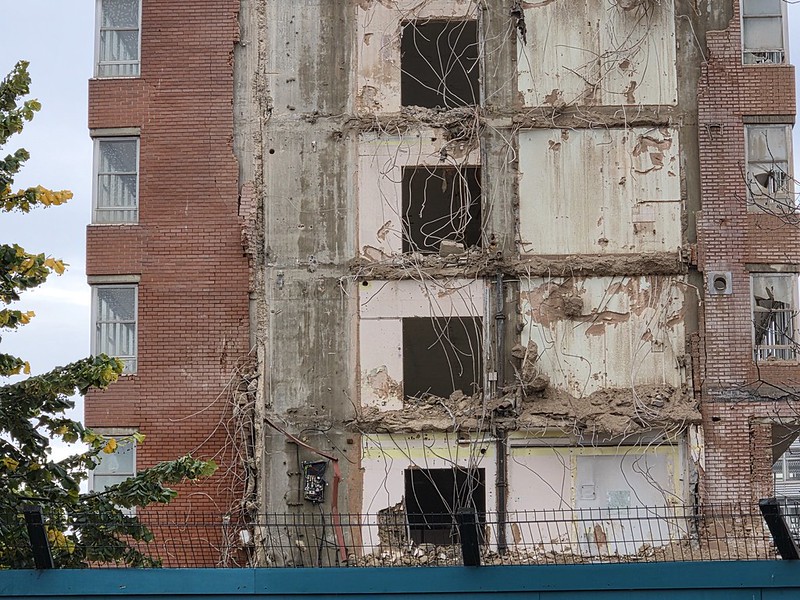

Just a few extra photos to show the progress made since my previous post of the day before…..



HOME · LATEST 100 POSTS · BAR BILLIARDS · GOOD BEER GUIDE · NORWICH MARKET · FLIGHTS · RAILWAYS · INDIAN MEALS · CONTACT
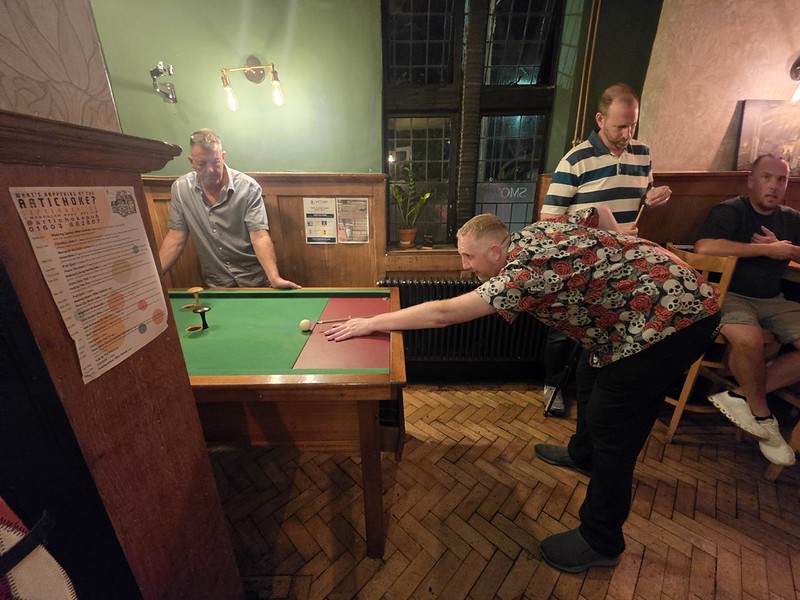

With Luke overseas again, living the life of a modern-day Judith Chalmers, I was required to serve as both captain and vice-captain. What could possibly go wrong? After successfully completing the draw, and thanks to Ivan for reminding me that I had forgotten to do the coin toss to decide who would break. I get muddled up.

I decided that I’d referee the first game and I was all ready with my beer and Hula Hoops, excited to see PJ winning to set us off on our winning ways. We’re the only team that the Red Lion have beaten all season, so I was confident we’d be able to get a victory on home territory. They had won the toss, so it was their team who would break in the first game.

My game was next and I managed to lose a break worth 460 points after an unfortunate interaction with our charmingly unpredictable table. As this was our home venue, blaming the equipment required a certain degree of confidence, but I recovered sufficiently to win and level the match at 1–1. Which reminds me, I must get Luke to re-level our table as that’s something that I’m not allowed to do.

Vaughan arrived and, after acquiring a beer, was sent directly to play his game. I felt that he would be in tip-top form if given as little time as possible to think about matters. My new policy of minimising the amount of time available for players to think had produced its first measurable success.

Vaughan was on tip-top form and put us 2-1 ahead, so my nerves started to settle a little. The vice-captain offered the captain no useful reassurance whatsoever.

Cal brought over the mid-game snacks and then fought in a close game before an unfortunate incident involving a miscue and the black peg where his score was wiped out. However, Cal got the biggest break of the game on our team, showing his natural talent. Ivan and Ian were unlucky and it suddenly meant that we were 4-2 down as we went into the doubles. My stress levels increased.

Ben, making his debut for the team, scored 200 with his first shot and immediately appeared substantially more competent than some of us who had been doing this for considerably longer. He will be allowed to play again. Actually, he doesn’t really have much choice, he’s on the team now.

Ben and Ian won before a highly competent Ivan and Vaughan brought us level at 4–4, leaving PJ and me to play the deciding game. Another unfortunate incident occurred which I shall not mention, but the shortened version is that we lost 5–4.
I think the absence of Luke’s carefully positioned mirror behind the table contributed substantially to the defeat. It had become detached from the wall for reasons that remain under investigation, and we are waiting for him to return from his latest holiday and restore it. It has been suggested that a civil engineer might need to oversee the matter next time.

We had come remarkably close, although the league table will show no interest in the emotional complexity of the evening. Many thanks to Tom and his team for a great evening and we look forward to returning to Coltishall next year. And we’re going to win that one. Definitely.

After landing in Kutaisi at a reasonable time of day, namely lunchtime, I realised that the slightly late arrival meant that I had missed the airport bus that departs every two hours. There was a wait of ninety minutes until the next one which felt a little sub-optimal as I was tired.
Out of interest, I had a look to see how much a Bolt taxi would cost, as Uber doesn’t operate in Georgia, and I realised that it was a fixed price of £6.90. This was twice the price of the bus, but I decided to treat myself to this almost unimaginable level of financial extravagance. Given that it was a 40 minute taxi journey and I’d be taken straight to the hotel, I considered this as a reasonable option. Anyone travelling as a pair might as well take a taxi, unless they particularly enjoy waiting beside an airport to save no money whatsoever.

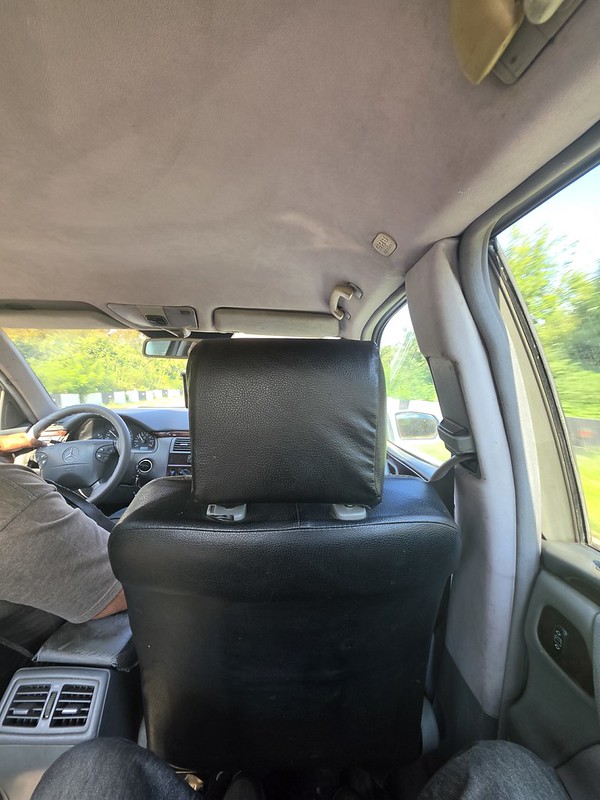
The driver arrived after around ninety seconds and I realised that there is a little waiting area for them. He seemed very positive and I was pleased to discover that he spoke no English, allowing international friendship to remain within manageable limits while I looked out of the window. I had no mobile roaming in Georgia, so I was temporarily forced to observe the country I had travelled there to see.
I tried to put my seat-belt on and the driver turned around and said “no need for that, I am a safe driver” which filled me with zero confidence. This is something that he must have learned in English to appear welcoming. The journey proceeded smoothly until he became lost in the city centre, uttered something that sounded suspiciously like a Georgian swear word and performed a brave U-turn in the road.
I was ultimately pleased that I got a taxi as I discovered that my hotel was at the top of a substantial hill, so not only did I save myself over an hour, I also saved myself a challenging walk.


After spending the night at Warsaw Airport, sustained by lounge coffee and an increasingly theoretical sense of alertness, it was time for the 09:10 flight to Kutaisi. I wasn’t entirely excited by leaving from 3N as it’s a bus gate, but I was by this time too tired to be much concerned.

We arrived at the aircraft and I took a photo of the registration number whilst still on the shuttle bus to save me looking it up later. Anyway, 9H-WNB was lined up to take us to Kutaisi and I was on the second shuttle bus so around half the passengers were already on board. There was some frantic waving from the ground staff, signalling that the shuttle-bus doors should remain closed, and we stayed where we were for around twenty minutes. It gradually became apparent that I probably had time for a little nap.
It transpired that 9H-WNB had just flown in from Kutaisi, but that was the limit of what it would be doing that day as perhaps there had been a minor technical issue that they wanted to look into. It had a nice day off at Warsaw Airport and was then back in service the following day, so this remains an aircraft that I’ve never been on.

After some faffing about we were driven to another aircraft, 9H-WNN, which has previously taken me from Warsaw to Genoa. We then had another twenty minute wait, by which point any remaining novelty associated with travelling around Warsaw Airport by bus had largely disappeared. One child felt ill and the doors were opened so he could collapse in an area with some space, although he perked up relatively quickly. No-one explained at any stage, either in English or Polish, what was going on so there was an air of surprise about what was unfolding. I don’t really like surprises when flying so I wasn’t entirely delighted.
Meanwhile, the passengers who had already been on the other aircraft had been deplaned (this is a word I like, I don’t care if it’s seen as American) and arrived in another shuttle bus. This meant that they still had some hope of boarding the aircraft first as most of them were priority passengers who would have expected to get ahead of the non-priority people. My friend Richard would have been horrified if his priority status had failed to secure the expected seven-second advantage as he is a VIP.

The flight itself is easy to summarise. I boarded, accepted the middle seat with which the seating gods had sub-optimally given me and fell asleep shortly after take-off. The aircraft was full, but the padded timetable absorbed most of the earlier delay and we landed in Kutaisi not long after the scheduled arrival time. I had therefore reached Georgia with remarkably little awareness of the flight itself, which is perhaps the ideal outcome when occupying a middle seat.

I had something like nine hours between my flight from Zadar landing in Warsaw Chopin Airport and my flight to Kutaisi departing. It didn’t really seem worth getting a hotel for the night, especially as they were relatively expensive, and so I thought that it would be easier, once again, to just stay awake at the airport.

At this time of the morning, it’s bright, open and quiet as an airport with sufficient power outlets dotted around to ensure there’s no panic of running out of phone battery. The departure board offered its usual collection of destinations designed to interfere with my future travel plans. Incidentally, the no photography sign on the right relates to the security area, I wasn’t being rebellious. I’m not suggesting that the airport terminal is entirely comfortable, but it’s spacious and there are 24 hour food options available landside.

The security checkpoints open early and that meant I was able to get through quickly before the bulk of passengers arrived. I’m not sure if they’re building a new lounge at the airport given this signage that was up.

The last couple of times I’ve flown from Warsaw there have been some delays due to the Entry/Exit System and going through earlier in the morning meant that the process was rather quicker and took just minutes.

By this point the airport was beginning to wake up, although there was still plenty of space and none of the usual competition for seats. I had survived the least sociable hours of the morning without falling asleep or losing possession of any electronic devices, which represented a satisfactory and optimal outcome for me.

I had made good time and arrived at the lounge shortly before it opened, joining the small queue while considering how many coffees I could reasonably justify after remaining awake all night.

I also didn’t have any problems finding a seat in the Etiuda lounge. I’ve always liked this non-Schengen lounge in Warsaw as it’s not too busy, there are plenty of power outlets and the food choice is decent.

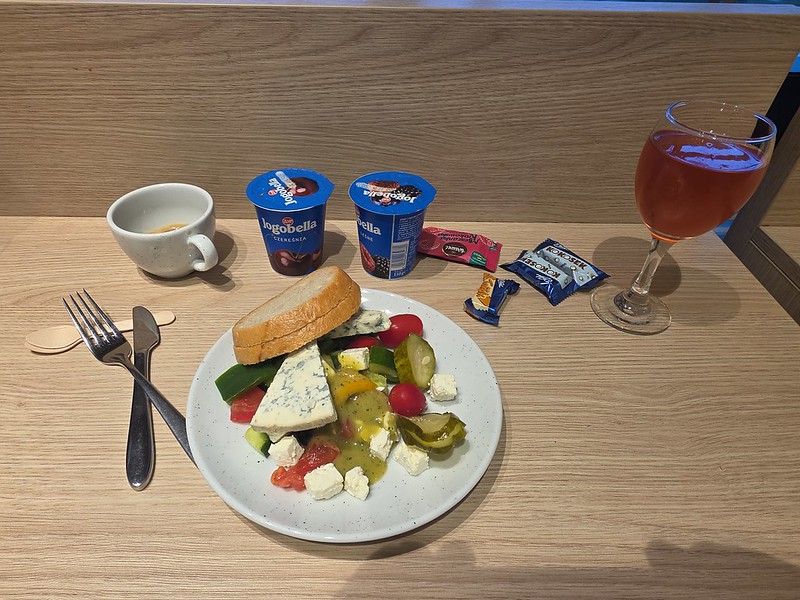
The breakfast of champions and all that. This was very much the sort of breakfast I like, with espresso, yoghurt, cheese, fruit juice, chocolate and enough salad to create a superficial impression of nutritional responsibility. The lounge was a comfortable conclusion to a surprisingly painless night at the airport and I could look forward to a little nap on the flight although I was aware that the seating gods had given me a middle seat.
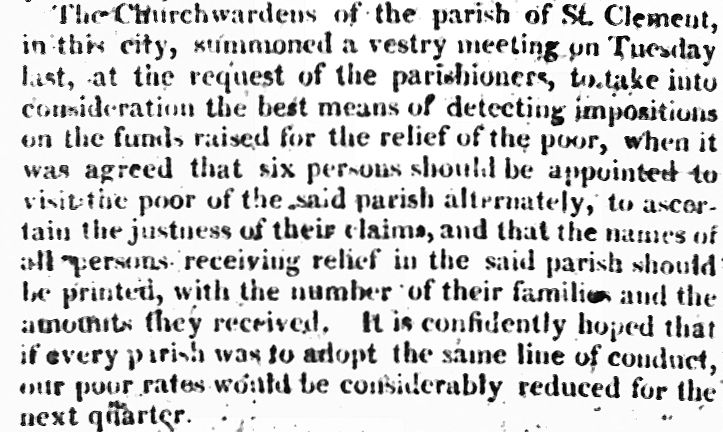

“The Churchwardens of the parish of St. Clement, in this city, summoned a vestry meeting on Tuesday last, at the request of the parishioners, to take into consideration the best means of detecting impositions on the funds raised for the relief of the poor, when it was agreed that six persons should be appointed to visit the poor of the said parish alternately, to ascertain the justness of their claims, and that the names of all persons receiving relief in the said parish should be printed, with the number of their families and the amounts they received. It is confidently hoped that if every parish was to adopt the same line of conduct, our poor rates would be considerably reduced for the next quarter.”
This short report appeared in the Norwich Mercury in September 1826 and describes what we might now call an attempt to investigate benefit fraud. Parishioners in St Clement had asked for a vestry meeting to consider possible “impositions” upon the money raised for poor relief. It was agreed that six people would take turns visiting recipients to assess whether their claims were justified. This was effectively a small team of local investigators, although without computers, central records or the opportunity to spend several months designing an official logo. But they had a mission to ensure that no-one was defrauding them.
The parish also proposed printing the names of everyone receiving relief, together with the size of their family and the amount they received. The methods would perhaps present certain difficulties under modern ideas about privacy and dignity, but the underlying combination of eligibility checks, home visits and a desire to reduce welfare expenditure feels remarkably familiar two centuries later.
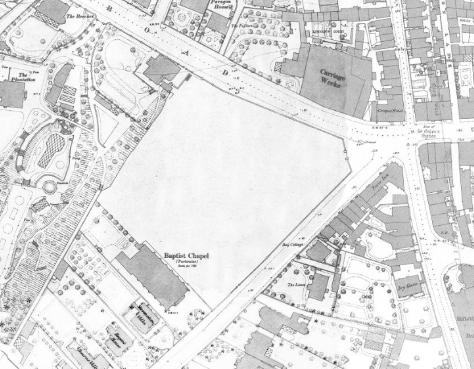

This map shows the empty site in 1884, shortly after Norwich City Gaol was demolished. The land on what is now Earlham Road is today occupied by the city’s Roman Catholic cathedral, but 200 years ago this month the newly completed gaol was at the centre of a substantial argument reported by the Norwich Mercury. The dispute concerned alleged departures from the building contract, work that had apparently not been completed and thousands of pounds in additional charges.
The article reads:
“At the adjourned Sessions, on Wednesday last, Alderman Crisp Brown, we are given from authority to understand, spoke nearly as follows:—He said he had a painful task to perform; but as justice had been denied him in another place, he was obliged to bring it before the Court. Many tradesmen in the city had informed him there was something very improper going forward at the new gaol, with respect to deviations from the contract. He had at various times recommended that a surveyor of eminence, and a stranger, should be employed to survey the works and report to the committee—but this was always strongly opposed by the chairman. In the month of June last he (Alderman Brown) sent for Mr. Richard Brown, the real architect, who formed the plan for our new gaol, and he was accompanied by Mr. Thos. Bird, a surveyor.
They pointed out great deviations, examined the bill of extras, amounting to 2300l. and discovered many things charged as extras which were positively included in the contract: amongst them were twelve iron doors, charged 72l. The iron frames to the cell windows, which by the contract were to have the outer rims and horizontal bars made of hammered iron, were all cast in one piece, which enabled the contractors to execute them at little more than half the expence, and yet not a shilling was deducted. The locking stones to the cell doors, 14 inches long, 14 inches wide, and 9 inches thick, were all left out and no deductions made, &c. &c. &c. He had these gentlemen in attendance upon the spot, with the plans and specifications in their hands, and ready to point out the various deviations, and he begged they might be admitted into the committee-room—but this request was refused. Subsequently he (Ald. Brown) gave a copy of Brown and Bird’s remarks upon the extra charges, & an order was entered in the book that enquiry should be made as to their correctness.—A most extraordinary plan however was pursued. They were sent to Messrs. Mears and Blyth, the contractors, to answer the observations—but they refused to give any answer, although the charges were heavy against them; nor could he (Mr. B.) get any answer whatever from the chairman. There was another glaring imposition, in the deductions for work not executed, with respect to 24 sets of iron louvre blinds to prison wings, and 8 iron doors, 54l. The doors amounted to 48l. leaving only 6l. for the louvre blinds, which the contractors themselves had estimated, when they made the contract, at 64l. 8s. making a difference of 58l. 8s. There were other extraordinary charges, such as 441l. for extra locks, and 284l. for extra brick-work. He had frequently requested to be informed where this extra brick-work was to be found, but could never obtain an answer.
All he wanted was that equal justice should be done to the contractors and to those who were to raise the money. But how was he treated? Why instead of going into the enquiry to ascertain the correctness of the charges, or receiving answers as promised him, the chairman told him (Ald. Brown) that the charges are not correct, and used very unbecoming language, with the evident design of deterring him from pursuing the enquiry. He therefore was compelled to stand up now in Court, in defence of his own character and in defence of his fellow citizens, who were called upon to raise 15,000l. this quarter for the maintenance of the poor, and therefore great care should be taken that they did not pay more for the new gaol than the contractors were entitled to.
The gaol was now finished, and besides the 2300l. for extras already claimed, there were more coming forward to the amount of about 2000l. He should therefore strongly recommend that they follow the example of the justices in the county, who had the whole work of the castle surveyed by a stranger; and therefore he moved that a surveyor of eminence, and a stranger, be employed to survey the new gaol. This was seconded by Alderman Bolingbroke; but in consequence of several magistrates having left the court to attend a committee, the debate was adjourned.”
I’m quite amused by the “he had frequently requested to be informed where this extra brick-work was to be found, but could ever obtain an answer”, which sums up the whole sorry story.
The contractors were playing fast and loose, but just as things were getting excited a number of magistrates left to attend another committee, so the debate was adjourned. Even £4,300 in disputed building charges was apparently no match for the gravitational pull of another meeting, but perhaps they had better snacks at that one. It’s a sign that public contracts have long since proved challenging to keep under control and I do wonder whether they found the missing brickwork.
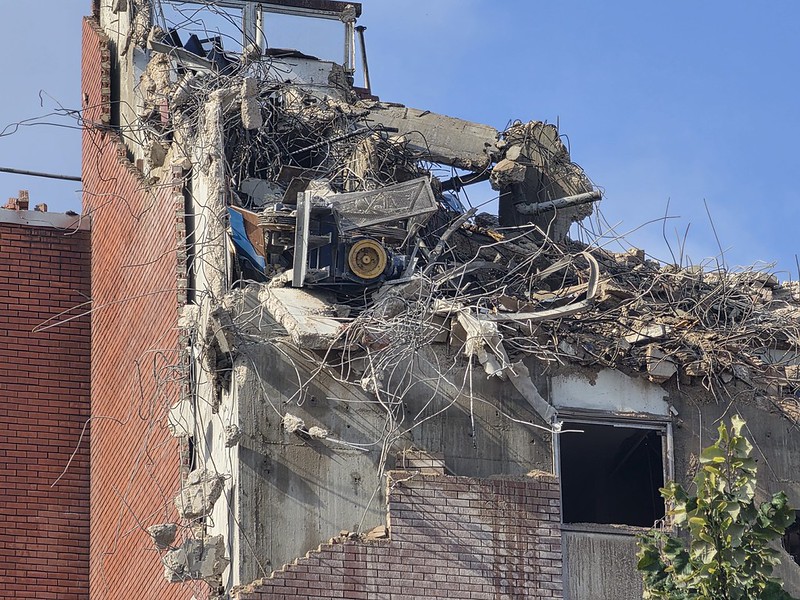
I haven’t posted much about the Anglia Square demolition recently as not much has happened. However, as I was walking by today there was finally some more action. And here are some photos of all the excitement.


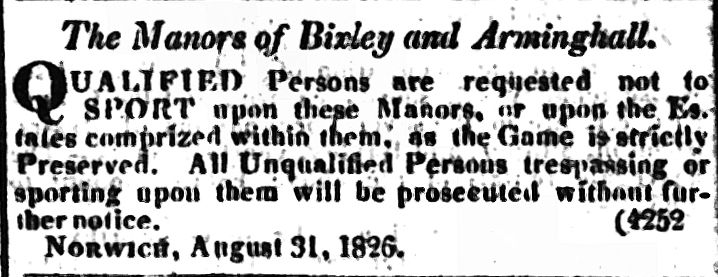

This notice appeared in the Norwich Mercury in September 1826 and relates to the manors of Bixley and Arminghall, immediately south of Norwich. It announced that game on the two estates was being strictly preserved and warned people against hunting or shooting there. In the language of the period, “sporting” meant pursuing animals such as hares, pheasants and partridges rather than participating in an especially vigorous game of bar billiards.
What makes the notice more interesting is the distinction it draws between “qualified” and “unqualified” people. Under the Game Laws then in force, the right to kill game was largely restricted to men with substantial property interests, certain long-term leaseholders and the eldest sons of esquires or men of higher social rank. Merely possessing a gun and finding a conveniently positioned pheasant was therefore insufficient in the eyes of the wealthy.
Those legally qualified to shoot were politely “requested” to stay away from the estates, while unqualified people were warned that they would be prosecuted without further notice. Being qualified did not give anyone the right to enter another person’s land, but the difference in tone is revealing. Wealthy sportsmen received a courteous announcement, while everyone else was informed that the authorities would be dealing with them and prosecution was likely.
The property qualification was abolished by the Game Act 1831, just five years after this notice appeared, although shooting still required the appropriate permission and certificate. It is a small snapshot of a different time, when hunting rights were determined by wealth, property and the apparently vital matter of whether someone’s father was sufficiently grand. You don’t get that in bar billiards.


This isn’t revolutionary stuff, but it is some of the earliest reporting of cricket scores that I’ve encountered, appearing in the Norwich Mercury in September 1826. Three separate matches are reported, including two between Attleburgh and a combined Caston and Griston side, followed by ten gentlemen, joined by Heyhoe of Shipdham, playing against Swaffham Club. I’m not a cricket expert, but the totals seem rather low by modern standards. Perhaps the quality of the bowling was exceptionally high in early nineteenth century Norfolk.
The newspaper uses the historical spelling Attleburgh, although the town is now generally known as Attleborough. The former has always made more sense to me, as that is how it is pronounced. The Swaffham game was likely played at the Racecourse Ground, which has some importance in the history of Norfolk cricket, with a tradition of the game being played in the town as early as 1700. Matches were recorded at the Racecourse Ground from 1797, while Norfolk teams played there between 1844 and 1850. Wikipedia notes that the location has now been lost, although I suspect it could be identified using older maps. That is a rabbit hole I won’t enter today, but I don’t think it would be a particularly deep one.
I now rather fear that historic cricket scores will start accumulating on this blog, as though it doesn’t already contain enough random piffle.