After one night in Nikšić, Montenegro’s second city, it was time to continue our journey by coach to Sarajevo in Bosnia and Herzegovina. We had booked the tickets the previous day and were surprised that we could pay by card, so we were fully prepared.
The bus timetable for anyone interested, and also for future historians attempting to establish why we thought this journey was a sensible idea.
There were several reasonably substantial coaches waiting at the station, so I naturally wondered which lovely and apparently roadworthy vehicle would be ours.
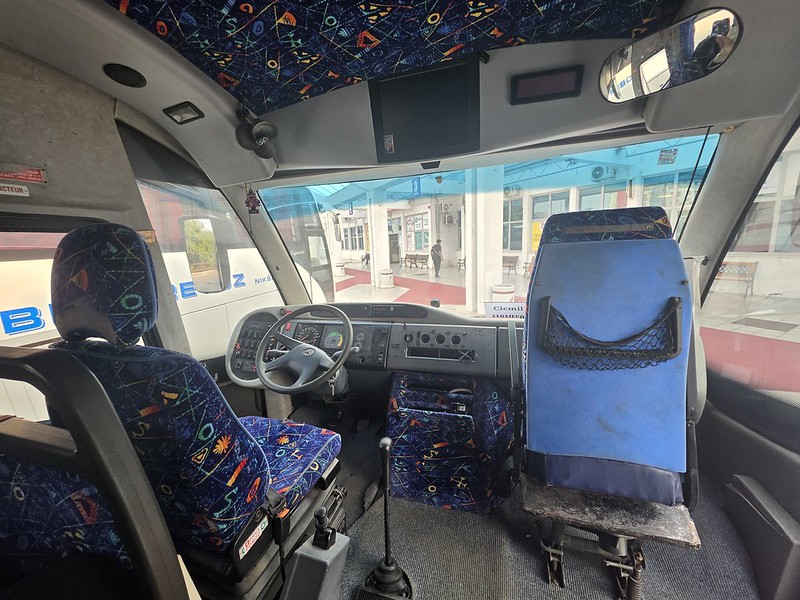
It transpired that it was none of them. Instead, we were allocated a dilapidated and impressively rickety minibus in which my seat belt did not work. I feared that any sharp braking might send me flying towards the driver, so I remained on high alert throughout the journey. The seat in front collapsed backwards at one point and, from my excellent vantage point, I could see the brake warning light flashing whenever the driver applied the brakes. It was reassuring to know that at least one part of the vehicle was still attempting to communicate.
I have some decent photographs of landscapes taken through coach windows coming up later in the trip, but there are rather fewer from this journey. I was occupied with remaining in my seat and monitoring the vehicle’s various cries for help. This is the village of Miločani, where the landscape began to open into increasingly dramatic valleys.
We then approached Plužine, surrounded by mountains beside the extraordinary blue waters of Piva Lake. By this point, the scenery had become spectacular enough to distract me temporarily from the mechanical condition of our transport.
We crossed the bridge over Piva Lake, an artificial reservoir created during the 1970s following the construction of the enormous Mratinje Dam. The views were spectacular and remain among my strongest memories of Montenegro, with blue water cutting through a landscape of mountains and deep valleys. Jonathan was still listening to podcasts, unaware of my solid work as the safety officer on board.
I didn’t want to photograph the border in any detail, but here we are at the Montenegrin checkpoint. The process was relatively quick, with the border officers asking to see each of us briefly before we waited beside the road and then returned to the minibus. It was all efficient and straightforward, although I was slightly surprised that the vehicle was permitted to leave the country. Well, unless they thought it was a good way of getting rid of it.
Anyway, the next post is the second half of the journey and the actual getting to Sarajevo. No spoilers, but I’m pleased to announce that we arrived safely.
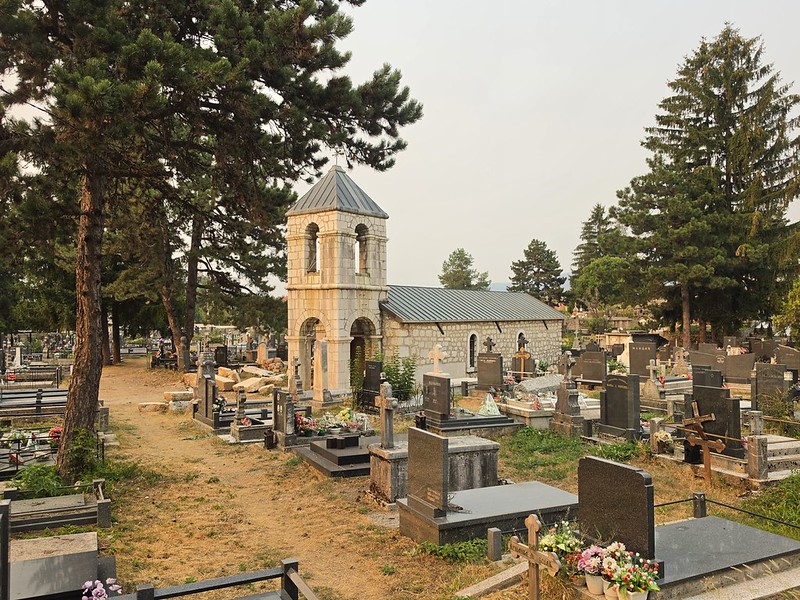
The Church of the Holy Apostles Peter and Paul stands among the graves of Nikšić’s old city cemetery, at the foot of Petrova Glavica and only a short distance from the much larger Cathedral Church of Saint Basil of Ostrog. I think it’s fair to say that it looks quite beautiful and the chance to see the foundations as we approached added to my excitement. I should probably get out more. Anyway, its exact age has long been disputed, with traditions placing its origins as early as the ninth or as late as the twelfth century, which seems rather a large gap to me.
Recent archaeological work, however, points towards a later date, suggesting that the present church probably originated during the fourteenth century before being altered and extended several times. It is considered one of the most important surviving monuments from medieval Onogošt, the settlement from which modern Nikšić developed.
At the western end is the tall stone bell tower, which also forms the entrance porch. This is one of the newest parts of the building, having been added towards the end of the nineteenth century after Nikšić was liberated from Ottoman rule. Unfortunately, the door was firmly locked when we visited, so this was as close as I came to conducting a detailed ecclesiastical inspection.
Internally, there are apparently fragments of historically important wall paintings which have survived, including depictions of the prophet Aaron, King Solomon holding a model of the Temple of Jerusalem, the Annunciation, the Communion of the Apostles and Christ Pantocrator.
What particularly interested me was that the ground had been excavated around parts of the church, exposing the lower walls and foundations normally hidden beneath the surface. Systematic archaeological investigations began in November 2025, partly to establish the sequence of the church’s different construction phases and partly to help address persistent damp which threatened the surviving paintings inside. The masonry clearly changes as it descends, with larger dressed blocks giving way to rougher stonework around the foundations. It is unusual to be able to see quite so directly how a historic building meets the ground, rather than having to accept on trust that it has foundations somewhere underneath. I’m not sure that Jonathan was quite as excited by the sight of exposed medieval rubble, though.
The excavation was especially noticeable beside this doorway, where the ground had been dug away to reveal the uneven courses of stone beneath the threshold. Archaeologists have identified several distinct phases of construction, while medieval monumetal, or stećak, tombstones were reused in parts of its walls and foundations. I might not have been able to see inside the church, but being allowed an unusually close look underneath it felt like a reasonable consolation prize.
Standing on Petrova Glavica above Nikšić, the Cathedral Church of Saint Basil of Ostrog is one of the city’s most prominent landmarks and Jonathan and I were keen to meander up the hill to have a look at it. It wasn’t an overly hot day, but it was still a little muggy, although of course I hardly even mention when it’s too warm.
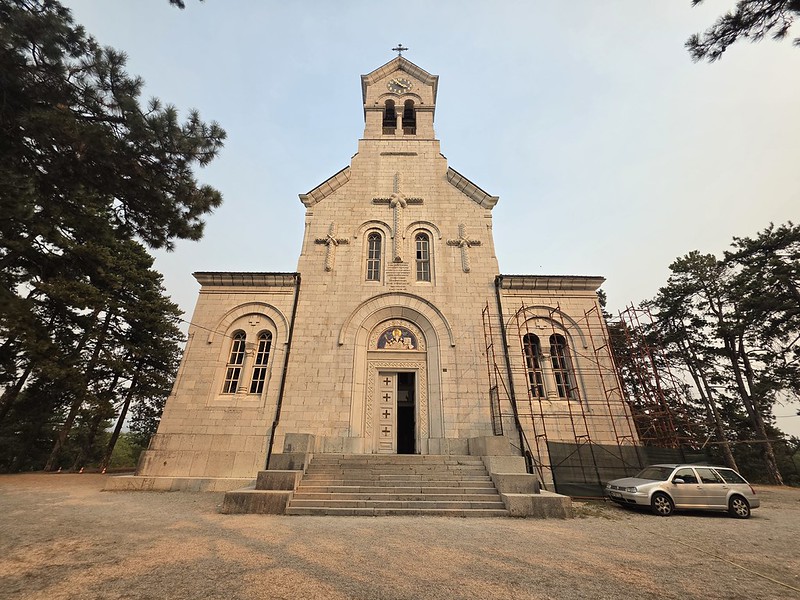
Prince Nikola I commissioned it to commemorate Montenegrin and Herzegovinian soldiers killed during the uprisings and wars against the Ottoman Empire between 1875 and 1878. Construction began in 1895 and the church was consecrated in 1900, having been designed by the Russian architect Mikhail Preobrazhensky. It was built from carefully cut local stone as a three aisled basilica, combining Byzantine influences with a tall Romanesque style bell tower. Scaffolding covered part of the building during our visit and they were busy doing something loud to the stonework, but there’s something strangely effective about the combination of spiritual reflection and industrial drilling.
The mosaic above the main doorway depicts Saint Basil of Ostrog, the seventeenth century Orthodox bishop after whom the cathedral is named. He is shown wearing episcopal robes, raising his right hand in blessing and holding an open book in his left. The miniature building across his chest represents the church itself, while the Cyrillic inscription identifies him as the miracle worker of Ostrog. Saint Basil founded the famous Ostrog Monastery south of Nikšić, where his relics are preserved and where he became one of the most widely venerated saints in Montenegro and the Serbian Orthodox Church. It’s nice when a church makes an effort to be clear about their patron saint, as I easily get muddled up without some hints.
The church occupies an elevated position overlooking Nikšić and forms part of a wider group of monuments around the hill, including the nearby palace built for Prince Nikola, who later became King Nikola. Nearby is the much smaller Church of Saints Peter and Paul, whose origins may reach back as far as the ninth century. We also went to have a look at that, but more on that later.
At the eastern end of the church is the iconostasis, the decorated screen which separates the sanctuary containing the altar from the main body of an Orthodox church. I am always intrigued by these and, although I instinctively prefer the more open arrangement familiar to me from the Church of England, the concealed sanctuary does give an Orthodox church an undeniable air of mystique. Its doors and panels carry images of Christ, the Virgin Mary and important saints, while the upper row presents a sequence of smaller sacred figures.
Looking along the nave reveals the cathedral’s considerable height, with massive stone columns and rounded arches supporting the vaulted roof and central dome. I rather liked the white walls which made the interior feel brighter and less visually crowded than many Orthodox churches. More importantly, it was quite cool inside, which immediately improved my theological appreciation of the building as I can’t enjoy a hot church.
Individual icons are displayed in richly carved wooden stands around the nave, allowing worshippers to approach, pray and light candles before particular holy figures. Incidentally, I rather liked the queue barrier for the iconostasis. After exploring the church, we then had a little sit down outside as this voyage of discovery can be quite tiring, especially when I insist on taking industrial amounts of photographs.
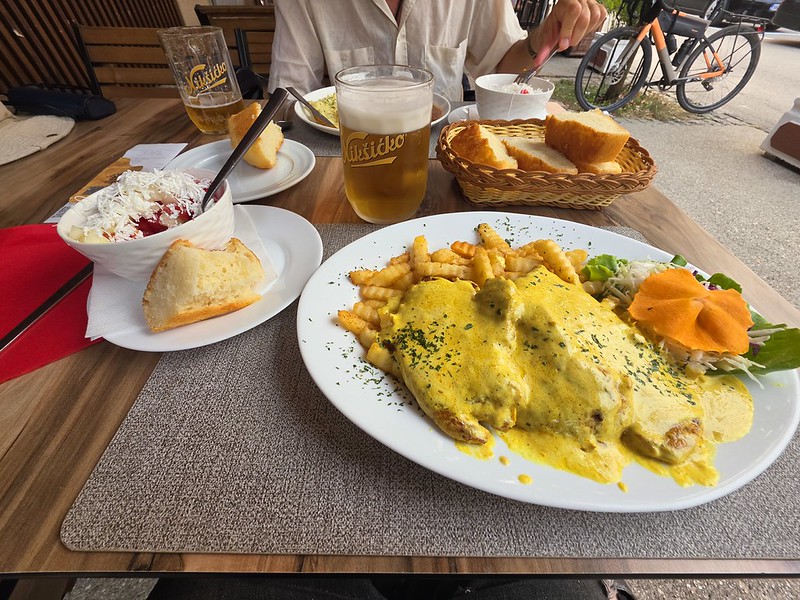
With tempting food options such as these, we couldn’t resist popping to this restaurant in Nikšić which was well reviewed online.
I started with a Nikšićko beer from the Trebjesa brewery, which is based in the city, although I was slightly disappointed to discover that they are owned by Molson Coors. The beer was clean and unexciting, very much another European lager, but it was inoffensive although that is not necessarily the highest ambition for a beer.
Jonathan’s goulash arrived which he declared as tasty, meaty and good value for money as it was the dish of the day.
There was some almost cake-like bread with my Shopska side salad which is tomato, cucumber, olive oil and grated white cheese on top. This is a popular salad in Montenegro. and I liked the simplicity of the dish and also the generosity of the cheese.
I ordered the chicken in curry sauce which seems to be something of a thing for the country and it was well presented. The chicken was tender, the sauce was generic but still tasted pleasant and the fries added a little to the whole arrangement.
The prices here were low, around £9 for a main course and a large beer which was all very reasonable. The server was very tolerant when Jonathan sent a beer back as he had become muddled up and the service generally was efficient, polite and I even agreed to sit outside which was very brave of me as that’s where smokers and insects often reside.
We were beside a slightly raucous English group, but fortunately they didn’t attempt to involve us in their frivolity and playing of Uno. Nikšić does not appear to receive enormous numbers of foreign tourists, so the chances of sitting beside a large English group must have been relatively low, yet we had somehow defeated the odds in the least useful lottery imaginable. Anyway, the restaurant is very much recommended, and I’d happily return if the opportunity arose.
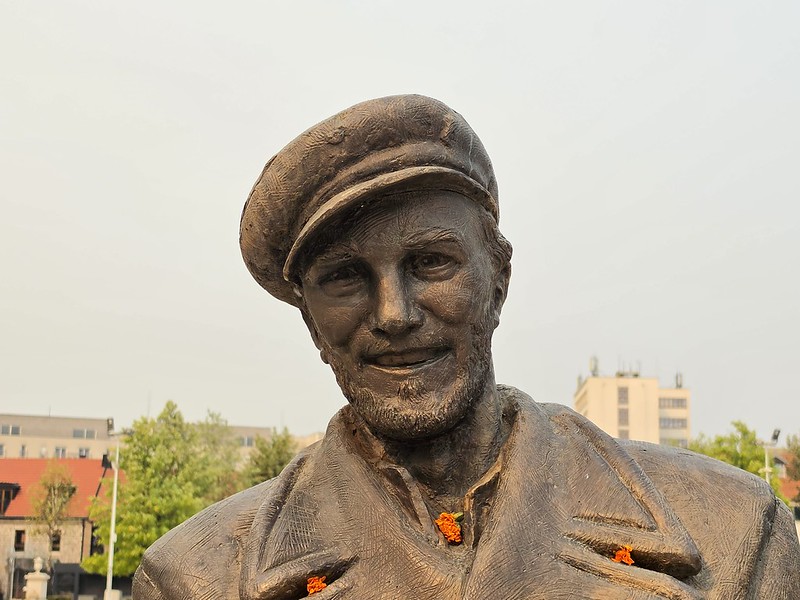
This bronze figure in Nikšić’s Freedom Square depicts Čedomir “Ljubo” Čupić, a Yugoslav Partisan whose final photograph became one of Montenegro’s most powerful images of resistance. Captured by Chetnik forces during the Italian occupation, Čupić was condemned to death and publicly executed in Nikšić on 9 May 1942. Shortly before the firing squad killed him, he was photographed in chains with an unmistakable smile on his face despite having just been tortured. That expression of defiance became a symbol of resistance to fascism, and Čupić was posthumously declared a People’s Hero of Yugoslavia in 1953.
The statue was unveiled in 2018 and recreates Čupić’s cap, long coat and remarkable smile, although the sculptors have shown him standing freely rather than shackled to a chair. Fresh flowers had been tucked into his hands, coat and collar when we visited which made it feel that he had a living presence. It’s one of the statues that I’ll likely remember seeing on this trip, it felt very powerful.
And here’s the famous image which has made him a national icon and he has been declared as a “people’s hero” in the country. Shackled and facing death, I can imagine that his captors felt it quite sub-optimal that he smiled in this way and I very much like that his memory has outlived those who executed him.
One of the most prominent and visible landmarks in Nikšić is Bedem Fortress, standing on a rocky hill immediately west of the modern city centre. Its surviving walls are also known as the Ramparts of Onogošt, preserving the name by which Nikšić was known for much of its earlier history. It is free to enter and there’s no information desk or the like, although there was a lady with a hosepipe and a cigarette watering the plants.
The hill has been strategically important since late antiquity. A Roman military settlement called Anderba was established in this area, close to routes connecting the Adriatic coast with the mountainous interior. Later traditions associate the site with Anagastum, a fortified settlement whose name gradually developed into the Slavic Onogošt. This made it a sensible place for Jonathan and me to begin, as the walls offered an early view across the city we were about to investigate.
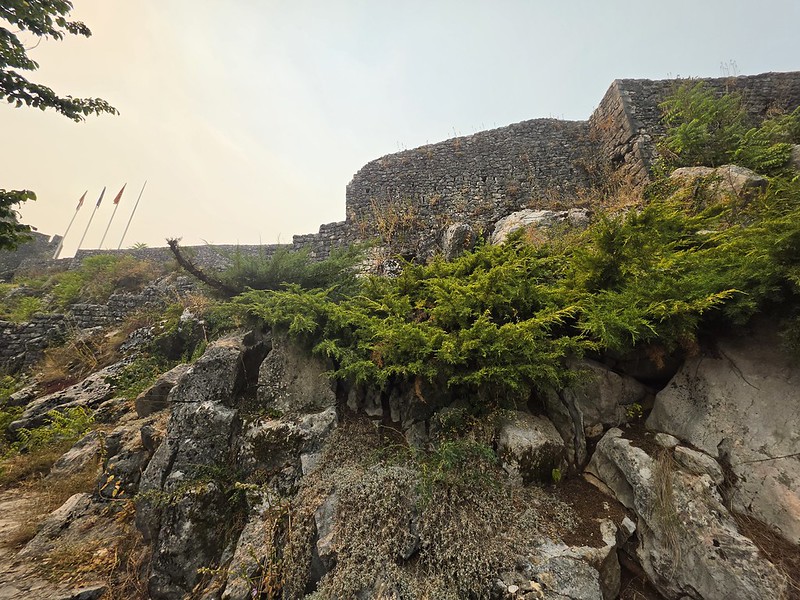
Onogošt became an important fortified settlement during the medieval period and gave its name to the surrounding district. Control passed between regional rulers as larger medieval states divided and contracted around it. The town was governed by the Kosača noble family during the fifteenth century before the Ottoman Empire took control of the region in 1465. The flags provide a conspicuously modern statement of identity above walls which have belonged to rather a long succession of rulers. There was little interpretation around the site, so visitors are largely trusted to arrive with historical knowledge or develop some with the assistance of a mobile signal. I used AI to provide Jonathan with a running commentary as we walked, thereby becoming a tour guide who was learning the material only seconds before delivering it.
The Ottomans developed Onogošt into an important military stronghold within the Sanjak of Herzegovina. Its position allowed troops stationed here to monitor routes across the Nikšić plain and defend the approaches towards the interior of Montenegro. The fortress was enlarged and strengthened over several centuries, creating the walls and defensive enclosures which dominate the remains today. This long curtain wall contains small openings which allowed defenders to observe or fire upon anyone approaching the fortress. The lower entrance is now protected by a metal gate, although it wouldn’t be hard for anyone to sneak into this fortress today as there are numerous holes in the walls.
Only fragments of many internal buildings remain, leaving doorways and windows opening onto rooms which no longer exist. This is atmospheric and added character to the whole arrangement, although it’s hard to imagine what they used to look like.
From higher ground within the fortress it is possible to appreciate the extent of the ruins and the scale of the site. The vegetation has been allowed to establish itself across much of the site and this does add to the attractiveness somewhat. Nikšić gradually replaced Onogošt as the town’s usual name during the Ottoman period. The name was already recorded during the sixteenth century and became the official form during the eighteenth century.
The elevated position provided defenders with extensive views across the plain. Modern Nikšić has since spread around the fortress and the current town is now visible in the background. As an aside, and it’s not immediately obvious from the photos, but there was quite a smoky feel to the city, it’s not clear what was from nearby forest fires and what was just linked to pollution, but I’m assuming that it was mainly the former.
Some sections have received paths, steps and white railings, although preservation across the fortress is uneven and it would be possible to have a rather sub-optimal fall. As ever, I was very careful and I’m pleased to note that there were no incidents.
The railway passes directly below the western side of the fortress. Nikšić later became an important industrial centre, particularly during the Yugoslav period, and its rail connections were developed to serve passengers and heavy industry. The line once continued through Bileća towards Bosnia and Herzegovina, but closed in 1976.
A narrow path follows the outside of the fortifications, with the wall rising on one side and the railway and open ground below on the other. This section gives a clearer impression of the defensive advantage created by building on exposed rock. Attackers would have faced steep ground before reaching walls occupied by people who were unlikely to entirely welcome them.
Montenegrin forces besieged Nikšić during the war against the Ottoman Empire in 1877. After sustained bombardment and the exhaustion of supplies, the Ottoman garrison surrendered in September of that year. Montenegro’s control of Nikšić was internationally recognised by the Treaty of Berlin in 1878 and that was the end of Ottoman rule.
The end of Ottoman rule also brought the end of Bedem’s central role in the town. Instead of continuing to develop within the fortress, Nikšić expanded across the plain below. Prince Nikola commissioned a new urban plan from the architect and engineer Josip Slade, whose 1883 design created the broad streets and radiating layout still evident in the centre.
Parts of the fortress have been stabilised and adapted for visitors, performances and cultural events. This former internal area now includes stone seating, allowing audiences to watch events in some interesting surroundings. Some of the work has been criticised for perhaps not being entirely in keeping with the most up-to-date architectural standards, but it has kept the building in use.
A larger open performance space has also been created within the walls. Bedem has hosted concerts and festivals, giving the old fortress a civic purpose long after its military usefulness disappeared. It is an effective setting, although performers must compete with several imposing walls and the likelihood that at least part of the audience is mainly inspecting the masonry. I would inevitably be part of that section.
These steps lead through another surviving entrance in the fortifications. The mixture of repaired masonry, weathered stone and straightforward metal handrail is typical of the site. There has been enough restoration to make much of it accessible, but not so much that the fortress has lost its sense of age. I proceeded with some caution as I didn’t want to have an incident with an unprotected drop. There were a few other visitors meandering around the site when we were there, but it certainly wasn’t busy.
My final view was from beneath one of the surviving defensive towers, where the walls appear to grow directly from the limestone. Bedem is not a polished attraction filled with displays, reconstructed rooms and strategically positioned gift shops. Its appeal lies in being able to explore the ruins, see how the fortress commanded the surrounding landscape and follow the physical remains of Nikšić’s earlier identities.
The site contains layers of Roman, medieval, Ottoman and Montenegrin history, although the visible structures are principally associated with the fortified town developed under Ottoman rule. It could certainly benefit from more signs and conservation, but its roughness is also part of its atmosphere. All very lovely given that there was no admission charge and it was a fun way to spend half an hour.
The bus times from the helpful tourist information office showed that the first bus out of Žabljak was just before lunchtime, but there was a bus poster on the wall which suggested that there was an earlier one. We didn’t want to rely on what might be an outdated poster, so Jonathan went out to investigate and there was a bus that was ready to take us to Nikšić.
This news meant that we didn’t have to faff about all morning wondering what to do and for €8 each we could leave immediately which would give us more time in Nikšić. We thought the red bus would be taking us, so naturally I photographed the wrong vehicle. It is actually the white one behind it, for anyone requiring accurate visual information.
It was comfortable on board and there was plenty of space. The modest number of passengers also suggested that the timetable’s existence was not widely known, which perhaps explained why the service had remained so comfortably spacious.
There were nice views along the journey, although I had started to think that I had likely seen enough Montenegrin mountains after spending so much time on buses and trains getting around the country. Rather more sadly, I started to see more fires.
The smoke got worse as we went on and this time I didn’t see any helicopters putting the fires out.
And safely in Nikšić, the second city of Montenegro. I had been following the route of the bus and when the driver stopped the bus I was ready to jump out and I thought that I’d better alert Jonathan to get out as well as that seemed kind.
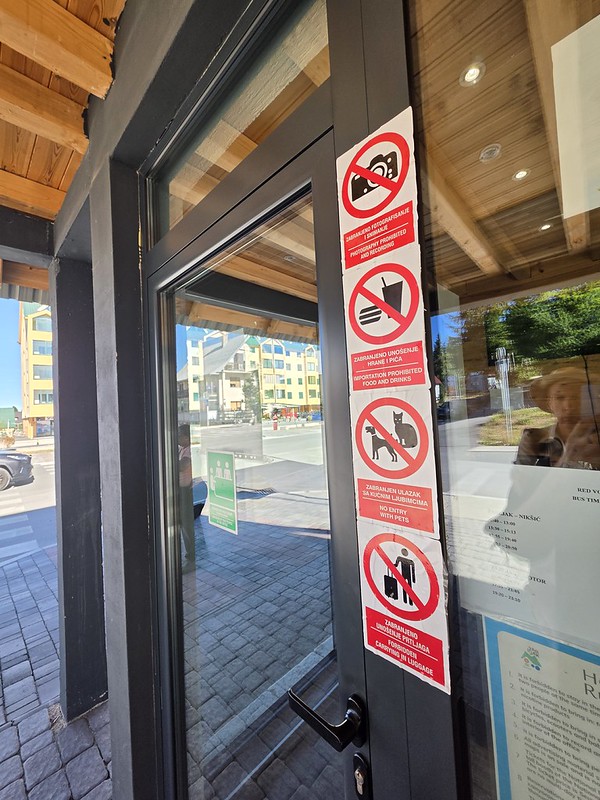
There’s a tourist information office at Žabljak which I found to be one of the more terrifying locations that I’ve visited, which isn’t really the vibe that I’d expect from such a service. This is their bench outside, with warnings not to eat or drink there, nor indeed could you sit there if you were waiting for a bus.
My favourite rule is that there are a maximum of two people allowed in the tourist information office at once, a ludicrous rule as it’s not quite clear what happens if it’s a family with two adults and two children. And also, don’t be taking your cat inside.
Here are some more detailed rules for those who just read the summary rules.
Jonathan decided to go in to find out some information about bus times, but they were clear that these times were printed out on a piece of paper in the window so he wasn’t in there for long. He had gone in as there was conflicting information and it transpired that the bus information provided by the tourist information was wrong.
I was amused at the review online which included a photo of the rules and noted:
“Customs control at the airport is easier to get through than getting in the tourist office. There are more rules for entering this place, than there are traffic laws in Montenegro.”
They didn’t agree, responding:
“Dear guests. Unfortunately every office has certain rules. The ones we posted are something what we had experienced before. We don’t see anything what is unusual. You probably saw that office is very tiny and we can’t have to much people inside. Cause we won’t be able to provide good service for our customers. Thank you for your feedback. We really appreciate it.”
A review from last week about the bus times:
“We went there to ask about the bus schedules, and they told us that the schedules were posted on the door. However, the information is not up to date! We woke up at 5 a.m. to catch the 6:30 a.m. bus to Podgorica but the bus never showed up! So don’t rely on the schedules posted there. Call the bus companies directly to make sure the buses are actually running.”
Sub-optimal. And a review from just two hours ago:
“If you’re expecting a friendly and welcoming approach, this may not be the right place for you. We came in with a few simple questions about the park, but the lady there seemed visibly annoyed that we were asking questions. Unfortunately, her attitude made the experience feel quite unwelcoming.”
I have to say, it felt sub-optimal as the whole welcome was pretty odd with the passive aggressive signage.
“We were greeted with toilet spray, and I assure you we were clean and didn’t smell at all. The second woman left immediately when we entered and came back as soon as we left. So why do they work in tourism?? We wonder!! I advise you to go, but just to annoy them 😅 You’ll be warned and you can take precautions. Good luck.”
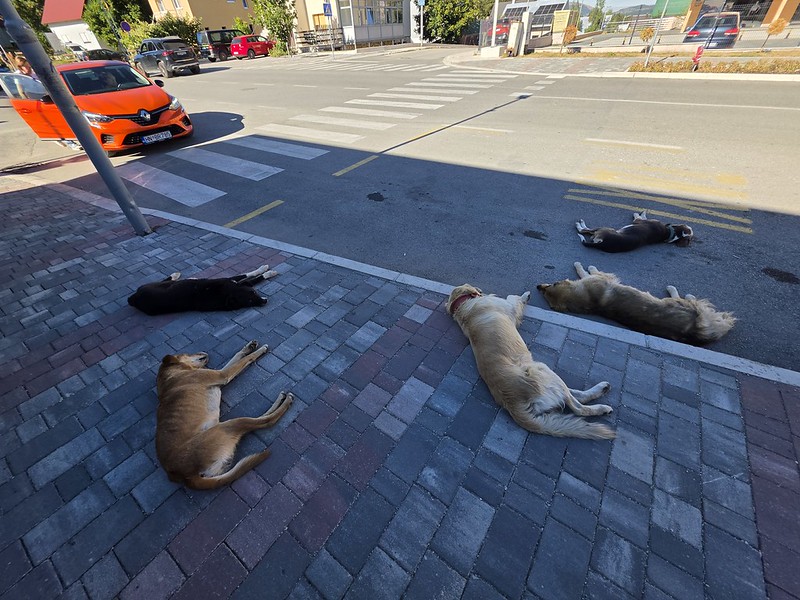
These pesky dogs spent approximately eight hours barking at one another, occasionally moving towards something resembling aggression before apparently remembering that they were friends. It was an impressively sustained disagreement given that none of them appeared to have any particular objective. When I download all the videos from this trip, I’ll upload some footage of the incessant barking so that readers can enjoy several seconds of the experience which accompanied us for most of the evening.
Having exhausted every available point of disagreement, they eventually decided to remain together for a little nap. They were really quite sweet and looked almost angelic, although this assessment might have been more generous if they had not spent the previous eight hours operating as Žabljak’s least necessary emergency siren.
For our second day of visiting the Durmitor National Park, we were looking for a walking route that would take around five hours, which wasn’t technically difficult and which would give us decent views from the mountains. Walking to the Ćurevac Viewpoint from Žabljak seemed to be the sensible option and wasn’t overly onerous. We’re not all David Morgan, regarding every mountain as an exciting challenge. Some of us prefer little hills which are ideally quite flat.
Quite why it has been decided to put a scrapyard in this area is a little difficult to understand. The other side of the road contained former fridges, washing machines and other assorted junk. It was an unexpectedly industrial opening to a walk leading towards one of Montenegro’s finest viewpoints.
We were fortunate with the weather, it was warm but it wasn’t overly hot and there was something of a breeze.
There was a lot of woodland walking, which is some of my favourite, and I appointed myself head of navigation.
The route was easy to follow from a map, but it was also pretty evident from the ground as well. We didn’t see many people on the trail and we had occasional little stops to rest.
Most of the route could have been managed by my friend Richard, albeit with a steady dialogue of complaints and collapses. As we got further in the whole arrangement started to become steeper and a little more challenging. I remained, as my loyal blog readers would expect, very brave.
Looking back over where we had walked, and I had started to complain, we were rewarded with some rather lovely views.
One more little burst of energy was needed to get to the viewpoint.
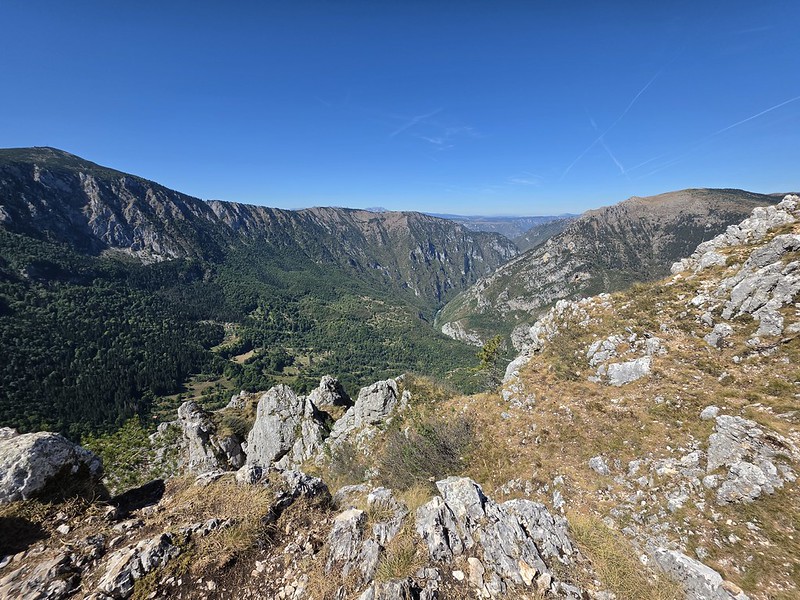
And these views made it worth it.
I didn’t go too near to the edge as I’m scared of sheer drops, but I perched myself on a rock to have a look over the valley.
The Tara River at the bottom of the valley.
Jonathan had acquired a stick through mountaineering expertise, while I acquired it through the more traditional method of taking it from him. I was nervous about some of the more challenging bits of descent and he was very agreeable.
My reward on the walk back to the start.
This was a really lovely walk, it wasn’t too onerous, I didn’t complain for more than five minutes at any one time and the views were spectacular. I think that there’s a car park near the top as there were a fair number of people at that section, but there were very few people on the rest of the route. And congratulations to Jonathan for listening to my “this is too slippery” on several occasions.