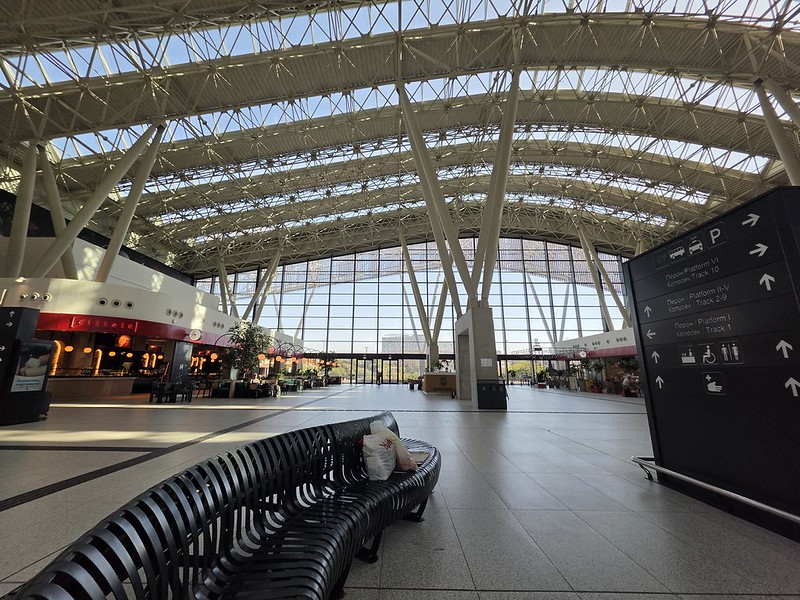
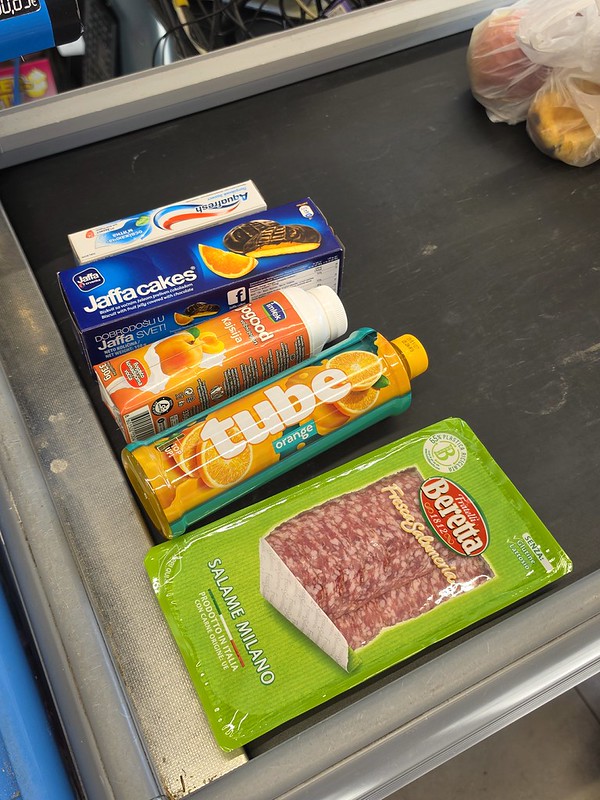
As I had about three hours before I could check-in, more on which later, I needed to find a seat and, more importantly, a power point. This looked like an appropriate place to visit and it was hardly packed with customers. Anyway, my main requirement from a venue is not ambience, cuisine or human connection, but electricity.
Thank you to AI for removing my thumb from this image…… Here are the food options, although I knew that I had a lounge visit coming up and so I resisted the temptation. Not that I was tempted anyway at those prices.
This was the limit of my purchase, a £3 can of Fanta, which I considered acceptable since I remained fully charged in terms of devices, I was in an air conditioned area and I had wifi. The online reviews for this place are pretty terrible, as they often are in airports, where everyone is tired, financially wounded and only one problem away from writing an angry one-star review. But I was content enough, which by airport standards is dangerously close to praise.
This isn’t the bus to the airport, it’s one of the standard buses used in the city and they reminded me somewhat of London buses. Albeit more dented versions.
This is the bus that took me to the airport and I took this photo when I disembarked. I wasn’t at all sure of the bus arrangement here, it departed from the city’s main bus station but it goes from outside the front rather than inside. I had purchased an all-day ticket and decided to get the 17:00 bus as the only later option was 19:00 and I don’t like ever getting the last bus in case something goes wrong. My mind is programmed to prepare for disaster at all times, unlike my friend Liam who doesn’t even let the thought cross his mind. I couldn’t live in that state of not being concerned.
I wasn’t sure of the bus arrangement and so I asked someone who didn’t look grumpy if I was in the right place. She was a lovely lady, also travelling to just about every European country that she could and was travelling on the same flight as me, albeit ending up in Birmingham. I was confused as she had purchased her ticket at the bus station, whereas I got mine online, and got a seat reservation. It felt like a different process to mine so I was slightly concerned about the arrangements in case I was waiting for the wrong bus. After boarding, it became clear that the seat reservation process was irrelevant and customers sat where they liked, something which I think is just much easier.
I was reassured when I zoomed into the driver’s timetable and saw that it was similar to the timetable I had booked from. This is the sort of detective work that gives travel a pleasing sense of purpose, even if it is mostly just me staring intensely at laminated paper through a phone camera. The tickets weren’t checked when boarding, but they were checked when we were getting off. For anyone who might need to know, this is the only company offering bus services to the airport and tickets can be purchased online, on the bus or at the bus station. It was all rather lovely, although as usual I had managed to arrive about six hours early at the airport, but I think that punctuality becomes more emotionally satisfying when taken to a completely unnecessary extreme.
In 1989, Skopje held a referendum on whether to develop a tram network, and the people of the city voted against it. This is mentioned in the museum where this poster was on display and also in various places online, but I’ve been unable to find the actual result of this referendum. I must admit to finding this less than ideal as I like my historical uncertainty to have the decency to be either fully obscure or properly documented, not sitting somewhere inbetween.
Anyway, it’s one of those decisions that may have made sense at the time, because large transport projects are expensive, disruptive and usually involve someone digging up a road just when everyone has decided they quite liked the road where it was. But looking at Skopje now, with its traffic, heat, wide roads and scattered districts, the decision does feel a little sub-optimal.
The idea has not gone away either, which suggests that the 1989 decision did not entirely settle the matter and numerous politicians have tried to bring the project back. They’ve had more success with their strategy of constructing tens of large statues about the place though and a lovely new tram system doesn’t look like it’ll be introduced in Skopje any time soon. On a similar note, Norwich needs a tram system, and frankly that is not talked about enough, presumably because everyone is too busy sitting in traffic pretending buses are the final stage of transportation civilisation.
No, this isn’t a statue of Richard that he’s been planning of himself for outside the Morrisons in Dereham, it’s Philip II of Macedon, with the whole arrangement being known as ‘the warrior’. It was installed here in 2012 and is not exactly easy to miss, showing the ancient Macedonian king standing with his fist raised and a staff in his other hand. Philip II, who lived from 382 to 336 BC, was the father of Alexander the Great and the ruler who transformed Macedon into the dominant military power in Greece. Alexander went on to become the more famous one, which feels slightly unfair, as Philip did quite a lot of the awkward preparatory work before his son took over the family expansion project to take over most of the then known world.
The statue is controversial, as are quite a few of Skopje’s grander monuments from this period. It formed part of the Skopje 2014 project, a huge and much-debated attempt to reshape the city centre with statues, fountains and neoclassical architecture. The problem, diplomatically speaking, was that ancient Macedonian history was also part of the long-running dispute with Greece over identity, heritage and the name of the country. And this is complex, so entirely over my knowledge base, but the Macedon empire that belonged to Philip II didn’t include what is now Skopje, it was much further south. But, as far as I’m concerned, if Skopje wants to have a statue to Philip II of Macedon then they should be welcome to do so. On that matter, I wonder whether Morrisons would put a little money towards the new statue of Richard he’s planning.
Literatura is a rather lovely bookshop which also happens to have a cafe at the back which looked to be agreeable. It’s a pleasant enough space and I like being surrounded by books and I could tell myself that this was cultural immersion. It’s part of a small chain of bookshops and it looked relatively busy when I was there, although the cafe element was quieter.
The menu was entirely in Macedonian so I was, once again, very grateful to Google Translate to assist me. Back in the time when this country was part of Yugoslavia, they primarily spoke Macedonian in this area, although the country’s main language was Serbo-Croat. I decided against purchasing a book in Macedonian though, it’s taking me long enough to be able to read anything in Polish and let alone a language written in the Cyrillic alphabet.
Annoyingly the power outlets in the cafe didn’t work, although I bravely coped without that. The coffee was hot, tasted like coffee and that’s going to be the limit of my professional commentary on the matter, it was also agreeably priced at the equivalent of around £1.75. All rather lovely.
This is the former Kino Kultura, one of Skopje’s old city-centre cinemas, built in 1937 by the Kostić brothers and once part of the city’s everyday cultural life. I rather liked the design of it, it reminded me of some old British cinemas and it merrily spent decades showing films, first as a private cinema and later within the Yugoslav-era public cinema system, before the familiar combination of political change, economic transition and new viewing habits did what it has done to so many old cinemas which is just made them nearly impossible to operate. In 1998, it was returned to the original family as the Government had taken it from them, but they didn’t have the resources to do anything with the building.
The building sat closed and deteriorating, before being revived in 2015 as Kino Kultura, a contemporary arts and performance space. That second life has now ended as well, leaving the building in this rather battered state, with graffiti at street level and the old ‘Култура’ sign still clinging on above, as though unwilling to admit the show is entirely over. It is not conventionally beautiful now, but I liked it for the past that it represented and, indeed, the earthquake that it survived. It’s centrally located in Skopje and it would be rather lovely if it could be restored to its former glory.
To get to the top of the tower on the right it’s necessary to walk along the fortress walls, which is something that has been properly restored. This high historic masonry expedition was primarily in the interests of blog content and some photographs to add to the arrangement.
The viewing platform on the top is a little sub-optimal, but the views over Skopje are rather lovely as can be seen below. And, yes, it was too hot and I had a little sit down for ten minutes on the cool steps (cool as in slightly cold, not as in ultra-fashionable) to recover. But, it was worth the effort….
I’ve already noted the rather sub-optimal arrangement where work has stopped on this fortress for political reasons, but this is the once rather lovely viewing platform they had at the top of one of the towers.
It’s not ideal….. Nice views though, but more of those in the next post.
Inside Skopje Fortress is an unfinished structure which now sits there as a rather awkward arrangement of stones, metal and unresolved civic ambition. It was intended to become a church-shaped museum, built over the remains of a medieval church found during archaeological work at the Kale, another name for the fortress. In theory and when things aren’t sub-optimal, this would have interpreted the Christian history of the site, but in practice, it became another reminder that in the Balkans, archaeology is rarely allowed the quiet life of being about old stones. The fortress has layers of Roman, Byzantine, medieval, Ottoman and modern history, which is fascinating for visitors but deeply inconvenient for anyone hoping to produce one neat national story without several other groups objecting.
The project became highly controversial in 2011, with Albanian political groups and community representatives arguing that the building looked too much like a new church and gave too much prominence to one version of the fortress’s past. Some also pointed to Ottoman and Islamic layers of the site, including the remains of a mosque, and argued that these were not being treated with the same enthusiasm. Macedonian supporters saw the work as a legitimate recognition of the medieval Christian remains. The dispute escalated into protests and clashes at the fortress in February 2011, with several people injured, after which the project was halted. It wasn’t quite what the archaeologists had hoped for, they’d found thousands of artefacts over a ten year archaeological study and it seems that they were quite keen for the story of this site to be told.
So, this is the result, an abandoned stone structure which is entirely out of keeping with the area around it. It might now be best to demolish it as it’s damaged anyway, scarring the landscape. It’s not for me to get involved in religious disputes, but this isn’t really the ideal way to show off an historic monument. Although, it is a reminder of history insomuch this land has been fought over on many occasions in the past.
This fortress is complex and there’s limited information about its history either at the site or online, but it’s a large and intriguing location. This is a former entrance way that looks like it has been out of commission for some time, but even relatively recently it was in use. It was the main entrance to the fortress before boulders were placed across it and entrance was forbidden to the public for several years. There’s a lot of controversy about this site which I’ll witter on about in future posts, but at least now there is some access possible.
The other side of the gate and hopefully in the future this can be opened up again. There’s currently one way into the fortress, which is through an odd looking arrangement at one side of the fortress which all looks a bit abandoned.