Category: UK
-

Books about Hertfordshire
The Origins of Hertfordshire by Tom Williamson is a large 270 page book which covers the history of the county from late prehistoric times to the thirteenth century. There’s lots of topographical history of the county, a subject not always well covered by books looking at this period of the county’s history. Primarily text based, as the period covered inevitably means that there is limited documentary evidence, there are though a number of maps. The book’s ISBN is 9781905313952.The Buildings of England – Hertfordshire book is the Bible of building archaeology in England, initially edited by the astute Nikolaus Pevsner, with research support from Bridget Cherry. The book has been recently updated by James Bettley and is 720 pages full of tightly written text about the buildings of Hertfordshire, in tremendous detail. There are many perambulations around the county’s towns, covering the main buildings of note. Pevsner’s quite cutting remarks about some buildings have remained in the book and there are some initial chapters about the general history of the county. The book’s ISBN is 9780300223903.The Watford to St. Albans Branch by SC Jenkins is part of the Locomotion Papers from the Oakwood Press. It’s a 90 page book which has an in-depth history of the line, with plenty of photos of stations, engines and also numerous older timetables and maps. There’s a great deal of clarity to the writing and plenty of history, despite this being a relatively short branch line. The book’s ISBN is 0853613990.Branch Lines Around Hertford and Hatfield to Broxbourne, St. Albans and Buntingford by Vic Mitchell and Keith Smith was published by Middleton Press in 2009. There are around 100 pages in the book, with Middleton being one of the prolific publishers of titles about the railway network. This title covers the evolution of the electrified branch line to Hertford East, along with the country branch to Buntingford. There’s not a substantial amount of supporting text, but the photos are interesting to look at, especially given how much has changed over the decades. There are also two pages of timetables, from the 1860s to the 1950s. The book’s ISBN is 9781906008581.The Origins of Hatfield Street Names compiled by Frank J Cox is a 16 page book which details how all of the streets in the town of Hatfield acquired their names. The book was published by Hatfield This Century, now the Hatfield Local History Society. The reasons for the name of Fiddle Bridge Lane are intriguing, it’s likely linked to the story of a merry fiddler from the medieval period.Hertfordshire Churches and Other Places of Worship by Jeffery W Whitelaw is 140 pages long and is something of a basic introduction to the historic religious buildings in the county. The book starts with a history of the local parish, with a chapter on the Cathedral and Abbey Church of St. Alban, with the book having an introduction by the Bishop. There’s then a section of post-conquest churches and monasteries up to the Reformation, then a chapter which covers the post-Reformation period. The next two chapters cover what to look for inside a church, then what to look for outside a church, along with a glossary of terms and then a gazetteer of the county’s churches. The book’s ISBN is 0948353856.Hertfordshire Buses by John Law is a 96 page book published by Amberley which has tens of photos of older coaches from the 1930s to today. Between the 1930s and the 1960s the buses were operated by London Transport, before being handed to the National Bus Company in 1969. Bus deregulation in the 1980s led by Margaret Thatcher saw it split into numerous smaller companies. There’s plenty of supporting text under each photo and it’s a well-written title. The book’s ISBN is 9781445669717.Hatfield and Its People – Part 5 : Roads and Railways was published in 1960 and was written by members of the Hatfield Branch of the Workers’ Educational Association. It’s a comprehensive 32 page book about primarily the evolution of the road system and the railways.Hatfield and Its People – Part 8 : Schools was published in 1962 and was written by members of the Hatfield Branch of the Workers’ Educational Association. It’s a short 32 page book which is nearly entirely about the Countess Anne foundation. The initial text of the book apologises about the omission about most other schools in the area, although they are very briefly listed. Unfortunately, the title of the book is perhaps a little misleading given how it is so focused on one institution, but it does cover this subject with some clarity.Hatfield and Its People – Part 11A : Families and Trades was published in 1964 and was written by members of the Hatfield Branch of the Workers’ Educational Association. It’s a 46 page book is inevitably a little niche given the broad subject being covered, which is the story of Hatfield’s trade and business families.NO IMAGEA Walk Around Old Hatfield by Gladys Brown is a short pamphlet which acts as an introduction to the town’s history. The author notes that there’s little new to long-term residents of Hatfield, but it is a useful history for those wanting to walk around and discover the important heritage elements. Brown was a former teacher and also a founder member of Hatfield This Century (later known as Hatfield Local History Society).Portrait of Hertfordshire by Brian J Bailey is 210 pages long and was originally published in 1978 by Robert Hale. It’s a conversational book in tone which makes it very readable, with the introduction noting that it has more village greens than any other county, and it was noted in the epilogue how important agriculture remained to the people of Hertfordshire. The author noted that he hoped that didn’t change, otherwise “the next chapter in the county’s story may well be the way to oblivion”.NO IMAGEGlebe Cottages Hatfield by Joy Emerton is a short pamphlet published by Frank J Cox for Hatfield Local History Society. It tells the story of the first 100 years of Glebe Cottages, from 1892 until 1992, including the names of the block residents and several photos.A Caring County? Social Welfare in Hertfordshire from 1600 edited by Steven King and Gillian Gear. This 350 page book was published the University of Hertfordshire Press and as an academic rigour to it, but it’s still a readable book and an intriguing question asked throughout is how has Hertfordshire dealt with the social needs of its residents over the centuries? The authors conclude that in many ways that the county has proved to be caring and nimble in its dealings with those needing assistance. The book’s ISBN is 9781909291126.Archaeology in Hertfordshire Recent Research – A Festschrift for Tony Rook edited by Kris Lockyear is a large 350 page book which covers the recent research that has taken place regarding the archaeological history of the county. The author Kris Lockyear is a senior lecturer at the Institute of Archaeology at UCL and the director of the Welwyn Archaeological Society. The reference to Tony Rook is because he was the founder of the Welwyn Archaeological Society and is very much a niche book, but essential reading though for those wanting a broad understanding of the different investigations which have taken place. The book’s ISBN is 9781909291423.Hertfordshire Soldiers of the Great War by Paul Johnson and Dan Hill is 280 pages long and is written by two military historians. Always well researched and with immense detail, there’s a chapter covering each year of the war, along with an extra section on the 1920s and another on the Home Front. There are numerous illustrations throughout, with this being a comprehensive introduction to what soldiers from the county faced during the First World War. The book’s ISBN is 1473893933.A Pilgrimage in Hertfordshire by HM Alderman was originally published in 1931 as a perambulation around the county, covering many of the landmarks in Hertfordshire. There are plenty of pen drawings of various historic locations and the book was republished in the 1990s to make it more accessible. The republished book’s ISBN is 1871199336.Biplanes to Rockets – 48 Years in Aviation by Ben French is a book about the recollections of a De Havilland Ground Engineer. French worked for the company between January 1935 and October 1983 and the book was originally written for his family, but then was published so that a wider audience can understand more about not just his own career, but also the heritage and history of the company. The book’s ISBN is 9781526205384. -
Towns in Hertfordshire
Some of the larger settlements in Hertfordshire and a brief history of each.
Borehamwood
Borehamwood is a town in Hertfordshire, England. It has a history that dates back to the medieval period, and its name is thought to derive from the “boreham wood” that was once located there.
In the 19th and early 20th centuries, Borehamwood was a small rural village. However, with the growth of London, the town underwent significant development in the 20th century, particularly during the interwar period, and became a suburban town. The film and television industries also established themselves in the town, with Elstree Studios located in Borehamwood.
Today, Borehamwood is a vibrant and bustling town with a diverse community, good transport links, and a variety of shops, restaurants, and other amenities. Despite its suburban character, it still retains some green spaces, including a number of parks and nature reserves, which provide a peaceful escape from the hustle and bustle of the town.
Bushey
Bushey is a town located in the county of Hertfordshire, England. The town has a history that dates back to the medieval period, with records of its existence going back to the 11th century. During the medieval period, Bushey was a small agricultural village, with its primary industry being farming.
In the 19th and 20th centuries, Bushey underwent significant growth and development, becoming a suburban town with a thriving community and several industries. The town was particularly known for its hat-making industry, which was one of the largest in the country at the time.
Today, Bushey is a vibrant and dynamic town with a diverse community, good transport links, and a variety of shops, restaurants, and other amenities. Despite its suburban character, it still retains some green spaces, including parks and nature reserves, which provide a peaceful escape from the hustle and bustle of the town.
Cheshunt
Cheshunt is a town in the Broxbourne borough of Hertfordshire, England, located on the River Lea. Its history dates back to the Roman period, when it was known as Cestrehunt, and was a major settlement along the Roman road that linked London to Colchester. During the Norman conquest, Cheshunt was mentioned in the Domesday Book of 1086 and was granted to the Bishop of London.
In the Middle Ages, Cheshunt was a market town and became an important centre for agriculture and brickmaking in the 19th century. The town was connected to London by the railway in 1840, leading to further growth and development. During World War II, Cheshunt suffered significant damage from German bombing, but was rebuilt after the war.
In the mid-20th century, Cheshunt saw significant growth with the arrival of major companies, such as Tesco and Sony, setting up their headquarters in the town. This led to an influx of residents and a expansion of the town’s residential and commercial areas. Today, Cheshunt is a suburban town with a mix of residential, commercial, and industrial areas and is known for its parks, lakes, and sports facilities.
Harpenden
Harpenden is a town in the St Albans district of Hertfordshire, England. It has a long history, with evidence of human habitation dating back to the Neolithic period. In the Middle Ages, Harpenden was a small agricultural village and remained so until the late 19th century, when it began to grow as a commuter town for London. The arrival of the railway in 1868 and the development of the town’s infrastructure led to a significant increase in population.
In the early 20th century, Harpenden continued to grow as a popular residential area and became a hub for the surrounding rural communities. The town saw a significant expansion in the interwar period, with the development of many new homes and the construction of several new schools and community facilities.
Today, Harpenden is a thriving town with a population of over 30,000. It is known for its historic architecture, parks and open spaces, and its high-quality shopping and dining options. The town is also home to several sporting clubs, a golf club, and a theatre, and is a popular destination for tourists and visitors.
Hatfield
Hatfield is a town in Hertfordshire, England, with a history dating back to the Roman period. The town was mentioned in the Domesday Book of 1086 and was the site of a royal palace in the Middle Ages, which was used by several monarchs, including King Henry VIII. In the 16th century, the palace was demolished and replaced by Hatfield House, which remains an important landmark in the town today.
During the Industrial Revolution, Hatfield grew as a centre for industry and transportation, with the arrival of the railway in the 19th century. The town was also home to several major aircraft and defence companies, including De Havilland and British Aerospace, which played a major role in the development of the aviation industry.
In the 20th century, Hatfield saw significant growth and development, with the construction of many new homes and the expansion of the town’s commercial and industrial areas. Today, Hatfield is a thriving suburban town with a mix of residential, commercial, and industrial areas, and is known for its parks, lakes, and sports facilities. The town is also home to the University of Hertfordshire, which was established in the mid-20th century and has grown to become one of the largest universities in the UK.
Hemel Hempstead
Hemel Hempstead is a town in Hertfordshire, England. It has a long history, with evidence of human habitation dating back to the Roman period. The town was mentioned in the Domesday Book of 1086 and was a small agricultural village for much of its history.
During the Industrial Revolution, Hemel Hempstead began to grow as a centre for industry and transportation, with the arrival of the railway in the 19th century. The town was also home to several major paper mills and printing works, which helped to drive its economic growth.
In the mid-20th century, Hemel Hempstead underwent significant expansion as a result of the government’s New Towns program, which aimed to alleviate overcrowding in London and other major cities. The town was designated as a New Town in 1947 and saw rapid growth, with the construction of many new homes, schools, and community facilities.
Today, Hemel Hempstead is a thriving suburban town with a population of over 90,000. It is known for its parks, lakes, and sports facilities, and is a popular destination for tourists and visitors. The town is also home to several large employers, including Marlowes Shopping Centre, which is one of the largest shopping centres in the UK.
Hertford
Hertford is the county town of Hertfordshire, England and has a long history, with evidence of human habitation dating back to the Roman period. The town was mentioned in the Domesday Book of 1086 and was a market town and an important centre for agriculture in the Middle Ages.
In the 16th and 17th centuries, Hertford was a centre for the wool trade and became known for its production of cloth and hats. The town was also a centre for the brewing industry, with several breweries established in the 17th and 18th centuries.
In the 19th century, Hertford saw significant growth as a result of the arrival of the railway and the expansion of the town’s infrastructure. This led to the development of new homes, schools, and community facilities, as well as a growth in industry and commerce.
Today, Hertford is a thriving town with a population of over 26,000. It is known for its historic architecture, parks and open spaces, and its high-quality shopping and dining options. The town is also a popular destination for tourists and visitors, and is home to several sporting clubs, a theatre, and several museums and galleries.
Hoddesdon
Hoddesdon is a town in the Broxbourne borough of Hertfordshire, England. It has a long history, with evidence of human habitation dating back to the Roman period. In the Middle Ages, Hoddesdon was a small agricultural village and remained so until the late 19th century, when it began to grow as a result of the expansion of the railway network.
In the early 20th century, Hoddesdon continued to grow as a popular residential area for workers in London, and saw the development of several new homes and community facilities. During World War II, the town was badly affected by bombing, with many homes and businesses damaged or destroyed.
After the war, Hoddesdon underwent significant redevelopment, with the construction of many new homes and the expansion of the town’s commercial and industrial areas. Today, Hoddesdon is a thriving town with a population of over 20,000. It is known for its parks, lakes, and sports facilities, and is a popular destination for tourists and visitors. The town is also home to several large employers, including pharmaceutical and medical technology companies.
Letchworth
Letchworth is a town in Hertfordshire, England. It is one of the first garden cities in the world and was founded in 1903 as a response to the growing problems of overcrowding and poor living conditions in urban areas. The garden city movement aimed to create a new type of urban settlement, one that was based on the principles of town planning and incorporated large areas of green space and parks.
Letchworth was designed as a planned town, with a grid-like street layout and a mix of residential, commercial, and industrial areas. The town was also designed to be self-sufficient, with its own water and sewage systems, electricity generation facilities, and parks and open spaces. In the years following its founding, Letchworth grew rapidly, attracting residents from London and other urban areas. The town was also an important centre for industry, with several major companies setting up operations there.
Today, Letchworth is a thriving town with a population of over 35,000. It is known for its parks and open spaces, and its distinctive architecture, which combines elements of Arts and Crafts style with Art Deco.
Rickmansworth
Rickmansworth is a town in the Three Rivers district of Hertfordshire, England. It has a long history, with evidence of human habitation dating back to the Roman period. In the Middle Ages, Rickmansworth was a small agricultural village and remained so until the late 19th century, when it began to grow as a result of the expansion of the railway network.
In the early 20th century, Rickmansworth continued to grow as a popular residential area for workers in London, and saw the development of several new homes and community facilities. During World War II, the town was badly affected by bombing, with many homes and businesses damaged or destroyed.
After the war, Rickmansworth underwent significant redevelopment, with the construction of many new homes and the expansion of the town’s commercial and industrial areas. Today, Rickmansworth is a thriving town with a population of over 15,000. It is known for its parks, lakes, and sports facilities, and is a popular destination for tourists and visitors. The town is also home to several large employers, including pharmaceutical and medical technology companies.
St Albans
St Albans is a city in Hertfordshire, England with a rich and diverse history. The city was originally called Verulamium and was a major Roman settlement and a centre of commerce and industry in the Roman province of Britannia. After the fall of the Roman Empire, Verulamium declined, but the town remained an important centre for agriculture and trade in the Middle Ages.
In the 16th and 17th centuries, St Albans became a centre for the cloth trade and was known for its production of fine cloth. The city was also an important centre for religion and was the site of several significant events in English church history, including the trial of St Alban, England’s first Christian martyr, and the birth of the English Reformation.
In the 19th and 20th centuries, St Albans grew rapidly as a result of the expansion of the railway network and the growth of London, and became a popular residential area for workers in the capital. Today, St Albans is a thriving city with a population of over 140,000. It is known for its rich history and cultural heritage, its parks and open spaces, and its high-quality shopping and dining options. The city is also home to several museums, theatres, and other cultural attractions, and is a popular destination for tourists and visitors.
Stevenage
Stevenage is a town in Hertfordshire, England. It is one of the country’s first new towns and was established in the mid-20th century as part of the UK government’s response to the growing problems of overcrowding and poor living conditions in urban areas.
The concept of the new town was to create a planned community with a mix of residential, commercial, and industrial areas, and to provide high-quality housing and public facilities for residents. Stevenage was designed as a self-contained town, with its own schools, shops, and public transport, and with plenty of green spaces and parks. In the years following its establishment, Stevenage grew rapidly, attracting residents from London and other urban areas. The town was also an important centre for industry, with several major companies setting up operations there.
Today, Stevenage is a thriving town with a population of over 85,000. It is known for its parks and open spaces, and its distinctive architecture, which combines elements of modernist and brutalist design.
Tring
Tring is a small market town in Hertfordshire, England, with a long and fascinating history. Archaeological evidence suggests that the area has been inhabited for thousands of years, and there are several historic sites in and around the town, including an Iron Age hill fort and a Roman settlement.
In the Middle Ages, Tring was a small agricultural village and was known for its wool trade. During the Tudor period, the town grew and prospered, and several fine buildings were constructed, including Tring Manor, which still stands today.
In the 19th and 20th centuries, Tring continued to grow and expand, and became a popular residential area for workers in London. The town was also a centre for industry, with several major companies setting up operations there.
Today, Tring is a thriving market town with a population of over 11,000. It is known for its historic buildings, its parks and open spaces, and its high-quality shopping and dining options.
Watford
Watford is a large town in Hertfordshire, England with a rich and diverse history. Archaeological evidence suggests that the area has been inhabited for thousands of years, and there are several historic sites in and around the town, including an Iron Age hill fort and a Roman settlement.
In the Middle Ages, Watford was a small agricultural village and remained so until the 19th century, when it began to grow as a result of the expansion of the railway network. In the late 19th and early 20th centuries, Watford became a popular residential area for workers in London, and saw the development of several new homes and community facilities.
During the 20th century, Watford continued to grow and expand, and became a major centre for industry and commerce. The town was home to several large companies, including printing and publishing firms, and was an important centre for the manufacture of paper, textiles, and other products.
Ware
Ware is a market town in Hertfordshire, England with a history that dates back to the Roman period. The town grew around a Roman settlement, which was established in the 1st century AD and became an important centre for trade and commerce.
In the Middle Ages, Ware became a prosperous market town and was known for its wool trade. During the Tudor period, the town grew and prospered, and several fine buildings were constructed, including several historic inns and taverns.
In the 19th and 20th centuries, Ware continued to grow and expand, and became a popular residential area for workers in London. The town was also a centre for industry, with several major companies setting up operations there.
-

Wednesday : London to Warsaw via Helsinki
Today’s adventure wasn’t an ideal situation, but British Airways needed to change my flight from London Heathrow to Warsaw and the only way that they could get me there was via Helsinki. These are challenging times for airlines at the moment, but I hope that these schedules start to settle down over the next few months, it’s not really a routing that I would have thought the most cost effective to arrange.
I was starting at the Ibis Styles at Heathrow, not my first time in the hotel, but my first time in the separate accommodation bloc. It’s really not apparent, but there’s a floor above what is visible here which is reset a little, which is where my room was.
Not that it’s particularly interesting, but that additional floor is visible behind Esso, with the main part of the hotel on the right.
A bus journey to Heathrow T3 central bus station and my complaint, yet again, that Heathrow have blocked off the pedestrian and cyclist entrance to the airport and so people are forced to use cars or go on public transport. In the past, the airport themselves paid for that public transport, but they don’t now. There’s an element of greed here and I find it a little sinister who is benefiting from these changes, but I had better not meander down that path for too long. So a little ride on the Travelator from the central bus station to get me to Heathrow T3.
And here it is again in all its glory, my favourite of the terminals at Heathrow. This is solely because of the lounges where I can get the most free food, T5 is a much better designed and interesting terminal architecturally (including the bits that my friend Liam built).
I can use the premium security line at Heathrow T3 because of my silver card (I have to mention every time that I got this through judicious use of Flyertalk tips, my spend on flights is very low and wouldn’t normally get me such decadence). A member of staff came over and said that the premium security line was longer than the standard line if anyone wanted to move over. I was by that point near the front and didn’t take the risk, but I was amused when someone just behind me said “you’re the one who just sent me over here”. I laughed just a little inside because the man seemed to want an argue but the staff member walked off. Security at T3 always seems quite quick and I got fortunate with my choice of queue, I think I was through within five minutes including the waiting time in the queue.
Lounge hopping at T3, I decided to start with Qantas to get a Salmon Eggs Benedict and delicious it was too. The service in the lounge was as impeccable as ever, efficient, informal and professional.
Part of the cold food selection, but I’ve written about this Qantas lounge before and won’t bore readers unnecessarily. It was though quiet, comfortable and as lovely as ever. I can’t decide which lounge I prefer, Qantas or Cathay Pacific, so I just visit them both.
I thought some exercise would be in order and so I walked to the Cathay Pacific Lounge to get food there, with this being the menu of the day.
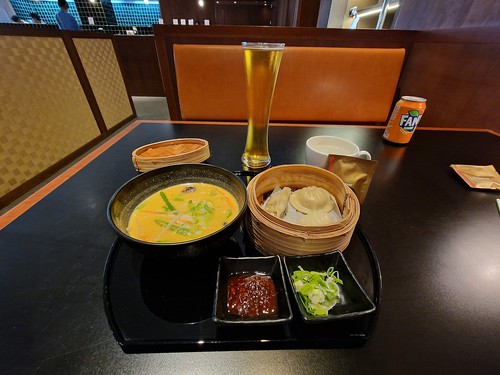
Delicious, that Dim Sum selection is always quite beautiful. There was some spicy kick to that Thai coconut and vegetable soup, which complemented the Asahi beer nicely. I didn’t bother visiting the British Airways lounge, it’s just not as decadent and they don’t have any beer there. Well, they have Heineken, but I mean proper beer. The barman mentioned that I had the last bottle of beer he had left, so I hope he had access to some more stock from somewhere. Service here, just as in the Qantas lounge, is professional and although more formal, it always feels welcoming. It’s a comfortable space as well, there are plenty of different seating types as well as lots of power points to charge devices. I mention that frequently as it is quite important to me, just imagine having a phone without any charge. It’s too much to even contemplate, I shall move on and away from that horrible thought.
My flights to Warsaw were with Finn Air, although it was a little difficult to work out when to board as the neighbouring gate spilled over and they had the wrong passengers in each queue for a short whilst. I think the other flight was going to Africa, so it would have been quite some distance if someone landed in Helsinki by mistake. I had a little problem when boarding as the staff member said “since you’re going to Warsaw as your final destination, I need to see your Covid pass”. I’m not actually sure that was right, as Poland doesn’t need the pass any more, so I spent about three minutes (that feels a long time when you know you’re holding up the queue) trying to find my older one, which he said would be sufficient. He was very helpful and after a few seconds of panic that I had forgotten to do something I should have done, I was ready to board.
I don’t know why they were using such a large aircraft, the Airbus A350-900, as the flight wasn’t that busy and it isn’t the usual aircraft that I’ve been on when shunted onto this service before. I was very pleased with it though, as it’s also a long-haul aircraft and I haven’t been on such a large aircraft since 2019.
I rarely get to see these sort of images, as British Airways opted out of the camera installation which isn’t relatively that expensive, they just claimed their passengers wouldn’t want it. I do, I like watching the plane from above and below, it’s quite surreal as it’s not the sort of image I’m used to seeing.
I had the entire row of three seats to myself, so I could lounge out and enjoy my free blueberry juice.
There was in-flight entertainment, so I watched an episode of Bear Grylls doing something adventurous with Alex Honnold, who I watched on board a BA flight a few years ago climbing with ropes in the film Free Solo (I mean I watched him on the BA in-flight entertainment, he wasn’t on the aircraft climbing things, although that would have been exciting). The series is Running Wild with Bear Grylls, it’s the sort of thing that my friend Liam would be excited to be on, it’s full of adventure and danger. I’d rather be in the pub than jumping out of aircraft or eating rattlesnakes.
We landed and I was transfixed watching the servicing of the aircraft underneath me. I hope British Airways change their minds and install these in the future, they’re very informative about how aircraft are serviced after landing, it’s all precisely timed.
I wasn’t in business class as I’m not that decadent, that’s the sort of thing my friend Richard does as he spends a lot of money on things he doesn’t need, but it looked really rather comfortable.
And there’s the aircraft.
I very much enjoyed visiting the non-Schengen Finn Air airport lounge a few weeks ago, but the Schengen one was much smaller and it was at near capacity when I went to it. The staff were friendly, although it’s the first time I’ve gone into a lounge and the check-in process has been via a scanner checking my boarding pass rather than a human inspecting it. The food wasn’t very exciting, a tray of pasta and a tray of cooked vegetables. It’s not exactly Michelin cuisine, nor actually is it even Greggs cuisine.
They had some feta salad with cooked vegetables, but I’d rather have had something cold and crisp with it, it was all very bland. I greedily got two slices of cheesecake as they looked delicious, but they weren’t very nice either. I can’t complain as this was all free, but I just got my hopes up from how good my experience had been before.
I had a couple of hours in the lounge and it got much quieter during the second half of my visit.
Wine and biscuits. I don’t know anything about wine to comment on the quality of that, but they needed some custard creams I thought. Or Jaffa Cakes, that would have been very good.
My laptop and I moved to the window to watch the aircraft. There were lots of power points in the lounge which was handy, so that I could get everything charged ready for the second flight.
All much more sedate when most people had left.
The self-pour selection.
I left the Finn Air lounge a little disappointed it wasn’t as good as their other one in the same airport, but I enjoyed the friendly service, the clean environment and indeed the entire airport felt relaxed and comfortable.
The flight to Warsaw was on a smaller aircraft.
The aircraft was at near capacity, so no empty row for me this time. The curtain between business class and economy is right at the front on this flight, there were just two people in business class. One of the debates on FlyerTalk is whether customers in economy should be able to use the washrooms in business class. usually it’s preferred not to, but on this flight, I saw the crew turning back three customers and sending them to the back of the aircraft to wait. I thought that was petty and it caused them service problems as then customers were trapped behind trolleys in the aisles and the crew had to reverse back up to let them pass. I don’t know how many washrooms they had on this aircraft, probably two at the rear and one at the front. Having one washroom for two customers and the other two for eighty customers doesn’t really make sense, however much you want to offer a differentiated service for business customers.
The crew member made an announcement at the end saying “please let business class passengers off first” which caused amusement as there were only two of them, and she looked annoyed people had laughed. I just thought it was all a bit odd, although it didn’t impact me.
Finn Air offer free blueberry juice and water, with other items being chargeable. I was quite happy with my blueberry juice.
The flight landed on time and I was through Warsaw airport security quickly enough, even though I (and others from the UK, it’s not just me) now have to wait in a queue separate to everyone else as I was from the UK and not in Schengen. I love being back here, it’s the railway station underneath Warsaw airport, which means I’m back in what is now my favourite city.
Warsaw landmarks on the seats, the train spotlessly clean and it cost me 74p for my ticket to the hotel. Bargain.
I was staying at the Warsaw Airport Mercure hotel again, one of my favourites and I’ve stayed there ten or so times I think now. It’s the smallest room I’ve been given in this particular hotel, but they said I might enjoy the tea theme of the room, so I thought that sounded interesting.
I wasn’t going to run out of tea.
My welcome gift and I always appreciate the gesture, even if it is mostly fruit. Indeed, as fruit goes, it was rather nice.
Pictures, all part of the tea theming of the room.
I liked it, there’s something quite fun about hotels having these individually designed rooms, it seems to be something that a few Accor hotels in the city are doing. Having quirky little elements like this makes things just a little more interesting, especially when it’s a room that I haven’t had before.
That’s the end of today’s little instalment. It was good to be back in Warsaw, I very much like it here.
-

Tuesday : Ealing, Angus Deayton and Heathrow
I liked the Ealing Ibis Styles, my first time there and it was a quiet and peaceful hotel with some strong movie related theming. The reviews aren’t great for the hotel and some are complaining that the hotel is charging for luggage storage, which is odd as I’d have thought that should have been included. I was fortunate to get this hotel for a reasonable price, the cost of staying in London is becoming ridiculous at the moment, well above pre-2020 prices. I hope for selfish reasons that this trend doesn’t continue permanently otherwise I’ll hardly be coming to London at all. At the moment, a single night at a city centre Travelodge is the same price as seven nights in an Accor hotel in some parts of Poland.
It was a pleasant day (well, too hot really, but I nearly always think it’s too hot as soon as the sun comes out) and this is Christ the Saviour Church in Ealing. It’s not that hard to guess the designer of this beautiful building, it’s Sir Gilbert Scott. Built in 1852 when Ealing’s population was starting to rapidly increase, it was damaged during the Second World War, but sensitively reconstructed and there’s plenty of foliage today around the building.
Fortunately, the underground strike of the previous day had come to an end, so the District Line was open again at Ealing Broadway Underground station. Note the old style signage of the station in the background.
It’s visible on the right hand side of this photo as well TFL note that these are originals, with the design dating to the early twentieth century. As an aside, you can buy original signage from the Underground at https://www.ltmuseumshop.co.uk/vintage-shop/underground-signs. It’s the kind of thing that I’d like, but it’s far too expensive and it’s not clear to me why I’d want a sign from London Liverpool Street in my flat. Although I would, I’d even appoint my friend Liam as the civil engineer responsible for the installation work.
All credit to TFL for this signage to help those coming from Ukraine.
Not many commuters on the Tuesday morning District Line service into central London. They try and paint the poles the same colour as the train service, so yellow for the Circle Line. It doesn’t always work out though, the District Line is green, but sometimes the lines share trains.
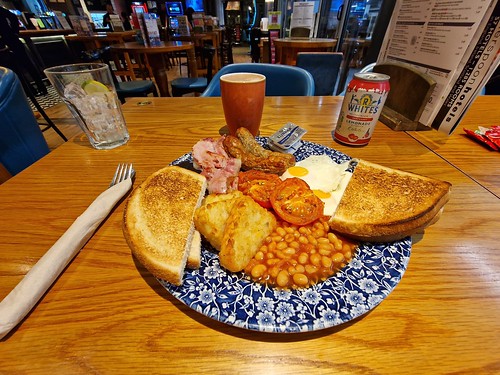
A quick Wetherspoons breakfast alongside countless refillable coffees, although it’s not entirely clear to me what they had done with the sausages, but I’d probably be best not knowing. I’m very productive in these surroundings and the coffees were delicious.
It was too hot so I went to St. James’s Park for a little while, a 57 acre park which was once land owned by the Palace of Whitehall.
This canal was added in the seventeenth century, although it doesn’t really go anywhere and is now more of a lake, they just diverted the Tyburn I think to fill it.
I was here a couple of days after the Jubilee weekend, so a lot of the barriers were still present and endless flags, although they might be permanent. The Government seem to be trying to put the union flag in as many places in London as they can and Priti Patel seems to spend most of her time standing in front of one. Anyway, I mustn’t get distracted back into politics.
I was annoyed at the heat so sat in Green Park trying to avoid the sun. The park was landscaped in 1820, but is one of the plainest of the parks, just lots of grass, but that suited my needs on this boiling hot day. Bloody global warming.
I had free tickets to the recording of Alone, which is a BBC Radio 4 comedy. It’s been going for a few years, but I’d never heard of it and half the audience also put their hands up saying they hadn’t heard the show before. This was by far the quietest of the shows that I’ve been to, the audience were only in the first few rows, although I think they had enough people to make it all work.
Another one of my hopeless photos, but this was the break and the performers (or whatever the word is) were just leaving the stage. There’s Angus Deayton, Pearce Quigley, Abigail Cruttenden, Kate Isitt and Bennett Arron. I like watching the process of recording these shows and how much of it has to be re-recorded because someone has made a mistake, there’s been a sound issue or something else went wrong. I hope the others wouldn’t be offended (although it hardly matters, they’re not going to read this) but I’d only heard of Angus Deayton and Pearce Quigley, the latter from the Detectorists. Anyway, it was all very entertaining.
A pizza from the very reliable and affordable Pizza Union chain, although I was conscious at this point that I should really get a move on to get to my hotel in Heathrow. I always have a slight fear that my hotel room will be resold and that would be a faff to resolve.
I had an hour’s journey on the Piccadilly Line from Holborn to Hounslow Central, where I would get a bus to the hotel. To my great annoyance, Heathrow still haven’t reinstated the Free Travel Zone around the airport, so I thought I’d get a bus from Hounslow instead of faffing about at the airport.
The Ibis Styles Heathrow Airport room, where I stayed a few weeks ago, and the room has a modern feel and I tolerate the lack of desk as that small table is sufficient. That also isn’t an oil slick on the floor, it’s the design of the carpet, which is clever as it hides any stains that guests might leave by just looking like it’s stained anyway. No problems though with my stay, quiet and comfortable with everything as expected.
The free welcome drinks, with the excitement for me that I was going overseas the next day. I never tire of that excited feeling and I wonder if I ever will.
-

Wombwell – The Horseshoe (JD Wetherspoon)
Just as a separate post as not to upset the flow of my beautiful prose (ahem) on the LDWA 100 posts. I’ll keep this post short to avoid any one of my flights of fancy.
This is the Horseshoe pub in Wombwell, which was built in the 1930s and more recently taken over by Wetherspoons. There was also a pub on this site before then, dating to around the early nineteenth century.
As an aside, Wombwell is a small town located not far from Barnsley, with coal mines once providing its wealth. Unfortunately, the good times seem to have faded somewhat and the town is need of some funds to restore some of their grander buildings. The local press are saying that this building may now be redeveloped, after ten years of mostly standing empty.
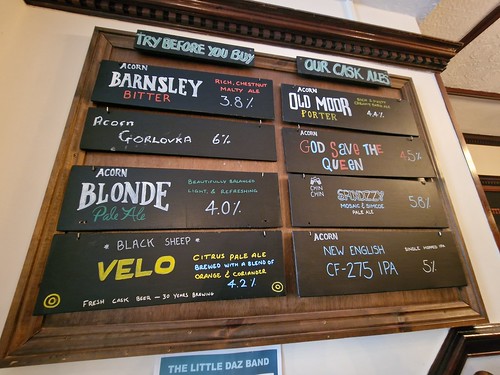
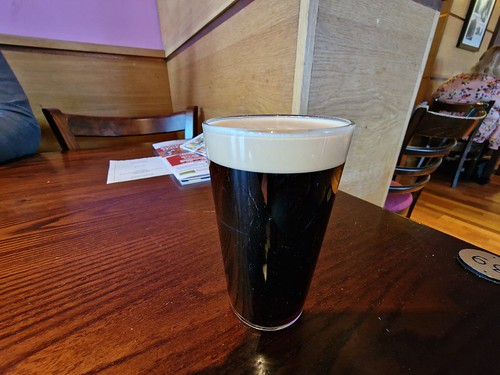
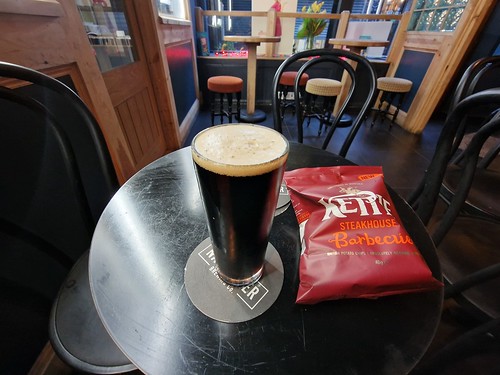
Arguably slightly underpoured, but this is the Gorlovka Imperial Stout from the nearby Acorn Brewery, very keenly priced at £1.20, especially given it’s 6% ABV. Well-kept and suitably delicious, no complaints from me about that.
It was busy on a Saturday afternoon and had something of a community feel, but the pub’s location means it’s unlikely to get too many visitors from outside of the area as I’m not sure that Wombwell is known for its tourist industry. It’s relatively well reviewed on-line for a JD Wetherspoon pub, with everything seemingly well managed. I did quite like the recent review of:
“Youth club. Full of bratty teenagers strutting around, thinking they own the place. Staff couldn’t care less. They congregate in the toilets. Going to the bar and sitting with free coffee refills for hours and on end. Obviously been dragged up. Zero manners. Why in earth the staff don’t throw them out is totally beyond me. If I was the manager they wouldn’t step one foot over the threshold. Spoilt the enjoyment of the evening (from a hard full time working adult).”
I’ve heard complaints of younger adults getting drunk in pubs and causing a nuisance, but not so frequently of youngsters binge drinking coffee and being annoying. I was quite disappointed to miss out on this extravaganza though as it wasn’t taking place when I was visited. It’s quite a large pub with one of the more modern interiors, it feels like they have the best maintained building in the area in terms of the exterior. It can’t have impressed enough local CAMRA members though, as it doesn’t feature in the Good Beer Guide.
-

Trouble at Smithfield – Jago Hazzard Video
Just as a break from my normal range of irrelevant blog posts, I found this video on Smithfield market, titled “Meat, Museums and Malarkey” to be interesting. I’ve found this market a fascinating site, since Des led a walk around it last June, when the photos below are from (other than the very bottom one which is from a few weeks ago when I went back to see what progress had been made). As the video says, the plan is to move a number of the markets from London all to a huge new site at Dagenham, which will be the largest wholesale market in the country.
But many of the traders don’t want to leave and there has been a meat market at this site for over 900 years and the Poultry section is still operating. The traders have refused to move and the City Corporation has been forced to try and get an Act of Parliament to remove them, a process which seems to have been going on for some months without any obvious updates.
The Museum of London will be moving onto the site as part of their celebration of all things London, alongside some sort of cultural and residential zone. And the irony pointed out by the video is one I’ve thought before, they’re shifting out something authentic and genuine from the city centre to put in a museum which, well, is the story of the authentic London. Or as the video notes, “London is increasingly become a theme park version of itself”. Hopefully they’ll be able to do something decent here, without a mix of housing that starts at £1 million and restaurants that end up being ridiculously expensive because of the rents they have to pay.
Although, the solution is perhaps to ensure it becomes a centre for decadent craft beers and breweries, that would be a much better story in the evolution of London as a great city.