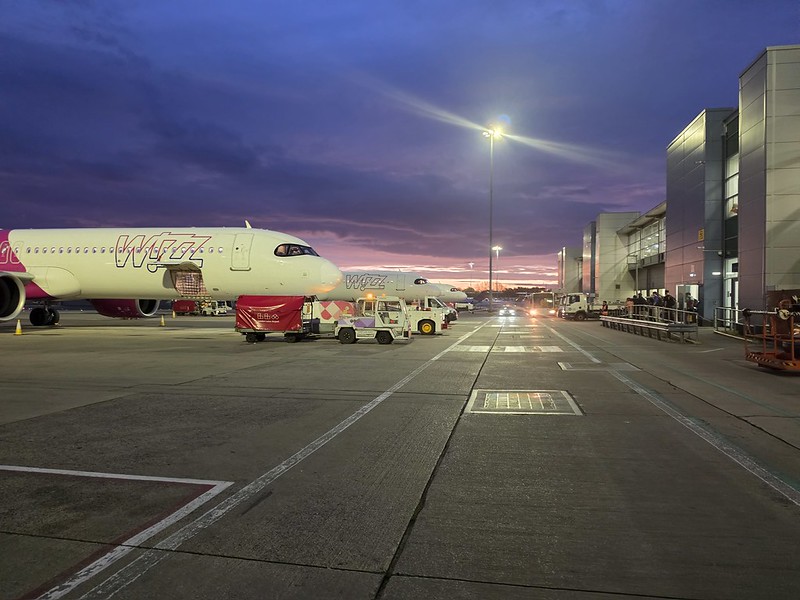
Category: UK

  • Ryanair (London Stansted to Lübeck)

    Ryanair (London Stansted to Lübeck)

    The entrance to the security area at Stansted looked a little more glamorous than when I was last here. It was also a quick process with staff members that looked buoyant and not entirely worn down by life. The security process here means that liquids and laptops don’t need to be removed from bags, so it’s a bit quicker.

    There’s currently no lounge available at Stansted Airport, other than for certain flights, as Escape has closed (and I don’t know what is opening in its place). However, my Priority Pass card gives me £18 to spend at Camden Bar & Kitchen, so I popped there.

    I’ve never been upstairs in here before and it was much busier than I had expected, although that’s true for the entire airport. The team members here were particularly friendly and engaging, despite how busy they all seemed to be.

    This cost just under the £18 that I had, which seemed slightly expensive, but the quality was high. The toast was soft, the tomatoes and avocado had a richness of taste and the eggs were runny when I cut into them. The latte had some flavour and it was an enjoyable breakfast all round.

    Back in the busy main terminal and there was a shortage of seating. I think they must be adding more as the overflow seating area downstairs is currently closed, so I’m hoping that they have a plan.

    Rather handily all of the screens had this error message on the left hand side, a little sub-optimal for those wanting to see what gate to head to.

    Michael O’Leary, the boss of Ryanair, said this week that passengers shouldn’t be allowed to drink alcohol in the morning at airports. I have some sympathy for him on this, there were more drunken passengers than I’ve noted before, some being quite raucous before boarding. Unfortunately, much of this seemed to be facilitated by JD Wetherspoon and they lost a set of Stella glasses from one group who just took their beers to the gate.

    Anyway, there was some certainly some vibrant behaviour from a couple of groups which continued all the way to the gate. It was about a ten minute walk and I wondered why they had so many drunken passengers wanting to get to Lübeck. All became clear here though, the left hand gate lane is for Ibiza, the right hand gate lane is for Lübeck. None of the raucous passengers were going to Lübeck and this felt like something of a relief.

    I was the first one to the gate, which was more because the flight was quiet than because I had managed to become quite athletic.

    There was then just a short walk to the aircraft.

    It’s aircraft 9H-QDD which I don’t think that I’ve been on before, but it’s been part of the Ryanair fleet since 2016. The seating Gods had given me a middle seat, but this was ridiculous as the flight was relatively empty so I had all three seats to myself. I assume Ryanair did that in the hope that I paid extra in advance to move to the window or aisle seat. The crew were friendly and the boarding process was efficient and it felt mostly clean, despite the number of empty cans and bits of paper left from the previous flight. With the quick turnaround, there’s only so much that can be done though.

    Just after taking off and Liam and I walked the Stansted Stagger a few months ago which went around the airport, so we must have walked somewhere there.

    We flew over Groningen.

    And safely into Lübeck with the sun still shining so it was still too hot. The flight was only just over an hour and we landed 25 minutes ahead of schedule, although Ryanair do pad their schedules.

    The border control process with the new EES was time consuming and took just under 30 minutes and I was towards the front of the queue. The EU passport queue was dealt with quickly, so for those of us without an EU passport it is all a bit sub-optimal.

    The flight was £14.99, so more than my usual £8.99 that I pay with Wizz Air, but it’s cheaper for me to get to Stansted than Luton Airport, so it worked out pretty similar. The flight was efficient, the crew were friendly, the pilots were calm, so I thought that I received a bargain flight.

  • Norwich to Stansted Airport Rail Journey

    Norwich to Stansted Airport Rail Journey

    This won’t be the most riveting of posts as there wasn’t really any drama. But, I had the opportunity to pop overseas for the weekend and that’s not something that I was going to deny myself. That meant a train journey from Norwich to Stansted Airport which was a very reasonable £14 booked on a complex ticketing arrangement.

    Waiting at the platform on a sunny Friday morning. It was already too hot.

    Here comes the train sweeping in and it was clear that there weren’t that many commuters waiting to go to Cambridge, which meant for a quiet journey in.

    And there’s my meal deal arrangement from the Co-op, very healthy as I’m sure that everyone would agree. Co-op sandwiches are not of the highest quality, the bacon is usually excessively fatty and the chicken has not been lavished with taste, but the prawn sandwich is agreeable enough.

    This was my view for most of the journey. Well, specifically I mean the empty seats, I didn’t have my head on the table.

    The waiting room at Cambridge railway station where I had a wait for the next train of around thirty minutes. A quick word on my rail ticket which technically required me to get off at Cambridge North and then get onto another operator’s train to take me the short distance to Cambridge. With the guard’s permission, I just stayed on the same train to avoid that change, but it’s that quirky switch to a Great Northern train which is why the ticket was much cheaper than the usual fare even to Cambridge. To be honest, at times it feels that securing agreement for an international treaty would be easier than getting cheap rail fares, the system really is sub-optimal in many ways.

    The view over Cambridge railway station from the bridge over the platforms.

    The only photo that I have of the second train and it was also relatively quiet. Fortunately, everything was running on time and there were no delays. As a side issue, I note that my bag looks in excellent condition there.

    I got muddled up at Stansted Airport railway station and managed to leave the ticket gates at the lift which I’ve never used before. I didn’t expect it to go straight into the terminal, I usually meander around some ramps to get there, so that was some operational efficiency that I hadn’t expected.

    With that, I had arrived on time and I could start to think about my flight….

  • Norwich – Bar Billiards (Game 3 – Artichoke Hearts vs Coach and Horses)

    Norwich – Bar Billiards (Game 3 – Artichoke Hearts vs Coach and Horses)

    This was our third game of the season in the league, we won against the Serengeti but lost to the Black Stars. This time, we were playing the Coach and Horses.

    With two of our regular team unable to make this week, we had a little bit of excitement to get a team together tonight for this third match. However, we were able to get six players together and the rest of the team spent the early evening practising whilst I focused on finding the best pairing of beer and bar snacks. I went for 0% Guinness and Squares, quite a classy little combination.

    Look at the contemplation from Cal before the other team arrived…… We were in the zone. Well, I was eating crisps and was pre-stressed, but the others were more positive.

    We have some dramatic photos of me in this post thanks to Cal, who was helpfully documenting matters. Here’s myself and my very capable vice-captain Luke as we did the draw. Thanks to Cal for the clipboard and for the printing as the not quite as capable team captain managed to forget to bring a score-sheet.

    And here’s the draw.

    I thought that I’d referee the first game which was with the first time league player Cal as I try to be helpful.

    We had a lot of interesting table layouts during the evening. I didn’t doubt that Cal was good, but he was very calm and collected with an entirely competent performance. It transpired that his score was the highest singles score of the evening, so I’ve decided that we’ll keep him.

    I felt that Cal’s victory meant that I should reward myself with more Squares. Leadership takes many forms.

    The next game was with Vaughan and once again I was ignored when I said that I didn’t want any games going to the final ball as they’re too stressful for me. He won the game by just ten points on the final ball…..

    PJ’s game went the same way, but the final ball result went our way, which meant that we were 3-0 ahead and I could put us 4-0 up if I was any bloody good.

    Thanks to Cal, there are the occasional photos of me playing in this post. I don’t wish to talk about my game though. OK, perhaps I should…. It was very close throughout, but my opponent was very strong at the end and I lost by 990 points to 850. My usual strategy is to try and score 1,000 points and that would have been dead handy here. Had I scored another 150 points, the result would have been completely different. I intend to apply this insight to all my future sporting disappointments.

    Cal getting ready to serve the meal of snacks. I had ensured that this was served after my game as I wanted something to look forwards to and to settle my nerves.

    Hmmmm, Taytos…. Next up was Gabriel, who insisted on getting to the final shot despite it being made very clear by Luke and myself that this is very stressful for us. Gabriel didn’t make this one, but his game was solid and he was very close.

    The final player in the singles was Luke and the game was again very close throughout, he lost by just 40 points. This all meant that we had gone from 3-0 ahead to 3-3, so thoughts of the Black Stars last week came to mind…

    Gabriel started to teach various players some hand gestures, but I didn’t get involved with that. Whatever he was actually doing remains unclear to me and I doubt whether any of it is recognised by Sport England.

    And then there were three games in the doubles. PJ and Cal surged to nearly 900 ahead, but then the brave players on the other team clawed it right back. But, PJ and Cal triumphed meaning that Luke and I could win the whole game if we just won our game. We didn’t, which made it 4-4 and which put all the pressure on Vaughan and Gabriel. Suddenly the room had the atmosphere of a courtroom waiting for a verdict, except with better crisps. But they surprised and delighted the Artichoke Hearts with a win, a punchy performance which once again went down to the final ball.

    A very hard won set of games, but full credit to the Coach and Horses team for not only some very close games but also being a marvellous group of people. There is a real pleasure in playing a team who are both good company and good players, even if it does make winning rather harder than I personally prefer. Cal’s first league appearance was alarmingly competent, which is always a little unsettling when given that my strategy is to build a team culture around anxious improvisation.

    I have a new rule that every time the team wins, I go to the King’s Head to celebrate. With no Julian sr, as he’s in Liverpool, it was Cal who was called upon to escort me to the pub. A more professional athlete might have gone home, stretched and hydrated, but I went to the pub and declared the evening a success, which is broadly the same thing. We only went for one, although I got muddled up and we stayed until the pub closed. This wasn’t my fault though, these things happen when a strict sporting recovery protocol is not properly supervised.

    And I’d like to note that it’s a fine team, a great atmosphere throughout and it’s all very exciting. And stressful when every game goes down to the wire. Next game is in Coltishall in two weeks and I’ll pretend that everything is under control.

    I’m enjoying this. Although I won’t show that of course.

  • Chatham – Historic Dockyard Chatham (Banff and Macduff Lifeboat Board)

    Chatham – Historic Dockyard Chatham (Banff and Macduff Lifeboat Board)

    This board is at the RNLI Historic Lifeboat Collection at Chatham and it records the first lifeboat at the Banff and Macduff station. The lifeboat was presented to the Royal National Lifeboat Institution in 1859 by Messrs Macfie & Sons, before being replaced by a new boat in 1870.

    In that relatively short service it helped save the crews of the schooner Auchincruive of Grangemouth in 1861 and the brig Regina of Swinemünde (now Świnoujście in Poland) in 1870, rescuing fifteen men in total, as well as being launched on four other occasions to assist vessels in distress.

    What rather interested me is why this particular board was at Chatham, but the lifeboat station was closed in 1924 and so this was likely placed in safe storage. There had been problems finding crew during the First World War, so the lifeboat station had been temporarily closed in 1917, but continued crewing difficulties made the closure permanent.

    Richard Lewis (1822-1883) was the Secretary of the RNLI between 1850 and 1883, credited with turning around the fortunes of a then depleted and financially deprived organisation into a world class search and rescue service.

    I’m pleased that someone with some initiative ensured that this board was kept, so much is just thrown into skips and the heritage lost forever.

  • Norwich – Anglia Square Demolition (6 May 2026)

    Norwich – Anglia Square Demolition (6 May 2026)

    So, the shopping centre at Anglia Square is pretty much all gone now. There are some walls that are still coming down, but it’s nearly entirely rubble and there’s no evidence at all of the Greggs that once stood here. It’ll now be the turn of the larger buildings to be demolished, they present different challenges and may well require specialist asbestos removing handling as well.

  • Chatham – Historic Dockyard Chatham (HMS Ocelot Submarine Tour Part 2)

    Chatham – Historic Dockyard Chatham (HMS Ocelot Submarine Tour Part 2)

    Carrying on from part one, this all looks rather refined. I suspect that this wasn’t for the junior members of crew on-board the submarine….

    Here’s a photo of a sink. Never let it be said that this blog doesn’t have riveting and fascinating content.

    It is genuinely impressive how everything on board this submarine was designed to use as little space as possible. In the days before IT and computers to help with the design, putting this whole thing together must have been a monumental challenge. Combining torpedoes for military use as well as sinks to try and make conditions vaguely comfortable for those on the submarine must have required some ingenuity.

    One thing not mentioned by the museum is that when this submarine was decommissioned and sent back to Chatham to go on display, much of the interior was stripped out. Some of the submarines were still in operation around the world and the last thing anyone wanted was for the Soviets to have a little day out at the museum and promptly see how everything fitted together. Much has been restored back to how it might have looked, but many of the fittings aren’t original and elements such as the TV and video player in a previous photo were sourced from elsewhere.

    The sound room where operators would monitor the sonar equipment if they could find space to sit down.

    There were a lot of these dials everywhere and I’m sure that they all displayed important information about what was happening in the submarine. One slight problem of the limited space of the tour is that the guide was at the front and anyone further back wasn’t going to hear anything that she might be saying. The one exception to this is when she stopped in an area to ensure that we all knew to have a look through the periscope.

    Always handy to have a map as it’s not easy to just have a little look out of the window.

    There’s certainly a lot going on here and it was mentioned that submarines aren’t so much driven as balanced, with everything having to be at the right depth, angle and buoyancy. This is something that my friend Liam would manage well, I’d probably be quite good at checking the food stocks were in order.

    The engineers on board who understood all of this really would have deserved their pay.

    Every valve and dial likely has a consequence, I was quite engaged with just how much of this there was on board.

    The communications room and this is somewhere that I might have been able to manage in.

    The luxury toilet facilities on board.

    Now this is exciting, the heart of the submarine’s operations, the kitchen. Being the chef here must have been challenging, there were around seventy men to feed on board the submarine and there’s not a huge amount of space here to do that.

    An example menu.

    I had to Google this, “snorting” is the process by which a submarine operates its diesel engines whilst they are submerged.

    There seemed like hundreds of metres of wires snaking around the submarine.

    A more spacious crew room, although that’s all a bit relative. I imagine it’s something that everyone got used to, with tours lasting for around eight weeks on average, but I’m sure that there must have been a fair few flare-ups between slightly annoyed submariners.

    At least they’re not stacked three high down this end of the submarine.

    And that was the end of the tour and it all lasted for around twenty minutes. The tours must be constant as another group was entering the submarine at the far end just as we were departing. The guide said that the history of the submarine’s tours was still covered by the Official Secrets Act and so it wasn’t known where Ocelot went around the world, although it’s fairly certain that it was used heavily in the Cold War. As for whether it was used in the Falklands War, there’s no official answer.

    It was all very interesting and the dry dock arrangement here shows the scale and size of the submarine. I did ask the guide about how hot it would have been on board and she said that it was often uncomfortably warm even with the air circulation systems that were in place. There was someone on the tour who used to serve on the submarine, but he was at the back of the group and so if he was offering little pearls of knowledge, I didn’t hear them.

    Although there were three more submarines made for the Canadian Navy, this was the end for the Royal Navy at Chatham. Investment was made to allow for the construction and repair of nuclear submarines, but no more were built here. It was announced in 1981 that the site would close in 1984 and although the Falklands War meant the dockyard was used again, it was still closed as expected.

  • Chatham – Historic Dockyard Chatham (HMS Ocelot Submarine Tour Part 1)

    Chatham – Historic Dockyard Chatham (HMS Ocelot Submarine Tour Part 1)

    This is HMS Ocelot was the last warship to be made at Chatham and it was launched from No. 7 slip on 5 May 1962, being commissioned into the Royal Navy on 31 January 1964. Chatham had been making submarines since 1908 and had constructed 57 of them over the years, but this was very much the end of an era.

    The museum offers free guided tours of the submarine, but they have to be booked and this was the one that was recommended to me in the limited time that I had at the museum. I got there for the tour and noticed that we all had to fit through a circle of this size. I had to have quite a think about that as although I’m an athlete, it did look rather small.

    The tour was led by Nat and she was cheerful and personable in the morning. Her task was to guide visitors through the submarine without getting stuck or annoyed, whilst trying to give some history about the whole arrangement.

    Ocelot was about 295 feet long overall and had diesel generators and electric motors. This set-up meant that it could travel more quietly submerged than many earlier boats, which was handy during the Cold War when surveillance and intelligence work were important.

    The first thing was to get on board the thing and that wasn’t using those steps, but they looked quite similar. I remember in Baltimore, United States, when I went on a guided tour of something similar that I commented on my bravery to the guide. A former member of the US navy giving the tour said that I gave the impression of someone from the Canadian navy, but I ignored that. Anyway, I digress.

    After I had nimbly climbed down the steps, the first thing that was visible were the torpedo tubes. There were six at the bow, with another two at the other end, three arranged on each side. The submarine carried 24 of the Mark 8 torpedoes, the rest were handily arranged on the wall in what was already a confined space.

    Inside the torpedo tube and the whole process was carefully controlled so the crew could load the weapon from inside the submarine, shut the inner door, flood the tube, open the outer door and fire. After firing, the outer door would be closed, the tube drained and the cycle could begin again. It was a highly disciplined little arrangement because the admiral, or whatever they’re called on a submarine, would likely be annoyed if their submarine had water flooding in.

    This little number must have been handy to read in the necessity of getting off the submarine quickly. I’m sure the training for this must have been extensive, if the submarine couldn’t surface then a controlled pressure chamber was the only route off. There seem to be some spelling mistakes on this which would fill me with confidence if I was standing there waiting to be evacuated. But, this is why I’m not in the Royal Navy as I suspect I would focus on matters that weren’t entirely important.

    The sleeping area and that must have been dead handy when someone decided that they wanted to play board games. It’s not what I would call spacious, but I doubt many people become submariners if they like having their own space.

    The entertainment area for those on board. The submarine was taken out of Royal Navy service in August 1991 and was returned to Chatham in 1992 to be used at the museum.

    More of the sleeping areas.

    These are the steps up that were visible in my earlier photo. They look a bit steep to me, but I’m scared of heights (and quite a lot of other things).

    Sleeping quarters for more decadent members of the crew.

    There really wasn’t much space along here. I didn’t take a photo of it, as I was quite focused on not getting stuck, but getting through the hatches wasn’t entirely easy. I’m not saying it was like an obstacle course, but it required grabbing the bar above the hatch and then swinging through into the next stage. Fortunately the woman behind me was about as athletic as my friend Richard, so I didn’t have anyone rushing me as she was having her own dramas.

    Anyway, more to follow in this riveting series of posts about a submarine…..

  • Chatham – Historic Dockyard Chatham (No. 3 Slip Cover Building)

    Chatham – Historic Dockyard Chatham (No. 3 Slip Cover Building)

    At first glance, the No. 3 Slip Cover at Chatham is a very large wooden shed and Britain has never been short of those, but this one has rather more going on. Built in 1838, it was designed to shelter ships while they were being constructed on the slip beneath, protecting the timber from rain, sun and the general damp enthusiasm of the Medway. When you’re building wooden warships, you don’t really want them getting damp before they’re ready.

    The building was designed by Sir Robert Seppings and the curved apse at its landward end was designed to accommodate a ship’s bow. Although buildings of this kind were constructed around the world, there aren’t many surviving and that’s not surprising as they’re not the most subtle arrangement.

    There was a lift up here, but as I’m an athlete, I decided to walk up the stairs. I wondered at the time what this floor was doing here in a huge building designed to build ships, but it was added in 1904 to store boats when the whole arrangement became more of a storage shed.

    This photo of underneath the mezzanine floor shows the scale of the building. As I had arrived early in the day, there were no other visitors in this area yet, it had a feeling of being a forbidden space with all this junk (or exhibits as the museum might call them) around.

  • Chatham – Historic Dockyard Chatham (Chatham Chest)

    Chatham – Historic Dockyard Chatham (Chatham Chest)

    The Chatham Chest didn’t look too exciting to me at first, but it’s what it represents which is perhaps more important. Established in the late sixteenth century, the Chatham Chest was an early naval welfare fund, created to support seamen who had been wounded, disabled or otherwise left unable to work after service at sea. Long before the modern welfare state, pensions bureaucracy and endless forms, this was an attempt to recognise sailors as individuals who needed support after the end of their service.

    Sailors contributed a portion of their pay into the fund and money from the chest was then used to provide relief for those who had suffered injury in service. This arrangement is the beginning of institutional responsibility and also there’s a constant that the authorities didn’t really trust those looking after it as it had five different locks to prevent fraud. This tactic didn’t work as money went missing and then King Charles I decided that he would use some to pay off some of his debts. Very handy for the pensioners who were entitled to the money from the chest.

    In 1814, after the long pressures of the Napoleonic Wars, the Chatham Chest was amalgamated with Greenwich Hospital, which had become the more formal national institution for supporting naval pensioners. The chest was moved to the National Maritime Museum and, more recently, to Chatham.

    I rather like what the museum has done here with its curation of the exhibits as this fund was created by Admiral Sir John Hawkins (1532 – 1595) making him one of the founders of the principle of a welfare state. He has been held in huge regard and in the twentieth century the Royal Navy named a ship after him. Things are more complex and his reputation is being examined as Hawkins was also involved in slavery, but rather than tell visitors what to think, they’ve neatly just told the story from both sides.

  • Chatham – Historic Dockyard Chatham (St. Paul Lifeboat)

    Chatham – Historic Dockyard Chatham (St. Paul Lifeboat)

    St Paul sits in the Lifeboat Museum with a rather battered dignity of something that has done its duty and would now rather like not to be poked by visitors with cameras. Built by the Beeching Brothers of Great Yarmouth in the clinker style associated with Norfolk and Suffolk beach boats, it is described on the panel as the oldest lifeboat in the RNLI Historic Lifeboat Collection.

    It served Kessingland from 1897 to 1931, powered by oars and sail, with a crew of sixteen and a shore party needed to haul it down to the water. Places such as Kessingland, Lowestoft, Caister and Gorleston lived with the sea because of their work and the RNLI and local lifeboat stations depended on courage and the willingness of people to turn out at awful hours in awful weather. During her service, the boat was launched 113 times and 22 lives were saved.

    The lifeboat served in Kessingland for 34 years before being converted into a private yacht, Stormcock, for which it was used for over forty years. This has made later conservation work more challenging, as they wanted to retain what was original and not restore the more later additions. It has been on display at the museum in Chatham since April 1996 and I rather like its rawness.