Lovely as Luton is, I try not to spend too much time there, but as my flight was arriving relatively late I wouldn’t have time to get back to Norwich. So, as the Thistle seems to have gone up in price, I went for this poorly reviewed little arrangement located near to the railway station. One of the reasons that I ignored the reviews is that booking.com noted that there was a high number of guests who rebooked there, which is usually a positive sign.
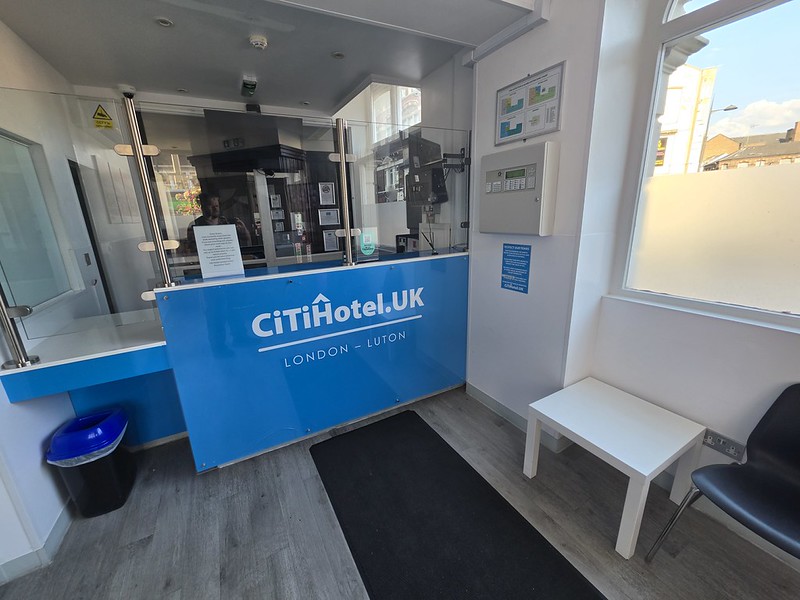
I had a ten minute wait at reception but this didn’t concern me as there was air conditioning in this area and I was too hot. After several days in France, I was prepared to tolerate quite significant administrative failure provided something kept blowing cold air at me. There was a phone number to ring in the event of an emergency, so I eventually rang that and a team member came out to complete the check-in process.
A quick look at the fire plan shows the general lack of decadence about the room size, but I like hotels such as this as they’re cheap, affordable and don’t include luxuries that I don’t need. Like windows. There are people who want boutique furnishings, mood lighting and an inspirational selection of cushions from their hotel room. I mostly want somewhere clean to sleep with a plug socket and a temperature that doesn’t make me irritable.
The basic room which was clean, at a temperature that was acceptable to me although not overly cold, and which I thought was entirely satisfactory.
I’d stay here again, I didn’t have any noise issues either internally or externally, although it would have been surprising to have any of the latter given that there was no window. The prices were low (the room was around £35 for the night), the staff member was polite and I was near to JD Wetherspoon and the railway station. For anyone that likes comfort, space and a window, then this is perhaps a little sub-optimal and that would explain the rather poor reviews.
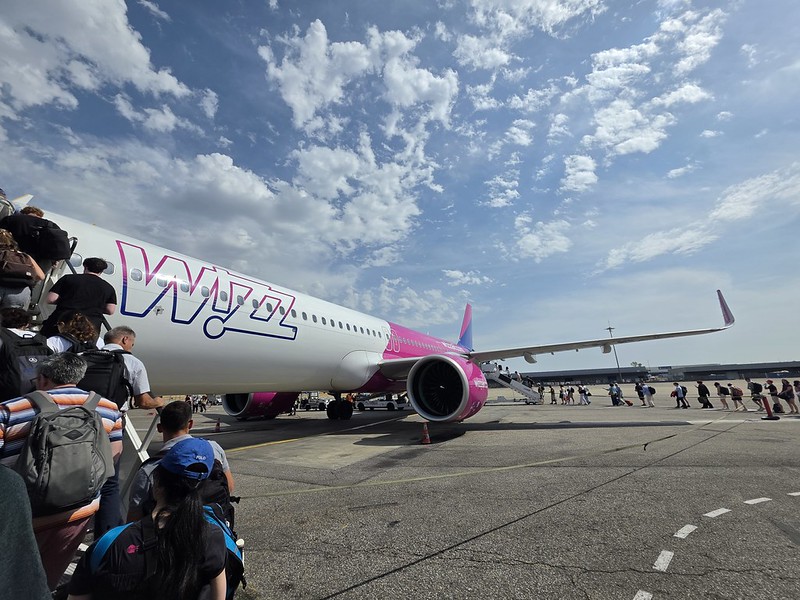
“To stay is to exist, but to travel is to live”. It is unlikely to surprise anyone that I agree with this sentiment, although I suspect whoever coined it had rather more romantic forms of travel in mind than standing in a corridor waiting to board a Wizz Air flight to Luton.
I had eaten, courtesy of Priority Pass, at Alpage and I saw the gate was announced relatively early, I meandered off as it’s never clear how long passport control will take.
The walk to the non-Schengen area of the airport.
Which was shut.
Budget air travel consists of a lot of standing around in corridors and this was no exception as after I had gone through the border control process, which took twenty seconds, I spent 45 minutes standing here. Travel can be very exotic.
Off to board.
The clouds had made the temperature quite reasonable, which was slightly annoying as I was now leaving France after days of being too hot. I may have mentioned the heat once or twice during these posts, although I feel I have shown considerable restraint.
The aircraft was G-WUKZ which I’m not sure that I’ve been on before. The seating Gods gave me an aisle seat and the flight was entirely pleasant. As usual the crew were polite, the service was efficient, the aircraft was clean and everyone travelled towards the destination in roughly the manner aviation intended. This is generally my preferred level of excitement when several thousand feet in the air, so all was well.
However, there was a failed landing and a go-around which was slightly sub-optimal from the point of view I was hoping not to have a delay on this flight. The cabin crew made what sounded like a reassuring scripted announcement before the First Officer followed with something rather more spontaneous. I’m not entirely convinced his additional contribution reduced the anxiety levels of every passenger, but at least nobody began distributing life jackets. And I like a bit of drama anyway.
After another fifteen minutes of faffing about above southern England we landed safely. Around five passengers applauded, which immediately gave me something new to be irritated about. I appreciate that landing an aircraft is considerably more complicated than parking a bicycle, but I generally assume the pilots regard getting us onto the ground safely as part of the agreed service.
And back at Luton Airport and I was ready to walk into the town centre, which I’m not sure that I’d call a treat, but at least the weather was moderate. Too hot, but moderate. Anyway, it was a very lovely trip to France, made slightly sad for me as I knew that it was the last trip abroad for a few weeks. Fortunately, I had returned to Luton, which is certainly one way of ensuring that the desire to travel again remains strong.
This article appeared in the Norwich Mercury 200 years ago this week and relates to the court cases that had been heard in Walsingham. I can’t find out anything about Rose Crask, she doesn’t appear in any records that I can find.
As for the details of this case, this was a period of different moral values, although the court cases at the time show that breaches were not uncommon. At the time a woman described or charged as a “lewd woman” was usually being treated as sexually immoral, disorderly or involved in prostitution, although it can relate to any of them.
The label might be applied to a woman found soliciting, keeping company with known prostitutes or criminals, living outside accepted domestic arrangements, behaving indecently in public or repeatedly coming to the attention of parish officers and magistrates. It was a broad and highly moralistic description, reflecting a period when poor and unmarried women were closely policed and could be punished as much for their reputation and way of life as for any clearly identified criminal act. Indeed women in general at this time could be invisible, which has transpired to be the case for finding out anything more about Rose.
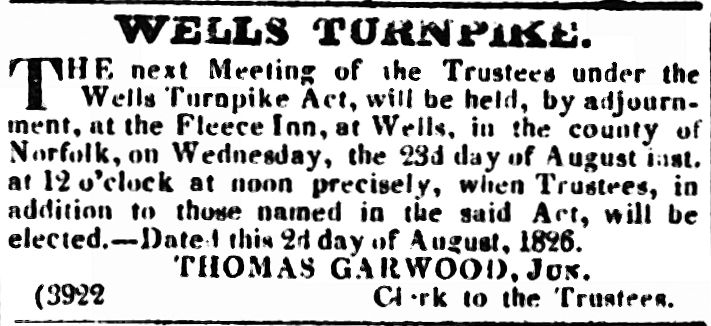
This notice was posted in the Norwich Mercury 200 years ago this week and it relates to the newly established turnpike road between Wells-next-the-Sea and Fakenham. This notice relates to a regular meeting of the trust, but the turnpike was new having been created by an Act of Parliament earlier in 1826, and this belonged to the final generation of turnpike trusts established in England. The period often described as ‘turnpike mania’ had largely taken place between the 1750s and the 1770s, while the last completely new English turnpike trusts would be authorised in the 1830s. In other words, Wells was something of a latecomer to a transport revolution that had already transformed much of the country, which perhaps seems fitting for this quieter corner of Norfolk.
The trust was more complicated than its name suggests. Rather than simply improving a single road between Wells and Fakenham, it administered a small network of connected highways. There were two principal routes from Fakenham to Wells, the western road passing through Egmere and the eastern route through Little Walsingham. A further branch ran from Walsingham through Great Snoring to Langor Bridge, where it joined the existing Norwich to Fakenham Turnpike. Early mapping also shows a branch westwards from Fakenham towards Hillington via Sculthorpe, although this appears never to have become an important part of the trust and later largely disappeared from its records. I’ve resisted vanishing completely down this rabbit hole, although I suspect there’s an entire series of blog posts waiting to be written about the trust.
Like every turnpike trust, its powers came from Parliament. The trustees could levy tolls, improve existing highways, acquire land where necessary and borrow money against future toll income. Unlike parish-maintained roads, which depended upon local labour obligations that varied enormously in quality, turnpikes introduced a more centralised and professional system of highway management. The trustees themselves were unpaid local gentlemen, merchants and landowners, but they appointed paid officers including surveyors, clerks and treasurers to administer the roads.
One particularly fascinating aspect of the Wells trust is that its minute books survive from the very first meeting. These reveal that deciding where to place tollgates proved surprisingly contentious. Bryant’s 1826 map shows the initial gates at Wells, Warham, Kettlestone and on the Sculthorpe road approaching Fakenham, broadly reflecting the trustees’ original decisions. However, almost as soon as toll collection began in the spring of 1827, travellers demonstrated an impressive enthusiasm for avoiding payment and that was considered most sub-optimal. By July the trustees were recording “very frequent evasions” and they were busy ordering additional gates across side roads to block alternative routes around the toll bars. Human ingenuity, it would appear, has always been remarkably effective when faced with paying road charges and judging by the repeated attempts to stop people avoiding the tolls, the trustees probably spent rather more time discussing human inventiveness than road engineering.
The arrival of the railways gradually undermined the economic justification for many turnpike trusts across Britain, and Wells was no exception. As traffic patterns changed during the second half of the nineteenth century, the toll system became increasingly difficult to justify. The Wells to Fakenham Turnpike Trust was finally wound up in 1881, ending fifty-five years of independent management. Responsibility for the roads returned to public authorities, while the tollgates disappeared into history.
Today, the milestones remain the easiest evidence that the trust ever existed and I wouldn’t at all be surprised if I decide that I need a friend to drive me to them to have a look. But they tell only a small part of the story. Behind them lay decades of meetings, arguments over gate locations, complaints about toll evasion, financial management and continual maintenance of roads that were vital to the economy of north west Norfolk. I’m fairly sure that these meetings would have been quite vibrant, but a bit of drama is good for the soul.
As an aside, I won’t say any more about the Fleece Inn in Wells, where the turnpike meeting was held, as it was one of the ten pubs that Roy, Jen and I visited a couple of weeks ago and those posts remain in the increasingly well-populated unwritten post blog queue.
The gate was called which meant it was time to traipse off to the furthest part of the airport which is where all my Ryanair flights seem to depart from. I suppose that the airport charges them a cheaper rate per gate for flights that depart from the very boundary of the terminal.
Ryanair aircraft everywhere, waiting patiently to transport people across Europe for less than the cost of buying lunch in the airport.
Gate 34, the same gate as I boarded from a couple of weeks ago and I’m not sure it’s possible to get a gate further away from the main terminal with a shuttle bus and an overnight expedition. Boarding was a little muddled, they didn’t put the “boarding” line on the screen and a confused gate agent came over to ask why people weren’t boarding. She said that she had been shouting, but as she was around 20 metres away, it wasn’t entirely a surprise that no-one heard her. A passenger then had an argument with her about the whole arrangement, just to add a little drama to proceedings.
We were then held up as another passenger was trying to take a backpack that looked like she had somehow fitted a hippo into it. The gate staff, who were letting some quite large bags go through, could hardly turn a blind eye to that and so that was another £60 for the airline in fees.
The walk to the aircraft, during which there was ample opportunity to reflect on whether Nantes was actually closer than the departure gate.
I’d never noticed this on the side of an aircraft before and Wikipedia tells me that “they measure undisturbed ambient atmospheric pressure. It is a vital component of the pitot-static system, supplying static air pressure data to the altimeter, vertical speed indicator (VSI), and airspeed indicator”.
I asked AI to explain this to me as though I were an idiot, which is a setting I have already spent considerable time training it to use. It replied that they were basically measuring altitude, so that was another aviation mystery comprehensively resolved without the inconvenience of obtaining a pilot’s licence.
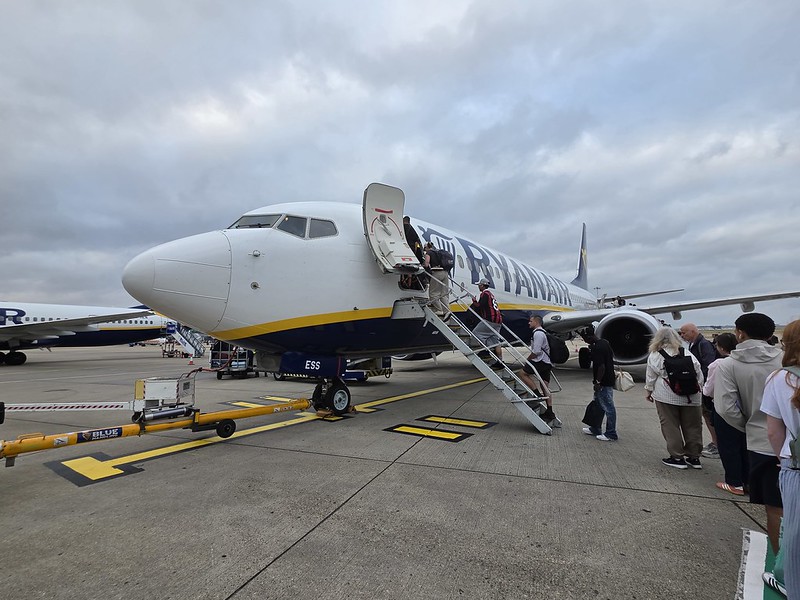
As always, I like these steps that fold into the aircraft before departure. The aircraft is EI-ESS and I looked at how many flights that completed today and it’s eight, which shows considerable efficiency. By comparison, I had managed to get myself from Luton Airport’s waiting area to Gate 34 and already felt that I had achieved enough.
As I hadn’t had any sleep I was getting a little tired by this point and was slightly pre-annoyed that the seating Gods had given me a middle seat.
Fortunately, there was no-one in the window seat and so I was able to move across. The flight was around 30% empty and so it seems the only reason I had been allocated a middle seat was to encourage me to pay to move to a window or aisle. In fairness to Wizz Air, they don’t seem to try that tactic on me, which is sensible as it doesn’t work on me at least.
I’m sure that there was a reason that I took this photo, although I can’t now remember what it was. So, here are some fields to look at. They appear to be functioning correctly in that role.
And safely landed on time into a very hot Nantes. The fare was more than I’d usually pay at £15, but the whole arrangement was efficient, the crew members were friendly, the aircraft was clean and everything went as I had expected. A smooth flight gives me less material for this blog, but it is probably best for all concerned and I remain entirely satisfied with Ryanair.
Straight after my day out with Roy and Jen to numerous north Norfolk pubs, but more on that later, it was time for Liam to pick me up on his way to work whilst dropping me off at Stansted Airport ready for an early morning flight. I’m not ideally sure that going straight to the airport straight after visiting several pubs was entirely sensible, but Liam made his car nice and cold for me. Richard still hasn’t got a car with seats which cool passengers down, but I suppose he’s not a VIP like Liam. And many thanks to Liam for his assistance, although he gets the excitement of my company for nearly two hours, so I can see why he’s keen to help.
I was the only person on the shuttle bus from Stansted medium-term parking to the main terminal, but that’s not entirely surprising as not many people feel the need to arrive at 01:00.
The main terminal effectively closes now at night, other than for a small section at arrivals, but the bus station terminal seems to always have space.
That there were people who thought feeding birds in the waiting room was a good idea annoys me.
Just before 03:00 I meandered up the main terminal which had just opened. Sleep is something of an optional luxury for me when a cheap air fare is available.
The security area opens at 03:00 and is always well staffed with friendly members of the security team. Despite the number of people queueing here I was able to get through within ten minutes, which was all rather efficient.
The airside’s main seating area where I took the opportunity to charge my phone.
This shows the scale of the Ryanair operation at Stansted Airport.
I get £18 to spend at Camden Bar & Kitchen with my Priority Pass. The Escape Lounge is closed at the moment, so this is the only option without spending my own money.
It’s getting more challenging to decide what to get with the £18 as the menu prices keep edging upwards.
The venue opens at 03:30, so I got there at 03:35 so that I didn’t look overly keen. I got a table with a power point, but I knew from past experience that I couldn’t order with Priority Pass until 04:00. This gave me 25 minutes to sit quietly and pretend I had not planned the entire operation around receiving breakfast at the earliest permissible moment.
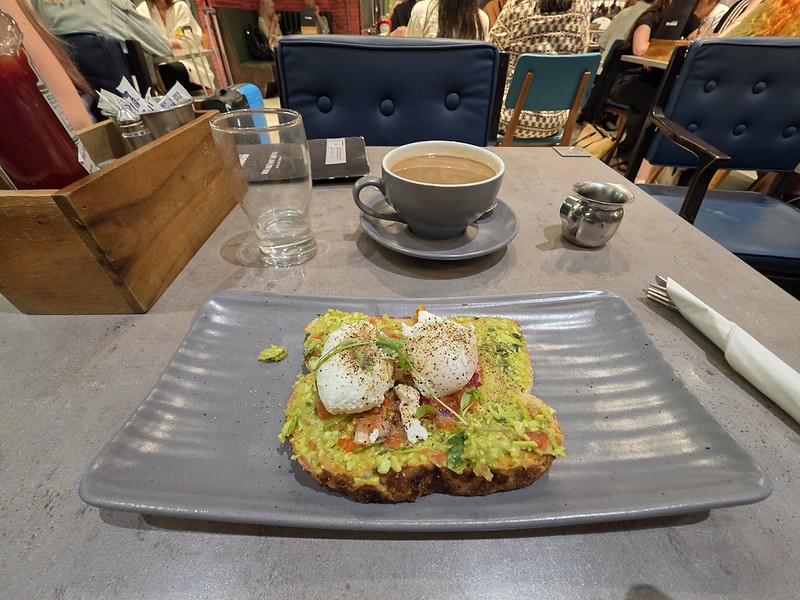
I went for this, the poached eggs on avocado toast with an Americano coffee, coming in a few pence under the allowance. It was suitably delicious, with the eggs being lightly runny, and sufficiently filling for that time in the morning. I’m not sure that I’d spend £18 of my own money, but as it was free with my pass, it was a convenient place to get a little rest before departing for my gate. Airport pricing is much easier to tolerate when somebody else’s accounting system is absorbing the emotional impact.
Anyway, with that I was ready for my flight to Nantes with Ryanair having been allocated the middle seat…..
After a little break in proceedings, and I would like the pun there to be properly acknowledged, it was time for another league match and we were playing the International Brigade in the sauna area of the King’s Head. We had a new strategy that we were deploying, namely Ivan, to beat them thoroughly in practice so that their confidence was damaged. Our advanced sporting psychology is what will set us apart from the other teams in the league, although the results so far have been reluctant to support that theory.
The teams had arrived, so it was time to think about doing the draw.
Somehow we managed to have PJ kicking off proceedings for us again, this seems to be a regular thing.
And off we go!
Cool, calm and confident. Anyway, we lost that game.
I was up second so thought I’d better get a quick pint to ensure that I was at peak performance levels in the sauna area.
It was a close second game and I decided to do a very brave 200 shot in the middle of the game as I kept sitting just a bit behind. I saw Luke’s face of horror and that wasn’t quite the look of encouragement I had wanted. But my thunderbolt shot worked so I surprised and delighted myself, before reminding myself I would now just settle for 10s. It remained close though, going down to the final ball which I’m pleased to note I got in, but the peg wobbled just a little more than I would have liked.
Ivan, our new head coach, came over with marshmallows that we could allocate to all the players fairly. I ate most of them if I’m being honest, but leadership sometimes requires difficult resource decisions. Ivan was also the referee for two games and he was entirely competent, not smashing up the table like he did last time he was referreeing.
Here’s me waiting to referee whilst hoping the marshmallows didn’t melt in the extreme heat. I queried with Oli that perhaps, as a team captain, she could have made a contribution towards getting air conditioning in the King’s Head, especially as she’s one of the top four staff members that they have. She shouted back in a jovial manner that she didn’t feel obliged to pay for air conditioning. This was disappointing, although at least the pub’s climate policy is now clear.
Luke found himself 900 down after the first shot, which is a sub-optimal place to be.
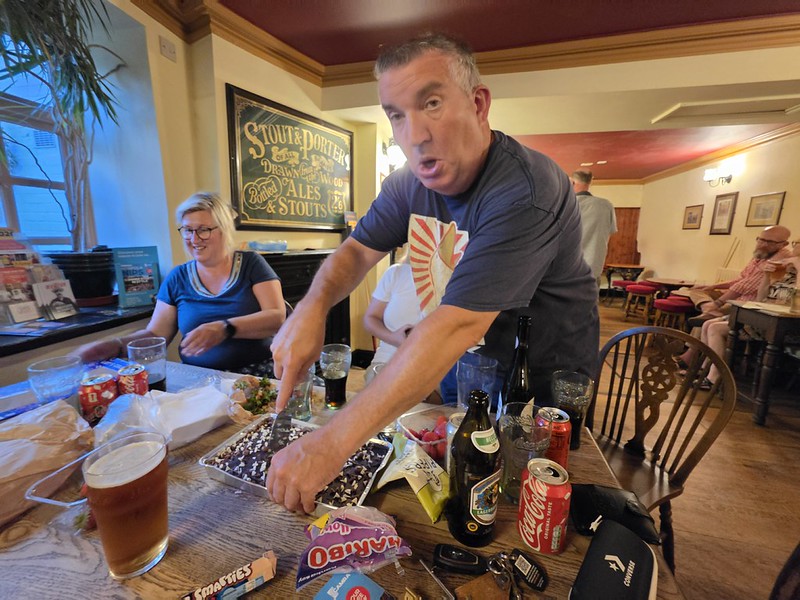
It was Luke’s birthday this week (the same night as Julian hit 70, although Luke didn’t fall over) and so we celebrated with cake and strawberries. We had assumed that John would arrange to throw some of the games to allow Luke to have an enjoyable birthday, but he didn’t. Luke and I didn’t say anything of course about this lack of sporting behaviour.
Let’s just say that we were 5-1 down after the singles, so we had lost the match. I had a little sit down outside for the fourth time to cool down and reflect on whether we just didn’t have enough chalk. There is always a technical explanation available……
Back to the doubles, and Vaughan and I were successful in a very good game, so I was hopeful of turning this round to be a loss of just 5-4.
We lost 7-2, but look at those scores, but Luke put up a valiant performance against big shot Marcel, with Kirsty and Terri getting closer than their score looks. But losing 7-2 is not that bad in such hostile weather and I was saddened not to be able to take Ivan up on his offer of a game, but I had to rush to the Weaver’s to check that Julian didn’t have another fall. I’ve very much realised that bar billiards captaincy does sometimes involve wider pastoral responsibilities.
But, the main thing about all of this is having fun and it was a very enjoyable evening and the International Brigade are a lovely team. No game next week, but then we have two in a row after that in the Artichoke, so what could possibly go wrong?
And, in other news, we have our next cup game confirmed, which is against the Lionhearts. Nathan, their captain, and I would never comment on this ourselves as we’re very modest and entirely free from competitive vanity, but it is hard to deny the evidence that this will be a game featuring the two best captains in the league. Between us, we have certainly had enough experience of challenging bar billiards encounters so this is a proper battle of the titans and I know there’s a chance of it being a major motion picture on YouTube. And, I might have mentioned, I’ve beaten Dave Brewer so I’m ready to take on Oscar as I have a score to settle. But, it’s just a game obviously, although I’m hoping Nathan is bringing his worst players.
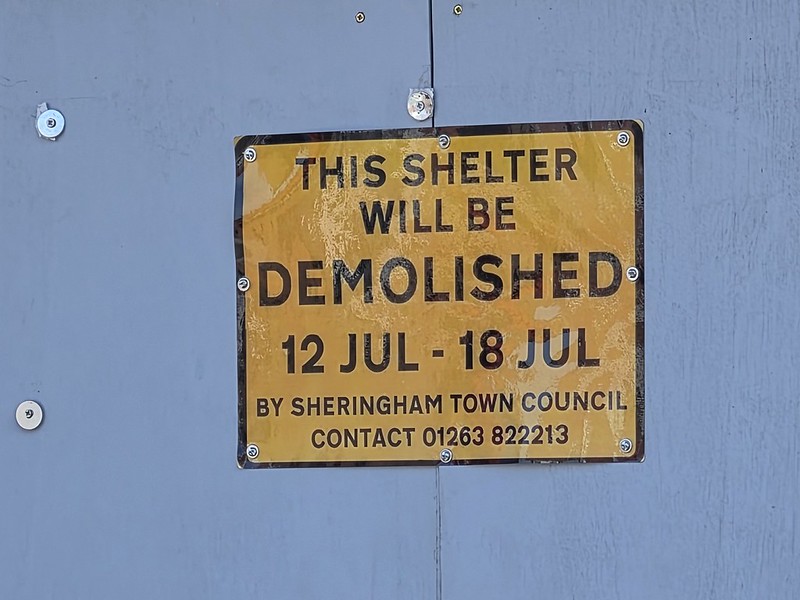
This is what I consider to be one of the more ridiculous local Government debacles to have taken place in North Norfolk, and it has not exactly enhanced the reputation for competence of some of the politicians involved. This is the old bus shelter that a fair number of residents wanted to keep, which is an entirely reasonable position to take. It is, after all, a bus shelter rather than a nuclear facility, although the administrative response has occasionally suggested otherwise.
Norfolk County Council was going to demolish it with the support of Sheringham Town Council, then Sheringham Town Council decided they wanted to keep it. But now, Sheringham Town Council have decided that they don’t want to keep it and Norfolk County Council are going to demolish it next week. So after all that expense, unnecessary meetings and damaging public confidence, Sheringham Town Council has ended up at the decision they made initially.
The whole matter could have been resolved rather more sensibly by extending the pavement into the road and changing how cars move through Sheringham. There are far too many vehicles using the main street, and reducing that traffic would not be especially difficult without removing access for those who genuinely need it. Instead, there appears to have been a deep institutional attachment to preserving a wide carriageway and a narrow pavement, as though the primary purpose of a town centre is to ensure that cars remain emotionally comfortable.
So there will now be a new bus shelter, which is at least better than the nonsensical and exposed arrangement they constructed in Cromer, and this one will be demolished all at a huge expense. Perhaps Count Binface might be available to unveil the replacement.
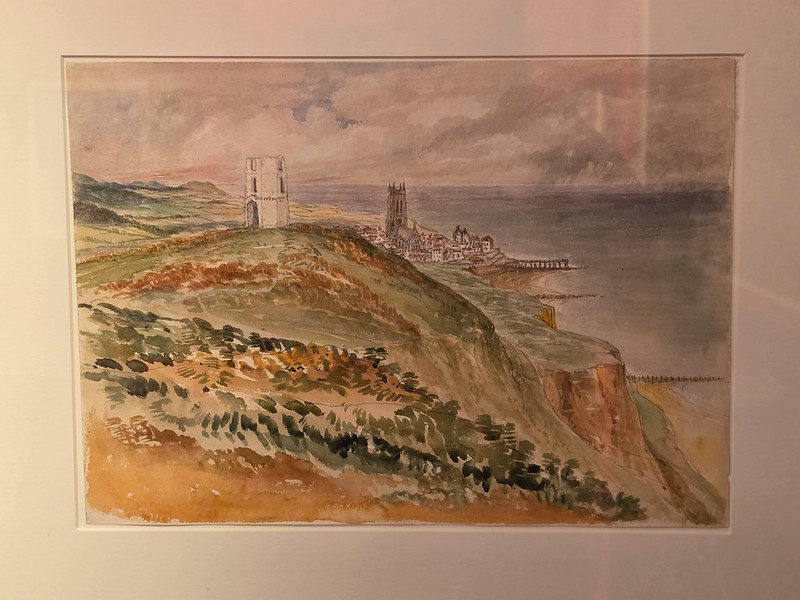
This watercolour is Views Along Cromer Cliffs and Beach by Catherine Buxton, painted in around 1860, and the artist was the daughter of Catherine Gurney (1814-1911) and Sir Edward North Buxton (1812-1858). This meant that she was brought up in the wealthy and very well-connected Quaker family, so she would have had access to education, travel and money.
The painting shows the coastline looking down towards Cromer, with the church tower rising above the town and the jetty built in 1845 stretching out into the sea. It also shows a Cromer that has expanded slightly, but the rapid growth wasn’t until after 1877 when the railways reached the town. This was from a time when the town wasn’t burdened by hotels and people trying to eat fish and chips in a strong wind. It was also before Greggs reached Cromer, which makes the whole scene look calm, elegant and faintly deprived.
But what I found the most interesting is that in the foreground is the ruined tower of the old lighthouse, built in the early eighteenth century and already looking as though the cliff had begun making firm plans for its removal. The lighthouse finally disappeared over the cliff in 1866, only a few years after this painting was completed, with Trinity House having more information about the structure.
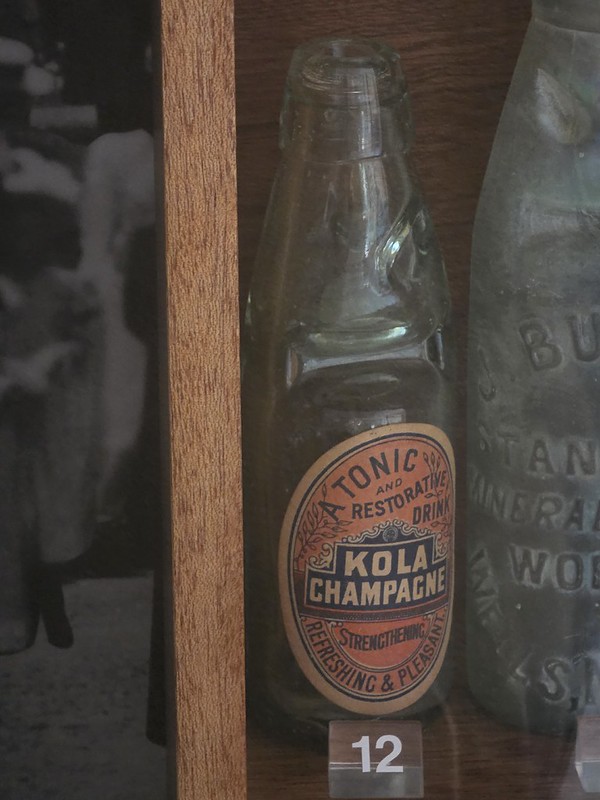
This bottle of Kola Champagne was one of the smaller exhibits at Cromer Museum, but it immediately caught my attention because “Kola Champagne” sounds like the sort of drink invented by someone who had access to both sugar and optimism. It’s a bit like Greene King saying that they’ve made a craft beer, the words are all technically present but I’d suggest a degree of caution.
The label describes it as “a tonic and restorative drink”, as well as “refreshing and pleasing”, which is quite a lot of responsibility to place on one bottle and I have a sense that it might have been a disappointment. Despite the name, it was not champagne and almost certainly had no meaningful connection with France and it would fall foul of labelling laws today.
The “kola” element would have referred to kola nut flavouring or extract, an ingredient associated with stimulant and tonic drinks long before cola became dominated by international brands and advertisements involving improbably happy people near swimming pools. It’s one of those bottles which has an internal closure arrangement at the neck, possibly with a little glass ball.
The local link is that this was sold by W. Everett of Bond Street in Cromer and they produced a range of soft drinks for supply locally. What I didn’t realise before writing this is that there is a drink still produced in the UK which has the same taste, namely KA Karibbean Kola, with Champagne Cola still being a thing in parts of Latin America. I wonder if I’d be restored after drinking one…..