Category: Norwich

  • Norwich History by Parish : St. Martin at Palace

    Norwich History by Parish : St. Martin at Palace

    And a new little project that Jonathan and I are undertaking because this lockdown is clearly here for at least a few more weeks. It’s a bit niche (our project I mean, not the lockdown), I’ll accept that, but there we go. Effectively, it’s walking around Norwich, ancient parish by ancient parish and seeing what is there now compared to a map from the 1880s (the map above is from 1789, but the one from the 1880s is more detailed, which is why we used that). There’s a PDF of these boundaries to provide some extra background to this whole project. Our first parish was St. Helen’s and this is the neighbouring parish of St. Martin at Palace.

    The precise ward boundaries are in the PDF above, but this is the area of Norwich that we had a little meander around.

    This is an area that neither Jonathan or I were aware of, despite my having walked by it hundreds of times. It’s located in front of the courts complex in Norwich and it’s the former site of the Tabernacle. This church, which held 1,000 people, was opened in 1753 and there’s plenty of information about the history of the building at https://ukwells.org/wells/the-tabernacle-norwich.

    The 200th anniversary of the building wasn’t the most fortunate, as it was entirely demolished in 1953 as it had fallen into a state of disrepair. The demolition was perhaps a mistake, this would have remained an interesting and quirky building if it had been allowed to stand. George Plunkett has a photo of what it looked like in 1941 and to give an idea of where it stood, that kerb on the bottom right hand side of the photo is where the Adam and Eve pub is located today.

    Nearly nothing remains of the Tabernacle, but this now quite damaged tablet is visible in the area where the house next to the tabernacle stood.

    Jonathan noticed a giant rat just before I decided I needed to have a look at this grave, but I braved the area anyway. There is very little I won’t brave for the sake of historical investigation. Well, not snakes though, I wouldn’t have gone in here if it had been ridden with snakes.

    This whole area of land is now used by the courts, but 100 years ago this was the site of a large gas works. The road in the foreground is modern, but at this end it follows the route of the old World’s End Lane. The area to the left is now just left empty, but this is where it fronts onto Bishopgate today, although the buildings that George Plunkett took a photo of in 1936 have been demolished. I’m really not sure that the courts need such a large car park, there’s definitely space for a Greggs or something here.

    This might not be much to look at, but underneath here is the Norman House (https://www.norwich360.com/normanhouse.html). I visited here on a Heritage Open Day, it’s well worth going to see for those who can, and I’ll put photos up in due course from when I went. Upstairs in the court area there’s also the Arminghall Arch.

    This is the Bishop’s Gate (and is where the street Bishopgate gets its name, although I think most people would guess that) which is Grade I listed and was constructed in around 1436. Just behind it is the new Bishop’s Palace, but this was also the entrance to the old Bishop’s Palace, today part of Norwich School.

    And I have managed never to notice this sizeable building which is attached to the Bishop’s Gate. This is a medieval barn and granary, although it was much changed in the eighteenth, nineteenth and twentieth centuries and is now offices. This also leads to the area where St Matthew the Apostle’s church once stood, long since demolished. The former churchyard, which was formerly left as a park, has now been built on by the council.

    St. Martin’s Vicarage, serving the church that this parish takes its name from and is located opposite, St. Martin’s at Palace Plain. The building dates to the middle of the nineteenth century, although there was another building here before that.

    St. Martin’s at Palace Plain church, which ceased to be used for services in 1971 and was later converted to be used by the Probation Service. It’s now used by the Norwich Historic Churches Trust as their base, and access is encouraged (well, not at the moment, but it will be again when normality resumes). There’s a George Plunkett photo of the interior from 1938, it’s quite a charming and well-ordered church.

    When the building was being converted to better suit its new office usage, which as an aside was done quite sensitively, there was an archaeological dig underneath the floor. This discovered that there were once two Saxon wooden churches on this site, with the foundations of the current church dating from the eleventh century. Most of the current structure dates to the fifteenth century, although following a little incident in the 1840s when the nave and chancel fell down (which wasn’t ideal), with a Victorian restoration of the structure. The slum clearances of the 1930s swept away much of the church’s congregation, so it did well to manage to survive as a working parish church until the beginning of the 1970s.

    The chancel wall, with the graves having been removed from their original place and shoved up against the church.

    A garage type arrangement, visible on the left of the photo, has been inserted under the churchyard. This road is now private access to the courts, but it was once the end of World’s End Lane, so effectively the church site was in the middle of a traffic island.

    The parish boundary takes in territory across the River Wensum, requiring a walk over Whitefriars Bridge. I’m not sure why it does this, I assume it was some medieval way of trying to balance out the population sizes between churches.

    All that remains of the Anchorite House, part of the Whitefriars Monastery, which stood here between 1256 and 1538.

    When younger, I thought that this was the National Coal Board building, which isn’t perhaps a bad guess. It’s actually the premises of Norwich Corrugated Board (well, Smurfit Kappa now, which goes to show that putting a company name on a building in brick isn’t perhaps ideal when the ownership changes) in what is an unusually large manufacturing building still in the centre of the city. More about this in the parish we visited the week after….

    The corner area here now has a modern building on it, but this was the site of a shoe factory a century ago. The street here is now known as Whitefriars, although it has historically been known as Cowgate. When the council smashed through the area with their new road, it split Cowgate into two, hence why this section has now been given the new Whitefriars name.

    This is Whitefriars Bridge, which has also historically been known as St. Martin’s Bridge. It was first constructed in around 1110, but this story is best told by the formidable George Plunkett (and he has a photo of the bridge from 1933):

    “Whitefriars Bridge is one of several in Norwich rebuilt during the 20c. Formerly known as St Martin’s bridge, it is first mentioned in a grant made by King Henry I to Bishop Herbert de Losinga shortly after 1100. In 1290 it was washed away by a great flood, and there are records of it having to be rebuilt at different times throughout the centuries. The earlier ones would have been wooden constructions; during Kett’s rebellion in 1549, we are told, the bridge was deliberately demolished with the dual purpose of impeding the rebels and using its timbers to strengthen the nearby city gates. In 1591 a more permanent edifice was built of stone, with a single pointed arch. This survived until replaced by the present bridge designed by Arthur E.Collins, City Engineer, and built by unemployed labour under a skilled foreman. It is of concrete reinforced by 1.5 inch steel bars and faced with mica quartz and white cement. The first half was opened to traffic on 19th February 1925. Its span of about 80 feet is some 50 feet wider than that of its predecessor.

    It was said at the time that the stones of the old bridge would be marked in order that it could be re-erected on a different site, but this was never done. Several suggestions have been put forward as to their fate, one of the least plausible being “that they happened to fall into a wherry as it passed under the bridge” and were conveyed by water to Wroxham and Horning to be used as foundations for riverside bungalows. It sees more likely that some at least were taken from the bridge to the Corporation Depot at Infirmary Square (now Starling Rd), and were later moved to another store at St Martin at Oak Wall Lane, finally ending up as foundations for roadworks on Aylsham Rd.”

    Now known as Quayside, this row of houses facing the river are around 100 years old. Although it wouldn’t have been possible at the time, there’s a path now along the river for those want to walk along it, a project which must have showed considerable foresight to establish.

    Pyes Yard, which has also been known as Fyes Yard and Pyes Court. In 1938, there was a slum clearance of the 17 houses down here, so everything of historic interest down to the river is lost. George Plunkett took a photo shortly before the area was condemned, which might have today made for some rather beautiful townhouses with a little (well, quite a lot) of modernisation.

    The old signage to the yard.

    The buildings facing Palace Plain have survived, even if the yards behind them have now been taken down. The white building on the left is 1 and 2 Palace Plain, originally built in the seventeenth century, then used as a shop before more recently being incorporated into an office building. The white building in the centre of the photo is what is historically known as the White Lion pub which has been a licensed premises from the mid eighteenth century and which was originally built in the sixteenth century as a residential property. When the courts were opened in 1985, the pub name was changed to the Wig and Pen, perhaps to tempt the wealthy lawyers and judges over. The red brick building on the right of the photo is Cotman House, originally built in the eighteenth century as a residential property.

    Cotman House is so named as John Sell Cotman (1782-1842) lived at the property. He was one of the artists who was part of the Norwich School of Painters, one of the first local art movements in the UK. The group was originally led by John Chrome, before Cotman took over to keep the informal movement going, although it fell apart a bit when he moved to London.

    The back of what was Busseys, the Ford car dealership, whose city centre land no doubt just became worth far more for building than it did for selling cars. The street that runs behind the back of these buildings, connecting Bedding Lane to Pigg Lane, is Joseph Lancaster Way.

    I’m not entirely confident that I know why this modern street has been given this name, so I’ll have to make a guess. The area behind Busseys was once a school and there is a Joseph Lancaster who was important in the nineteenth century for the establishment of more modern educational methods. He’s known for the phrase “a place for everything and everything in its place”, which makes him sound rather organised…. Anyway, I’ll probably find out that it’s been named after some local councillor, but that’s the best reasoning I’ve got as to the naming of the street.

    The building in the centre is 17 Palace Street, which dates from the eighteenth century, although the range stretching back a little at the rear is from the seventeenth century. The building next to it is modern and is where the entrance to Busseys once was, and George Plunkett has a photo of that from 1987.

    That concluded the day’s historical activities, we then went to try Ron’s Chips.

  • Norwich – Barrett’s Fish and Chips

    Norwich – Barrett’s Fish and Chips

    Whilst meandering near to the Reepham Road on a random walk, I thought that I’d pop in here as the chip shop was well reviewed. It takes its name from Noel Barrett who owned and operated these premises for some decades, but there’s a new family now managing the shop. Incidentally, I’m not entirely taken by that signage, feels a bit generic to me.

    Anyway, the service here was marvellous, and that’s evident in the reviews I read as well. One reviewer wrote, and wasn’t being sarcastic, that he refers to the owners as “Mr and Mrs Smiler”, which seems a suitable name given the friendly welcome that I received. It’s always nice to get a bit of welcoming enthusiasm, especially on a drab day.

    The chips costs £1.80, which is a little higher than the average, but hardly anything to become overly irate about. And another of my complaints about not accepting cards is true here, although I was pre-prepared on this occasion so as not to be deprived of chips. Anyway, the packaging was rather thrifty, but the chips were suitably hot, firm on the exterior and cooked appropriately, just what I was hoping for. So, all rather lovely.

  • GeoGuessr (Norwich Version) – Walk 1

    GeoGuessr (Norwich Version) – Walk 1

    I already have a better explanation (well, longer explanation anyway) for this plan. In essence, whilst lockdown is on, I need to find ways of walking nearby to Norwich in quiet areas for my LDWA 100 training. So, I’m using GeoGuessr to pick out five random locations within a certain area which I’ve defined and then walking to them, to see what kind of story I can uncover.

    Pointless? Well, yes, it is a bit. But it’s good exercise and I’m hoping to always see something new or uncover a different part of Norwich. And I’ve got Liam, Nathan and Jonathan signed up to do these walks with me as well (separately as the maximum group size is two), so I won’t have any shortage of opportunities to meander around Norwich.

    Anyway, the five locations randomly selected using GeoGuessr are in the map above. I used Komoot to draw a line between them, although I didn’t always follow it if something else looked interesting nearby. And, I accept this isn’t the most exciting walking adventure possible, but it’s about all that’s safe to do at the moment, so it’ll have to do.

    So, the start of the walk in Barrack Street, which take its name from the Cavalry Barracks which were located here between 1792 and 1963. It’s now the Heathgate estate, which doesn’t seem to get a very good press in the local media.

    The route goes up the big hill of Mousehold, by the entrance to Dragoon Way, a former cavalry way.

    I realised at this point that I hadn’t bothered putting on walking boots, just normal shoes, which wasn’t entirely in keeping with meandering through the mud of Mousehold Heath. This route wasn’t too bad, although there were numerous options that looked quite moist.

    I had a minor problem here, as I needed to get down to the road. And there were some slightly steep elements where I could have fallen down the slope. There’s a road at the back of this photo and people walking along it, so I didn’t wish them to have their walk distracted by the sound of someone falling down a hole. So I found a more manageable route back down to the safety of the pavement and I don’t think anyone noticed. I didn’t go too far into Mousehold Heath based on this experience, sticking to firmer ground.

    This is a quite wonderful building and one of the oldest in the city, at over 900 years old. It’s the city’s lazar house, or leper hospital, founded by the first Bishop of Norwich, Herbert de Losinga. After centuries of helping the ill and poor, it was closed following the Dissolution of the Monasteries and used as a barn. The city was fortunate to have had people who managed to save it from destruction in the early twentieth century and it was restored and turned into a branch library. As yet another appalling decision from the local council, they decided in 2003 to scrap this library and stop free public access to the building. It is now used by a charity to help those with learning difficulties and they no doubt do an admirable job, but it’s a great shame that the usage as a library had to stop.

    This is St. George’s Catholic Church on Sprowston Road. Simon Knott, who writes in detail on Norfolk churches, has an appalling tale about the unfriendliness of this church. I’ve never been turned away from a church and I’d be equally disappointed to be turned away in such a manner. If it was me, I’d be so annoyed that I’d stomp off whilst writing in my mind the letter that I was going to send to the Pope.

    I don’t often see the word ‘Loke’ used in Norwich, another word to describe a road which come to a dead end or a narrow path.

    I don’t have any interest in live music, so this is a pub that holds little relevance to me, but it has a formidable reputation for its work. There was a petition last year to keep this place going and I hope that it can continue, live music is important in pubs (albeit not the ones I visit) and it would be a shame to lose it.

    Now starting to enter Old Catton, this is School Lane and appropriately this is the large former school building. It’s now the Sprowston Diamond Centre, but it was originally built as a school in 1860, soon being extended in 1873.

    The Woodman pub, which I can’t say that I’ve ever been to. it was opened as a pub in the early nineteenth century and there were rumours of its closure a couple of years ago, but it’s still here.

    GEOGUESSR 1 – I haven’t taken a huge amount of care in finding the exact spot of the five GeoGuessr locations in terms of matching up photos. This was the first one in Old Catton, on George Hill.

    One of the things that I wanted to do on these walks was to identify some listed buildings that I’ve never noticed before. This is one, which is The Firs in Old Catton, and it was first constructed in around 1750. It has since been split into four buildings, although apparently the historic eighteenth century interior is intact.

    This is the best non-pub pub sign that I’ve seen.

    Taken over by Enterprise Inns in 2009, so it’s fortunate that it’s still here, this is the Maid’s Head which has been trading since around 1830. Now a Stonegate pub, I’ve never been to it, although perhaps I’ll get back here again to try the real ale (which judging from Whatpub looks a bit generic to be honest).

    This is Catton Park, which wasn’t exactly the busiest today. This land was originally part of Catton Hall, which was built in the 1770s by Charles Buckle. That property is still standing, now owned by Norfolk County Council, but the land can be used by the public. The paths here were quite wet and muddy, but it’s a nice piece of open space.

    Some World War Two history in Old Catton.

    The Old Catton village sign and St. Margaret’s Church.

    Mary Sewell is perhaps better known for being the mother of Anna Sewell, the author of Black Beauty.

    Another listed building, this is the Manor House in Old Catton, built in the sixteenth century and extended in the following century.

    Moving away from Old Catton, I had forgotten about this Greggs on Fifers Lane, although I’ve visited a few times before. It mainly serves the industrial units in the area, and, today it had the delight of my custom.

    And a quick sausage roll, which was entirely delicious.

    Norse Groups is owned by Norfolk County Council and it’s a trading company providing services to local Governments across the country. Their company sign seems to have included random bits of material that they use and I couldn’t work out whether it looked really smart or really tacky.

    The sad end to the Firs pub in Norwich, which closed down in 2009 and was turned into a Tesco. At least the building is still there, but I’d rather that it was in use as a pub selling decadent craft beer.

    GEOGUESSR 2 – OK, I’ve cheated here (and I can hear Nathan tutting). The actual route that got selected for me was on the NDR, which isn’t accessible to pedestrians as they annoy Norfolk County Council. So, I was going to just get a photo of it from the nearest point, but that would have involved a huge detour. So, I thought I’d get a photo of it from Norwich Airport, but it was all a bit misty. So, this is the memorial at Norwich Airport to RAF Horsham St Faith, and that’s doing me as the second point.

    Well, it was open, so I went in, as if I’m traipsing out to these places I might as well take advantage of the situation.

    I’ll write about this elsewhere in more detail, but the service here was welcoming, the prices were OK (although not particularly cheap) and the chips were delicious.

    Sad to see the Whiffler, a JD Wetherspoon pub, all closed up. This was, until last year, their car park, but to encourage social distancing and to give them more space, they opened it up as an external seating area. I hope that change of use continues in the future.

    I noticed on the side of this sign it has printed on it “Do Not Display on Drive-Thru Lane”. I suspect this is because it mentions their cheap products on the Saver Menu (the ones I keep buying) and they don’t actually want customers to be reminded of them at the point of ordering.

    I’ve been meaning to visit this, hence my detour along the Boundary Road, it’s the boundary cross which was erected in the fifteenth century to mark where the King’s Way crossed the Norwich City boundary.

    I was slightly annoyed at this. I saw a sign to “new cemetery” and I’m intrigued by cemeteries, so went to have a look. It transpired that this was the back of St. Mary’s Church in Hellesdon, which I hadn’t initially realised. And, the sign was a lie, as there’s a bloody great big gate which stops pedestrians getting in. Looking at old maps, there were footpaths here which allowed people to access the rear of the church, but they never made it through to the Definitive Map and the church has taken the opportunity to restrict access. Or, at least, I couldn’t find access, hence the above photo. It’s also clear that people have been trying to gain access and the fence there has been added to stop them. Personally, if I had a church (which I don’t, and I don’t intend to acquire one), I’d quite like people to go in it.

    Back on the route that Nathan and I undertook a few weeks ago.

    GEOGUESSR 3 – this is the reason that I went out this far, to get to Gunton Lane.

    This is the Marlpit Community Garden, a seven acre plot of land that was once part of Lower Earlham Farm. Individuals now use the land for communal growing and there’s a bee area, footpaths, orchards and wild flowers.

    To get back to the city centre, I ignored the Komoot suggested route and just went along Marriott’s Way, which was much quieter than I had expected.

    One of the sculptures along Marriott’s Way, a former railway line. There’s a sculpture every mile along the route, this is the second one along which was installed in 2009, designed by John Behm and Nigel Barnett.

    The former inspection platforms at the engine shed at the now closed Norwich City Station.

    I’m always sad to see railway lines closed, this is the site of Norwich City Station which closed to passengers in 1959.

    This is a listed structure, a urinal which was designed by AE Collins, the city engineer, in 1919. It’s the oldest surviving concrete urinal in Britain and the city council now use it for people to graffiti on.

    The walk back into Norwich covers areas that I’ve written about already, but I hadn’t noticed these flood level markers at New Mills Yard before.

    Some information about St Giles’s Street that I hadn’t noticed before.

    GEOGUESSR 4 – the fourth location was Norwich City Hall, a building that destroyed much local heritage when it was constructed in 1938. I quickly popped into Tesco on Westlegate at this point to buy their reduced sandwiches…..

    Walking past St. Julian’s Church, which I wrote about the other day.

    Going onto King Street, this is Dragon’s Hall, sadly no longer open to the public, but this was a museum that wasn’t allowed to continue. It’s a Grade I listed building, with much of the current structure dating to the fifteenth century, although there is evidence of a ninth century structure having been here before. I hope that this building can in future be repurposed and brought back into public use, as it’s currently been taken over by the National Centre for Writing.

    Work has started this week on the development of the former Ferry Boat Inn site by the River Wensum. I don’t see why the developers couldn’t have restored the pub element in their project, but apparently the building was too damaged (although not too damaged to allow its conversion into two residential properties). It’s positive to see this area being brought back into usage though, it’s been derelict for over a decade now.

    GEOGUESSR 5 – and the final point of the day, Norwich City Football Club. The club was founded in 1902 and they’ve played at this Carrow Road site since 1935.

    And that was the end of the walk. It was fourteen miles and took me just under five hours, although I did keep getting distracted along the way, hence the slow pace. I’m not sure that there’s any great unifying story for me to tell here, but I discovered some things that I didn’t know existed in Norwich. And I like this element of random, it gives a purpose to an expedition, as otherwise there’s no way I’d have been bothered to have walked so far.

  • Norwich – Ron’s Fish and Chips

    Norwich – Ron’s Fish and Chips

    I haven’t been to Ron’s Fish and Chips on the market before, not least because I have been rather obsessed with Grosvenor for two decades. I visited a different chip shop on Norwich Market a few months ago and it was, to be honest, a really unimpressive effort from Norwich City Council who operate the market. There was near zero Covid-19 compliance and the chip shop (not Ron’s) in question was failing to operate with any care.

    The picture today was really very different, and everything feels very safe and well managed. The one-way system is in operation, individual units no longer have customers standing and eating there and everything seems clean and organised. A polite member of security staff was explaining that there is no eating anywhere near the stalls, customers need to take food just a short walk away. All very professional, I’m suitably impressed.

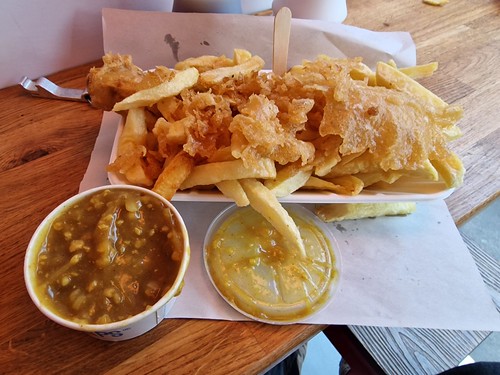
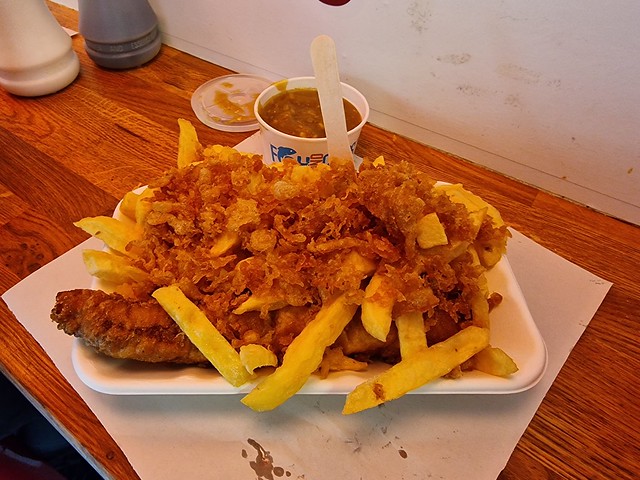
    Back to Ron’s. I’ve muttered and moaned (but not in a very grumpy manner….) about chip shops not taking cards, it’s just a faff to be forced to use cash. Ron’s isn’t one of those, they have a card machine (although I had come armed with coins just in case). They also have a very friendly member of staff serving, a clean operation and rather cheap prices. My battered sausage and chips came to £1.80, which I thought was really quite acceptable. The chips were hot and tasted sufficiently chip like for my needs (nice and firm on the exterior, fluffy inside and with plenty of smaller chips), with the batter on the sausage having some depth of flavour, I was again impressed.

    So, all told, this is now one of my favourite chip shop locations in Norwich. Which will mean I’ll have to pop back a few times, but I think I can manage that.

  • Norwich – Rosary Cemetery (James Light)

    Norwich – Rosary Cemetery (James Light)

    Located at Rosary Cemetery in Norwich, this is the grave of James Light, who was born in Southampton in 1849, the son of Isaac Light and Lucy Light. Isaac and Lucy (nee Sillince) had married on 4 July 1847 in Southampton.

    At the 1851 census, James lived at St Faith’s Lane in Norwich with his parents, and they were lodging with another family. Isaac Light was an engine driver on the railways and he would have been one of the first to have that role in Norfolk, as the first line in the county was Yarmouth & Norwich Railway which opened in 1842. I’m not sure why the family made a move from Southampton, but perhaps it was so that Isaac could secure employment in this new industry.

    By the time of the 1861 census, James and his parents were living at Garden Street in the city, along with their other children, Emma, Richard and George. They had moved to Wilderness Place by 1871, with Isaac, Lucy, James, Richard and George living there. Isaac, James and Richard were all working for the railways and although I’m guessing here, I suspect they would have found this a more exciting job to have than some others which were available at the time (mostly shoe manufacture in Norwich). The railways were still relatively new and exciting, there must have been something of an element of adventure and a knowledge that the railway network was expanding.

    However, bad things were to take place. Whilst working as a fireman on the train, James died on 10 September 1874 at the age of 25 in what is known as the Thorpe rail accident. This incident, which took place near what is now known as the Rushcutters pub, caused the death of 25 people and over 75 others were injured. It occured when a mail train and a passenger train hit each other head on due to some confusion and poor communications. When the crash took place it was the second worst rail incident that had taken place in the country in terms of fatalities, with more people having died only at the Abergele rail crash of 1868. One of the legacies of this major incident at Thorpe was the introduction of the tablet system, to try and prevent head-on crashes.

    I’ve marked the scene of the crash on the above map from the 1920s, which was very close to the Rushcutters, although the pub was known as Thorpe Gardens at the time. The coroner at the time insisted during the trial that the phrase “railway accident” wasn’t to be used, it was to be referred to as “a railway collision”. Shortly after, he said “it is due to the public to know how this collision did happen, whether it was through carelessness or accident; though I am afraid we cannot bring it to the latter, for everything at present appears to contradict that”. It’s clear that the coroner didn’t intend to oversee a whitewash with his inquest.

    The saddest element was the identification of the dead. For James, this was done by his brother Richard, who said:

    “I live in Wilderness Place, King Street and I am a fireman. The deceased James Light was my brother. I have identified his body lying here. My brother was a fireman in the employ of the Great Eastern Railway Company. He was twenty-five years of age and lived at Wilderness Place”.

    This must have been a hugely emotional task for Richard to perform, especially as he had the same job on the railways as his brother.

  • Norwich – Bridewell Prison Door

    Norwich – Bridewell Prison Door

    And today’s post is about a door-frame. Content doesn’t get more interesting than this….. OK, it does, but I still like this door and I’ve only recently noticed that it exists.

    Perhaps the best description of this door is from George Plunkett, who noted:

    “Descending St Andrew’s Hill from London St, there is about halfway down on the left a wooden doorway thought to date from about 1490, the former entrance to the Bridewell. Its spandrels, carved to resemble foliage, support a large wooden grille enclosed within the doorframe. This grille, which in unglazed, is of Gothic design and consists of two large lights, each divided into four smaller ones by slender mullions which interlace at the top like tracery in a church window. Sadly two of these mullions have gone since the 1930s; in view of the extreme rarity of such a doorway one would like to see it sympathetically repaired and conserved to prolong its existence for a few more centuries.”

    And he’s quite right, he has a photo from 1935 and it shows that bits have gone missing since then, having previously managed to survive several centuries. And I’m not sure what that bloody awful box is doing to the left of the doorway, it hardly ignites a feeling of beauty and history.

    These Norwich Lanes tablets (or slabs, whatever they’re called) very often give details of where pubs once stood, but this is a handy reminder that this door was once the entrance to Bridewell Prison. And if this excitement about the door isn’t enough, here’s some more about the flint wall on the same building, with a bit more history about the prison. I think I need to get out more….

  • Norwich – St. Julian’s Church

    Norwich – St. Julian’s Church

    It’s not known who the church of St. Julian is named after, it could either be Julian the Hospitaller or Julian of Le Mans. I hope that it’s the former, as he’s the Patron Saint of travellers and he’s venerated in Malta, where there’s a town called St. Julian’s which is named after him. The church seem less convinced, they think it’s of Julian of Le Mans….. Anyway, I walked by here a couple of weeks ago and hadn’t realised it would be open, so I had a little meander inside.

    Much has changed from this nineteenth century map of the church, with St. Julian’s Alley now reached off of Rouen Road.

    The church was heavily restored between 1868 and 1870 under the supervision of Walter Emilius McCarthy. The chancel was reconstructed and there was some modernisation to the building, similar to what Victorians did to other churches across the country. Here though, the work was overdue as the church had been allowed to fall into a state of disrepair before the work was undertaken.

    Unfortunately, nearly all of what is visible today is a post-war reconstruction as the building was nearly entirely destroyed during the Second World War, on 27 June 1942. The church has been restored to mostly look like as it did before it fell, but the tower wasn’t restored to its original height. It was the only badly bomb damaged church in Norwich to be rebuilt, even though others had more structurally left standing. This is mostly, and indeed likely entirely, due to the connection with Mother Julian.

    One discovery which was made were the Saxon windows that had been covered up in later restorations and which have now been made visible again. One example in the main photo of the church’s frontage above is the small circular window which are likely late Saxon.

    The main doorway of the church, which needed to be repaired following the war damage. George Plunkett has, of course some marvellous pictures of the church before it was damaged, as well as during the restoration.

    1937 – church before war damage

    1946 – church reduced to rubble

    1952 – reconstruction of north side of church

    1962 – completed church after rebuild

    The nave of the church.

    The chancel of the church.

    The church’s font was originally located at All Saints’ Church in the city.

    This door is from the nearby St. Michael at Thorn Church which was also damaged during the Second World War, but despite the tower remaining, the whole building was pulled down. The site is now used as the EDP’s car park and although I understand that there was a problem with the high number of churches already being under-used in Norwich, not keeping at least the tower was I think a mistake. But there was a desire to entirely redevelop that area of the city, something not really done that well in my view and it would have preferable to at least keep the streetlines.

    The door is though quite marvellous, it dates from the first half of the twelfth century and it’s now the entrance into the chapel of Julian of Norwich.

    This is the chapel of St. Julian, which is where Julian of Norwich was an anchoress where she lived in total seclusion whilst praying and writing. This chapel is a new addition, there were some foundations found during the excavations of the church following the war damage and it was thought they might have been from Julian’s cell. It was thought appropriate to build a chapel on those foundations, and I must say this is a gloriously peaceful little room.

    She has the honour of being the first known woman in England to have written a book, known as the Revelations of Divine Love (of which much more on Wikipedia). There’s also more about Julian of Norwich at the church’s web-site.

  • Norwich – Rosary Cemetery (George Johns)

    Norwich – Rosary Cemetery (George Johns)

    This is the gravestone of George Johns, located in the Rosary Cemetery in Norwich. George was born in Ludham in 1833, the son of John Johns, who was an innkeeper. George trained as a carpenter, but for reasons unknown, perhaps by necessity or in search of adventure, he decided to embark on a new career in the military.

    George joined the Royal Regiment of the Horse Guards on 9 October 1862, at the age of 31. His army records show that he was 6 foot tall (well, 5 foot 11 and 3/8 inches which seems ridiculously precise to me) and had brown hair. His service record seems a bit patchy, and there’s an absence without leave in there.

    George, who by now had retired from the army, married Lydia Bond, who was 12 years younger than him, on 22 October 1874. Eugene had already been born on 16 December 1870, which is perhaps the reason that George thought he’d better request to leave the army.

    At the 1881 census, George was living with Lydia and his 10 year old son Eugene at 3 Chester Place in Norwich. This road still exists, it’s located off of Earlham Road, near to the Roman Catholic Cathedral. Indeed, when George and his family were living here, work would have been taking place to demolish the Norwich City Gaol which was on the site to replace it with the Cathedral.

    The three family members were also living in the same location in 1891, with George still working as a starch maker and Eugene was now working as a shoe maker. I do wonder what someone like Eugene would have been doing today, perhaps a computer programmer or working in finance, there would be plenty of choice. For men in the late nineteenth century in Norwich, the choice was often limited to work in the shoe trade.

    George died on 19 May 1892, at the age of 59 years old and Lydia, George’s wife, died on 25 May 1922.

    Eugene married Kate and at the 1901 census, he was living with her at 12 Patteson Road, along with their children Harry, Hilda, George and Ivy. Eugene is listed on the 1939 register, by this time retired from the shoe industry, living with his wife Kate at 45 Midland Street in Norwich. Eugene’s home on Midland Street was only a two or three minute walk from where he had lived at Chester Place for many years. Eugene died in 1959, at the age of 89.

  • Norwich – Rosary Cemetery (Arthur Thomas Woodard)

    Norwich – Rosary Cemetery (Arthur Thomas Woodard)

    Arthur Thomas Woodard was born on 6 June 1873, the son of John and Charlotte Woodard. He was baptised at St John de Sepulchre Church in Norwich on 27 August 1879.

    At the 1881 census, Arthur was living with his parents at Brown’s Yard, off St. Stephen’s Street in Norwich. Later renamed Mansfield Court, this was all swept away with the post-war widening of St. Stephen’s Street. Arthur’s father John was working for the railways, and Arthur had numerous siblings also living in the same property, namely William, Elizabeth, Robert, Jemima and Mary Ann.

    Arthur served in the Royal Navy on HMS Abdiel and his service number was 350238. HMS Abdiel was a minelayer which launched in October 1915 and it laid 6,293 mines during the course of the First World War.

    Arthur died on 10 March 1918, at the age of 45. Arthur was a 2nd class sick berth steward and although the ship was involved in dangerous military action, his death followed a heart attack he had on board. Arthur’s job title sounds like it was something akin to a cruise ship, but here it’s just the rank for what is better known today as medical assistants. The ranks were, from more junior to senior, 1st & 2nd class boys, sick berth attendant, sick berth attendant 2nd class, sick berth attendant 1st class and chief sick berth steward.

    At the time of his death, Arthur’s parents were living at 11 Thorn Lane in the city and his father had to sign this letter to confirm the details of what they wanted on their son’s grave. I can’t quite imagine the emotions that parents and loved ones went through when sending these forms back to the Imperial War Graves Commission. It’s nice though to see that someone is still tending his grave, with Arthur being one of 31 Commonwealth War Graves at the cemetery.

  • Norwich History by Parish : St. Helen’s

    Norwich History by Parish : St. Helen’s

    And a new little project that Jonathan and I are undertaking because this lockdown is clearly here for at least a few more weeks. It’s a bit niche (our project I mean, not the lockdown), I’ll accept that, but there we go. Effectively, it’s walking around Norwich, ancient parish by ancient parish and seeing what is there now compared to a map from the 1880s (the map above is from 1789, but the one from the 1880s is more detailed, which is why we used that). There’s a PDF of these boundaries to provide some extra background to this whole project.

    So, starting our expedition, this is Bishopgate Bridge and three parish boundaries (St. Helen’s, St Mary in the Marsh and Thorpe) merge on this structure. Work on the bridge started in 1340 and a gate was added to protect the city soon afterwards, although that part of the structure was removed in 1790. Originally the bridge was owned and managed by the priory, but it became the responsibility of the city from 1393. The above photo looks down Bishopgate, the parish we were interested in today covers only the right hand side of this road.

    The Red Lion pub, which closed in January 2020, but which is expected to open again under a new leaseholder when the current lockdown is over. This building is from the 1870s, but there was a previous pub on this site called the Green Dragon.

    This is now the car park of the Red Lion, but it once had a number of houses on, some of which were near to the river.

    This part of the river bank of the Wensum doesn’t appear to have been built on, although that metal structure to the right is likely the supporting part of the bank from the houses that once stood there.

    The next stretch of the riverside path was once used as some form of allotments or vegetable gardens by the Great Hospital. It’s unlikely that there were ever any buildings here, it’s just a little higher than other sections of the riverbank, so might have been less liable to flood.

    This area, which is partly flooded now, was used for grazing livestock and was probably useless for most other purposes.

    And here is Cow Tower, and its name is from the cows which once grazed here. There have been some structural issues from the moist land that it sits on, but I think it’s done pretty well to have survived several centuries.

    The tower was built between 1398 and 1399, used to defend against foreign invasion and local troublemakers. The latter caused the city some problems during Kett’s Rebellion in 1549, and the structure was damaged during that time.

    The stairs that go up to the higher parts of the tower, which is all inaccessible now since the floors have collapsed. Much was demolished during the late eighteenth century, including many city walls and towers, but this survived. This was perhaps as it came under the care of the Great Hospital, who had no real need to demolish it. The building was patched up in the nineteenth century, but this was done by sloppy civil engineers and they caused large cracks to appear by their use of modern cement.

    I had never noticed this art project by London Fieldworks before, designed to be occupied by birds and insects, it was installed here in 2011.

    The next stretch of the River Wensum, again, this has never been built on and has likely only ever been used for grazing. All of this land was in the care of the Great Hospital, so nothing in this section got developed in the way that it might otherwise have done.

    This is the entrance to the swan pit, which isn’t accessible to the general public at the moment. The whole situation here seems complex, and a member of the public added some comments as I was reading out what it said on Wikipedia (spoiler, the woman disagreed a bit with Wikipedia). I’m not a swan expert, but there appear to be two elements to all of this.

    Cygnets (baby swans) were in Norwich owned by a number of different people, so they would be nicked on their beak to identify who owned which one. It seems that this meant that when they were older, and more grown up swans, the owner of the swan could be identified (swan upping is a tradition that still exists). Also, at the same time, the swan pit allowed swans to grow whilst being fed grain and not dirty muddy water, so they were forced into staying in a small area. When the swan was all grown up, it was killed and eaten (more information on this at https://en.wikipedia.org/wiki/Swan_pit). But, Joe Mason has much about this at https://joemasonspage.wordpress.com/2013/01/10/the-swan-pit/.

    A hole has been punched through this wall more recently, but this was the end of the Great Hospital’s estate, which went down to the river.

    The next section of land is now a car park (and it does seem that it could perhaps be better used for something else), but this was used in the nineteenth and early twentieth centuries as a timber yard. The wall on the right hand side (which contained a religious building that Jonathan and I didn’t realise was there – but more on this in another post as it’s outside the parish boundary) is now the courts complex.

    The Adam and Eve pub is one of two licensed premises within the parish, although there were in the 1880s four pubs in St Helen’s. This might be the oldest pub in the city and would have been frequented by those who were building and maintaining Norwich Cathedral. It was certainly in existence in the 1240s, but is likely older. The current structure dates to the seventeenth century, although there is a Saxon well under one of the bars.

    The new main entrance to the Great Hospital.

    And this is the former entrance, which was on a blind corner and so not strategically useful in more modern times. The evidence of the old entrance drive isn’t hard to spot…….

    This is the main part of the Great Hospital, with the former vicarage on the left and St. Helen’s Church on the right. George Plunkett (is there anything this remarkable man didn’t do for Norwich’s history?) has drawn a map of the complex.

    Going back a bit, this whole walk today was effectively on land owned by the Great Hospital, it was a powerful and wealthy institution. It had been founded in 1249 by Walter de Suffield and it helped retired priests and also local paupers. There’s a comprehensive history about the Great Hospital at http://www.thegreathospital.co.uk/, but one element is interesting and it’s the wait that the residents would have had at the Dissolution of the Monasteries to hear what would happen to them. They were lucky, not a great deal changed, just that the religious element of the institution became less important, but the charitable element remained.

    St. Helen’s Church, a Grade I listed building of some considerable history, although this isn’t the first religious building on the site. When the Great Hospital was given the land and church in 1270, they decided to start planning a bigger structure, so the new and larger church was opened in the late fourteenth century and updated in the fifteenth century.

    The main part of the nave is still used for worship, and is one of the few churches in Norwich that I haven’t been able to visit yet. The chancel end was turned into accommodation that was only closed in the 1970s, but the photos at the Norfolk Churches web-site better tell the story.

    There’s a close-up of the text of that stone tablet at https://www.flickr.com/photos/norfolkodyssey/3788676616/.

    And the final picture for this parish. As mentioned earlier, ignore everything on the left hand side of the road, that’s in a different parish….. The right-hand side has changed enormously, with two pubs having been swept away, the Marquis of Granby and the Rose and Crown.

    So, this whole project is rather niche, although Jonathan and myself were rather engaged by this first attempt of ours. There’s an amazing amount of history which I’d managed to never notice before, although some has to be hunted for a little bit. Future parishes are larger, so will have more to challenge us…..