Category: United States

  • 2022 US Trip – Day 11 (Briggs Hardware Building in Raleigh)

    2022 US Trip – Day 11 (Briggs Hardware Building in Raleigh)

    https://commons.wikimedia.org/wiki/File:Briggs-Hardware-Building-20080321.jpeg

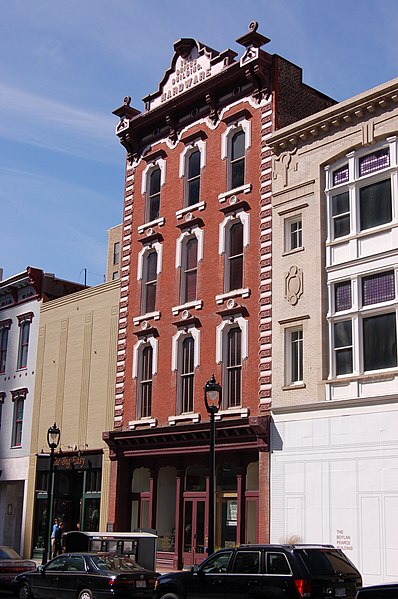
    I’m relying on a public domain image for this post as I didn’t realise how historic this building was when I visited the museum which is located on the ground floor of the Briggs Hardware Building. The backdrop to this is that Raleigh was a planned city, one of the few state capitals that was, and it didn’t really start getting developed until the early nineteenth century. This building is later, constructed in 1874 and it was the city’s first skyscraper and remained the tallest structure in the area for over three decades. Today it rather blends into the streetscape, although it has a sense of architectural beauty to it.

    20220928_133447

    This is the ground floor of the building today, the home of the marvellous City of Raleigh Museum. The reason I mention all this is that it seems to me to be a pivotal moment of the history of the United States, when new cities were being laid out and expanding fast as migrants moved to the country from around the world. Of course, this was a difficult time because of the American Civil War, but there must have been a sense of wonder as this structure was constructed. There’s a story that the whole construction was paid for by gold and silver coins that had been buried by Briggs at the beginning of the war, although that’s now a rumour that is unlikely to be proved.

    It was built for Thomas H. Briggs to house his hardware store and they used it for this purpose until 1995, when after a period of not being used it started its new life as a museum. There’s a skylight running through the centre of the building which ensures it’s well lit throughout, necessary given that there was no electricity when it was constructed. The building is the only remaining one in Raleigh from the nineteenth century that still exists in something like its original form, a survivor of the city’s early days when excitement for the future must have been running high.

  • 2022 US Trip – Day 11 (North Carolina Museum of History – Blackbeard and the Queen Anne’s Revenge)

    2022 US Trip – Day 11 (North Carolina Museum of History – Blackbeard and the Queen Anne’s Revenge)

    20220928_092714

    This whole display was something that I hadn’t expected to see, simply because although I have known about the voyages of Blackbeard since a child, I didn’t ever realise where his escapades took place. The museum has a model of the Queen Anne’s Revenge, probably constructed in Bristol in 1710 and later used by Blackbeard, also known as Edward Teach. He pinched the ship from the French, who were using it as a slave ship, in 1717, although he managed to sink it the next year when it ran aground. That little incident happened in North Carolina, hence why it’s featured in this museum.

    20220928_092831

    The ship was rediscovered by a private company in 1996 and excavated by archaeologists who dived down to it, although there have been all manner of arguments since about who owns what. The end result is that a number of items from the wreck are now on display in the museum, so I was suitably surprised and delighted to see these items that were on Blackbeard’s ship when it sank. In this photo are barrel hoop fragments.

    20220928_092841

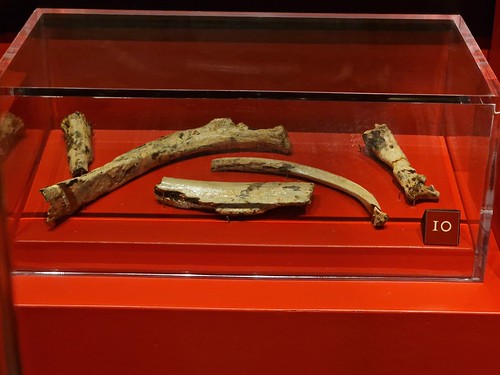
    These are fragments of animal bones.

    20220928_092849

    A pewter plate and one of the interesting things for archaeologists is that they have had to try and work out where items originally came from, given that Blackbeard had stolen from so many different ships which had come from various countries. Incidentally, they have found 300,000 artefacts from the wreck, so that should amuse archaeologists for some time to come.

    20220928_092903

    Dating items is made easier as it’s known the ship was wrecked in 1718, so it’s known that this bottle is from between 1698 and 1718.

    As for Edward Teach, or Blackbeard, he was a much feared man from Bristol (as they often are, they’re not as refined and clean-cut as Bathonians) who became a sailor and then took a rather dubious career path. He actually tried to avoid violence and instead relied on his frightening appearance, and perhaps Bristol accent, to scare people into handing over their goods. I mention the Bristol accent as it’s the depictions of Blackbeard in films and television programmes over the years that have meant that all pirates are somehow assumed to speak with a West Country accent.

    Anyway, I was impressed by this display as I hadn’t expected to see anything relating to pirates in a museum about North Carolina and I feel much better informed now about the matter. And it was quite stirring to see items that came from the ship of a pirate, moving it from a matter of fiction into much more of a reality.

  • 2022 US Trip – Day 11 (North Carolina Museum of History – An Old Brick)

    2022 US Trip – Day 11 (North Carolina Museum of History – An Old Brick)

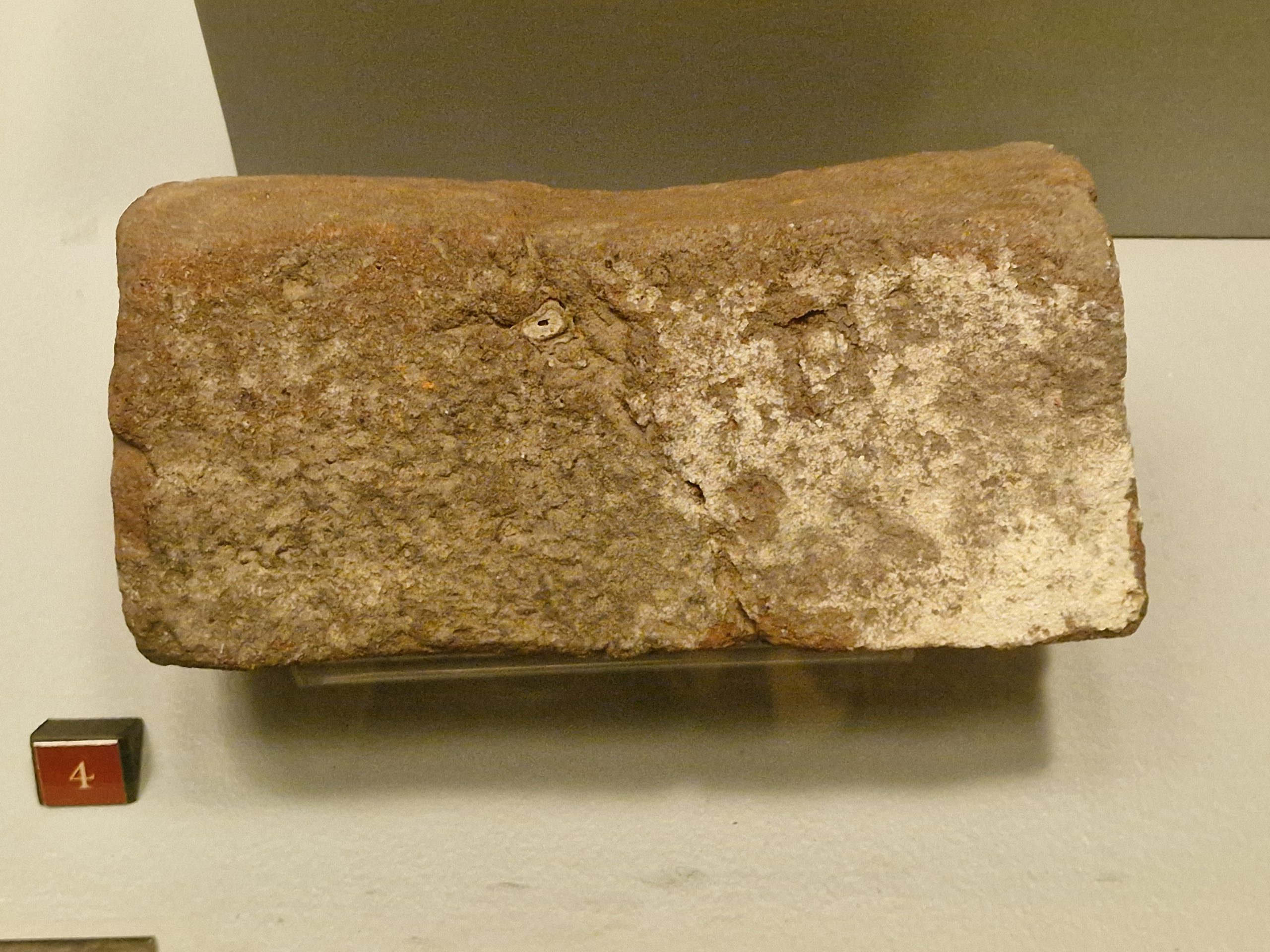
    I do like an old brick with some heritage to it. This one comes from the New Bern structure known as “Tryon’s Palace”, important because the building was used as the Colony of North Carolina’s first permanent Capitol, as well as being used as a home for the royal governor.

    The building takes it name as the Governor of North Carolina between 1765 and 1771 was William Tryon and he then went off to become the Governor of New York between 1771 and 1777 after he managed to annoy most of the local residents. Just to show that nothing ever really changes, there was a lot of controversy about the construction of the building as it was so opulent that taxes rose sharply to fund it. It took three years to construct, between 1767 and 1770, meaning that Tryon was only able to live in it for one year before he was replaced by Governor Josiah Martin. Martin enjoyed living there until 1775 until it was taken from him during the American War of Independence and although it was used for a few meetings, it was soon replaced by a new Capitol building in Raleigh. But more on that later as I went to see that.

    The building was used for a few purposes after political activity moved to Raleigh, including as a school, a Masonic lodge and a boarding house. It was damaged in a fire in 1798 which destroyed nearly all of the buildings in the complex. In the 1950s, it was decided to rebuild the Palace, which was slightly problematic as they had to move a road, knock down 50 private dwellings and reconstruct a bridge. I’m not entirely sure whether that was worth it, but anyway, it is possible to visit the Palace now, although it’s nearly all a reconstruction.

    Of the original building, only the Stable Office remains. Well, and also this brick, a memory of an opulent and mostly unnecessary British structure that became very briefly a centre for political activity and then went up in flames before falling down. We’ve just had a Prime Minister like that, but I mustn’t get distracted by politics.

  • 2022 US Trip – Day 11 (North Carolina Museum of History – Gold Panning in North Carolina)

    2022 US Trip – Day 11 (North Carolina Museum of History – Gold Panning in North Carolina)

    20220928_093750

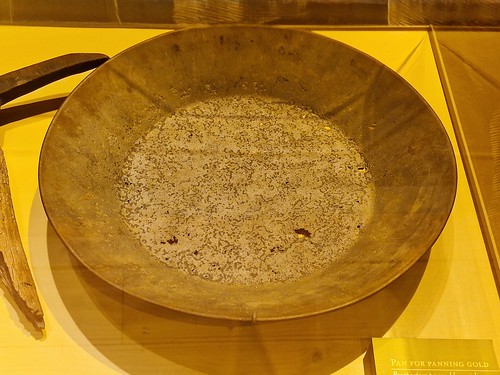
    This is another subject that I haven’t much thought about, but I had rather assumed gold panning in the United States took place further to the west than the state of North Carolina (and that isn’t entirely stupid to be fair, the state of Nevada is the biggest gold mining area now in the US). However, gold mining was an important industry in the early United States and this pan dates to the early twentieth century and was used to, well, pan for gold.

    Indeed, North Carolina was also the location where the first documented commercial gold find was made, at Reed Gold Mine in 1799. The finder of the gold, Conrad Reed, had no idea what he had found and used his lovely 17 pound yellow rock as a doorstop for a number of years, before realising it might be worth something and getting $3.50 for it. It was worth $3,600 even at the time, so someone did well out of that little exercise. The family didn’t lose out though, they made a fortune over the next few decades from the gold mine that was plonked down on their land.

    That gold mine is a tourist location now, but another thing that I found interesting is that individual can still pan for gold in the National Parks of North Carolina. Might be a useful way of funding another trip to the United States…..

    20220928_093739

    A coin made at the Charlotte Mint using gold that had been mined in North Carolina, alongside an old banknote from the Miners and Planters Bank.

  • 2022 US Trip – Day 11 (North Carolina Museum of History – A Crowded Slave Home)

    2022 US Trip – Day 11 (North Carolina Museum of History – A Crowded Slave Home)

    20220928_093931

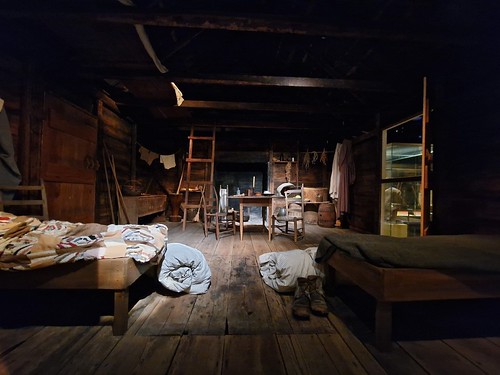
    I thought initially that this was a recreation of some hut used by gold miners, since it was located next to the display about the history of that subject. However, it’s an actual one-room building that was moved to the museum in the 1990s and it was once lived in by seven African American slaves. It once stood in Martin County, which is off towards the east of North Carolina and it was moved here as it would otherwise have been lost to yet another road widening project in the state. Although it might look cosy since it’s in the middle of a warm museum, I can imagine that this was a damp and miserable structure in which to have to reside.

    One thing the museum mentions about this recreation is that there aren’t large numbers of possessions surviving which were once owned by slaves, as they were hardly from a prosperous class. Instead, their story has to be told in different ways and imagining seven people shoved into this small space with few possessions seems a powerful way of telling that story. And there’s a limit to how much can be said about the people who lived here, as even though attempts have been made to establish who the residents would have been, there isn’t enough documentary evidence to let their story be told in that way. There is far more information available about the ‘owner’ of the slaves, who was Andrew Jackson Purvis, but it seems wrong to make this post about him.

    One of the shocking (to me anyway) statistic is that there were around 331,000 slaves in North Carolina in the years before the American Civil War, which was around a third of the state’s population. That’s a lot of people by any measure and 160 years ago isn’t really that long away in the country’s past. And the politicians in the state’s General Assembly weren’t going to change much, as 85% of them owned slaves in 1860, which is more than in any other state.

    As another aside, I’m also going to come back in a post shortly about whether the museum is racist and pro-confederate in the way that it shows its exhibits, as I’ve noticed a few articles about this, although very few negative reviews from visitors. As a slight spoiler about this, I didn’t have the same depth of concerns about the museum, but more on this later.

  • 2022 US Trip – Day 11 (North Carolina Museum of History – North Carolina State Flag from 1862)

    2022 US Trip – Day 11 (North Carolina Museum of History – North Carolina State Flag from 1862)

    20220928_094046

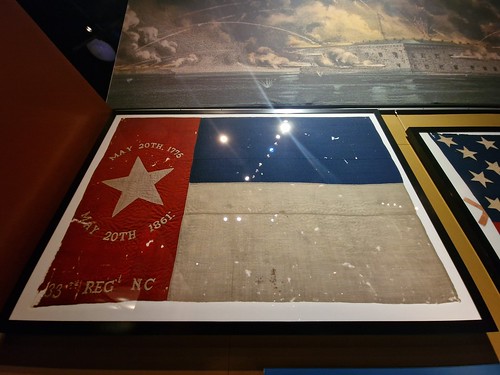
    This is a powerful piece of history, the North Carolina state flag that was carried by the 33rd regiment of the state’s troops into what became known as the Battle of New Bern on 14 March 1862. As misguided armies go in the history of warfare, it’s perhaps the confederate army that seems the most tragic as great chunks of those fighting were conscripted and many were there because they were defending their state out of loyalty. It’s true they were fighting for the right to hold slaves, although, conveniently for wealthy slave owners, if you ‘owned’ 20 slaves then you didn’t have to take part in the war. Very handy that was.

    800,000 men from the confederate states went to fight in the American Civil War and 260,000 of them died in the process, they were outnumbered and out-trained by the army of the United States. And that’s what makes this so tragic, thousands of people fighting for a highly dodgy Confederate cause where they were under-trained and never really with any hope of winning. The names of 2,937 men who served in the North Carolina 33rd regiment are listed at National Park Service web-site.

    Another thing that I find interesting is that date on the flag, the 20 May 1775, which is still on the state flag of North Carolina today. It relates to the Mecklenburg Declaration of Independence, which for a long time the state thought was the first declaration of independence from Great Britain. But, in truth, it’s almost certainly a fake and no evidence for its existence has remained.

    20220928_094053

    This is the Confederate First National Flag, carried by the 34th regiment, and this was captured or surrendered at the Appomattox campaign in April 1865, right towards the end of the Civil War. The names of 2,366 men from the Confederate army are listed at the National Park Service web-site. The flag likely saw numerous battles as it was made in around 1861 and it survived until the last major conflict of the war. I suspect the squares were cut off as souvenirs, although fortunately the majority of the flag has remained in one piece. This reminds me of when I saw, with not inconsiderable excitement, the Star Spangled Banner flag in Washington where previous owners had flogged little bits off.

  • 2022 US Trip – Day 11 (North Carolina Museum of History – Is the Museum Peddling a Narrative?)

    2022 US Trip – Day 11 (North Carolina Museum of History – Is the Museum Peddling a Narrative?)

    20220928_094126

    It’s true that there is a lot of Confederate ‘stuff’ at the North Carolina Museum of History, which is very well reviewed on sites such as Google and TripAdvisor, but there are occasional posts such as at https://www.everywhereist.com/2016/02/the-revisionist-narrative-of-the-north-carolina-museum-of-history-raleigh/ which question the intentions of the museum staff. Although to be fair, these are very rare criticisms of the museum indeed compared to the number of positive reviews that are made. It’s sitting at 4.8 out of 5 on Google Reviews, which is realistically as high as museum ratings go.

    I don’t want to get overly involved in the matters relating to the Civil War, but I have been interested in how this subject matter has been covered in institutions that I’ve visited in the region. There’s a need to avoid sensationalising it, or indeed putting it on a pedestal as was done literally in the early twentieth century, but there’s still a clear requirement to tell the story of something so important to American history. The hatred and intolerance that led to the Civil War continued in a different form after the end of that conflict, and in many ways continues to this day in terms of inequality of opportunity.

    20220928_094555

    On that theme, I’m disappointed when there’s sometimes outright abuse of museums rather than a positive discussion on how displays are presented. It is possible to argue why is there a confederate flag in this display? This is the Confederate Second National Flag that was carried by the 13th regiment of the North Carolina Troops into the Battle of the Wilderness. But, I’m not sure where else these flags are supposed to go. You can’t fly them on the top of Government buildings, they have to be put in storage of some kind as part of the nation’s heritage and I don’t see any advantage in putting them into a cupboard where the public can’t see them. The museum does have a few of these flags, and it might be useful to place them all in one cabinet so that the imagery is only shown once, but they’re all telling a different story and relating to different parts of the Civil War.

    20220928_095025

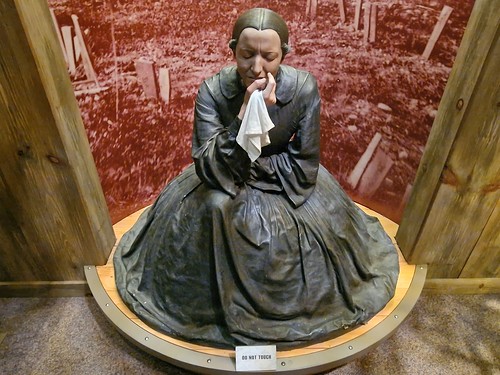
    I’m not sure that I hold this imagery is problematic, it’s showing that 35,000 North Carolina Confederate soldiers died during the Civil War, leaving families devastated. And it’s the case that this disastrous war left victims all over the place, not least amongst the wives and children of those who died defending a cause that was perhaps always going to be in vain.

    20220928_095028

    I’m going to claim that this is accurate rather than political. One element that German and Polish museums refer to a lot about the end of the Second World War is the vast displacement of peoples in forced resettlements where Germans were moved west and Poles took their place. I’m not sure that’s a “woe is me, the poor Germans”, it’s far more showing the huge damage that was done by the Second World War. The way German institutions handle the Second World War is perhaps relevant here, and it’s usually done in a similar manner to this museum which is to be informative and not really to hide anything. Being respectful is important, using carefully language is essential, but there’s still a story to be told.

    20220928_094950

    This hat was worn by General William R. Cox (1832-1919), the commander of the brigade that fired what transpired to be one of the last volleys from the Confederate side. He seems a complex figure, he was the 10th Secretary of the United States Senate from 1893 until 1900 and played a substantial part in national politics after the country came back together as best it could.

    20220928_094852

    The wallet that belonged to Colonal Thomas F. Toon that he used during the Civil War.

    20220928_094722

    Items from the CSS Neuse, an ironclad boat that was launched in late 1863 and spent some time stuck in the mud before it was scuttled by the Confederates on 12 March 1865 to stop the union forces using it. The remains of the boat were raised in 1963, a century after it was launched, and these are artillery projectiles from it.

    20220928_094707

    And iron plates from the ironclad.

    But, back to the museum. Personally, I thought the museum curators had done the job that they needed to do, telling this part of the state’s history and explaining the damage that the Civil War did to the country. Confederate troops were brave, which doesn’t mean that they were right in what they were fighting for, it’s just an unfortunate fact in many ways that the men fighting often do their very best in difficult circumstances. That the slave owners themselves were exempt from going to war just shows the futility of the cause in which those men were fighting.

    There are large exhibits at the museum on slavery as well as the civil rights movements during the twentieth century, so these topics weren’t ignored. But I’m not sure there’s anything to be scared of by saying the Confederate troops were courageous and their almost inevitable demise didn’t have a huge impact on their families. That’s the cost of war, division and hatred, I’m not sure that it can be much disregarded. But, I accept, it’s not for me to say what should be in the museum, the communities who live in North Carolina will have to decide that for themselves. And the displays have been there since 2011, so they’re probably in need of an update, but I hope they continue on a similar theme to what they have, but building and improving.

    20220928_095044

    Unfortunately, despite the right to the vote for black men, as the museum notes, this wasn’t accepted by many in North Carolina. That lack of tolerance led to the next disaster for civil rights, the Jim Crow laws, which as I mentioned, the museum moves onto next.

    Anyway, I’m sure there are always improvements that can be made to the text of panels in the museum and many institutions are quite rightly working through that process to ensure wording and terminology is appropriate and inclusive. But my general thoughts about the museum as an outsider was that it followed good practice in telling the story of those who fought in the war, which it would be odd to just miss out. I didn’t leave the museum suddenly deciding the Confederate cause was somehow misrepresented, just a little more knowledgeable about how much damage was caused to North Carolina by the Civil War. That messaging seems appropriate to me.

  • 2022 US Trip – Day 11 (North Carolina Museum of History – Wright Flyer)

    2022 US Trip – Day 11 (North Carolina Museum of History – Wright Flyer)

    20220928_095434

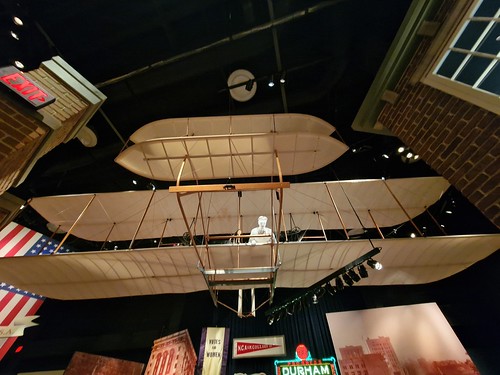
    This is a reproduction of the Wright Flyer, important because it was the first sustained manned flight in the world and it took place at Kitty Hawk, which is in North Carolina. And it seems fair that this museum should make quite a thing of that. I’ve seen the original in the National Air and Space Museum in Washington, but I hadn’t realised that it was on display at the Science Museum in London between 1928 and 1948 due to arguments between Orville Wright and the Smithsonian. That all revolved around Charles Walcott refusing to credit the Wrights with their achievements and wanted to give credit to his friend Samuel Langley, later causing great damage to the reputation of the Smithsonian. But I digress and this is an impressive replica of the original.

    20220928_095457

    I was just pleased to see this, bits of the 1905 plane and a letter from Orville Wright. The covering of the plane in Washington is a replacement, so it’s quite exciting to have seen this early bit of fabric. And it’s quite a thing to think just how aviation has improved in such a relatively short period of time. As an aside, this looks to be the item auctioned in 2014 at https://www.bonhams.com/auctions/21652/lot/108/, I would have thought it was worth more than $10k (they flog off even small bits of modern aircraft for quite large sums), but then again, I’m not really an expert in early twentieth century fabric from aircraft.

  • 2022 US Trip – Day 11 (North Carolina State Capitol in Raleigh)

    2022 US Trip – Day 11 (North Carolina State Capitol in Raleigh)

    20220928_102839

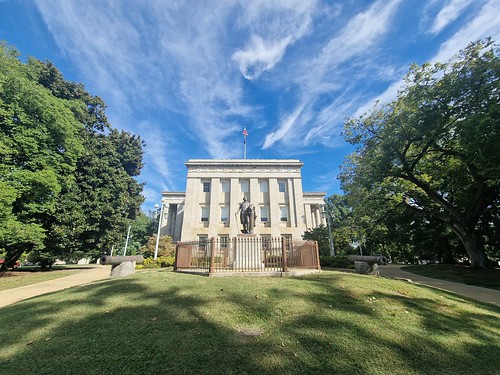
    I like to visit State Capitols and this is no exception, although unlike many others it’s no longer in use as originally intended as they constructed a new building in the 1960s. There was the usual security process to get in, but the guard was helpful and welcoming. It was a bit unclear at first where to go as there aren’t any printed guides, but nearly everything was open and visitors could just walk in, so that proved to be easier than I had expected.

    20220928_102333

    The grand entrance area and the statue of George Washington. I had to take this photo at the end of my visit as I was about to take a photo at the beginning when the tour guide pushed past with her group. I was more amused than anything else at the situation as the group were mostly ignoring her and she seemed a bit oblivious to everything else around her. She also blocked the steps for other visitors later on after deciding she would have her group stand on the stairs to listen to her quite boring monologue. She wasn’t a patch on the lovely guide at the Virginia State Capitol.

    20220928_102457

    Rolling back a little on the history of the building, the first section was opened in 1794, replacing the previous Capitol at Tryon’s Palace. The denizens of the state were very pleased with their building, extending it between 1820 and 1824. And then it burnt down in 1831, which it was unanimously agreed wasn’t entirely ideal.

    20220928_102609

    A new building replaced it in 1840 and that’s the one that stands today, although it came at a huge cost of $530,000 which was a ridiculously large sum for the time.

    20220928_101334

    Some of the ground floor rooms in the building are still used for State business and this is one of the Governor’s rooms.

    20220928_101507

    The first floor (or second floor if you’re American) with the two former legislative chambers on either side.

    20220928_101510

    I thought that this was suitably grand. I did debate doing something similar in my flat, but then thought it might be a bit ambitious.

    20220928_101532

    This is the North Carolina House of Representatives, in use between 1840 and 1961, and this was originally known as the House of Commons. There’s some poignant history here, this is the room where in May 1861 delegates unanimously agreed to secede from the union.

    20220928_101616

    The same room and it’s a shame that they couldn’t have kept sitting here for reasons of heritage, but I imagine they didn’t feel that there was enough space. To be fair, the tour guide managed to block half the building on her own, so it’s hard to picture the scene of hundreds of legislators and their staff.

    20220928_101658

    The North Carolina Senate, also in use between 1840 and 1961. There were fifty members who sat in this Chamber, compared to 120 in the House of Representatives.

    20220928_101717

    And the same room from a different angle.

    20220928_101749

    I very much liked this, it’s the key to the 1831 building that burned down. It’s also the first exhibit that was obtained by the North Carolina Museum of History (that I’ve just written several posts about) although clearly they weren’t allowed to keep it.

    20220928_101757

    The statue of Washington I mentioned earlier is a replacement because the original, designed by Antonio Canova,was destroyed in the fire. This is one of the bits that they salvaged. Not really enough to patch something together with.

    20220928_101759

    And some bricks, as I like historic bricks, from the foundations of the first State House in the city.

    20220928_101904

    One advantage in the building mostly coming out of use is that they’ve been able to open sections of it up, including the first library. It was used as the State Library between 1840 and 1888, but they had to start again as their other books were destroyed in the 1832 fire with the exception of a huge number that had been taken out by Archibald Murphey and were long overdue.

    20220928_102031

    Viewing the Senate Room from above.

    20220928_102059

    On the other side of the building is what was in 1840 the State Court, but that soon moved and this became a geology room which was used as something of a museum. Fortunately, the building wasn’t too badly damaged when the Confederates handed the Capitol over to the US army, although some items did go missing.

    I didn’t have much time to really explore the grounds of the building, nor indeed visit the replacement Capitol, as I had a third museum to visit, a bar and then had my train to catch. But I very much enjoyed looking around this Capitol, it is more of a museum than a working building, but it felt quite authentic for that reason. And no prizes for guessing that my favourite room in the building was the library, I felt that was really quite peaceful and charming.

  • 2022 US Trip – Day 11 (North Carolina Museum of Natural Sciences in Raleigh – Snakes)

    2022 US Trip – Day 11 (North Carolina Museum of Natural Sciences in Raleigh – Snakes)

    20220928_110140

    20220928_110148

    20220928_110248

    20220928_110255

    20220928_110304

    20220928_110405

    20220928_110447

    20220928_110620

    My third museum of the day in Raleigh was the North Carolina Museum of Natural Sciences, which was free of charge and was of some considerable size. One of the elements that I liked was going to look at snakes behind glass, which personally I’d rather was their natural habitat although I understand that’s not a view shared by all environmentalists.

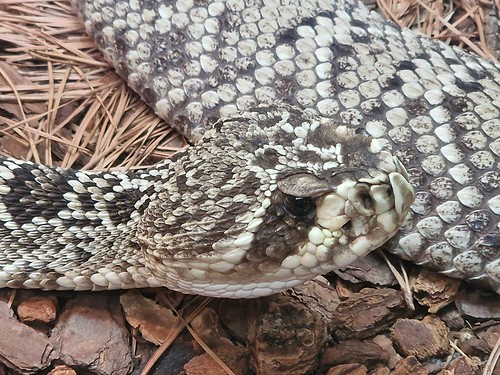
    The museum has quite a collection of snakes and it’s the angriest little herd of these reptiles that I’ve seen in a zoo or similar institution before. Normally they just lie there whilst visitors stare at them, but here they were all really quite vibrant, moving about and I think that they looked angry. I’m not sure if snakes can just look angry, but I decided that at least half here were. I’m not sure if they were unsettled by the visitors, whether they hadn’t been fed or that snakes in North Carolina are just generally inclined to get annoyed easily. I thought that the angriest in the herd were the timber and Eastern Diamondback rattlesnakes.

    There was someone who was very enthusiastically telling me how lovely these frightening creatures were (despite my telling him that they were anything but lovely), I didn’t quite work out whether he was an excited visitor or a museum docent. He did though keep pointing out the snakes that I’d already looked at, but as I’m polite I had another look at them and if anything they were more annoyed than when I had looked before.