Category: Raleigh

  • 2022 US Trip – Day 11 (Amtrak Train from Raleigh to Charlotte)

    2022 US Trip – Day 11 (Amtrak Train from Raleigh to Charlotte)

    20220928_144801

    After being suitably recharged in digital and technological form at Raleigh railway station, the Amtrak train to Charlotte arrived on time.

    20220928_144818

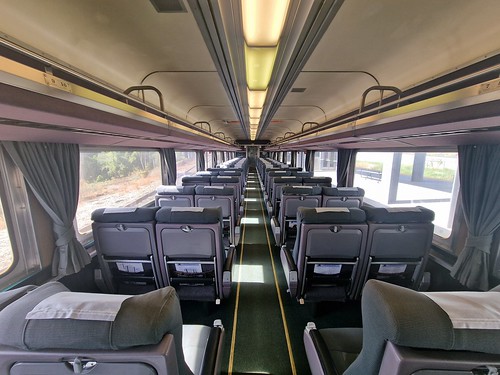
    I have to comment on the ridiculous amount of space available in coach on these Amtrak trains, with plenty of space to use a laptop and not annoy anyone who might be sitting in the next seat. I took this photo just before I disembarked, it was busier than this although there was still plenty of space and less than half filled. The power worked, the w-fi worked and so all was well with the world.

    Let’s just contrast this situation with the fiasco of Northern Rail, where they have crammed five seats in a narrow carriage and have the knees of passengers hitting each other when seats face each other. There’s no point talking about moving people onto rail so they can get work done when the trains look like this, and that’s even if they’re running with the current situation with strikes.

    20220928_182145

    The rather barren platforms of Charlotte railway station, which is a bit of a distance from the city centre. This station was opened in 1962, slightly further away from the centre than the previous building, and it’s showing its age now.

    20220928_182238

    It’s not at modern as at Raleigh railway station, although it is the busiest in the state of North Carolina.

    20220928_182332

    The exterior of Charlotte railway station, from where I was about to set off on a 4.9 mile walk to the hotel in true Dave Morgan style. I wasn’t getting the train back from here, so this was my only visit to the railway station although I did go through it en route to Newark at the end of my trip. It’s likely that I’ll never visit this railway station again, as it’s being relocated to be nearer to the city centre and this should open by late 2023 or early 2024. The replacement is Charlotte Gateway Station which will serves trams, buses, long distance coaches and rail, a very ambitious project which seems a very worthy endeavour.
  • 2022 US Trip – Day 11 (City of Raleigh Museum – Literary Tests in North Carolina)

    2022 US Trip – Day 11 (City of Raleigh Museum – Literary Tests in North Carolina)

    20220928_133802

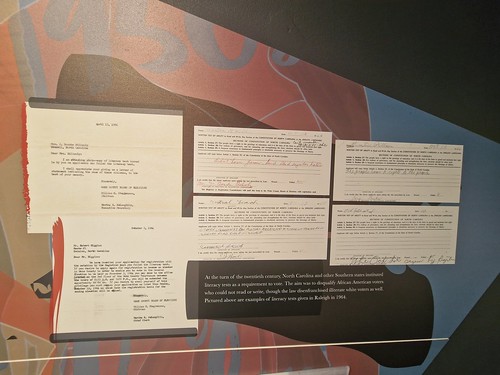
    They were certainly creative in North Carolina in finding ways to limit the black population from voting in elections. Although the policy of being able to read and write also limited poorer and less educated white voters as well, its aim in the southern states was to restrict the number of black voters. This was a thing in the United States between the 1850s and the 1960s before it was outlawed, although the principle was also copied by South Africa for the same purpose. The letters in the above photo date from 1964, shortly before the tests were outlawed nationally.

    As an aside, there’s an interesting debate the other way, namely about forcing everyone to vote. This is the situation in Australia and I’ve always thought it’s an intriguing and positive thing, as it makes it harder for more extreme candidates to get traction. Alastair Campbell has mentioned this on the excellent ‘The Rest is Politics’ podcast this week following his interview with Julia Gillard, it’s a concept that should perhaps be explored and all a far cry from when authorities wanted to deliberately limit the number of people who could vote.

  • 2022 US Trip – Day 11 (City of Raleigh Museum – Ku Klux Klan in Raleigh)

    2022 US Trip – Day 11 (City of Raleigh Museum – Ku Klux Klan in Raleigh)


    20220928_134129

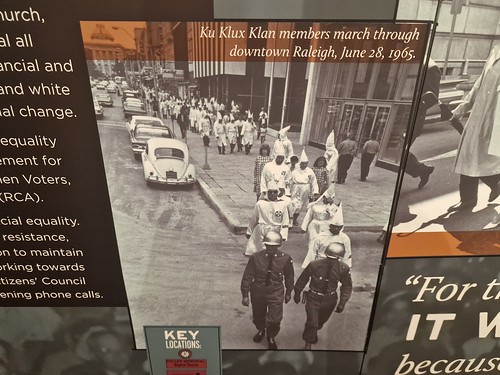
    I find the civil rights movement in the United States as a haunting, although fascinating, piece of history, not just because it was so long in coming, but also because they’re still nowhere near the equality that they strived for in terms of opportunity. I always had a belief that the membership of the Ku Klux Klan (KKK) was more secretive and individuals didn’t want to be identified, but there are no covered faces on this rally in Raleigh that was held on 28 June 1965. This wasn’t a small movement either, in the following year there was a march in the city that was attended by 1,800 members of the KKK. This article suggests that there were just under 10,000 members of the KKK in North Carolina in the 1960s, a higher number that I had realised before visiting this museum.

    This article is also interesting, a reminder that the children taken on the march by their KKK parents are still perhaps in their sixties, none of this is really that long ago. Anyway, best not to dwell too long on this, but it’s an inescapable part of the city’s history.

  • 2022 US Trip – Day 11 (City of Raleigh Museum – 1797 Map of Raleigh)

    2022 US Trip – Day 11 (City of Raleigh Museum – 1797 Map of Raleigh)

    20220928_134245

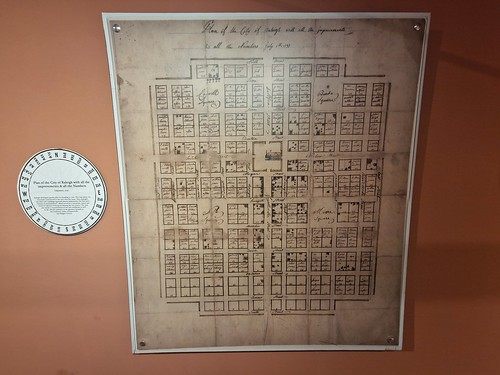
    I like an old map and this one is from 1797, just five years after the city of Raleigh was laid out. Clicking on the image will make it larger, with the Capitol building in the centre and four parks neatly laid out. Moore Square and Nash Square, the two southern ones, are still parks, but the northern two have been used for civic buildings. What I find intriguing about this map is the hopes and excitement the city founders and early residents must have felt, the opportunity that laid ahead. The early purchasers of land also got a fair chunk of space for their buildings as well and I’m pleased to read that taverns were constructed nearly immediately for the workers creating Raleigh. Incidentally, there were some half hearted attempts to keep the grid pattern as the city expanded, but developers got a bit fed up with that and things became a bit more erratic.

  • 2022 US Trip – Day 11 (City of Raleigh Museum – 1847 Map of Raleigh)

    2022 US Trip – Day 11 (City of Raleigh Museum – 1847 Map of Raleigh)

    20220928_134256

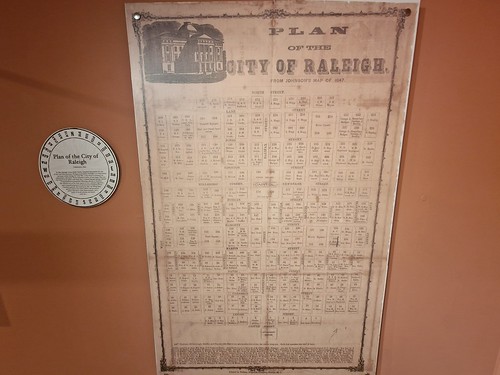
    Just to continue the theme following my post of the 1797 map of Raleigh. There was a large fire in the city in 1831, but the grid system was retained as buildings and structures were rebuilt. As some additional background, I was becoming conscious that I was faffing around in this museum when I should have been heading to the railway station (Raleigh didn’t get its first railway station until 1890 incidentally, so it’s not on the above map), such is my interest in maps and the evolution of cities. I accept, once again, that I should probably get out more….

  • 2022 US Trip – Day 11 (Raleigh’s Amtrak Railway Station)

    2022 US Trip – Day 11 (Raleigh’s Amtrak Railway Station)

    20220928_135830

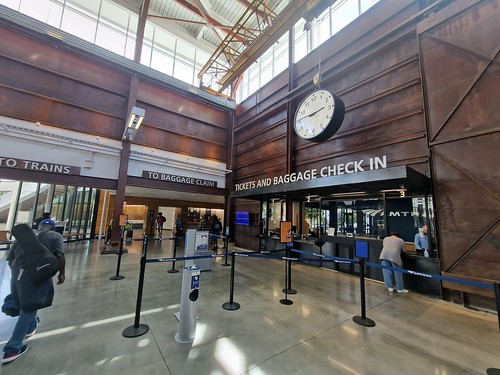
    After visiting four museums and one of the largest bars in the world, it was time to leave Raleigh after just a brief visit. It’s fair to say that spending under 24 hours in the city clearly wasn’t enough, I very much liked Raleigh and would merrily go again.

    Raleigh’s first railway station was built in 1890, relatively late by European standards for a city of its size. This building is new, opened in 2018, taking the name Union Station as a nod to the original Union Depot building.

    20220928_135851

    There seem to be numerous levels in the building, but there are a number of lifts for those who don’t or can’t traipse up and down all the steps.

    20220928_135918

    In the background is the traditional tall back Amtrak seating, with the railway station being a multi-functional building that they can hire out as required. They’re very good at creating railway stations with event space to help mitigate the costs of running the building, it seems a decent plan for the future.

    20220928_140010

    Mine was the 15:00 Piedmont train departure, which I cut incredibly fine by my standards by arriving just one hour early.

    20220928_140039

    This was very handy, I could charge my devices and also use Amtrak’s very fast wi-fi (their web-site says they don’t have wi-fi here, but they absolutely do) to upload hundreds of photos. I thought that it was a thoughtfully designed railway station, modern and functional.

    20220928_144525

    Many railway stations in the United States don’t allow access to the platforms until just before the train is due, so passengers wait in the main hall to be called. In the background the Amtrak staff member is visible guiding passengers, whilst I was faffing about uploading the last of my photos onto Flickr…. It was time to board the train to go to Charlotte, my next stop in North Carolina.

  • 2022 US Trip – Day 11 (City of Raleigh Museum – Yarborough House Hotel Menu)

    2022 US Trip – Day 11 (City of Raleigh Museum – Yarborough House Hotel Menu)

    20220928_132906

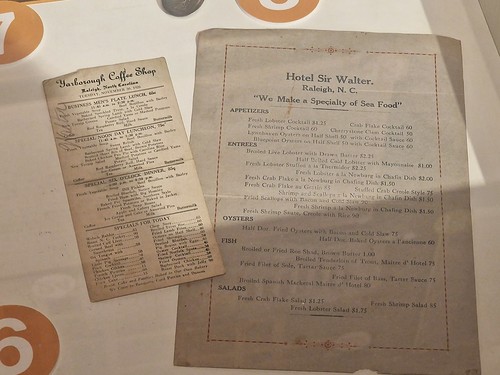
    There are two menus on display in the museum, the one on the right is from the 1950s and is from the Sir Walter Hotel. But, it’s the menu from 1926 (Tuesday 30 November 1926 to be precise) that I thought was the more interesting, from the Yarborough House Hotel, which burnt down in 1928 and was never rebuilt. During its period of opening it was the place to be seen, and numerous Presidents, including Presidents Johnson, Roosevelt, Taft, and Wilson.

    Frankly, some parts of the menu sound hideous, although each to their own, but the pigs brains with eggs don’t really appeal to me, nor do the chicken giblets. Although having written that, there’s a chicken pan pie, which I think is another way of referring the rather delicious chicken pot pie. There’s an appearance of Chop Suey, which at that time was a relatively new dish that was created for Americans along the lines of Chinese food. The phrase “French Fries potatoes” was also relatively new at the time, indeed they sound quite exotic served alongside the broiled bluefish.

    As a museum exhibit, I liked it, it’s a snapshot of culinary history in the United States from 100 years ago.

  • 2022 US Trip – Day 11 (City of Raleigh Museum – Lunch Counters Boycott)

    2022 US Trip – Day 11 (City of Raleigh Museum – Lunch Counters Boycott)

    20220928_133356

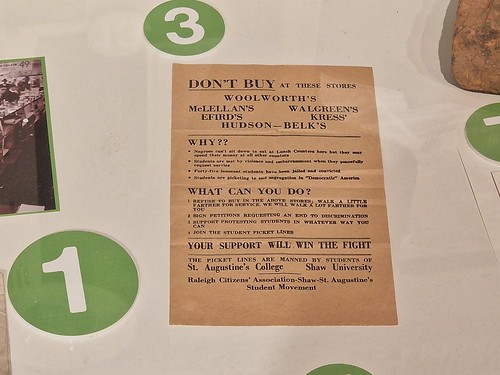
    It still seems remarkable to me that at the turns of the 1960s there was segregation at lunch counters in Raleigh and other cities across the United States. This is a leaflet encouraging people to boycott companies such as Woolworths and Walgreens where segregation was enforced, with these campaigns being mostly organised in Raleigh by students at St. Augustine’s College and Shaw University. The latter of those establishments is important as it’s what called an historically black university, namely one which educated black students in the days before educational segregation was brought to an end with the 1964 Civil Rights Act. St. Augustine’s College also has a proud history of educating black students, being founded by the Episcopal church in 1867 to give freed slaves education.

    This campaign, and others like it, were successful and lunch counters in Raleigh were made integrated on 19 August 1960. Alongside other North Carolina cities as Greensboro, the peaceful protests caused large economic losses for the companies as well as raising the rather obvious issue that it was ridiculous to have segregated counters. As an aside, it’s an interesting quirk of history just how popular lunch counters in drug stores, such as Walgreens, became and perhaps something of a shame that they mostly fell of fashion in the 1970s and 1980s.

  • 2022 US Trip – Day 11 (City of Raleigh Museum – Sir Walter Raleigh)

    2022 US Trip – Day 11 (City of Raleigh Museum – Sir Walter Raleigh)

    20220928_132639

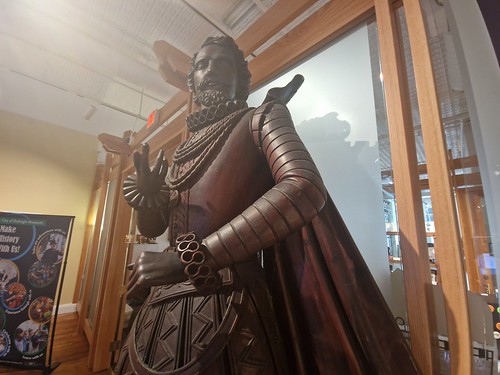
    I was clearly lax in my reading of the history of Raleigh in North Carolina as it wasn’t until I got to this museum that I realised where the city got its name from. I had stupidly assumed that it was someone called Raleigh who had funded the city or something similar, but it is all a bit more prosaic as it’s named after the great British statesman Sir Walter Raleigh (1552-1618). And here he is in statue form in the museum.

    Raleigh had the honour of having a city named after him because when they were laying the new state capital out in 1788 they decided to commemorate him as he was the sponsor of Roanoke Island, the ‘lost colony’. As an aside, people have been arguing how to pronounce Raleigh for at least 175 years, which is something in itself. I think the explorer’s surname should be pronounced ‘ral-lee’, but Americans tend to go for ‘rah-lee’, which has also impacted on how their pronounce their city’s name. And it all goes back to the word ‘ra’ meaning deer and ‘lea’ meaning a clearing, so somewhere in England in the tenth century or whatever there were some deer in a clearing and now there’s an American city named after them….

  • 2022 US Trip – Day 11 (City of Raleigh Museum – Some Rusty Old Nails)

    2022 US Trip – Day 11 (City of Raleigh Museum – Some Rusty Old Nails)

    20220928_132829

    Without context, I accept that this isn’t the most riveting display I’ve ever seen in a museum (and there’s a pun there with rivets, but readers can write their own….). However, they’re iron nails from Isaac Hunter’s tavern from when it was first constructed in 1769. And this building is important, because in 1788 the State’s General Assembly declared that the new capital of Raleigh must be built within ten miles of the tavern. Talk about how much this must have been important to the politicians of the time, it’s like the House of Commons declaring that any new city has to be constructed near to a Wetherspoons.

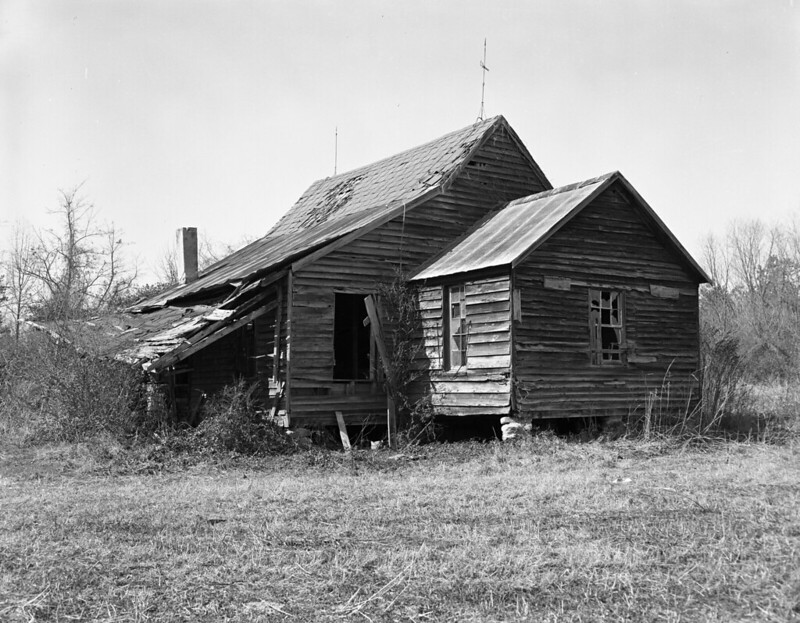
    And here’s the tavern in the 1970s. It was a little bit rediscovered (primarily as a previous owner had moved it from its original location) and it had been used for many purposes since its early days as a tavern, including being split up for domestic purposes and also redesigned to be a stable. However, I understand that instead of saving this, it was torn down and I’m guessing that’s when they sent some of its nails to the museum. I’d bet that at some stage in the future this will be rebuilt, it’s too important for Raleigh to be ignored and all that there is at the moment is a heritage sign to mark the location.

    The conclusion of all of this is that I like nails with a bit of history to them.