Category: Norwich

  • Norwich – Norwich Cathedral (Virtual Tour)

    Norwich – Norwich Cathedral (Virtual Tour)

    This photo is from one of my visits to Norwich Cathedral Library, a beautiful part of the building that I’d very much recommend. Anyway, the reason for this blog post is because of the rather lovely virtual tour that the cathedral has unveiled.

    Available for free at https://www.cathedral.org.uk/visit/virtual-cathedral-tour, it allows people to use their phones or laptops to explore the Cathedral. The quality of the imagery is excellent and it’s a quite marvellous alternative since sections of the building aren’t currently open to the public. It would be really positive if more historic buildings could be shown in this way, especially if some more behind the scenes sections were also shown.

  • Norwich History by Parish : St. Julian (Section 1/2)

    Norwich History by Parish : St. Julian (Section 1/2)

    And a new little project that Jonathan and I are undertaking because this lockdown is clearly here for at least a few more weeks. It’s a bit niche (our project I mean, not the lockdown), I’ll accept that, but there we go. Effectively, it’s walking around Norwich, ancient parish by ancient parish and seeing what is there now compared to a map from the 1880s (the map above is from 1789, but the one from the 1880s is more detailed, which is why we used that). There’s a PDF of these boundaries to provide some extra background to this whole project.

    St. Julian is the eight parish we’ve visited and as can be seen from the above PDF, it’s split into two separate areas, with St. Etheldreda in the middle. Given the complexity of that, this post is just about the most northern of the two sections of the parish and the one containing St. Julian’s Church. The other half we’ll do next week (I can imagine the excitement that everyone has already…… or perhaps not…..).

    This is the Waterfront on King Street, a live music venue and club, with this artwork at the front giving some examples of bands and singers who have performed there.

    This is the Waterfront’s riverside drinking area, which is all rather lovely, and it’s on the site of the old mortuary.

    This is Abbey Lane (formerly known as Cockey Lane), with the Waterfront on the left-hand side, looking back towards King Street. It’s also where St. Clement’s Church once stood, in the former parish of St Clement at Conesford. It was united with the parish of St. Julian in 1482, but the church remained open, but fell out of usage in the 1560s. The building was still there in the eighteenth century and it’s though some parts of it might remain underneath the nineteenth century structure of the Waterfront. To add to the mortuary situation, there were numerous burials found here in the 1960s in the former churchyard.

    This is the next street along, Hobrough Lane, and this would have once led down to a ferry which crossed the River Wensum. Once the frontages on King Street would have had residential properties that the wealthy lived in, but over the centuries it all became more of an industrial area.

    This area has now been cleared, but this would have been Greenman Yard and there was a pub, the Green Man, standing where that wall is. This was a pub from the mid-eighteenth century until it was demolished just before the war and George Plunkett took a photo of it in 1936. I’ve written this before, but Norwich is so very fortunate to have had George Plunkett, as I can’t imagine there would have been many other photos taken of this pub.

    Much has been written elsewhere about Dragon Hall (not least this rather lovely volunteer guide from 2005), so there’s little need for me to add a great deal here. It’s a former medieval hall of national importance which was constructed in the early fifteenth century. Although it was constructed as a grand hall for a wealthy man, Robert Toppes, it got sub-divided up over the centuries as King Street became a place more for industry than decadent living. It’s a slight miracle that the building didn’t fall down by the early twentieth century and it was in quite a state. Properties behind the building were removed as part of slum clearance, but the council had the foresight to save Dragon Hall (a name it was given in the 1980s) and take it into their own ownership. Some forward thinking individuals turned this into a museum and its change into the National Centre for Writing is a slightly retrograde step in my view (I’d have liked the building to have remained a museum so its fine interior was accessible to the public), but in all fairness, the new organisation does allow visits to see inside.

    The building to the right (125-129 King Street) on the above photo is historically interesting, but it has been rather marred by the lower floor windows that have been punched into it. I remember this building as BB Adams, the electrical retailer, but it’s been boarded up for some time now. It looked much better as it was in this 1936 photo from George Plunkett.

    The entrance to Old Barge Yard, which takes its name from the pub which traded here from the middle of the nineteenth century until it closed in 1969. The window seats from the Old Barge Yard pub are apparently still visible inside the building.

    Old Barge Yard, which did lead to the River Wensum, although it has now been blocked off.

    One of the old doorways into Dragon Hall and this dates to the early fourteenth century when the building was being constructed, although the decoration is from the fifteenth century. George Plunkett has a photo of the doorway taken in 1935.

    Looking back along Old Barge Yard, towards King Street.

    This was the area behind Dragon Hall which was cleared during the slum removals of the 1930s. The entire site, including the flats behind, are now part of the Saint Anne’s Quarter project.

    Back on King Street, opposite Dragon Hall, is this entrance to Drays Yard. Although it has an historic sounding name, this isn’t original and is a new construct.

    St. Julian’s Alley and that wall to the left is a bit of a survivor. It isn’t the former wall of a building, just something that was built around a property boundary, so it’s done well to be kept and integrated into the newer structure behind it.

    This area hasn’t changed much over the centuries, it’s the churchyard of St. Julian’s Church and the alley named St. Julian’s Alley goes off to the left, straight ahead and to the right. George Plunkett has a photo from 1938 of the building which is behind where I’m standing, although this has now gone and there’s a modern residential property there now.

    St. Julian’s Church, from which the parish takes its name. As I visited here a few weeks ago, I’ll just link into that blog post. George Plunkett has a photo from 1946 which shows the damage which had been done to the building during the air raids, and the city is fortunate that this church was reconstructed.

    This is St. Julian Alley which now ends at Rouen Road, a poorly designed area of the city which has seen housing replaced by car parking and uninspiring buildings. This alley once led on to Crusoe Street.

    This is the view when standing outside of St. Julian’s Church, along what is now Kilderkin Way, but which was once the King Street Old Brewery. Thorn Lane used to stretch from Ber Street to King Street, so would have run through the middle of this site, but only the upper end of Thorn Lane remains. Most of this lies in another parish, so I’ll come back to this in the future. But, as an example, this is what Thorn Lane used to look like in 1938. This is a nicely designed street though which fits into the area well.

    Walking back to King Street, this is a former entrance to the school which sat behind St. Julian’s Church. More on this in a moment.

    Looking back down to King Street.

    This is the same alley as in the above photo from the other end, and it’s called St. Julian’s Alley, which complicates things a little as that’s also the name of the neighbouring alley mentioned earlier.

    This is the site of the school behind St. Julian’s Church, and the one that was accessed through the bricked up gate. I’m not entirely sure why the school is no longer here, perhaps destroyed by the bombing during the Second World War which destroyed most of the church. This is now a housing development called King’s Gate on the map, but is named as St. Cecilia’s Court on the road sign. I imagine that the latter is correct.

    There were two school buildings within the complex, a larger one and a smaller one, the latter survives. It’s now used by the Sue Lambert Trust, a charity who help those who have suffered from sexual abuse.

    The photos of the school site were taken on what is now Music House Lane, named after the historic building in the parish of St. Etheldreda. This is a new name, as this street was once the lower part of Horn Lane, which stretched from Ber Street to King Street.

    This photo is taken from Rouen Road, the new road that was built ploughing through housing that was torn down, looking towards King Street. Someone standing here 100 years ago would have seen St. Julian Street to the left, Horn Lane in front of them (and behind them) and Burleigh Street to the right.

    This is the former route of Horn Lane, and also the edge of the parish boundary. It’s now been blocked off and turned into a walkway, although Horn Lane does continue on the other side. That section of the lane has retained its name, but that’s in a different parish and a story for another day.

    It’s hard to imagine that this was once a thriving community, with people living on what was Garden Street, Bartholomew Street, St. Julian Street and Crusoe Street.

    Walking back down to King Street, that concluded this little meander. King Street is in pretty decent shape in historic terms, so much has been saved there, although there are numerous clumsy planning decisions which have led to some incongruous buildings popping up. The buildings on the site of the King Street Old Brewery are also decent and have retained some interesting architecture, but the area the council decided they’d demolish to build a giant car park is really an eye sore as it stands.

  • Norwich – Speeding, Road Rage and Hit & Run in 1871

    Norwich – Speeding, Road Rage and Hit & Run in 1871

    150 years ago this week, there was a case heard in the Shirehall in Norwich with a Mr. J. Longs in the chair and it’s quite an early case that combines speeding, road rage and hit & run. I’m not sure that I’ve read about an earlier case involving these breaches of road etiquette, but I’m sure that Colonel Custance wasn’t entirely pleased to hear about this incident.

    Incidentally, the above image is from Attlebridge, on the old Norwich and Fakenham turnpike road, although I don’t know where exactly the accident took place.

    I shall quote the case from the Norwich Mercury:

    “William Dann, teamman, in the employ of Colonel Custance, was charged with driving furiously on the Norwich and Fakenham turnpike road on Tuesday last, and causing wilful damage to a cart driven by Mary Ann Fisher, of Reepham. It appeared that the complainant was driving home from Norwich when she overtook the defendant, who was at that time driving quietly. After passing him, however, defendant whipped his horses and dashed along, apparently with the view of getting before the complainant, who drew close to the edge of the road, but could not avoid a collision.

    The result was that defendant’s wagon caught the wheel of complainant’s cart, smashing it to pieces. The woman was thrown out of her cart, and became unconscious, but notwithstanding this, the defendant drove on without rendering any assistance. The amount of damage the defendant had already agreed to pay, and pleading guilty to the charge, he was now fined 5s and £1. 9s. 6d costs”.

  • Norwich History by Parish : St. Etheldreda

    Norwich History by Parish : St. Etheldreda

    And a new little project that Jonathan and I are undertaking because this lockdown is clearly here for at least a few more weeks. It’s a bit niche (our project I mean, not the lockdown), I’ll accept that, but there we go. Effectively, it’s walking around Norwich, ancient parish by ancient parish and seeing what is there now compared to a map from the 1880s (the map above is from 1789, but the one from the 1880s is more detailed, which is why we used that). There’s a PDF of these boundaries to provide some extra background to this whole project.

    St. Etheldreda is the seventh parish we’ve visited and is one of the smallest in terms of its physical size. When we started this parish I had wondered whether there would be much of interest, as great swathes of it have been destroyed and replaced with modern housing. However, some elements remain and it was a suitably intriguing challenge to work out where the roads once were in relation to where we were standing.

    As for the destruction of much of this parish, which was partly pre-war slum clearance, partly air raid damage but mostly post-war clearances. It’s easy to be critical of the council that they destroyed so much history, but that should be tempered with the situation that they had residents needing decent housing, they had war-damaged properties and also poor quality housing. It’s too simplistic perhaps to just condemn the council for bull-dozing history given the limitations that they had.

    However, even after noting that, I personally think that the council made substantial mistakes with this huge rezoning. They retained little, with most streetlines being lost and the heritage they could have saved was just bulldozed away. There was all manner of local opposition and numerous historic buildings were lost, despite the hopes of locals that they could be saved. The council by all accounts disregarded these attempts to save elements of the area, which is perhaps a great shame.

    So it all means that there is no anchor to the past, they created a new community that feels a little separate from Norwich city centre, despite it being a very short walk away. The council demolished Mariners Lane which connected King Street to Ber Street and broke the direct link between the two areas. Instead, they ploughed a new street, Rouen Road, through the middle of what was once housing which now has several car parks and under-used sites along it.

    It appears from the media that the reason that the council did this was because they initially expected the site to be entirely reused, even as a university site, although the University of East Anglia were attracted by more spacious surroundings outside the city centre. This would therefore make more sense in terms of demolishing the area, although perhaps the council might have got clarity on that before tearing everything down.

    The EDP has a photo of what this area looked like in the early 1960s, and that street heading down to the middle of the photo is Mariners Lane.

    And here is that same location today, Mariners Lane, which is now a cul-de-sac leading off from Ber Street. This is in St. John De Sepulchre parish though, so we mostly ignored this today.

    This photo is taken at the base of the hill, looking at Normandie Tower, which is I think the only tower block in Norwich City Centre. I initially thought that this piece of hill was original, but it isn’t, this is where Mariners Lane came down.

    This photo is taken in the same place as the previous one, but facing the other way and looking at Rouen Road.

    Clicking on the above map makes it bigger. I was standing on the final T of “William Street” on the map when taking the photos, with Normandie Tower being pretty much on top of Compass Street.

    Now standing on Rouen Road at what appears to be some sort of temporary bus station that First have created for themselves, with Normandie Tower in the background.

    This is the route of Mariners Lane, now demolished here.

    This photo is taken in (nearly) the same place as that taken by George Plunkett in 1935. On his photo, it’s possible to see the sign for the Congregational Mission Hall at Sherbourne Place where services took place on Sunday evenings at 19:00. This has now been demolished, as have all of the malthouses which stood along here.

    This is where the malthouses once stood. The buildings on the right are the rear of the properties fronting onto King Street. The council tore down many buildings along King Street, but on numerous occasions there was local opposition which ensured that the properties were maintained. Although King Street might have lost some of its history, it hasn’t been decimated.

    This is the church from which the parish takes its name, a now redundant (in religious terms) Grade I listed building which dates from the twelfth century, with additions made in the fourteenth century and a substantial Victorian restoration. It’s now in use by an arts organisation and I’ve been inside on a heritage day weekend, I’ll retrieve my photos from that weekend at some point.

    The churchyard is in quite a state in numerous different ways, not least because some of these littered about the place.

    The Norman style doorway, which is actually probably Norman……

    A photo taken from the grounds of Normandie Tower, looking back into the churchyard.

    The church, looking quite pretty here. The roof was thatched until the Victorian restoration.

    Something doesn’t feel right about this being here, I’m wondering whether this has been moved from inside the church. It might have been on top of a box tomb, but I’m not convinced this was its original placement.

    A broken stone in the churchyard.

    The north side of the church.

    I am still yet to be convinced that using gravestones as some sort of garden feature is appropriate or respectful. Others may have different views.

    This is the end of the parish, and the Ferry Boat Inn is at the rear, across the parish border. And an explanation of that, the parish of St. Julian’s is located both to the north and south of the St. Etheldreda parish, it’s a strange split. Anyway, somewhere on the left the Rainbow pub stood until 1959, which backed onto the parish boundary.

    This car park is on the former site of the Crown Brewery, which occupied a large site along the river from the early nineteenth century. The National Archives note that “the Crown Brewery was gradually acquired by the firm of brewers known variously as Baseley, Youngs and Roe, Youngs and Burt, Crawshay and Youngs, and Crawshay, Youngs and Youngs, in the years” and it closed in the middle of the twentieth century. A few of the buildings from that period survive and the brewery also owned the Music House building, more of which later on in this post.

    Photos from the Crown Brewery site, with the River Wensum visible.

    Some decoration in the foliage.

    A mural on the wall, with some not ideally placed bins. I understand that this was designed by Walter Kershaw in 1984 and it features numerous elements of Norwich’s history. The mural is on the reverse of the building, so it’s not visible from King Street itself.

    The buildings on the right, 176-178 King Street, are also visible in George Plunkett’s photo from 1936.

    This is the former Ship pub and another loss, in my opinion, to King Street as this would have made for a quite marvellous licensed premises. George Plunkett yet again helps me here, this is the pub in 1939 and the EDP have one from a not dissimilar period.

    Not only will I link to George Plunkett’s marvellous photos, I shall also quote his text about this:

    “The yard to its south has at some time been partly built over, so that while formerly wide enough for the passage of carts it will now accommodate only pedestrians. The finely carved lintel above bears a design of foliage together with the rather contradictory inscription “Princes In”; it is believed that this was brought here at some time from the famous inn of that name, first mentioned in 1391, which once stood in St George Tombland parish on the north side of Princes Street”

    It’s also quite visible in this photo just how the width has been narrowed.

    The old name of the yard.

    Inside the yard, which is blocked at the end and there’s nothing older behind these buildings, it’s all been demolished.

    The old entrance to the Ship Inn, which ceased being a licensed premises in 1969.

    Wooo!!! Some survivors on the outside of the pub, with our parish of St Etheldreda on the left hand one from 1786. The two on the right both relate to the parish of St. Julian (the J was once used more interchangeably with the I) but in two different formats, one from 1800 and the other from 1825.

    On the other side of the road from the Ship Inn is 167 King Street, or the Music House. This is also on the edge of the parish boundary and some of this structure dates to the twelfth century. The undercroft is now Jurnet’s Bar and is full of character and history, taking its name from a man known as Jurnet the Jew, who purchased the building from John Curry in 1225. Once a house for the wealthy, this area became a little less glamorous over time, so the building was split up into tenements in the eighteenth century. It is the only non secular building from the twelfth century to survive in Norwich and it’s used today by Norfolk County Council. Behind here was the Crown Brewery, who owned the building for much of the nineteenth and early twentieth centuries.

    These parish boundary markers are on the Music House, with the parish of St. Julian off towards the left of this photo and this has markers from 1789 and 1825, with the marker for St. Etheldreda dating to 1786. I like that one of these iron parish boundary markers was placed here in the year of the French Revolution, that’s a quite remarkable survival really given everything else that has changed in this area.

    And a look back down towards the parish of St. Etheldreda, a really quite fascinating section of street.

  • Norwich History by Parish : St. John Baptist Timberhill

    Norwich History by Parish : St. John Baptist Timberhill

    And a new little project that Jonathan and I are undertaking because this lockdown is clearly here for at least a few more weeks. It’s a bit niche (our project I mean, not the lockdown), I’ll accept that, but there we go. Effectively, it’s walking around Norwich, ancient parish by ancient parish and seeing what is there now compared to a map from the 1880s (the map above is from 1789, but the one from the 1880s is more detailed, which is why we used that). There’s a PDF of these boundaries to provide some extra background to this whole project.

    St. John Baptist Timberhill is the sixth parish we’ve done this for and, again, there’s substantially more history than I can mention in this post, a reminder of just how much heritage remains in Norwich. As can be seen in the above PDF, these boundaries are not that neat and they follow the lines of buildings that have long since gone. I’m generally spelling Timber Hill as two words, but views on this seem to differ, but I won’t let it overly worry me…..

    This is the area of Norwich that we were meandering around. And, this parish was difficult to follow, not least because the entire cattle market area to the north of the former parish has disappeared and has been replaced by the Norwich Castle Quarter shopping centre, but also because the Rouen Road area has been entirely changed in post-war developments.

    Starting off at St. John the Baptist Church, which was open and offering a friendly welcome. I took numerous photos in the church, but I’ve written about this building before and shall just refer back to that. Nearly no graves remain in the churchyard, but they appear to have been removed long ago, and little of the exterior remains. The church’s tower collapsed in 1784, during a period when many Church of England buildings were neglected as the number of people attending services started to fall, and it was never replaced.

    We first went to the southern end of the parish, which is now the beginning of Ber Street, but this section was once considered to be part of Timber Hill. Also visible in the above photo is the entrance to White Hart Yard, which was named after the pub which once stood at its entrance. The pub closed in 1940 for the duration of the war, but it was then bomb damaged and became derelict, so that re-opening never happened.

    This is perhaps something of a loss, this was the Kings Arms and George Plunkett took a photo of it in 1979. It had traded as a pub since the first few years of the nineteenth century, was damaged during the Second World War, but then repaired and it remained open until 1968.

    The former Cullings Coaches building, a independent bus company which operated from Norwich.

    The parish boundary stops about here somewhere where it meets St. Michael at Thorn parish. The back of these buildings on Ber Street would have once been yards which stretched back some distance, but this has all gone now, and that’s the back of the Archant building at the rear.

    This is on the other side of Ber Street and is the Bonds building (operated by John Lewis) and this is a post-war building as their rather lovely previous shop got destroyed during the Second World War. George Plunkett has a photo of the Bonds building from 1935, which would have perhaps been one of the iconic images of the city if it had survived the war.

    Bonds (or John Lewis) today, although the area on the right is in a different parish, but there was no evidence of any old parish markers here to show where that line was exactly.

    We then went back to St. John the Baptist Church and walked back towards the city centre along Timber Hill. This is a vastly improved road and the city council have done a decent job here, with pedestrianisation making it a much more walkable area and there are numerous cafes and restaurants along here. Older photos show a busy road and pedestrians shoved to one side, so this is a more pleasant area to be now.

    The entrance to Scotts Court, not to be confused with Scotts Yard on nearby Ber Street. On the other side of the road here is the Castle Quarter shopping centre (formerly the Castle Mall) which means little original from this area remains.

    And a parish marker at last and many of them have gone missing from this area, with PAS meaning the Parish of All Saints.

    The entrance to Lion and Castle Yard, which leads off Timberhill and is in the parish. It takes its name from the Lion and Castle pub which was located here between 1822 and 1925, with a sign also noting that the lion and castle are on the city’s coat of arms.

    This building in the yard is one of the few thatched structures that still remain in Norwich and it is now one single property that was combined from two seventeenth century cottages. The building was restored by the Norwich Preservation Trust in 1996 and it’s likely that weavers would have once lived in the properties. George Plunkett took a photo of this location in 1935 and the area has a rather different feel today to back then.

    Back on Timber Hill, this is the former Baptist Particular Chapel, which was originally built as a warehouse in the eighteenth century. It was purchased by the Particular Baptists in 1832 for £1,150 and then converted into a chapel, a usage that it retained until 1975. More recently it has been converted into a restaurant and bar.

    Looking back up Timber Hill, with the Murderers Pub on the left.

    This is the birthplace of Sir Arthur Michael Samuel (1872-1942), who was the first Jewish Lord Mayor of Norwich. He later became the Conservative MP for Farnham, the Secretary of Overseas Trade between 1924 and 1927 and then the Financial Secretary to the Treasury until 1929.

    This is where Timber Hill meets Orford Hill and George Plunkett took a photo in 1984 of that stag being lifted onto the roof. There’s a blue plaque on that building which noted that George Walpole, the Earl of Orford (1730-1791) was seen as a bit of an eccentric at the time, but he gave generously to public subscriptions to fund planning improvements. This section of the street, which is also where three parishes meet, was renamed from Hog Hill to Orford Hill in his honour.

    Orford Street, looking down towards Farmers Avenue.

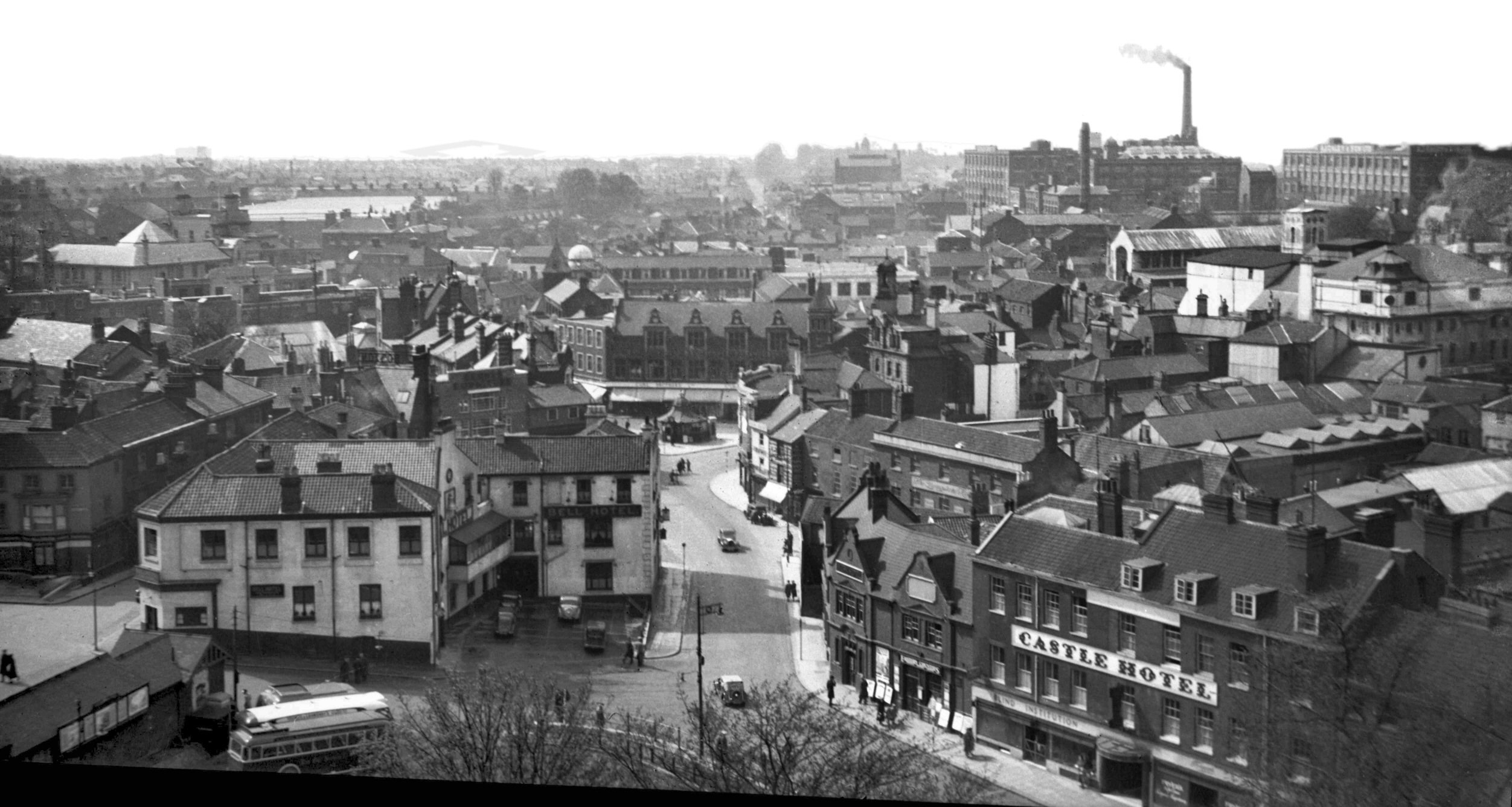
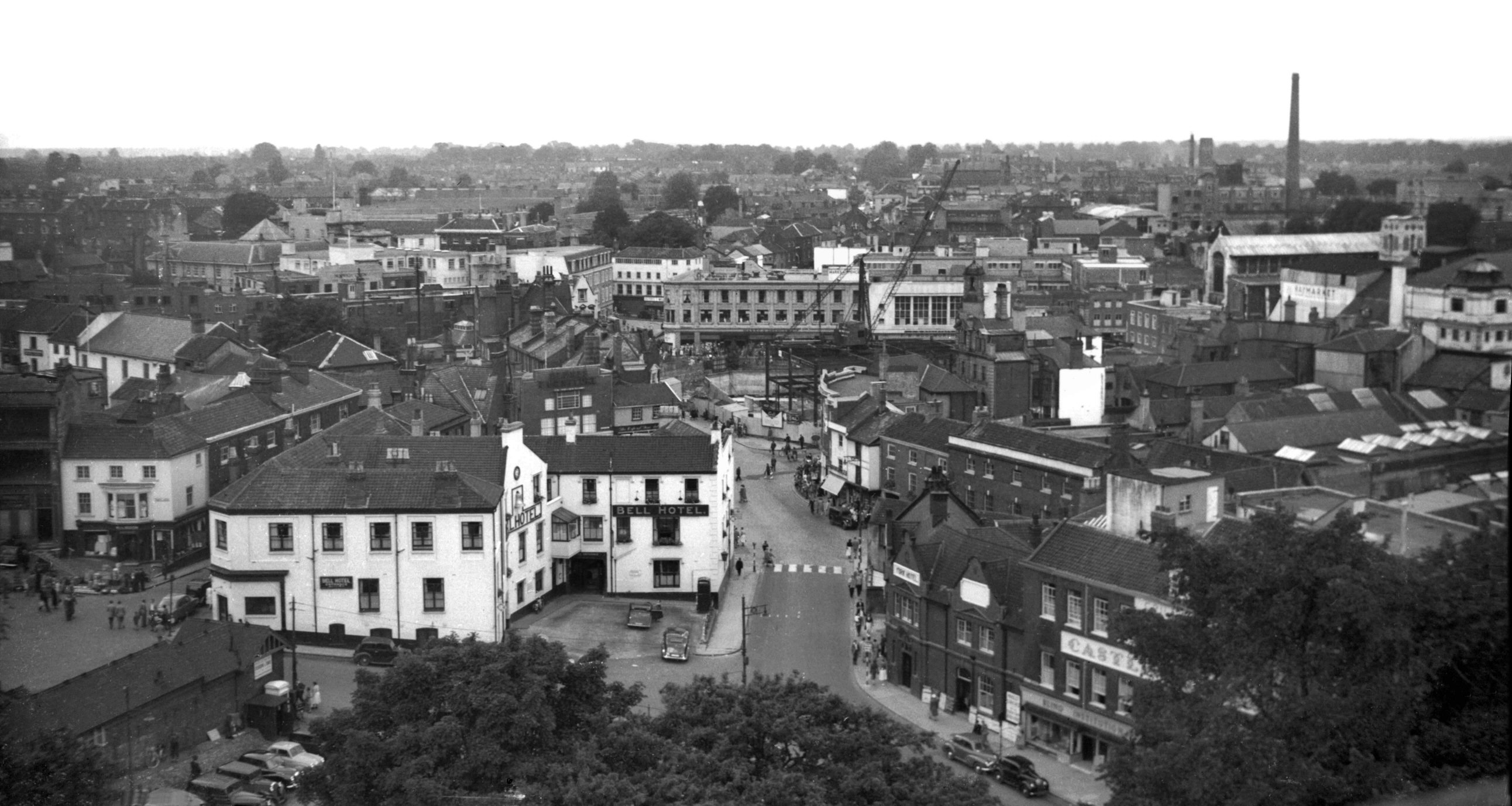
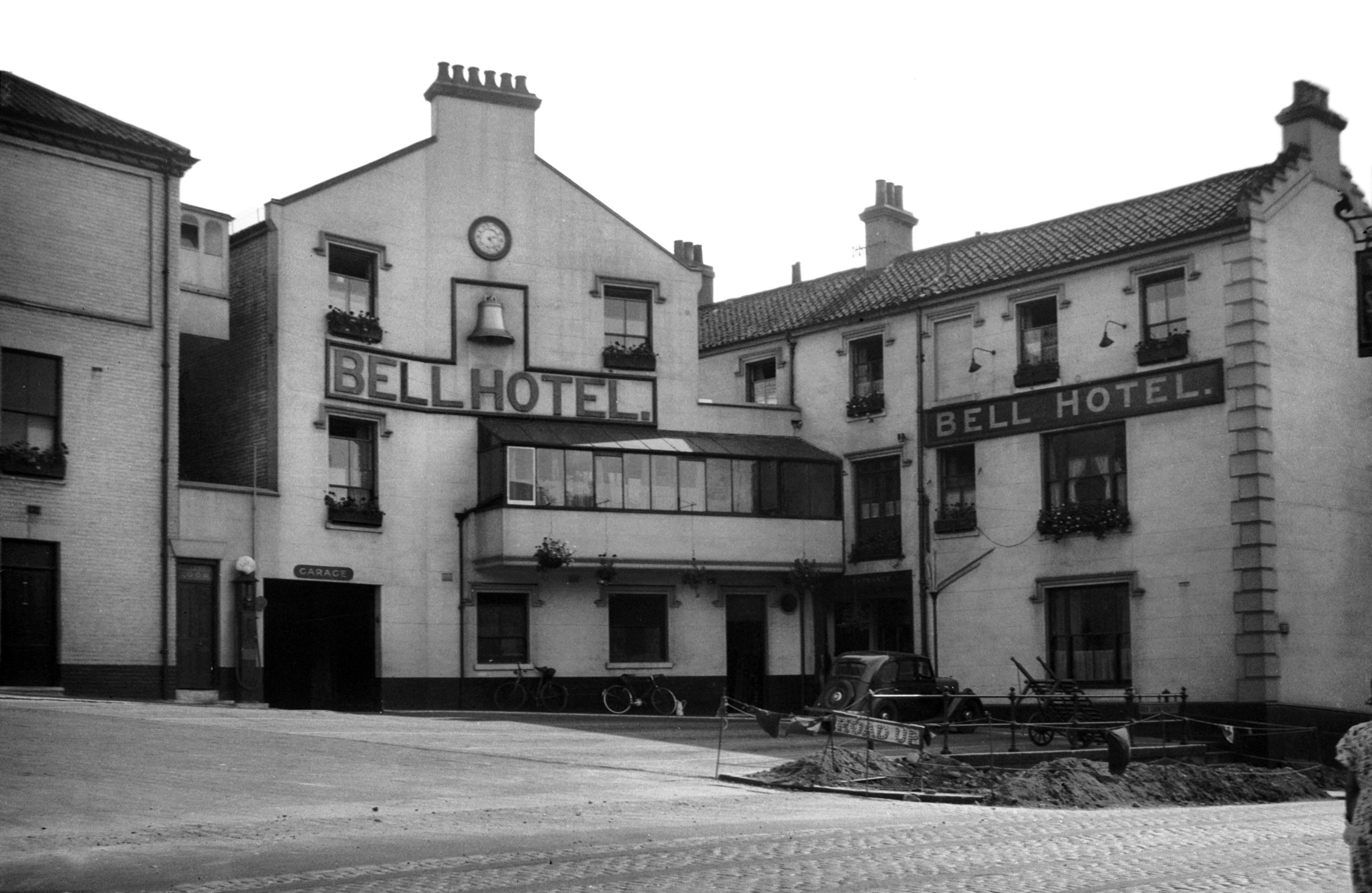
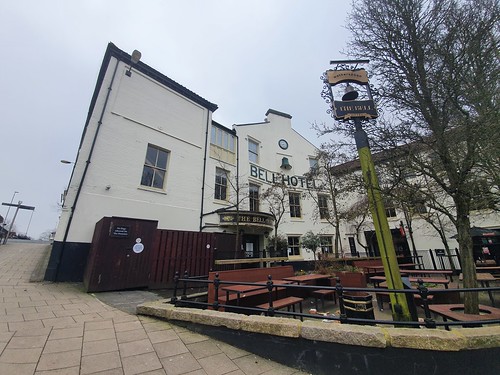
    The Bell Hotel from the Orford Street side. This large building is no longer a hotel and is operated as a JD Wetherspoon pub and is one of their first in the country to have opened outside of London. Sections of the structure remain from the fifteenth century and it has been known as the Bell (or the Blue Bell) since at least 1696. Revolutionary groups met here in the eighteenth and nineteenth centuries (and frankly, I can think of a few that have met here over the last few years, but that’s a different matter) and it was also used by the American Women’s Army Air Corps during the Second World War.

    The front of the pub, from Castle Meadow.

    The rather grand entrance, which was formerly the way into the stables of what was then a coaching inn.

    This area has all changed now, with Norwich Castle in the background, Farmers Avenue now has the Castle Quarter structures on it.

    The entrance to Orford Hill on the right, but once again, everything behind that has changed with the shopping centre development.

    The entrance to the cinema.

    This is the only remaining older section of this road, with what was Number 12 at the rear, a now permanently closed restaurant that was located in a building with parts remaining from the seventeenth century.

    The rear of Number 12.

    This building, 18 Golden Ball Street, was saved and now sits a little awkwardly within the Castle Quarter shopping centre structure. George Plunkett took a photo of this property in 1936, but everything else around here has gone. To the left of these structures is St. John the Baptist Church, where we started our little meander.

    There’s also a parish boundary marker located on the front of the building and I wondered whether it was put there as part of the renovation and heritage of the building. However, it’s also visible in the old photo from George Plunkett and it stands for St. John Timber Hill.

    The Archant building, which is perhaps not the most liked structure in terms of its design, but is something a little different and I’m sure it’ll become an important part of the architectural history of the city. Long since the home of the EDP, the building was sold by their owners Archant in 2019 to Alan Boswell Insurance, but they retain a floor in it. New ways of working and changes to regional newspapers (primarily they don’t sell many now) meant that Archant didn’t need as much office space, hence the downsizing arrangement.

    Paid for by Archant, or Eastern Counties Newspapers as they were, this sculpture is by local man Bernard Meadows (1915-2005).

    The car park of the Archant building, where once there was housing.

    This is Paradise Place which is an old name for the streets here, but they were changed in the post-war period when a new housing development was placed here. Personally, I think this area has been botched in terms of its atmosphere (given there’s a busy road and big car park by it), as it doesn’t feel like part of the city and the old streetlines were lost. However, I’m sure that the quality of housing is better than what was here before, so the residents were perhaps rather quite pleased. And, I do like old streetlines to be maintained, so perhaps I’m just being biased.

    And that concludes another parish, one which isn’t necessarily geographically huge, but which again contains a fair chunk of history. As usual, I’ve had to omit many stories from this account as there are far too many to tell, but it’s a reminder of just how much there is remaining in Norwich from the past.

  • GeoGuessr (Norwich Version) – Walk 5

    GeoGuessr (Norwich Version) – Walk 5

    I already have a better explanation (well, longer explanation anyway) for this plan. In essence, whilst lockdown is on, I need to find ways of walking nearby to Norwich in quiet areas for my LDWA 100 training. So, I’m using GeoGuessr to pick out five random locations within a certain area which I’ve defined and then walking to them, to see what kind of story I can uncover.

    The five random locations, all fairly close to the city centre, so this ended up being a walk of just under seven miles. Nathan was helpfully understanding when I turned up late as I bumped into (not literally) someone I knew.

    It’s a little difficult to find anything new in the centre of Norwich given how much I’ve been traipsing around it, so the more mundane may become more predominant. But, perhaps there’s something just as magical about these old stones under the road surface than a building that was constructed at the same time. The paving here on Barrack Street is likely the best part of a century old and it was part of a long roadway down towards the River Wensum, although it’s mostly gone now.

    This was the first location, Whitefriars Bridge, which I’ve written about before…..

    This, until recently, was the Del Ballroom on Waggon and Horses Lane which was used until 2013 as a dance studio. Norwich City Council decided that as there was a dance studio nearby, this interesting and quirky building could be torn down, despite some local objections from nearby property owners. I suppose it’s not a hugely historic building, as it was only built in the 1930s, but it added some character to the local area. The seven new properties they’re cramming into the site don’t have car parking provided and no right to a permit, so it’s all quite environmental in terms of not adding cars to the roads of Norwich. Anyway, I digress……

    Our second location and this photo was taken from just outside the rather lovely Strangers’ Hall Museum. The Strangers were Dutch Protestants who were invited to live in Norwich by the city authorities and so many came that they eventually comprised a third of the city’s population. They did much to boost the textile trade in Norwich and also helped the local economic situation, with relatively little evidence of any animosity between locals and incomers. There’s a strong legacy in the city today of Dutch style buildings and it was the migrants that brought over canaries, which is the city’s football symbol today.

    This is the former site of St Benedict’s Gate, also known as Bennet Gate and Westwyk Gate, which was demolished at the end of the eighteenth century. A little bit of this gate survived until the Second World War air raids destroyed it, as can be seen in this George Plunkett photo. Today, the route of the city wall and the outline of the city gate is marked out in brick paving which is always a marvellous idea.

    The line of the wall looking up towards Grapes Hill.

    Our third location, the former Britannia pub.

    The pub was opened in 1975 and closed again in 2000, now being used for housing. It’s really not the most attractive of buildings, but I’m sure that the city council thought that this was marvellous when they approved it in the early 1970s. The pub was built to replace the Sandringham Arms, an interesting Victorian building which had been a licensed premises since the 1860s.

    The Rose Valley Tavern, or whatever name they’ve fiddled it about to now, which has been a licensed premises since the mid-nineteenth century.

    And Nathan had put chips on the agenda for the evening’s walk, which was a most useful idea. I’ve never been here before, so another first, this is Lee’s Fish Bar on Chester Street.

    Full marks for presenting chips (and a battered sausage) like this, they were much easier to eat and this is proper innovation as far as I’m concerned. Also, I discovered that they had given me scraps with the chips, and I very much like them. I was in rather a good mood with Nathan for some time after this little meal. The chips were quite salty, but I liked that, indeed, they catered very well for me here.

    Fourth location, which is Leopold Road. I’m not going to comment on the history of this road as I didn’t pay any attention to it at the time, so that would be a bit fake….

    This is the railway crossing which goes under Hall Road, although the line isn’t there any more, it led into what was Norwich Victoria Station. This was a complete mistake IMO to remove, as the lines connected in, so the city could have trains running into the centre of Norwich, opposite the bus station. An integrated public transport policy. Although, it’s important to note that passenger services ended here over 100 years ago, in 1916, and the station was used primarily for goods transportation after that.

    Nathan was doing the navigation for the evening and he excelled himself (I hope he doesn’t read this, he’ll quote that for ages) in the choice of route towards our fifth location. This is the former city wall at Carrow Hill and George Plunkett took a photo here in 1934 when it was covered in rather more ivy.

    At this point it was dark and we were navigating by torch light down this hill Nathan had chosen, but it took us under Wilderness Tower. I promise that I won’t enter this photo for any photography competitions.

    There are some reasonable views of the city from up here.

    And then by Black Tower, although I accept that there’s not a great deal of detail visible in the photo. I’ll walk by here again in the day to take some more photos I think.

    And we dropped down to near Norwich City Football Club for our fifth location and I’m unsure why GeoGuessr keeps giving random locations around here. I have more photos of the side of Morrison’s than is healthy for someone in their late 30s / early 40s…..

    Anyway, this was an easy way to add a few more miles of walking in, as it’s really not long until the LDWA 100….. The weather was mild, which was fortunate, as it’s annoying to get drizzle when trying to get chips on the go.

  • Norwich – Banger Stop

    Norwich – Banger Stop

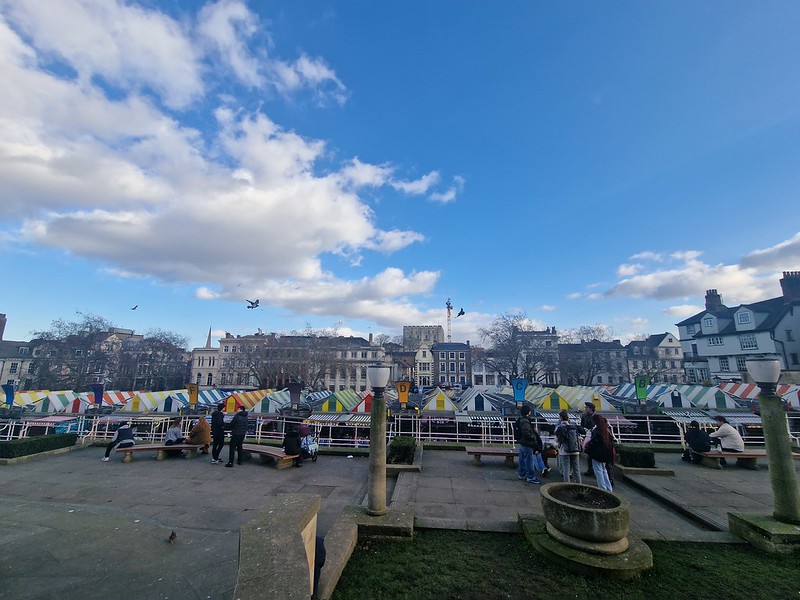
    I haven’t paid much attention to Norwich Market in the past, for no obvious reason than I’m not sure I realised how wide a choice of food and drink they had there (to be fair, it’s near Grosvenor and so I hadn’t realised I needed to go elsewhere). Having meandered around the various chip stalls over recent weeks, I thought I’d pop to Banger Stop today.

    The city’s market has been in its current location for 900 years, which is a fair run I think it’s reasonable to say. George Plunkett has a photo of the market from 1939, not long before the war broke out, and Banger Stop is located roughly where the group of three people are in the photo.

    As someone who gets confused by too many options being available, I quite liked the precision here with the choices marked on the boards of:

    (i) The Classic – pork sausage with cheese, onion and homemade ketchup (£3.50)

    (ii) The Chilli Dog – as above, but with chilli sauce (£3.50)

    (iii) The Plain – just the sausage and onions (£3)

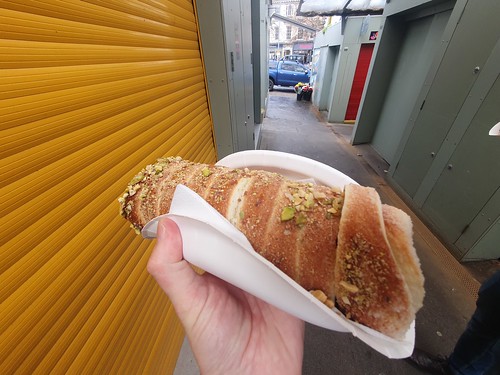
    There was a nice welcome, and I didn’t struggle to decide to go for the chilli dog, although I was initially concerned about how much of it I’d manage to drop on myself. Fortunately, some forward planning has taken place here with the packaging with the provision of a little box surround for the hot dog to avoid unnecessary spillages. I was charged £3, perhaps because I didn’t need any cheese, and the stall accepts cards which is rather handy. Everything was also clean and organised, especially important during these challenging times….

    I thought it was all entirely acceptable and sufficiently filling, the sausage is made just for this stall on the market and isn’t bought in, it was also hot without burning me. The red pepper chilli sauce wasn’t particularly hot in terms of spice, but added some texture to the arrangement and onions also bring a little extra taste. Definitely all rather lovely, and it’s worth having a little hunt for within the market.

  • Norwich – Thomas Want Abandoning His Family

    Norwich – Thomas Want Abandoning His Family

    200 years ago this week, the Norfolk Chronicle published a story about about how Thomas Want, a former school master in Norwich, had cleared off and left his wife and four children. This was certainly a problem as far as the city was concerned, as the Corporation would now have to fund these children and I can’t imagine they’d have been thrilled at that thought. So, the hunt for him started, and it appears that he had run off with this woman who had a hawker’s licence.

    I like a story and so I wanted to know more about this little arrangement, although the documentary chain of evidence was always going to be a little limited. Thomas had married Frances Oldman in St. Stephen’s Church in Norwich (the one in front of the Chantry shopping centre with a path leading to it through the graveyard) on 3 June 1806, so they had been married for fifteen years.

    Francis Arthur Want was born on 24 July 1810 and baptised on 17 August 1810 at St. Stephen’s Church. Frances Lucinda Want was born on 10 November 1811 and baptised on 17 November 1811, this time at St. George Colegate Church. Jane Pearcy Want was born on 21 June 1816 and baptised on 30 June 1816, this time at St. Martin at Palace Church. There should be another child, since the newspaper mentioned he had left four, but I can’t find details of that, although I imagine they were born some time around 1814.

    Francis Arthur Want married and became a railway station master in Burton upon Trent in Staffordshire, with none of his children being named after Thomas. Frances Lucinda Want never married, going to work as a servant cook, she died in Middlesex in February 1894. Jane Pearcy Want married Robert Newman in Cromer on 4 October 1841 and they lived in the town, with none of their children being named after Thomas. It is this lack of naming their children after Thomas that makes me suspect that the children didn’t have a great deal of respect for their father.

    Moving back to Thomas’s wife, Frances. There are no suitable candidates showing on the 1841 census, so I’m fairly sure she died before then. And there is a burial of a Frances Want at Old Lakenham Church in Norwich on 26 August 1822 and I’m going to assume that this was the wife that Thomas left behind. She died just a year after her husband left her and, perhaps not unsurprisingly, I can’t find any record of a gravestone. I can’t imagine that anyone would have had any money to pay for one.

    Back to Thomas, he was 42 when he went missing, so he was a fair bit older than Frances, having been born in around 1779. He was a schoolmaster from at least 1812 to 1815 at the academy on St. George’s Plain which was a boarding school for young gentlemen. As for his death, the only one I can find that fits anywhere in the country is the Thomas Want who was buried in Norwich on 17 September 1844. I have yet to discover what happened to Thomas after he went off with this woman with her hawker’s licence, but I don’t feel that he ever went back and his voyage of passion will perhaps remain a mystery to history.

  • Norwich – Thomas Edgar Stealing from the Coach and Horses

    Norwich – Thomas Edgar Stealing from the Coach and Horses

    Continuing with my theme of events that happened 150 years ago today, the Norfolk Chronicle reported in late February 1871 that Thomas Edgar had been charged and tried for the theft of a scarf from the Coach and Horses pub on Red Lion Street whilst the owner was playing skittles. I’d never realised that pub existed and it suggests an answer to a question I had of whether skittles was commonly played in Norwich in the past.

    Anyway, back to the details of the court case, although this was just the first hearing. Thomas Edgar, who lived at Crook’s Place (that unfortunate fact isn’t lost on me…..), visited the Coach and Horses pub and I suspect he didn’t plan any nefarious activity when he arrived. However, Frederick Leech (named as William Frederick Leach in another newspaper) who lived at Oxford Street, located off Unthank Road, had arrived with his expensive cashmere scarf. I’ve got a picture in my mind of what I imagine he was like, but others can draw their own mental image here….. Leech was enjoying a game of skittles and had placed his scarf neatly on his hat and put that on a table. After a while of enjoying his game of skittles (the paper didn’t mention the score) he realised that his scarf had gone missing and he then saw Edgar rushing out of the pub looking suspicious. Leech left the pub and tried to follow Edgar, but lost him and so he contacted the police. The police rushed out and found Edgar and the missing scarf at Crook’s Place, which sounds some rather excellent detective work. Edgar’s defence was that he was drunk, which doesn’t seem unreasonable as far as excuses go.

    For some more information about this, I had to jump forwards a month to late March 1871 when the full trial took place. More details came out, including that Edgar had offered to look after the hat and scarf, which doesn’t seem to be a very subtle way of pinching something. The detective work from the police was explained, a police officer and a man called Piggin had followed Edgar to his home and this wasn’t some brilliant piece of guesswork. Edgar’s defence was accepted, which was that he was so drunk he didn’t know what he was doing. These were ferocious times in terms of sentencing though, and when Edgar was found guilty, he was sent to prison with hard labour for six months. The additional reporting also noted that Leech (or Leach) was an ironmonger and Thomas Edgar was aged 21.

    Rolling back a little here, the pub itself, the Coach and Horses. This was located at 3 Red Lion Street and it’s still there today, although it’s now a Bella Italia having ceased being a public house in around 1984. The building was constructed by the brewery at the beginning of the twentieth century, on the site of an older building and the one where Edgar pinched the scarf from. And we also know that the pub had a skittle alley judging from the events of that night, and it also had a three dimensional bas relief panel by notable local artist John Moray-Smith. That is now sadly lost, although there’s one of his works remaining at the nearby Woolpack pub.

    Back to Thomas Edgar though. He was born in 1849, the son of Matthias Edgar and Mary Ann Edgar and at the 1861 census he had four older brothers and sisters. Mary Ann was from Devon and the two oldest children had been born in Plymouth, but Thomas was born in Norwich. The family at this stage lived at 44 King Street (probably not where most people would think this was, but more on this in a moment) and Matthias worked as a brush maker.

    The 1871 census isn’t entirely helpful about where he lived, since he was in the city gaol, which was at that time at the end of Earlham Road (or St. Giles’s Street at the time, before a bloody great road was built at Grapes Hill orphaning the end of it), which is now the site of the Roman Catholic Cathedral.

    We do know from the newspaper that he had been living at Crook’s Yard and this is where things got a little confusing for me, as I’ve now discovered that there were two King Streets in Norwich at that time. Not the Upper King Street and King Street that we have today, which are still really the same road. Some bloody idiot had built a King Street and a Queen Street (ignoring the fact that these street names already existed) near to where the Norfolk & Norwich Hospital was located in the city centre. This clearly caused complete confusion at the time as records from the time are all over the place, but wiser heads prevailed and King Street was renamed Shadwell Street and Queen Street was renamed Nicholas Street. In the above map, Crook’s Yard (or Crook’s Place) is the road leading off from the right. It’s possible that this name confusion meant that Thomas was still living with his parents at this time on King Street.

    At the 1881 census, Thomas was living with his mother at 44 King Street and he was working as a waiter. By 1901, Thomas was now married and living (alone, for reasons unknown if he was married) at 86 Shadwell Street and was working as a fruit-seller. Thomas died in the city in 1910, at the age of 61, and there is no mention of his death in the local press. At a guess, 44 King Street and 86 Shadwell Street were probably the same house, but either way, they would have been demolished after the Second World War.

    But, the element of all this that I quite like is the thought of the atmosphere in the Coach and Horses in the city 150 years ago. I’m not sure that skittles is played much anywhere, not least because it’s quite space consuming, but there’s an equivalence with bar billiards. And I can imagine a similar set of circumstances playing out, someone leaving their expensive cashmere scarf out (and I can think of a couple of friends who would turn up at the pub with something like that….) and finding that it was stolen. Thomas Edgar doesn’t seem to have been a particularly bad person, he certainly didn’t have a long life of crime after this incident. And I’ve tried to work out the route that he would have taken from the pub back to his house (I bet he went down St. Stephen’s, walking by where there is a Greggs today), perhaps testament to the reality that I need to get out more.

  • Norwich – William Rudling (the thieving butcher)

    Norwich – William Rudling (the thieving butcher)

    I’d add firstly that this isn’t some angry blog post about being short changed on a sausage roll, this is a story from the Norfolk Chronicle that was published 150 years ago today, in late February 1871.

    The newspaper noted that William Rudling was a butcher on Ber Street and he had rigged his scales to short-change customers. Samuel Sutton, the Inspector of Weights and Measures, had visited his shop and noticed that a piece of iron wire had been attached to the scales which found half an ounce against the purchaser. A second test was performed and the scales were still out, although now they were an ounce out.

    The case was heard at the Guildhall in the city and William decided that he wouldn’t turn up and instead he sent his wife Charlotte to deal with the matter. I can imagine she was really pleased with this little arrangement, although she then didn’t say anything in court, so that might not have gone to plan. With that lack of defence, William was fined £1 (something like £60 in today’s money) and was also ordered to pay costs of just over £1.

    At the 1871 census (which took place shortly after this, at the beginning of April 1871) William Rudling lived above his shop on Ber Street with his wife Charlotte, and his children, Charlotte, Elizabeth, Esther, Thomas and Emma, along with their grand-child Alice. At this time, both William and his wife were aged 53.

    Going back ten years to the 1861 census, the family lived at the same property on Ber Street, with the children William, Henry, Emma, Charlotte, Elizabeth, Esther, Alice and Thomas living with them, along with a servant, Sophia Poll. At this 1861 census William was listed as being a carpenter and builder, so his butchery skills were perhaps acquired after that, and he had also been listed in the 1851 census as living as Ber Street and working as a carpenter. As an aside, the younger William Rudling had taken up an apprenticeship as a stone mason which he ran off from on 12 April 1865. At the magistrates court it was decided that the matter would be dropped as the young William said that he would return to complete his apprenticeship.

    At the 1881 census, the household was rather quieter, it was just William and Charlotte, along with an Elizabeth Osborne who was listed as a companion. The husband and wife were now living at 4 Horns Lane in the city, with William being described as a carpenter again. Horns Lane is still a street in Norwich and it’s located off of Ber Street, so William didn’t really move very far in his lifetime. The property has gone though, the area was flattened by the council and the area is mostly now a car park.

    WIlliam died on 26 October 1890, and he died at the age of 73 having been born in 1817. His death was reported in the local paper, the Eastern Daily Press, and he was now living at 10 Horns Lane.

    Unfortunately, none of the trade directories tell me exactly where on Ber Street that William had his shop, but what I’m interested in is why he suddenly became a butcher. I’m guessing that he wasn’t perhaps doing very well, which is why he was sent to court for defrauding customers. There was in the 1860s a large increase in the demand for meat, with more people entering the butchery trade, so perhaps William was tempted by the financial rewards. I can’t imagine that some of the locals were too impressed after the court case, that might be the reason that William returned to carpentry.

    And would this sort of behaviour happen today? Indeed it would, as just two days ago there was a butcher in Willenhall, the Muddy Pig Butchers, where it was found that coins had been attached to the scales to short change customers by 40g. That’s about 1.4 ounces, so only marginally more than William defrauded his customers. This butcher in Willenhall was treated more severely than William though, he was ordered to pay costs totalling £1,798 and given an 18-month community order of 200 hours of unpaid work..

    Nothing ever really changes….