
Blog

  • 2022 US Trip – Day 1 (Getting to Heathrow T5)

    2022 US Trip – Day 1 (Getting to Heathrow T5)

    Well, we’re off (I say we, it’s just me on this trip) and the first part of the expedition was getting to Heathrow T5. Luckily my ever-ready friend Liam was willing to take me to Heathrow T5, avoiding a potentially expensive hotel which I would have only been in for a short period of time.

    20220918_021643

    As Liam has an electric car we had to factor a couple of charging points, with the first meant to be at Harlow. However, a horde of taxi drivers (is that the correct name?) were using the facilities and we would have been quite some time waiting for them. They’re not in the photo, I didn’t want to look rude by taking a photo of them. There seem to be ever more electric charging points being added to the network, but it’s still not comprehensive coverage and there’s little protection from a queue of taxi drivers wanting to use them.

    20220918_023734

    We drove on a bit and found what seemed a slightly ridiculous set-up at a business park which seemed in the dark to be in the middle of nowhere. I’m sure it’s very vibrant in the day, but it felt rather shady at night.

    20220918_025303

    Car charging doesn’t get any more decadent than this. Parking is free on Sunday, so I got a ticket printed from the machine in case we were meant to have one. I didn’t expect to see a parking attendant though at this time of the morning.

    20220918_034844

    All was going very well, Liam’s had checked the app of where people were charging and that saw us glide into our second location at Gerrards Cross in Buckinghamshire. He went off to get a coffee for £1, a perk that you get when charging cars at BP petrol stations it seems. After 25 minutes or so, we were good to to.

    20220918_043210

    Heathrow annoys me, it doesn’t let you walk in, it has scrapped the free travel zone and it now charges for drop offs. Far from ideal, but they do at least allow free drop-offs at the long-stay car parking. You get 29 minutes to park there for free, with buses operating every ten minutes or so. Liam, who built some of Heathrow T5, was pleased to see that this is on the site of his former works car park. I did wonder where to get the bus from at first, then Liam realised that it was the huge big bus shelter at the entrance to the car park, which is a very sensible place to put it.

    20220918_043213

    I was busy taking photos having just got to the bus stop when I realised that the bus to T5 was coming to the stop, Liam had timed the drop-off perfectly. So, it’s quite a blurry photo, but the driver had a big smile and seemed unnervingly content for 04:30 in the morning.

    20220918_043339

    It’s only a five minute or so journey on the bus to Heathrow T5, so in terms of drop-offs, it is convenient and saves paying the £5 fee.

    20220918_043500

    Some professional signage there. But the service was timely, the bus was clean and it’s fast and efficient, so definitely worth considering for those who want to avoid the Heathrow drop-off charges. I’m not sure if you’re meant to, but you could actually just avoid paying for the TFL bus into Heathrow T5 and just get on this bus from the long-stay car park.

    20220918_043943

    My obligatory “welcome to our home” photo, which has again come out blurry. I didn’t get the sleep that I had hoped for, which is also not ideal, but I’ll muddle on by. I’m not going directly to the United States, that’s not until tomorrow, I’m first going to Dublin.

    20220918_045354

    Heathrow is commemorating HM Queen Elizabeth II in numerous ways, including on these large signs.

    Timing wise, this was all rather lovely, the security process took around twelve minutes and I arrived at the entrance to the lounge one minute before it opened at 05:00. Liam is getting very good at this timing thing (he has been known to cut things far too fine) and it was very kind of him to do the dropping off. Hopefully he has good fortune using the chargers on his way back to Norwich.

  • 2022 US Trip – Day 1 (BA Galleries South Lounge Heathrow T5)

    2022 US Trip – Day 1 (BA Galleries South Lounge Heathrow T5)

    Liam’s impressive timing meant that I got to the airport at a perfect time, not too early (my usual style) and not too late (his usual style). I arrived at the Heathrow T5 BA lounge complex at 04:59, one minute before it opened. Very handy.

    20220918_050200

    I was the first person into Galleries South lounge, that’s never happened before. I can’t claim it’s something that I should get a badge for, but it did let me get some photos without other passengers cluttering them up. This is the main food area in this photo where they were laying out breakfast.

    20220918_050202

    One of the seating areas, this one is just behind where passengers enter the lounge. These lounges do sprawl and there are three of these Galleries Lounges for BA customers at T5, two in the main terminal and one at B Gates (plus the First Class Lounge and the Concorde Room, which are too decadent for me).

    20220918_050227

    The seating area at the end of the lounge which overlooks south security, with the cinema room off to the right.

    20220918_050235

    And my favourite seating area, high chairs and power points, very convenient for my laptop arrangement.

    20220918_050544

    Another photo at the back of the lounge. You used to be able to overlook security until they put that sea of grey over the windows, which is understandable, but I did used to like watching it.

    20220918_050551

    One of the coffee stations and sets of beer fridges, where I was pleased to see that Brewdog Jet Stream was available. I had a few espressos to wake me up, although I’m not sure that they worked that well.

    20220918_050558

    The cinema room.

    20220918_050757

    I only had one beer as it was a bit early. I was pleased to see that the lounge had burnt the bacon, which is good as that’s just how I like it. Those sausage patties are very moreish as well. The BA food offering has definitely improved recently at this lounge (and non burnt bacon was also available).

    20220918_055703

    Some healthy eating. Along with some grapes.

    Anyway, my three hours in the lounge was very productive, although I was a little sleepy. The lounge was starting to get very busy when I left, so I was pleased with my timing.

    20220918_074132

    I’ve photographed this before, but it’s just an iconic image and so I thought I’d have another image of it.

  • Tuesday – The Bulmer Stone – Darlington’s Oldest Landmark (Part Four)

    Tuesday – The Bulmer Stone – Darlington’s Oldest Landmark (Part Four)

    20220823_175947

    As some bonus footage, or whatever anyone would like to call it, I felt the need to mention the Bulmer Stone located on Northgate. This is named after Willy Bulmer, a former Borough Crier, who would shout the latest news and gossip out all about Darlington. Apparently it used to be said in the town that “no other town or city in the world has a more ancient monument in its midst”, which is certainly an aspirational statement for this rock. It’s a bit hidden away behind the railings, but to the town, it is an important lump of granite. I don’t think there’s any legend along the lines of “if the rock is stolen, then the town’s market falls down”, but perhaps there should be to add some extra intrigue to it.

    20220823_175951

    And the nearby information board. It’s recommended (by me) to have a quick look at it, but I wouldn’t take kids there for a day out or anything.

    [NB, the rest of this ‘riveting’ series of posts will be continued in 2023, as the US trip posts will have take priority. I hope that my loyal reader(s) aren’t too disappointed]

  • Tuesday – Quick Visit to Bishop Auckland (Part Three)

    Tuesday – Quick Visit to Bishop Auckland (Part Three)

    20220823_151521

    Setting off from Shildon railway station after my visit to the Locomotion museum, which has been here since 1825 and its siting here led to a great expansion of the village during the nineteenth century. Unfortunately, there’s not much here in terms of station infrastructure, even slow and steady improvements over just under 200 years should have seen more facilities. The nearby museum has though helped usage of the station and that is likely to increase from the expansion of Locomotion.

    20220823_151645

    It’s a short rail journey into Bishop Auckland along the route of a line which is also original from the beginnings of the Stockton & Darlington Railway.

    20220823_153218

    I don’t think that I’ve visited Bishop Auckland before and the main street from the railway station didn’t look anything particularly exciting, but then this rather grand and lovely market square appeared into view.

    20220823_163754

    I thought as though I might as well pop into the JD Wetherspoon, the Stanley Jefferson. I clearly don’t know my comedy history as I assumed that this was some Victorian benefactor to the town, but instead:

    “The Laurel Room, in Bishop Auckland Town Hall, is named after Stan Laurel. Born Stanley Jefferson, Stan Laurel is better known as the thin half of the famous double-act Laurel and Hardy. Stan’s parents managed the town’s Theatre Royal. Stan was christened here and, in 1903, attended the grammar school.”

    20220823_154823

    Not overly decadent, but entirely satisfactory and there were also numerous power points to keep my devices charged. I seem to focus too much on that, but I can’t be one of those care-free people in life who wouldn’t collapse into a state of nervous tension if their phone died.

    The pub seems well reviewed, but of course not everyone is surprised and delighted. I liked this one:

    “4 Regular Real Ale enthusiasts Abbott Ale being our favourite. Today, no Abbott next choice 2 were pulled then off. Next choice also off. When we questioned it we were told “Well we don’t sell much Real Ale on weekends it’s mostly SHOTS ” !!!. What a load of insulting rubbish!!”

    I make no comment on Abbot Ale as that would be cheap, but I was amused about the “on weekends it’s mostly shots”. I know a pub that was run like that…. Ah for the days of selling Apple Sourz.

    20220823_164044

    St. Anne’s Church which is Grade II listed, but is relatively late for a town’s main church, with the building having been designed by William Thompson and dating from between 1846 and 1848. It was though built on the site of a former medieval chapel, but it’s not currently in good shape and is on the Heritage at Risk Register. It received funding a few years ago from the National Lottery Heritage Fund and Historic England but another project is needed to secure the building.

    20220823_164109

    The town’s war memorial, which was moved a few years ago from its previous location on Station Approach.

    20220823_164120

    A line was added in 1982 to note the Falkland Islands war. It’s a beautiful monument and in a nice area of the town, although those steps could do with a bit of tidying up.

    20220823_164128

    Auckland Tower, which I had though was something to do with the fire service, but it’s actually a 29 metre high viewing tower. It was designed by Nìall McLaughlin and is meant to look modern but also to reflect the design of historic buildings. It has sweeping views over the castle and the Wetherspoons.

    20220823_164152

    The town grew up from when in 1183 the Prince Bishops of Durham built their country retreat here, which later became Auckland Castle.

    20220823_164211

    The entrance to the gateway, this area certainly feels salubrious.

    20220823_164250

    The gateway from outside.

    20220823_164310

    And a nearly identical photo of the gateway, this time taken from within the castle estate. The gateway was constructed in 1760 and was designed by Sir Thomas Robinson of Rokeby for Bishop William Trevor.

    20220823_164314

    A rather glorious building, I can’t say I’ve seen one which has combined building materials like this.

    20220823_164539

    One of the external walls to the castle.

    20220823_164509

    And the reason I took the previous photo is that this interesting heritage board shows what they discovered on this site during recent archaeological digs.

    20220823_164430

    Looking over to the gardens.

    20220823_164604

    The entrance to the castle, which is open to the public during the day and there’s plenty to see during a visit looking at their web-site. If I come back to Bishop Auckland, I think I’d like to look around these buildings. I understand that the town feels it needs a major economic boost and it’s trying to create something of a tourist attraction of this castle, and other projects such as the aforementioned viewing tower and the gardens. They are aiming to encourage people to stay for a couple of days, rather than just briefly popping to the town. So, in short, trying to get people not to do what I did. The castle is still owned by the church and they use part of the site as offices.

    20220823_165340

    Back in the market square and I was slightly surprised seeing such a grand building being used by Sports Direct (not that there’s anything wrong with that, but in a wealthier town it would likely by tea rooms or something). There were a fair few empty shops in the town and it didn’t have a vibrant atmosphere, despite all of the heritage and history all around.

    20220823_165928

    Bondgate, a quaint street which is more what I’d expect from a provincial town and this was once the retail heart of Bishop Auckland. Shops down here are mostly independent retailers, similar to The Lanes in Norwich, something a little different from the usual number of chains.

    20220823_170246

    Back on Newgate Street, walking back to the railway station.

    20220823_170404

    I was rather taken by this building (not Heron Foods, but the former Lloyds) and it would probably make an interesting place to live, especially if there’s access to the bank’s former vault.

    20220823_170419

    The number of shops to let is visible in this photo, there were probably around twenty along Newgate Street.

    20220823_171305

    The town’s railway station (not Halfords, the building in the middle of the photo) which was opened in the 1980s after they had demolished the previous one. It was (in my view at least) yet another sad chapter in the history of British Rail, the demolition of a grand 1867 railway station to be replaced with a completely inadequate replacement. There are lots of photos of the old station, which is buried underneath Halfords and the other retail units, at http://disused-stations.org.uk/b/bishop_auckland/index.shtml.

    20220823_171420

    The inadequate station is open for limited hours and for the rest of the time, passengers have to walk around the side to get access to the platforms.

    20220823_171501

    The end of the line for the rail network, although the line continues on for 18 miles to Eastgate station as a heritage railway set-up. It closed long ago for passengers, in 1953, but freight services continued until 1992 which is why the line wasn’t entirely lost. Full credit for the heritage railway keeping it open, but this should ideally be opened to passenger services once again, and that has been suggested as part of the Government’s Restoring the Railways project. As it’s a very marginal constituency, it has a decent chance and I understand funding has been made available for a feasibility study.

    20220823_172551

    With that the train to Darlington came in, another efficient Northern service. I had enjoyed Bishop Auckland, but I had expected it to be wealthier and not have quite so many empty retail units. However, they clearly have lots of exciting plans for tourists and I’d like to spend longer in the town.

    20220823_180629

    Back in Darlington, ready for another peaceful night in the Mercure with the drinks in my little fridge being handily restocked again. And I got to use my welcome drink on a free Extra Smooth Ale from John Smith’s, albeit a little belatedly. How lovely (well, quite lovely in terms of the drink).

  • 2022 US Trip – Day 0 (McCain Backpack)

    2022 US Trip – Day 0 (McCain Backpack)

    I’m now packed and waiting for Liam who has kindly offered (or been commandeered, pick your favourite) to take me to Heathrow just after midnight. To save the £5 drop-off fee we’ll have to work out the free long-stay parking option at the airport, that’ll be an interesting challenge in the middle of the night. I could have done with more sleep as well, but we can’t have everything.

    So that we start on random drivel, I felt I should have one post about my McCain backpack, because at some point it’ll be nicked, accidentally destroyed or something else I might not like. I’ve worked out that it has been to around 30 countries, over 30 US states and I think nearly every county in the UK. It’s also made an appearance on just about every long-distance walk that I’ve done, so it’s a very well travelled bag. Bits keep falling off it, the zip is glued shut as it got broken (there’s another way in obviously) and it’ll probably fall apart in the next few years. But for the moment, I’m sticking with it. Although it regularly gets washed, it looks a bloody mess, but who wants decadent matching luggage anyway?

    Bag aside, this will be an interesting trip, which goes via Dublin, as parts of it have already been troublesome in terms of needing to reschedule things (not least Amtrak who have amended, cancelled and refunded numerous trips I had booked) and half of it isn’t planned now. There are also rather cheaper Airbnbs making an appearance due to the horrendous pound and dollar exchange rate, meaning ever cost cutting measures. But over-planning is never good for the soul and I’m sure that nothing could possibly go wrong….

    There might be a lot of posts over the next few weeks, I’ll do more shorter posts otherwise I’ll never catch up, so those people who subscribe to individual posts might want to switch them to the daily summary versions. Unless they like receiving exciting blog updates like the story of a bag.

  • Tuesday – Second Railway Museum of the Day, Locomotion at Shildon (Part Two)

    Tuesday – Second Railway Museum of the Day, Locomotion at Shildon (Part Two)

    One railway museum is likely enough for one day, but in addition to visiting the Head of Steam in Darlington, it seemed worthwhile to get off the train en route to Bishop Auckland to have a look around the Locomotion museum. This name change confused me slightly (actually quite a lot), I thought that it was known as the National Railway Museum at Shildon, which seems rather more appropriate to me, but there we go. There are more photos at https://flickr.com/photos/julianwhite-uk/albums/72177720302071941 should anyone be catatonically bored.

    Shildon Railway Museum

    It’s a short walk along the track (not literally along it, there’s a path to the side) from Shildon railway station to the museum and I thought I’d visit for an hour before catching the next train that would take me to Bishop Auckland.

    Shildon Railway Museum

    The museum, opened by the then local MP and Prime Minister Tony Blair in 2004. They’re undergoing a large modernisation project which will see more exhibition space given how popular the museum has become. I very much like how easy it is to access by rail and as part of the modernisation project they’re restoring some of the other station buildings. There’s more about this project at https://www.locomotion.org.uk/about-us/our-future-vision-2025.

    Shildon Railway Museum

    At the moment the museum is effectively a large shed full of locomotives, carriages and some other related items. They have very few smaller items relating to railway history, they’re mostly at the National Railway Museum in York.

    Shildon Railway Museum

    This is Lyon, the Hetton colliery locomotive, although I feel that I’ve introduced it as if it’s something from Thomas the Tank Engine. It was probably built in 1852 and improved a bit in 1882 when they rebuilt it, remaining in service until the early twentieth century. It was an important part of the 1925 centenary of the Stockton and Darlington Railway, an event organised by LNER, but I think they thought at the time that it was older than it was. The museum is hedging its bets by having both dates on there, the 1820s and the 1850s, with a possibility that this is a genuine George Stephenson locomotive.

    Shildon Railway Museum

    A Maglev railway car from 1984 which glided from Birmingham International Airport to Birmingham Exhibition Centre and it’s hard to think of anywhere more glamorous that they could have installed it. Quite excitingly, this was the first Maglev railway in the world, although it was a bit rickety and expensive to repair so they decommissioned it in 1995. As an aside, I’ve been on the Shanghai Maglev train, which is quite phenomenal at 268 mph (431 kmph) and is so fast that by the time it reaches full speed it has to start slowing down again. If that train fell off the track, it would launch itself hundreds of metres away. Well, that’s my best guess, I’m not an engineer to make such calculations, but as a journey I remember it being very smooth. I digress though, I don’t think the Birmingham one went as quickly.

    Shildon Railway Museum

    I hadn’t planned to take so many photos, although that is usually the case, but there were plenty of shiny things to distract me in the museum. This is a Waterloo & City carriage from when the line opened in 1898, which is handily my favourite London Underground line. This carriage was constructed in Woolwich by Siemens Brothers, relations of the founders of the German company. It remained in use on the line until May 1968 and it was only retired then because of electrical burnout. It then apparently went to Brighton, for reasons I’m unaware of but perhaps they just thought it deserved a little holiday, before becoming part of the national railway collection.

    Shildon Railway Museum

    Here’s a nice red fire engine, dating from 1880 and this was used by the staff at Gateshead Railway Works.

    Shildon Railway Museum

    Composite 31, which sounds like a discussion point at Labour’s party conference, dates from 1846 and there’s a first and second class section. The board notes that anyone in third class would have a much worse journey, as the carriage often didn’t have a roof, didn’t have seats and was packed full of people. Perhaps I won’t moan quite so much when Greater Anglia put the Stansted Express rolling stock on the London to Norwich mainline. Although I probably will.

    Shildon Railway Museum

    Timothy Hackworth, who lived locally and who was important in building the local railway (more at https://en.wikipedia.org/wiki/Timothy_Hackworth), with what is left of his Sans Pareil original locomotive. This was presented to the Patent Office Museum in 1864, which in turn became the Science Museum and then it went to the National Railway Museum. It’s interesting how these things evolve, there was a lack of foresight in creating a national railway museum in the late nineteenth century and they were partly inspired by Nuremberg’s railway museum which had just opened. GWR got bored of waiting and after having saved their early North Star locomotive for display, they instead cut it up in 1906. They realised this wasn’t ideal when a museum opened, so in 1925 they stuck some bits of the original they found back together as part of a replica. That replica is now in the Great Western Railway museum in Swindon and I can’t remember if I even knew there was such a thing, but I now want to go there.

    Shildon Railway Museum

    A prettier version of Sans Pareil, a replica which shows how colourful the original might have been. The locomotive means “without equal” and the original dates from 1829 whilst the replica is from 1980.

    Shildon Railway Museum

    A good old Intercity branded British Railways Mark 1 carriage, although it dates from 1964 which predates that branding.

    Shildon Railway Museum

    I don’t like corridor trains and I’m glad British Rail got rid of them and there aren’t any on services today in the UK (other than on heritage, preservation and private railways). They still have them in some European countries, including Poland and Ukraine, although I think they’re being phased out in Poland. I think the Ukrainians are busy with other things at the moment to be fair.

    Shildon Railway Museum

    This is an early tilting train, the APT-E (Advanced Passenger Train Experimental) produced in 1972. ASLEF were horrified at it and their drivers were banned from using it. British Rail decided they’d test it for a few years, which they did and in 1976 they sent it to the National Railway Museum for preservation. But, they didn’t stop there and didn’t give up, the engineers then developed APT-P (Advanced Passenger Train Prototype) which was tested until the mid 1980s when it was scrapped due to a lack of money in British Rail. They did sell some of their technology to Fiat Ferroviaria for use in their development of the Pendolino train, so we helpfully supported another country’s tilting train technology.

    Shildon Railway Museum

    TC (Trailer Car) which was attached to the APT-E, more of which at http://www.apt-e.org/onthemove/tc2.htm.

    Shildon Railway Museum

    I mentioned that earlier in the day I had been to the Head of Seam Museum at Darlington North Road railway station and there was some sadness when they lost the Locomotion No. 1 locomotive which had been there between 1975 and 2021. I thought it was a little unnecessary of this museum to call it back from loan so they could put it on display here, as they’ve got rather enough trains of their own to play with. It did though mean I still got to see this early steam locomotive which was built by George Stephenson and Robert Stephenson in 1825. It’s heavily restored now (I often wonder how much of the original I’m ever looking at with these things), but some bits of it are original and from when it pulled the first train on the Stockton and Darlington Railway, making it the first locomotive on a public railway anywhere in the world. I think that’s some claim to fame. It sped along at 15 mph, which I think is about the speed that the Greater Anglia train manages on the East Suffolk line today.

    Shildon Railway Museum

    I was of course impressed at this historic piece of metal, but the museum has just placed it amongst their other trains and I don’t think they’ve made much of it. The Locomotion museum seemingly upset a fair few residents of Darlington over this and they’ve promised to lend it back to the Head of Steam museum in the run-up to 2025 when it’s 200 years old. Anyway, enough of my stirring up a local argument about where to store an old train….

    Shildon Railway Museum

    As it was very hot, yet again, I decided to go to the museum’s cafe where they have reclaimed train seats to get a Feast. Such decadence….

    Anyway, I very much enjoyed this museum, although I only had less than an hour there, although that was enough to see a good selection of locomotives and other exhibits. There’s no admission charge, a policy in common with the Science Museum and the National Railway Museum, so that was a bonus. I took far more photos than I had expected and there was certainly enough to see to make a visit last a couple of hours. BTW, the Feast was delicious if anyone wondered.

  • Monday – Former JD Wetherspoon in Middlesbrough and Meander Back to Darlington (Part Two)

    Monday – Former JD Wetherspoon in Middlesbrough and Meander Back to Darlington (Part Two)

    20220822_135717

    After a lingering visit at one of the craft beer bars in Middlesbrough, I thought I might as well tick off the second JD Wetherspoon outlet in the town, which is the Swatters Carr. One again, I’ll pinch the pub’s history from their web-site:

    “This has been a public house for more than a century. Mostly, the three-storey building (which extends along Victoria Road) was the Empire (not to be confused with the nearby Empire Theatre – now a nightclub). The Empire was originally named the Empire Hotel. The building is recorded in the 1891 census as the Swatters Carr Hotel Public House – Swatters (or Swathers) Carr after the isolated farmhouse, first recorded on a map dated 1618.”

    20220822_135743

    Something of an art installation with some history, I thought that this was suitably quirky. The pub is one of the better reviewed pubs in the JD Wetherspoon chain and I thought it seemed well managed and organised. It’s a large venue, but it was clean, comfortable and peaceful. My laptop and I were quite content here for some time.

    20220822_140136

    I was pleased to see that the pub had Plum Porter from Titanic Brewery on, so I had a half of that for not much more than £1. I made another mental note to go and visit some pubs owned by Titanic, mostly around the Stoke area, perhaps I’ll do that in 2024.

    20220822_152628

    This enormous building was opened in July 1923 as the Elite Cinema, designed by James Forbes and with 1,900 seats. As with so many other cinemas, it couldn’t sustain sufficient trade in the 1980s and it was converted into the Crown Bingo Hall. That didn’t last long and it was turned into a pub in 1996 and I can only imagine that JD Wetherspoon had a think about getting involved, but it later on became operated by Stonegate as the Crown pub. They rather abandoned it in January 2015 by flogging it off to a property developer and it has been slowly falling into dereliction over recent years. The council is currently making warning noises that they’ll compulsorily purchase it if nothing is done soon, which seems the most sensible plan. At least the council are suggesting that they won’t countenance its demolition, which is perhaps what the property developers had hoped would happen. Urban explorers visited the building a couple of years ago, there’s a lot worth saving but it’ll cost a fortune to fix that up. I trust that no little incidents will happen to the building which would justify it being demolished.

    20220822_161502

    The former Masham Hotel and what a beautiful frontage for a building, although sadly it’s no longer a pub. The former nineteenth century pub closed a couple of decades ago and was initially turned into shops and is now in use as an office.

    20220822_161540

    The same pub company and a not dissimilar frontage to the Masham (not least as it was done by the same designers, Kitching and Lee in the 1920s), with a similar fate of this no longer being a pub. It’s a little sad, but this one closed its doors as a licensed premises in the late 1990s, although there has been talk of giving it another go as a pub. I hope they do, it just feels like a pub with character.

    20220822_170415

    I was quite intrigued by the Isaac Wilson pub for a number of reasons, it’s a converted courthouse built in 1901 on the site of a Quaker burial ground, which is also named after a Quaker who opposed drinking. I bet he’d be thrilled. It’s also a former JD Wetherspoon pub and they closed it in 2017 and sold it to another company.

    20220822_161903

    20220822_161853

    20220822_163759

    20220822_170124

    20220822_170130

    What I was a little surprised by is that the new owners have effectively just kept running it in exactly the same way, so even five years later it looks the same as it did other than there’s now a pool table and darts board. I can’t complain about that, if I took over a former JD Wetherspoon pub, I’d do the minimum possible, just paint out the old signs and leave everything else. So the signage, tables, carpet, bar and even pictures are unchanged. The new operator is Tees Inns, who also operate the former JD Wetherspoon King Johns Tavern pub in Hartlepool.

    20220822_161913

    The pub had maintained low prices and I went for half a pint of the York Chocolate Stout from Rudgate Brewery, a reliable beer which was well kept. The team member was friendly, politely querying why I was ordering halves, but he was satisfied with my answer that it lets me visit twice the number of pubs. I can’t say that I struggled to find a table, but to be fair, late Monday afternoons aren’t really the peak trading time for pubs.

    20220822_170516

    The frontage of the railway station, currently undergoing what looks like quite a restoration.

    20220822_170725

    This feels like a proper railway station, it almost felt like a castle in the tunnels under the platforms.

    20220822_170821

    I did comment yesterday on the random foliage on the platform, but to be fair, they have made a big effort elsewhere in the railway station.

    20220822_170847

    I always like to see a board about history and I’m especially pleased to see them in railway stations. I suspect that I really should get out more….

    20220822_171128

    And what a lovely waiting area, there’s a hint of decadence here.

    20220822_170955

    I’m not sure why I was disappointed by the platforms, I think it’s just that other parts of the railway station felt like they were dripping in heritage and this just looked like most other stations.

    20220822_172335

    My Northern train back to Darlington. On time, clean and efficient.

    20220822_175626

    The photo is because I liked the Ukrainian flag. I still regret not going back to the country this January when I had chance, but I hope to return as soon as is even vaguely possible.

    20220822_180049

    What looks like a random photo….

    20220822_180054

    But I took the photo there because I was standing where this window is marked out in what was the Manor House, a grand and substantial building overlooking the river. The property had originally been built in the twelfth century and it was used by the Bishops of Durham. I think they fancied having a property in a rather grander place and so it fell into disrepair before it was demolished in 1808. The site was then turned into a workhouse for the poor, but this and the remains of some buildings from the manor house that had survived were all pulled down in the late nineteenth century.

    In their place, Luck’s Square and Luck’s Terrace had been built on part of the manor house’s land.

    However, in the 1960s this too was pulled down, as they wanted the land to build themselves a nice new Town Hall. Although, being honest, it looks a little like it was near to falling down anyway. It’s a much nicer area now, there are benches overlooking the river and it’s rather peaceful. The calmness does hide just how much this site has changed in usage over the last two centuries, from a grand manor house to a rickety building that needed pulling down, then a workhouse, then terraced housing and now the large green area outside the town hall.

    And after all that excitement, I went back to the Mercure hotel that I was staying in, pleased to note that they had restocked all the free welcome drinks in the fridge. How really rather lovely.

  • Tuesday – Head of Steam Museum at Darlington North Road Station (Part One)

    Tuesday – Head of Steam Museum at Darlington North Road Station (Part One)

    There are more photos of my visit to the Head of Steam museum at https://flickr.com/photos/julianwhite-uk/albums/72177720302087058 for anyone who is profoundly bored.

    20220823_100424

    I had been looking forwards to visiting this museum, not just because I like railway stuff, but because the building it is located in is also of significant importance in its own right.

    20220823_100522

    It’s North Road railway station which is around a twenty minute walk from the centre of Darlington and it’s the town’s original transport hub for rail. It was opened in 1842 and although it was expanded later on, its central core is from that original opening. There aren’t that many railway stations that are 180 years old and which still look relatively similar to as they did when they were constructed.

    20220823_100725

    The survival of the building is more through good fortune as the line has nearly been closed on two occasions and these stations are often flogged off cheaply when that happens. Darlington has a main railway station, originally known as Bank Top, which opened in 1887 and that’s much larger and more substantial. There’s an admission charge of £5 to this museum and the team member was suitably helpful, despite my complaining how hot it was outside. I’m not actually sure that she was at all interested in my weather commentary, but there we go. The tour starts with a video which introduces the visitor to the heritage of the site.

    20220823_101138

    Behind me are the original doors, the ticket desks are to the right (a photo later on shows the other side) and so this is the corridor that passengers would have once used to get to the platforms.

    20220823_101159

    The museum was quiet, just another three or four visitors, and it felt suitably Victorian. A lot of the good fortune here is that the railway station was never really modernised or altered, so things never really much changed. That’s not always ideal for passengers, but it’s very good indeed for heritage.

    20220823_101235

    The Manor House in Darlington which I mentioned yesterday.

    20220823_101251

    There’s no railway heritage here, I just liked these carved dogs heads. They’re from a business that was located on Blackwellgate in Darlington.

    20220823_101336

    I had never thought about railway stations having a cellar, but this is the porter’s cellar which comprises of four different rooms and had its own cooking area. There’s a story which is explained about how this might be haunted with the ghost of Thomas Munro Winter. I’m oddly intrigued now to know how many other railway stations have cellars.

    20220823_101635

    The Pease Room (named after Joseph Pease) and most of the items here have significance to the railways, they’re not random things that the museum has found and shoved in to appease visitors (I’ve encountered that before on my travels….). The sofa at the rear is the one which Edward Pease and George Stephenson sat on whilst discussing the Stockton and Darlington Railway (S&DR), the world’s first to use steam locomotives. The bureau on the left is from the Northgate Estate Office of the S&DR, whilst the chair on the right was used by the directors of the S&DR in the Northgate Offices in Darlington.

    20220823_102407

    I don’t want to sound like I’m cooing at bits of metal with such heritage, but this is Derwent, built in 1845 for the S&DR. It was used by the railway until 1869 when it was sent to be used on colliery lines. Showing some considerable foresight, when it was made redundant in 1898 it was gifted to North Eastern Railway for preservation, hence why it still survives. For a long time this was on display at Bank Top (now just known as Darlington) railway station, but it’s now on display here on long-term loan from the National Railway Museum. Railway locomotives don’t come much older than this….

    20220823_102521

    No. 1463 which was made for North Eastern Railway in 1885 and was used primarily to power express trains. There were twenty made and all of them were made redundant between 1926 and 1929, with nineteen being scrapped and so this is the sole survivor.

    20220823_102549

    The platforms and bridge over to the other side. To the right, on the other side of that wall, is the other platform which is still in use. More on that later.

    20220823_102650

    I thought that this would make a nice photo of the museum, but the trusses got in the way a bit. It seemed a waste of climbing the steps to be honest, but I suppose it was some slight exercise. I digress though.

    20220823_102755

    No. 901 which was made by LNER in 1919, one of fifteen and they all remained in service until between 1954 and 1962. Fourteen were destroyed by British Rail, this is again the sole survivor.

    20220823_102832

    Inside the cab of the No. 901, this is all black magic to me despite all the little labels explaining what things do. I expect my friend Liam would understand this, I think civil engineers understand railway engineering.

    20220823_103012

    This is from a demonstration that took place in 1963 following the announcement that Darlington Works, which were located by this railway station, would be closed down.

    As part of the ridiculous nature of how British Railways operated, the works were expanded heavily in the 1950s, showing a complete lack of foresight given they entirely closed them soon after. The map above (the railway station which is now the museum is at the bottom) is from the early twentieth century, before the works were expanded to be nearly 250,000 square feet in size. The site is apparently now a Morrisons supermarket and I’m sure it’s lovely, but there’s no reason that these locomotive works needed to be closed down, but there was a moderate panic in the 1960s that the age of the railways was coming to an end.

    20220823_103411

    Walker and Wilson, a stand set up to sell books and newspapers to passengers.

    20220823_103314

    A carriage body made by North Eastern Railway in around 1865.

    20220823_104327

    The old toilets of the railway station, from a time when facilities were actually provided to passengers at even relatively small stations.

    20220823_104413

    Although, such convenience (excuse the pun) didn’t come cheap, as passengers had to literally spend a penny that was handed over here. The museum noted that toilets were usually not provided on board trains, as they stopped so frequently at stations and for so long, there wasn’t the need. Although that did mean a mad rush for the toilets when the train did stop and I’m not sure that was ideal.

    20220823_104334

    An old cubicle, there were six of these at the station. These facilities at the station remained in use until the building closed in the 1960s.

    20220823_104341

    I avoided getting it in the photo, but there is a sign telling visitors not to use the facilities. I’m sure there’s a back story as to why they needed that signage, but I didn’t dwell on that. The facility in the middle is a wooden replica, the others are original and from the late nineteenth century.

    20220823_104523

    I liked the museum’s obsession with trying to explain the size of the original railway station, and the limit of the 1842 station is marked here on the wall.

    20220823_104623

    The ticket office and that corridor at the rear is the one I mentioned earlier.

    20220823_104632

    The ticket office also doubled up as a parcel office. Inevitably things changed over the decades, but the museum has tried to explain what every room was used for. Sometimes that’s easier than others, as walls were sometimes taken down or put in when someone had a great plan to fiddle with the arrangements.

    20220823_111827

    The railway station building isn’t in use today by the network, it’s solely used by the museum. It requires a walk of two minutes or so to a different entrance for anyone who wants to board a train here.

    20220823_111925

    The station yard of the museum is visible from here.

    20220823_111943

    Here’s the railway station that passengers can use, with rather fewer facilities, so no toilets, waiting room, cafe or newspaper stall.

    20220823_112037

    The museum section of the station is on the left, beyond the fence.

    20220823_112107

    Earlier on, I mentioned the wall on the right hand side of a photo I took of the platforms. And this is what is on the other side.

    As a museum, I thought this was really rather wonderful with all of its railway heritage. There’s been a little controversy that they’ve recently lost the Locomotion No. 1 steam locomotive, but I was seeing that in a new location later on during the day, so I’ll return to that then (two railway museums in one day! Well it excited me….). I’m pleased that not only has the building survived and is in use as a museum, but also that the railway still stops here, nearly 200 years on from when the S&DR first opened in 1825. I used this line later on in the day, more on which later of course, and there is something quite rousing about being on such an historic line.

    The museum’s web-site is at https://www.head-of-steam.co.uk/ and I’d say (write) that a visit will likely last for around 60 to 90 minutes or so. I’m not sure what they have planned for 2025 when the S&DR is 200 years old, but I’m sure that there will be plenty of celebrations of one kind or another.

  • Monday – Failed Visit to Piercebridge But More Success in Middlesbrough (Part One)

    Monday – Failed Visit to Piercebridge But More Success in Middlesbrough (Part One)

    20220822_092109

    My intention had been to visit Piercebridge, promoted by the area’s tourist authorities, which is the site of a Roman bridge. I had watched the Time Team episode filmed at the bridge a year or so ago and though that it looked like an interesting site. I abandoned that plan when I discovered that the bus was going to cost £6.60 for a return ticket, despite it being a 12 minute bus journey. Normally I would have just walked it instead, but it was raining and quite bleak.

    The Arriva bus driver was very helpful and tried to work out on his machine if he could find an alternative, but he was unable to do so. He apologised on numerous occasions for the price gouging of his employer, but it was hardly his fault. His bus departed shortly afterwards with just one passenger on board. If I had wanted a day ticket for the wider area it was nearly the same price and I realised why the company hid the prices of single and return tickets on their web-site. As an aside, the Government has demanded recently that bus companies publish a list of all of their fares, but they’re presented in a complex format which makes it hard to unpick without some IT knowledge.

    I accept that this is yet another complaint I’m making on this blog despite trying to be a permanent ray of sunshine, but it’s no wonder that increasing numbers of people are moving away from using the bus network. Since this little failed adventure, Grant Shapps has announced (before being sacked) the new £2 bus fare maximum from January to March next year, which would have meant that I would have made this journey.

    20220822_101058

    Instead, I decided to walk back to Darlington’s railway station to get a day return to Middlesbrough. This was a cheaper ticket than the bus would have been which pleased me greatly. The rail network very often produces remarkable value for money, particularly on advance fares, so the day was looking more interesting. And Middlesbrough has more beer than Piercebridge. It did mean traipsing back to the hotel en route to pick up my bag, but at least that meant I could have my laptop for the day.

    20220822_101502

    Another photo of the grand interior of Darlington’s railway station.

    20220822_101526

    My train would be departing from Platform 3.

    20220822_101708

    And here thunders in the Northern train that I needed to catch, on time and in the right place. Still in a slight mood about the bus fares that Arriva charge, I decided once again that I’m really more of a rail person.

    20220822_101759

    Clean and functional. I had purchased an off-peak return and wondered what times I could return, but the helpful guard said that there was no limit in the afternoons.

    20220822_101817

    Wooo, power.

    20220822_105106

    Welcome to Middlesbrough.

    20220822_105253

    The railway station felt just a little bleak. The town had a railway station as early as 1830 when the Stockton and Darlington railway line was extended here, although the current building is from 1877. It was badly damaged during an air raid in August 1942 and apparently has been restored recently, although I’m not sure which bit. Please do though enjoy the beautiful greenery that the station has as its floral display.

    20220822_105716

    What a graceful building, the former National Provincial Bank on Albert Road which opened in the 1930s. I’m not sure that its current usage is quite as decadent, but at least the building is still standing. For anyone interested, some helpful individual has placed the architect’s plans on-line.

    20220822_105858

    The beating heart of Middlesbrough. I quite liked the town, but they had a lot of empty premises, including some large shops which are currently boarded up. It’s hard to see how they’ll fill those, but the atmosphere felt suitably vibrant. Like many cities and towns, Middlesbrough has had to transform itself from an industrial and manufacturing town into a more service and IT based economy over recent decades.

    20220822_130102

    I thought I might as well tick off a JD Wetherspoon outlet first and this is the Resolution. The large Lloyds pub explains on its website:

    “This pub is part of the Captain Cook Square development, named after Middlesbrough’s most famous son. The pub takes its name from Cook’s flagship, Resolution. Between July 1772 and July 1775, Cook undertook an even more ambitious voyage. He was given two ships, with the Resolution as his flagship. He successfully completed the first west-east circumnavigation in high latitudes, chartered Tonga and Easter Island, discovered New Caledonia in the Pacific, the South Sandwich Islands and South Georgia in the Atlantic.”

    20220822_114717

    For reasons unknown, but which I assume relate to price testing, this is the cheapest JD Wetherspoon outlet that I’ve seen in a long time, this meal and drink came to £5. It’s quite a well reviewed pub as far as these things go, although they annoyed one local:

    “I work in a bar an night club so I know how to treat customers right your polite and not rude it’s called manners whiclh your staff don’t have. There ill mannerd and are walking around like lifeless zombies an a face like Margret thatcher” [sic in several places there]

    I tried to picture this whole experience in my mind, but perhaps I shouldn’t have done. Anyway, my lunch was delicious just in case anyone wanted to know. I accept that I have no idea who might want to know that, but there we go.

    20220822_112439

    The coffee was lovely as well. There was then a chat with another customer, not instigated by me obviously, that distracted me for around half an hour, although he said early on that I had a posh southern accent. When I said I was from Norwich, he replied that he thought my accent was from somewhere posher such as Surrey. I was annoyed at numerous levels with that, but there we go…. Bloody Surrey.

    20220822_130557

    I approve of this, a number of streets which are more accessible for pedestrians and where outdoor areas have been created for restaurants and bars. Who would have though Middlesbrough would be so on trend? But what would I know, since I come from Norwich and not Surrey…..

    20220822_130746

    Very appropriate for Baker Street. This road, along with Bedford Street, had an abundance of micro-pubs, I was really quite impressed. They had so many micro-pubs that I’m very tempted to visit Middlesbrough again, it was an unexpected delight that was only limited that I didn’t have time to get to many on the day I went.

    20220822_135119

    Although some of the micro-pubs weren’t yet open, I felt the need to visit one and I went for the Twisted Lip, which is a former terraced house turned into a micro-pub. It has been trading since 2014 and seems to have quite some following, with a range of craft and keg options which were all keenly priced.

    20220822_131100

    I ordered, in my upmarket accent, the Thunderbridge Stout brewed by Small World Beers of Huddersfield, a very decent and rich stout.

    20220822_131028

    I think it would be hard for anyone to deny that this interior was anything other than quirky.

    20220822_131049

    The pub seems to get busy, but it was relatively quiet in the afternoon. The service was friendly and I was rather taken with the surroundings of the venue. I’d merrily recommend this pub, it sets its own style and avoids being formulaic.

    Anyway, more about my little meander around Middlesbrough in the next blog post including a former Wetherspoons pub which I thought was quite intriguing…. And, not wanting to go on about it, there is nothing less decadent about Norwich compared to Surrey.

  • Sunday – A Short Perambulation around Darlington

    Sunday – A Short Perambulation around Darlington

    20220821_090654

    Saturday evening was wet to say the least, but it all looked a bit drier, and indeed hotter, on the Sunday morning. On the left of this photo is the TCB Darlington, or The Chinese Buffet, which closed down earlier this year. The story of the closure is a bit odd, it closed due to lockdown which is understandable, and then after a break of a few months it reopened for about three hours before being shut down due to irregularities with the electricity supply. Draw your own conclusions….

    20220821_090749

    The River Skerne, which is a tributary of the River Tees, and this area is of note for an historic building which was once here. But, I only realised that later on during my visit to the town, so more about that on a different blog post. Oh, the anticipation…

    20220821_090835

    The entrance to the parish churchyard of St. Cuthbert, with rather a sparse collection of graves, so I assume many have been removed at some point.

    20220821_090903

    The church dates from the twelfth century, although was modernised and faffed about with during the 1860s by George Gilbert Scott.

    20220821_091006

    A war memorial in the church’s graveyard in memory of those who died between 1899 and 1902 during the Second Boer War.

    20220821_091014

    It’s a grand war memorial and it was unveiled by Field Marshal the Rt Hon Earl Roberts (1832-1914) on 5 August 1905. This would have been seen as important, as he was the man who was in charge of the entire campaign and had also been the last Commander-in-Chief of the Forces until the abolition of the role in 1904. He died during the early stages of the First World War, although he fell ill on a tour of troops and not through enemy action, and was buried in St. Paul’s Cathedral.

    20220821_091025

    A list of the 11 men from the local area who died during the campaign.

    20220821_091033

    And 89 more names are on Grade II listed monument, but these were listed in honour of the men’s contribution to the campaign. Unfortunately, war memorials following the First World War could hardly list everyone who had fought, just those who had died. This memorial was funded by 5,576 different subscribers, so it’s a real public effort.

    20220821_091401

    Another quick visit to the William Stead with its interesting carpet. I was rather productive here for some time, lots of coffees for just £1.25. I may have mentioned I’d constantly surprised and delighted by this bargain arrangement though.

    20220821_135614

    And then to Darlington’s covered market. The council are mid-way through their modernisation, and it seems from reading news articles that this has been a controversial process. The market building itself is rather beautiful and was designed by Alfred Waterhouse and constructed in 1863.

    20220821_123855

    There aren’t many stalls here at all and they’re a little aggressively priced in terms of the food. I’m not suggesting that’s bad, as it’s expensive running a business, but the prices of the stalls inside the market seemed to be higher than the outlets outside of the market. That seemed an odd way round to me, this is being run as a decadent arrangement and not as a cheap alternative for locals. A chips stall here would be good, affordable and inviting, which could then sit alongside the more expensive options.

    20220821_125350

    The bar at the market, which I thought (and perhaps harshly as I try not to be too judgemental) was rather formulaic and bland, but I think it’s fair to say that they’re pitching themselves at a rather younger market to myself, namely teenage girls I suspect (of a legal drinking age I’d better add). It’s a shame though, this market would have been lifted by a on-trend, modern and exciting craft beer bar which sold some interesting drinks. Given there are some operators of fantastic bars nearby, perhaps they could have been prevailed upon to operate this.

    20220821_124240

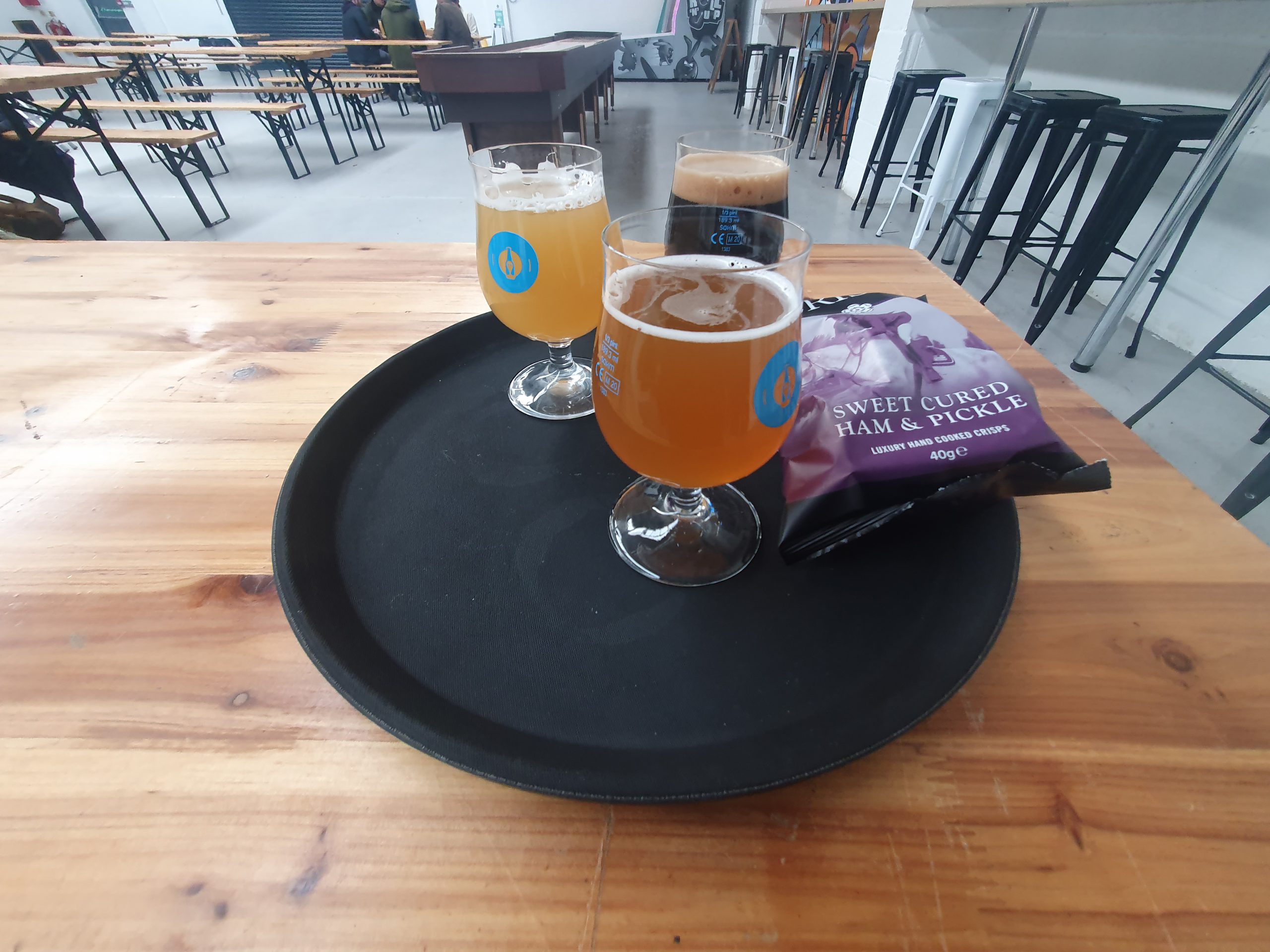
    I went for the IPA from Caps Off Brewery who are from nearby Bishop Auckland. I asked for half a pint, which the staff member repeated back, but then was clearly pouring a pint. I stopped her before she served the entire pint but she then decided to get another glass and tip what she had already poured into that. That of course fobbed the beer up (which is evident from the photo), so there was a wait whilst that settled. She then tried again and proudly announced that she had given me more than a half. Unfortunately, she was reading the third of a pint line on the glass, so I politely queried that and she poured a bit more in. I have no idea what she did with the small amount of beer that was left, but it was a comedic performance at least which added positively to the visit.

    20220821_124351

    The beer was acceptable, but I wasn’t entirely confident that it was being kept at the appropriate temperature, but it wasn’t so bad as to be a problem. The scampi fries were delicious though, the bar excelled themselves there. I was surprised how few people were in the market, but it did have something of a laid-back atmosphere at least. I hope that Darlington can do something with this market when the refurbishment project is completed, these are such important elements to a town and it would be good to see it done right. Barnsley have really thought through their new market, which is on-trend, affordable and interesting.

    20220821_135818

    The statue of Joseph Pease (1799-1872), the railway pioneer who was born and died in the town. He was involved with the creation of the Stockton and Darlington railway company, on which more in tomorrow’s riveting blog post, as well as being the first Quaker MP. There’s also a link to Norfolk as he married Emma Gurney in 1826, the youngest daughter of the banker Joseph Gurney.

    20220821_135845

    20220821_135852

    The four panels represent different elements of Pease’s life, including politics, industry, education and the emancipation of the slaves.

    20220821_140623

    Thrifty.

    20220821_141754

    And a quick half a Bass in the Darlington Flyer, which is a Stonegate pub on Skinnergate. The prices are low, the service was polite and the surroundings were comfortable enough. Most of the customers were watching football and minding their own business, but they all seemed to be enjoying their visit. This was a Yates Bar, but Stonegate have rebranded it, which is probably for the best. The pub is opposite the Tanners Hall pub, operated by JD Wetherspoon, and this is perhaps their nearest competition in terms of a pub chain. Stonegate are going for a similar market, although they are orientated a bit more towards showing sports at this venue. All affordable and not at all pretentious, which I think is a very nice compliment.

    20220821_151658

    Back to the Mercure Darlington which I’d stayed at a couple of nights before, although this time I was staying for three nights. I was upgraded again to a superior room, which meant more free drinks and it was once again all peaceful. I mentioned this before, but I was impressed at this hotel, it seemed very well run.

    20220821_193724

    The pigeons looked content as the sun started to set.