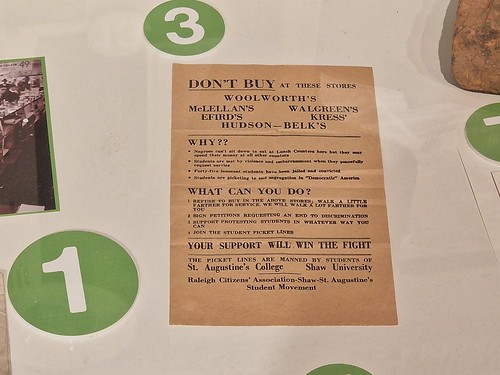
It still seems remarkable to me that at the turns of the 1960s there was segregation at lunch counters in Raleigh and other cities across the United States. This is a leaflet encouraging people to boycott companies such as Woolworths and Walgreens where segregation was enforced, with these campaigns being mostly organised in Raleigh by students at St. Augustine’s College and Shaw University. The latter of those establishments is important as it’s what called an historically black university, namely one which educated black students in the days before educational segregation was brought to an end with the 1964 Civil Rights Act. St. Augustine’s College also has a proud history of educating black students, being founded by the Episcopal church in 1867 to give freed slaves education.
This campaign, and others like it, were successful and lunch counters in Raleigh were made integrated on 19 August 1960. Alongside other North Carolina cities as Greensboro, the peaceful protests caused large economic losses for the companies as well as raising the rather obvious issue that it was ridiculous to have segregated counters. As an aside, it’s an interesting quirk of history just how popular lunch counters in drug stores, such as Walgreens, became and perhaps something of a shame that they mostly fell of fashion in the 1970s and 1980s.
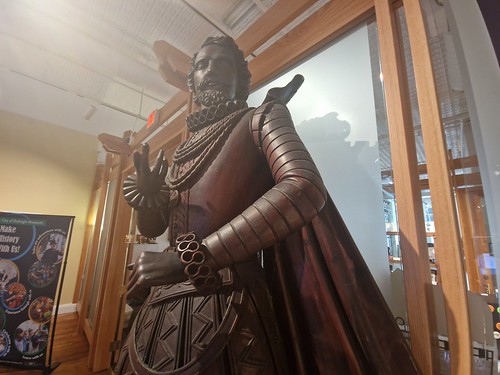
I was clearly lax in my reading of the history of Raleigh in North Carolina as it wasn’t until I got to this museum that I realised where the city got its name from. I had stupidly assumed that it was someone called Raleigh who had funded the city or something similar, but it is all a bit more prosaic as it’s named after the great British statesman Sir Walter Raleigh (1552-1618). And here he is in statue form in the museum.
Raleigh had the honour of having a city named after him because when they were laying the new state capital out in 1788 they decided to commemorate him as he was the sponsor of Roanoke Island, the ‘lost colony’. As an aside, people have been arguing how to pronounce Raleigh for at least 175 years, which is something in itself. I think the explorer’s surname should be pronounced ‘ral-lee’, but Americans tend to go for ‘rah-lee’, which has also impacted on how their pronounce their city’s name. And it all goes back to the word ‘ra’ meaning deer and ‘lea’ meaning a clearing, so somewhere in England in the tenth century or whatever there were some deer in a clearing and now there’s an American city named after them….
Without context, I accept that this isn’t the most riveting display I’ve ever seen in a museum (and there’s a pun there with rivets, but readers can write their own….). However, they’re iron nails from Isaac Hunter’s tavern from when it was first constructed in 1769. And this building is important, because in 1788 the State’s General Assembly declared that the new capital of Raleigh must be built within ten miles of the tavern. Talk about how much this must have been important to the politicians of the time, it’s like the House of Commons declaring that any new city has to be constructed near to a Wetherspoons.
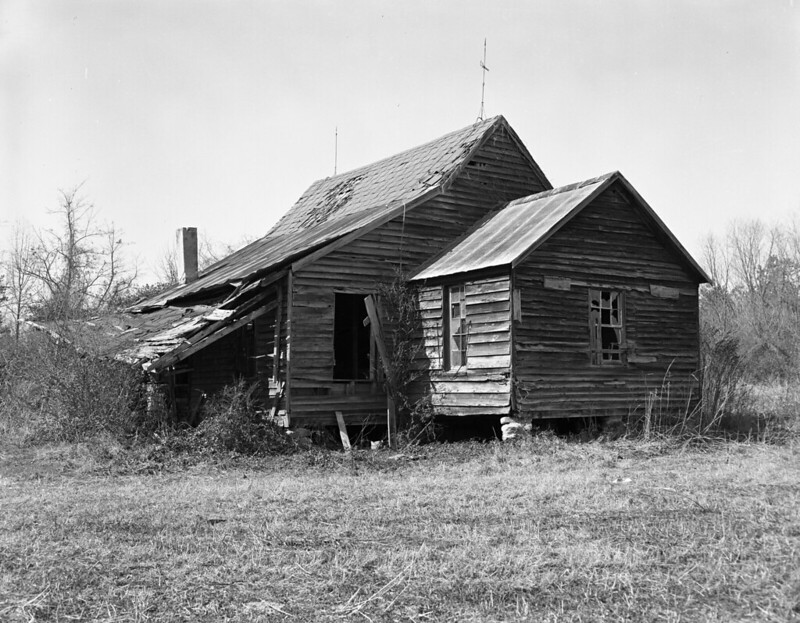
And here’s the tavern in the 1970s. It was a little bit rediscovered (primarily as a previous owner had moved it from its original location) and it had been used for many purposes since its early days as a tavern, including being split up for domestic purposes and also redesigned to be a stable. However, I understand that instead of saving this, it was torn down and I’m guessing that’s when they sent some of its nails to the museum. I’d bet that at some stage in the future this will be rebuilt, it’s too important for Raleigh to be ignored and all that there is at the moment is a heritage sign to mark the location.
The conclusion of all of this is that I like nails with a bit of history to them.
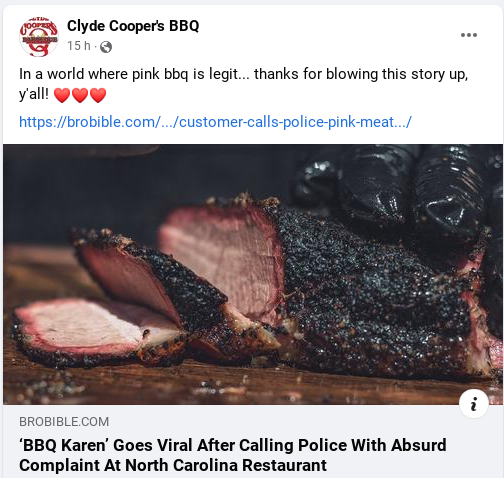
There’s a news story circulating across social media about how this week a customer of Clyde Cooper’s BBQ called the police because some of the BBQ meat she ordered was pink. This is entirely normal, but it seems that the customer is now taking legal action against the now very annoyed restaurant. On the bright side, they’re quickly getting merchandise ready and so this is some rather excellent advertising…
And why am I mentioning this? Primarily because I think it’s an amusing news story. Although I didn’t go there, it just happens that the restaurant is located on the next road to the City of Raleigh Museum that I’m currently writing about on this blog, so it felt appropriate in terms of timing….. And not everything has to be entirely relevant on this blog ?
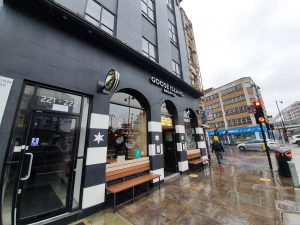
In a little interruption to my random piffle about my US trip….. I knew that it was coming because the manager of Goose Island’s taproom in Chicago told me last month, but Goose Island’s Shoreditch has now closed. Apparently profit making, but not falling within the requirements of Goose Island, it closed in September 2022 and has been immediately converted into the Queens Head.
I visited this bar tens of times (many of which are recorded on here….) because I considered it to be one of the best run operations in the UK and I’m glad that I got to see the manager Daniel a few weeks ago before it was too late. Impeccable service, engaging staff and a commitment to excellent beer, fine food and a welcoming atmosphere. The Chicago Goose Island manager told me that the UK team has been able to visit the Chicago taproom just before it closed, which was some form of gesture I suppose to the outstanding bar that they had in their estate.
A huge loss to the London bar scene that was vastly better than any other operation I’ve seen in the capital.
I had been looking forwards to visiting this bar as it was once the home of the most beers on tap in the world. I only discovered a few days later that it was their sister pub in Charlotte who had recently overtaken them and so I of course visited there too, but more about that in a future post. Anyway, this is Raleigh Beer Garden and it has something like 350 beers on tap, which I’d say is a very reasonable number indeed.
I thought that the outside space looked big, but I was to soon realise that the interior was also cavernous.
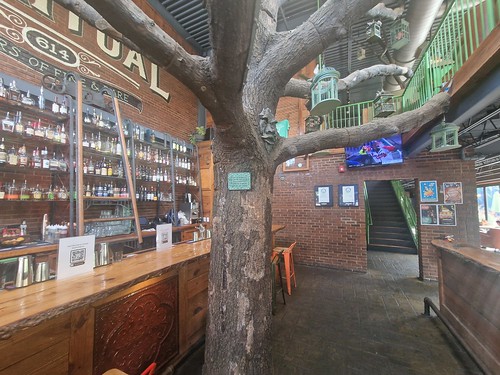
Every bar needs a tree in it. I got a bit muddled up here as I went to the bar to order, but a helpful team member quickly explained that this was just the spirits bar, the two beers bars were located further back in the building.
The downstairs bar and I was pleased that there were power outlets available at the bar itself, as I had somewhat depleted my phone battery by taking endless photos from the three museums I had visited earlier on during the day. This is the local beers bar. The beer list is on Untappd, which I’d say is essential for a venue such as this, making it easy for me to see what was available. Realistically, customers are going to need to use their phone to see the on-line or Untapped menus, as it’s too hard to make out the individual beers from their taps.
I had five beers and they ranged from outstanding to near perfection. This was the first that I tried, the Forget About the World from Casita Brewing of Wilson, North Carolina. Can you quite imagine a beer that could be nearer to a smoothie if it tried? Pure decadence, tastes of blackcurrant, raspberry and a bit of hedge (I don’t know what hedge tastes like, but it just reminded me of the outdoors).
And I thought that I’d better order some burger and fries to go with it, reasonably priced given this was at the peak of the Liz Truss and Kwasi Kwarteng failed budget when the pound was in freefall. Tasty and meaty beef and plenty of fries, all very acceptable. Incidentally, note in the background just how thick that smoothie beer was.
This hovered at the 5/5 level on Untappd for me, a cheesecake dessert beer with flavours of banana and raspberry. Just pure decadence. I was by now loving this bar, with the server being on top form in terms of friendliness, engagement and beer knowledge.
This is the upstairs bar which has the beers from further afield in the United States and beyond. Incidentally, it must be a challenge for the staff to ascertain exactly what beers they’re pouring and from where, although my server had no issues.
The seating overlooked the garden and it was beautifully cool, with both shady and hot spots available depending on what the customer preferred.
And evidence of their world record status.
A bit more of their beer garden and I’ve noticed reviews which say that the venue can reach capacity. This is certainly one popular location.
Looking back down the upstairs bar.
More of the upstairs space.
And my fifth and final beer, an incredible marshmallow and coconut imperial stout. These are some of my favourite flavours in a beer and the Prairie Artisan Ales brewery from Krebs, Oklahoma didn’t let me down here. It was 13.3% ABV, but it hardly tasted of alcohol, it was as smooth as you could want a stout to be. This was certainly going to set me up for the rest of the day.
The reviews of this venue are generally very positive, although a few people thought that it was all a bit complex in terms of the ordering process. I do get that, as anyone who knows nothing about beer is going to be overwhelmed by options and if it’s busy, I can imagine it’s hard for the staff to spend a lot of time engaging and guiding customers through the menu. I like this review though:
“Looking at the menu with my friend, after seeing a refreshing Miller Lite on tap, I asked for it, and you would have thought a nuclear warhead went off…the bartender upstairs not only looked at me, said verbatim “NO.””
It’s important not to sneer about what beers people like, but I am just a little surprised that anyone can peruse the 350 beer options and decide that they want a bloody Miller Lite. Anyway, that’s slightly ungracious of me and Miller Lite does have its place. Although I won’t say where.
All told, this was an superlative bar in many meanings of the word. The service was welcoming, pro-active and engaging, the beer choice was clearly incredible, the food was excellent and the knowledge and enthusiasm of the team members was evident. The venue was thoughtfully laid out, it was spotlessly clean and I wish this was located just a little bit nearer to me as I would happily become a regular here. On-trend and glorious, anyone who likes beer and is anywhere near Raleigh should pop in.
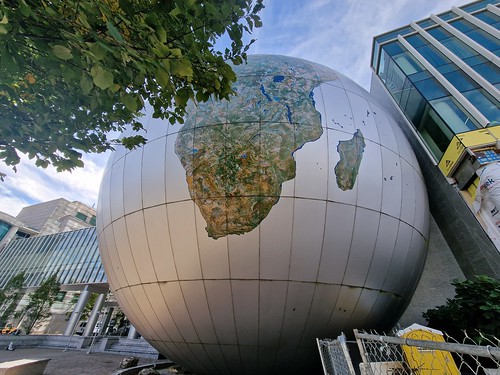
Not only does Raleigh have the bar with the second highest number of draft beers available in the world, it also has the second largest earth on earth (the largest is in New York) as they call it. The globe is known as the SECU Daily Planet and it’s 70 feet in width, another sign that the Americans do things bigger if nothing else.
It’s part of the North Carolina Museum of Natural Sciences and they decided to plonk it here in 2012. It’s not just decorative either, inside is a theatre which they use for educational performances. The construction wasn’t entirely easy, they needed to use vinyl roll on 217 panels with the image on the globe being 60GB in size.
Suitably impressive and apparently it’s often lit up at night, although I had a train to catch later that afternoon so had no way of proving that either way.
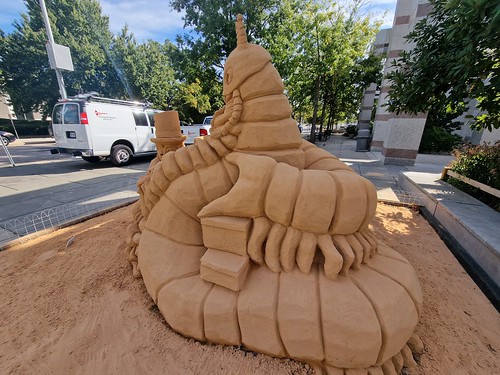
You have to admire a city that has sand art. Not just because they’ve found someone talented enough to create it and someone organised enough to fund it, but because no bloody local person has got drunk and stomped all over it. I’m afraid I’m not sure that this would have lasted in a lot of UK cities, so all credit to Raleigh for having some permanence to their sand art in what isn’t meant to be a particular enduring technique.
The creator of this sculpture is local man Ed Moore and his company Sandy Feat and he explains on his web-site just how much time it takes to craft these pieces of art. Where possible, he also likes to get anyone passing by involved in the creation and I can imagine that’s quite exciting and especially so for children. It’s not within my limited range of talents to create anything like this, but I can see that it’s something that an artist can really enjoy. They get the immediate response of those walking by, it’s an artwork that appeals to children and they can be endlessly creative with their project.
This all gives me an idea of how to measure the well-being of a city, put a sand sculpture in the main square of every major settlement in the world and see just how long they last before being damaged, vandalised or otherwise faffed about with. The Economist have the Big Mac Index to measure the true value of a currency, this could be the Sand Index to measure the decency of the local population.
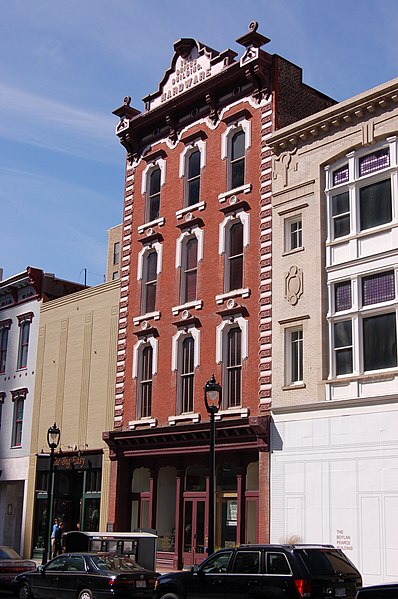
I’m relying on a public domain image for this post as I didn’t realise how historic this building was when I visited the museum which is located on the ground floor of the Briggs Hardware Building. The backdrop to this is that Raleigh was a planned city, one of the few state capitals that was, and it didn’t really start getting developed until the early nineteenth century. This building is later, constructed in 1874 and it was the city’s first skyscraper and remained the tallest structure in the area for over three decades. Today it rather blends into the streetscape, although it has a sense of architectural beauty to it.
This is the ground floor of the building today, the home of the marvellous City of Raleigh Museum. The reason I mention all this is that it seems to me to be a pivotal moment of the history of the United States, when new cities were being laid out and expanding fast as migrants moved to the country from around the world. Of course, this was a difficult time because of the American Civil War, but there must have been a sense of wonder as this structure was constructed. There’s a story that the whole construction was paid for by gold and silver coins that had been buried by Briggs at the beginning of the war, although that’s now a rumour that is unlikely to be proved.
It was built for Thomas H. Briggs to house his hardware store and they used it for this purpose until 1995, when after a period of not being used it started its new life as a museum. There’s a skylight running through the centre of the building which ensures it’s well lit throughout, necessary given that there was no electricity when it was constructed. The building is the only remaining one in Raleigh from the nineteenth century that still exists in something like its original form, a survivor of the city’s early days when excitement for the future must have been running high.
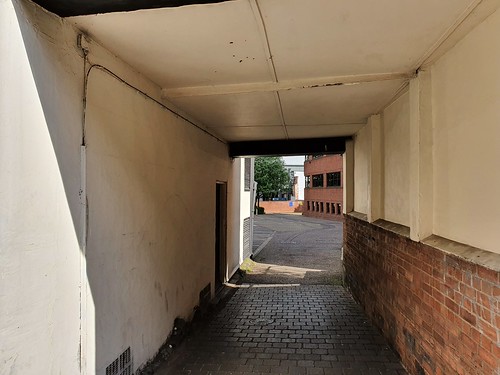
One of the reasons I started doing this long-winded thing of walking around every street in Norwich is that I hoped to notice some things that I hadn’t really seen before. I’ve found all manner of things I didn’t know existed, including plaques, streets and historic buildings. And, although I’ve been by it hundreds of times, I’ve never noticed Stamp Office Yard located off of St. Andrew’s Street (it’s the one in the centre of the above map, so to the left of the S of St. Andrew’s Street).
The street takes its name from a business that operated here in the eighteenth century, which stamped official documents. Although in the map above, from 1885, there were plenty of buildings in the yard, it’s all been opened up now at the rear and is mostly car parking. The building to the right hand-side of the Stamp Office Yard is St. Andrew’s House, and when that was extended in the 1970s there were plenty of medieval pottery finds.
At the 1921 census, there were two households reported as living on the street. In the first property there were six members of the Sabberton family, Frank William (aged 56), Emily (aged 59), Stanley (aged 22), Hilda (aged 25), Emily Ellen (aged 19) and Winifred (aged 16). Frank William Sabberton worked as an engineer at a clothing manufacturer, whilst Emily was noted to be working at home duties. Stanley was an engineer at Sabberton Brothers Engineers at Palace Plain, Hilda was a shorthand typist at Boulton & Paul, Emily was a clerk at Mann Egerton Cars on Prince of Wales Road, whilst Winifred was a shorthand typist at Singer Sewing who were at 16 Calvert Street in the city. In the other household was husband and wife Reginald Arthur Sabberton and Amelia Sabberton, aged 28 and 34. Reginald worked as a motor engineer for Goffs at Aylsham Road.