Tag: New Orleans

  • 2022 US Trip – Day 26 (The National WWII Museum in New Orleans – Glass Bottles from Nagasaki)

    2022 US Trip – Day 26 (The National WWII Museum in New Orleans – Glass Bottles from Nagasaki)

    20221013_132324

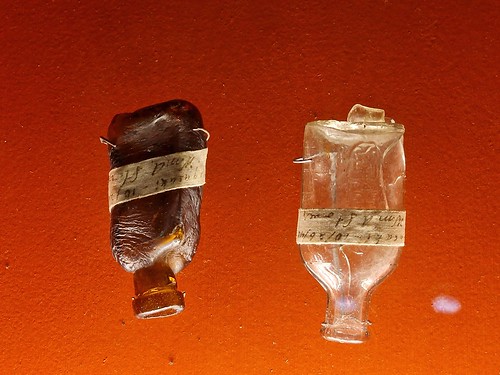
    These two glass bottles are on display at the National WWII Museum in New Orleans and the museum exhibit notes:

    “Eighteen-year old William A Stover, a pharmacist mate aboard LST 585, went ashore at Nagasaki on October 26 1945. Among the ruins, Stover collected these two bottles. In a letter home to his father, Stover recounted his experience: “Yesterday I went ashore in Nagasaki. A bunch of us went up to the ruins to hunt for souvenirs. I’m sending a few pieces home that I picked up. There were some skeletons around, but when you touched them they just crumbled to ashes”.

    Stover’s visit was over two months from when Nagasaki had suffered from a nuclear bomb dropped by the United States on 9 August 1945. The above photo are from the US National Archives showing the city before and after the bombing and it’s hard to think what the 18-year old Stover would have thought about what he saw.

    Back to the glasses, the writing on them is from before the attack and despite the nuclear bomb, the bottles were twisted out of shape but didn’t break or lose their paper labels. The museum gives more information about Stover, although that’s more because they want to charge for usage of imagery ($20 to have the image saved only locally on a private computer, much more to use anywhere else), but that’s better than their usual efforts. They add:

    “William Ammon Stover was born on 15 March 1926 in Williamsport, Pennsylvania. He joined the United States Navy Reserves in April 1943 and graduated from the Navy Hospital Corps School Norfolk Navy Hospital in Portsmouth, Virginia in September 1943. Stover served aboard LST 585 in the PTO as a Pharmacist’s Mate, Second Class. Stover left LST 585 on 2 November 1945 and was transferred to a fleet pool in Okinawa and then served on USS LSM 273. He was discharged on 2 March 1946 at the Sampson Naval Separation Center on Lake Seneca, New York. During his service he took part in the Lingayen Campaign, Tarakan Island, Dutch Borneo as well as the landings on Bataan Island and Corregidor Island. In 1948 he married Carolyn Margaret Russell. After the Navy, Stover attended Bucknell University and worked as a technical illustrator, writer, and editor. He spent ten years with Bell Aircraft in Buffalo, three years with GE in Syracuse and Oklahoma City, and six years with Texas Instruments in Dallas, Texas. He later owned, operated, and retired from a Kwik-Kopy printing company.”

    I mention all this as it must have been something of a culture shock to come back from such an experience in Japan to try and settle back into what might be called a normal life.

  • 2022 US Trip – Day 26 (The National WWII Museum in New Orleans – Wreckage of Augustus Hamilton’s Aircraft)

    2022 US Trip – Day 26 (The National WWII Museum in New Orleans – Wreckage of Augustus Hamilton’s Aircraft)

    20221013_103700

    This heap of metal are parts of the wreckage of the P-47 Thunderbolt aircraft that was being flown by 1st Lieutenant Augustus Hamilton on 14 July 1944. It was intended to be his final mission before returning to the United States to see his wife and new born-son, but it was a flight that he didn’t survive after being shot down by German enemy aircraft. It wasn’t known exactly what happened to his aircraft until 1993 when the crash site was found in France and these items recovered.

    Augustus died at the age of just 22, never meeting his son also named Augustus (1944-1985). What I find especially poignant is that his sister Margaret Hamilton McPhail lived until 2013. She lived for just shy of 70 years without her brother, but at least she got to find out exactly had happened to him during her lifetime. There are some more photos at the Association of Forced Landings web-site. Augustus was born on 4 January 1922 and would have celebrated his 100th birthday just a few days ago. He’s buried at Normandy American Cemetery and Memorial which is located by Omaha Beach.

  • 2022 US Trip – Day 26 (The National WWII Museum in New Orleans – Thorpe Abbotts Airfield Sign)

    2022 US Trip – Day 26 (The National WWII Museum in New Orleans – Thorpe Abbotts Airfield Sign)

    20221013_104020

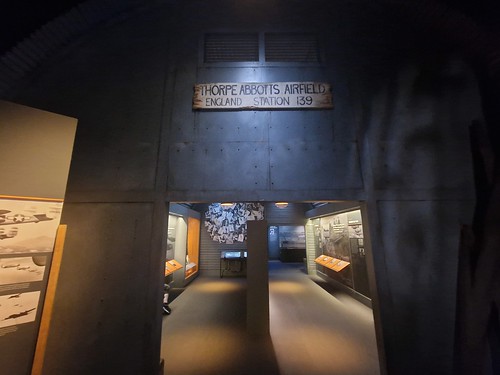
    I’m not claiming that New Orleans is in some remote part of the world, but there’s always something exciting and homely seeing a reminder of Norfolk. I know nothing more about this sign, not least as the National WWII Museum seem to make limited effort to explain anything as recent posts may have noted, but I felt the need to reference the Norfolk links. Thorpe Abbotts Airfield, given the United States Army Air Forces (USAAF) reference number of 139, was built for the RAF in 1942, transferred to the USAAF in 1943 and ultimately remained in use until 1956. I hadn’t realised this, but although most of the airfield has been returned to other uses, the control tower is now home to the 100th Bomb Group Memorial Museum.

    Back to this sign, I like to think that some brave pilot brought back this sign when the US air force went back to the United States in late 1945 and handed the airfield back to the RAF. A little bit of Norfolk in New Orleans and I rather like that and I must go to that museum at some point.

  • 2022 US Trip – Day 26 (The National WWII Museum in New Orleans – French Teenagers and the Handmade American Flag)

    2022 US Trip – Day 26 (The National WWII Museum in New Orleans – French Teenagers and the Handmade American Flag)

    20221013_103231

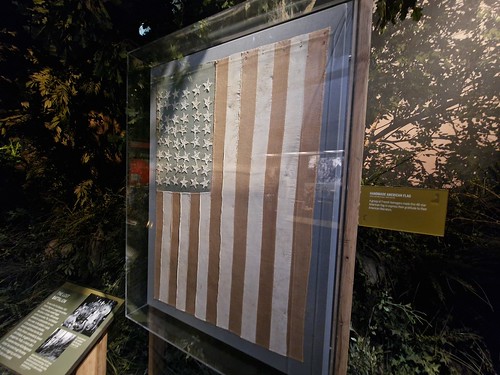
    Unfortunately, this is another exhibit at the National WWII Museum in New Orleans which has lost something of its provenance to visitors as there’s nothing more about it on the museum’s web-site. Indeed, the only other mention I can find of it anywhere is on the blog of another visitor who simply makes reference to it. The description at the museum is:

    “A group of French teenagers made this 48-star American flag to express their gratitude to their American liberators”.

    This is really quite lovely, it would have been a difficult and time-consuming flag to make and I’m sure that it meant a lot to those American soldiers who were there at the liberation of whatever French village, town or city in which the teenagers lived. The museum must have at some stage accepted this item and been told its back story to some degree, but it’s not something that they’re passing on. I find this all quite strange, I’m sure that there must be an internal database of their collections and perhaps one day they might make that available on-line to everyone.

    It would have added something really quite positive to the story of this flag if there was some hint of where in France it might have come from, some greater recognition for those involved in its creation. But it’s still a beautiful gift and I’m sure it was very much appreciated, something which is evident by the fact that it has survived.

  • 2022 US Trip – Day 26 (The National WWII Museum in New Orleans – German Soldbuch)

    2022 US Trip – Day 26 (The National WWII Museum in New Orleans – German Soldbuch)

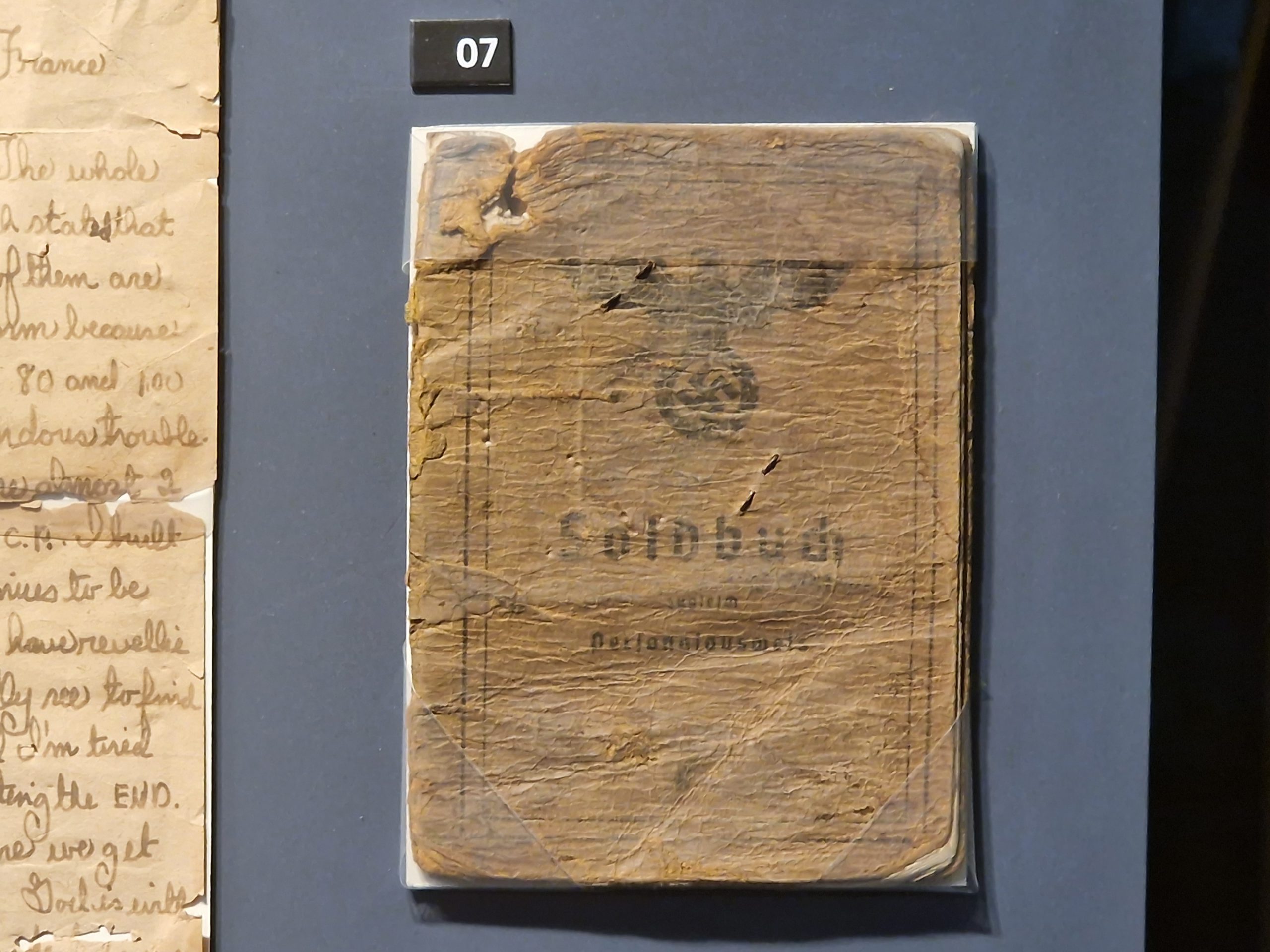
    On display at the National WWII Museum in New Orleans, this is a German Soldbuch which was issued to all members of the German military and was used as identification and to record pay and other matters. This one, which has been damaged by a bullet, belonged to Alfred Heisig, but I can’t find any details about him on the German war graves site, so perhaps he survived. Again, the museum doesn’t have any more information on-line about the item which seems something of a shame.

    Anyway, this was another item that I thought was powerful as any German soldier wouldn’t have wanted to have been parted from this book. At one stage in the life of this document it was pristine and cared for by the soldier who would have placed it in his tunic pocket whilst perhaps fearing for the next day and the military action that he might have been involved in. I find myself thinking of the Stoic writing that “remember that all we have is on loan from fortune, which can reclaim it without our permission”, the soldier could never have thought that this book would have been taken away from him and then eventually taken on a new life in a museum in Louisiana.

  • 2022 US Trip – Day 26 (The National WWII Museum in New Orleans – Young German Soldiers)

    2022 US Trip – Day 26 (The National WWII Museum in New Orleans – Young German Soldiers)

    20221013_102118

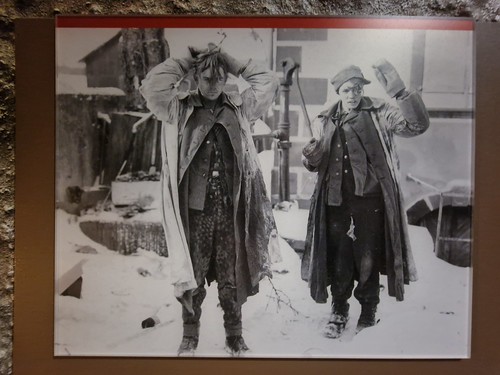
    I hadn’t seen this photo on display at the National WWII Museum in New Orleans before, although a reverse image search shows that it’s of two young German soldiers who were fighting in Schillersdorf as part of Operation Northwind. The Germans has lost Strasbourg on 24 November 1944 and they had plans to retake it by the end of January 1945, but that didn’t go exactly how they planned. And soldiers like these young men here, who look like they’re aged about 15, had to bear the brunt of this futility in what look like freezing cold conditions. They were though in many ways likely quite fortunate as they likely survived as prisoners of war, whilst tens of thousands others died in the campaign.

    And just when this madness looks like it might be finally never be repeated on the European mainland, along it all starts again….. This is one of the images that I remember from the museum, hence why I’ve posted about it here. The modern-day Massacre of the Innocents, whether destroying their bodies or their minds.

  • 2022 US Trip – Day 26 (The National WWII Museum in New Orleans – Life Jacket of Troy Graves)

    2022 US Trip – Day 26 (The National WWII Museum in New Orleans – Life Jacket of Troy Graves)

    20221013_101043

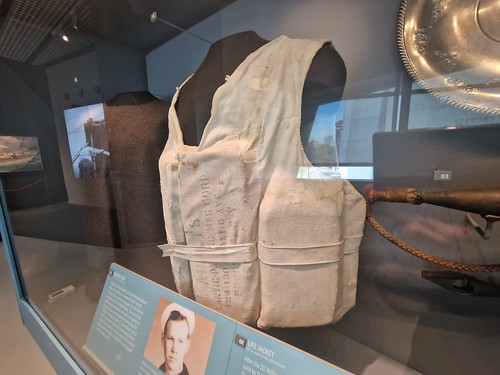
    This is one of the exhibits at the National WWII Museum in New Orleans, a life jacket which was worn by Seaman Troy Graves for 20 hours after the SS William J Salman was torpedoed and sunk by a German U-125 submarine on 18 May 1942. The museum doesn’t go into the back story of this incident so it’s easy to walk by and not take in the enormity of what Graves must have gone through. There were 28 crew on board the William J Salman, a merchant ship which was unarmed and unescorted.

    The attack happened around 120 miles from Cuba and the submarine’s torpedo meant that the SS William J Salman had no chance, sinking within just a couple of minutes of the attack. Of the 28 men on board there were eight officers and twenty seaman, with no time to launch the lifeboat. Two officers died, including the master Charles Bryant, as well as four other crewmen, the other 22 crew survived. But they had to stay afloat on bits of the boat that hadn’t sunk for 20 hours before the Latvian steam merchant Kegums picked them up and returned them to the United States.

    It’s really not very easy for anyone who hasn’t been involved in war to be able to imagine what this sort of event must have been like. The Germans attacked 150 ships in this area between 1942 and 1944, forcing the allies to use convoys despite being nowhere near the main theatre of war at the time. The Americans had only just entered the Second World War at this point and the crew on merchant ships must have been suitably terrified of an attack that could come at any time. Ironically, the SS William J Salman had already been involved in the war in a different way, it was a rescue vessel which picked up the survivors of the M/V Australia which was carrying fuel oil to New York.

    Then suddenly an attack does come, for which the crew were no doubt trained but they had little time to think with their vessel sinking in just two minutes. Troy Graves must have known that colleagues on board had died and the hours in the water must have been traumatic. There were at least 22 men to try and keep spirits up and the water was perhaps tolerable in terms of temperature, but I can’t imagine it was particularly idyllic knowing that there was potential for attack from things living in the sea and perhaps from German forces.

    And this life jacket is one of the few items that remains from the vessel, which is still stuck at the bottom of the ocean. I can only imagine that Troy Graves treasured it as a memento of a fortunate escape, but a reminder of the horrors that took place and the colleagues that were lost. If it were me, I think I’d keep the life jacket but try and hide it away so that I didn’t have to see it. There’s not much else I can find out about Troy Graves and the only clue is that a Jeraldine Peek gifted this to the museum in 2005. Unfortunately, the museum has a poor on-line database which doesn’t list much of their holdings and they have nothing on this. Even if typing in the item number code into Google it still comes up with nothing, although the search comes up with several other museums who must be using similar software to record their items. But at least they’ve got the life jacket, so the story can still be told in at least some form, but there must be more to tell about what Troy Graves went through.

  • 2022 US Trip – Day 26 (The National WWII Museum in New Orleans)

    2022 US Trip – Day 26 (The National WWII Museum in New Orleans)

    20221013_095140

    This museum was the reason that I had returned to New Orleans as I didn’t have time to do it justice on my previous visits. I was also particularly interested in how the story of World War II was told from the US perspective, as I’m used to museums in Poland, the UK, Germany and so on having their own focus and narrative of the events. Looking at the reviews, there are a few people complaining that the museum is telling the story far too much from the US side of things, but I’m not sure that I would want it to be anything but. I don’t much want to see an identical museum in every country in the world explaining the Second World War in exactly the same way, I’d expect the German, Russian and Polish perspectives to be different.

    20221013_100139

    The museum journey starts with a short recorded message and encouraging visitors to use the dog tag card they’ve been given to follow through an individual and their Second World War story.

    20221013_100159

    I thought this was all a bit odd, there wasn’t really any following through of the character and it felt a little one-dimensional with a short story of what they did during the war. But, for anyone interested they can type the dog tag card number in at http://dogtagexperience.org/. The museum claim this is a very popular feature that they’re proud of, but I didn’t see anyone using them to tap onto the displays.

    20221013_100759

    Looking down into the main hall of the museum where visitors can buy tickets, although I purchased mine on-line in advance as they recommended this as the most efficient way of visiting and it allowed me to get a timed ticket. They had plenty of free lockers which was handy as I didn’t want to traipse my bag around and I’m not sure that I would have been allowed to either. A docent was full of enthusiasm when greeting me and there was a feeling that this was an inviting place to visit that I liked, some very good first impressions.

    20221013_102405

    Originally known as the D-Day Museum when it opened in 2000, there have been several expansions to the site and it’s now a number of separate buildings with some slightly confusing navigation between them. Unfortunately, the piecemeal expansion of the museum as new funding streams have become available has created a lack of flow between the different areas as well as some pinch points which are far from ideal.

    20221013_104552

    Some areas were a little crowded with people, but for those I just came back a little later and the same sections were often deserted. I did feel that given the efforts the museum claimed it was making on timed tickets and not allowing crowds that it did feel rather over busy at times, but I had the time to revisit displays when it wasn’t as packed. There are no shortage of visual elements though in the displays and they’ve balanced technology well between things to read, things to look at, things to watch and things to listen to.

    20221013_105109

    As for the content of the museum, it was thought through and in terms of navigation I only went the wrong way once which is a result for me. There were plenty of video and audio sections to find out more about a topic and I learned a substantial amount about the D-Day landings at this museum due to the way the information was presented. There are strong focuses on these landings, as well as the Road to Berlin, the Pacific war starting with Pearl Harbour and ending with the nuclear attacks on Japan. The museum deliberately doesn’t tackle matters such as the Holocaust in any depth, although they by no means shy away from it, but its focus is on being a military museum.

    20221013_132744

    In addition to the permanent collections there’s also a revolving temporary collections area, at the moment it’s about military photography during the war.

    20221013_133233

    There’s a main hall of various aircraft which makes for quite a first impression given its size.

    20221013_133325

    There was a lift to the top, but I’m brave and so walked up these steps.

    20221013_133643

    I don’t like heights so I was being very brave as far as I was concerned.

    20221013_133456

    It was worth it for the views.

    20221013_135834

    And for everyone who fought to protect the freedom of the United States.

    20221013_132311

    I’ll write more about a few individual items in the museum that resonated with me in the next few posts, but to me this was the most powerful of all the display rooms. It was large images of Hiroshima and Nagasaki which effectively brought the Second World War to an end, with a number of exhibits in the room that were damaged during the nuclear attack. Seeing exhibits of that kind does bring the fearsome reality of these horrors to life and the relative minimalism to this room accentuated that.

    Entrance to the museum was expensive at over £30, but I was there for the bulk of the day and it would be possible to stay for longer if listening to all of the audio and watching all of the videos. Museum fatigue creeps in with me after around five hours though, so I felt that I had seen everything I needed to. It was a magnum opus of military museums and I was very pleased that I went.

    As something of an addendum, I feel the need to mention that the museum has a poor on-line catalogue of their exhibits which is far behind most other national museums. There’s nearly nothing mentioned on-line, so many exhibits feel like they’ve lost their provenance with limited information on their display labels at the museum and no way for the public to access the institution’s collection database. I would hope that some work can be done in this area, as if it doesn’t involve selling the rights to use images, the digital presence of the museum is very weak outside of the specific exhibits they want to feature.

  • 2022 US Trip – Day 26 (The National WWII Museum in New Orleans – Atlantic Wall Fragments at Utah Beach)

    2022 US Trip – Day 26 (The National WWII Museum in New Orleans – Atlantic Wall Fragments at Utah Beach)

    20221013_095229

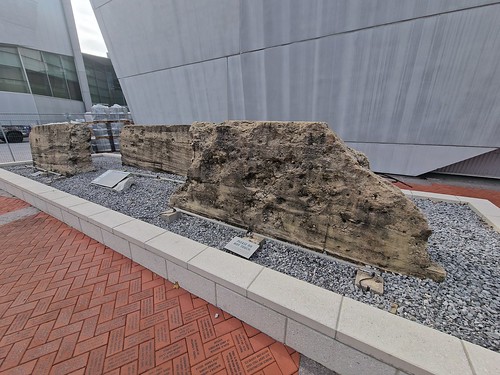
    Between 1942 and 1944 the Germans thought they had a great idea in building a defensive wall along the Atlantic coast that was nearly 1,700 miles long. The French and Belgian sections were constructed by 600,000 French workers forced into building this defensive wall which was intended to repel any attacks by the allies into mainland Europe which Germany controlled so much of. Rommel was put in charge of this whole arrangement in late 1943 and I think it’s fair to say that he wasn’t entirely impressed. Much of what had been constructed was of marginal use as the allied air forces could just blow most of it away before launching an invasion of the beachhead.

    Rommel put huge efforts into mining the beaches, creating structures on the beach to make landing more difficult and trying to refocus on stopping any enemy ships from being able to make the crossing. He also strengthened some of the existing structures and by the time of D-Day the Germans had managed to pour 17 million cubic yards of concrete which was reinforced by 1.3 million short tons of steel. The reinforcements didn’t really trouble the invaders as the allies were able to secure the majority of their objectives on the first day after landing.

    These three lumps of concrete are from that wall, part of the defences at Utah Beach where the Americans landed as part of the allied joint expedition. There are holes in the concrete still visible which were caused by the weaponry fired at it by the allied forces when attempting to land and secure the beachhead. I like big chunks of exhibits like this, which I imagine were a hassle to get shipped into the United States, and they were donated by the Utah Beach D-Day Museum. That museum is built at the location where American soldiers stormed the beach, somewhere that one day I’ll hopefully get to visit.

  • 2022 US Trip – Day 26 (The National WWII Museum in New Orleans – “Lest We Forget: The Mission”)

    2022 US Trip – Day 26 (The National WWII Museum in New Orleans – “Lest We Forget: The Mission”)

    20221013_095201

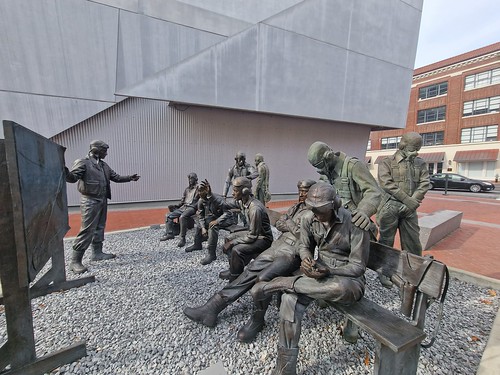
    This sizeable sculpture is located outside of The National WWII Museum in New Orleans and depicts a pre-flight mission for pilots, commemorating the 88,000 US airmen who died during the conflict. It was designed by Major Fredric Arnold, himself a former combat fighter pilot who completed the art commission at the age of 94 and who died two years later on Memorial Day. He spoke honestly when saying he was worried that he might not live long enough to complete the work, but he did and he certainly delivered a masterpiece.

    20221013_095212

    The empty place on the bench is designed to represent the place of the sculptor as he survived the conflict and it also symbolises the other survivors from the Second World War.

    20221013_095207

    The display board which gives further information about each of the characters depicted, which aren’t designed to be specific people but instead to represent all those who died. All of these characters are emotive because they are based on various traits from people the sculptor knew, but perhaps no more so than ‘Frenchy’ who depicts the spirit of the pilot who died the previous day, “gently touching his comrades with a bond that cannot be broken, even after death”. It is all very powerful and I can see why they’ve chosen this to be outside of this nationally important museum.

    There’s a web-site to this sculpture and some FAQs answered by the sculptor and this is a striking and eloquent piece of prose:

    “When asked to visualize scenes of WWII aviation, many think of the aircraft of that era or stylized dogfights unrealistically portrayed by Hollywood. Almost none of the public stop to think, however, about the daunting challenge which faced these young (typically 19-21 years old), ill-trained (90 hours total flight time) pilots prior to each mission.

    During much of the war, the death rate among fighter pilots was so high that, statistically, it was a certainty that none of us would survive 50 missions to come home. In spite of that knowledge, each pilot made the conscious decision to board their aircraft and leave the safety of their home base to fly toward the battle. Day after day. The scene depicted by this sculpture is intended to capture a poignant moment in time when the mission is laid before the squadron and each pilot recommits himself to go again, even as they feel the presence of pilots already killed and not yet gone or forgotten. In truth, we faced a harrowing real life example of Russian Roulette.”

    The scale of the help of the American forces is explained by the Imperial War Museum:

    “Over two million American servicemen passed through Britain during the Second World War. In 1944, at the height of activity, up to half a million were based there with the United States Army Air Forces (USAAF). Their job was to man and maintain the vast fleets of aircraft needed to attack German cities and industry. Working with the Royal Air Force (RAF), their aim was to severely weaken Germany’s ability to fight. This was a central part of the Allied strategy for winning the war. American women also served, working for the American Red Cross or as members of the Women’s Army Corps.

    Over 200 airfields were occupied or newly-built by the USAAF. Each one would house around 2,500 American men – many times the population of the nearest village. Thousands more were based at smaller sites. Halls and country houses became headquarters for commanders and planners. Some were converted to hospitals or rest-homes for combat-weary fliers. Barns and outbuildings would house teams of truck drivers and their vehicles. Even specialist bakery units were dotted around the UK, providing fresh bread for the airmen.”

    All very brave.