Category: Virginia

  • 2022 US Trip – Day 7 (Hollywood Cemetery in Richmond – Confederate Army Memorial Pyramid)

    2022 US Trip – Day 7 (Hollywood Cemetery in Richmond – Confederate Army Memorial Pyramid)

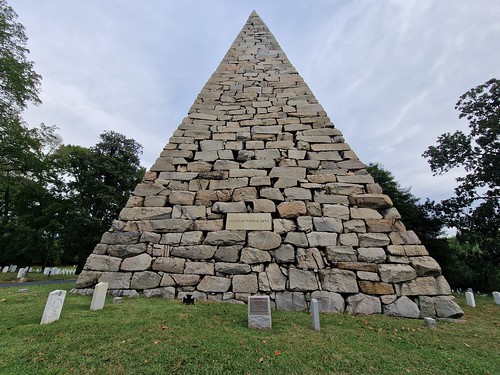
    20220924_082607

    This large pyramid is located at Hollywood Cemetery and was erected here in 1869 to commemorate the 18,000 Confederate men who lost their lives in the Civil War and were buried here. The cemetery itself prefers the interpretation not that the Civil War was “a lost cause” but that it united the nation and set the foundation for the future.

    20220924_082617

    The pyramid stands 27 metres high and was designed by Charles H Dimmock (1831-1873).

    20220924_082658

    The 1869 stone marking that the pyramid was erected by the Hollywood Memorial Association.

    20220924_082309

    Some of the thousands of Confederate graves which have been well cared for.

    20220924_082726

    Located next to the pyramid, this feels slightly out of place in the cemetery……

  • 2022 US Trip – Day 7 (Hollywood Cemetery in Richmond – Iron Dog)

    2022 US Trip – Day 7 (Hollywood Cemetery in Richmond – Iron Dog)

    20220924_083354

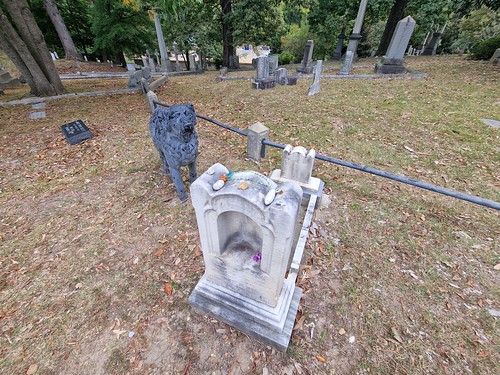
    OK, my final post about the Hollywood Cemetery in Richmond…. This is one of the best known graves because of the cast iron Newfoundland dog. The dog is guarding the grave of a little girl (there’s not agreement on her first name, although her surname was Rees) and it’s traditional to place toys here to commemorate her life. As to why the dog is present, many historians seem to agree that it was placed here in the early 1860s during the Civil War to prevent it being melted down for the war effort, although it could just have been placed here by the little girl’s family. Whichever story is true, this is now an iconic location for the city of Richmond.

  • 2022 US Trip – Day 7 (Free Public Transport in Richmond)

    2022 US Trip – Day 7 (Free Public Transport in Richmond)

    20220924_095747

    There are a number of cities in the United States who are doing great things with public transport in a country where the car dominates nearly everywhere. There’s also Chicago where the public transport system is, frankly, outdated if we were in the 1950s. But I’ll be coming onto that complaint in a few days. Indeed, I might spread those complaints out over several posts as the system is so ineptly run I can’t recall seeing anything as badly planned in any city I’ve been to.

    Anyway, unlike Chicago, Richmond is pioneering with its work on public transport and there will be a little more on this as I returned to the city after going to Williamsburg. One of the things that they’ve done is make public transport free until 2025 and it certainly seems from my observation of passenger usage to be very popular. Every bus stop also has a code which then gives live information on where the buses are, which wasn’t entirely perfect but it worked well enough.

    20220924_100609

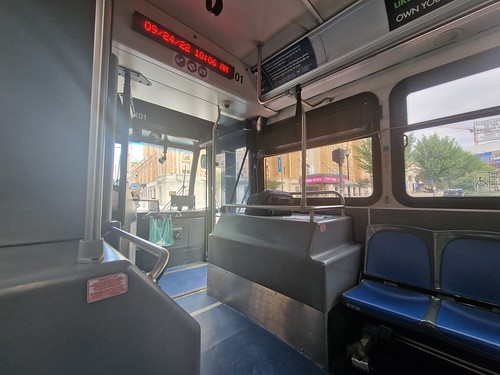
    I double checked that it was definitely free when boarding, just in case I had got muddled up, but, all was as expected. As free as a bird…. Unless it’s a caged one. I digress I think.

    20220924_101154

    And the bus sailing off after safely depositing me near to the Virginia Museum of Fine Arts. I’d better add that’s where I wanted to get off, I wasn’t removed from the vehicle. But, a very impressive effort from the city of Richmond to increase the usage of public transport, I was very impressed.

  • 2022 US Trip – Day 7 (Abortion Protests in Richmond)

    2022 US Trip – Day 7 (Abortion Protests in Richmond)

    20220924_101730

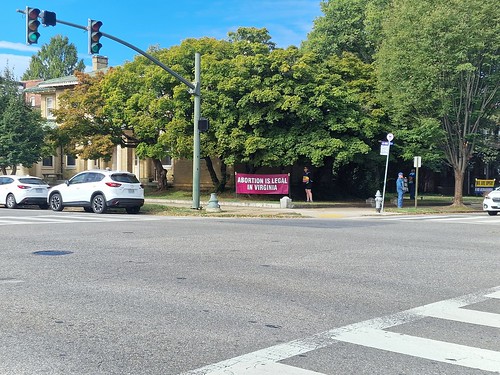
    I’ve never seen anything like this before, which were some protesters standing outside of a women’s health centre in Richmond, next to the Virginia Museum of Fine Arts. The banner is the centre’s as abortion is still legal in Virginia, but the men standing nearby with the “Baby Lives Matter” had a megaphone and were saying what they thought about the abortion advice that was being offered inside. There was a lot of “you can adopt your baby rather than murder it” which was it’s fair to say quite emotionally charged language for anyone sitting inside.

    Anyway, I’ve heard of this sort of protest but it’s the first time that I’ve seen anything like it. The midterms are on 8 November here and the abortion issue is a huge one in the United States, perhaps slightly favouring the Democrats for these elections more than the Republicans.

  • 2022 US Trip – Day 7 (Virginia Museum of Fine Arts – Gullscape by Roy Lichtenstein)

    2022 US Trip – Day 7 (Virginia Museum of Fine Arts – Gullscape by Roy Lichtenstein)

    20220924_103938

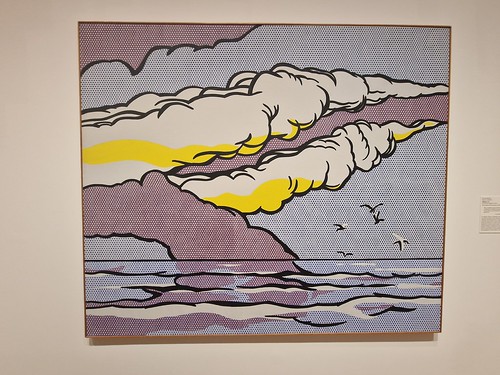
    I’ll try not to get too distracted and write hundreds of posts about artworks at the Virginia Museum of Fine Arts, which means that I might have to limit myself somewhat given the number of photos that I took. Roy Lichtenstein is one of the defining American artists in my limited knowledge of this sort of thing, although he himself has said that he didn’t like his work being defined as American, he thought that it was more industrial.

    This artwork was painted in 1964 and as the gallery says, it all questions where the lines are drawn between advertising and art. I liked the heritage of this as well, acquired by Sydney and Frances Lewis in 1980 as part of their collection before they donated it to the gallery in 1985. The couple built up an enormous set of artworks as they exchanged items from their mail order catalogue to up and coming artists, a rather clever tactic.

    I won’t offer any more analysis than that as it would just sound trite, but this felt like being in an American gallery looking at a proper piece of American art. As for the value of this, I have no idea and I can’t imagine that it would ever be sold, but in 2017, ‘Masterpiece’ by the artist sold for $165 million.

  • 2022 US Trip – Day 7 (Virginia Museum of Fine Arts – Pontiac in a Deserted Lot by John Salt)

    2022 US Trip – Day 7 (Virginia Museum of Fine Arts – Pontiac in a Deserted Lot by John Salt)

    20220924_104412

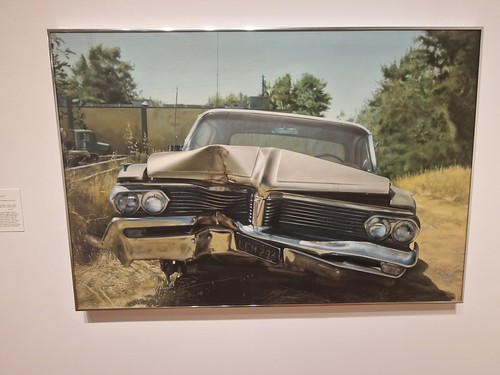
    And continuing with my theme of my favourite artworks in the Virginia Museum of Fine Arts, this is a painting by John Salt who I have to confess that I hadn’t heard of. Born in 1937, he died in December 2021 and has a pub named after him in London which is something that I’m very impressed about. He was an English artist and his works are based around photo-realism and I had to get close to this before I realised that it wasn’t a photograph.

    Salt went to Baltimore to study in 1967 and although he intended to return at the end of his course, he remained in the United States until 1978 when he came back to the UK and settled in Shropshire. I’ll use the gallery’s text about this artwork as it’s better than anything that I could write:

    “Although bathed in strong California sunlight, this scene could be from almost anywhere in America. While Salt clearly delights in the play of light on glass and metal, the directness of the image addresses classic themes of waste, destruction, and even mortality, as the abandoned car, in human terms, has finished its life span.”

    The gallery bought this artwork in 1971 after it was painted, funded by a grant from Sydney and Frances Lewis. It’s another example of an artwork that just shouted American at me, which felt extra appropriate from an English artist. It’s also got something of a haunting feel, a car left to be scrapped and no longer of use.

  • 2022 US Trip – Day 7 (Virginia Museum of Fine Arts – Irises by the Pond by Claude Monet)

    20220924_105737

    One thing that interests me about artworks in galleries, especially those which have no relation to the artist or where they painted it, is just how it got there. This artwork in the Virginia Museum of Fine Arts is by Claude Monet and is from sometime between 1914 and 1917, one of many that he painted at his home and gardens at Giverny in France, which is now open to the public as a museum and gallery.

    Monet’s paintings are scattered around the world and at a quick count I noticed they are in over 150 different galleries, including major institutions and some are in odd little places (which I won’t name as I don’t want to be blacklisted by the people who reside in what I might have called an odd place). This painting is here in Richmond because of Paul Mellon who had inherited much of his money, and then gave it away as one of the country’s leading philanthropists, being a wealthy man and donating tens of artworks to the gallery. And he lived in the area because it’s where his wife, Rachel (or Bunny), was brought up in Virginia and never quite entirely moved away.

    This painting has been displayed at galleries all over the world, including Padua (Italy), Nashville, Pittsburgh, Cleveland, New Orleans, St.Louis (United States), Copenhagen (Denmark), Basel (Switzerland) and Madrid (Spain). I was rather more taken with just how many people in so many cities have seen this artwork than the painting itself, not least because there’s nothing much I can say about Monet’s works, other than how clumpy the paint is and I accept that I’m not going to be employed as an art critic with that kind of commentary.

    But there’s something fascinating to me of wondering about a painting’s journey and I’m pleased that the gallery has made so much information available about their artworks, and that’s the main point behind these witterings.

  • 2022 US Trip – Day 7 (Virginia Museum of Fine Arts – Roman Glass)

    2022 US Trip – Day 7 (Virginia Museum of Fine Arts – Roman Glass)

    20220924_112723

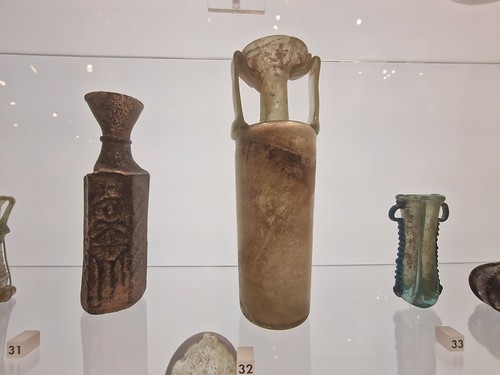
    The latest post in my “stuff I like in the Virginia Museum of Fine Arts” (and don’t worry anyone, I’ve nearly finished) is this piece of Roman glassware dating to the third or fourth century. It (the one in the middle of the photo, above the number 32) was made in Rhineland, which was one of the first centres of Roman glass making in the empire outside of what is now Italy, with the limitations being the raw materials that were needed by the industry.

    It’s a bottle, or apparently it’s technically called a stamnium, but I think the former is a better word here and it’s one that I can spell. I don’t know what was in it, probably olive oil or something (and there’s a glass Roman bottle in Naples which still has the olive oil in it), but I like to think that it was beer. The Germanic people did brew beer in this period, although Tacitus complained about the quality of it, but we’ve all been there with our commentary on that.

    As an aside, the bottle on the left above the number 31, is Byzantine and was made between the fifth and seventh centuries. There’s a little more knowledge about this one as it has Christian motifs, meaning that it could have been used by a pilgrim to carry either water or oil. I like the idea of someone taking part in a pilgrimage carrying that as I went on my own little pilgrimage to a brewery today in Chicago (this blog is being written a little retrospectively at the moment) and rejected the free glass I was offered and instead was given several branded plastic glasses which have rather less chance of breaking. But, I digress.

  • 2022 US Trip – Day 7 (Virginia Museum of Fine Arts – Canaletto not on Display)

    2022 US Trip – Day 7 (Virginia Museum of Fine Arts – Canaletto not on Display)

    Image released by Virginia Museum of Fine Arts via Creative Commons CC-BY-NC

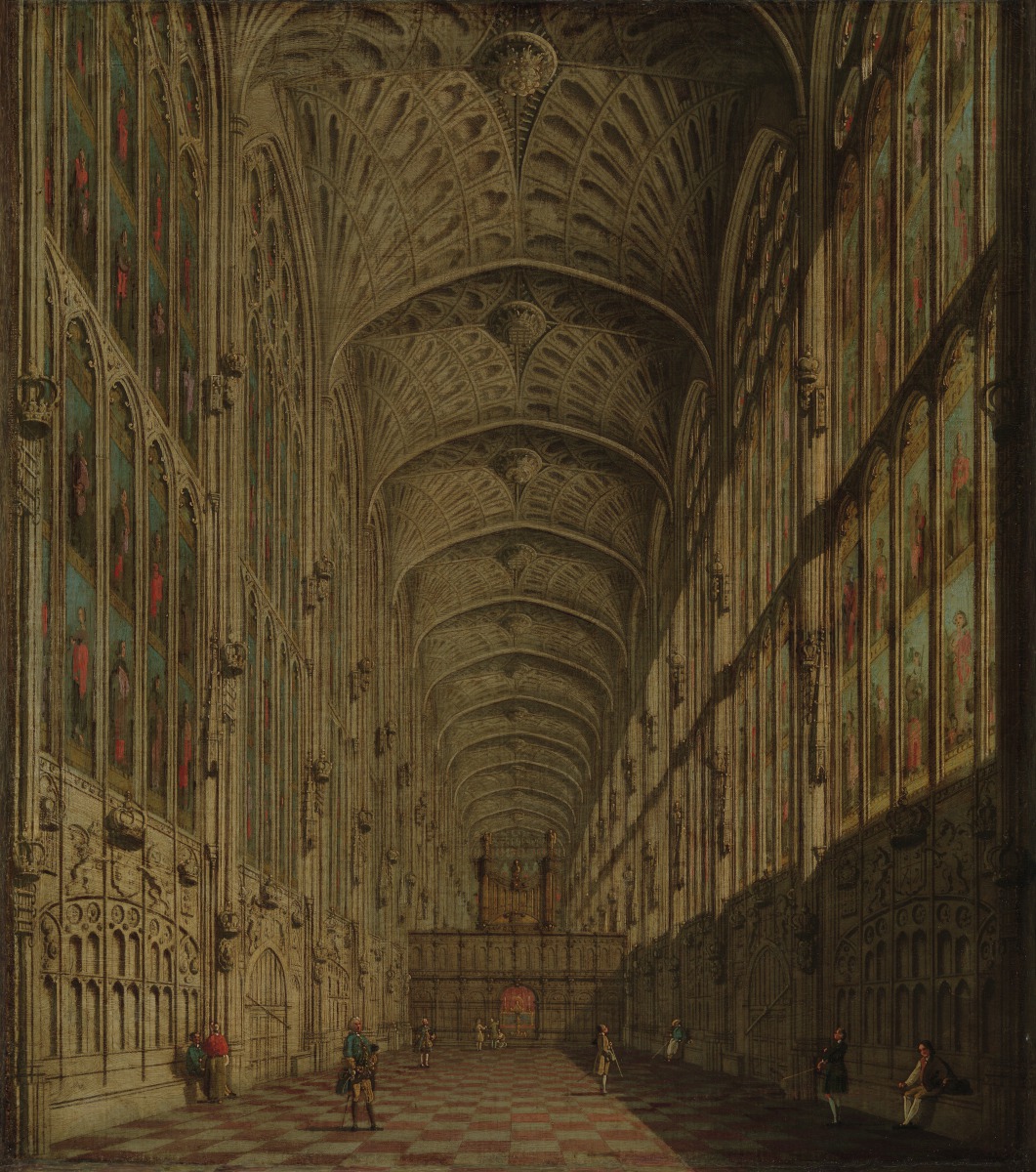
    I didn’t see this artwork by Canaletto at the Virginia Museum of Fine Arts, the only artist that I routinely hunt out at every gallery I go to, but that’s primarily because it’s not on display. Painted between 1746 and 1755, it’s the interior of King’s College Chapel in Cambridge and it was given to the gallery by Elizabeth Golsan Schneider, in memory of her mother, Florence Ramage Golsan.

    This painting was once owned by Horace Walpole, the son of the first Prime Minister, Sir Robert Walpole and was displayed at his Strawberry Hill House at Twickenham (which is part of the Borough of Richmond, relevant as that’s where this city in Virginia is named after). The Lewis Walpole Library of Yale University has managed to ascertain that this painting was being displayed in the breakfast room of the house in 1774 and in the waiting room in 1784. It was sold at auction on 17 May 1842 and then it got a bit lost to the record, but it was given to this gallery in 2002. As a little aside, that sale was because George Waldegrave, 7th Earl Waldegrave, has spent all the family money and they had to flog everything off, and one of his distant relatives was the far more capable William Waldegrave, the former Conservative Cabinet Minister.

    It’s a great shame that this artwork isn’t on display and there’s an argument that I keep reading about just how much stuff is in the collections of museums and galleries that the public can’t see. I know some galleries will make artworks available on request, but I can’t imagine that many do given the complexity of shunting stuff about. Perhaps this painting will make an appearance on display in the future, but it’s a shame that it can’t be despatched somewhere else that could display it, particularly if it was in Cambridge. I also find it slightly sad that someone has donated an artwork to a gallery in memory of someone else and it’s just stuck in a backroom somewhere and not on display. On the positive side, there is a huge expansion of the gallery planned which will give them more space, so this might alleviate some of the limitations they have.

  • 2022 US Trip – Day 7 (Virginia Museum of Fine Arts – Grand Canal: The Rialto Bridge from the South by Canaletto)

    2022 US Trip – Day 7 (Virginia Museum of Fine Arts – Grand Canal: The Rialto Bridge from the South by Canaletto)

    20220924_114038

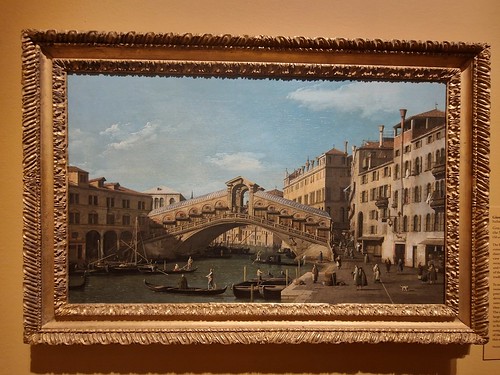
    This will have to be the last post about individual artworks in the Virginia Museum of Fine Arts or I’ll never catch up on this American trip blog. But, I do like to note Canaletto paintings and so I can’t miss this one out. It was painted in either the late 1720s or the early 1730s using the camera ottica technique which allowed a projection of the image to be used as a basis for the artwork. I very much like the detail in these paintings, they’re near photo realism as far as I’m concerned and the quality of them shines through. The artworks are also so accurate that they can be used to measure climate change over the centuries.

    This artwork and around 80 others, are on loan from the Jordan and Thomas A. Saunders III Collection, although I don’t know how long they’ll be here for. A very similar artwork by Canaletto was for auction a few months ago, with an estimated price of $3 to $5 million, slightly beyond my art purchasing budget (which to be fair is zero).