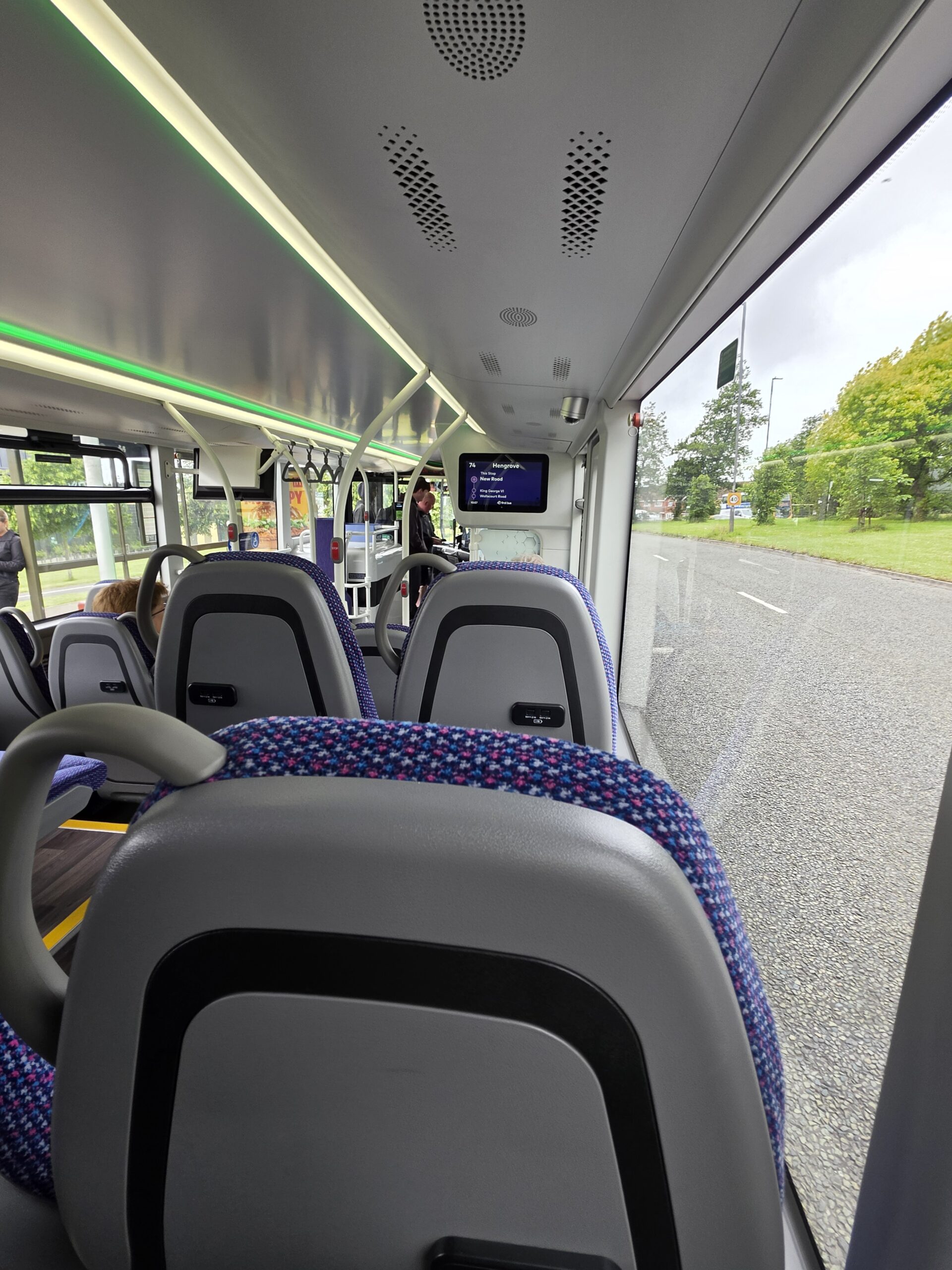
Perhaps one of the unexpected little joys of using buses in Bristol is that First Bus has, quite correctly, decided that the announcements should sound as though they belong there. Not a flat national voice, not the slightly bloodless tone of railway automation and not the sort of corporate voiceover that sounds as though it was recorded in a cupboard near Milton Keynes. Instead, there is a West Country accent and it’s very noticeable for passengers.
So I am choosing to regard Bristol’s bus announcements as a small civic victory. Not a grand one, admittedly, but a win. Fran Edwards was first revealed in 2019 as the voice behind the announcements, and that she now voices announcements across Bristol and the wider West of England network. I wonder if they’ll do this in the Norfolk countryside next…..
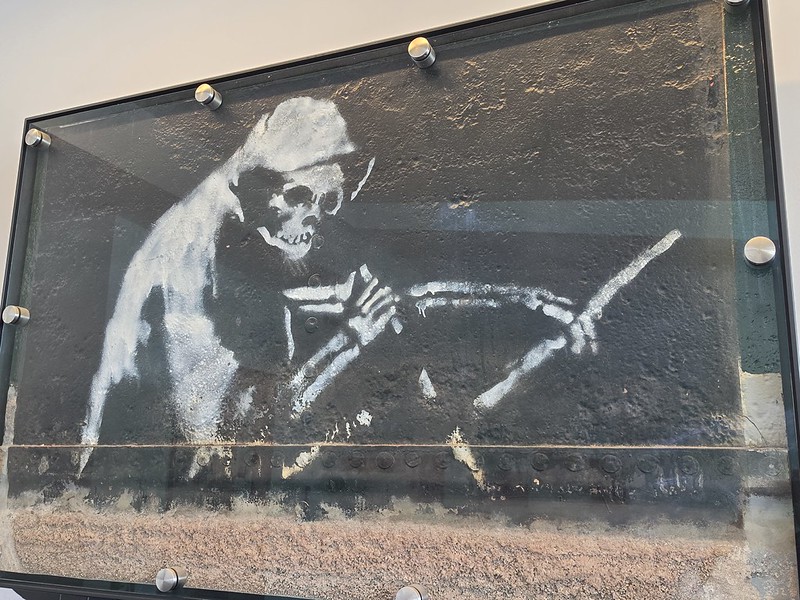
Banksy is one of Bristol’s most famous cultural exports, which is a slightly odd phrase to use about an artist whose identity remains officially unconfirmed and whose early career depended rather heavily on not asking permission. The museum doesn’t name him, but it gives his date of birth as 1974, which aligns with the long-running claim that Banksy is Robin Gunningham, a Bristol-born figure who has repeatedly been linked with the artist, although the anonymity remains part of the performance and should probably be treated with a little caution. Still, when a museum gives Banksy a birth year rather than leaving him floating entirely in the mist, it feels like a discreet nod towards the most widely accepted theory.
The Grim Reaper is a very Bristol object because it belongs to that awkward middle ground between mischief and heritage. Painted in 2003 on the side of Thekla, the former cargo ship turned nightclub in Bristol Harbour, it shows death rowing along the hull with a pleasingly bleak sense of purpose. It worked because of its setting: a skeleton in a boat, on a boat, in a harbour city. The work was later removed from the vessel because exposure to the elements was damaging it, and it now survives as a conserved object rather than as something glimpsed outside in its original setting.
I know that Banksy blurs the lines between graffiti and art, but his work is intriguing and interesting, usually drawing a crowd who want to see it. And this feels like one of the most appropriate places for one of his artworks to end up, all very lovely.
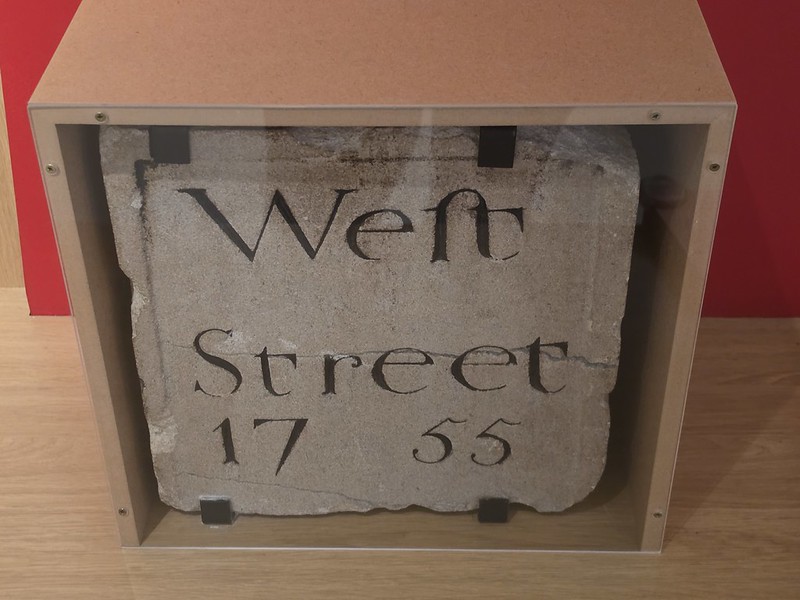
There is something rather pleasing about a street sign that has survived since 1755 and still does exactly what it was made to do which is to announce, without drama, that this was West Street. It comes from Bedminster, now part of Bristol, but historically a separate place south of the Avon, with its own parish, streets and identity before the city expanded around and into it.
I like random stuff like this because residents walked past this sign on their way to work, to market, to church, to the pub or to whatever little arrangement the eighteenth century had decided to inflict on them that day. Most of them presumably ignored it completely, which is usually the fate of useful things. Now it sits in a museum, looked at by people like me, apparently emotionally invested in carved municipal directions. I probably shouldn’t try and attribute meaning to so many things, but I doubt that very many of these survived.
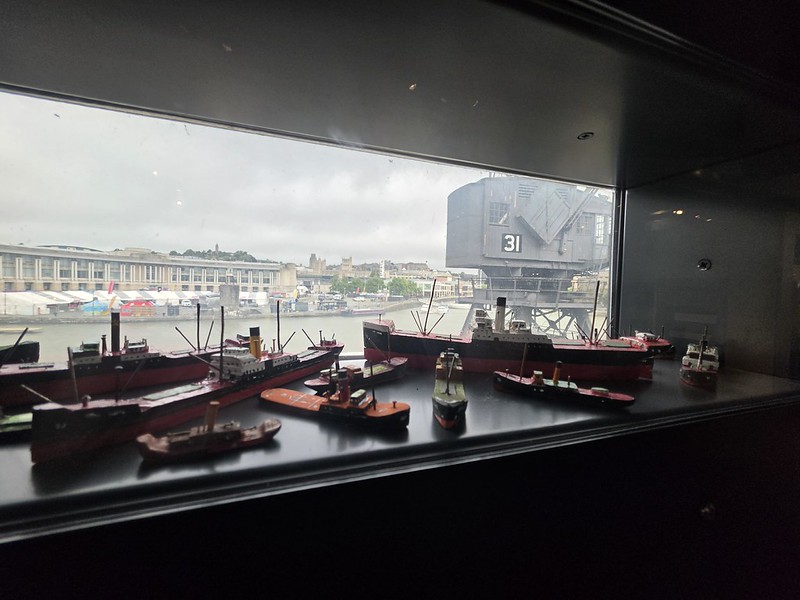
I’ve been to M Shed a couple of times before, it’s a free museum situated in the heart of the former Bristol dockyards which is already a strong start. It appears to be in quite a state at the moment, probably around half of the interactive exhibits are out of order and it all feels a little beleaguered. There is something quite dispiriting about a button that promises excitement and then delivers only silence, although admittedly that is also a fair summary of much of adult life.
It’s also one of the most interestingly curated museums that I’ve seen, with some erratic descriptions of items and an odd flow with no clear narrative as if numerous museum concepts have been asked to share a space and they’re trying to be very polite about it. The slightly annoying element for me was often trying to find where they had put the description of an item, it was too often in small white writing on glass nowhere near the actual exhibit. I won’t linger on this point, but I suspect some of the signage was developed by someone with excellent eyesight and a dangerous level of confidence in reflective surfaces.
I fear that this is one of those museums which has been underfunded and I wonder whether they’d be better shuffling the exhibits here into one of the other city museums and looking to repurpose this back into the Bristol Industrial Museum that once stood here. It felt to me that the museum has tried to put various themes into the exhibits over the years that now don’t flow together and there are great chunks of Bristol’s social history missing or underplayed. There are also empty spaces in the museum where more history could be told, but that might be again due to underfunding which I suppose is a monument itself to austerity.
Entertaining as some exhibits were, and helpful as the staff members were, I’m not entirely sure that I discovered much during my visit in a way that I’d normally expect from a museum. However, there are nice views over the river from the viewpoint on the first floor and the Banksy artwork was an appropriate and interesting exhibit. And I can’t complain much, despite hinting at that here, since there’s no admission charge and also no pressure to make visitors give a donation and that is genuinely appreciated.
Anyway, I’ll now witter on about some of the exhibits, so that’ll be exciting for everyone. Well, something like that. I appreciate this may not be the sort of promise that makes people cancel other plans, but my two loyal blog readers know by now that this is the level of jeopardy on offer.
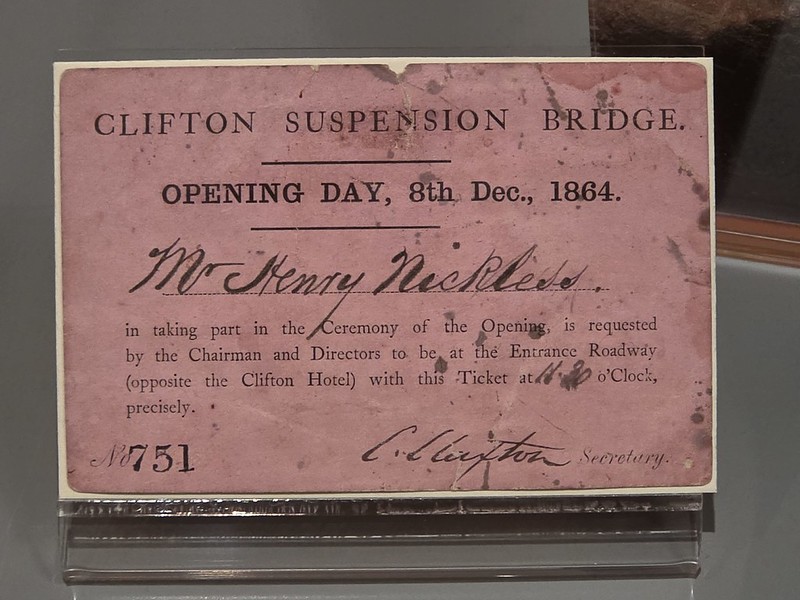
This is a ticket for the opening day of the Clifton Suspension Bridge on 8 December 1864, which I think is a rather lovely little survival from one of Bristol’s great civic set-pieces. The ticket was issued to Mr Henry Nockless (although more on that in a moment), who was requested to be at the entrance roadway opposite the Clifton Hotel. The bridge had taken a very long time to reach this point, having been designed by Isambard Kingdom Brunel (1806–1859), who rather inconveniently died five years before it opened.
The bridge itself had been discussed, delayed, redesigned and generally subjected to the kind of long civic gestation period that makes modern planning disputes seem almost brisk. It used chains from Brunel’s demolished Hungerford Bridge in London, which is pleasingly thrifty in a grand Victorian way. This ticket belongs to a particular morning, a particular entrance, a particular man and a particular instruction to arrive precisely on time. It’s a nice reminder of history and at least back then they didn’t just send a PDF.
Back to Henry Nockless and I don’t understand where the museum has got that name from. There was no Henry Nockless in the country at that time and I think that ticket reads Henry Nickless, of which there were numerous locally. No Henry Nockless has ever been mentioned in a UK newspaper, but I find it highly unlikely that the museum hasn’t checked this.
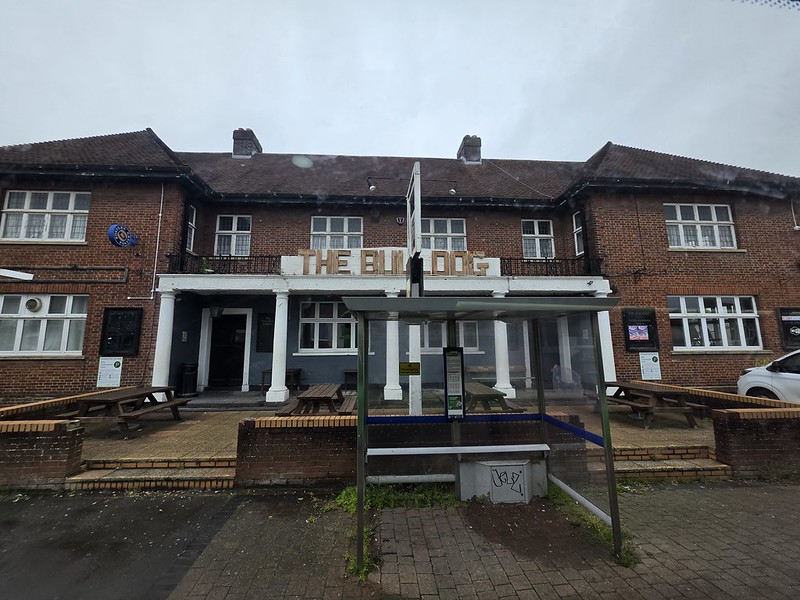
Posted without any real comment, just I’m not sure that I’ve seen pub signage on an inter-war building quite like this. Made up of bits of wood nailed together it’s quite quirky and has some character, although I suppose quite thrifty…… But if you need a sign and have some wood, it’s perhaps a sensible choice.
After an overnight coach journey with National Express, I felt that I deserved a coffee and I knew a place that would do unlimited coffees for £1.89. This is the JD Wetherspoon operated Commercial Rooms, which they’ve been running since the 1990s, so it’s one of their earlier venues outside of London.
It’s a grand building internally and the chain give the history of the name:
“Situated in the heart of Bristol’s old city and opposite the historic Corn Exchange, The Commercial Rooms was built in 1810 as a meeting point for the city’s traders. The retained weather vane, above the bar, would let merchants know whether it was safe for ships to negotiate the treacherous Avon Gorge. The three statues at the top of this grade II listed building represent Bristol, commerce and navigation.”
It’s one of the smaller JD Wetherspoon venues, there’s the main room and then a back room that was once a meeting area, with the toilets located upstairs. They had an impressive seven real ales available including options from Thornbridge, Brains and Otter, all priced at under £4 a pint.
I sat near the coffee machine as I thought that would save time.
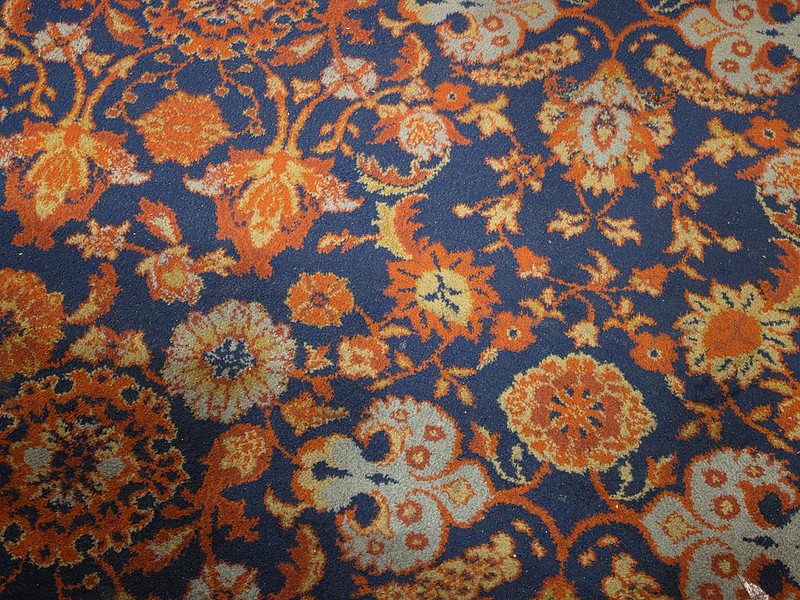
My now obligatory carpet photo.
As it’s a JD Wetherspoon venue, I feel obliged to have a little look at the reviews, which are broadly in keeping with the chain’s average across the country.
“If you want to hang out with friends and have a fun time, don’t go to commercial rooms. The atmosphere was awful, no music at all and the dim lighting is horrendous”
Perfect. No music.
“The security was so rude and very aggressive. He said he doesn’t take BRP. Im international student and if we can not use BRP, we can use E-visa. No one goes around carrying Passport, which is the most important document while staying abroad”
I carry my passport. No ID, no entry….
“The bouncer informed us that Wetherspoons management had installed microphones around the pub to listen in to what the customers are talking about.”
They haven’t.
“Not Pet friendly. Went elsewhere.”
Disappointingly, this is the only negative review about someone not being allowed their dog inside. Well, I assume it was a dog they tried to bring in, I suppose that it might have been a cat.
Now there is one review of a pint of Guinness with absolutely no head and that does seem to be a very valid complaint, it would be hard to pour a Guinness like that. A deserved 1 out of 5 if that is genuinely true and it was from three years ago, so more unlikely to be AI generated.
“Waiter told 2 year old to shut up on a Saturday affernoon”
Reasonable.
Anyway, I was entirely content at this visit, the team members were friendly, it was pretty clean and I had several coffees for £1.89. And the building had some history to it, which always adds positively to a visit for me. I’ve visited this one a few times over the years and for a cheap coffee (well, several coffees), it certainly didn’t disappoint.
After the first part of my coach journey from London Luton to London Victoria coach station, it was now time for the second part which would get me to Bristol. I’ll note here that I was getting a coach because GWR’s fares are far too expensive and although I do enjoy trains, I prefer not to fund them as though I am making a modest contribution to railway infrastructure personally.
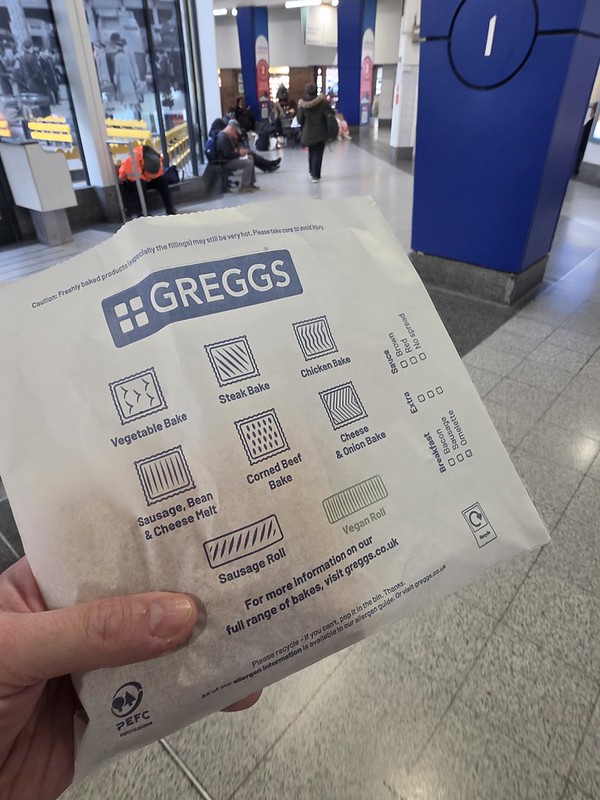
O2 give me one baked item, or coffee, at Greggs for £1 every week, so I thought now was an ideal time to get a chicken bake for £1. It was hot and delicious.
I managed to find a seat at the packed gate. It is not an especially glamorous place if I’m being honest, but it does at least provide a useful reminder that all forms of travel eventually involve sitting near strangers and hoping everyone behaves. Unless you’re my friend Richard who tries to avoid people unless it’s in a VIP area.
Much as I’m sure these warnings are useful to avoid anyone doing something dangerous, a number of passengers were struggling to read the departure information which is a little lost at the bottom of the screen.
And time to board.
And the emergency exit row seat again, very lovely.
This turned into something of a sleeper service for me as I fell asleep in London and woke up in Bristol. This tells its own story that the coach must have been peaceful and the driving smooth, so I was suitably impressed and refreshed ready for the excitement of Bristol which I knew was going to involve food, craft beer and a museum. And is there anything more to life?
It was another reminder though that National Express services seem to be getting quieter, it might now be the time to increase the space between seats and address some of their high pricing, before FlixBus steals their entire market. FlixBus are getting a little bit unstoppable, they’re already knocked most Megabus services out of business…..
As I always allow far too much time for connections, I had a wait of three hours at London Luton Airport after my flight from Skopje. I tried to get a filter coffee at Pret as they’re a cheap option, but they told me that they had run out. I remained at Pret anyway as they had a power point which suited my needs. At this stage, the commercial transaction was less about food and drink and more about temporary access to electricity whilst sitting in a chair. But, I couldn’t board a coach hungry and so I obtained a breakfast of champions meal deal at the new Sainsbury’s at the airport. Does travel get any more exciting than this?
And is there anything more beautiful than London Luton Airport at sunrise? OK, there probably is, but it’s intriguing watching the light appear whilst also observing already pre-annoyed families wheeling their cases and angry children into the airport.
Mine was the 05:40 which was showing as delayed by six minutes. This didn’t overly worry me, but I was conscious that National Express often saw their delays extend and I only had a thirty minute connection at London Victoria Coach station. I decided to ask the driver of the 05:25 service before if I could get on his coach and he told me that I could do what I liked, which I took as a yes. In fairness, the driver was very friendly and it was early.
Two of us boarded the coach, so I understood the driver’s lack of concern about whether I boarded or not.
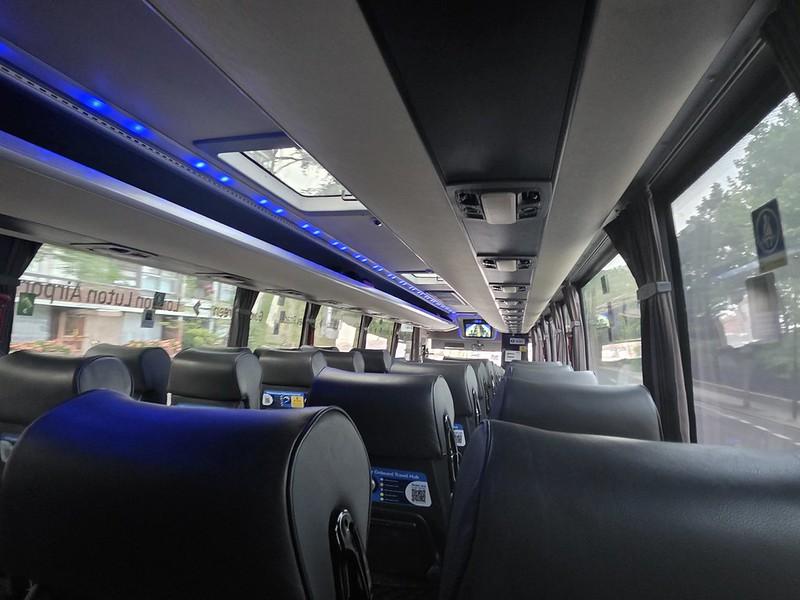
I got the emergency exit door seat, although there wasn’t a huge demand for it as the other passenger had sat at the front of the coach. It was too early for a logistical dilemma over seating, so I was pleased at the efficiency of this arrangement. I think this service regularity is more for getting passengers to the airport for their early morning flights, so there is likely usually a surplus of spaces for taking passengers away from the airport.
And safely into London Victoria coach station. As an aside, National Express seems to have been struggling recently and their services rarely seem very full. It’s been a while since I’ve been here and half the services appear to now be run by FlixBus, perhaps an observation that National Express got greedy with their prices and customers walked away. Anyway, it was then time to find the coach that would take me to Bristol.
One of the slight annoyances about Skopje Airport is that I couldn’t complete online check-in in advance, I had to go and see a staff member at the Wizz Air check-in desk to check documents. Despite checking, the staff member at the check-in desks for earlier flights couldn’t check my documents, but he did tell me what desk would be opening and when so that I wouldn’t have to wait in a queue when my flight did open.
It wasn’t the busiest of airports.
The helpful check-in agent told me to wait at precisely this spot at a particular time. I looked like a very experienced traveller at this point and a number of people started to queue behind me.
It worked, it meant I was at the front of the queue and was the first one through the security area and that meant I could have more time in the Primeclass lounge. I accept that there’s more to life than a free coffee and beer in an airport lounge, but there’s no point lingering about when that’s available.
The signage, as ever for Wizz Air, was clear and there wasn’t long to wait despite the aircraft having been delayed.
This will interest no-one other than me, although that’s true for this blog in general, but not only was it the same aircraft but it was also the same row. This photo from my previous flight shows the window seat I had this time, so that’s handy planning in blog imagery terms. Some people arrange their lives around career development, relationships or spiritual growth. I appear to have reached the stage where I am pleased by the efficient reuse of an aircraft seating photograph.
Wizz Air are very good at keeping the cabin relatively dark on late evening flights, they do their usual run of food and drink, but they did it quietly and try to avoid disturbing passengers. I was happy with my randomly allocated window seat as I fell asleep for half the flight.
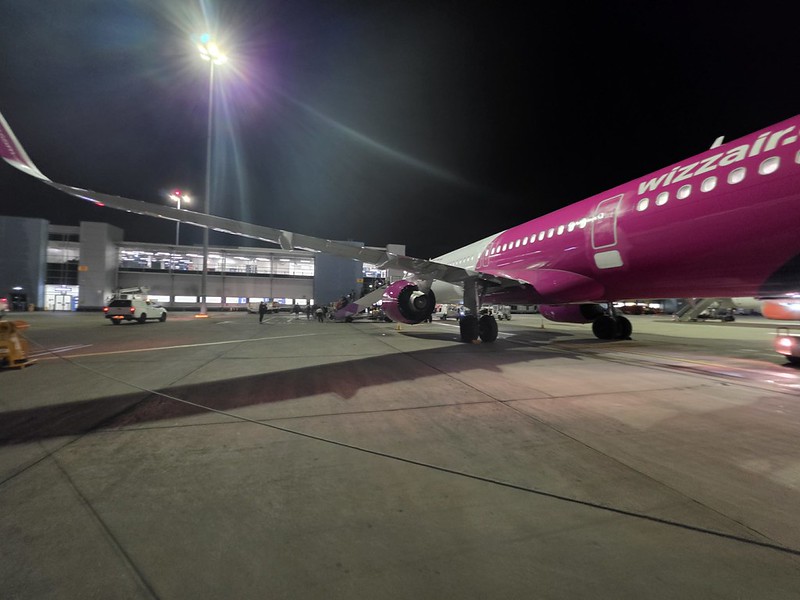
And safely back into London Luton airport and it was pretty much on-time as the padded schedule had enabled them to catch up. Unusually, there were very long queues for non-UK passport holders, I was through the border in under five minutes but it would have been a longer wait for those without UK or EU passports.
Anyway, this was another £8.99 flight with Wizz Air where I was suitably delighted with the whole arrangement. The aircraft was clean, the crew were friendly, everything was just about on time and it was a stress free experience.