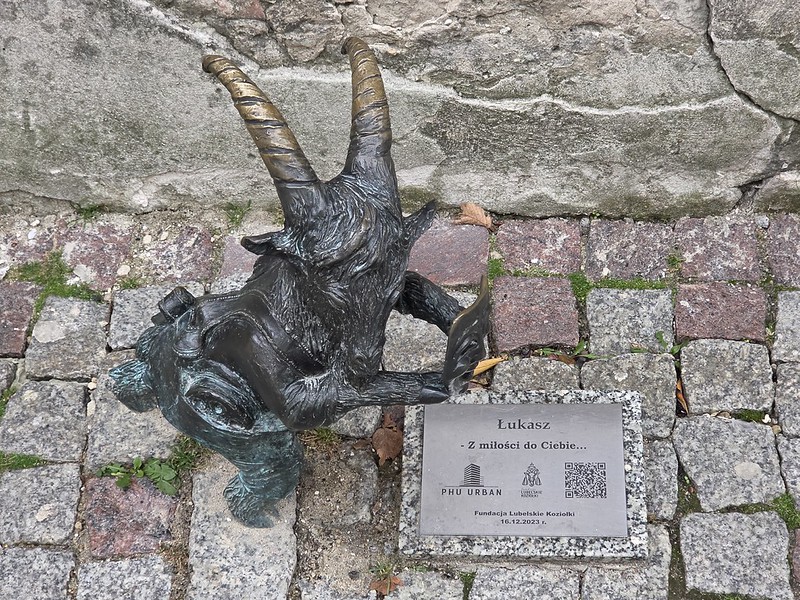
This rather lovely little sculpture on Jezuicka Street is Łukasz, one of the goats dotted around Lublin as part of the Lubelskie Koziołki trail. Installed on 16 December 2023 opposite the Old Theatre, he has a theatrical mask to suit his surroundings.
I took the photograph partly for my friend Łukasz, who comes from this area of Poland, although the sculpture has a different namesake. I wouldn’t want him getting ideas about being commemorated in bronze just yet. Although perhaps one day.
The name honours Łukasz Rodakiewicz, the architect responsible for the Old Theatre, built in 1822. According to the story celebrated by the sculpture, he built it to fulfil his wife Marianna’s wish to have a theatre of her own. The inscription beside the goat, “Z miłości do Ciebie…“, means “Out of love for you…” Quite a substantial romantic gesture, with rather more ongoing maintenance than a bunch of flowers though.
The trail uses these small sculptures to introduce people and stories associated with different parts of the city. I rather like the approach, giving people a reason to stop and learn something without requiring them to commit to a museum visit. Here, a goat beside the pavement provides a link to the theatre opposite and the people behind it. It also gives me another category of things to photograph, which is clearly what my already restrained photographic habits needed……
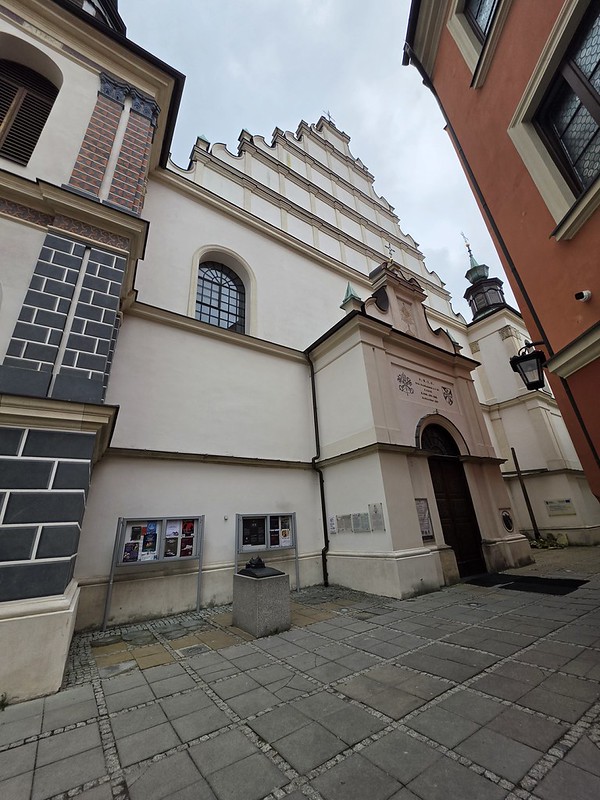
The Dominican Basilica of St Stanislaus sits at the end of Złota Street, its tall decorative gable rising above a relatively modest entrance. The present church developed from a foundation supported by King Casimir the Great in 1342, although the Dominicans were established in Lublin before then. A major fire in 1575 caused extensive damage and much of its present appearance dates from the rebuilding that followed, with further additions over the centuries.
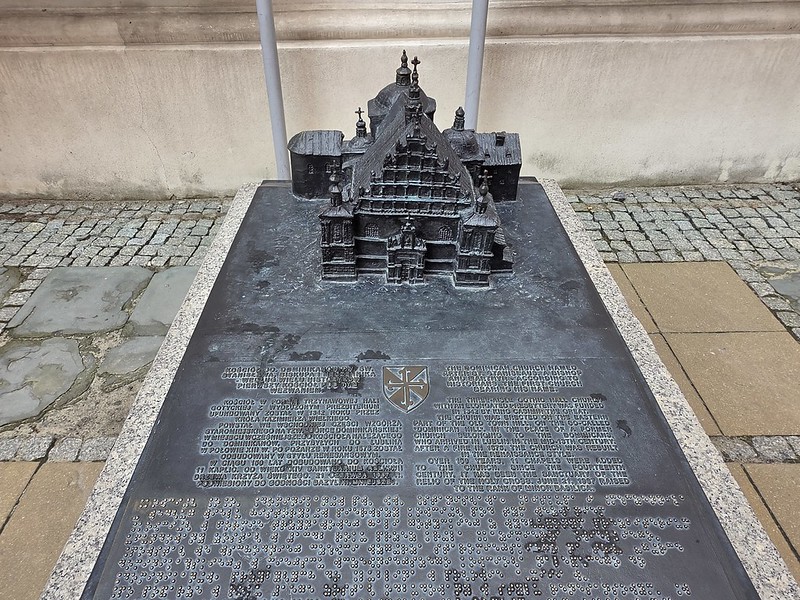
Outside is a tactile model of the basilica, accompanied by raised lettering and Braille. It’s rather easier to understand what the front of the basilica looks like without quite a few buildings getting in the way.
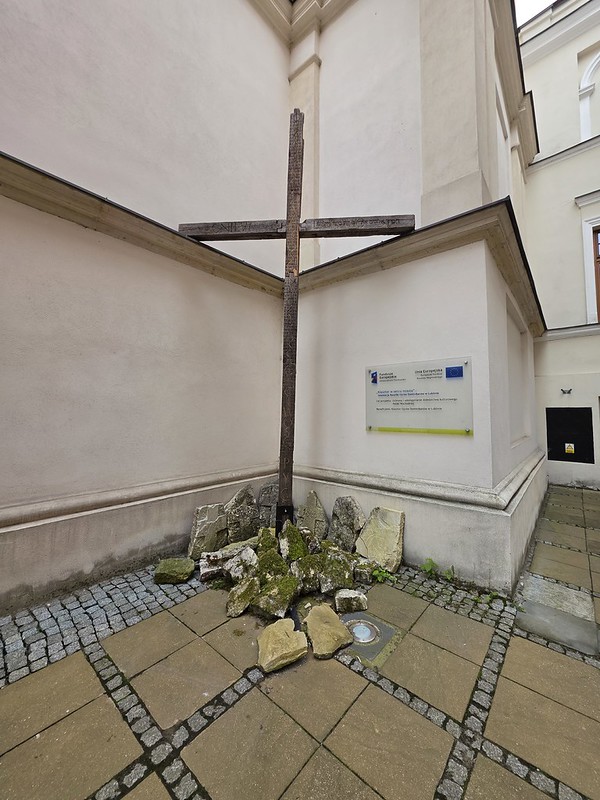
This tall wooden cross stands amongst rough stones in a corner outside the basilica. I’m not sure why they picked this particular corner, but I like the simplicity of it.
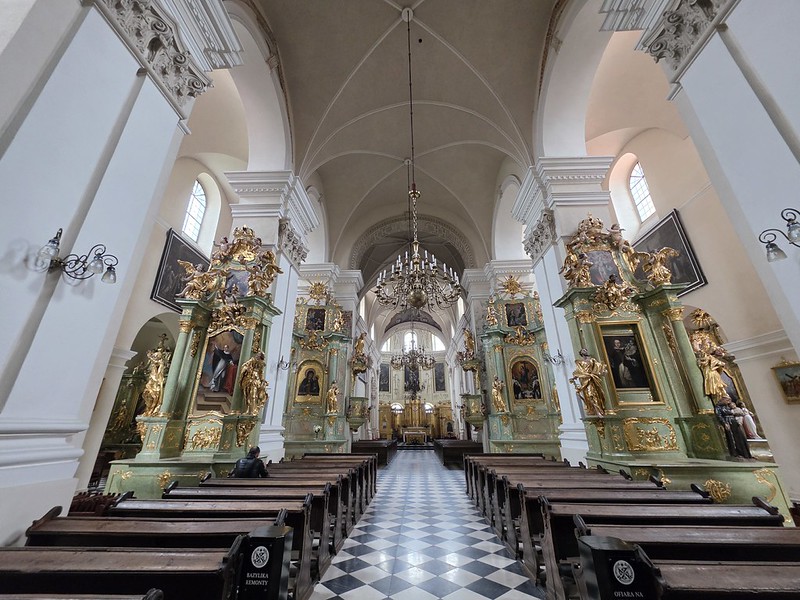
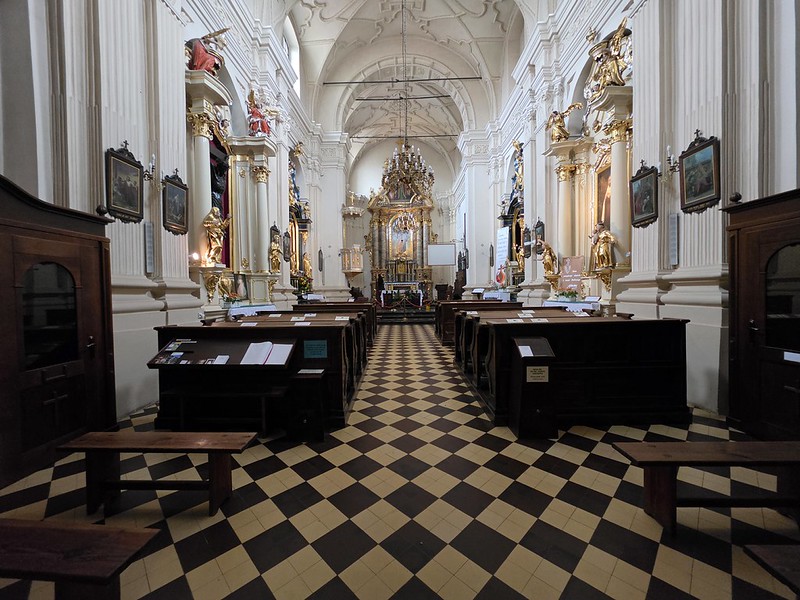
The nave of the basilica and I’m pleased that this is one of those photos I’ve taken which is actually sort of level. I like the flooring, it draws the eye towards the chancel and there’s certainly no shortage of things attached to the wall to look at.
As an aside, I was slightly surprised to see a confession taking place in a traditional confessional just off the nave. I had somehow assumed that these things generally happened in separate private rooms now. A reminder that, whilst I was wandering around admiring the furnishings, other people were getting on with the religious purposes for which the building was intended.
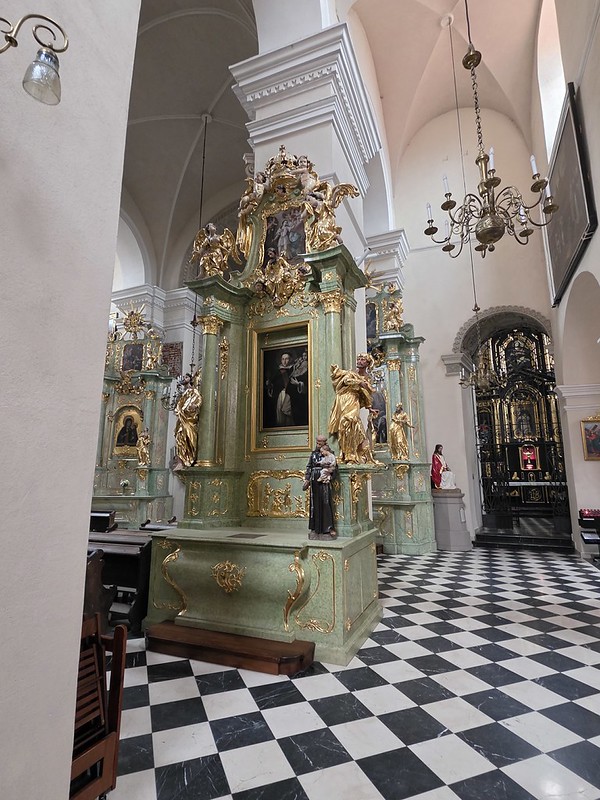
This is the altar of St Hyacinth, known in Polish as św. Jacek, with an eighteenth-century painting of the Dominican saint at its centre. They seem to like this pale green colour around the basilica as well.
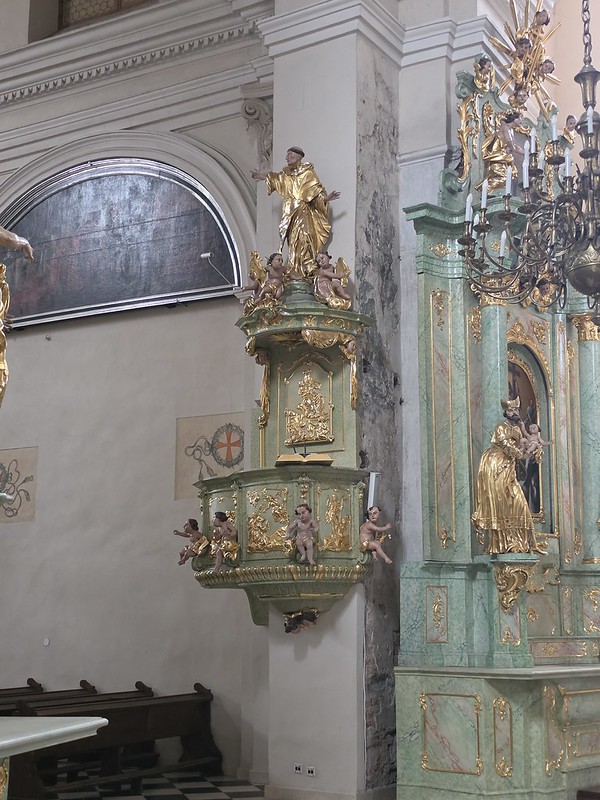
The basilica has two facing pulpits, made in Sebastian Zeisel’s workshop in 1761. The church’s guide explains that they served preaching at different altars, as well as providing symmetry, rather than being installed for opposing speakers to debate each other. This one continues the green and gold colour scheme, with small figures around the front and a saint above the canopy. Quite an elaborate place from which to address a congregation, although presumably useful for keeping their attention before microphones became available.
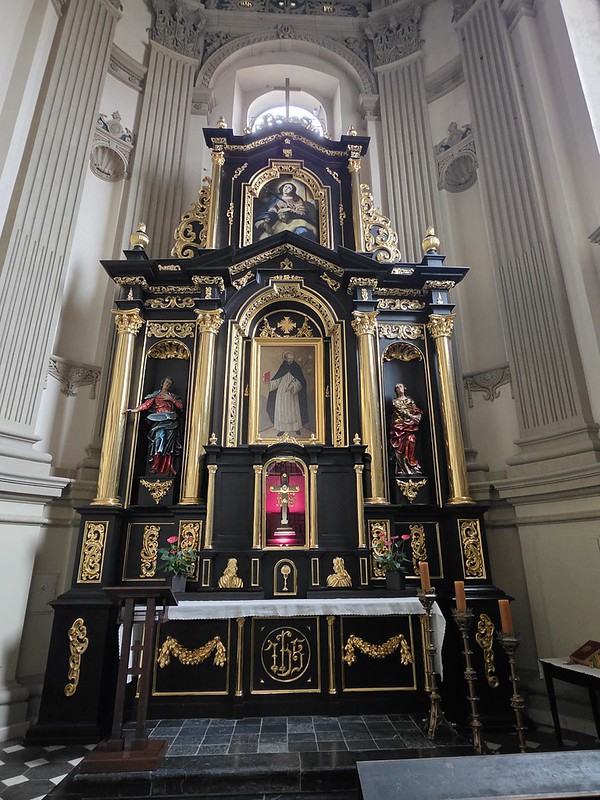
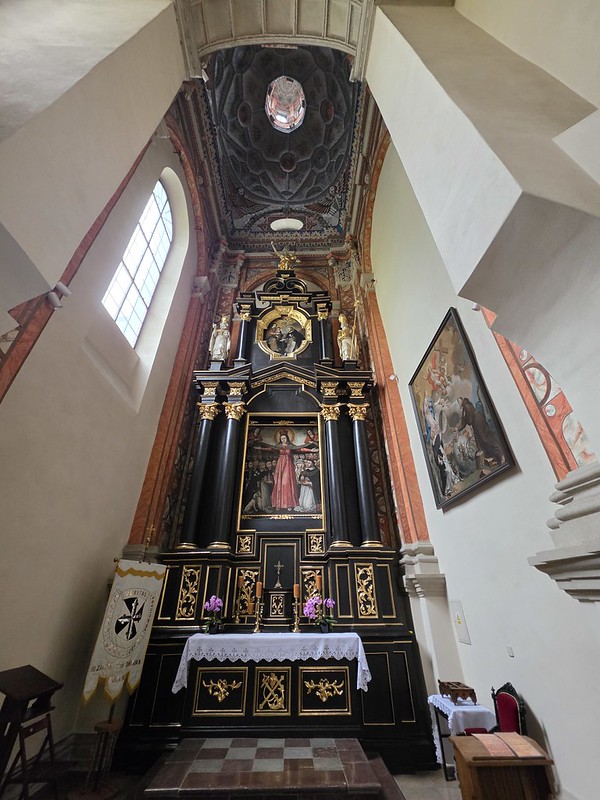
The Firlej Chapel has a black and gold altar, with a painting of St Dominic made in 1645 by the Dominican artist Brother Reginald. The chapel was founded in 1615 as a family burial place and somewhere to house the relic of the True Cross. The relic itself was stolen from the basilica in February 1991, a rather sub-optimal later chapter in the history of something which had shaped the church’s religious life for centuries.
The Ossoliński Chapel contains a painting of the Virgin Mary sheltering members of the Dominican order beneath her cloak. Founded in 1624, the chapel has changed dedication as its devotional images have changed.
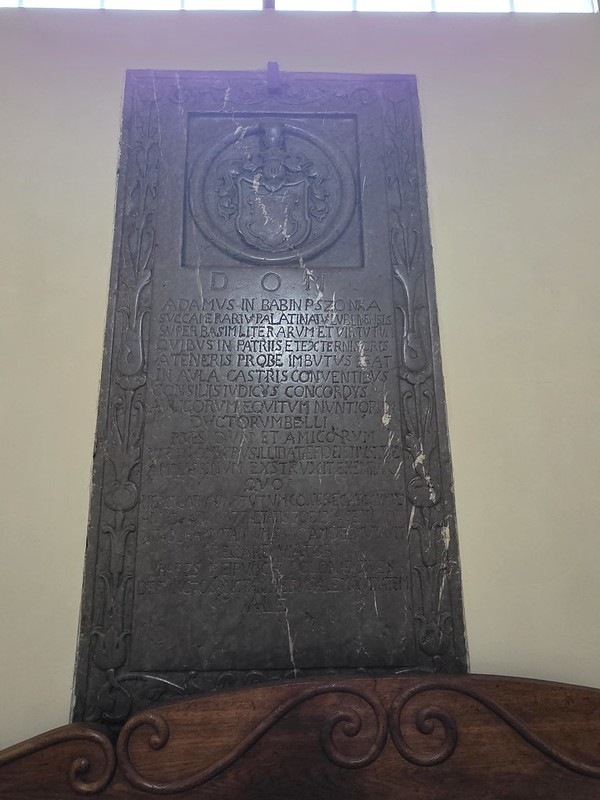
This memorial tablet commemorates Adam Pszonka of Babin, who died in 1677, and is in the Pszonka Chapel. Its dark surface and the light from the window made photographing it something of a challenge. Nevertheless, these individual memorials are useful reminders that the chapels were also places of family remembrance, alongside their religious functions.
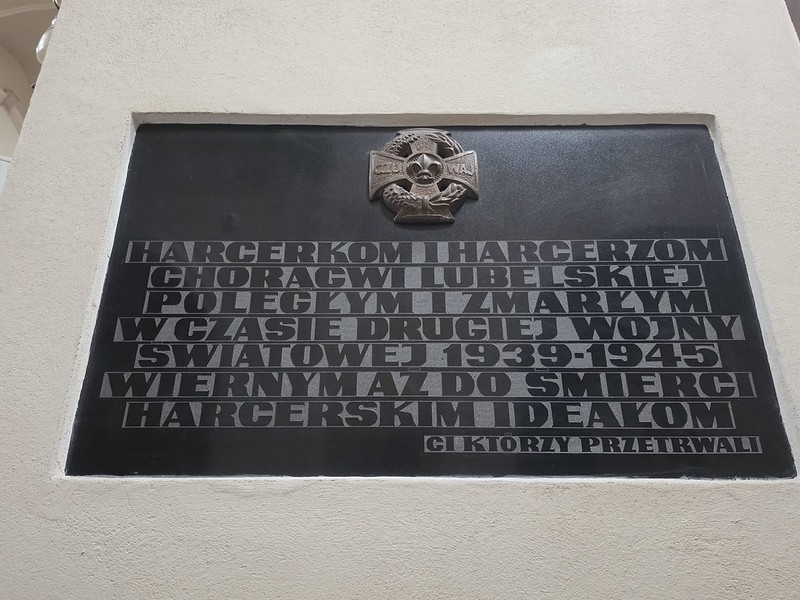
This plaque remembers the female and male scouts of the Lublin scouting region who were killed or died during the Second World War, between 1939 and 1945. It describes them as faithful to their scouting ideals until death, with the dedication below coming from those who survived. Above the inscription is the Polish Scout Cross bearing the motto “Czuwaj”, meaning “Be prepared” or “Stay alert”. A brief memorial, but one that brings the basilica’s history much closer to the present than its seventeenth-century family monuments.
It’s a rather lovely building, although like so many there have been numerous challenging events over the centuries. More recently, the monastery was suppressed by the Russian authorities in 1886, with the remaining friars expelled. The Dominicans returned in 1938, renewing the order’s presence here.
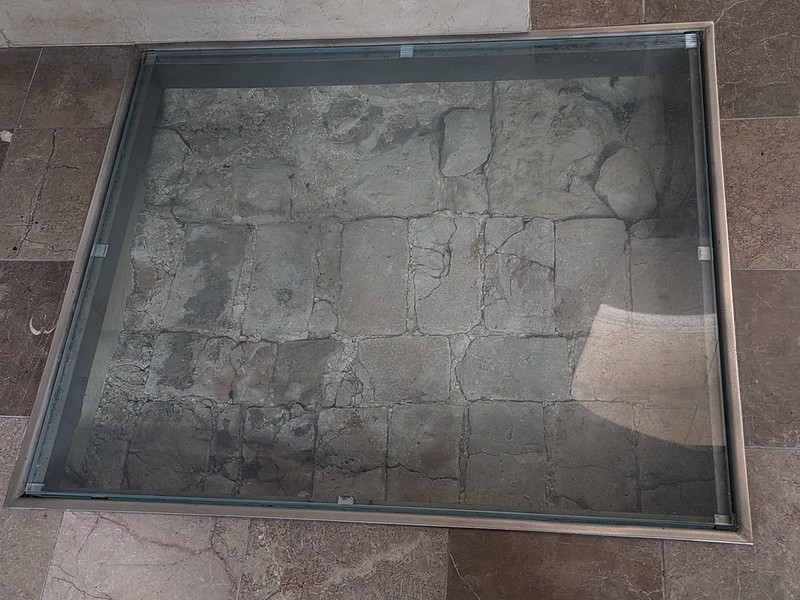
I like a little glimpse into the past and this glass panel preserves a section of older brick flooring in the Szaniawski Chapel of Lublin’s Dominican Basilica. During the restoration that took place between 2015 and 2018, removing the floor installed in the 1970s revealed an earlier brick surface beneath it. The best-preserved section was left in place and incorporated into the finished interior. The chapel dates to around 1660, and it’s possible that the bricks date from the same period, although the conservation report doesn’t give them a precise date. Either way, whether they belong to its original floor or a later replacement, I rather like that they’ve been left visible.
This chapel is also home to The Fire of Lublin painting, so there are reasons to look both upwards and downwards here. Quite a demanding arrangement for someone who can become distracted whilst looking straight ahead, but there we go.
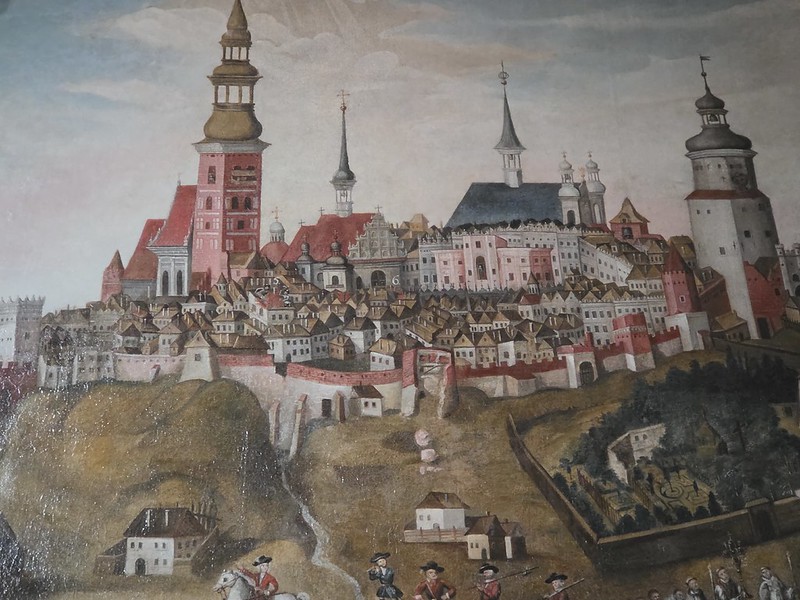
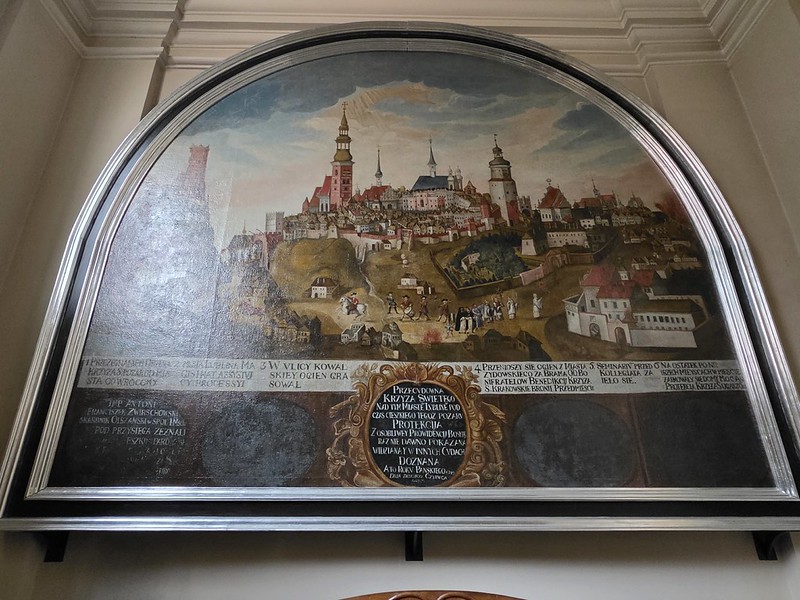
This large and rather interesting painting hangs prominently in Lublin’s Dominican Basilica of St Stanislaus, with rather a lot of the city squeezed into it. Known as The Fire of Lublin, it depicts the fire of 2 June 1719, which spread through the buildings below the Old Town and threatened those within the city walls. The artist is unknown, and the painting is generally dated to the second quarter of the eighteenth century. It was therefore painted after the event, rather than by someone standing about with an easel whilst everyone else fetched water. An early version of filming everything and being absolutely no help.
According to local religious tradition, the Dominican friars carried their relic of the True Cross through the streets in procession, praying for the city to be saved, and the flames were miraculously checked. Very handy. The painting shows the processions below the city walls, including one emerging from the Grodzka Gate, alongside people responding to the fire.
The writing beneath the painting helps explain what is happening, with the central inscription crediting the Holy Cross with protecting Lublin during the fire caused by lightning on 2 June 1719. Numbered captions identify buildings and describe the numbered scenes, including the musicians sounding the alarm and the Dominicans carrying the relic in procession. I like artworks which give an explanation of what they’re showing, as it’s not unheard of for me to entirely miss the main point.
I particularly like the detail of the buildings, with houses packed behind the walls and church towers rising above them. The tall tower towards the left belongs to St Michael’s Church, which no longer stands, making this a useful record of a noticeably different Lublin. Historians have used the painting to help reconstruct the city’s earlier appearance, although it was intended to tell the story of a miracle rather than provide an exact architectural survey.
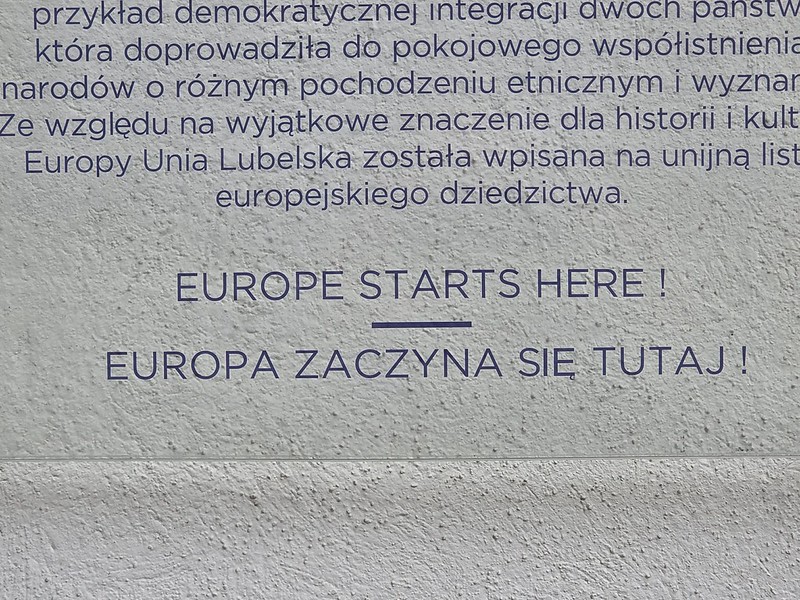
“Europe starts here” is perhaps quite a claim to encounter outside a church in Lublin, but there is a reasonable historical argument behind it. On 1 July 1569, the Union of Lublin brought the Kingdom of Poland and the Grand Duchy of Lithuania together in the Polish-Lithuanian Commonwealth. The two states already shared a ruler, but the agreement established a closer union with a common parliament and a jointly elected monarch, whilst preserving separate laws, armies and treasuries. All very handy and it was an important experiment in governing together without surrendering separate identities.
The connection with the Dominican basilica is also more than geographical convenience. Following the ceremonies at Lublin Castle, a thanksgiving service was held here in the presence of King Sigismund II Augustus. The Commonwealth brought together populations with different languages, traditions and religions, and the Warsaw Confederation of 1573 subsequently established important guarantees of religious peace among the nobility.
Europe might not have begun outside these basilica doors, but the events commemorated here represent an important chapter in the history of European cooperation. Shared institutions and separate identities were already being negotiated in 1569, but this was progress and now Lublin stands firmly as an important part of the European Union.
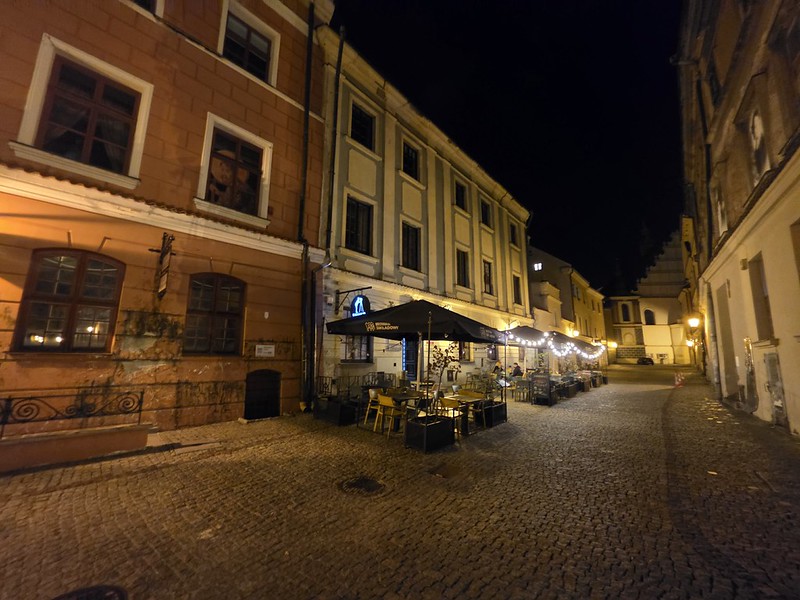
For my one evening in Lublin, I felt that the best choice was to visit U Fotografa which specialises in craft beer and burgers, a whole cuisine style that I can get behind. The outdoor tables lining the cobbled street added some atmosphere, but I went inside as I’m not continental.
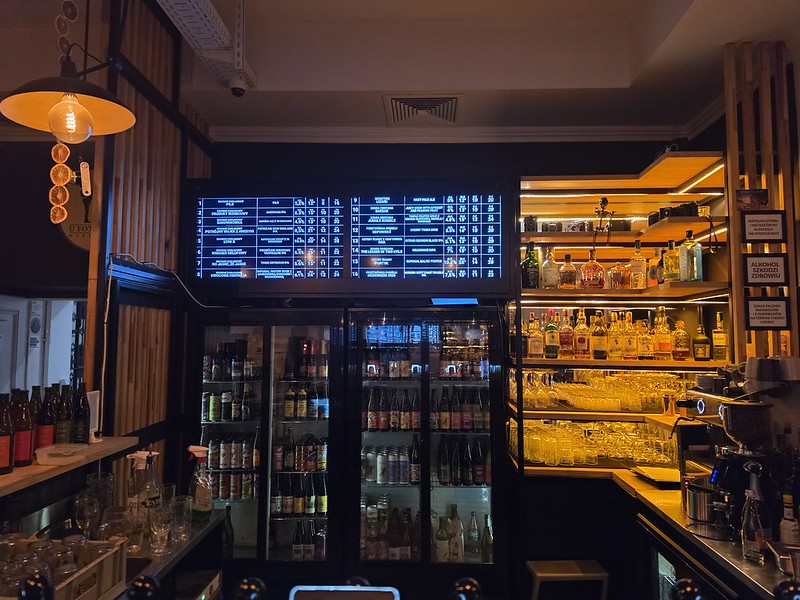
The beer options were suitably interesting and covered a range of styles including sours, pales and stouts. There was a modern and on-trend feel to the whole arrangement and there was a friendly welcome. I asked the staff member if they were still serving food and she found me an English menu which realistically made things easier for everyone.
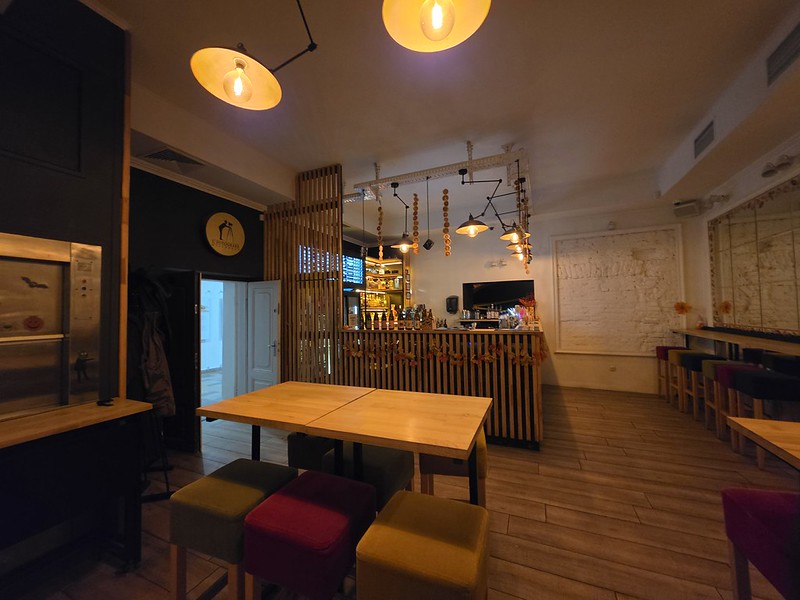
Inside, there were wooden tables, colourful upholstered stools and seating along the walls, with exposed brickwork and warm lighting. Welcoming and comfortable, with the temperature also being appropriate.
My first beer was the Lesser of Two Evils from Ziemia Obiecana brewery who are based in Ksawerów, just outside of Łódź. This is a milkshake IPA which had a complex taste with some bitterness to it and which was also fruity and hoppy.
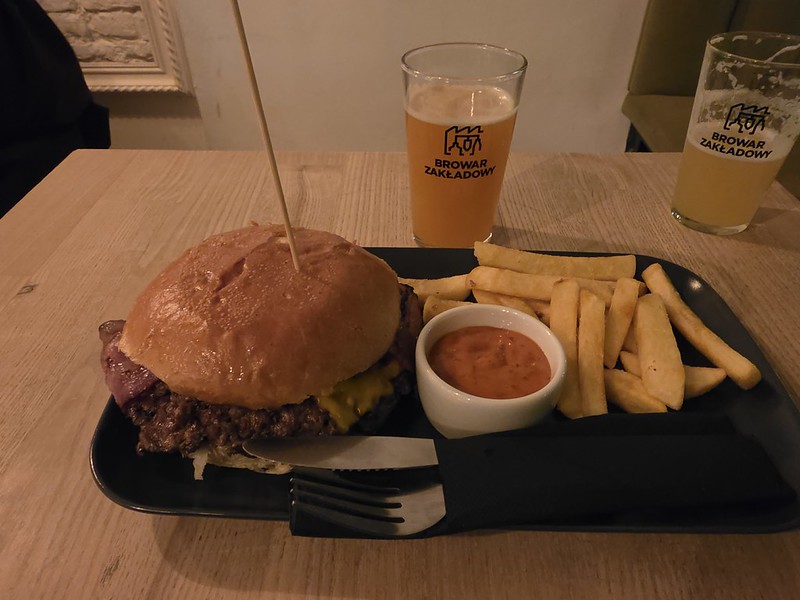
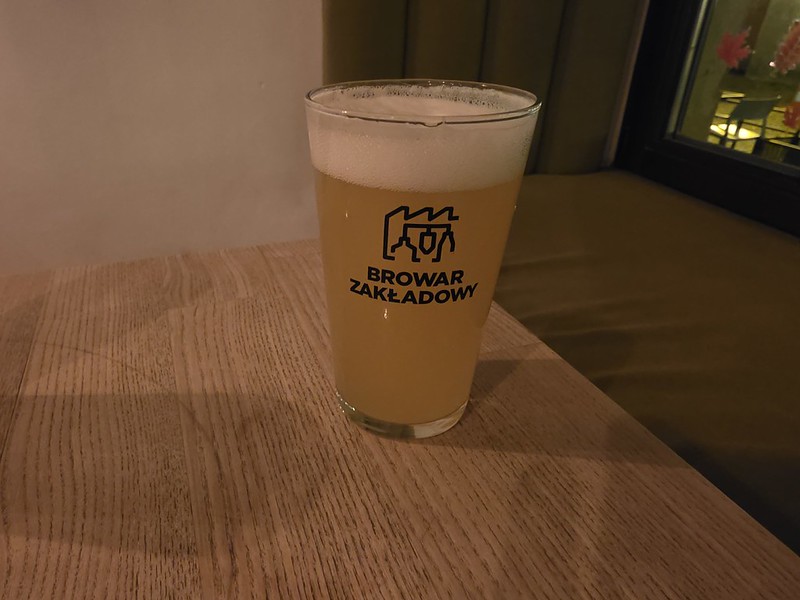
My second beer was the Owocowa Fantazja : Marchew Banan Brzoskwinia from Browar Zakładowy, a pastry sour which was fruity with a taste of mango, apricot, peach and had a punchy flavour. The beer name includes the ingredients of carrot, banana and peach, but the first two were lost to me.
I went for the Tropical Heat burger, which had two beef patties in a brioche bun with bacon, cheddar, pickles, jalapeños and chipotle mayo, accompanied by a little pot of extra hot sauce. The burgers were meaty with a nicely browned crust and the hot sauce elevated matters somewhat. The chips were fluffy internally and firm on the exterior, with everything looking well presented and hot.
I very much liked it here, the service was friendly, the surroundings were comfortable and the prices were reasonable. All rather lovely.
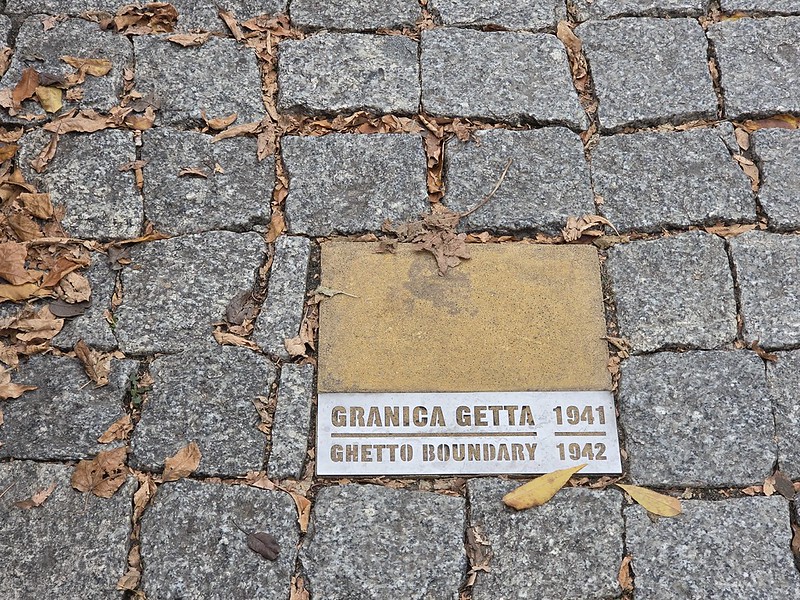
The German occupying authorities established the Lublin ghetto in March 1941 in the Podzamcze district, beneath the castle and around streets including Szeroka and Lubartowska. Jewish residents were forced to move into the designated area, where overcrowding, food shortages and poor sanitation made daily life increasingly difficult. Today, the former ghetto boundaries are marked on the street and I walked around trying to find as many of these markers as I could.
The liquidation of the ghetto began on the night of 16 to 17 March 1942, as part of Operation Reinhard, the German programme to murder the Jews of the General Government (the German administered territory in occupied Poland). Over the following weeks, approximately 26,000 people were deported to the Bełżec extermination camp, while others were murdered in Lublin. Several thousand survivors were moved to a smaller ghetto at Majdan Tatarski, which was itself liquidated in November 1942, with residents murdered or taken to Majdanek. This is the concentration camp on the edge of the city that I visited last time I was in Lublin.
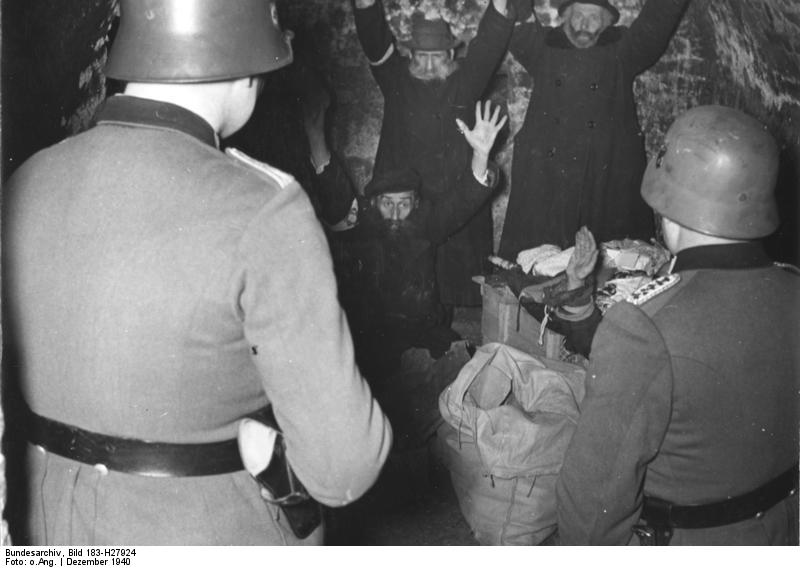
This photograph from the German Federal Archives is particularly haunting. It shows German police descending into cellars in Lublin during a raid dated December 1940, before the formal establishment of the ghetto. The accompanying archive descriptions record arrests and the seizure of hidden food and possessions. Even at this time before the ghetto was established, those caught faced the danger of violence, imprisonment and forced labour.
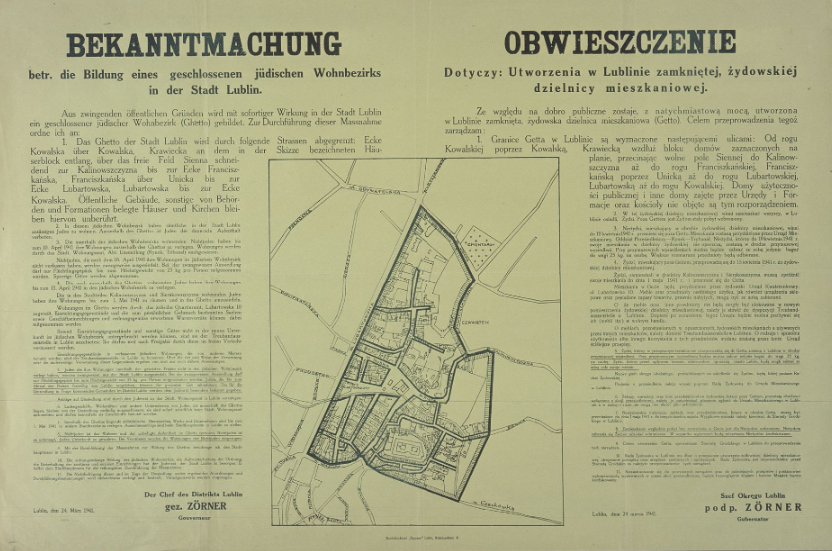
Also from the state archives, this is the announcement in March 1941 of the creation of the ghetto. The Germans stated that it was for “compelling health reasons” using public health as a pretext for forcibly segregating the city’s Jewish population.
St Joseph’s Church on Świętoduska Street was built for the Discalced Carmelite nuns during the seventeenth century. They had acquired an unfinished fortified residence belonging to Rafał Leszczyński in 1630 and adapted it into a convent, adding their own church alongside it. An agreement with the architect Jakub Tremanzel was signed in 1635, and the church was consecrated on 28 August 1644.
The religious community changed several times during the nineteenth century. Under Austrian rule, the nuns were ordered to move elsewhere, and Carmelite friars displaced by a fire at their own monastery took their place. The complex subsequently housed Visitation nuns before the friars returned in 1835. Following the January Uprising against Russian rule, the monastery was suppressed and its buildings converted into military barracks.
The adjoining monastery also has a much darker history. During the German occupation it served as a military prison for Poles suspected of underground resistance activities. In July and August 1944 it housed an NKVD (Soviet secret police) detention facility, followed by a communist security service prison. Communist military intelligence and prosecutors subsequently used the building, where members of the Home Army and National Armed Forces were imprisoned and brutally interrogated.
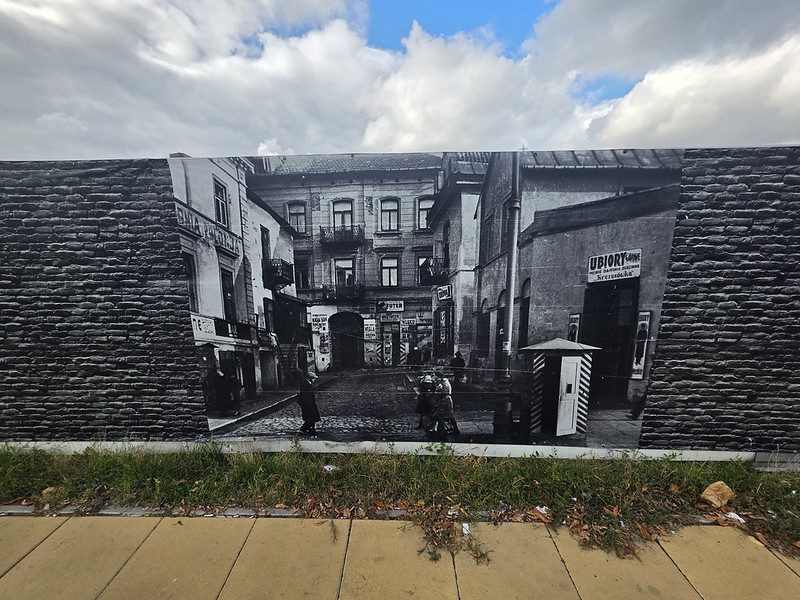
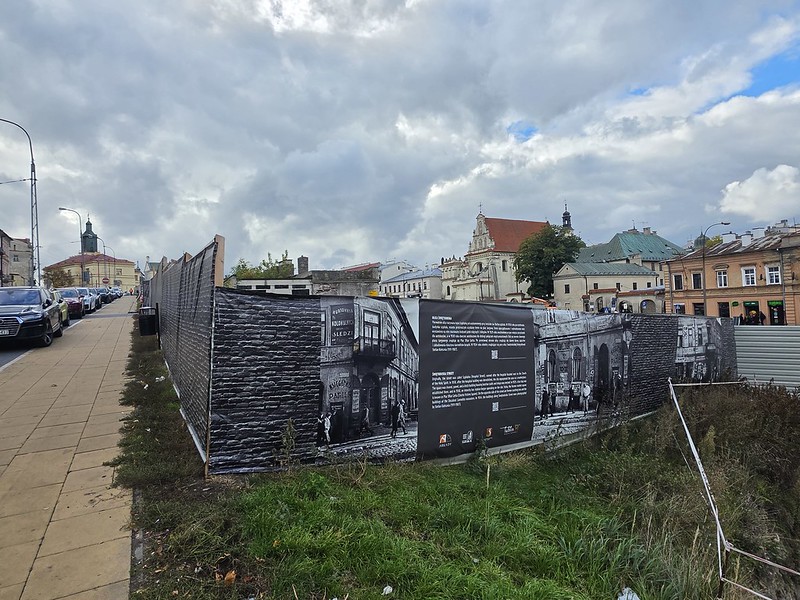
The interior is not overly decorative although the pillars, altar and ceiling do brighten matters up and I also rather like the distinctive flooring. I only took this one photograph as there was a nun in the chancel and I didn’t want to look like I was interfering with the whole arrangement. I must admit that I took over forty photos of a construction fence with images of Lublin in the 1930s and managed to take only one photo of this church, but who needs consistency?
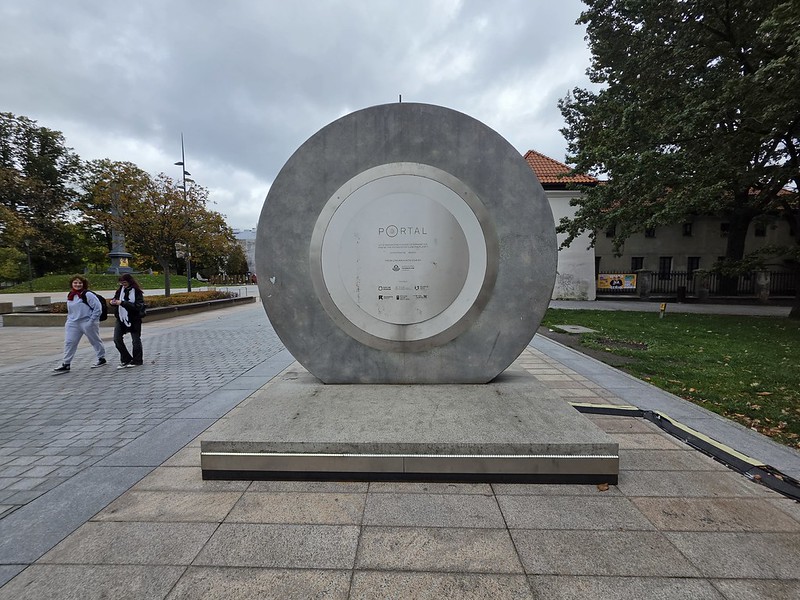
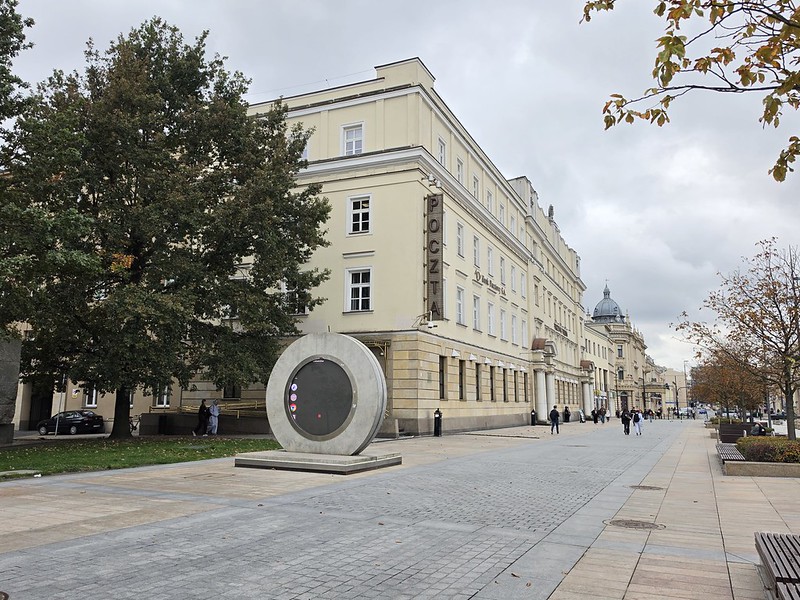
I’ve posted before about the portal in Vilnius that showed live images of Lublin in a bid to spread community and friendship across countries. Since then, Ipswich has also acquired its own portal and I was very excited to see the delights of this fine town whilst in Lublin. Unfortunately, it was broken. All rather sub-optimal.
It’s a nice concept, although they had problems in Dublin with some people rather abusing the whole vision. Give humanity a window into another country and someone will inevitably decide that what international relations really needs is a view of their backside. Fortunately, the denizens of Lublin, Vilnius and even Ipswich were all rather more positive about the arrangement.
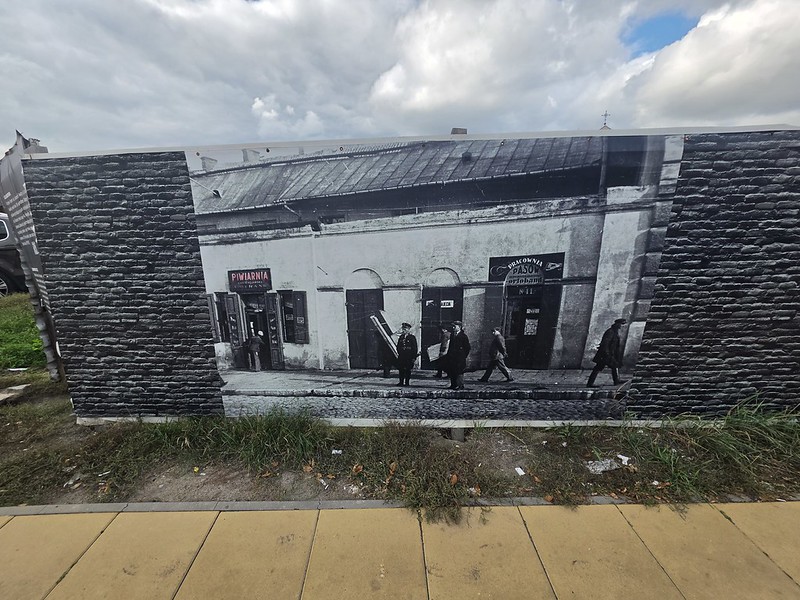
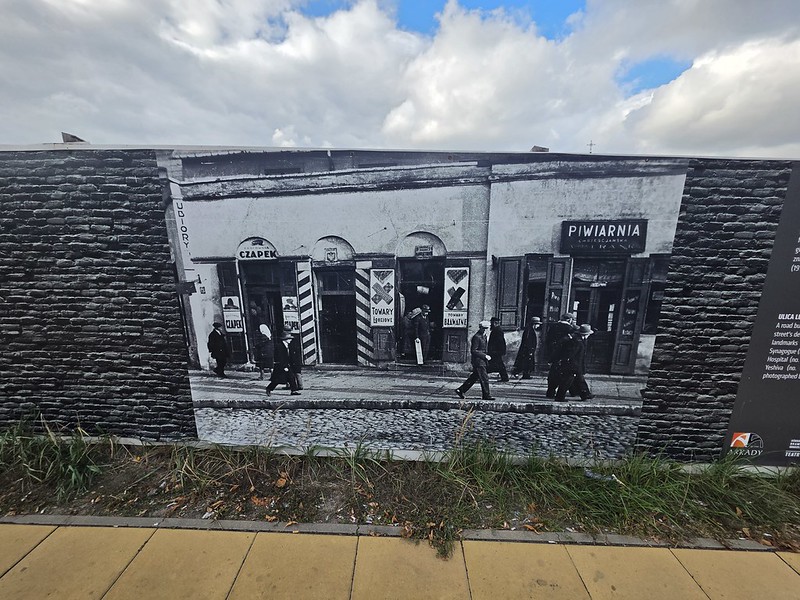
Between 1937 and the outbreak of war in September 1939, Lublin’s Jewish inhabitants faced growing antisemitism, including organised attempts to discourage customers from using Jewish shops. A boycott campaign launched by the National Party in 1936 formed part of this increasingly hostile atmosphere. One Jewish resident, Sara Grinfeld, recalled students picketing a shop in the spring of 1939 and attaching notices telling people not to buy from Jews. Businesses continued trading and everyday life carried on. These photographs taken by Stefan Kiełsznia in the 1930s capture that everyday activity, although they cannot show all the hostility and uncertainty behind it.
German troops occupied Lublin on 18 September 1939, and persecution of its Jewish inhabitants began in the first weeks of occupation. Forced labour was imposed, and from 1 December 1939 Jews aged ten and over were required to wear identifying armbands bearing the Star of David. Looking at the shopfronts here, it is difficult to reconcile their ordinary appearance with how quickly life in the city changed.
The first photograph shows a low building with a long sloping roof, a beer house on the left and a belt-making workshop on the right. Between them are doorways beneath shallow arches, with pedestrians passing along the narrow pavement. There is nothing particularly dramatic happening, just people walking past businesses and getting on with their day.
The second photograph offers another view of the beer house, alongside shops advertising caps and fabrics. The fabric shop has particularly conspicuous painted panels around its entrance, making rather good use of the limited space between the doors. Several people are passing, while others stand near the open shopfronts. There is rather more variety here than the plain building initially suggests, with each small business finding its own way to attract attention. The large “PIWIARNIA” sign makes the beer house especially easy to identify, even with my limited Polish.
The third photograph looks into a cobbled courtyard or passage off the street, with more businesses tucked around its edges. A clothing sign is visible on the right, while further shop signs surround the archway at the back. The one element that I haven’t been able to entirely understand is which, if any, of these properties are still standing.