
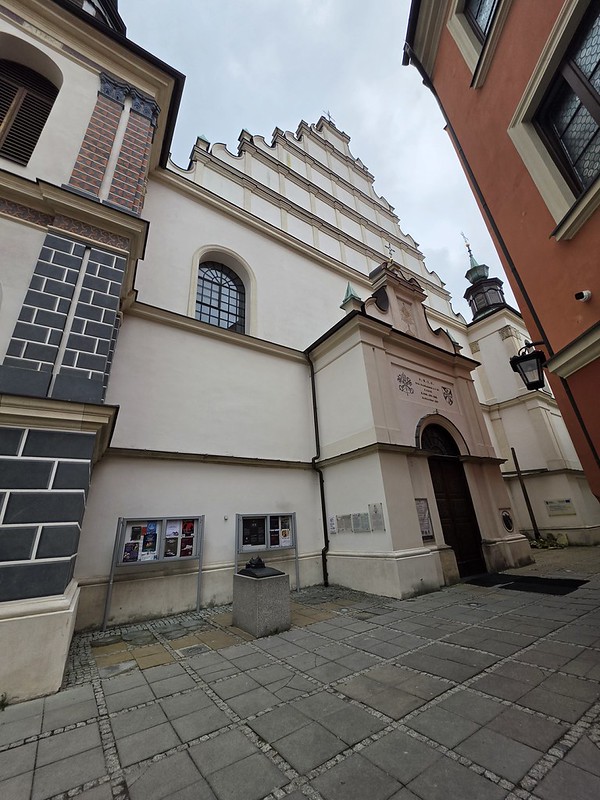
The Dominican Basilica of St Stanislaus sits at the end of Złota Street, its tall decorative gable rising above a relatively modest entrance. The present church developed from a foundation supported by King Casimir the Great in 1342, although the Dominicans were established in Lublin before then. A major fire in 1575 caused extensive damage and much of its present appearance dates from the rebuilding that followed, with further additions over the centuries.
Incidentally, I’ve already written about historic flooring inside the basilica, the Fire of Lublin painting and Europe Starts Here, so more than enough to excite and delight my two loyal blog readers.
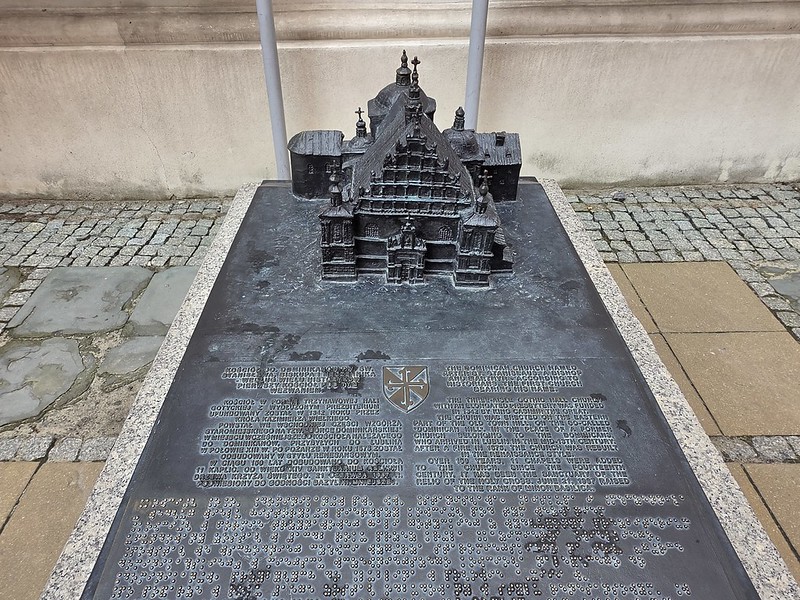
Outside is a tactile model of the basilica, accompanied by raised lettering and Braille. It’s rather easier to understand what the front of the basilica looks like without quite a few buildings getting in the way.
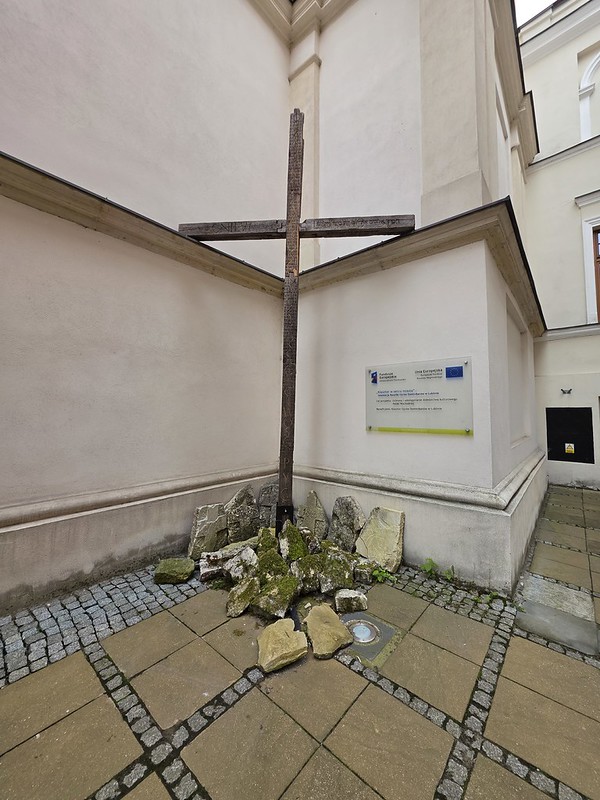
This tall wooden cross stands amongst rough stones in a corner outside the basilica. I’m not sure why they picked this particular corner, but I like the simplicity of it.
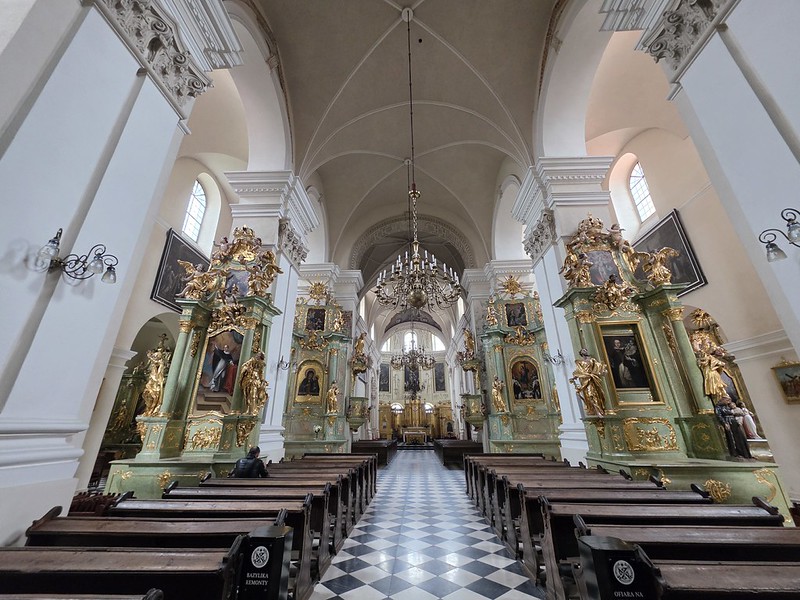
The nave of the basilica and I’m pleased that this is one of those photos I’ve taken which is actually sort of level. I like the flooring, it draws the eye towards the chancel and there’s certainly no shortage of things attached to the wall to look at.
As an aside, I was slightly surprised to see a confession taking place in a traditional confessional just off the nave. I had somehow assumed that these things generally happened in separate private rooms now. A reminder that, whilst I was wandering around admiring the furnishings, other people were getting on with the religious purposes for which the building was intended.
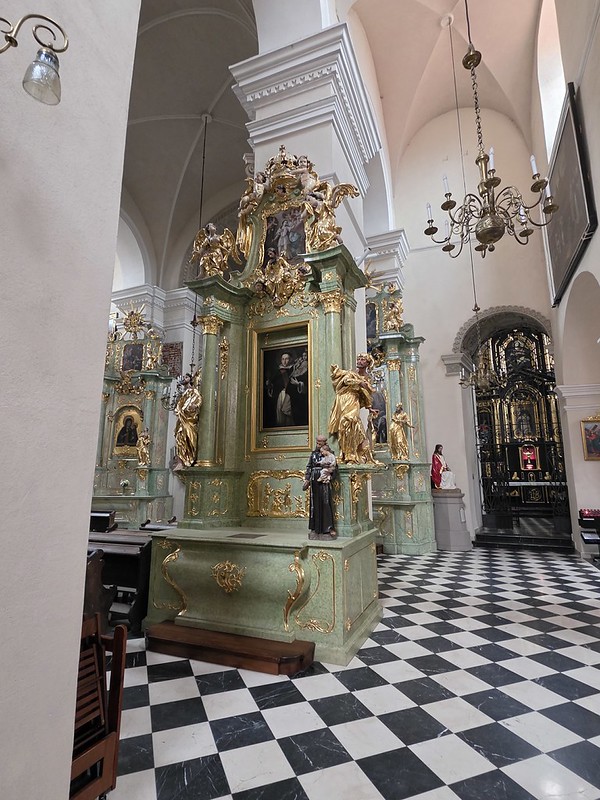
This is the altar of St Hyacinth, known in Polish as św. Jacek, with an eighteenth-century painting of the Dominican saint at its centre. They seem to like this pale green colour around the basilica as well.
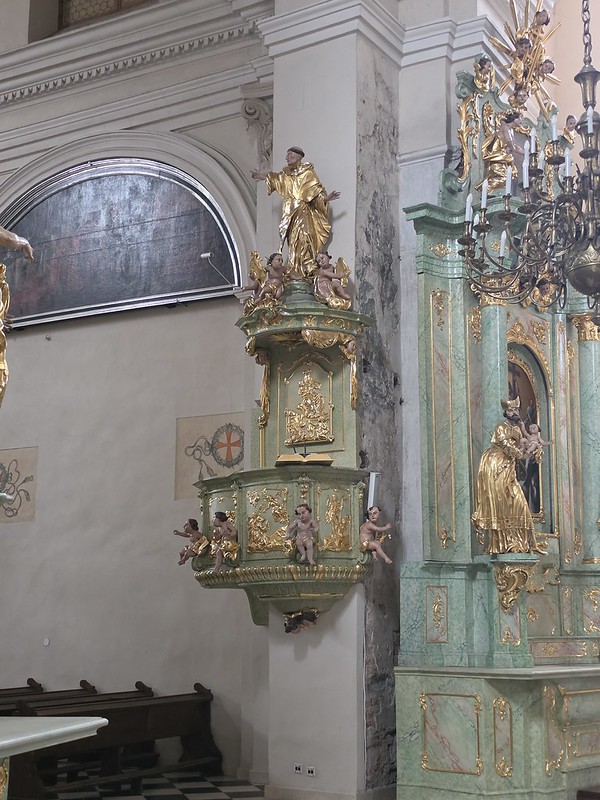
The basilica has two facing pulpits, made in Sebastian Zeisel’s workshop in 1761. The church’s guide explains that they served preaching at different altars, as well as providing symmetry, rather than being installed for opposing speakers to debate each other. This one continues the green and gold colour scheme, with small figures around the front and a saint above the canopy. Quite an elaborate place from which to address a congregation, although presumably useful for keeping their attention before microphones became available.
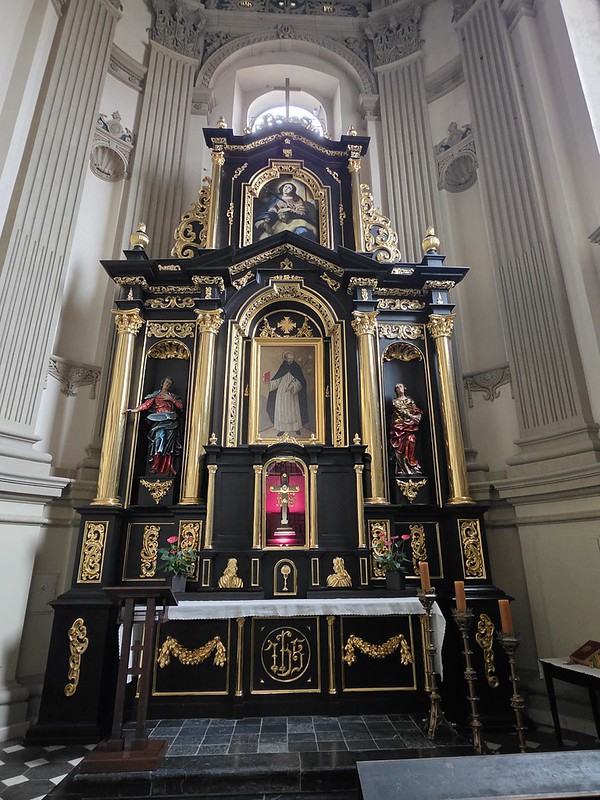
The Firlej Chapel has a black and gold altar, with a painting of St Dominic made in 1645 by the Dominican artist Brother Reginald. The chapel was founded in 1615 as a family burial place and somewhere to house the relic of the True Cross. The relic itself was stolen from the basilica in February 1991, a rather sub-optimal later chapter in the history of something which had shaped the church’s religious life for centuries.
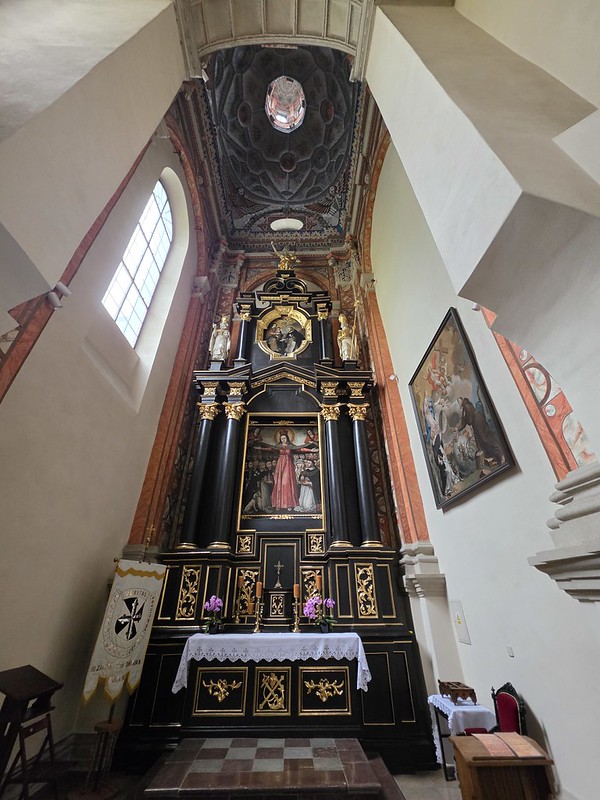
The Ossoliński Chapel contains a painting of the Virgin Mary sheltering members of the Dominican order beneath her cloak. Founded in 1624, the chapel has changed dedication as its devotional images have changed.
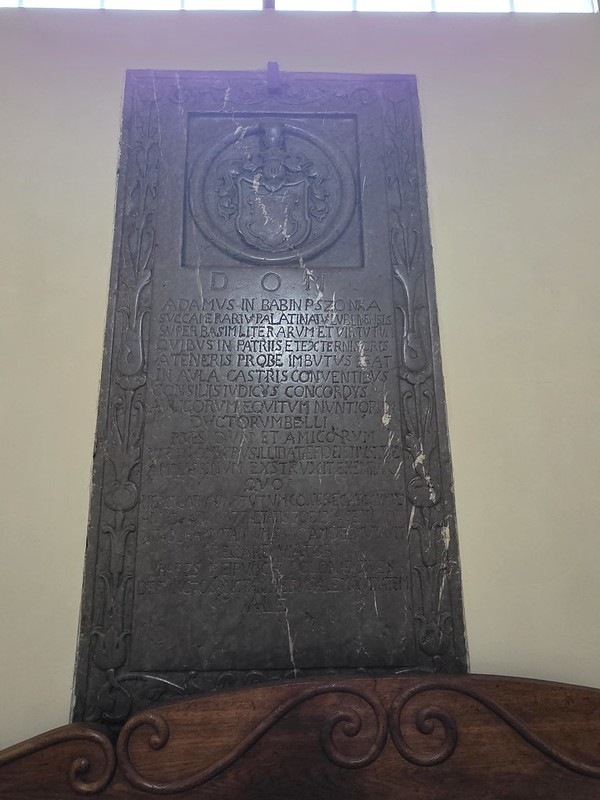
This memorial tablet commemorates Adam Pszonka of Babin, who died in 1677, and is in the Pszonka Chapel. Its dark surface and the light from the window made photographing it something of a challenge. Nevertheless, these individual memorials are useful reminders that the chapels were also places of family remembrance, alongside their religious functions.
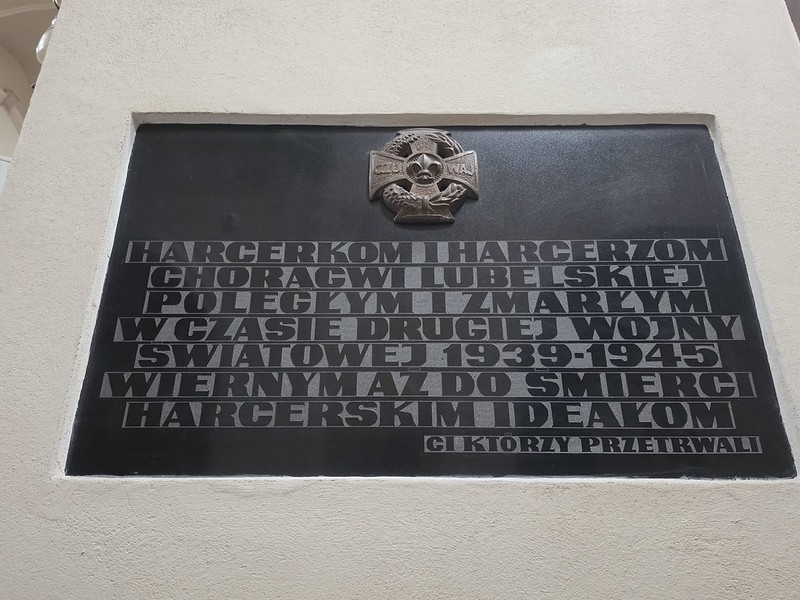
This plaque remembers the female and male scouts of the Lublin scouting region who were killed or died during the Second World War, between 1939 and 1945. It describes them as faithful to their scouting ideals until death, with the dedication below coming from those who survived. Above the inscription is the Polish Scout Cross bearing the motto “Czuwaj”, meaning “Be prepared” or “Stay alert”. A brief memorial, but one that brings the basilica’s history much closer to the present than its seventeenth-century family monuments.
It’s a rather lovely building, although like so many there have been numerous challenging events over the centuries. More recently, the monastery was suppressed by the Russian authorities in 1886, with the remaining friars expelled. The Dominicans returned in 1938, renewing the order’s presence here.