
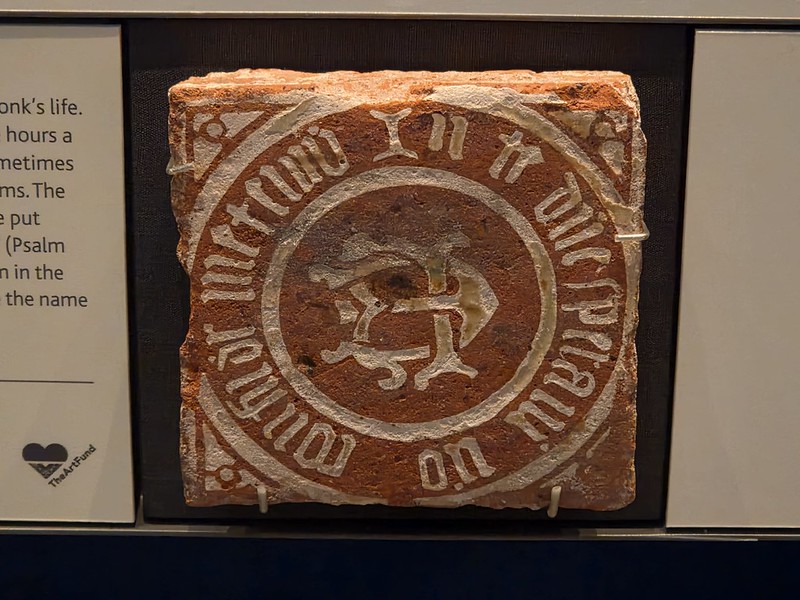
My new and perhaps unexpected interest in medieval flooring continues with this tile at the British Museum, made in England between around 1450 to 1500. After the alphabet tiles from Chertsey Abbey and Anthony Melton’s rather personalised floor, this example combines a religious inscription with a monogram that has proved rather less straightforward to explain. The letters in the centre read E.R., although whoever they represented has currently been lost to history, but perhaps the mystery might be solved in the future.
The Latin inscription translates as ‘In thee O Lord I have put my trust, let me never be confounded’, identified by the museum as coming from Psalm 70 in the Latin Vulgate Bible, or Psalm 71 in more modern bibles. Communal worship would have occupied a substantial part of a monk’s day, with singing psalms potentially taking up to five hours. I might not have the right religious attitude, but this feels a little excessive.
The museum suggests that E.R. might identify an abbot or a monastery, but it doesn’t know which. Much as I would like to solve a small medieval mystery, I think that this one might be beyond me. My investigation has so far established that there are two letters, which I appreciate is unlikely to trouble the museum’s research department. It’s a useful reminder that putting your initials on something is only a successful long-term identification strategy if someone actually remembers what they stood for.