
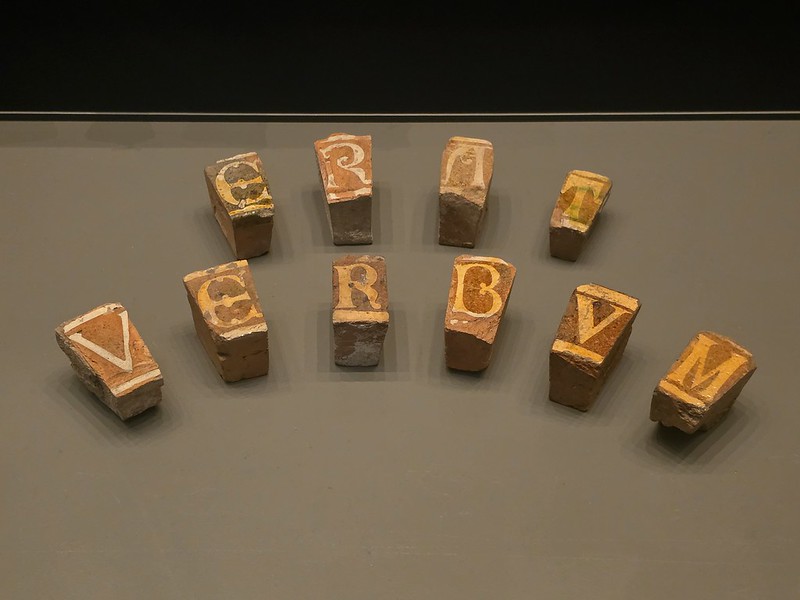
Having spent some time working my way through photographs from the Foundling Museum, I’m now starting a little series from the British Museum, which should keep my two loyal blog readers occupied for a while. I can almost sense the positive excitement. Anyway, these are alphabet tiles from Chertsey Abbey in Surrey, dating from around 1250-1300, made from lead-glazed earthenware. This abbey was once one of the most important in the country, but it didn’t survive the Dissolution of the Monasteries. There were extensive excavations at the site in the nineteenth century, which is why the British Museum has several examples of various tiles that were found.
The ones on display here look rather like the beginnings of a medieval word game, although they are in essence a similar set-up to the movable type used by printers. The individual letters were made to form Latin inscriptions, including ‘In principio erat verbum’, meaning ‘In the beginning was the Word’, which is the opening of St John’s Gospel. The tiles shown here spell out the ‘erat verbum’ part and at least it would be easy to fix any little spelling mistakes using this method. A tile kiln containing faulty, unused tiles was discovered near the abbey in 1922, helping to confirm that these tiles from the abbey were produced locally. I rather like that the unsuccessful attempts survived too, although I imagine the people who made them would have preferred us to concentrate on the finished floor.
Literacy was an important part of monastic life, both for religious purposes and for general administration as these were effectively large businesses with land and property to manage. The museum describes these as the only tiles of their kind known in England, although many examples have been found in France. I’ve never much thought about this, but I’m surprised that these tiles weren’t used more in England, they seem rather practical.