
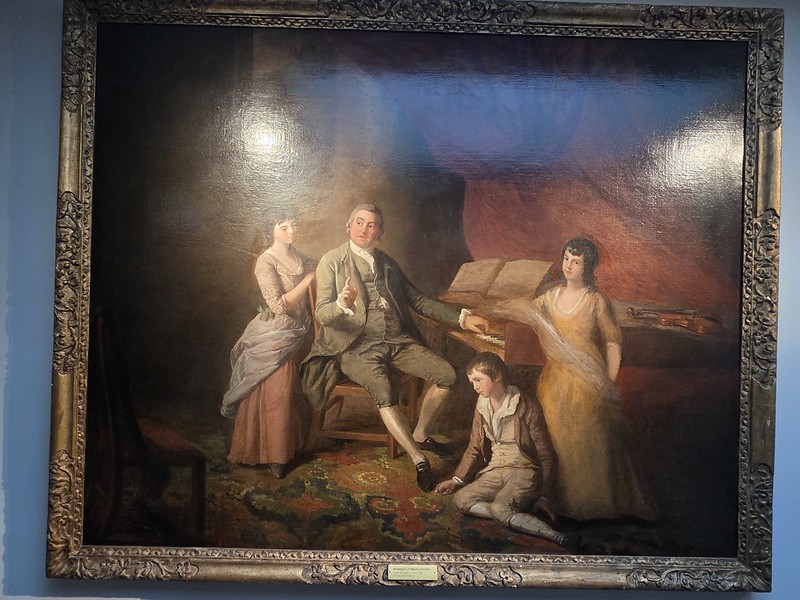
This is Felice Giardini and Children, painted around 1775 and attributed to John Francis Rigaud, at the Foundling Museum in London. Giardini sits at a keyboard surrounded by children and looking like he’s making an important point that he wants everyone to listen to carefully. I hadn’t heard of him before I visited this museum but noticing from the museum’s information label that an Italian musician who had enjoyed considerable success in London ended his life in poverty in Moscow seemed sufficient reason to find out a little more.
Giardini was born in Turin in 1716 and received some of his early musical education as a chorister at Milan Cathedral, before returning to Turin to study the violin under Giovanni Battista Somis. He subsequently worked in orchestras in Rome and Naples, then in 1748 he embarked on a European concert tour, perhaps similar to the study tours embarked upon by my friend older Julian (but obviously he wasn’t on the 1748 tour), reaching London around 1750 by way of Berlin and Paris. I rather admire the travelling involved although at least he didn’t have to deal with the EES system.
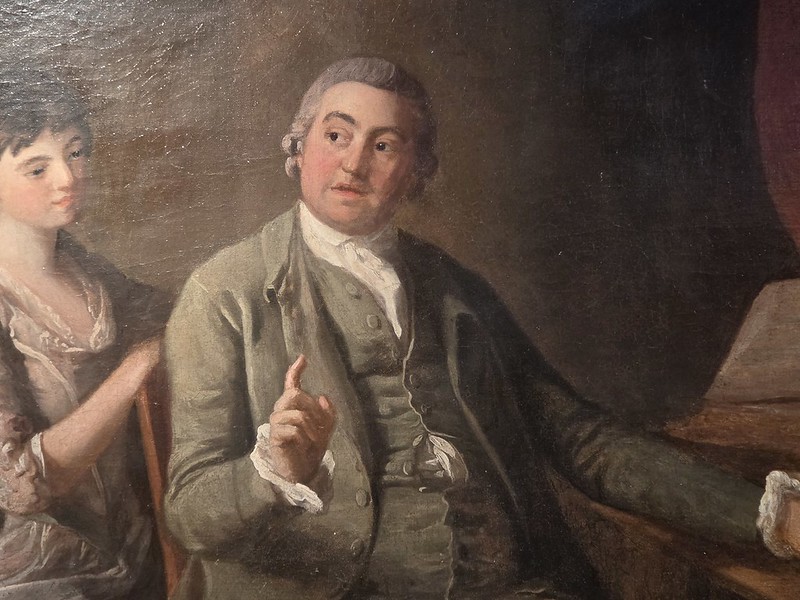
Giardini’s violin playing made him a considerable success in London, where he performed, taught and became involved in directing the Italian Opera. His pupils and patrons included members of the aristocracy and royal family, so he was certainly working in the right circles. His connection with the Foundling Hospital was a substantial one, as he became a Governor and he led its annual benefit concerts for several years. With the music historian Charles Burney, he proposed developing the Hospital as a music teaching institution, although their fellow Governors were less impressed and they rejected the idea which I imagine he considered as a rather sub-optimal decision.
He left London for Italy in 1784, but his subsequent travels took him considerably further afield. The Italian biographical dictionary Treccani records him as being in Siena and Naples in 1786 and then Madrid in 1787, with a letter also referring to onward movements to Lisbon and Paris. He really could have done with a Wizz Air all you can fly pass, it would have made matters much easier for him. He then returned to London around 1790 to try his hand again at managing the whole opera thing, having already suffered financial losses through earlier ventures. By this stage he was well into his seventies and I imagine that he was quite exhausted after all that travel.
The Moscow connection that had interested me in the first place came towards the end of his life, when he was still looking for work and trying to make his opera ventures succeed. Treccani places his journey to Russia in 1793 with an Italian opera company and records time in St Petersburg before Moscow, where he died in 1796. The accounts of his final years describe poverty, a rather sad ending for someone who had once been so prominent in London’s musical life. All told, he sounds a rather interesting character and someone who had worked hard to improve the lives of the children at the Hospital.