
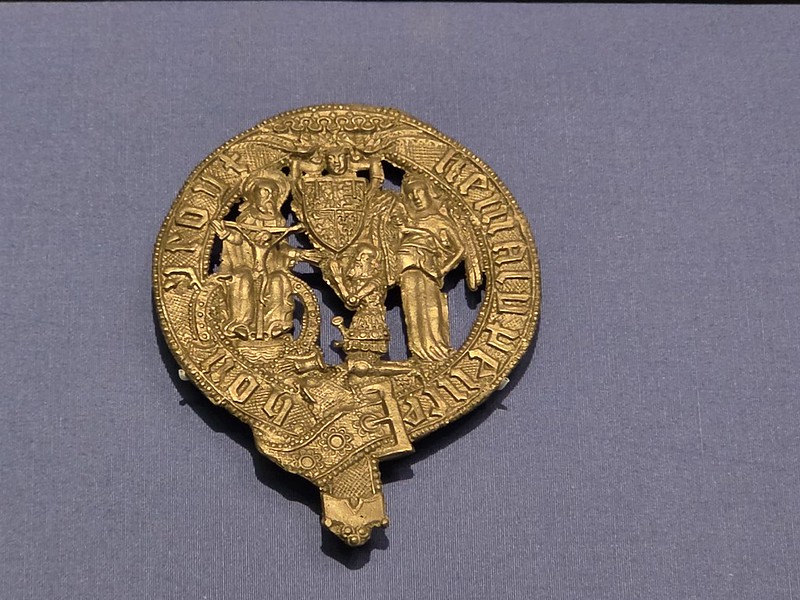
After the personalised flooring of Abbot Anthony Melton, this is another exhibit at the British Museum that leaves little doubt about the importance of the person being commemorated. It’s a funeral badge associated with Edward of Woodstock, better known as the Black Prince, dating from around 1376. Despite its rather golden and decadent appearance in my photograph, it’s made from lead alloy, so I would have been getting slightly ahead of myself had I started assessing its value as treasure.
Edward was the eldest son of Edward III and a successful military commander, fighting at Crécy as a teenager and later capturing the French king, John II, at Poitiers in 1356. He died in 1376 before his father, so he never became king himself, although his son subsequently became King Richard II. He was buried at Canterbury Cathedral, where his elaborate and grand tomb survives, having left detailed instructions about his funeral and commemoration. This wasn’t just a funeral where people were told to come and look solemn, this was a carefully crafted and planned event. As an aside, he wasn’t known as the Black Prince until after his death, so this wasn’t an arrangement that he was aware of. The actual origins of why he obtained this name aren’t known for sure, it’s another medieval mystery.
The badge shows the prince kneeling before the Holy Trinity, accompanied by angels and his heraldic shield, with the scene enclosed by a buckled garter. This bit is relevant as he was a founding member of the Order of the Garter, established by his father in 1348 and which now boasts members including Sir John Major, Tony Blair and Chris Patten amongst several others. Although the membership has changed somewhat, I imagine the arrangements still involve being told where to stand and what to wear. The French inscription around the edge is its motto, usually rendered as ‘Shame on him who thinks evil of it’.
Badges of this type are thought to have been worn at his funeral, although that doesn’t necessarily mean that this particular example was there. They may have been made at Canterbury, where craftsmen already produced souvenirs for pilgrims, while the quality of this one has prompted the suggestion that a court craftsman was involved in the arrangement. Although it’s not known who wore it, I like that nearly 650 years on this badge is still doing an effective job of reminding people who the Black Prince was. I wonder whether my random assortment of LDWA, CAMRA, Ramblers, Wembley, mud run and other assorted lanyards will still be about in 650 years reminding people about me……