Category: Central London

  • London – City of London – Sir John Oldcastle Pub

    London – City of London – Sir John Oldcastle Pub

    20251102_135316

    As I had a couple of hours spare in London before my train from Farringdon, I thought I’d pop into the JD Wetherspoon operated Sir John Oldcastle which is at the end of the street. It’s not been one of my favourite pubs as it’s often very busy, but matters are more sedate on a Sunday early afternoon.

    As usual, I’ll use the pub chain’s own history of the pub name:

    “Named after The Sir John Oldcastle Tavern, which stood in the former grounds of Sir John’s nearby mansion, this was already long established by 1680. Oldcastle is thought to have been the model for Shakespeare’s character ‘Falstaff’.”

    Not a vast amount has changed with the street layout here in the last 150 years, the pub is located just above the “EET” of Charles Street. The ward of Saffron Hill has now gone, which originally took its name as saffron grew around here. It’s also where Fagin’s den was located in Oliver Twist.

    20251102_130029

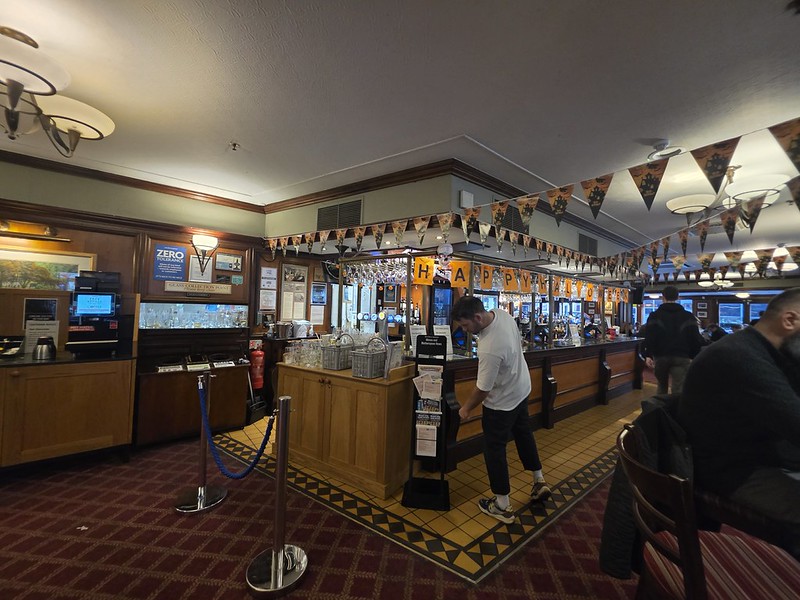
    The bar area and coffee machines and today it was the £1.81 unlimited hot drinks that tempted me in here rather than beer. It all seems functional enough and it felt well managed.

    20251102_121735

    Carpets in every JD Wetherspoon venue are unique, although this one isn’t necessarily the most decadent in terms of its styling.

    The online reviews are pretty decent for a JD Wetherspoon venue, despite the challenges they must have here with having a small site and limited space in terms of facilities.

    “I was so surprised when the staff said to me I can not paid by 50 in cash. No explanation why. The answer was “not because not”. This is absolutely disgusting and ridiculous. I asked about manager to explanation me this situation. He didn’t show up to speak with me. I will never back to this place. Higley not recommended.”

    Disgusting that a venue won’t accept a £50 note? Hmmmm. Seems quite reasonable to me given the number of forgeries.

    “I’ve just been kicked out of here, because I had the audacity to bring a Costa Coffee in; even though I’d just ordered and paid for breakfast. They’d rather refund my breakfast purchase; than let me have a Costa with it. If their machine coffee was better; I wouldn’t have had to in the first place.”

    Why not just bring in your own food as well?

    “Good interior. Ordered porridge. I went to the toilet and when I came back some waiter had taken it away. I hadn’t eaten any of it. I found it was thrown away! Another diner’s beer was also taken away by the same waiter undrunk.”

    Very efficient service, it’s good to keep the tables clean.

    “If you want to sit and read a paper or a book, this is the place for you. If however, you want to have a laugh and giggle with friends, go to the castle pub instead.”

    I’m with the pub, this group sounds needlessly frivolous.

    “Leffe. £3.49 a pint in most Wetherspoons. John Oldcastle £5.49 some might say different location BUT McDonalds do not have this issue.”

    It feels inevitable to me that a pub in central London will be more expensive than one in Swindon.

    “Asked to leave when we were causing no trouble…”

    I suspect another side to this story….

    Anyway, once again I digress. I thought the pub looked relatively clean, although the toilets probably need more rebuilding than cleaning, with the team members seeming friendly enough. And the coffees and other assorted hot drinks tasted as expected, so a rather peaceful couple of hours.

  • London – City of London – London Liverpool Street Proposed Upgrade

    London – City of London – London Liverpool Street Proposed Upgrade

    20230424_215151

    There seems to have been some opposition to the proposed upgrade of London Liverpool Street railway station, but for what it’s worth (which I accept isn’t a great deal), I’m in favour of the whole thing. There’s a little exhibition area at the railway station, along with some external posters explaining the reasoning for the project, although I fear that it’ll all be in vain as there appears to be organised opposition against it, not least from the Victorian Society.

    20230424_215825

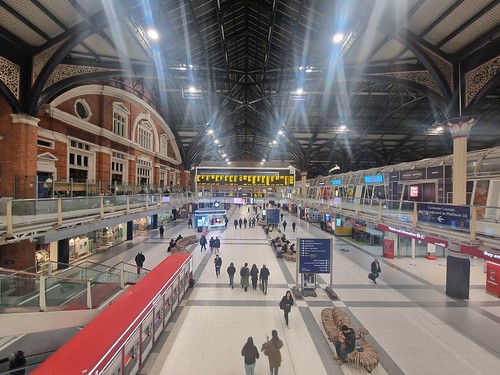
    The concourse design dates primarily to the 1980s upgrade which was modern and vibrant when it was completed, but the whole railway station is now struggling with passenger numbers. The toilets aren’t large enough, there’s insufficient seating, there are no power points for passengers and the disability access is terrible (as I’ve experienced with trying to manoeuvre a wheelchair around the concourse). It’s over-crowded, cluttered and I think needs modernising and extending.

    20230424_215813

    This all looks quite creative to me, the historical elements that I want preserving do remain in place. Over-shadowed perhaps, but they’re kept.

    20230424_220000

    I accept that it’s not necessarily the most inspiring of building designs and it will obscure some exterior views of the railway station, but functionality seems to be more important to me. And since the floors placed on top of the building will be profitable for the developers, that means no cost to the rail passenger or taxpayer.

    20230424_215947

    I’m less convinced about the need for this, but I suppose it’s a useful amenity.

    20230424_220000

    We’ll just have to see what the planners and ultimately Sadiq Khan think about the whole arrangement, but as I’ve mentioned, I think it’s overall a positive addition to the railway station. The Victorians hacked about with their stations all the time, expanding and improving them. Although perhaps the developers could also fund the restoration of Brandon railway station which is currently falling down since Greater Anglia have ignored it (or tried to demolish it). Maybe they could put a swimming pool, or lido, on top of that as well.

    For anyone interested, the plans are at https://www.upgradelss.com/.

  • Trouble at Smithfield – Jago Hazzard Video

    Trouble at Smithfield – Jago Hazzard Video

    Just as a break from my normal range of irrelevant blog posts, I found this video on Smithfield market, titled “Meat, Museums and Malarkey” to be interesting. I’ve found this market a fascinating site, since Des led a walk around it last June, when the photos below are from (other than the very bottom one which is from a few weeks ago when I went back to see what progress had been made). As the video says, the plan is to move a number of the markets from London all to a huge new site at Dagenham, which will be the largest wholesale market in the country.

    But many of the traders don’t want to leave and there has been a meat market at this site for over 900 years and the Poultry section is still operating. The traders have refused to move and the City Corporation has been forced to try and get an Act of Parliament to remove them, a process which seems to have been going on for some months without any obvious updates.

    The Museum of London will be moving onto the site as part of their celebration of all things London, alongside some sort of cultural and residential zone. And the irony pointed out by the video is one I’ve thought before, they’re shifting out something authentic and genuine from the city centre to put in a museum which, well, is the story of the authentic London. Or as the video notes, “London is increasingly become a theme park version of itself”. Hopefully they’ll be able to do something decent here, without a mix of housing that starts at £1 million and restaurants that end up being ridiculously expensive because of the rents they have to pay.

    Although, the solution is perhaps to ensure it becomes a centre for decadent craft beers and breweries, that would be a much better story in the evolution of London as a great city.

    20210624_201758

    20210624_201817

    20210624_202206

    20210624_202256

    20210624_202619

    20220510_140233

  • Wednesday : Bunhill Fields Burial Ground, the Stablehand Pub and Another Bloody Tableless Train

    Wednesday : Bunhill Fields Burial Ground, the Stablehand Pub and Another Bloody Tableless Train

    20220511_104423

    The standard JD Wetherspoon breakfast at Goodman’s Field in London, with the bacon seemingly heated under a candle, but everything else suitably hot and appropriately cooked. This is a handy pub given the number of power points that they have, with the venue being clean and organised. It’s not going to win a Michelin award, but breakfasts at JD Wetherspoons are reliable for being of a reasonable quality and usually having one or two obvious faults such as a hard egg or a cold hash brown.

    20220511_121651

    I’ve never previously noticed this memorial located by All Hallows-by-the-Tower church, commemorating the decision to give the entire population of Malta the George Cross in April 1942. The monument was placed here in 2005 and the limestone memorial is made from stone which comes from the island of Gozo. There’s quite a lot of text on the memorial and the Maltese cross image is visible above the information panel. There were many cases of bravery amongst the islanders who stood firm against the attempted invasion by the Axis powers which became known as the Siege of Malta. As an aside, the stone probably needs cleaning, it’s much brighter in images taken a few years ago.

    20220511_123049

    This is the One Millennium Bridge development, converting the former offices known as Millennium Bridge House, opened in 1988, which were used by the Old Mutual. The new development is meant to combine offices, residential and social space, which will also increase the length of the Thames Path.

    20220511_124945

    This all feels a little odd, it’s the Hoop and Grapes pub at 80 Farringdon Street in London. Demolition of the buildings either side have meant that the pub is just a little exposed, and rather inevitably, it’s also just a little closed. It was nearly demolished in the 1990s, but fortunately it was saved. I visited in late 2020 as it was listed in the Good Beer Guide, and hopefully that will come to pass once again when it’s re-opened. The building is a brave survivor of demolitions on this street, adding charm and heritage to the area.

    20220511_151043

    Bunhill Fields, a burial ground in Islington which was in use between 1665 and 1854, with around 125,000 burials having taken place.

    20220511_151047

    Disappointingly, there’s no public access to much of the site as there’s a large fence separating the central walkway to the graves.

    20220511_151052

    There’s plenty of character to the burial ground and likely numerous rats playing in all of that undergrowth which is inaccessible to humans (unless they happen to have a key).

    20220511_152135

    The end of platform at Farringdon Station, where I got the underground service to Paddington. I’ll leave the history of this station to Wikipedia, but I do think of the heritage of the service at what is one of the longest operating underground services in the country, having started in 1863 as the terminus of the Metropolitan Railway.

    20220511_170955

    For the second day in a row, I had a meal paid for by The Fork, this time at the Stablehand pub near Paddington, built in 1839 on the site of an old archery range. My table reservation was for 17:00 but I arrived at the pub, completely soaked due to a typhoon which was hitting the area, and the signage said drinks only until 18:00 which didn’t seem ideal. It’s a gastropub in its intentions, having recently opened at what was until 2021 the Angelus French restaurant. The welcome was immediate and authentic, with the staff member merrily giving me the table with a power supply (as in the power supply was located by the table, it wasn’t a table which electrocuted me) which also handily had a hook that I could hang my drenched coat on.

    20220511_171040

    The beer was reasonable, this is the IPA from Rebellion Beer which was well-kept but not particularly exciting in terms of flavour.

    20220511_172245

    The staff at the venue were friendly, pro-active and helpful, saying that they were happy to see if the kitchen could produce something easy before the food service formally opened. I asked if the cheese board was available, and after checking if cutting cheese would be OK in terms of being easy, the chefs were keen to oblige. There were though a handful of customers who came in and left when they discovered food wasn’t available, it seemed a slightly odd decision to not serve earlier.

    Back to the pub though, which is food focused, but is also welcoming to those who just want drinks. They offer a British only menu, so there’s an attempt to source good quality products without the need for importing anything. The cheeses were decadent and delicious, a rich blue cheese and a creamy brie, which isn’t a cheese I usually go for, but was suitably full in flavour. The staff member was also knowledgeable, and I liked that she remembered to come over to take my main course order when the kitchen had opened fully.

    20220511_181711

    The photography here doesn’t show how decent this meal was, but it’s steak and kidney pudding served with vegetables and with a side of mashed potato. I asked for extra gravy and I received an additional jug which was richer than it looks in the photo, where it gives the impression of being watery. Actually, I’m not sure I would have ordered this meal if I had seen this photo in advance, it all looks a bit insipid.

    However, this is probably the best steak and kidney pie that I’ve had, with large chunks of steak which were tender and had no sections of fat on them (I’m quite fussy). There were a few small pieces of kidney, but this pie was all about the steak and the kidney was just a sideshow, which is just how I think it should be. The gravy inside the pie was rich, the steak packed with flavour and the pastry was light. I don’t usually order mashed potato as it annoys me (I get pre-annoyed far too easily), but here it was smooth and not over-packed with anything like butter or cheese. All in all, very impressive.

    20220511_184315

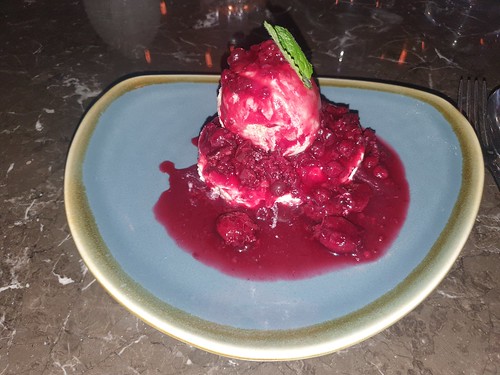
    I had hoped for the Arctic roll for dessert, but this was unavailable, so I went for this fruit based explosion instead. My bill came in at under £50, meaning there was nothing for me to pay, so thanks to The Fork for such a suitably delightful meal. I’d recommend this pub, it was informal and comfortable, with the staff being keen to engage and also knowledgeable and attentive. The prices were moderate for the area, with the quality of all of the food and drink being high.

    20220511_185403

    Certainly drier than when I went in, when the road was more like a river. After a short walk back to Paddington, I got the underground to London Liverpool Street, although unfortunately this was the week before the Crossrail service between the two stations was opening.

    20220511_193034

    My initial intention has been to position to near Gatwick Airport ready for a flight to Montenegro the following day, but I had instead booked a cheap train home to Norwich. I did notice this hoarding at London Liverpool Street, at least meaning that passengers can be properly fed before their rail departures.

    20220511_202808

    Liverpool Street was busy, but then again, it always seems to be busy.

    20220511_204617

    I was yet again annoyed that Greater Anglia were using a train which had no tables, which caused a number of passengers some difficulty trying to position their laptops and devices. The train was busy and Greater Anglia’s obsession with using the Stansted Express carriages on this service remains a complete mystery to me. However, there seems little point in my repeating my general annoyance at this situation, with the train being on time and otherwise clean.

  • London – Tower of London (Wild Flowers)

    London – Tower of London (Wild Flowers)

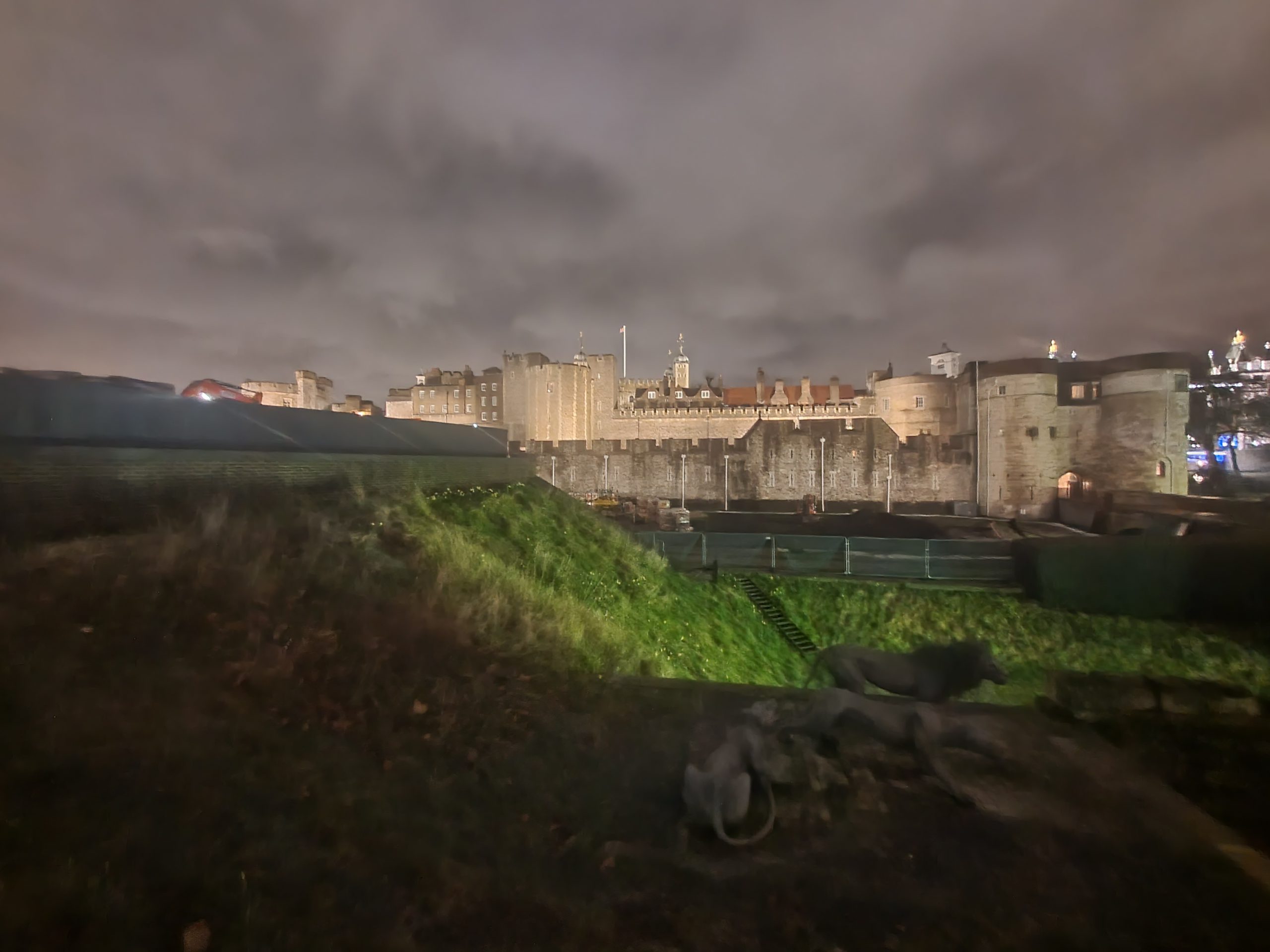
    Last year I went to look at the poppies that they put in the moat of the Tower of London, this year they’ve dug the moat up to grow wildflowers. As an aside, I still think it’d look better with water in it, but it’s been a dry moat since it was drained during the nineteenth century.

    The Tower authorities are making some big holes around the place as they’re planting 20 million seeds this spring so that they flower from June to September, to mark the Queen’s Platinum Jubilee celebrations. There will be chance to walk amongst the wildflowers, but I imagine that’ll be expensive, so I’ll just return in a few months to take photos from the same elevated position. I’m sure it’ll look impressive when the flowers grow (and probably play havoc with my hayfever), it certainly looks like they’re going to a lot of trouble to get it right.

    And as an aside, here are a few more photos of the exterior of the Tower of London at night whilst I was meandering around it.

  • London – Central London – The Hand and Shears

    London – Central London – The Hand and Shears

    There has been a licensed premises at this site near Smithfields since the middle of the sixteenth century, although the current building dates to 1849. I visited it as it’s in the Good Beer Guide and it’s tucked away a little, just behind St. Bartholomew’s Church.

    This location is noted on the list of CAMRA’s Historic Pub Interiors and they think that these signs date to around the 1930s. Usually swept away by endless refurbishments, the two separate areas of the pub still survive.

    The pub is Grade II listed and, since it’s so comprehensive, this is the listed building record:

    “The history of the Hand and Shears in Smithfield can be traced back to the C16. Whilst the name is recorded at this early stage, the plot it occupies and the surrounding street layout are of a slightly later date. The arrangement of Middle Street, between Cloth Street (to the east) and Kinghorn Street (west), is largely the product of the redevelopment of St Bartholomew’s Priory overseen by Lord Rich, for which leases of new properties were issued between 1597 and 1614. An etching of 1811 shows the prominent corner-plot position of the public house and the earlier building’s gambrel roof to Kinghorn Street with its two bar room entrances. The name ‘Hand and Shears’ references the important local cloth trade which thrived in the area, but it also relates to the famed St Bartholomew Fair which was held annually in August from 1133. The history of the Hand and Shears is closely intertwined with that of the fair, with important ceremonial traditions centred on the public house. One such example was referred to by E A Webb in a history of the fair of 1921:

    ‘There used to be a burlesque proclamation, the evening before the [official] proclamation by the Lord Mayor, by a company of drapers and tailors who met at the ‘Hand and Shears’… from whence they marched, shears in hand, to the archway leading from Cloth Fair into Smithfield, and announced the opening of the fair with a general shout and snapping of shears.’ (E A Webb, ‘Bartholomew Fair’, in The Records of St. Bartholomew’s Priory and St. Bartholomew the Great, West Smithfield: Volume 1, 1921, p300).

    As with other public houses positioned close to markets or fairs, the Hand and Shears hosted what was known as a Pye Powder Court (the name originating from ‘pied puldreaux’, an old French term for a pedlar). From the medieval period, such courts had responsibility for keeping order and settling disputes between merchants and the public at markets and fairs. The court held at the Hand and Shears became particularly notable owing to the notorious vice and disorderly behaviour associated with the Bartholomew Fair. A sense of how the court would have appeared and functioned can be gleaned from a drawing of a session held in the panelled dining room of the Hand and Shears, published in Londina Illustrata in 1811: this shows the Pye Court judge at his bench with his secretary presiding over a dispute between two actors in theatrical dress. Ultimately, the scandal and excess drove the authorities’ efforts to supress it. This culminated in the prohibition in 1843 of all performances and shows, which inevitably caused the popularity of the fair to wane. A report from the Illustrated London News dated the 5 September 1846, lamented the consequent decline of the Pye Powder Court, where its duties had been ‘confined to the receipts of piccage, stallage and tollage’. The suppression of entertainments and the consequent lack of interest meant that, on the eve of the feast of St Bartholomew in 1850, ‘the mayor found no fair worth proclaiming’ (Webb, p317).

    The decline of the Bartholomew Fair broadly coincided with – possibly even brought about – the redevelopment of the Hand and Shears and several neighbouring buildings. The rebuilding of the pub along with the adjoining house at 2 Middle Street was undertaken in around 1850 (sources record alternative dates of 1849 and 1852). The earliest known plan of the building’s bar arrangement is in a conveyance dated 1857, showing a similar configuration to the present arrangement, though with a smaller island counter and the stairs in a different position. The plan demonstrates that the main bar was entered from the corner door, with a private bar and distinct back parlour to Kinghorn Street, as remains the case. To the east, along Middle Street, was a large rectangular dining room with a specified area for bagatelle at its south end. The work of around 1850 appears to have been a private venture (the pub not being tied to a brewery at this stage). However, by 1872, the site was in the hands of the Whitbread Brewery. Save for a brief two-year spell when the freehold passed to the Lion Brewery, the Hand and Shears remained the property of Whitbread until 1896, when it was acquired by Barclay Perkins. In the same year the interior saw some remodelling, with a new internal vestibule added to the Kinghorn Street entrance, the island counter and stairs being reconfigured and a small office added at the back of the dining room. According to the plans, the proposed alterations were ‘before the Bench’ (the licensing magistrates) in February 1896 and were complete by December.

    Into the 1920s some minor alterations were undertaken. In April 1920, plans were produced by F G Newnham (Barclay Perkin’s chief architect) to reposition the stairs to the cellar in order to extend the saloon bar (the same bar room formerly marked as the ‘parlour’). It is probable that this phase of ground-floor work also included the introduction of some of the present bar room windows and the two brick and tile fireplaces, which are characteristic of the period. Six years after the work to the ground-floor rooms, Newnham produced plans to introduce a new service area with a hatch for the first-floor dining area, followed in 1929 with a plan to integrate an adjacent sitting room and the main dining room. This investment prompted a remarkable boom in lunch and dinner sales: the pub recording that in 1930 it served 28,500 meals during the year, this increasing to 650 per week in 1931. Among those served were some esteemed visitors, including Prime Minister Stanley Baldwin on 20 October 1930 and, on 11 February 1931, Winston Churchill.

    Since the inter-war work there have been only minor changes to the Hand and Shears. In 1962, the merged Courage and Barclay Brewery added a women’s WC in part of the former yard area to Kinghorn Street (accessed via an inserted door from the saloon bar). This has since been replaced with a first-floor WC and the rear passage now has steps from Kinghorn Street leading up to the first-floor level. In 1982-1983, the pub had to close for 18 months following structural damage caused by piling at Founders’ Hall on the opposite side of Kinghorn Street. Work was subsequently undertaken to strengthen the existing floors (consented in 1989), with new steel columns and beams inserted to the ground, first and second floors. The pub fittings, including the bar, screens and panelling were stored and reinstated whilst this was undertaken. In addition to the structural work, sensitive refurbishment of the ground-floor expanded the men’s WC into the rear (Middle Street) bar; this phase of work also involved the installation of the diagonal shelving over the servery, the replacement of the original iron columns and the reuse of an existing timber screen to create the counter in the first-floor room.”

    I like that Winston Churchill and Stanley Baldwin visited the pub and by all accounts, the venue hasn’t been that much changed since the popped in for their lunch. I’d confidently say that they aren’t doing 650 lunches per week today, but there is a function room upstairs that allows them to host larger-scale dinners and events.

    Warm and homely, with a fire going. This is the old saloon bar area of the pub and is probably the section that I wouldn’t have been in back in the day, I suspect I’d be saving a few pence and sitting in the public bar.

    The main bar servery and this really is a delightful venue. The staff member was helpful and personable, so it felt like an inviting pub and I liked his engagement. There’s plenty to look at in the pub in terms of heritage and I’m pleased that this hasn’t been turned into a high-end gastropub. This is one of the advantages of the Good Beer Guide, it’s highly unlikely to send me into an expensive pub which is mostly all about the food. They do serve lunches here, but one of their strengths judging from reviews are their sausages rolls and pork pies. A review said that there was no jelly inside the pork pie inside which disappointed them, but it would have surprised and delighted me.

    One negative review of the pub was:

    “The place itself is grimy and very old – it is in desperate need of refurbishing. I wouldn’t go there again.”

    And this is why companies refurbish places, they think it makes them better. But stampeding through this pub with a modernising plan would simply make things worse. Incidentally, everything was clean and organised on my visit, it was all really rather comfortable.

    The beer choice was a little limited, but the Stiff Lip from Portobello Brewing was well-kept and at the appropriate temperature. I liked the surroundings of this pub and two American tourists came in who were merrily enthusing about the heritage and authenticity. The staff member said that the pub had very few customers last week, but it had picked up a little this week, but these remain challenging times for the hospitality industry in this part of London. I very much liked the pub though, the staff member was a clearly competent barman and he made the effort to engage with every customer, welcome them and say goodbye when they left.

    Definitely a very worthy entry into the Good Beer Guide.

  • London – Central London – Punch Tavern

    London – Central London – Punch Tavern

    This is some frontage for a pub and it’s the Punch Tavern located on Fleet Street, operated by Urban Pubs and Bars. I’m trying to visit some of the pubs in London city centre that I haven’t been to before, traditionally because they’re too busy.

    Once a gin palace, and it still has plenty of gins to choose from, it took its current name not from the dreadful Pubco, but from when Punch Magazine staff used to drink here. Every newspaper and major magazine on Fleet Street had its own pub their staff used and they must have drunk a lot at Punch as they had only been publishing for a couple of years when the pub named themselves after them.

    CAMRA have added it to their list of historic pub interiors, noting:

    “Rebuilt in two phases by Saville and Martin, first the main part of the pub and the Fleet Street frontage in 1894-5 and then the Bride Lane frontage with a Luncheon Bar behind in 1896-7.”

    A nicely decorated corridor into the pub, necessitated by the shopfronts on either side of this narrow entrance.

    It wasn’t packed with the customers in the pub, although a group on some sort of tour did pop in later on.

    The Hophead from Dark Star Brewing, which is a perfectly acceptable beer and it was well kept here, and at the appropriate temperature. It was also the only real ale available, so it was fortunate that they had a reasonable one and not Greene King IPA or similar. When things return to some form of normality a pub like this is going to need more choice than this though, it’s not ideal at the moment.

    This pub has a much stronger selection of gins, but there are some bottled beers (clicking on the image makes it bigger).

    The service in the pub was friendly and engaging, so it felt like a welcoming and comfortable place to visit. It’s also a very large venue, there’s a room at the back and additional space for private groups. The reviews are generally positive on-line and the manager answers them politely and professionally, which is usually a good sign. Anyway, everything felt well managed enough, but the beer options aren’t sufficient to want to tempt me back, even though I liked the environment.

  • London – Central London – Ye Olde Cock Tavern

    London – Central London – Ye Olde Cock Tavern

    I’ve meant to visit this historic pub on Fleet Street on numerous occasions in the past, but it’s operated by Greene King and that’s always put me off. However, it’s important to support the hospitality industry and so I thought I’d have a little visit since I was walking by.

    Indeed inspirational, but a slightly odd quote for a family pub, but there we go. Although to be fair, they can hardly advertise their beers given the choice they have inside.

    Slightly hard to read from this angle (I was avoiding my reflection being in the photo) but it reads:

    “The Cock was opened in 1888 with the original fittings from the original tavern on the site of the branch of the Bank of England opposite. The records of the tavern go back to the early seventeenth century. Pepys says “April 23 1668, to the Cock Alehouse and drink and eat a lobster, and sand and…. and then Knipp and I to the Temple again, and took boat, it being darkish. And to Foxhall, alas there are now no Vauxhall Gardens where we can take our Knipp but there is still the Cock.”

    The pub was visited by men like Pepys, Samuel Johnson and Charles Dickens, but they visited the pub that had stood since 1546 on the other side of the road. And the historic fittings brought across in the late nineteenth century were mostly destroyed by a fire in 1990. There’s still a depth of heritage here, but it’s a bit tenuous in places.

    Another history of the pub.

    As for the pub itself, this is a mess. The toilets had no hand-dryer, just a sign saying it was broken, but there was no thought to an alternative provision of hand towels or the like. There was no acknowledgement at the bar which didn’t concern me, but is unusual at the moment given how quiet pubs are. However, it was seeing the ‘exciting’ beer selection of Greene King IPA and bloody Rocking Rudolph which they were trying to discount at £2.50 per pint (I added the bloody BTW, that isn’t the beer name) that made me give up. These are not interesting beers (to me at least, and indeed to few people judging by their Untappd scores) and although there are some generic cask options, I lost heart at this effort from Greene King. There are so many good beers in the world, why do Greene King keep insisting on shying away from quality?

    Anyway, if Greene King don’t care about their pub, then nor do I, so I went to find another venue for a quick drink. I will say that there was a wide selection of gins, which would have once been one of their staple products so there’s some continuation of history there. Greene King make little effort to explain the history of the pub on their web-site and it’s a shame that another operator isn’t in control here. Mainstream as Nicholson’s might be, they’d put a touch of elegance into proceedings, and even JD Wetherspoon would do a far better job although the venue is a little too small for them. Maybe one day a pub like this will be independent and have owners that it deserves given its heritage, even if that heritage is a bit loosely defined.

    Moan over for the day.

  • London – Central London – Salters’ Hall Gates

    London – Central London – Salters’ Hall Gates

    These gates are near to Fore Street, situated a few metres away from the Minotaur sculpture, but these have just a little more relevance to their surroundings. They are the gates purchased in 1887 by Salters’ Hall for their building then located off St. Swithin’s Lane. The gates weren’t specifically created for them, they had been displayed at the International Exhibition and were commissioned by Prince Albert (1819-1861) and designed by John Thomas (1813-1862) at the beginning of the 1860s, but they then both died and so it’s fair to say the project lost its shine a little. There were a few little amendments for the new owners, such as the addition of the Salters’ crest, but then they were good to go. And I’m sure that everyone was pleased with the gates until the 1941 Blitz saw Salters’ Hall destroyed. On the bright side, they still had the gates. In 1949, they were moved to Salters’ Almhouses in Watford and in 2017 they were moved to their current location, near to the new Salters’ Hall.

    The original location of the gates at the old Salters’ Hall (clicking on the map makes it larger).

  • London – Central London – The Minotaur Statue

    London – Central London – The Minotaur Statue

    With a stretch of Roman Wall in the background, this is the public space in front of Salters’ Hall.

    Part human and part bull, the sculpture of the Minotaur was designed by Michael Ayrton (1921-1975) in the early 1970s. I was interested to understand the significance of why the monument was placed here and the link, but it transpires that there’s absolutely none. It was originally designed for a private estate, with this cast going to a number of locations before the Corporation of London purchased it in 1973. They then placed it in Postman’s Park, but after just over twenty years it was thought that the sculpture needed a change of scenery and it was moved to a high walkway near to the Roman wall. When that was all redesigned, he was brought down to ground level on the terrace outside the Guildhall School of Music and Drama.

    The sculpture does feel a little incongruous to its surroundings, as if it’s trying to make an artistic statement, but no-one is quite sure what it’s saying. It’ll perhaps be moved about again at some point in the future, maybe it’s more suited to somewhere like Canary Wharf where an aggressive sculpture might be more fitting.