Tag: London

  • London – Waltham Forest (Borough of) – Chingford Mount Cemetery (War Grave of Thomas Seabrook)

    London – Waltham Forest (Borough of) – Chingford Mount Cemetery (War Grave of Thomas Seabrook)

    One of the war grave areas at Chingford Mount Cemetery.

    I’d better start these posts by saying I haven’t selected stories from war heroes that have legendary status for whatever reason, but the other route of taking photos of graves and looking for what information I can find about the lives of the less noted. Everyone is unique and the sacrifice of their lives were all equally enormous, with a surprisingly limited amount of records about many of the war dead.

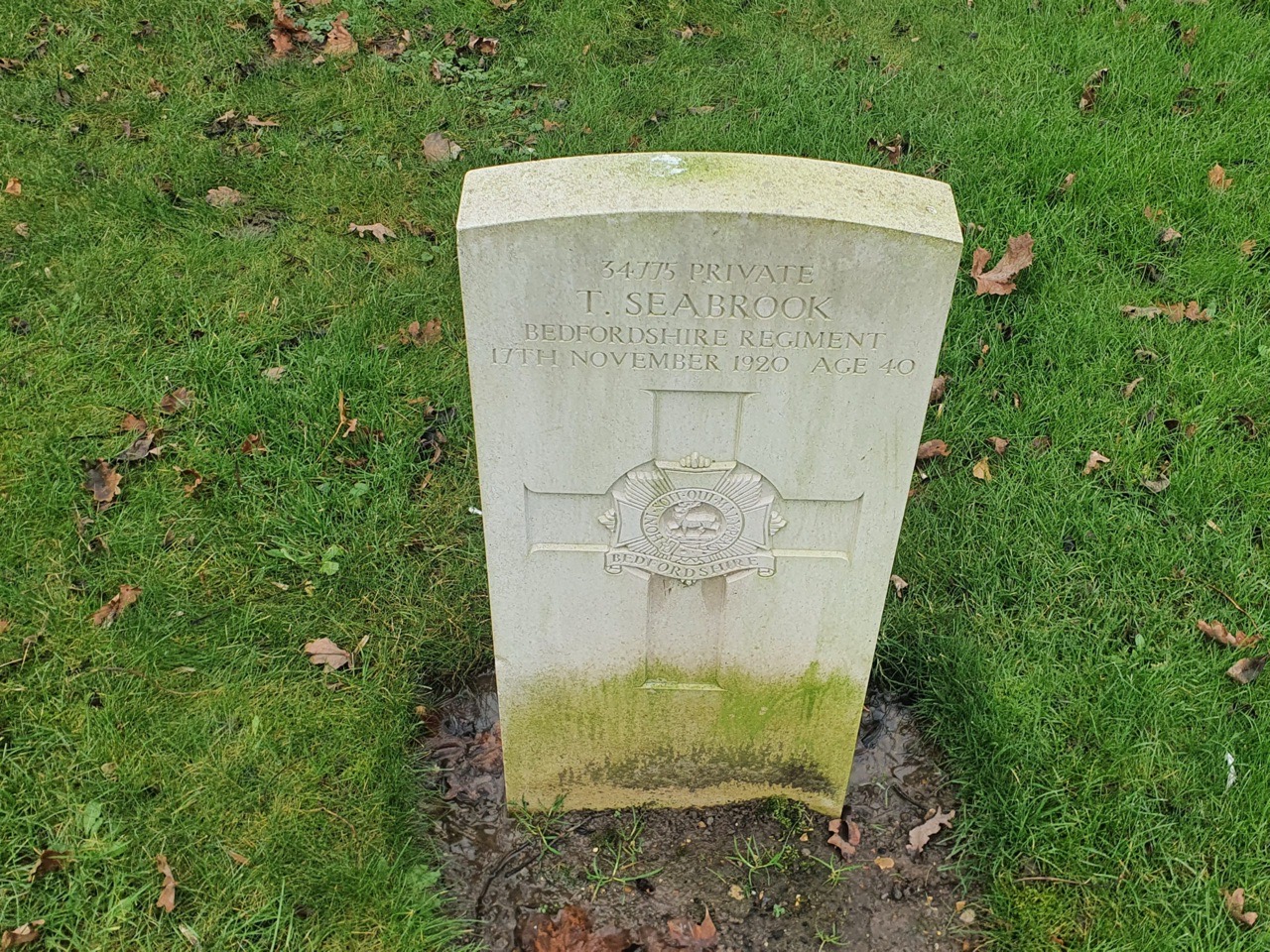
    This is the war grave of Thomas Seabrook, the son of William John Seabrook (born in Shoreditch in 1845) and Lavinia Jane Seabrook (born in Colchester in 1849). Thomas was born in Bethnal Green, London in 1881 and at the time of the 1901 census he was living with his parents and younger sister Sophia at 3 Gossett Street in Bethnal Green, being listed as working as a wood carver. Thomas had a number of older siblings though, as at the 1881 census when they lived in the same property, there was a 9-year old Lavinia, a 7-year old William, a 5-year old Elizabeth and a 2-year old Matthew.

    Thomas was a private in the 13th Battalion of the Bedfordshire Regiment, service number 34775, although I don’t know why he was in that regiment. Thomas died on 17 November 1920 at the age of 40, but there’s nothing I can find in the media about how he died. It looks like the troops from the regiment had all returned by the previous year at the latest, so I assume it was some sort of accident that took place in the UK. But, I’d like to know more…..

  • London – Camden (Borough of) – Euston Travelodge Central

    London – Camden (Borough of) – Euston Travelodge Central

    Travelodge had an offer on a week or so ago which was get one night half price when booking at least two nights, which meant that this hotel became really quite affordable despite its central location. It’s literally a one-minute walk from Euston railway station, and around five minutes from King’s Cross St Pancras railway station, so ideal for those needing to catch a train.

    When I entered the hotel I was surprised and delighted to see that they had ripped up most of the floor, and even more surprised when I left to go out two hours later and they had restored the flooring. Whatever work they were doing, the tradespeople were very efficient at least. The staff member at reception was helpful and everything seemed in order, other than I struggled to hear her amidst noises of the floor being ripped up. No mention was made of breakfast or the cafe, which was of no relevance to me anyway as I wasn’t using them, but I was slightly surprised there was no upsell tried. Although, to be fair, the staff member already could hardly hear themselves think with the sound of their floor being ripped up around them.

    The room is standard Travelodge fare, but actually it was entirely satisfactory and I had no complaints. The window opened and the air conditioning was very effective, something that I don’t necessarily expect in budget hotels. There was a bath in the bathroom, another feature that many hotels lack. I was given the quiet side of the hotel, although I don’t mind road noise, but reviews of the hotel are littered by complaints about the sound of traffic keeping people awake.

    The hotel has started to renovate its rooms and they have the SuperRooms which you pay a bit extra and get a decadent coffee machine and a KitKat. I decided against going for such luxury. I didn’t have any noise problems internally or externally, despite this seeming to be the most common complaint from guests.

    As for the reviews, the staff are being creative with excuses and not blaming Covid for shortages:

    “Rooms are unvacuumed and dirty. Toilet is dirty. Shower curtains ( bleurgh) Rooms are sprayed liberally with air freshener instead of cleaned and it’s suffocating. The reason, apparently, is ‘Brexit’.”

    Firealarmgate doesn’t sound ideal either…..

    “Finally, on the second night when I was getting out baby ready for bed, the fire alarm went off. I scrambled to get us both semi-decent and grab the essentials, then ran down to the foyer. I didn’t take the room key as I thought there was a fire tearing through the building. The fire alarm stopped on the way down. I reached the foyer, and stood there, with a half-dressed baby and myself shoeless, for 20 minutes with no sign of staff.”

    And I know some people like this:

    “I spent half of my time going down to the reception to complain about something.”

    There are over twenty reviews of guests who have been given keycards to already occupied rooms, something which I still think is unforgivable incompetence from a hotel. I merrily barricade a room with a chair behind the door to try and prevent such things, but I’d be demanding my night be refunded should it ever happen…. Fortunately, it hasn’t (although it has to Nathan, he gets all the excitement….).

    Although one customer was livid about a series of things and noted:

    “We advised of the issues and all they were able to do was give us a handful of free Kit Kat’s, not exactly a suitable response.”

    That would have won me over…..

    Anyway, I liked this hotel as it was central, clean and quiet, although I likely won’t stay here again as it’s normally relatively expensive. I understand that there are some rooms in the cellar and that doesn’t sound ideal, probably best to try and refuse those at reception if possible.

  • London – Westminster (Borough of) – The Cambridge Pub

    London – Westminster (Borough of) – The Cambridge Pub

    I got an e-mail from Nicholson’s pubs last week that said they had half-price main courses available on most weekdays over the next couple of weeks. That seemed like a very reasonable deal, so I thought that I’d pop to some of their London establishments that I haven’t been to before.

    This is the Cambridge pub in Charing Cross, which is in the area of Soho. Nicely decorated ceiling and it’s also got an upstairs dining area. The pub says about its history:

    “Deep in London’s theatre district, The Cambridge is popular with audiences and actors alike. Built in 1887 on the site of The King’s Arms, it is next to the Palace Theatre, formerly the Royal English Opera House. The Cambridge lies in the heart of Soho, a royal hunting ground in the days of Henry VIII. We bet you didn’t know that Soho takes its name from a hunting call.”

    The pub’s location (the PH just above the CAM of Cambridge Circus) on a map from the early twentieth century, an arrangement named after the Duke of Cambridge.

    The beer choice is quite limited here, or at least for my decadent needs, so I sufficed with half a pint of London Pride. It was well-kept, at the appropriate temperature and tasted as it should, that’s about all I can say.

    The fish and chips, which looked a smaller portion that it actually was, I think because of their plate of choice. Anyway, this was actually very good, the fish flaked away and was of a decent quality, with the batter having some flavour to it. The batter wasn’t greasy, the chips were fluffy inside and the mushy peas had an air of sophistication to them although they were a tad cold. And lots of tartare sauce, I liked that.

    Service in the pub was friendly and engaging, with the member of bar staff being warm and conversational. The pub was clean and comfortable, as well as being surprisingly busy. I can imagine how busy this pub must get when things are a little more normal in the country and the nearby theatres are packed. The reviews are generally very positive and the management responses on TripAdvisor to the negative ones are some of the longest and most comprehensive that I’ve seen. They’re actually very professional responses, it made me like the venue even more as I imagine they’d resolve any actual problems if they occurred.

    The whole cost of this decadent lunch was £10, which I thought was reasonable as it’s the same as the nearest Wetherspoons and it’s good to visit somewhere different. I’d rather Nicholson’s work on its beer options, but the venue seemed very well managed and so I haven’t got any complaints beyond the lack of decent and perhaps even innovative beers. Certainly not a bad lunch option, although the pricing is a little rich for me when there aren’t offers on.

  • London – Westminster (Borough of) – West End Comedy Club

    London – Westminster (Borough of) – West End Comedy Club

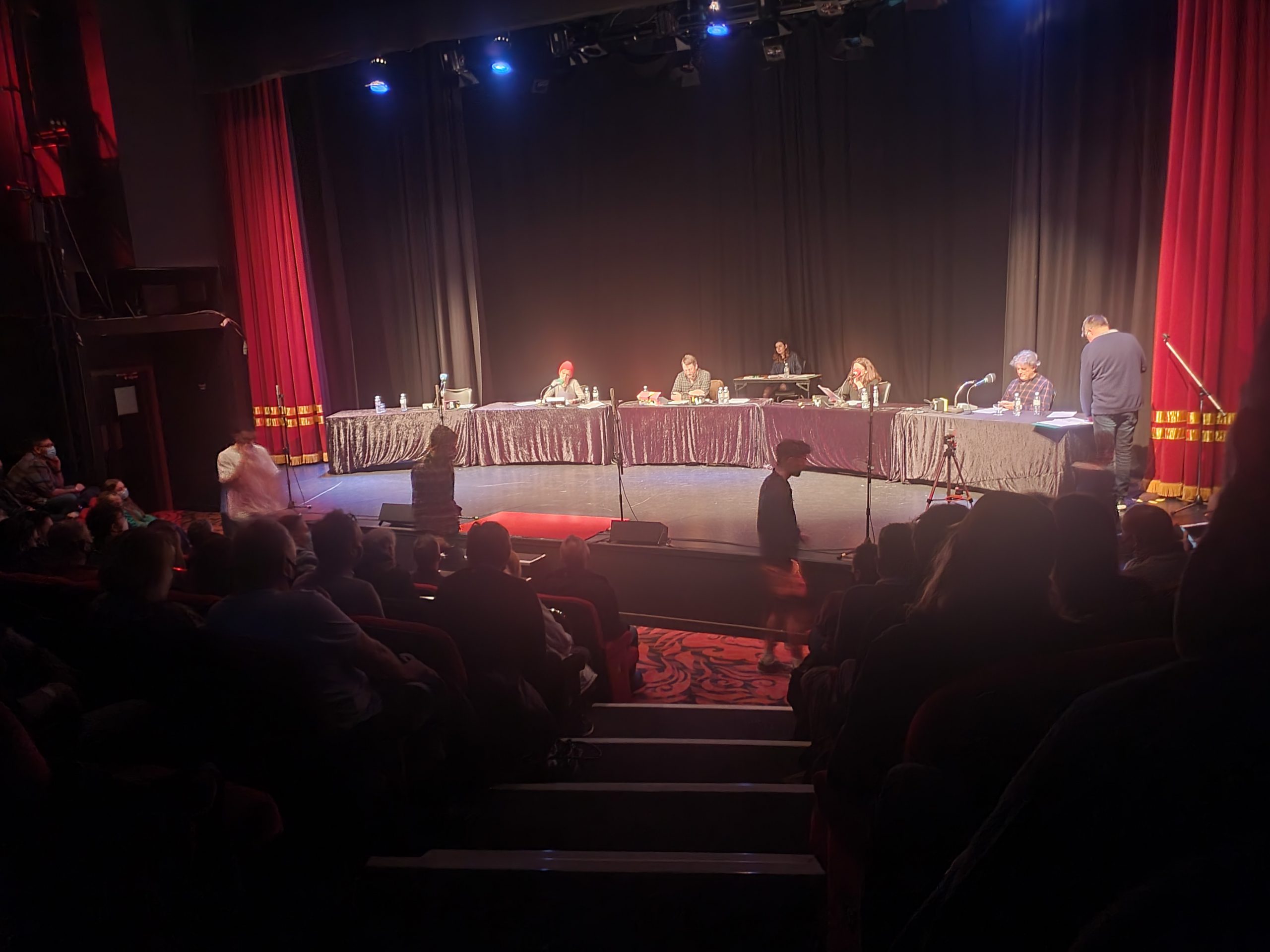
    There was a Time Out offer on last week to get a comedy club ticket for £5, instead of the usual £12, and as I haven’t been to one before, I thought this seemed like a good idea. Live comedy has been rather decimated over the last two years, so there are big efforts being made to try and bring people back in. The West End Comedy Club is a new set-up upstairs at the Covent Garden Social Club, at Great Newport Street. It was easy to find and the signage was clear.

    I read that it was good to get there at opening to get a seat as it wasn’t a large venue, with an absolute limit of 70 people. It certainly wasn’t a big space, just one quite large room with a bar in it, so it felt quite an intimate performance area.

    There was a friendly welcome from the organiser, who mentioned to me that it was sold out and to find a space that wouldn’t take up a larger space give that there were groups coming.

    Given what I was told, I decided to opt for a seat by the bar, this is always a comforting place for me to be. Only two people had got there earlier than me, so I didn’t have to fight for space.

    I had also read about the decadent drinks prices, although £5 for Staropramen isn’t entirely unreasonable given the location. Since this was a night of comedy I won’t comment on the lack of beer options, humorous as the limited selection was. Incidentally, the bar mostly served cocktails and there was one poor barman on his own making these drinks and causing quite a queue to develop although not because he wasn’t actually a decent barman, but because those drinks take so long to serve. And the bar is also brave as any customers wanting a tab had to leave their card behind the bar, which will likely haunt them at some random point in the future. Anyway, bar commentary aside, onto the main event.

    Photos from the venue itself, with Michael Odewale (top-left) being particularly good and I hadn’t realised that he had been on BBC’s Mock the Week before. There was one performer who wasn’t named before the event, and was just listed as a celebrity, and that transpired to be Simon Brodkin (bottom left) who I’ve never really paid much attention to in the past other than reading about some of his stunts, the best known to me being Brodkin’s great work in annoying the disgrace that is Sepp Blatter and also his handing Theresa May a P45 at a party conference.

    Inevitably some material was stronger than others and one comedian had a more muted reaction from the audience as his content was a bit strained. Some of the material is new and the comedians are trying it out with a live audience, with Tom Ward (top-right) having the most surreal of the content, but he integrated music well into his act. Brodkin seemed the smoothest performer out of them all, but he’s had the chance to have more experience and opportunities so I guess that’s inevitable. Incidentally, I hadn’t realised that Brodkin was a trained doctor (I say that not to suggest that some doctors are untrained, just to show he had completed training) before starting a stand-up career, which made his Covid health jokes seem even more appropriate.

    There was a smattering of political humour through the performances and inevitably Boris Johnson and Priti Patel didn’t come out too well from that. Covid humour was also in there quite regularly, but not to excess as that would have likely grated after a while given that people want to get away from it. It was a decent balance of different styles of humour and content, all nicely done.

    Fortunately, my seating location meant I avoided any of the audience participation, although I think the comedians were most interested in those sitting just in front of them on the sofas. Anyone sitting there would deliberately want attention, so that seems fair enough. And a Scottish man who kept shouting, but the comedians had him sussed quite early on. It all went quite quickly, which must have meant that it was an enjoyable enough experience and I thought rather good for a total cost of £10 for the entry and the drink. Something different at least.

  • London – Waltham Forest (Borough of) – Holiday Inn Express London Chingford North Circular

    London – Waltham Forest (Borough of) – Holiday Inn Express London Chingford North Circular

    The hotel option for the last two days has been this Holiday Inn Express, around a fifteen minute walk from Highams Park Overground station and around a thirty minute from Walthamstow Central. And indeed, about a 15 second walk from the North Circular, but that was less relevant to me.

    I didn’t have any particular problems here and the staff at the hotel were all friendly throughout my stay, with the check-in process being efficient enough. For reasons unknown, the atmosphere at reception felt more like a stressed budget American hotel, but the environment seemed safe and organised.

    My IHG and Accor preferences both say that I prefer a room on the top floor away from the lift, and it’s unusual for me not to get that. Here, the staff gave me a room next to the lift on the first floor which wasn’t entirely ideal, but didn’t give me any particular noise issues. The room was clean and felt sufficiently modern, with housekeeping cleaning the room daily and fully restocking everything. There were no plugs by the bed, but there was a USB socket, so that was all sufficient.

    There was the noise of traffic from the North Circular, but I like that random hum of city life, so it didn’t disturb me. The room had working air conditioning and also a window that opened, so ventilation was just as I liked it. There were also no real noise disturbances either internally or externally, although I don’t think that the hotel is that busy at the moment.

    The carefully completed welcome drink voucher.

    The beer choice was far from ideal, it was effectively this, pints of Stella or bottles of Corona. I’m not expecting craft beer heaven from a Holiday Inn Express, but this is weak even by the chain’s standards. I’m not sure why if a hotel has one draft line on for beer that it would choose Stella, that’s brave to say the least. And the hotel didn’t burden themselves with offering the free snack that was promised.

    The breakfast arrangements were a little better than the usual Holiday Inn Express brand standard, and I’ve never seen tinned tomatoes available in this chain. I’m not going to claim that this is hugely decadent or exciting, but I thought it was a useful addition given that there are usually only ever four hot options (sausages, bacon, baked beans and scrambled egg). The area was clean and tidy, although they probably need to deal with their dishwasher which isn’t working as well as it perhaps could (and I’m assuming here they’re using a machine) judging by the state of some of the dishes.

    Just down the road is Walthamstow Stadium, which I remember when it actually had a stadium behind the frontage. Other than this section it has all been demolished now, with housing behind the frontage.

    The hotel is generally well reviewed on-line, although the average friendliness of the staff score is lower than usual, not that I experienced any issues along those lines. I did like the review on the IHG web-site which said simply and without any other comment:

    “The lady at the front desk refused to sell me a kit kat at the front desk”.

    I’d like to think that there’s an exciting back story there, but I suspect that it’s just because the hotel is card only and the guest was trying to pay with cash. Not that I have to worry as I don’t have a vehicle, but there appear to have been a fair few thefts which have taken place in the car park, which I can imagine is more than a little annoying for any tradespeople staying here.

    Anyway, as a hotel I thought that it was all entirely reasonable, especially as the price came in at under £35 per night including breakfast. They’re playing just a bit fast and loose with the IHG Rewards Programme, but given the hotel was clean, the staff were friendly and the breakfast was as expected, it’d be hard for me to complain too much (or no more than normal anyway).

  • Chiltern Railways : Wembley Stadium to London Marylebone

    Chiltern Railways : Wembley Stadium to London Marylebone

    And another in my niche series of rail journeys around the UK, which are primarily for me to remember what rail companies I’ve travelled with, primarily with an interest in how they do things differently.

    Wembley Stadium isn’t the most exciting of railway stations and the history of railways around here is confused, as there was a different station with the same name at one point. This station opened in 1906 as Wembley Hill, was renamed Wembley Complex in 1978 and took its current name of Wembley Stadium in 1987. Incidentally, the Wembley Complex isn’t what I would consider to be a traditional way of naming British railway stations (and sounds more like a psychological conjecture) so I’m pleased that it was changed. The railway station is around a five minute walk away from Wembley Stadium, so the naming is appropriate.

    In the above photo, at the back is the White Horse Bridge, opened in 2008 and replacing the old concrete footbridge which was built for the British Empire Exhibition in 1925.

    The railway station is solely used by Chiltern Railways on their mainline to Birmingham and it’s a fast connection into the city centre as it gets into London Marylebone in only around ten minutes. I stood here and then realised that the train stops a little back way, with the platform being longer than it needs to be as occasionally they bring in longer trains when there are matches or events taking place at Wembley Stadium.

    The train was about a third full, not overly busy. I don’t know if there was a guard on board the train, but if there was, I didn’t see him or her at any stage of the journey. Legroom isn’t ideal and the interior of these trains probably need a more modern refit soon with a return to 2+2 seating rather than 3+2 which doesn’t really fit.

    And here we are ten minutes later in London Marylebone. There are usually two services which operate between Wembley Stadium and London Marylebone every hour, so the service is relatively frequent.

    As I’ve written about before, Marylebone is the smallest London mainline railway station, and also the last one to be completed.

    And the station’s frontage. Everything ran to time, the train was clean and the service was easy to get a ticket for as it just uses contactless at each end. Looping back to the start, there’s not a lot that Chiltern Railways seem to do differently of particular note, especially for a short journey such as this, but they’ve invested considerably in the infra-structure of this route over the last couple of decades. Only a few weeks ago a new franchise was given to the company to operate this route and this lasts until the end of 2027, but with the proviso that the contract might change with the introduction of Great British Railways in 2025ish.

  • London – Central London – Salters’ Hall Gates

    London – Central London – Salters’ Hall Gates

    These gates are near to Fore Street, situated a few metres away from the Minotaur sculpture, but these have just a little more relevance to their surroundings. They are the gates purchased in 1887 by Salters’ Hall for their building then located off St. Swithin’s Lane. The gates weren’t specifically created for them, they had been displayed at the International Exhibition and were commissioned by Prince Albert (1819-1861) and designed by John Thomas (1813-1862) at the beginning of the 1860s, but they then both died and so it’s fair to say the project lost its shine a little. There were a few little amendments for the new owners, such as the addition of the Salters’ crest, but then they were good to go. And I’m sure that everyone was pleased with the gates until the 1941 Blitz saw Salters’ Hall destroyed. On the bright side, they still had the gates. In 1949, they were moved to Salters’ Almhouses in Watford and in 2017 they were moved to their current location, near to the new Salters’ Hall.

    The original location of the gates at the old Salters’ Hall (clicking on the map makes it larger).

  • London – Central London – The Minotaur Statue

    London – Central London – The Minotaur Statue

    With a stretch of Roman Wall in the background, this is the public space in front of Salters’ Hall.

    Part human and part bull, the sculpture of the Minotaur was designed by Michael Ayrton (1921-1975) in the early 1970s. I was interested to understand the significance of why the monument was placed here and the link, but it transpires that there’s absolutely none. It was originally designed for a private estate, with this cast going to a number of locations before the Corporation of London purchased it in 1973. They then placed it in Postman’s Park, but after just over twenty years it was thought that the sculpture needed a change of scenery and it was moved to a high walkway near to the Roman wall. When that was all redesigned, he was brought down to ground level on the terrace outside the Guildhall School of Music and Drama.

    The sculpture does feel a little incongruous to its surroundings, as if it’s trying to make an artistic statement, but no-one is quite sure what it’s saying. It’ll perhaps be moved about again at some point in the future, maybe it’s more suited to somewhere like Canary Wharf where an aggressive sculpture might be more fitting.

  • London – Westminster (Borough of) – Plaque to Pret

    London – Westminster (Borough of) – Plaque to Pret

    I learn something every day (well, most days and a lot of what I learn is broadly irrelevant), and I’ve discovered that the existing Pret shop at 93-95 Victoria Street is just a stone’s throw from where it all began for the company in 1986, at 75B Victoria Street. There was actually a shop in Hampstead but that went bust and Sinclair Beecham and Julian Metcalfe purchased the name and imagery, and they opened at 75B. There are now 500 Prets around the world, with plans to open many more.

    Pret renamed their Head Office, which is nearby above Platform 1 at Victoria railway station, 75B in honour of their first shop. Incidentally, their designers have put up photos of the interior of their head office, very decadent….. I wonder if Greggs has a plaque anywhere.

  • London – Central London – Roman Wall at St Alphage Garden

    London – Central London – Roman Wall at St Alphage Garden

    This stretch of Roman Wall is located next to the Tower of Elsing Spital, by what is now the road named London Wall.

    This is the listed building map of historic buildings in London, with the red line being the scheduling of the remains of Roman Wall that still stand (or where foundations are known to survive), a series of large and small fragments which show the size of early Londinium. This section of Roman Wall is near to the top of the image, a little closer to the Blackfriars end rather than the Tower of London end.

    Looking down from the aerial walkway, this would be a much busier scene in summer months with people eating their lunches or just taking some time to get outside in the relative peace and quiet of the surroundings.

    That’s Salter’s Hall in the background, now a large charitable institution, but previously one of the Livery Companies of the city. It’s a modernist style building which is in keeping with the nearby Barbican development in its post-war contemporary architecture, although it doesn’t fit quite as easily with the Roman wall.

    The plaque is now harder to read, but notes when this area was laid out as a public garden in 1872.

    Much of what is visible isn’t part of the Roman wall, although the foundations of the original structure are still there, but they were built on during the medieval period when it was being strengthened. The brick section on the far right of this photo is from 1477 when Ralph Jocelyn ordered substantial repairs to the wall, at that stage in a bad state in some sections, during the War of the Roses. He bravely raised taxes to fund this endeavour, as well as purchasing large quantities of bricks and lime.

    There was also a church, St Alphage, which backed onto this site and the former wall lines are marked on the ground. This church was constructed in the eleventh century, but was knocked down during the Dissolution of the Monasteries.

    Another Victorian stone, but it’s now nearly entirely unreadable, damaged by the decades of London smog, pollution and not helped by the bombing of the area during the Second World War.

    The medieval putlog holes are still visible where the wooden scaffolding was once placed against the structure.

    The rear of the wall is visible from the gardens of Salter’s Hall which are sometimes open to the public, but which were closed when I visited. The medieval brick additions, and the only stretch of crenellations along the wall which survive, are much more easily seen from this side. The reason that so much of this wall survived was due to it being incorporated into later buildings, although it was only after the bombing of the Second World War that it became quite so visible.