
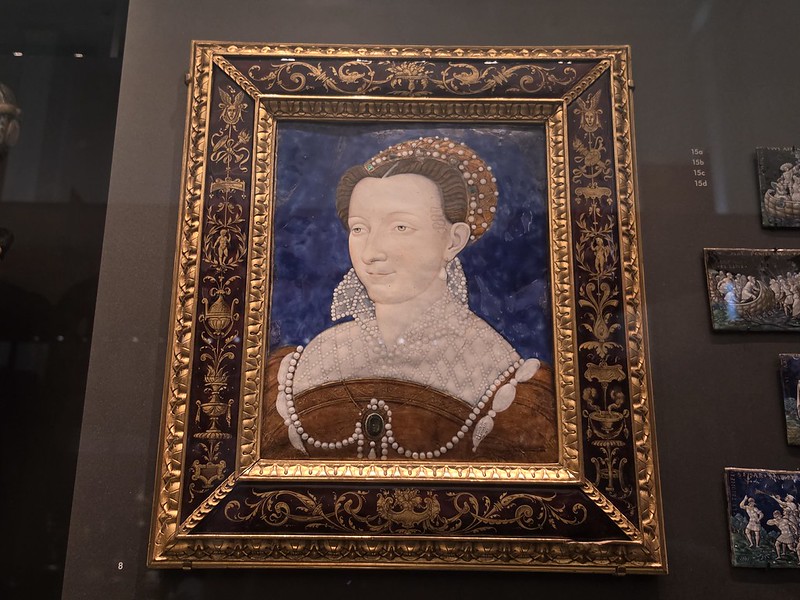
This rather decadent portrait at the British Museum shows Anne d’Este, a woman who appears to have approached jewellery with some considerable enthusiasm and so I assumed that she must have been important. Made in Limoges, now without its town hall, between around 1563 to 1566, it’s the work of artist Léonard Limosin and is painted enamel on copper. The museum notes that his signature is on her right sleeve, which seems a rather discreet arrangement given how much competition there is from the pearls. The elaborate frame is a nineteenth-century addition, as if the arrangement needed even more decoration.
Born in Ferrara in 1531, Anne was the daughter of Duke Ercole II d’Este and Renée of France, making her a granddaughter of the French King Louis XII. Her life became entangled in the French Wars of Religion, the prolonged conflicts between Catholics and Protestants. Her husband François, Duke of Guise, was assassinated in 1563 and Anne spent years pursuing justice against those she believed responsible, before marrying Jacques, Duke of Nemours, in 1566.
Further tragedy followed in 1588, when two of her sons, Henri, Duke of Guise, and Louis, Cardinal of Guise, were killed on the orders of Henry III. Anne was an important supporter of the Catholic League, which opposed the Protestant Henry of Navarre’s claim to the throne, and was herself imprisoned during the dispute. There’s rather more political upheaval than the portrait might suggest and my own arrangements generally become unsettled when someone changes the time of a meeting.
The portrait forms part of the Waddesdon Bequest, the collection assembled by Baron Ferdinand de Rothschild and left to the British Museum. The museum suggests that portraits such as this appealed to the Rothschilds because they evoked the intrigue and romance of the French Renaissance court. I rather just liked the bright colours, but this is why I’m not an international art collector of note.
Although I note, just as an aside, although the museum label notes that this is Anne d’Este, the online description of the artwork says that it’s probably her. So it might not be her, which makes this yet another blog post that may or may not actually be accurate. But I’m right about those bright colours.