And this is week 15 of our attempt to visit every food stall at Norwich Market, with James querying when I was going to post this, so I’ve rushed matters along. When James and I did all of this before in 2023, I wasn’t entirely surprised and delighted with the quality of the offering as the roll didn’t seem as fresh as it could have been. I happened to be telling someone who supplies Bread Source and he defended their quality and mentioned it wasn’t the best product to buy at 13:00 as the rolls would have been fresher earlier. I don’t really think that this holds entirely true though, it’s not for the customer to know when they’re supposed to order things and lunchtime hardly seems end of day in any event. Anyway, this meant that I was keen to give Bread Source a second chance and I was ready to give them an opportunity to engage so that I was excited and enthused by their offerings as I like positivity.
The food looked appetising and was neatly lined up and clearly priced.
Unlike last time, there were very few filled rolls visible and so perhaps they are keen to ensure that they don’t stay out too long. Unfortunately, this is as far as I can go with my enthusiasm as the team member ignored us when we were standing looking at their collection of their baked goods. I’ve blurred him from the photos as I don’t want to spread any needless negatively, but despite moving into the stall itself and then trying to make random noises to get his attention from his tablet there was no engagement here at all and it wasn’t at all easy to be served. I’d go as far as to say that we weren’t really made very welcome at all, the situation was sub-optimal. I did have the Inbetweeners clip in my mind with the quote:
“Why don’t we at least attempt to have a sophisticated conversation? I know it’s a tall order, and I’m not expecting sparkling, but let’s give it a go…..”
To be fair, I would have been happy with someone saying “hi” and didn’t necessarily even need the sophisticated conversation.
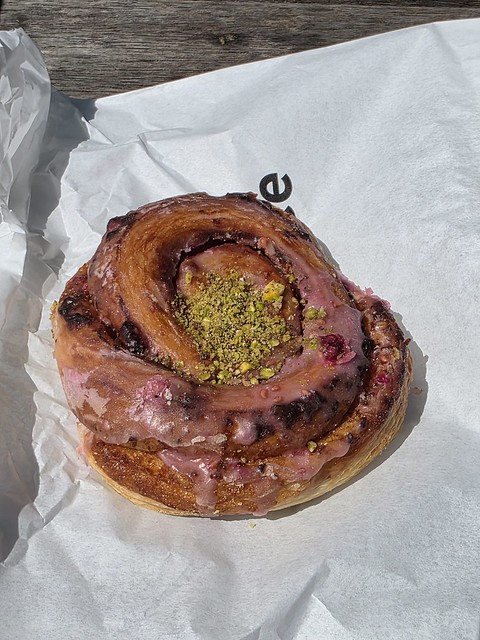
In fairness, my raspberry and pistachio bun was fresh, it had a pleasant taste, the texture was smooth with a crisp edge from the pistachio and it felt like a high quality product. The price tag of £3 wasn’t unreasonable and the quality was better than I had expected, so there’s a win.
James didn’t dislike his doughnut (I actually think that he quite liked it), but signalled his anger by taking a photograph of it next to an ashtray. I didn’t say anything.
Without wishing to be controversial, but I do wonder why Bread Source are still on the market. I can’t remember being ignored at somewhere like Greggs or similar, but I’d understand it more if I was, as people do get tired and bored when serving customers. But, the quality of the engagement from Norwich market traders is exceptionally high because they want to build their businesses up and get a loyal following. If Bread Source left their stall (and I assume they aren’t tied in here, although I’m not an expert on the rental agreements at the market if I’m being honest), it would perhaps allow a new independent food operator in and give them an opportunity to offer something different and have some passion about what they do. Norwich Market is full of traders like that, as this series of posts shows. Given that Bread Source have multiple other shops in the city, I hope that they wouldn’t be too annoyed, although I can’t imagine they’ll read this anyway, if I wrote that I hope they move on to give someone else a go. Which isn’t to note that the company hasn’t done very well and clearly has a substantial following, but it is now a large outfit and times changes….. But, in terms of the positive, the product was decent and I felt that the value for money was reasonable, so it’s not all negative.
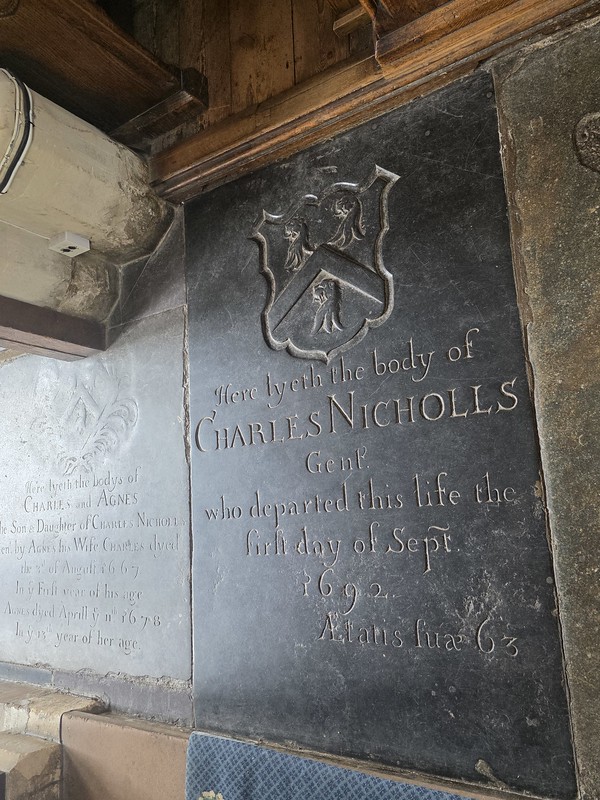
This is the ledger stone of Charles Nicholls (c.1629-1692) which is located in St. Mary’s Church in Hitchin. I’m not sure why the “Ætatis suæ 63” bit is in Latin (a throw-back to the pre-Reformation maybe), but he died at the age of 63. I can’t find out much about him, but his son is interesting as Bedfordshire Archives have some of the family records in their collection and they’ve added some narrative about them:
“(1) NICHOLLS FAMILY 1664-1746
Charles Nicholls senior was a Hitchin gentleman who built up an estate round the borders of Bedfordshire and Hertfordshire over many years. He was survived by his two children, Charles and Mary, and his widow Agnes who had previously been Miss Peake, Mrs Greene and Mrs Rolf. Charles Nicholls junior became an attorney in Hitchin. He inherited his father’s estate in 1692 and added to it, mainly by lending money with property as security and foreclosing on the ‘mortgages’. These properties included a large estate in the Waldens, Hertfordshire, against which John Cripps had borrowed over 2,000 from Nicholls by 1708. When Nicholls foreclosed, Cripps called him a rogue, rascal and villain, and came near to killing him at Bendish, Herts, one November afternoon in 1709. Nicholls fled in fear of his life to London where he made a deposition about what had happened. The deposition has survived almost entirely and gives a fascinating glimpse of the speech, behaviour, manners and dangers of the period. In the end Nicholls’ foreclosure resulted in Cripps’ dying penniless in the Fleet Prison, London soon afterwards, leaving a widow and two infant daughters. Overall, Nicholls loaned at least 3199 which now, in 2003, would be equivalent to over a quarter of a million pounds.
The period around the end of the 1600s and early 1700s was volatile in financial terms. From 1688, Parliament supplied monopoly rights to mercantile ventures including the East India Company, the Hudson’s Bay Company and later the South Sea Company. This led to great speculation in stocks and shares, with companies starting up and often failing very quickly. Before the South Sea Bubble burst in 1720, investors and speculators made fortunes. But fortunes were also lost as these documents show, although the cause is never stated here. Men like Charles Nicholls, who lent money to anyone who had over-reached himself, were the winners because a defaulting borrower seldom reclaimed his property. The estates in this collection acquired by the Nicholls family are : –
1665 Pulloxhill Manor from Pigot and Hale (purchase) 1684 Barton Bridge Closes from Edmund Castell (purchase) 1692 Brotherhood House, Hitchin from Papworth (foreclosure) 1706 Offley from Plummer & Shotbolt (foreclosure) 1709 Stondon from Ansell 1710-19 Hitchin & Ippollitts from Crawley (foreclosure) 1711 Kings Walden & Pauls Walden, Herts from Cripps (foreclosure) 1712 Henlow Grey cottage from Albone (foreclosure) 1715 Pegsden from Ansell (foreclosure) 1722 Pulloxhill leys from Pepyatt (foreclosure) 1723 Foxholes, Hitchin from Draper & Runton (foreclosure) 1729 Chibbley, Pegsdon & Shillington from Tapster & Ansell 1744 Welwyn from Plummer”
It’s an example of how wealth was built up, not necessarily ethically (although nothing changes there with some property owners), during this challenging period, much of it probably still resides in the hands of subsequent generations. Bedfordshire Archives also has this family tree tree for the Nicholls.
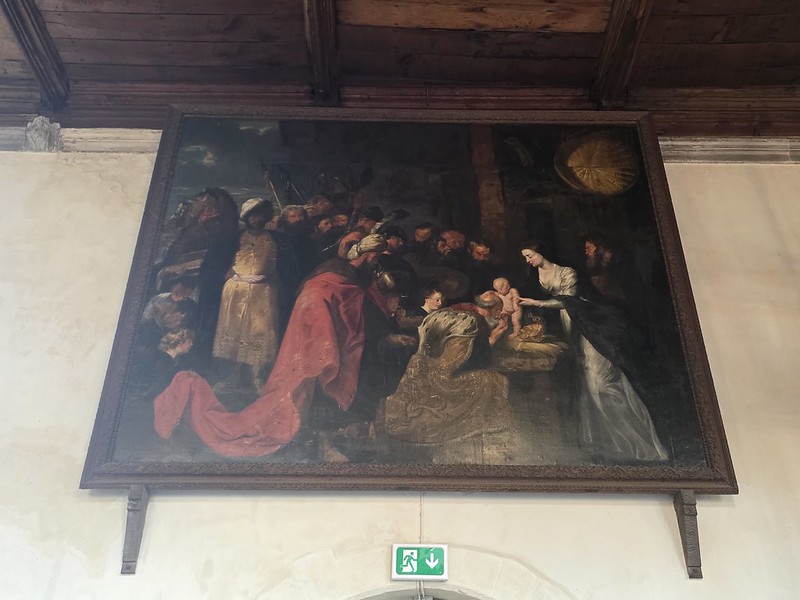
Located above the north door of St. Mary’s Church in Hitchin is this large painting of the Adoration of the Magi. It occurred to me (and others will inevitably disagree) that it seemed just a little out of place, as if they had this painting and they weren’t entirely sure where to put it. And it has been moved around the church a little, although it moved to its current position in the early nineteenth century and I don’t imagine it’ll be on any travels in the near future. It was donated to the church by John Radcliffe (1738–1783) in 1774 and his family lived in Hitchin Priory so it was unlikely that a gift from the local gentry would have been declined. The painting itself is a copy of an artwork that came from Peter Paul Rubens’s workshop and it’s fortunate that it came after the Puritans had a little rummage about the church as otherwise this would have likely been destroyed. There’s some authenticity to having this religious imagery in a church, although it’s a little dark and hard to see when it’s high up on a church wall. Anyway, what really intrigued me is that no-one has ever taken it down, it would have only taken one vicar who didn’t like it and it would have gone, with the Victorians being particularly good at this wholesale removal of items.
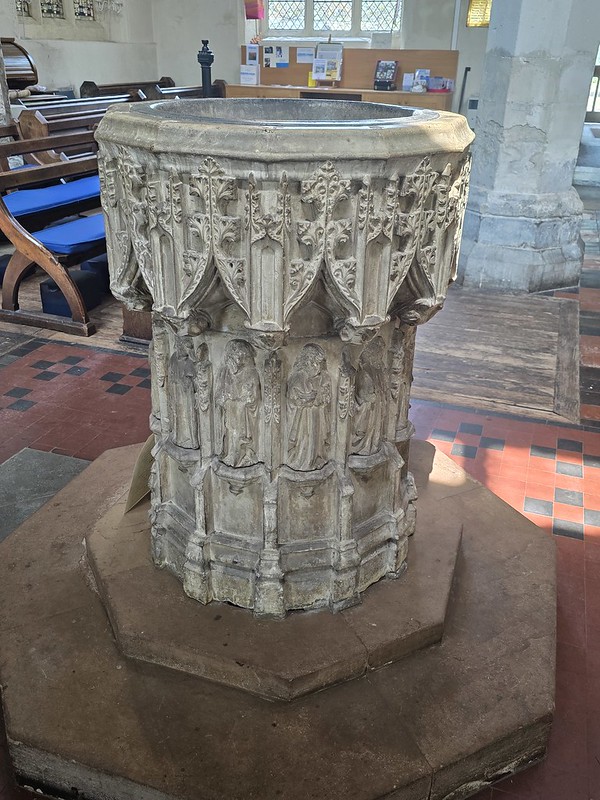
This is something of an impressive font located at St. Mary’s Church in Hitchin. It’s made from Ketton stone and is thought to date to around 1470 and it has representations of the 12 apostles of Jesus. There was once an additional step here, but the Victorians decided that they’d remove that.
And the font cover, which certainly couldn’t be said to be under-stated.
The quality of the carving is high but then the Puritans came along in the 1640s and knocked the heads of the apostles off. I won’t compare them to any other recent political movement, but the Puritans decided that the Reformation wasn’t done properly and so they went full steam into a more extreme version of it. But, I like the history behind this, it’s something of a survivor and it retains its place in the centre of the church.
This is week 14 of James and I eating at every food stall at Norwich market, for the second time. We did extra visits in May so I had something to write up whilst away, we are very good at forward planning like that, which means that my two loyal readers won’t go short on posts from this series. I rather liked Thai Bubble when we visited last time, although the service time was a little excessive.
It’s not necessarily the easiest menu to understand in terms of the ordering process, but the helpful team member was pro-active in talking me through the whole arrangement. There’s certainly plenty of choice to be had and the stall takes cash and card.
After you order, then you are shown where to wait for the drink on the side of the unit. This time, we didn’t have a long wait, with the drinks being served after a couple of minutes. They’ve changed things a little since we last visited and you can’t sit in the unit now, it’s takeaway only. It all seemed clean and organised, with something of a welcoming vibe to it.
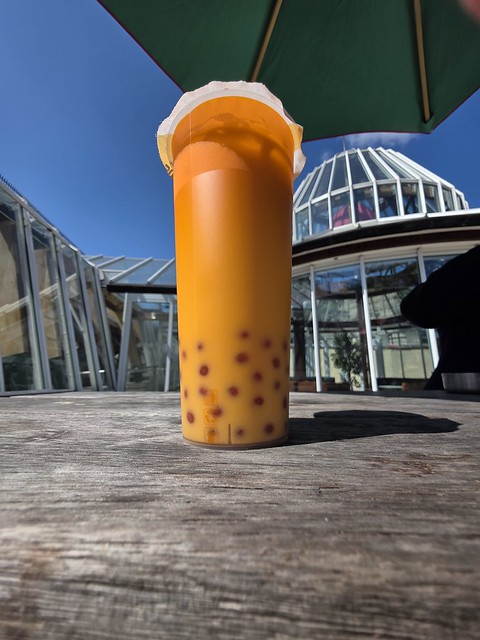
We relocated to the Castle Mall and this is the mango bubble tea with cherry. Sealed at the unit, it kept its chilled temperature and it had a depth of flavour to it. I really rather like the tapioca ball as they add texture to the whole arrangement, although I’m always worried when James has a bubble tea as he ends up choking on one of the balls. It’s also quite a filling drink, there’s plenty of it although I did opt for the larger version.
Talking of which, this is the one that James got and he spent quite a long time trying to work out how to get his straw in. I have to be careful, as otherwise he’ll tell me that I’ve made him sound like an idiot instead of the executive that he is.
This is a slightly light review as it was a drinks visit only, but I liked it here and felt welcome. I’d say that the concept is slightly complex for anyone who doesn’t know what they’re doing, which is so often me, but the service was engaging and warm so that resolved that. I think that we agreed that we’d both go here again (although we say that and then promptly march over to get chips from Lucys), my drink was £4.50 and that’s comparable to a coffee now and my inner child likes the whole concept behind these drinks….. We didn’t order food this time, but they do offer waffles as well.
I had a spare hour in Hitchin whilst going to Luton Airport, the first time that I can remember actually visiting the town. It was rather more decadent than I expected, there were lots of artisan shops and outlets with lots of people about.
Information about the pub’s history outside of the main door.
“The Angel Vaults
This Grade II listed building dates from c 1765 and was originally a “commodious family home.” In the yard behind the house was the brewery established by the Crabbe family in c 1885. Hitchin Conservative Party moved into the building, remaining here until it became the Angel Vaults. The name is from the medieval inn that stood next-door-but-one, on the site of 1–3 Sun Street. Until the 17th century, Sun Street had been named Angel Street for the preceding two centuries. The old Angel Vaults was an L-shaped, timber and plaster building, with a tiled roof and a coach arch. By the 1950s, it was in a poor condition and demolished, but its name lives on.
These premises were refurbished by JD Wetherspoon and opened in December 2014.”
I can’t unfortunately find any photos of the interior of the building before the conversion, but here’s a Google Street view image from early 2014.
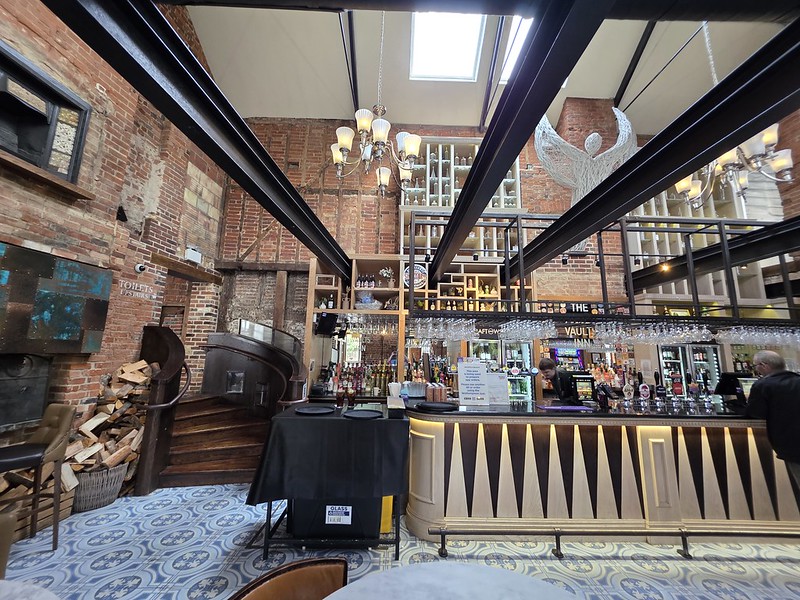
JD Wetherspoon manage to transform buildings in a creative and sensitive manner, with the interior of this structure maintaining some of its original features.
Not least that fireplace.
There is seating at the front of the building, but the main bar is at the rear.
And there’s this side area with the coffee machine and access to the beer garden.
The unique carpet.
I’m not hugely engaged with the muffins that Wetherspoons sell, but they’re so cheap that I decided to get the sausage and egg one, which tasted perfectly acceptable as my morning snack. The beer is the Urban Dusk from Redemption Brewing, which was maybe just a little thin but it was pleasant tasting with a caramel and toffee edge to it. The half pint of beer, unlimited coffee and muffin came to £4.24.
In terms of the beer options available, there was some stuff from Greene King (who operate the pub in the building next door) that I ignored, alongside Thornbridge Jaipur, Adnams Mosaic, Redemption Urban Dusk and Stonehenge Great Bustard.
The milk slightly scared me as it was left out for a long time and had a fly swimming in it. I’m not sure why they weren’t using the usual milk jugs, but the likely reason is someone has pinched it.
As it’s a JD Wetherspoon, I like having a little look at the reviews and the rating is just a little towards the lower end of the scale for the chain.
“Visited last Saturday and found that both coffee machines needed refilling. I waited until a member of staff, who was returning plates to the kitchen was passing and said ‘Excuse me, both the coffee machines need refilling please.’ She snapped back ‘Can’t you see we’re busy?’ Eventually the machines were attended to by another staff member. A little later I went back for a refill, one of the machines still needed refilling, but the other appeared to be working. I selected latte but only got hot milk. Had to go to the bar for a fresh mug, but the barman said there weren’t any so had to rinse it out for me. I returned to the machines, told another member of staff, who came back with supplies and I pointed out the problem with the machine only dispensing milk although apparently working just as the first one passed by again and repeated ‘Can’t you see we’re busy?’ Complained to Wetherspoons customer services who said the staff would be spoken to. I suggested a refund would be appropriate and they replied it wasn’t warranted. Very poor.”
Having spent a lot of time at JD Wetherspoons, because they have cheap coffee and lots of space, there’s definitely a divide between customers. There are some who just wait until the team members fix the coffee machines pro-actively, which they nearly always do as they flash different colours when they’re broken (the machines, not the team members) and seem to accept that the £1.71 for unlimited coffees inevitably comes with some occasional delays as team members are often busy. Then there are those customers who feel the need to seek out team members already busy with other things to inform them that the machine is broken, which they will know. So take your side really, give team members time or demand what you’ve paid for, I suppose both options are acceptable….
“Avoid if there is a concert on at the Hitchin priory. Ordered food via the app, food came in good time but drinks didn’t arrive for over half an hour. Waitress expressed that they were short staffed.”
This is a common problem where the kitchen is quicker than the bar, but then customers end up with their meal and no drink to have with it. Sub-optimal….
“Particular waitress had a very bad attitude and threw down cutlery when pointed out the order was wrong and stropped off in a huff, this was over a gluten free option. The manageress was less than sympathetic and was more than rude and ordered us to leave”
Two sides to every story, I’ve never been asked to leave because I’ve mentioned an order is wrong….
“Service is perfectly to the level you would expect 16 year olds”
And the rest of the review is just more sneering about younger people. I imagine the pub won’t be too disappointed if the customer goes elsewhere.
“Tried going for our breakfast today, we’re going to sit in the garden as it was so lovely and we had our small dog with us, we were just about to order and were told it was company policy NOT to allow dogs even in the garden. What a shame another customer close by it was a rediculas ‘company policy ‘. No social media either so could get a response from them as to why such a policy”
So a one star review because a customer wanted their dog to be exempted from the pub’s long-standing company policy and wasn’t……
“Cold food( 3 MEALS) with a row with assistant about taken it back And just been served a Bailey in a 25 ml shot glass went questioned staff I don’t know ( hate to tell you bailey is a 50 ml)not going back don’t bother going !!!”
Ah, I’m with the customer, bar staff should know you can’t serve Baileys as a 25ml…. Although I think I’d get over it and go back.
“What a sham for a restaurant. But then this is what I have been told to expect at Wetherspoons. I am an ex pat living in Canada where the service culture is king and the customer is looked after. I went in for Sunday lunch and ordered a pint and the ale pie and chips. The beer was great by the way. When the food came the pie and the gravy were stone cold. The chips and peas were hot. I could not attract a waiter’s attention so I walked the food to the kitchen area and found my waiter and told him my food was cold. The first thing he said to me was ‘would you like me to warm that up for you’, not something like very sorry I will replace that straight away. I asked whether I could have a whole new meal rather than warming it up and he said yes but again said we can also warm it up for you pushing me towards this option. At this point I asked to talk to the manager and walked my plate back to my table. A few minutes later a manager appeared who was very apologetic and did offer to refund me my bill so it did appease me but seriously, train the waiters to be more customer oriented. In north America I would have had a refund and a free meal. Clearly England and / or Wetherspoons has some catching up to do unless you want to be married to the classic English ‘fawlty towers` client service model.”
A sham of a restaurant as a customer wasn’t given a free meal and a refund. Hmmmm.
“No sports on the TV… waste of time going there.”
Another plus point for JD Wetherspoon in my eyes.
“Some of our party didn’t get their drinks, felt like I moved to Essex.”
Is this an Essex thing in terms of not serving drinks?
“Arguing in front of the customers is not very good practice”
But very exciting.
“Food appaling if this is supposed to be a gastro pub.”
I don’t think it’s supposed to be a gastro pub if I’m being honest.
Anyway, I’ve digressed once again. I rather liked it here, the building has some history to it, the service was friendly, the surroundings were clean and I felt that there was value for money.
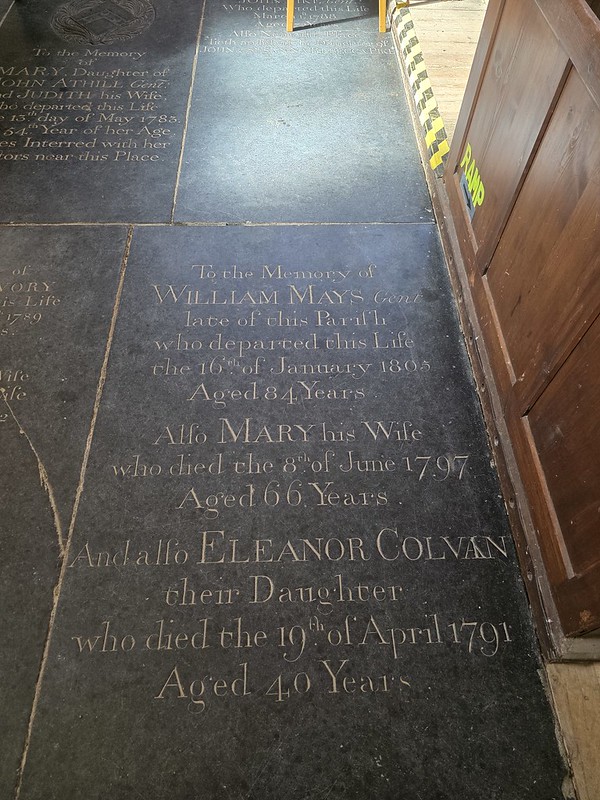
This is the ledger stone of William Mays (1720-1805) at Holy Innocents Church in Foulsham. There are a collection of these stones in the church from this date, but that’s perhaps likely as a huge fire in 1770 gutted much of the interior and so many older ones might have been badly damaged.
William was baptised in the church in Swanton Morley on 8 March 1720, the son of John Mays and Margaret Mays and he married Mary (nee Brown) in Thurgarton, Norfolk on 25 April 1756.
William died on 16 January 1805 and he was buried on 21 January 1805, his wife Mary having died on 8 June 1797. The name of their daughter has been completely mauled about on the grave, it’s Ellen Colville and it’s quite clear in the church records.
This is another instance where I suspect I’ll find out more at some point in the future, but as there are no newspaper articles about him and he pre-dates the census, there’s not much more of excitement that I can find at the moment.
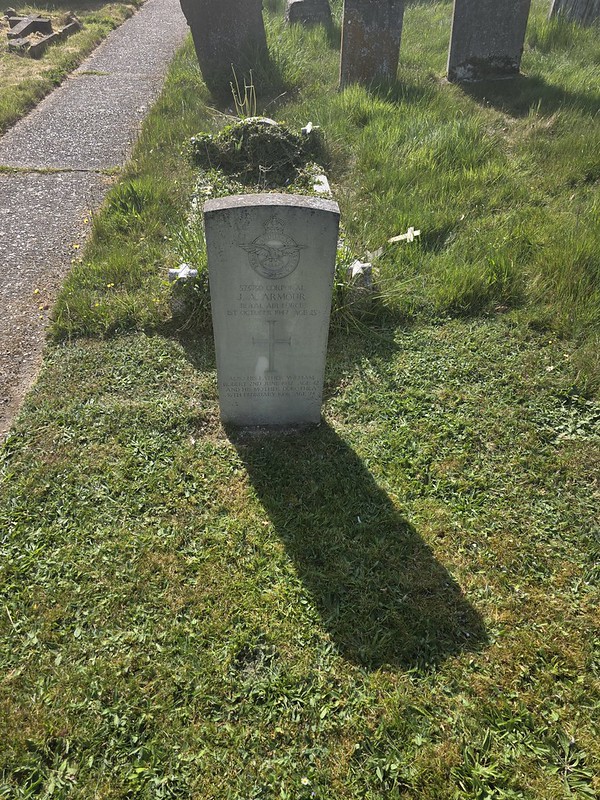
This is the Commonwealth war grave of James Austin Armour located in the churchyard of Holy Innocents Church in Foulsham.
James was born in 1922, the son of William Robert Armour and Dorothea Armour, who was a Corporal in the RAF (service number 573750). He was educated at Hamond’s Grammar School in Swaffham and he had joined the RAF as an apprentice in August 1938.
James died at King’s Lynn hospital on 1 October 1947 and he was buried on 6 October 1947. He received a war grave from the Second World War shortly before the official end date of 31 December 1947, so this must be one of the last ones issued.
The death wasn’t directly war related, the Lynn Advertiser reported on 3 October 1947
“Motor-cycling fatalities
The second fatal motor-cycling accident in West Norfolk this week involved Corporal James Austin Armour (25), R.A.F., of Foulsham. He was involved in a collision on Wednesday near Modney Bridge, Hilgay, with a motor-car driven by Mr. A. W. Underwood, 3 Crown-lane, Littleport.
Dr. W. J. Tavendale (Downham) attended Corporal Armour, who was removed to Lynn Hospital by the Downham motor-ambulance. He had been stationed at Oakington, Cambridgeshire. The first fatality involved Percy Hewitt (27), Freebridge-terrace, Middleton, who died in Lynn Hospital on Monday.”
The probate issued in 1948 showed that he had assets of £127 which went to his mother. His parents are also listed on the war grave, his father died on 2 June 1932 at the age of 42 and his mother died on 16 February 1966 at the age of 74. This must have been a very difficult time for his mother given the early death of her husband, then seeing her son survive the Second World War before dying in a motorcycle accident.
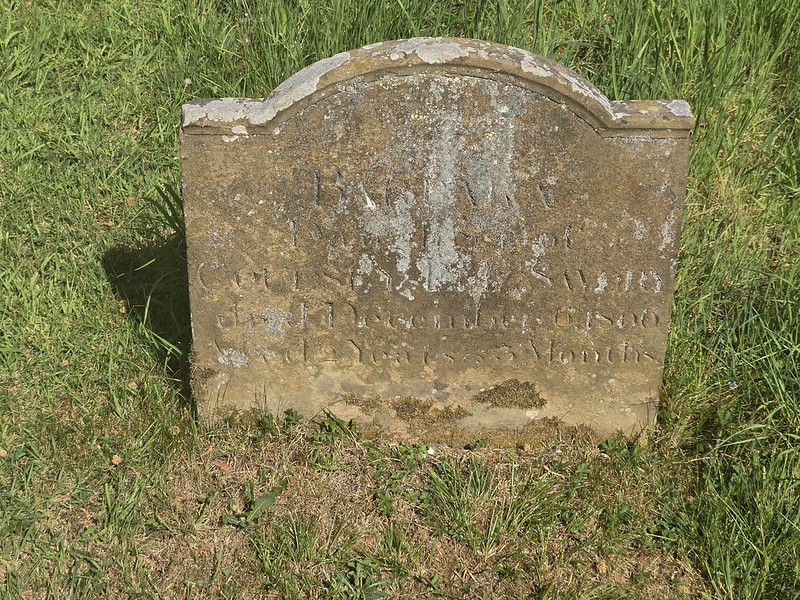
This grave at St. Nicholas Church in Twyford commemorates the life of Barbara Savoury, the daughter of Coulsey and Elizabeth Savory. Coulsey seems an interesting person, he was a small-scale landowner who found himself in a financial situation later in life that was sub-optimal, although like Alan Partridge, he bounced back. He was to die in 1837 and was buried in the church, although his gravestone is no longer extant.
At first, I struggled to read the name on this grave, but the death at a young age was visible and I was intrigued. It was easy to work out by going to do the burial records of the church from that year and this is the only death in 1800. Barbara died on 6 December 1800, aged just two years and three months. Although there’s quite a lot of media attention about her father over the decades, there’s no mention of Barbara other than the birth and funeral record. A few years after her death, her parents had another girl who they also named Barbara, although she also died young and was buried on 4 February 1829 at the age of 20. Her parents also had a son called Edward who was born in 1807 and he grew up and lived in the village, later naming his own child Barbara Savory and I’m pleased that she had a much longer life. So, in some form, the name of young Barbara did live on.
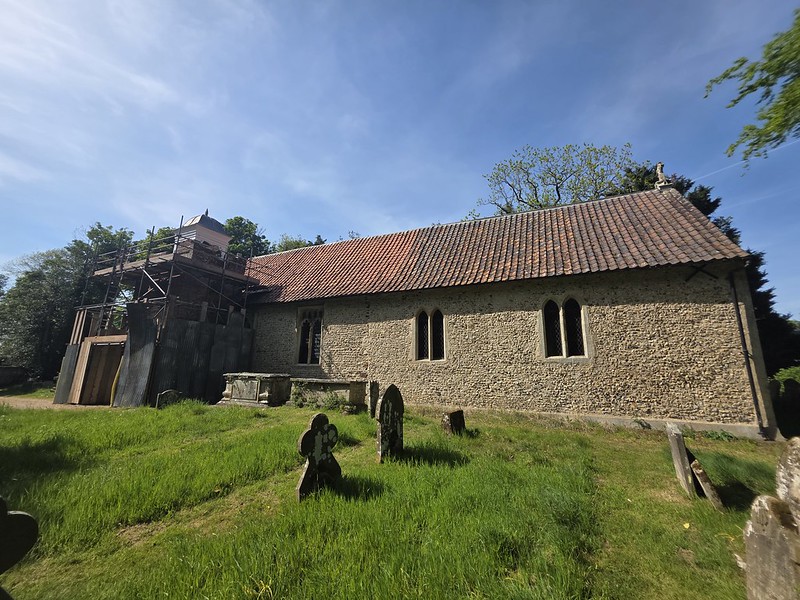
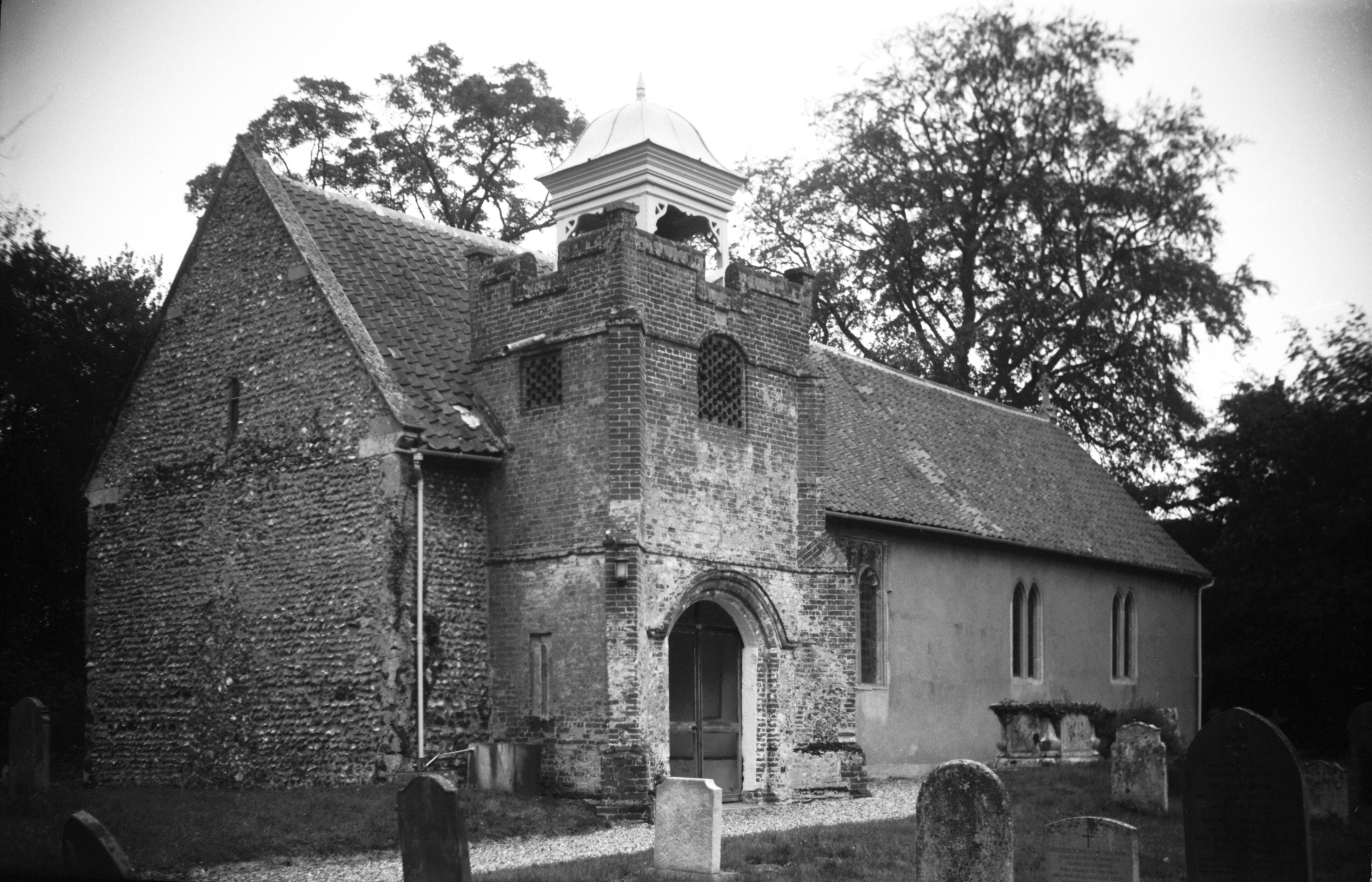
St. Nicholas Church in Twyford feels both remote, but also heavily impacted by the heavy road going right by it. The village currently has fewer than thirty residents, which has inevitably made this rather challenging to run as a viable church. The name of the village, meaning ‘double ford’ is Saxon, but there’s no evidence of a religious building here from before the Norman period. It’s thought that the nave dates to the early twelfth century and the chancel is a little later, although they are now under the same roof, which I’m not entirely sure has always been the case. George Plunkett came this way in 1992 and since that visit, the render has been removed from the chancel so that the historic stone is visible.
There’s scaffolding up as there was a little incident a couple of years ago when a tree fell down during a storm and hit the church and some gravestones. This porch, which could arguably be called a tower, has been added to the church in 1732 and I’m not sure that it was ever the most congruous of arrangements.
Work on the porch, which is expected to be completed by the Autumn of 2025. Unfortunately, the church was locked and so it wasn’t possible to look inside.
The news update about the matter.
It’s not clear that there was ever a tower to this church, although it would have likely been where the porch is located if there had been, which I doubt was the case. There looks like a bricked up door here into the nave, although it’s hard to make out.
The end of the chancel. There was some remodelling during the Victorian period, but I suspect it was more tidying up than anything more substantial.
This former doorway is thought to date from the fourteenth century and it’s another church that I’d like to go inside, but I suspect arranging that would be relatively difficult. It’s positive that there is funding to repair the damage to the porch, but I can imagine this is a tough one to fund raise for given the limited local population size.