Category: Poland

  • Elbląg – Wielokran Absztyfikant

    Elbląg – Wielokran Absztyfikant

    One of my go to web-sites for craft beer in Poland is https://ontap.pl/, which lists the various beers that venues have and links to their Untappd scores and it has numerous other features. There’s only one location listed in Elbląg, which meant that it would feel amiss if I didn’t visit it. It’s also very well reviewed and I get the impression it dominates the craft beer scene in the city.

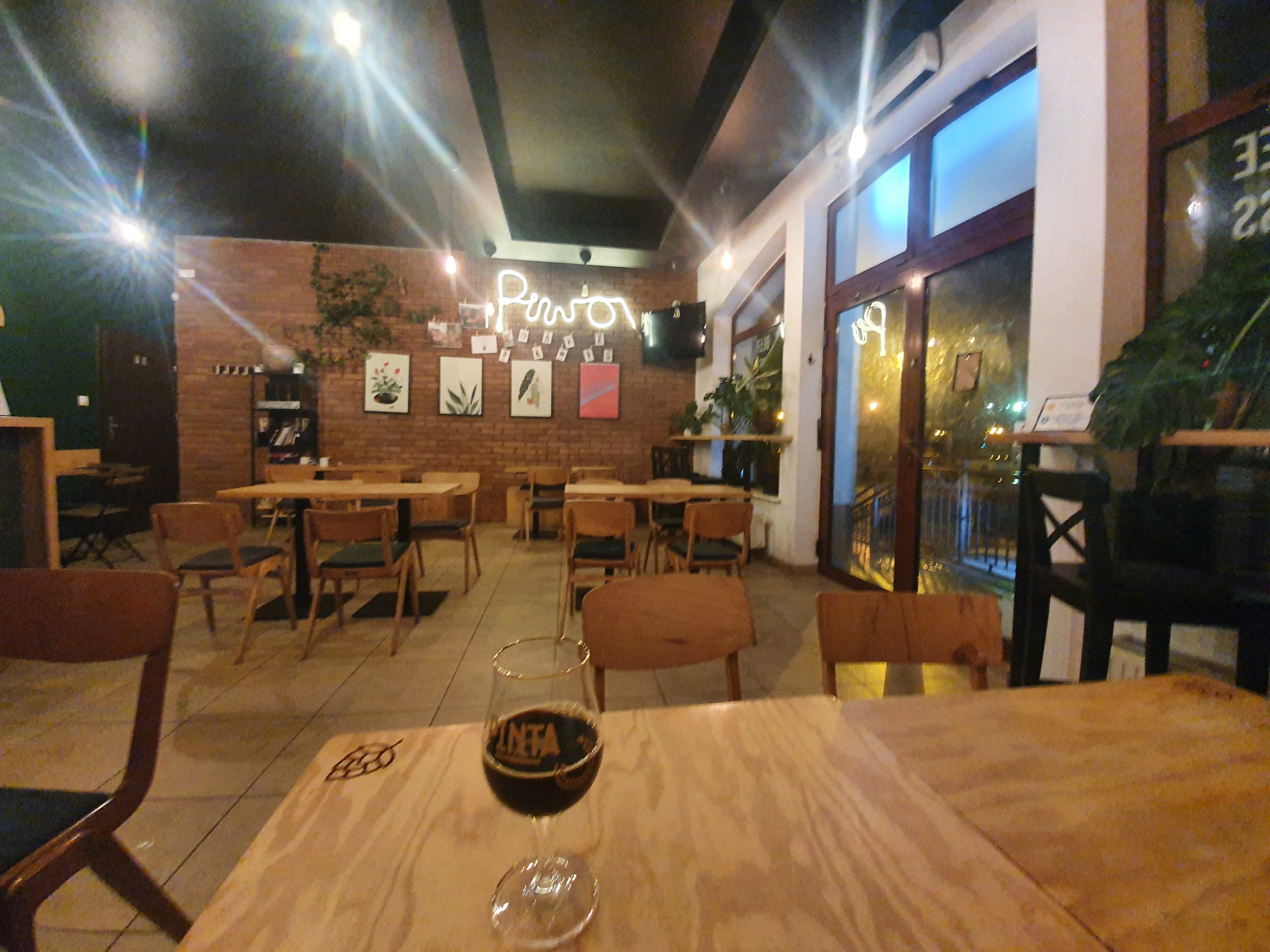
    It was empty of customers when I came into the bar, but it got busier later on. The atmosphere was inviting, the staff member was helpful and there were eight different beers available across a range of beer styles. The beers are chalked up on boards behind the bar and there are also samples of each visible which helps identify the type of beer it is.

    In the photo is the Portermass Cocoa Nibs, Vanilla and Cinnamon from Browar PINTA and I’ve had several from that brewery over the years, but this is the best. Although we’re a bit part the Christmas period now, the mixture of chocolate and cinnamon on top of a rich imperial Baltic stout is a decadent treat. It’s 11%, but it was smooth given that alcoholic volume, a very drinkable beer.

    I also ordered the Juicilicious from Piwne Podziemie and then realised on Untappd that I’d had this before a few months ago in Warsaw. When I order a beer again without checking if I’ve had it before, I just have to hope that I liked it last time, and in this case, I very much did. It’s a decent hazy IPA with a citrus and hoppy taste.

    This venue doesn’t do food other than some crisps and nuts, and I could have done with a pizza or the like to go with the beer. The environment was welcoming, so it’s a venue to linger at, and I liked the beer options available, nicely curated. The prices were reasonable and as they’ve been going for a couple of years and are still trading, it seems like they’re doing well, so hopefully they’ll be trading for many years to come. I was pleased that I came here, an on-trend and well managed bar.

  • Elbląg – Centrum Sztuki Galeria EL (former Dominican church of the Blessed Virgin Mary)

    Elbląg – Centrum Sztuki Galeria EL (former Dominican church of the Blessed Virgin Mary)

    There has been a church on this site since 1239, the same time as the Teutonic Knights came to the city and I remember visiting their castle in Torun. The Dominicans founded their monastery and they extended the building in the late thirteenth century. A large fire destroyed much of the building in 1504, but it was rebuilt and later that century a pulpit was constructed which is today in the city’s cathedral.

    The Dominicans had left the building in 1542, when they gave it to the city authorities, who then handed it to an Evangelical church. There was some reconstruction in the late nineteenth century, but there was major devastation in 1945 and a fire swept through the building. Much was lost and the building remained in ruins until 1959, when it was decided to turn it into an art gallery.

    There are still some ruined buildings to the side of the churchyard.

    The member of staff at the desk was helpful, but I think she was surprised to see anyone visiting, I suspect I was their first visitor of the day and they’d been open for a couple of hours. She showed me which bits of the building that I could visit, although first she had to rush around turning all of the lights on. There was a friendly atmosphere to the whole arrangement and the admission fee was low.

    I had seen a photo of this before and after the war in the city’s museum earlier in the day, sadly badly damaged during the Second World War.

    There is now a two floor metal structure within the church which is relatively recent, with this holding the art collections.

    The former nave of the church, with the two new floors visible on the right. I probably should have used the lift, as the metal steps are see through and I realised just how high I was by the time I reached the second floor. I’m not great with heights, but I bravely battled on.

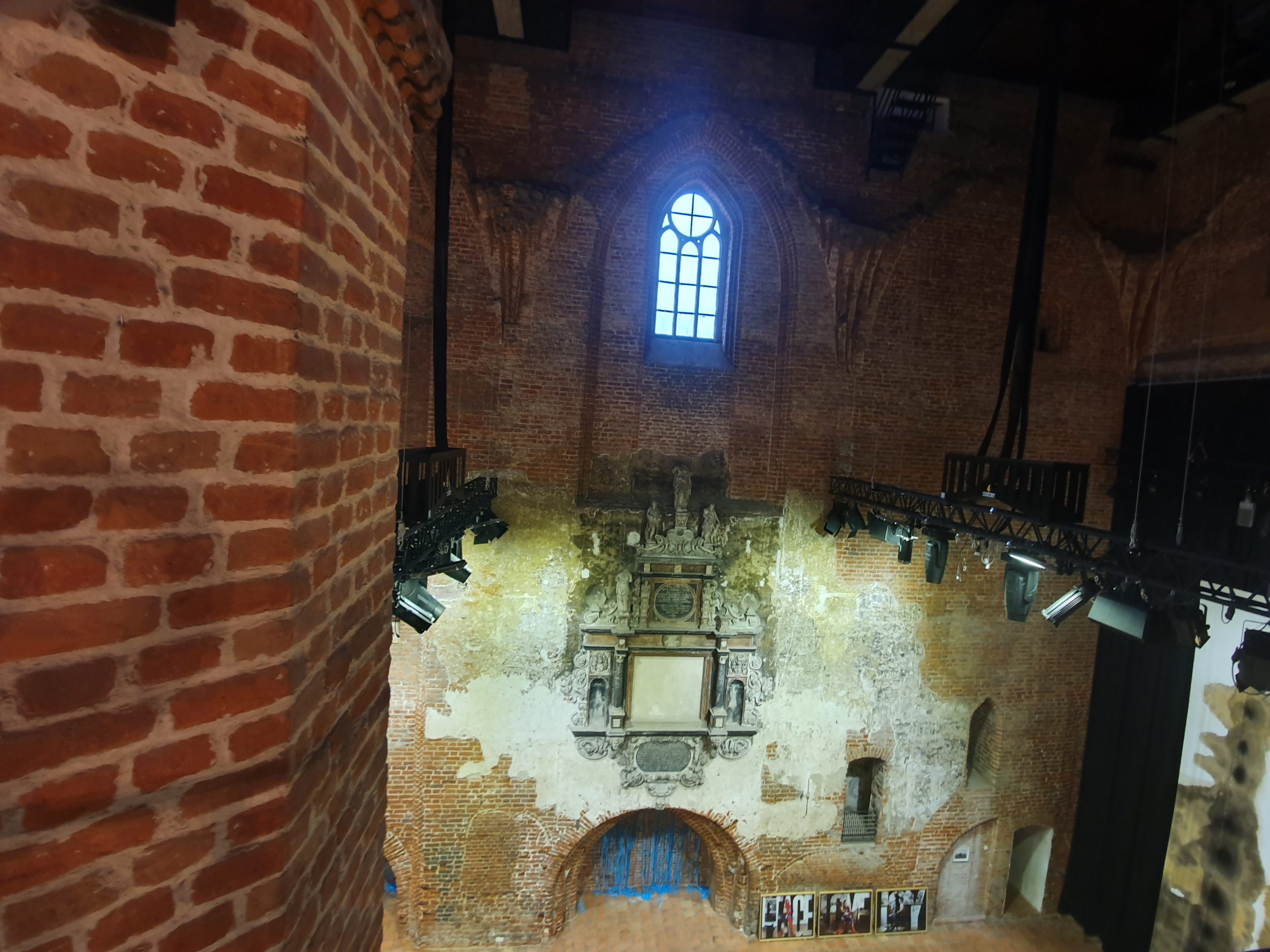
    Looking past the blue, that’s a very Germanic arch.

    Without being negative, as I understand that the art gallery arrangement has secured the building, but I didn’t engage with the artistic collection at all. I thought in places that it intruded on the building, the heritage of the church just undermined the works within it, they weren’t strong enough to cope with their environment. This artistic installation of water dripping into buckets (or I assume it’s an installation, it’s just randomly placed there) is rendered pointless because of the grand nature of what is around it, there’s no point trying to find meaning in an artwork when it’s surrounded by a building entirely dripping, if I can verge from literal to metaphor meanings, with stories. As a balance, I did try and find out more about this exhibit on the gallery’s web-site, but there’s nothing.

    Many of these tombstones are damaged, but they’ve at least survived in some form.

    When I went into this huge space the lights were off, and it had more of a charm and atmosphere to it. I understand the need for lights with regards to an art collection, but they take away from the space a little. I’m trying not to sound negative about the art collection, because that is what saved the building and makes it viable and accessible today, but it’s an uneasy mix in places. I’d imagine that, like me, a fair number of people are really visiting to see the building itself, not necessarily to see the galleries. With the exception of a sign externally giving the history of the church, there’s nothing internally giving further information about the building’s heritage. Nor either is there anything on the gallery’s web-site, which is perhaps a little disappointing.

    One of the aisles (which is perhaps the side of a former cloister) is also accessible, all carefully restored.

    Some of the tombstones and memorials which are located in the aisle of the church, all safely preserved now. I don’t know enough about the church locally to know if this could have remained an active religious building if it wasn’t for the Second World War, but I’m pleased that it has been saved. Given that the church was Protestant, the transition from Germany to Poland certainly meant it would have had a very different future. The building remained derelict until 1959, as this city took some time to recover, and the former church could easily just have been bulldozed. I like that there are many festivals and events that take place here, it’s a really thought provoking environment. I didn’t engage much with the artworks here today, but I like what the whole place has become, but I still feel as if I could have been told more about the art collection and the building itself.

  • Elbląg – Photos at Night

    Elbląg – Photos at Night

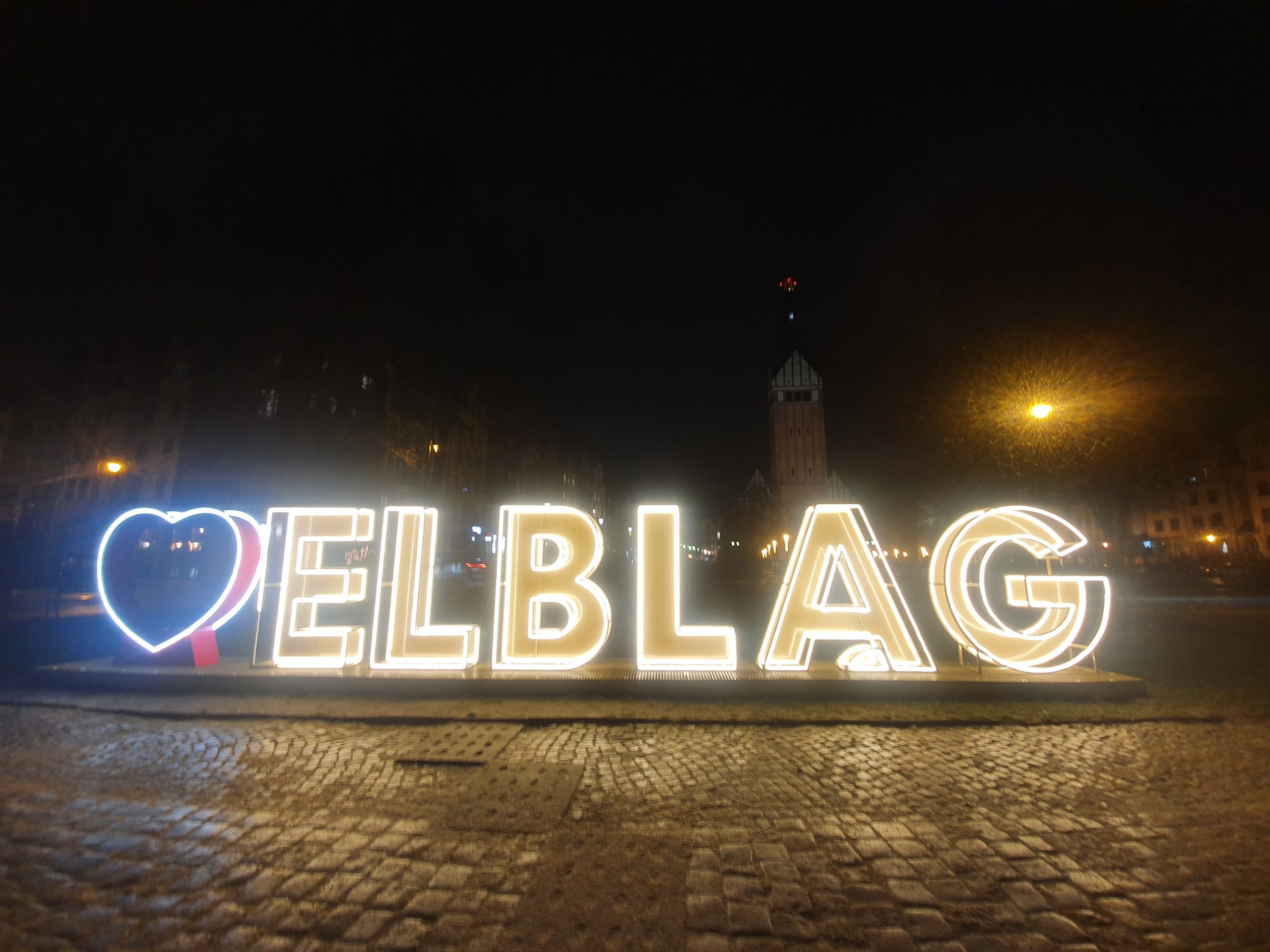
    I’m not intending to win any prizes with these photos, a couple of which aren’t quite level, but an initial indication of the city of Elbląg in the evening. The city is quiet tonight on a January evening and the restaurants all look nearly empty. It’s reasonably warm and although there’s more snow on the ground than in Gdansk, most has melted. I haven’t seen much lit up beyond what’s in these photos, which is the old market square area.

    As I mentioned in a previous post, I can’t quite capture in my mind the medieval charm of this once Hanseatic city, so much has been destroyed over the centuries, not least during the Second World War. There are some photos of the city as it was before the war at https://fotopolska.eu/zdjecia/m37662,Elblag.html?zakres=3&zdjeciaOd=1900&zdjeciaDo=1917.

  • Elbląg – Molto Bene

    Elbląg – Molto Bene

    I wasn’t sure what to expect from Elbląg, but it became evident immediately just how repaired it needed to be following the destruction of the Second World War. A fair amount of imagination is needed to picture the Hanseatic city as it once was and much of the reconstruction took place towards the end of the twentieth century and that is noticeable. Anyway, those initial impressions aside, my first place to visit in what is a new location for me was the cafe of Molto Bene which is in the historic old market area of the city.

    There was an old world charm to the interior and the staff member was welcoming and friendly. I was the only customer she had during my visit, with the exception of someone who purchased a coffee to takeaway. These places are doing well to open with all the limitations that they have at the moment, but it’s sad to see any cafe with such little lunchtime trade.

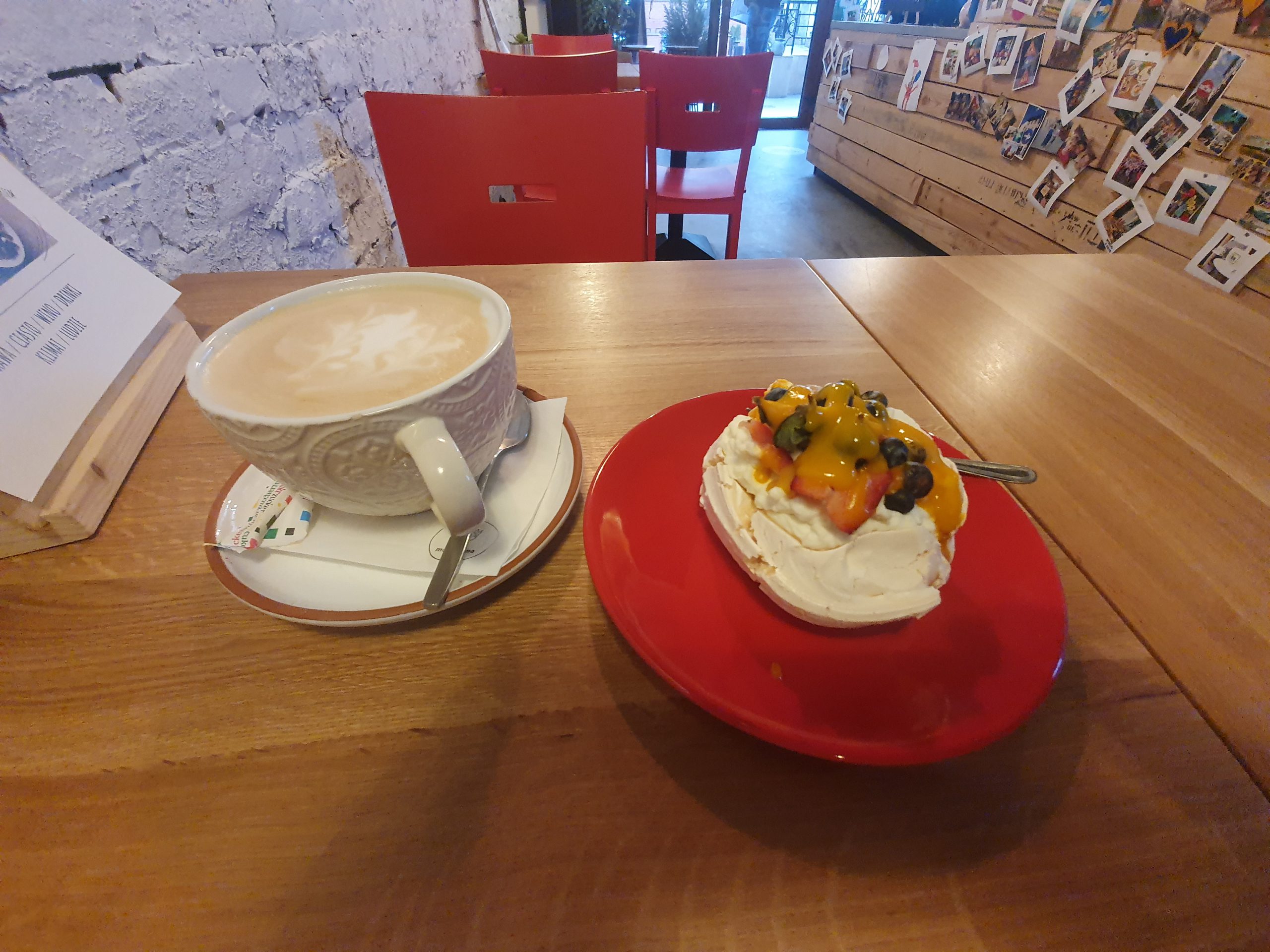
    I went for a large latte and a rather delicious meringue with fruit on top. I was entirely delighted with my healthy fruit option, with what I think was a mango puree and the firm exterior of the meringue and the melt away inside added some sweetness to the arrangement. All nicely presented, although they probably need new cups as they’re slightly chipped.

    There was certainly no issues with the quality of the food and drink here, nor was the welcome anything other than friendly. I hope that they get a suitable surge of custom in the summer months to make up for these challenging times.

  • PKP – Gdańsk Główny to Elbląg

    PKP – Gdańsk Główny to Elbląg

    This was meant to be a straightforward rail journey of just under one hour from Gdańsk Główny to Elbląg, using a PKP Intercity service.

    I’ve mentioned before that I find this to be the easiest way of seeing rail departures and arrivals, regularly updated yellow and white sheets. It’s far better than the UK system, with every stop listed so that it’s easy to understand where the trains are departing from and at what time. It’s surprisingly hard to get such clarity about the rail times and options when at a railway station in the UK.

    As an aside, this was the train to Berlin, which I had expected to be a little grander.

    And then to my slight disappointment, my 09:41 train started to show as delayed for nearly an hour. But just under it is a 09:44 train which is going to the same destination of Elbląg, it just takes a little longer. This gives me a dilemma as I don’t understand the Polish rail system well enough to know if I can transfer trains to that one, as I have a ticket for a specific train. It’s also a rural train (Przewozy Regionalne  or PR) which used to be part of PKP, but they’ve been given to the regional governments to operate, so it’s not the same company or set-up.

    As everyone got on the platform got on the train, I guessed that I could likely use this service. However, I’m not taking risks like that, so I went and asked the guard if I could get on his lovely train. He was friendly, grinned and pointed to get on. I was concerned whether he was grinning because he was excited that he could fine a passenger, but it transpired he was just keen to help. That friendliness seems to be path of the course in Poland, so it didn’t come as a complete surprise.

    What didn’t help was having my ticket checked a further two times by different guards, although they seemed satisfied with my ticket for the wrong train. The train itself was clean and modern, running to schedule and the signage on board was clear and timely.

    And safely into Elbląg, on time and without being fined or being told that I had the wrong ticket.

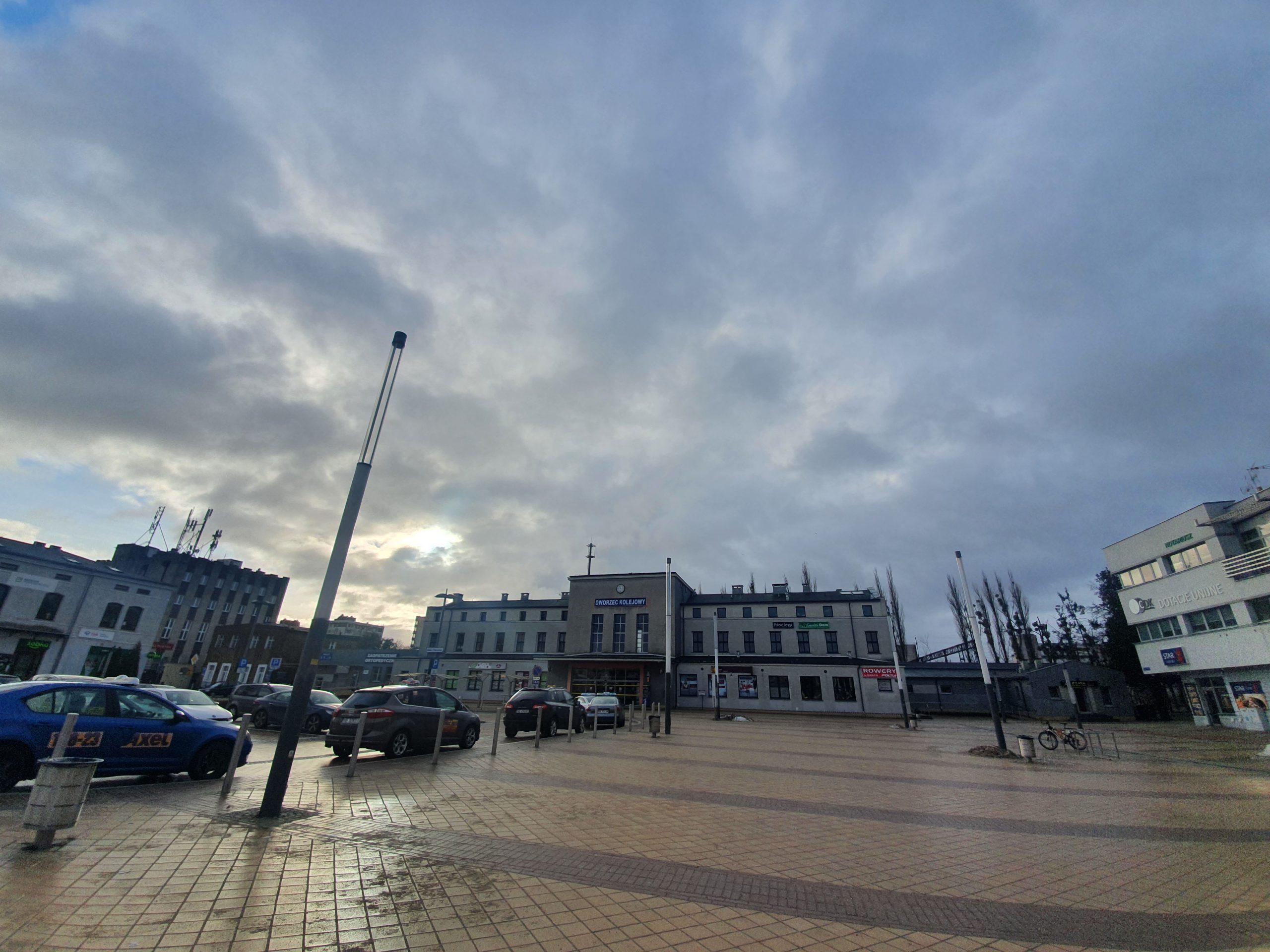
    It’s not the most glamorous of railway stations, but I was pleased to get there. There has been a railway station here since 1845, but it was rebuilt in 1937 and then repaired again following the end of the Second World War. On May 26, 1916, the German Emperor, Wilhelm II, arrived at the railway station on a visit to the city. Back then, the city was known as Elbing and was the second largest in East Prussia, the section of Germany which wasn’t connected to the rest of the country because of the Polish corridor.

    And the frontage of Elbląg railway station. Fortunately, everything went well, although I could have done without all of the confusion with the train delay. But I’m glad that I didn’t wait for my heavily delayed service, Gdansk railway station is undergoing modernisation and there’s not a great deal to do there at the moment.

  • Gdansk – Museum of the Second World War (Damaged Statue of Lenin)

    Gdansk – Museum of the Second World War (Damaged Statue of Lenin)

    This will be one of a series of posts of exhibits that particularly interested me in the Museum of the Second World War in Gdansk.

    I thought it was interesting that the smashed remains of a statue had survived, as usually they’d be destroyed quite quickly. The story behind this is though tragic and it took place in Jedwabne, a small town in a rural area of Poland which isn’t a huge distance away from Białystok. Before the Second World War, the Jewish community made up around 40% of the town’s population. A pogrom took place on 10 July 1941, when 340 men, women and children were murdered, 300 of whom lost their lives after being placed in a barn which was set on fire. During the day, a number of the Jews had been ordered to destroy the Lenin statue on Dworna Street, which is why it was wrecked.

    Much of this was left to history until 2001 when a exhumation of the bodies at the site was undertaken, when two mass graves were found, as well as the remains of the Lenin statue. There is all manner of controversy about whether the murderers were Polish or German and Aleksander Kwaśniewski, the then Polish President, apologised for any involvement by the Poles. Political arguments have ensued since saying that the Polish shouldn’t have apologised, it was nothing to do with them. There’s an interesting article at https://polin.pl/en/news/2016/07/09/78-anniversary-of-the-jedwabne-pogrom about the excavations and the timeline of events behind it.

    Either way, this makes this statue more remarkable, as it was brought down that was part of an act of mass murder and it was then buried. It has been excavated from a war grave and brought here to the museum, part of the story that led to the destruction of an entire Jewish community. The site is unlikely to be dug again so that the graves can remain intact, so this is the only piece of the story that is left visible, the statue which once stood in the market square.

  • Gdansk – Museum of the Second World War

    Gdansk – Museum of the Second World War

    This museum wasn’t quite completed when I was last in Gdansk and it was one of the main things that I wanted to visit on this trip. It’s the national Second World War museum and there was some controversy building it, but it’s completed and very well reviewed. The museum is operating on a reduced capacity at the moment to allow for social distancing and tickets can be purchased in advance on-line. I took a chance on going on free visiting day, which is a Tuesday, conscious that getting a ticket might be difficult given the demand as it’s not possible to get the free tickets in advance on-line.

    To cut a long story short, I arrived at the museum twenty minutes before they opened, and I expected a short queue at the ticket office. The set-up wasn’t quite as I imagined it, as the ticket office is down on the third floor underground, but I was surprised that they’d opened this already. I went down, collected my free ticket and then waited the 15 minutes or so for them to open the doors for the permanent collection. The design of the museum is really all quite odd and it isn’t particularly logical, but it is clearly signed. The main desk on entrance isn’t the ticket desk and it’s a moderately confusing set-up that seemed to be confusing a fair number of people.

    There are two elements here, firstly, absolutely everything is available in English, including the multimedia installations, whilst, secondly, the wording is quite strong. It’s not inaccurate, but there is something of an equivalence made between the Soviet Union and Germany, which runs through the whole museum.

    One of the scenes of what a peaceful Polish high street might have looked like during the inter-war period.

    In the centre are actual flags from the war period, and another reminder of how the Soviets and Germans are equated in the exhibits.

    A large-scale version of the Molotov–Ribbentrop Pact map which sought to carve up Polish lands between the Soviets and the Germans, with Gdansk coming under German control.

    One of the museum rooms which contained a variety of weaponry. This isn’t something I’m particularly engaged with, but there were plenty of guns for those who wanted to look at them.

    A display which serves as a reminder of the starvation that so many suffered from during the conflict.

    An example of one of the exhibition rooms and it was generally quiet throughout the museum, although there were quite a few people clumped together near the beginning. There were a range of Nazi recruiting posters on display on the left that were particularly interesting.

    This means terror in Polish (my language skills are really coming on).

    There’s no known history about this rail car other than it was made by the Germans during the First World War. It was though the type of transport that was later used by the Soviets to transport Poles and the Germans to transport Jews to concentration camps.

    This was quite a sobering room, some of the many individuals who died in the concentration camps.

    Opór, which in English means the resistance, with this section of the museum covering the efforts made in numerous countries to undermine German rule in their territories.

    This is quite a remarkable room, a recreation of some of the destruction to so many cities.

    I spent over three hours in this museum and although I didn’t skip anything, I did start to tire a little by the end and stopped watching every video and reading every piece of text. This wasn’t because the museum was dull or tiresome, but it was a little emotionally draining given the content and that’s also a long time to spend in the same museum. What was evident was how much times others were taking, I got the impression that a three hour visit was almost the average and the museum themselves say that’s the minimum needed.

    This is a very nicely put together museum and it flows in chronological order and keeps up the narrative in an engaging manner. The signage is generally excellent, although it was slightly unclear where to go in places, but it was hard to go too far wrong. I’m not sure why Gdansk was chosen for this museum, but it’s appropriate given that the war started here for the Polish at Westerplatte.

    I went to look at the reviews for the museum and they are exceptionally high, the same rating as the Louvre and just behind what is perhaps my favourite museum, the Metropolitan Museum of Art in New York. Indeed reading the reviews can be a bit dull, they’re just all full of praise, although I accept that’s all for the good. I wanted to see how anyone could not like this museum, and I noted that a few people tried hard.

    “Total waste of time. The exhibition is very static and boring. No visitor activities at all. It looked like an art museum, not a history one. Everyone walked around in total silence with no emotions and no discussions – even the small ones. Like in funeral services or something 🙂 It was like a walkthrough using Wikipedia articles, photos and videos. In some halls were no chairs for elderly. My little girl who is very intrested about military stuff said also it was so boring.”

    I’m unsure what visitor activities the museum could bring in (you too can smash some buildings up?), maybe they wanted some sort of theme park experience. Although there was a sombre feel to the museum I did notice, I felt that was hugely to their credit as the majority of visitors seemed to be engaged about the exhibits and the implications of the text and imagery. There were a couple of school groups as well, perhaps the best behaved I’ve seen, entirely attentive to their tour guides. I’m actually not sure that I’d bring a little child to the museum and the museum recommends that visitors should be at least twelve years old, although that’s not enforced and is just a guide.

    “Horrible experience, the staff barely speaks English so I cannot get support on my issue of not having a mask and being late to catch up to my group. She just spoke to me in polish.”

    It’s almost as if the museum is in Poland…..

    “Couple of tanks & motorcycle on display. Mainly video & pictures, I guess you could find all on internet.”

    The museum isn’t actually packed with exhibits, but it’s new and there’s a limit to what they’re going to be able to get in a relatively short space of time. I’d still say that they had 1,000 or so exhibits, and probably more. That’s actually an issue the museum authorities must have faced, as they wanted to cover the resistance, but the Warsaw Uprising Museum has much of that material, as well as items from concentration camps, but there’s a limited availability of such exhibits and most are already in museums. I’d struggle to find a lot of the material here on the Internet though, and museums are all about curation.

    “I only recommend this place if you’re a fan of WWII.”

    This was a 1/5 review mostly about how someone got locked in the toilet (it’s quite an involved tale which intrigued me for a while), but I’d be surprised if someone not interested in the Second World War went to the Second World War museum. Probably not that many visitors are what I would call fans, but there we go.

    “This place is more about the civilian cost to Europe and the world rather than a military museum”

    Good. That’s the reality of war.

    “Director of this museum is absolutely ruthless and hateful to Soviet Soldiers and the history!”

    I think this relates to a political storm a few years ago with this museum, but it’s fair to say that the Soviets don’t come out well here in the museum. It’s hard though for a museum in Gdansk to really develop this any other way, the Soviets tried to give the city to Germany in 1939 and then the Red Army caused mass destruction in the city after they have liberated it, with some morally reprehensible behaviour. There’s a rather excellent article about this at https://www.thefirstnews.com/article/incredible-forgotten-photos-reveal-true-horror-of-red-armys-destruction-of-gdansk-but-also-its-subsequent-rebirth-11681, with plenty of photos of the destruction.

    “After visiting the old part of the city, I decided to visit this museum. When I came to buy a ticket..they did not want to receive the euro, only the local Polish currency”

    Nice, someone giving a rating of 1/5 as the museum didn’t want to accept a different currency and couldn’t really come up with an alternative….

    Anyway, I’ve digressed again, but most of the negative reviews are about the difficultly in getting tickets, which has been a problem for the museum to deal with, although I was pleased with my experience. I thought that the entire visit was positive, not least because it was free today, but because it was an informative, decently curated and well put together museum. Very lovely.

    And to follow at some point in the future are some individual posts about items in the collection that I felt were particularly noteworthy.

  • Gdansk – Underbeer

    Gdansk – Underbeer

    I’ve somehow managed to miss this craft beer bar located in the city centre of Gdansk and I only located it because I was looking for somewhere I hadn’t been that might sell decadent pizzas. Or indeed any pizzas.

    I arrived just after 14:00 and I’m not entirely sure why so many places in Poland open at that time, which is too late for lunch and seemingly too early for most other people. I was the only person in the bar, which didn’t entirely surprise me. There was a friendly welcome from the staff member though and it felt an inviting environment to be in.
    The concept here is of having cans and bottles in the fridges, with a staff member pro-actively offering assistance to help customers find something that they like. The staff member explained the fridges and their contents, all friendly and engaging. The fridges are also clearly laid out and are in a logical order.

    It became apparent quickly that the choice of beers here was outstandingly good. This set-up frankly shames hundreds of British pubs who offer no craft beers, but yet could nearly all offer some set-up like this (assuming they’re not tied). Such a simple and easy way of offering a wide selection of beers across lots of different styles. I very much liked it, although it gave me a problem that there were too many good beers and I had to buy some to take away with me.

    The bar had a wide selection of beers from the Warsaw based Funky Fluid, which can be a little difficult to source in the UK (I think I’ve only seen them in Brewdog and even then, only rarely), who are one of my favourite breweries.This pink guava, passion fruit and peach beer was a delight, packed with fruit flavour, easy to drink and with a suitable amount of sour kick to it. For me, it would be hard to make a sour much better than this, a glorious drink.

    And then the Cooke Monster from Inne Beczki, a micro-brewery based in Blonie (I had to look that up, it’s a town not far to the west of Warsaw). This was the decadent delight that I was looking for, packed with coffee and chocolate flavours, as well as being smooth, despite being 7.8%. This wasn’t far from being like a chocolate milkshake, one of the better oatmeal stouts that I’ve had.

    I gave thought to whether I should just spend the entire day in the bar, but I thought that might be pushing it a little too far as I didn’t want to stumble out. The snow and ice has nearly all gone, but I thought a long visit might be excessive, although I wouldn’t have taken much persuading to stay for longer.

    I had found this bar because their pizzas were recommended, but I went instead for the chicken bagel with pickle, mozzarella, pickled red onion and white cabbage. I expected something much smaller than this if I’m being honest. Although I expected to enjoy the bagel (otherwise I wouldn’t have ordered it) this was far better than I had expected. A large portion, an entire chicken breast and a coating that was rich in flavour. The chicken was tender and moist, the pickle and red onion added a salty and sour taste, whilst the bagel was of a decent quality. Very enjoyable and even the white cabbage was delicious, so they’re clearly doing something right for me to be able to write that.

    But back to the bar itself, which was clean and comfortable, with pro-active service from the staff. There were a number of customers who came in during my visit, often they just bought one beer to take out or sit in, some others lingered for longer. It’s rare that I’m so delighted by the beer options that I have to take some beers away with me, and it’s so rare I’m not sure that I’ve ever done it. There are also enough other beers here to keep me entertained on a future visit, with the prices are all being reasonable for the quality offered.

    As I mentioned, this is what more pubs in the UK should be doing, not just micro-pubs and a few forward thinking bars. Too often the choice of beers in pubs and restaurants is bland and unappealing, but yet this lovely little bar in Gdansk has managed to outclass so many of them. This is one of the best bars that I’ve been to, such a simple concept but such excellent food and drink and a friendly and genuine service. This is very much all on-trend, but it isn’t formulaic, it’s just informal and forward thinking.

  • Gdansk – Etno Cafe

    Gdansk – Etno Cafe

    Sundays are designed for craft beer or cafes (and religion for those that want – I don’t judge), and I was happy to follow this tradition by doing both. It’s important to support a broad range of hospitality sectors in Gdansk, I’m happy to do that.

    This was a slightly busier cafe than my photos suggest, I had to wait for people to leave before taking them. The surroundings are pleasant, I particularly liked the books. Reading the news, I was puzzling over the situation in Ukraine that was unfolding when I was sitting here as well, I was thinking about going back to Kyiv next week, but I think I might wait to see what happens first as I’m not into danger travel. Anyway, that’s enough politics for the blog.

    This is a surprisingly interesting way to people watch. I suspect that I need to get out more if things have come to this, but there we go.

    I ordered at the counter in my usual broken Polish, which went better than usual, although I set the bar very low on these encounters. I was given a buzzer so that I knew when to collect the food and I like it when things are kept simple like this. It took them 12 minutes to prepare my coffee and cake which seemed quite a long time, but I was in no rush at all.

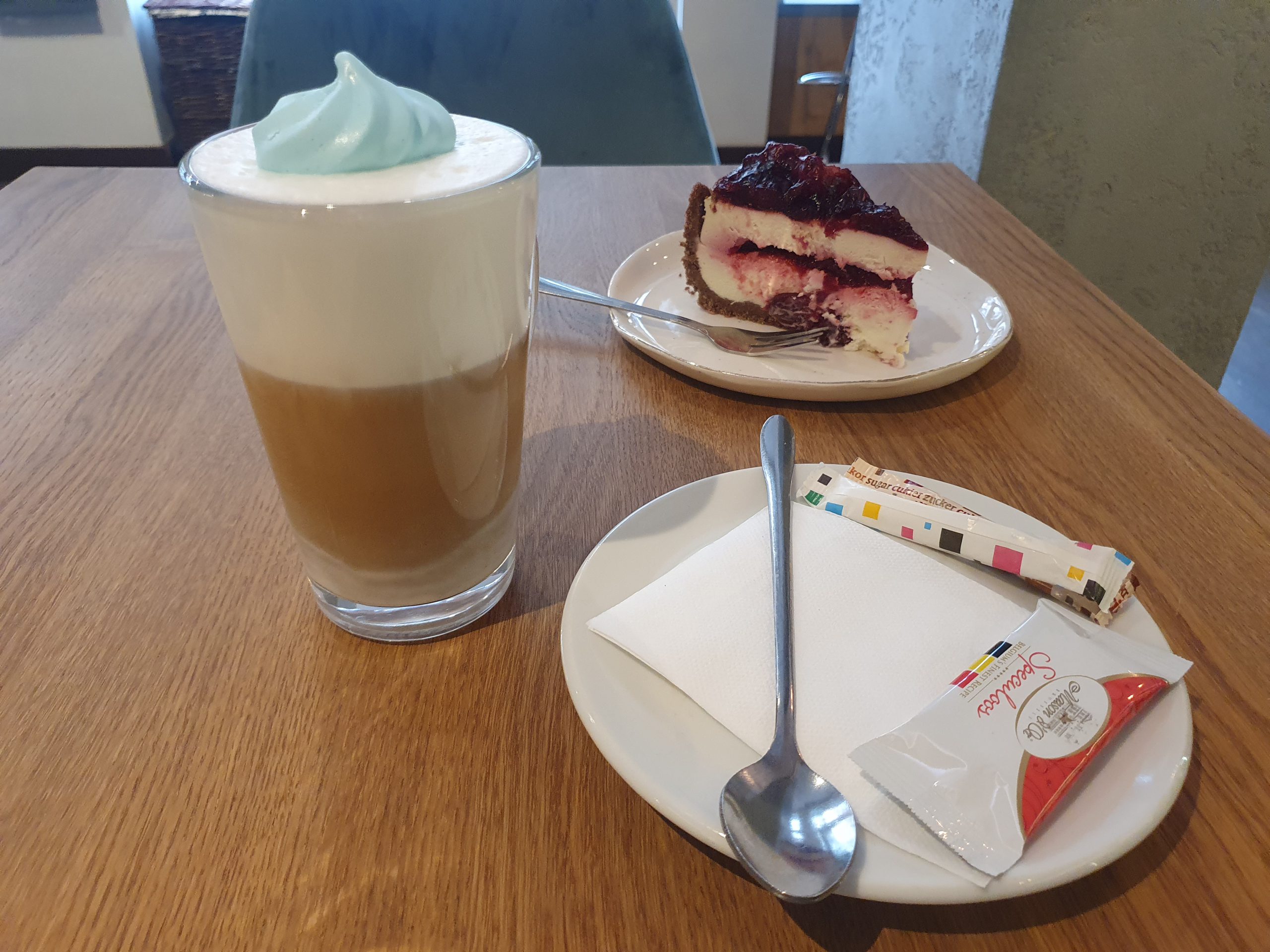
    This photo is something of an optical illusion. That’s a large slice of cake and it’s almost a bucket sized cup of coffee, although to be fair, I did order a large latte. The prices were expensive for Poland, coming in at just over £5.50, which was quite decadent of me, but the peanut butter cake was delicious and the latte was one of the best that I’ve had. This was quite fortunate as I had about a litre of it to get through.

    I liked this cafe, it was laid-back, informal and I stayed for a quite a while getting work done. They serve slightly more substantial meals, but I was happy with my cake which tasted moist and so seemed fresh. Friendly surroundings, a peaceful environment, good food and drink, definitely a recommended way to spend part of a Sunday afternoon.

  • Gdansk – Hotel Artus

    Gdansk – Hotel Artus

    Leaving my usual IHG and Accor options for the night, I booked into the Hotel Artus in Gdansk city centre, opposite St. Mary’s Church. I noticed that the Genius Level 3 offer for this hotel gave a free room upgrade, so I thought I’d try that, especially given the low prices.

    Positive first impressions, I don’t think that brickwork is particularly old, but it adds some character to the room, as do the big windows.

    The sitting area of the room, all modern and contemporary. The light at the rear didn’t have a bulb in and the bathroom sink didn’t have a plug, but I didn’t let these factors concern me.

    And that was the view from the room, quite spectacular and a complete delight to look out onto. There was regular noise from the church bells and the usual sounds of a city, all of which I thought were charming and added character. The hotel has picked up some negative reviews about the noise from the church bells, which is ridiculous as far as I’m concerned, what’s the point in staying next to this historic building which is one of the largest brick built structures in Europe and complaining about the noise from it? Anyway, I thought it was all really rather lovely.

    The breakfast room in the attached cafe, my first impressions were positive. This serves as a cafe which is open to the public during the day and the surroundings are a well thought through mix of modern and traditional.

    The latte was dusted with cinnamon, this was a decent coffee.

    I was disappointed to discover that they’ve scrapped the buffet breakfast arrangement and are just serving plated breakfasts. I’m fairly sure that this is just because they’re quiet, but I don’t like penny pinching like that as they could just put a few items out and refresh as appropriate so that guests can have what they want. The rolls, peppers and salad elements here were nice, as was the yoghurt. What I assume is pork was bland and tasteless, and the cheese tasted of cardboard. I was initially pleased to see toast, but it was some sort of odd and inedible toastie. Annoyingly, there was no orange juice, jams or gherkins, which are my staple diet at Polish hotels, along with salamis and the like. I must admit to missing the breakfasts offered by IHG and Accor hotels, and these shouldn’t really be better than smaller hotels like the Artus, especially given it has its own cafe.

    The hot options were limited to sausages and scrambled eggs, which is a shame as a decent poached egg and toast is one of the nicest things. The sausages were poor quality and things like this are far better just placed on a buffet arrangement so that guests can choose if they want them or not, perhaps just trying a small amount. The onions were nice, although it’d be difficult to get that wrong. I felt quite guilty about how much of the food here had to be chucked in the bin, this is a wasteful arrangement from the hotel. I’m not convinced that their penny pinching actually saved them anything here either.

    Anyway, this room was cheap, at £20, so absolutely nothing to complain about there, although the breakfast was extra. As room views go, this was one of the best that I’ve had and as a lover of city noise, the ambient sound of church bells and pedestrians worked nicely for me. It was a shame the hotel served some cheap items up for breakfast, otherwise this would have been a near perfect review. Breakfast aside, I liked the atmosphere in the hotel and there were no annoying noises either internally or externally. I’ll also remember that lovely room view for a long time, so I’m glad I stayed here.