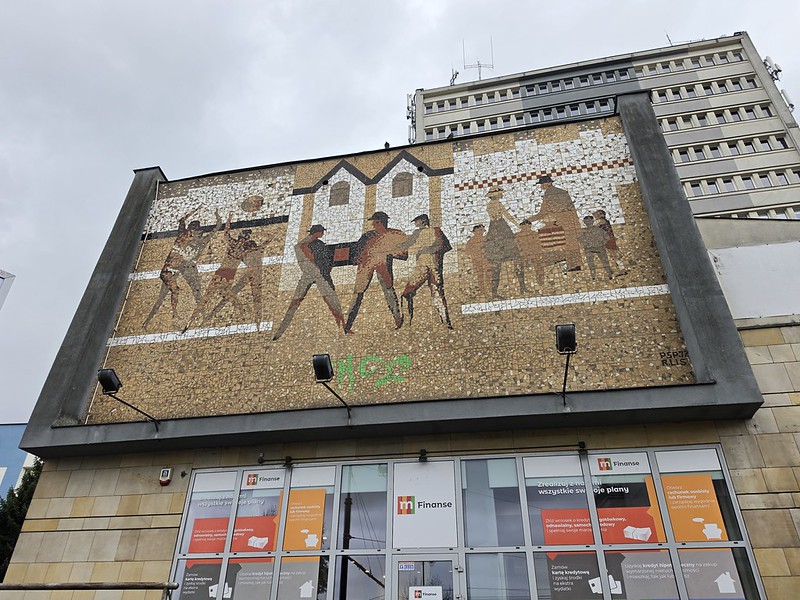
This substantial mosaic sits above the ground floor premises at 13 Aleja Józefa Piłsudskiego in Lublin. There’s a financial services office underneath it, although I suspect the artwork wasn’t commissioned to celebrate the availability of a competitive mortgage.
The composition is divided into three scenes, with volleyball players on the left, a group of figures in front of white buildings in the centre and adults with children on the right. The limited palette of brown, ochre, white and muted red ties the sections together, giving it something of the feel of a Soviet mosaic. There’s quite a lot happening within what initially seems a fairly simple design and I rather liked the whole arrangement.
I couldn’t establish who created it or exactly when it was installed. Judging purely by its style and architectural setting, I’d tentatively place it in the 1960s or 1970s, although I’m not a mosaic historian, so I could be entirely wrong. It appears in a photograph of the building from 1993, so it was certainly there by then.
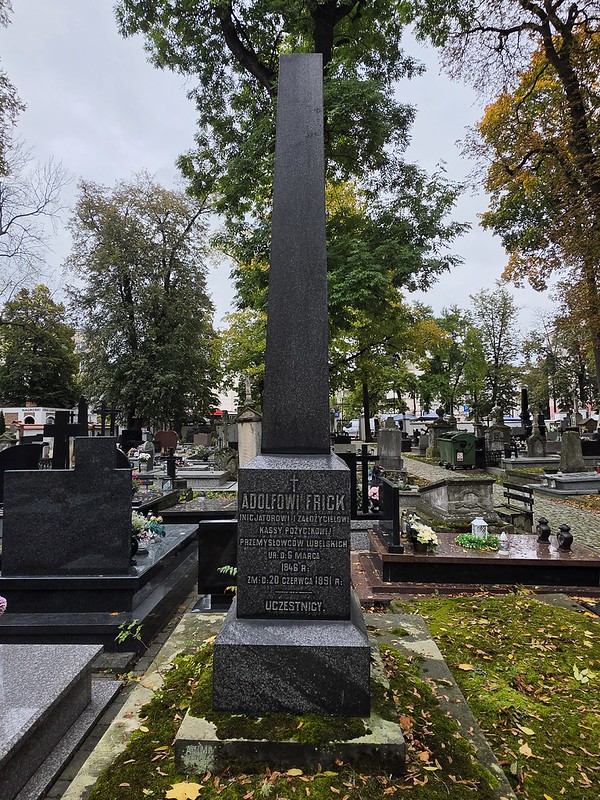
This tall, dark stone obelisk at Lublin’s Lipowa cemetery commemorates Adolf Frick, a brewer whose interests extended rather beyond producing beer. Alongside his brother Juliusz, he ran the A. i J. Frick brewery, but he also helped establish financial institutions and get a theatre built. Apparently running a brewery wasn’t considered quite enough to be getting on with, although it seems a very sensible place to start.
Born in 1846, Frick was one of the figures behind the establishment of the Lublin Industrialists’ Loan Fund in 1884. This provided credit to local businesses, helping finance the investment and everyday expenditure needed to keep them operating. His work formed part of the wider contribution made by Lublin’s Protestant business community to the city’s industrial development. Beer was involved, reassuringly, but so were mills, factories and the less immediately exciting business of making the finances work.
Adolf and Juliusz were also instrumental in the creation of the theatre now named after Juliusz Osterwa. It opened in 1886, giving Lublin a substantial new venue for performances. There’s something rather appealing about brewers helping to provide both the beer and the cultural facilities, although I imagine the financial arrangements were slightly more complicated than putting a collection tin on the bar.
Frick died in 1891, aged just 45, and the brewery also ceased operating that year. His memorial stands among the trees in the Protestant cemetery, its inscription recording his role in founding the loan fund. By 45, he had helped run a brewery, establish a loan fund and get a theatre built. I’m increasingly pleased if I complete a task without first needing a little sit down.
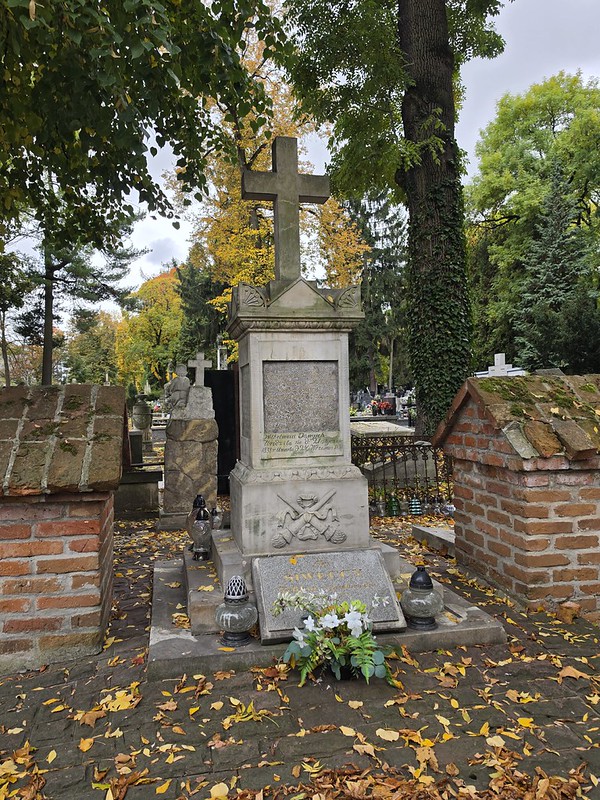
This grave at Lublin’s Lipowa cemetery occupies a gap in the brick wall separating the Catholic and Protestant burial grounds. That might seem an unusual place to put it, but the position was quite deliberate. It allowed people who had shared their lives to remain together in death, whilst technically staying on the correct side of the religious boundary.
The cemetery dates back to 1794, when a Roman Catholic burial ground was established outside the built up area of Lublin. A neighbouring Lutheran cemetery followed in 1826, with an Orthodox cemetery established in 1840 and a military and municipal cemetery added in 1916. What now feels like one large cemetery is therefore a collection of separate burial grounds, reflecting something of the city’s religious history. This is all rather lovely as a general arrangement, until people start marrying someone from another denomination.
From the middle of the nineteenth century, some married couples of different denominations were buried along the boundary between the Catholic and Protestant cemeteries. A shared monument stood in an opening in the wall, with each person buried on the side belonging to their own denomination.
There’s something rather touching about this practical compromise. The division remained, but space was made within it for a couple to share a burial plot. Here, beneath a tall stone cross and surrounded by autumn leaves, the result is a memorial which belongs to both sides of the wall. Marriage had brought them together, and a carefully positioned hole in the wall ensured that this didn’t become administratively inconvenient.
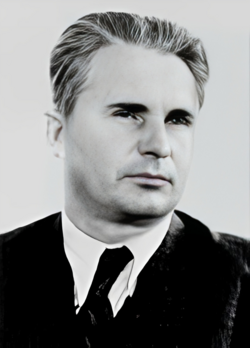
One of the political figures connected with Lublin’s rather complicated twentieth century history is Edward Osóbka-Morawski. He was just 34 when he became chairman of the Polish Committee of National Liberation in July 1944, placing him at the head of an administration which would help shape Poland’s postwar future. Within a few years, however, he had lost the premiership and was heading towards the political sidelines. There’s something striking perhaps about a career in which the most important chapter was largely over before its subject reached 40.
His connection with Lublin comes through that committee, usually known by its Polish initials, PKWN. Although closely associated with the city, it was actually formed in Moscow under Stalin’s patronage, before establishing its headquarters in Lublin in August 1944. It presented itself as an authority for territory emerging from German occupation, directly challenging the established Polish Government in exile in London.
That Government in exile maintained Poland’s legal continuity and had the allegiance of the Polish Underground State, but the committee had the backing of the Soviet Union and the army advancing across the country. These were competing claims to govern Poland, with military power increasingly determining which would prevail. It’s this element that I was most interested in as I hadn’t previously realised, although really should have done, that there were competing visions of who should govern Poland after the Second World War.
Władysław Raczkiewicz, the President of Poland in exile, found himself left in the UK after 1945, living in Ruthin in Wales until his death in 1947. There were elections in Poland in 1947 that were rigged to ensure victory for the communist led bloc. I’m not sure how I’ve missed this rigged election either, it’s not something that seems to be covered in the museums I’ve visited.
Osóbka-Morawski came from the socialist movement rather than the Communist Party, having joined the Polish Socialist Party in 1928. His presence helped give the new administration a broader political appearance, although he actively participated in establishing the Soviet backed order. He was also forceful in attacking the rival government in London, publicly dismissing its supporters as isolated political failures. At the end of December 1944, the committee became the Provisional Government, with Osóbka-Morawski as Prime Minister. In June 1945, he retained the premiership of the Provisional Government of National Unity, which brought in the former London based Prime Minister Stanisław Mikołajczyk.
His own decline was gradual rather than a single dramatic disappearance. Józef Cyrankiewicz replaced him as Prime Minister in February 1947, although Osóbka-Morawski remained Minister of Public Administration until 1949. He subsequently spent years directing the country’s central spa administration, a considerable change from leading a government during the reconstruction of Poland. He had helped establish the new political system, but his own position within it proved much less enduring.
He lived until 1997, surviving long enough to see Communist rule collapse and even attempting to revive a socialist party in 1990, without significant political success. For Lublin, his story belongs to that brief period when the city became the headquarters of an administration claiming the right to govern the country. The rival Polish Government remained in London, but Osóbka-Morawski’s administration could exercise authority on Polish soil under Soviet protection.
I find it difficult to imagine what it must have been like going from leading a government to running the country’s spa administration, then living for another half a century. He had helped establish a political system which pushed him aside, and eventually lived long enough to see that system collapse. Anyway, that’s another rabbit hole that I’ve ended up going down.
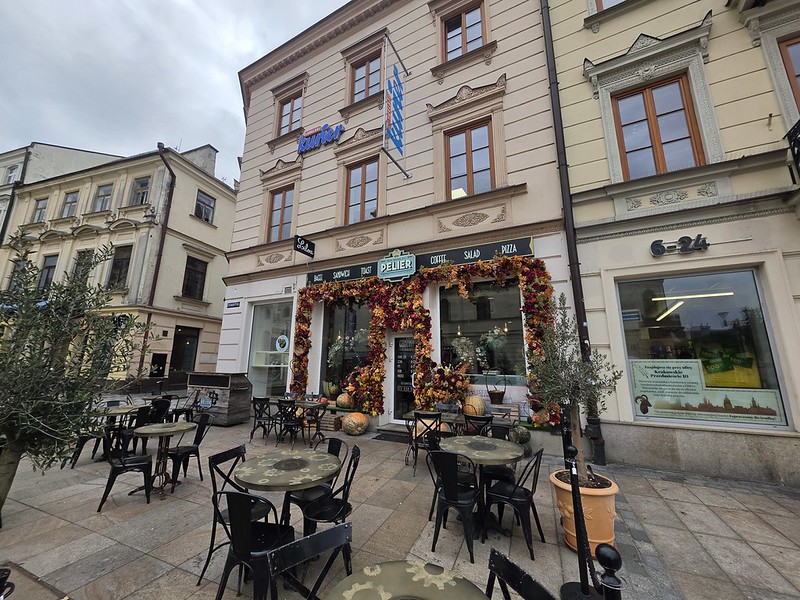
Unlike my friend Richard, who likes visiting anywhere with a word such as ‘bistro’ in its name, I usually prefer somewhere rather less decadent. However, Pelier was very well reviewed online and offered craft beer and pizza, so I was sold. It was quite busy when I entered, but the helpful team member at the door pointed me towards a table. My timing was good, as the remaining tables filled up shortly afterwards and it’s evident that this is a popular location. I noted that no-one was brave enough to sit outside and I certainly wasn’t going to start a trend.
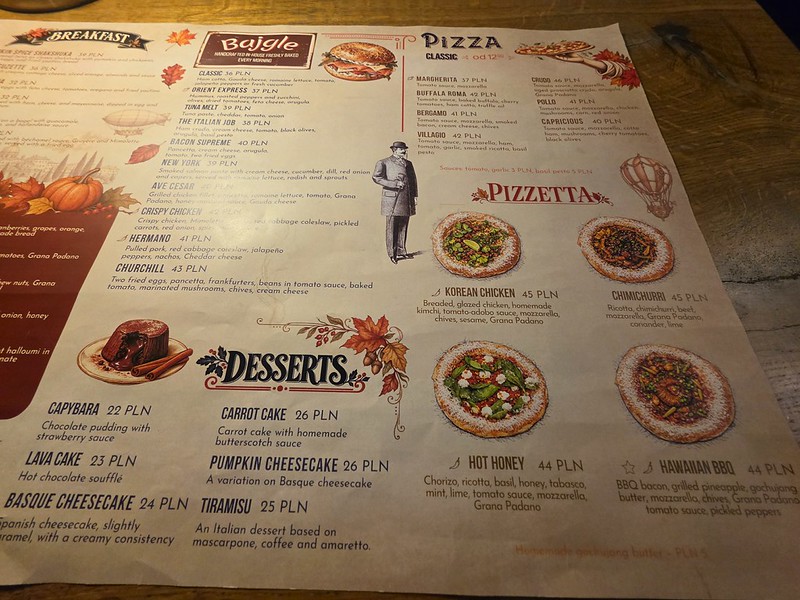
Some of the menu offerings, including the Hot Honey pizzetta that I went for. I appreciated that the restaurant had English menus available, it makes matters easier for all concerned.
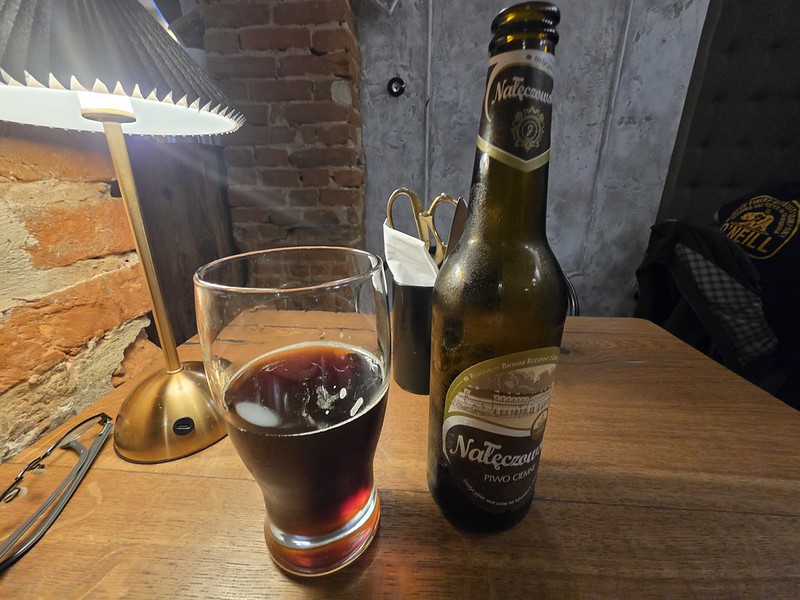
I went for the Nałęczowskie Ciemne from Browar Jagiełło, a slightly sweet dark lager which complemented the food well enough and was a change from the normally generic lagers.
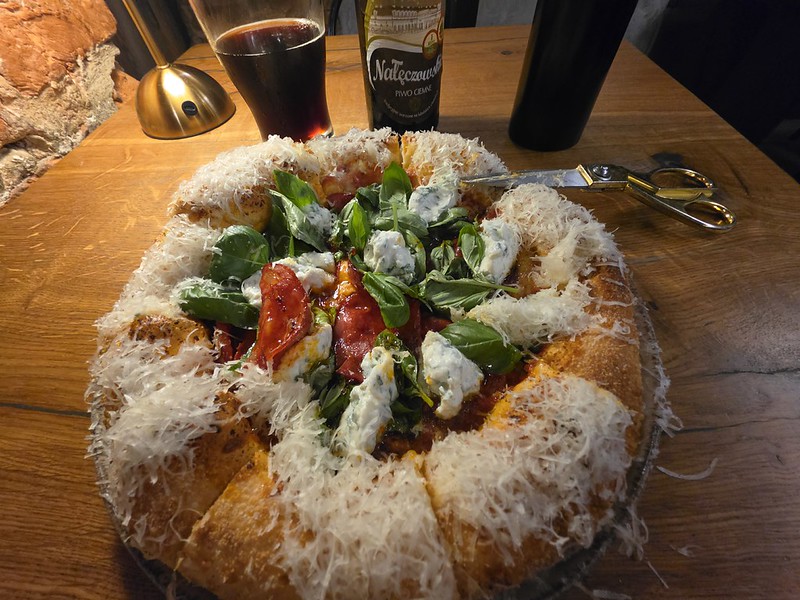
When the team member brought over this rather delicious looking pizza arrangement, she mentioned that it was recommended to use the scissors to cut it. I’m not sure that I’ve been advised to cut food with scissors before, but it was a very sensible suggestion and astute readers will note that I’ve carefully cut the pizza into equal sections. This was a filling meal with the fluffy cheese making it look quite an impressive pizza. The hot honey added sweetness, the chorizo added a depth of taste and the ricotta added creaminess.
I very much liked this restaurant with the service being friendly, the surroundings clean, the prices reasonable and the food and drink certainly delighted me. And Richard would have been delighted with it.
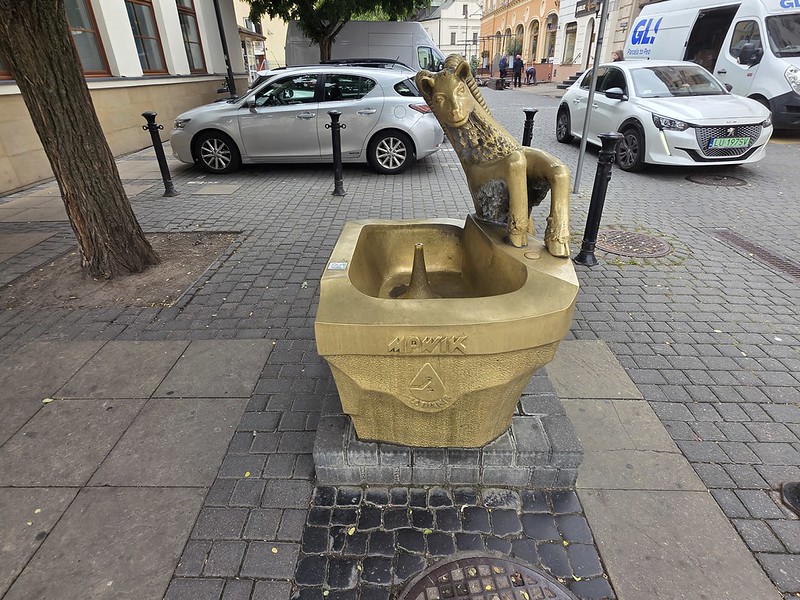
This little golden coloured goat caught my eye whilst I was meandering around Lublin, leaning over a basin with a slightly quizzical expression. It’s a public drinking fountain at the junction of Krakowskie Przedmieście and Wróblewskiego, installed in 2001. The goat is one of Lublin’s symbols and appears on the city’s coat of arms, standing on its hind legs against a grapevine.
There’s a local legend involving a goat whose milk helped keep children alive after a Tatar raid, which seems a reasonable contribution to have recognised. The story then becomes a little more complicated, involving a drunken painter who muddled the design of the coat of arms. As explanations for municipal heraldry go, it’s rather more entertaining than a committee agreeing on a logo.
The initials on the front of the basin belong to MPWiK, the city’s water and sewerage company. It has also had a slightly more eventful life than might be expected of a stationary goat. In April 2023, it returned following repairs to a leg damaged when a car hit it. All rather sub-optimal.
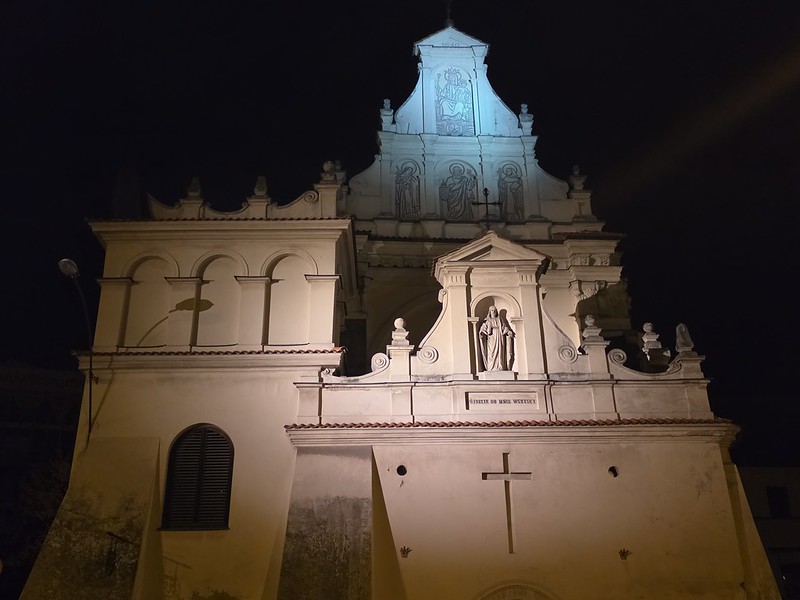
Just a few photos from my little meanderings around Lublin one evening last week. This is St Joseph’s Church looking rather lovely illuminated against the night sky. Built for the Discalced Carmelite nuns during the seventeenth century and consecrated in 1644, it has considerably more history than my brief evening photograph can accommodate.
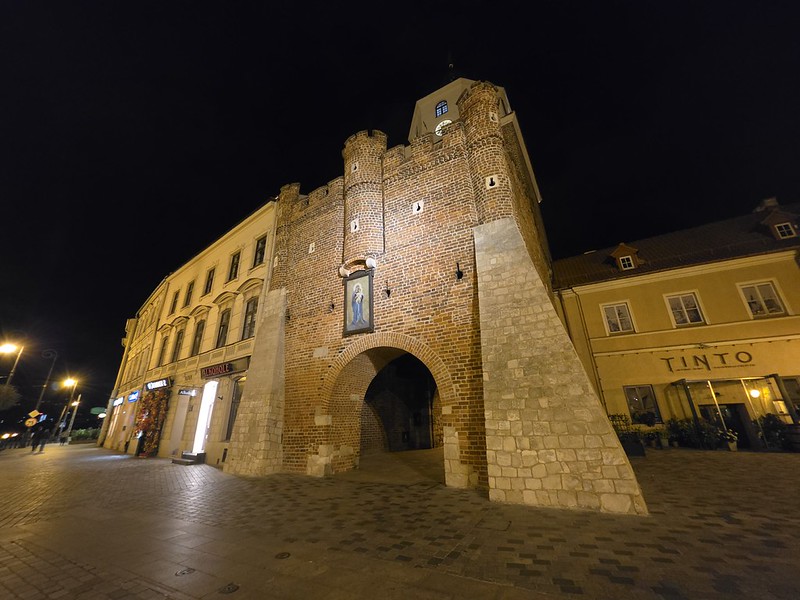
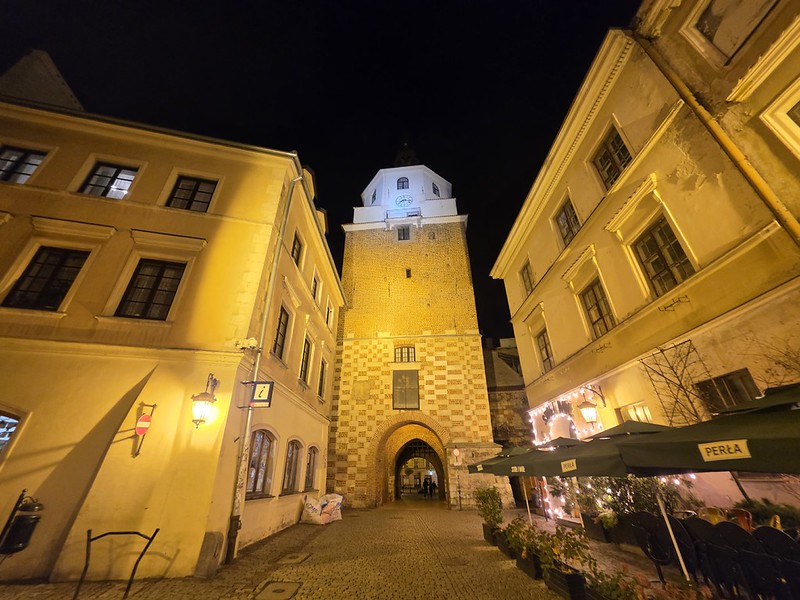
The Kraków Gate formed part of Lublin’s medieval defences, built following the Tatar attack of 1341. It still makes a suitably imposing entrance, although the arrangements for admitting visitors have thankfully become less defensive.
The Kraków Gate from inside the Old Town, showing the mixture of brickwork and later additions above its medieval entrance. Its name recalls the route towards Kraków, although I was planning a rather less ambitious journey back to my accommodation.
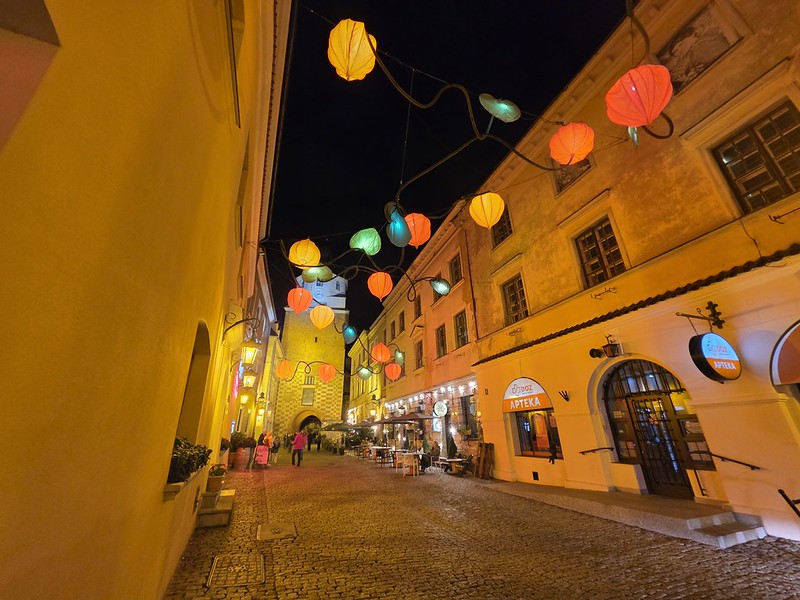
Colourful lanterns hang above Bramowa Street, with the medieval Kraków Gate visible at the end. A rather cheerful addition to a street whose earlier visitors would have had to manage without quite so much assistance with their holiday photographs.
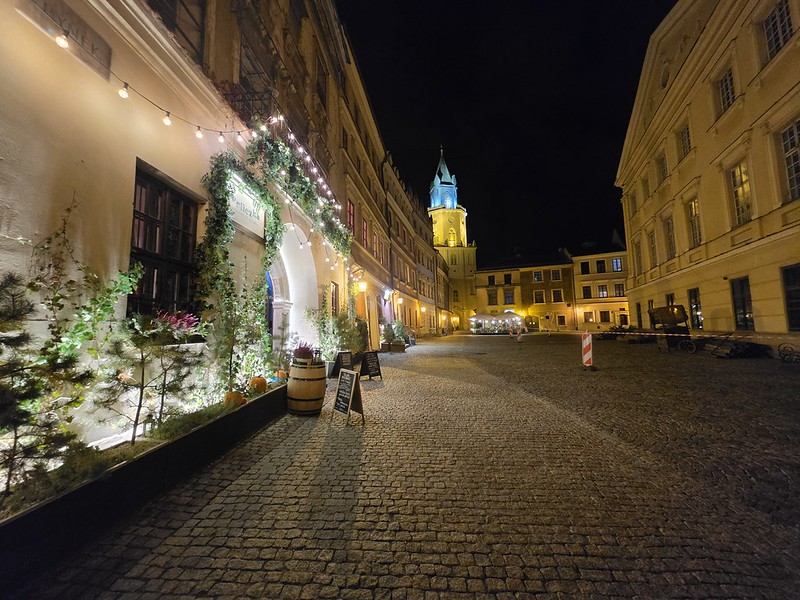
The Trinitarian Tower rises beyond the restaurant lights, its present neo-Gothic appearance dating from 1819. Originally a bell tower, it provides a useful landmark when wandering around.
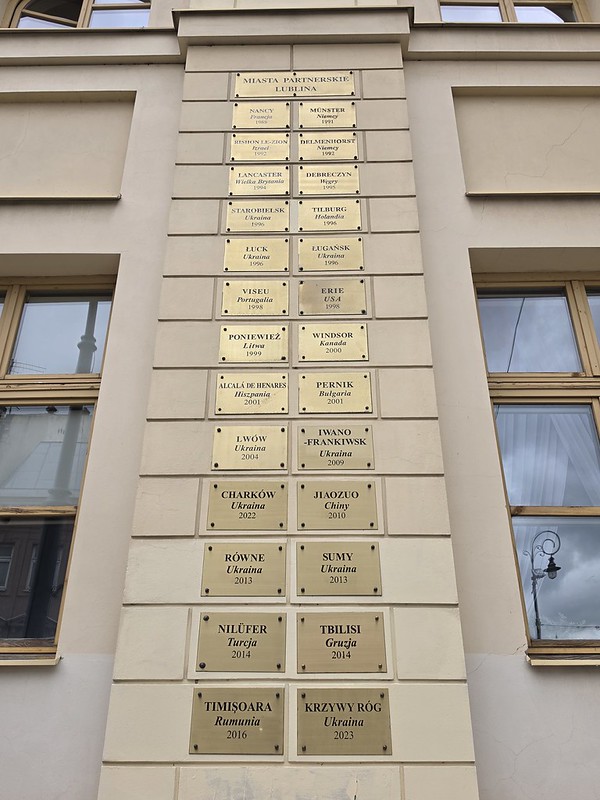
These plaques list Lublin’s partner cities, with “Miasta partnerskie Lublina” and it seems that the authorities have been busy here. The names stretch from Nancy and Münster to Windsor in Canada and Jiaozuo in China, each accompanied by a year. Lublin’s first formal partnership was with Nancy in 1988 and matters seem to have escalated from there. Some people struggle to maintain contact with three friends, but Lublin appears to have an entire department for it.
The British representative is Lancaster, partnered with Lublin since 1994. It sits amongst places including Tilburg, Viseu, Timișoara and Tbilisi, a respectable selection of destinations for anyone planning their holidays by reading a wall. I rather like seeing these connections displayed so prominently. There is a substantial Ukrainian presence, with names including Lviv, Lutsk, Ivano-Frankivsk, Rivne and Sumy appearing in their Polish forms. The bottom right plaque records Kryvyi Rih, whose partnership agreement was signed in February 2023.
Not every municipal friendship has lasted. Lublin ended its cooperation with the Russian city of Omsk following the invasion of Ukraine in 2022, also severing links with Brest and Vitebsk in Belarus. Omsk’s relationship had only reached the letter of intent stage, rather than full twinning. Hopefully in the future there might be better relations, although that feels quite a long way off.
The practical purpose is to encourage links between schools, cultural organisations, sports clubs, businesses and local communities. As with any list of cities, it has also given me several more places to consider visiting. I had thought that photographing a wall was a reasonably economical activity, but apparently there can be substantial ongoing costs. I now feel the need to visit Tilburg in the Netherlands.
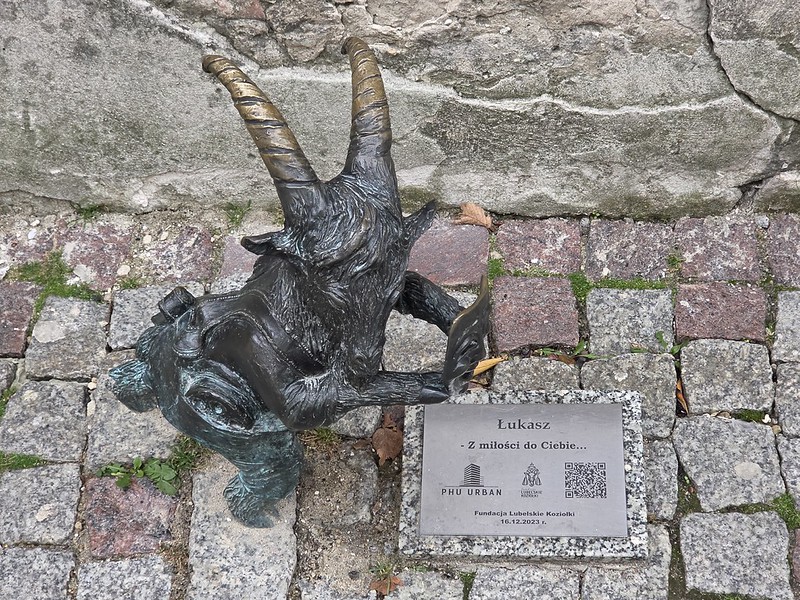
This rather lovely little sculpture on Jezuicka Street is Łukasz, one of the goats dotted around Lublin as part of the Lubelskie Koziołki trail. Installed on 16 December 2023 opposite the Old Theatre, he has a theatrical mask to suit his surroundings.
I took the photograph partly for my friend Łukasz, who comes from this area of Poland, although the sculpture has a different namesake. I wouldn’t want him getting ideas about being commemorated in bronze just yet. Although perhaps one day.
The name honours Łukasz Rodakiewicz, the architect responsible for the Old Theatre, built in 1822. According to the story celebrated by the sculpture, he built it to fulfil his wife Marianna’s wish to have a theatre of her own. The inscription beside the goat, “Z miłości do Ciebie…“, means “Out of love for you…” Quite a substantial romantic gesture, with rather more ongoing maintenance than a bunch of flowers though.
The trail uses these small sculptures to introduce people and stories associated with different parts of the city. I rather like the approach, giving people a reason to stop and learn something without requiring them to commit to a museum visit. Here, a goat beside the pavement provides a link to the theatre opposite and the people behind it. It also gives me another category of things to photograph, which is clearly what my already restrained photographic habits needed……
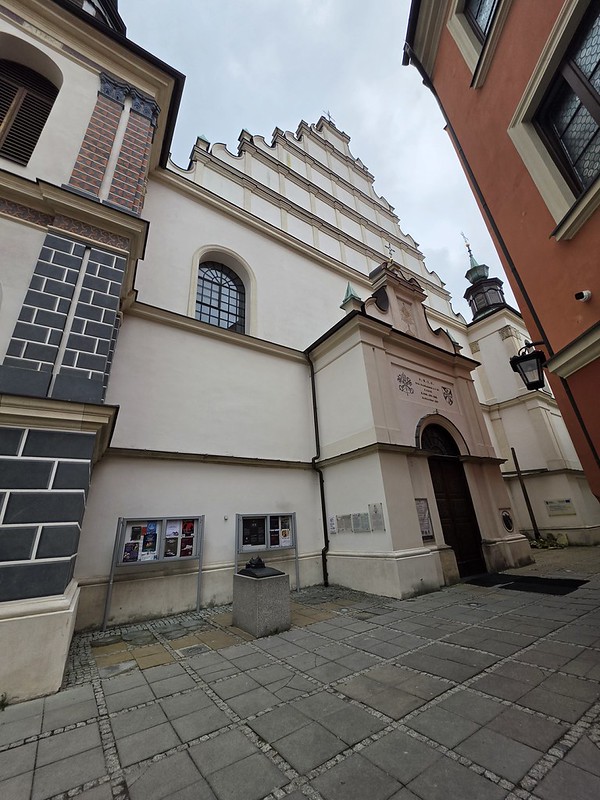
The Dominican Basilica of St Stanislaus sits at the end of Złota Street, its tall decorative gable rising above a relatively modest entrance. The present church developed from a foundation supported by King Casimir the Great in 1342, although the Dominicans were established in Lublin before then. A major fire in 1575 caused extensive damage and much of its present appearance dates from the rebuilding that followed, with further additions over the centuries.
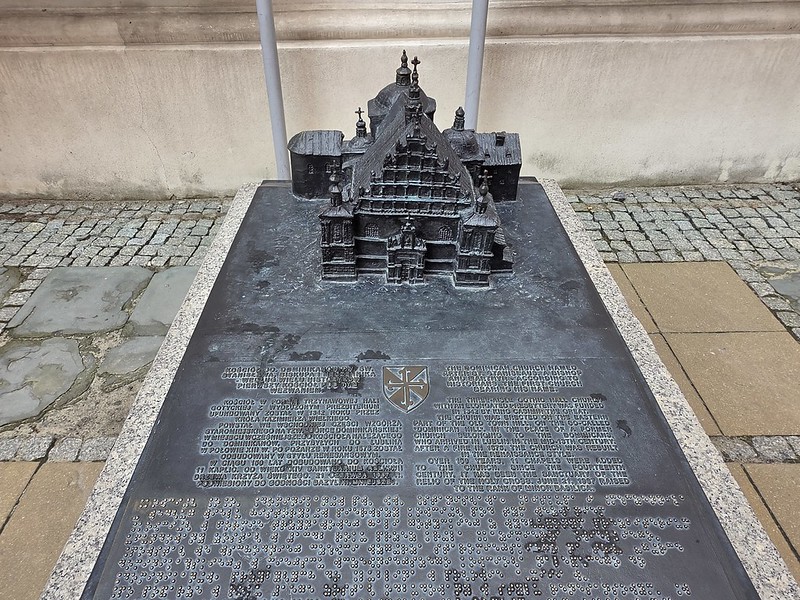
Outside is a tactile model of the basilica, accompanied by raised lettering and Braille. It’s rather easier to understand what the front of the basilica looks like without quite a few buildings getting in the way.
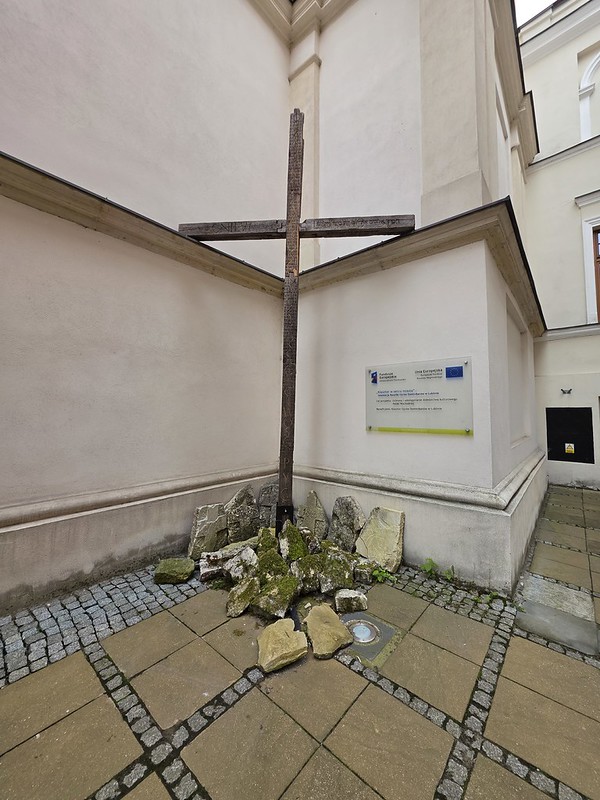
This tall wooden cross stands amongst rough stones in a corner outside the basilica. I’m not sure why they picked this particular corner, but I like the simplicity of it.
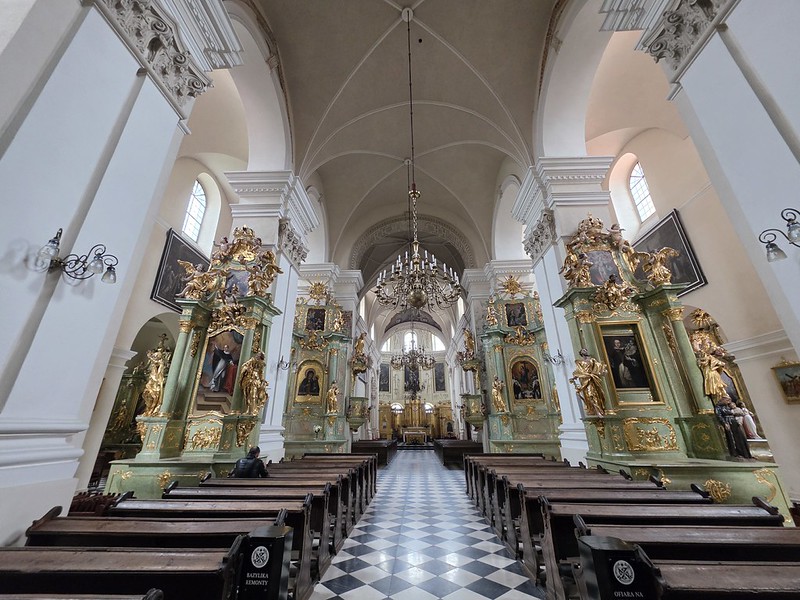
The nave of the basilica and I’m pleased that this is one of those photos I’ve taken which is actually sort of level. I like the flooring, it draws the eye towards the chancel and there’s certainly no shortage of things attached to the wall to look at.
As an aside, I was slightly surprised to see a confession taking place in a traditional confessional just off the nave. I had somehow assumed that these things generally happened in separate private rooms now. A reminder that, whilst I was wandering around admiring the furnishings, other people were getting on with the religious purposes for which the building was intended.
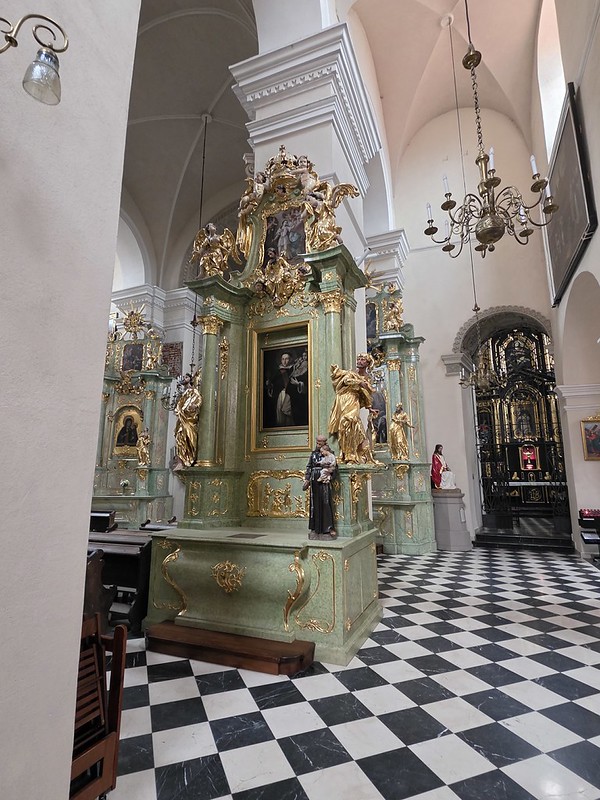
This is the altar of St Hyacinth, known in Polish as św. Jacek, with an eighteenth-century painting of the Dominican saint at its centre. They seem to like this pale green colour around the basilica as well.
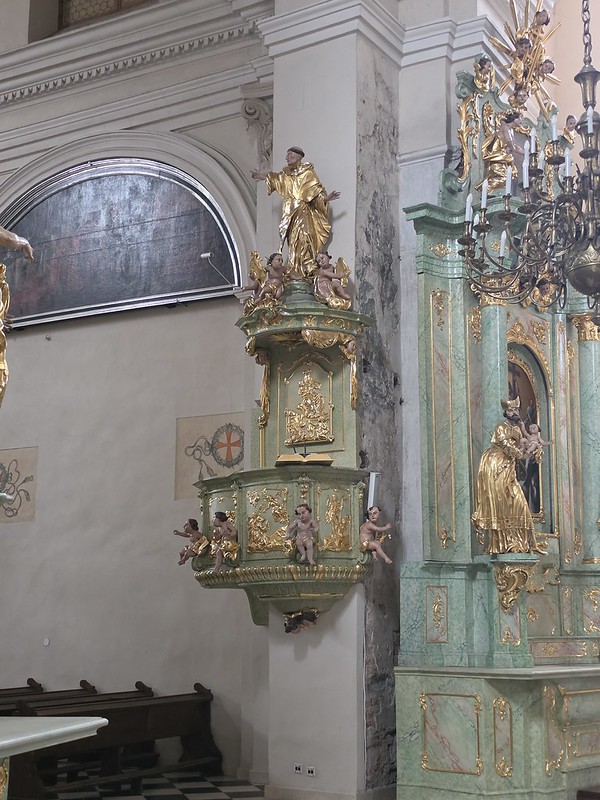
The basilica has two facing pulpits, made in Sebastian Zeisel’s workshop in 1761. The church’s guide explains that they served preaching at different altars, as well as providing symmetry, rather than being installed for opposing speakers to debate each other. This one continues the green and gold colour scheme, with small figures around the front and a saint above the canopy. Quite an elaborate place from which to address a congregation, although presumably useful for keeping their attention before microphones became available.
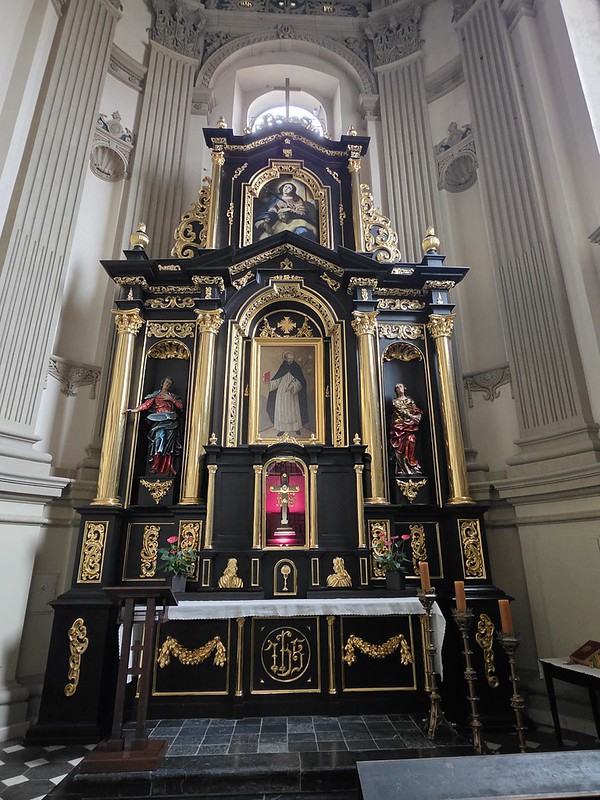
The Firlej Chapel has a black and gold altar, with a painting of St Dominic made in 1645 by the Dominican artist Brother Reginald. The chapel was founded in 1615 as a family burial place and somewhere to house the relic of the True Cross. The relic itself was stolen from the basilica in February 1991, a rather sub-optimal later chapter in the history of something which had shaped the church’s religious life for centuries.
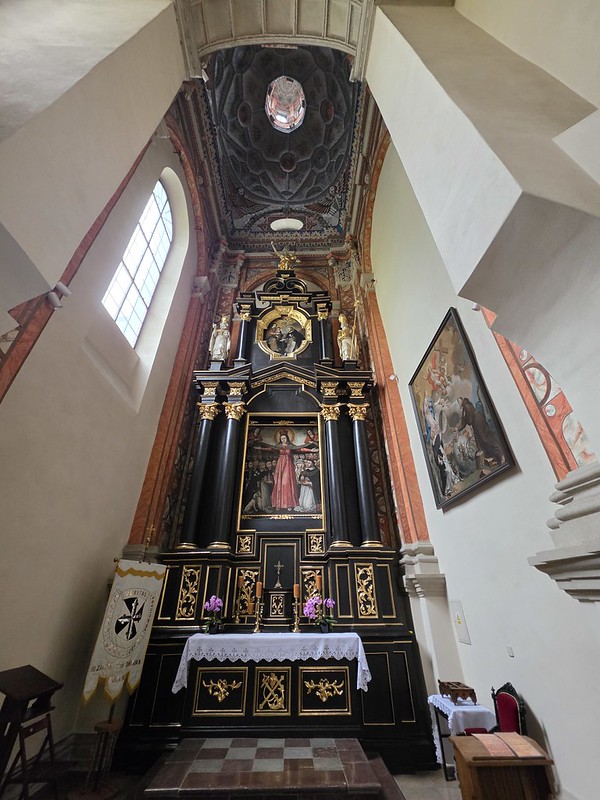
The Ossoliński Chapel contains a painting of the Virgin Mary sheltering members of the Dominican order beneath her cloak. Founded in 1624, the chapel has changed dedication as its devotional images have changed.
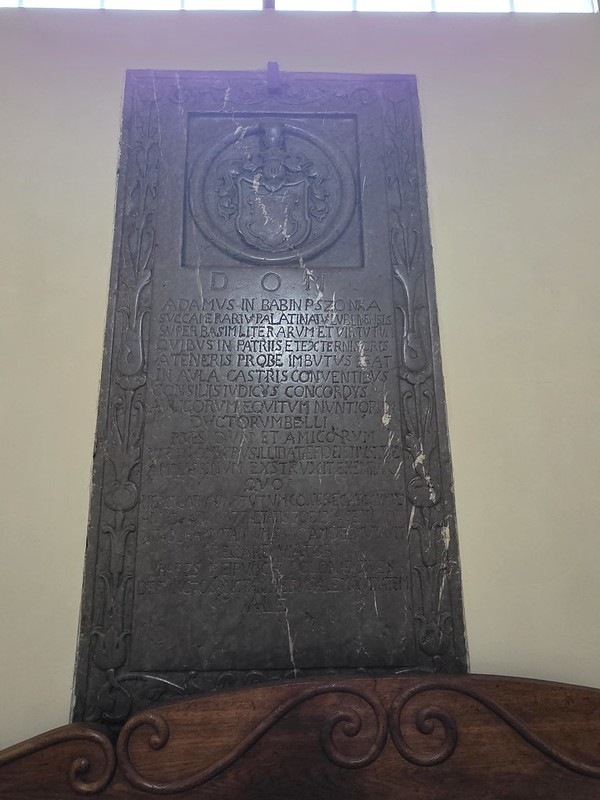
This memorial tablet commemorates Adam Pszonka of Babin, who died in 1677, and is in the Pszonka Chapel. Its dark surface and the light from the window made photographing it something of a challenge. Nevertheless, these individual memorials are useful reminders that the chapels were also places of family remembrance, alongside their religious functions.
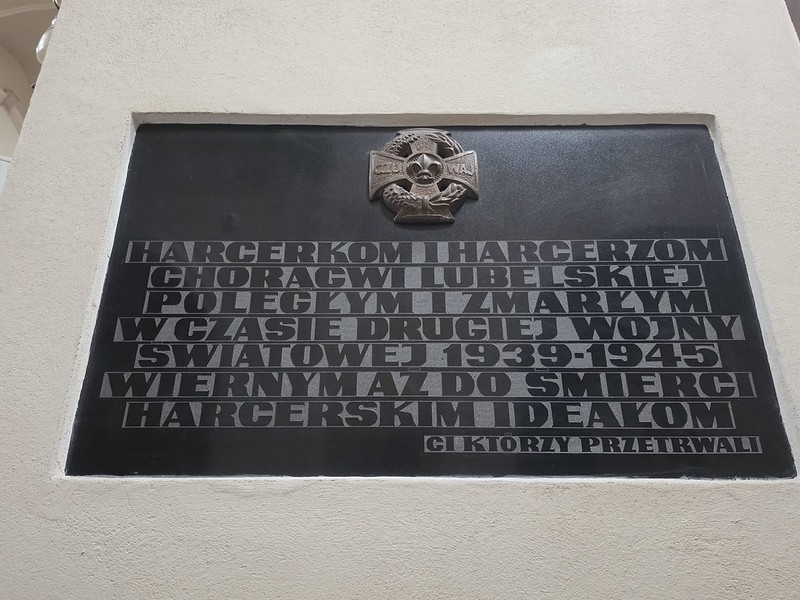
This plaque remembers the female and male scouts of the Lublin scouting region who were killed or died during the Second World War, between 1939 and 1945. It describes them as faithful to their scouting ideals until death, with the dedication below coming from those who survived. Above the inscription is the Polish Scout Cross bearing the motto “Czuwaj”, meaning “Be prepared” or “Stay alert”. A brief memorial, but one that brings the basilica’s history much closer to the present than its seventeenth-century family monuments.
It’s a rather lovely building, although like so many there have been numerous challenging events over the centuries. More recently, the monastery was suppressed by the Russian authorities in 1886, with the remaining friars expelled. The Dominicans returned in 1938, renewing the order’s presence here.