Part of my Streets of Norwich project….

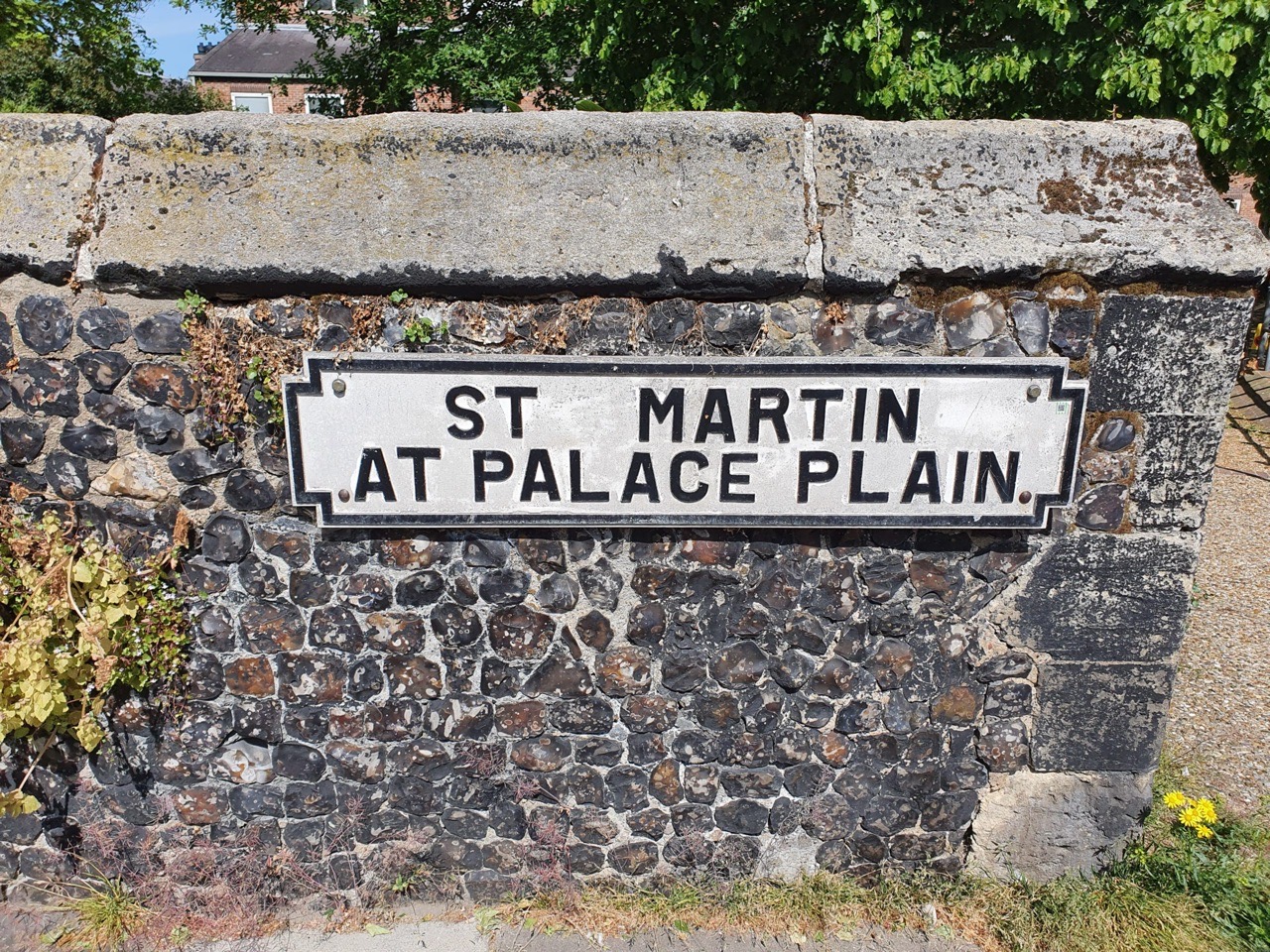
I’ve realised today how little bloody attention I pay to things, given that I’ve been calling a road I thought that I knew by the wrong name. It’s only a marginal error, but I’m moderately irritated that I hadn’t realised, Bishopgate ends earlier than I thought and becomes St. Martin at Palace Plain. Now, this is hardly of much relevance to anything of global importance, but the quirky layout is due to how things have shifted over the last century.
In the above map, St. Martin at Palace Plain covers part of the square, then the road down to where it looks like there is a pub in the middle of the road, before going up to another pub. Today, that is the entrance to the courts and the road and Worldsend Lane have all gone, so St. Martin at Palace Plain is effectively just the stump of road between the church and the entrance to the Bishop’s Great Gate and not that much further. Indeed, I’ve noticed that some properties have been moved out of St. Martin at Palace Plain on the listed buildings register and placed under other streets.
But, despite this street now just being a bit of a stump, it has a tremendous amount of history packed into it.

This is the view from the end of St. Martin at Palace Plain, looking down towards Bishopgate.

The sun gave me problems taking this photo, but this is the Bishop’s Gate, a structure constructed in 1436 to give access to the Bishop’s Palace. I’ve been in the chapels at the top of the Erpingham Gate and the Ethelbert Gate, but I don’t know what the set-up is with this one. The old Bishop’s Palace is now used by Norwich School, but there’s a new palace used by the bishop which is just the other side of this gate.

This is St. Martin’s Church, which has spent its lifetime literally overshadowed by the cathedral. No longer really having any congregation of its own as the nearby housing had gone, the church stopped being used for services in 1971. Since then it has been used to store church furniture, as offices for the Probation Service and is now used by the Norwich Historic Churches Trust. More on this in another post as I’ve been on a guided tour of this church, and it’s one of my favourites in the city.

This was once the wall of the Bishop’s Palace, although there has been some building just inside of it over the last century.

On the wall in the previous photo is this plaque, which marks where Lord Sheffield was killed during Kett’s Rebellion in August 1549.
The Kett’s Rebellion was started by the desire of some landowners to enclose land for their own financial benefit. That’s a slightly shortened version of the enclosure process, but that’s the upshot of it. The locals didn’t like that, so on 8 July 1549 some denizens at Wymondham ripped up the landowners’ lovely new fences. The owner of the manor of Wymondham was Robert Kett, who should have been most aggrieved at the damage done to property. But, he decided to back the rebels and he became their leader.
Kett decided that he would march on Norwich to show the authorities that the locals weren’t happy and that it was the poorest who would suffer the most. Perhaps unfortunately for him, he had thousands of people with him, turning a little local dispute into one of the largest protest marches that East Anglia had ever seen. He reached Bowthorpe, a suburb of Norwich today, on 9 July 1549 and Sir Edmund Wyndham, the Sheriff of Norwich, popped out to tell Kett that he should perhaps go home. Kett ignored that.
Instead of going home, Kett led his men to set up camp at Mousehold Heath, on the edges of the city centre, on 12 July 1549. Although this location was outside of the city walls, it offered views into Norwich and this is where they established their camp for six weeks whilst issuing their demands for a fairer society. By now, there were 16,000 people at this camp, which was presenting a problem for Norwich, as although it was the second-largest city in the country at the time, it still only had a population of 12,000.
The authorities agreed to listen to the demands that Kett had, which took some time, as there were 29 grievances that Kett wanted dealing with. Some of these were fiercely ambitious and only one related to the enclosure process, which is what had started this all off. During this time, the city hadn’t closed off its gates, so the people at the camp could enter Norwich to buy food and supplies, with something of a party atmosphere going on at Mousehold Heath by all accounts.
On 21 July 1549, the city authorities got fed up with this and they shut the gates. Faced with the camp having to break up due to a lack of supplies, Kett led an attack on the city. Despite having a strong artillery and city defences, Kett’s rebel forces won and took control of the city. This was a serious threat to King Edward VI now, so he ordered 1,500 troops led by the Marquess of Northampton to retake Norwich.
The relevance of this story to the street I’m writing about is that one of the military leaders was Lord Sheffield. He had had what I assume was a lovely breakfast at the Maid’s Head, a hotel which is still trading today, and led a mounted attack on rebels to force them back along St. Martin’s at Palace Plain to Bishopgate and then back out of the city. Unfortunately, he fell off his horse into a ditch. The rules of engagement at the time said that in such circumstances, the fallen man should be taken and held for ransom. Unfortunately for Lord Sheffield, a butcher decided to hit him on the head and kill him. And, today the location of Lord Sheffield’s death is marked by the plaque on the wall.
Just to finish the tale, the rebels could never win this, the Monarch was too strong. He despatched the Earl of Warwick and 14,000 men, including some rather rough mercenaries, to take back control (there’s a phrase….) and after a series of battles, the rebels lost. Although the Earl of Warwick’s army lost 250 men, there were over 3,000 rebels killed during the fighting. Many surviving rebels were promptly executed and Robert Kett and his brother William were taken to the Tower of London to face trial. They were, unsurprisingly really, found guilty and Robert Kett was sent back to Norwich to be hanged on the walls of Norwich Castle, whilst his brother was hanged on the west tower of Wymondham Abbey.
Was the rebel sacrifice worthwhile? Probably not. Little changed, other than the city announced it would mark a day of celebration every year on 27 August to celebrate the defeat of the rebels, with this party carrying on for well over a century.
Anyway, after that story, back to St. Martin’s at Palace Plain. The other building that is now situated off this road is the modern court complex, which has one of the city’s oldest buildings in its cellar, the Norman House. But more of this when I find those photos….