I like a good list and this sign shows all of the ships built at the Old Naval Yard (King’s Yard), with it being particularly active during the Anglo-Dutch Wars. The location didn’t have sufficient deep water access to the larger ships that were needed later on so its usefulness started to diminish. Unfortunately, I understand that every single ship constructed here has been lost whether sunk, scuppered, set on fire or broken up. The Navy used the dockyards between 1652 and 1713, with the site being used by private operators until the early nineteenth century. There’s more about the history of the site at https://www.harwich-society.co.uk/maritime-heritage-trail/the-navyard-wharf/.
Author: admin
-

Five A Side – Another One of My Good Ideas….. (or maybe not)

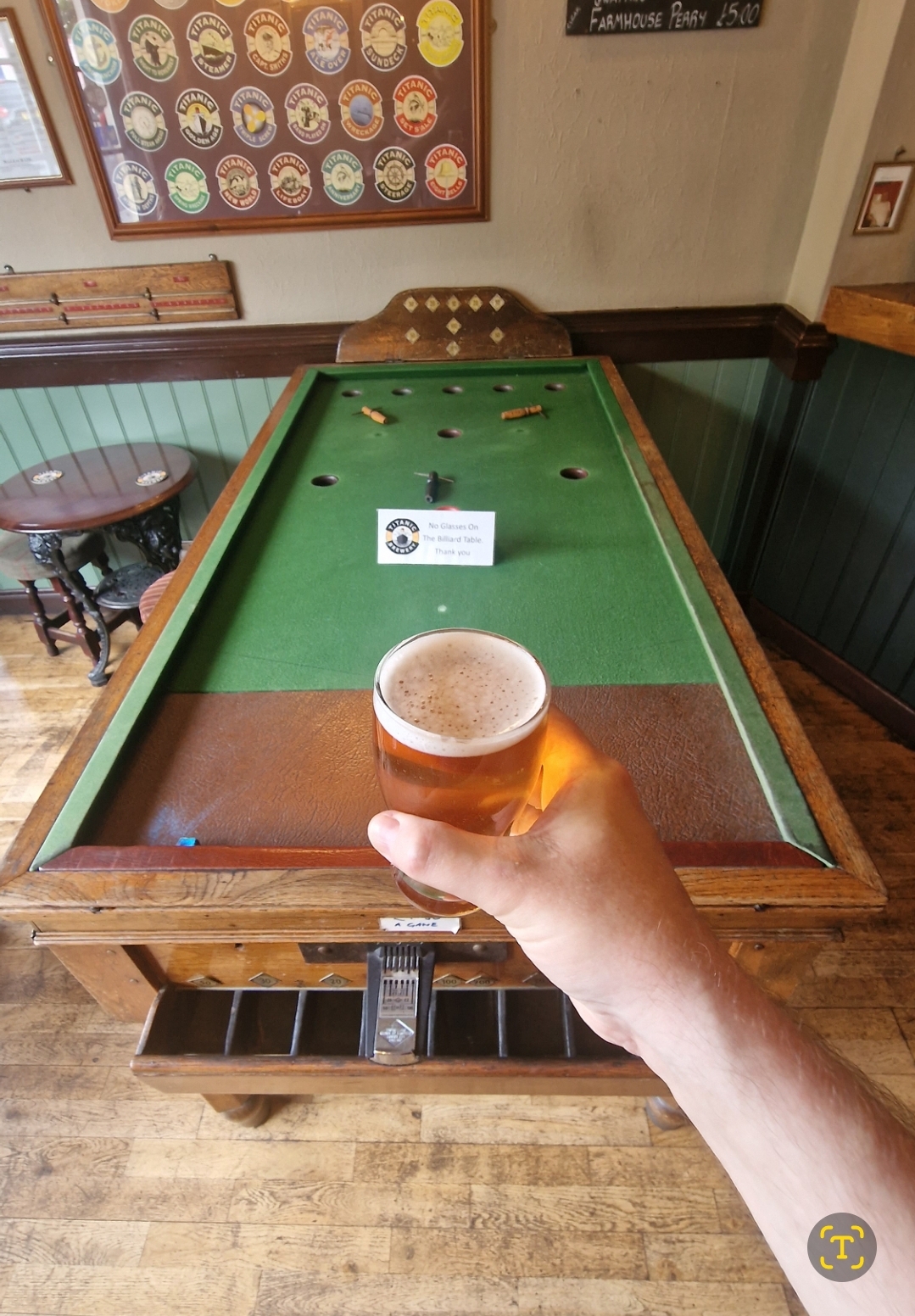
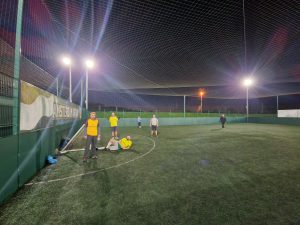
As one of Norwich’s leading athletes I decided that I should come up with a new idea to show off my sporting prowess, because long-distance walking, squash, bar billiards and competitive crisp eating just isn’t enough for me. I’ve straggled enough people together to form a five a side team, or technically two teams otherwise there wouldn’t be much of a game. We played at Goals on Hall Road and I must say that they’re incredibly welcoming and made the whole thing easy to book and arrange.
I’ve realised a few things after playing for an hour which include that bar billiards hasn’t given the ability to sprint for short distances tens of times, as well as discovering that my feet are more delicate than I had anticipated. And I’ve grazed my knees, so the multiple warnings I received in the King’s Head the night before that I might injure myself sort of were very valid concerns. I did score a goal though, so that was a highlight and I think it was the best of the game, an essential part of our victory against the other team.
Next game in a few weeks and then probably fortnightly after that, fortunately it seems that just about everyone wants to play again and some new recruits are coming along to add to the mix. And Dylan is a very good little player although I ignored his taunts of why couldn’t I run as fast as him. Everyone else didn’t feel the need to have food after the game, but Dylan and I needed Chicken McNuggets, so I’m suspecting that we’re the two professionals of this whole arrangement.
I probably should get a couple more photos next time as well in case I feel the need to write about it.
-

Harwich – 1953 Flood Memorial
This rather lovely little garden is a memorial to those who died in the February 1953 floods and it was reopened just a few weeks ago following a restoration to mark the 70th anniversary of the disaster. There’s an extensive Wikipedia page about the flooding and there were nine Harwich residents who lost their lives. And here’s more about how the flood impacted on the town itself.
In the centre of the garden is a spherical sundial with seating placed around the exterior. It’s a fitting tribute and it’s located on Wellington Road, near to the Harwich lifeboat museum.
Information on how the disaster unfolded.
The names of the victims are listed along the pathway, this one commemorates the life of the youngest, who was just 16 months old. Peaceful and quiet, it’s a very respectful memorial and I like that they’ve made such an effort to add information about the flooding and its impact on Harwich.
-

Harwich – The New Bell Inn (Good Beer Guide)
From the perspective of visiting Harwich to go to all the Good Beer Guide listed pubs, choosing a Tuesday wasn’t ideal as that meant that 50% of the two pubs in the book were shut. This was all clearly advertised so I wasn’t surprised, but I suspect that I would have very much liked this pub from the reviews. They apparently usually have a mild on, as well as four or so real ales. The food prices are firmly towards the lower end of the scale, but the quality seems high, with reviews marking on the community feel of the pub.
The pub is the oldest one surviving in Harwich having been established in something like 1743 and there’s more information about its history at http://www.harwichpubtrail.co.uk/newbell.html.
Some not entirely cheery history on a plaque above the door which commemorates William Bamford, a weaver from Coggeshall, who was burnt at the stake in 1555. This location was chosen as the pub sits on the area that was once the punishment area in the Tudor period.
-

Harwich – I’m Passionate that the Pub Should be Part of the People
I saw this on the side of a construction site and I think that the sentiment and the wording is really quite lovely.
-

Harwich – Alma Inn (Good Beer Guide)
This is the only Good Beer Guide pub in Harwich that was open during my visit to the town and although its frontage isn’t necessarily the most appealing I was aware from reviews that this would likely be a positive experience.
Customers need to walk down the little corridor and then into the bar area, ignoring the tempting doors to the side.
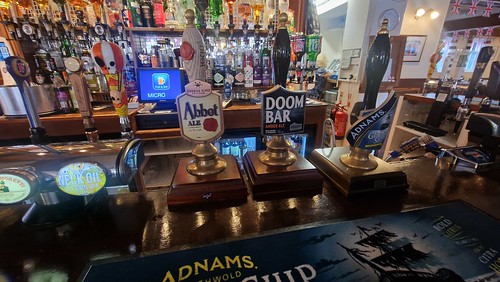
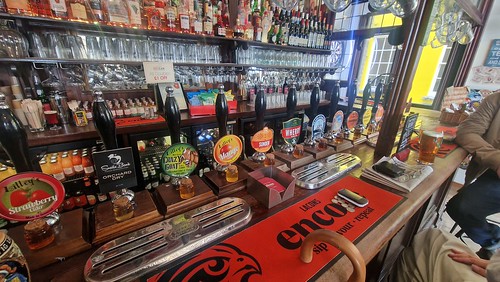
This range of real ale surprised me, five different options across numerous beer styles is hard to achieve and maintain quality. However, since they’re listed in the Good Beer Guide and the reviews are broadly positive, they’re clearly achieving that. The prices are high though, over £6 a pint for real ale is what I’d expect to see in London. However, this venue is primarily a restaurant and so I’m assuming those prices reflect that, although those just wanting a drink are also welcome and there are some stools at the bar for when they’re full of diners.
Not a very clear photo, but a sign showing how high the flood water rose in 1953.
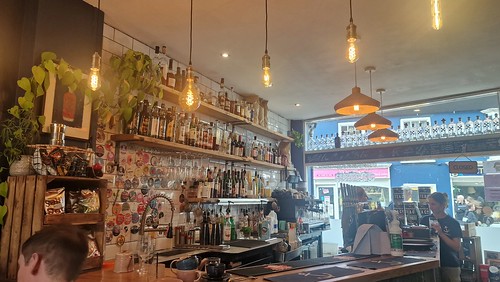
The interior has plenty of character and feels homely. The service was informal and polite, although I wouldn’t say there was any attempt to much engage beyond the minimum needed. But, that’s fine, not every pub is going to be the Hop & Vine, a friendly welcome is sufficient for me.
I’ve had the Black Adder from Mauldons before and it’s a very good stout, a roasted flavour with a creamy texture, with the pint here tasting just as I expected. The crisps were also delicious and complemented the beer nicely.
Someone has added the word “beer” at the bottom, which isn’t a bad shout. The pub’s web-site has a section which has the title “Officially the finest pub in the East of England” underneath “CAMRA Real Ale Pub” but I can’t find any evidence of that on CAMRA’s area web-site. It did win the branch award seven years ago but I can’t find any regional awards, but perhaps they were from other organisations.
I’m slightly disappointed (and only very slightly, I have more pressing concerns) as well that the pub’s web-site mentions nothing of its history other than it dates from the 1850s. Instead, the Harwich Pub Trail has a full history of the pub which is interesting, particularly the reference to:
“As it stands the building dates from many different periods but it was probably built in 1464 as a house. By 1599 it was owned by Captain Twitt – a relative of Thomas Twitt (or Twytt) a merchant and brewer in the town. The Twitt family were well-connecting and well-known in the town and Captain Twitt’s daughter married Christopher Jones at St. Nicholas’s Church in 1593. Although Sara died aged 27 in 1603 her husband went on to own a rather famous ship named the Mayflower and used it to guide the Pilgrim Fathers to America in 1620.”
It was a Tolly Cobbold pub between 1957 and 1990, then Pubmaster before falling into the hands of the hopeless and hapless Punch Taverns who sold it in 2010. And there’s some more history and older photos here.
There’s elements of quirkiness that I like, such as the details of their six bedrooms where they note about the view from one that “it boasts a sea view and a view of a quite charming electrical substation“. I also hadn’t seen before the poster on the inside of the entrance to the toilet that said something along the lines of ‘let those coming in have priority, their need is greater than yours’. I like that informality, I think it gives a softer edge to the pub and makes it feel that bit more inviting.
As a random aside, it’s not my problem and nor indeed anything I’ll think about again after writing this, but I find the pub’s use of the CAMRA logo all over the place and on every page a little confusing, as well as the reference to their being a “CAMRA Real Ale Pub” without any links to the national web-site. It may be that CAMRA have authorised this use of the logo and wording, but it seems unusual terminology that I haven’t seen before.
The on-line reviews for the pub are very positive, so I’d say it’s a safe bet that the food is reliably good, whilst the clear fact they’re able to stock five real ales is showing just how much beer they’re selling. It’s one of the more expensive pubs I’ve been in for real ale, and actually the most expensive pub listed in the Good Beer Guide that I can recall and that includes tens of London pubs, but prices are rising and no venue is immune to them.
This is one of these pubs that’s worth coming to get a drink for just to feel part of the history of the building, but given the excellent choice of real ales and how well kept they are, that all comes together to feel like reasonable value for money. And I like the irreverent sense of humours that is evidence throughout the pub, all rather lovely.
-

Harwich – Statue of Queen Victoria
This statue spoke to me, albeit not literally, because it is a snapshot in time of the hopes that existed in Harwich in the late nineteenth century and early twentieth century. The statue was placed here in 1904 and it was listed in 1994 which has likely made it easier to receive the repairs that it had urgently needed over recent decades. The statue was unveiled by the Earl of Warwick on 11 June 1904 and was funded by public subscription which raised the necessary £400. The Earl of Warwick said that he was personally delighted that “all classes have subscribed liberally towards it, showing their spirit of loyalty”.
If Queen Victoria could turn around a little bit, this is the rather beautiful view that she would see. I suspect that if there were requests for statues of Queen Elizabeth II then the population would likely give generously, but it seems that the great era for statues and memorials is perhaps over.
-

Harwich – Harwich Masonic Hall
The star at the front represents the Masons as I understand and it feels like an austere frontage for a building that is still in use. It was constructed in the late nineteenth century, but the building was badly damaged in the Great Flood of 1953 which caused substantial damage to the coastline of East Anglia.
The frontage did have windows at the time of the Great Flood, so I suspect that they were removed during the repair of the building in the late 1950s. Despite a large number of buildings in the area being listed, this one hasn’t been which also means that I haven’t been able to discover much more about its history. I found it interesting though with its frontage and was pleased to see it’s still used for community events. They’ve got a web-site at https://harwichmasonichall.co.uk/.
-

Harwich – Greater Anglia Train from Norwich to Harwich
Today’s little pub, history and walking expedition is to Harwich since I thought that I needed a day out. I noticed on-line that the London train before mine was cancelled so thought I’d rush down in anticipation of the actual service I was booked on being full. Fortunately, I got a table just in time so was able to merrily type away for an hour or so. The service inevitably got busier and I got chatting to a confused passenger (they weren’t confused by me, or at least I don’t think so) who wondered why the train was so busy. We then shared our thoughts about Greater Anglia, which is a healthy scepticism I would say mixed with a supportive attitude.
My train arrived into Manningtree on time, but since it was a tight connection I didn’t get time to have a look around the railway station.
Looking to the left, the train was empty. Something of a contrast to the standing room only of the train that I had just disembarked.
Looking to the right, the train was empty. Now, I know I complain, but I hate it when they shove five seats in across. They’re so narrow that it effectively takes out the middle seat of the three so I disagree that there’s any benefit in terms of passenger numbers. Indeed, they’ve just made it more uncomfortable for everyone as it’s hard to navigate down the aisle and there’s a reason why trains traditionally have four seats across.
A couple of other people got on and then got off again at the gateway to the globe railway station that is Harwich International.
I do love a bit of history and they’ve made an effort with the boards at Harwich Town. The sign notes that between December 1938 and May 1940 that 10,000 unaccompanied children came to Britain from Europe. Although many people were involved, it is impossible for me not to mention the work done by Sir Nicholas Winton, someone that I consider to be one of the greatest people of the twentieth century. The relevance is that the children arrived here at Harwich and many stayed locally.
Another board about the Kindertransport.
I’ve been watching a lot of Hi-de-Hi recently and I didn’t realise that the programme was filmed at Warners which wasn’t far from the railway station, but unfortunately it was all demolished in 1992. That was a suitable treat to feel so near to where all this comedy action took place.
It’s a pretty railway station and it’s at the end of the Mayflower Line, with the building being rebuilt between 1865 and 1866.
And an information board at the front of the station, it all felt more remote than I had expected with all this greenery. But I had arrived into Harwich on time and ready to explore the town for my first time in recent years.