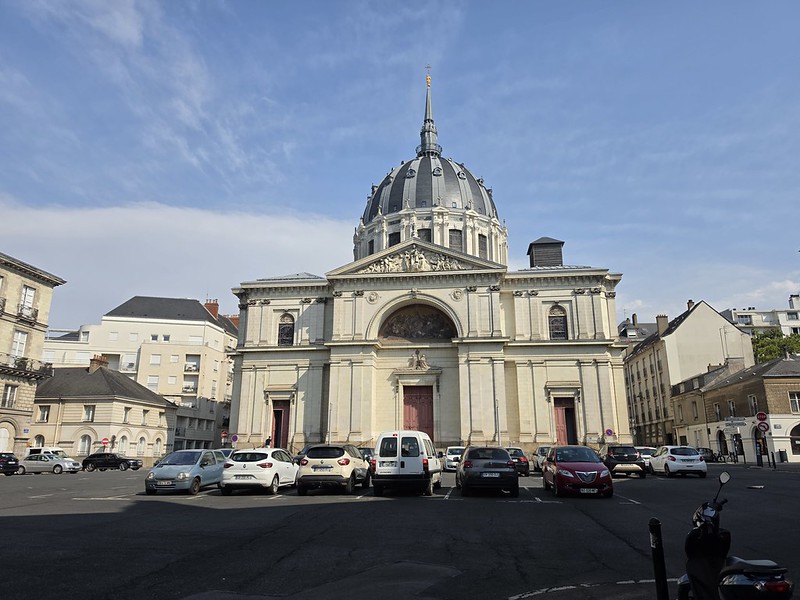
This is Notre-Dame-de-Bon-Port, a grand nineteenth-century church built close to the former harbour and dedicated to the Virgin Mary as protector of sailors. Its enormous dome and elaborate neoclassical façade give it a suitably commanding presence, suggesting that architectural modesty was considered and then rejected before the plans were approved. It’s a robust building though, I can imagine that the sailors liked it and I was also pleased that the authorities have put up an information board about it.
This is only a short post, which will likely come as a relief to my two loyal blog readers, as I did not go inside and therefore cannot offer my usual detailed assessment of the stonework, stained glass and available seating. It looked exceptionally grand from the exterior, although it was a shame that so many cars were parked directly in front of it, perhaps slightly compromising the intended effect of the monumental façade. Nineteenth-century architects rarely allowed for the possibility that their finest civic views would eventually become convenient places to leave a random assortment of Renaults.
There is no shortage of Accor hotel options in Nantes, which is fortunate as it means that the pricing is relatively favourable even during July. This particular hotel was centrally located and reasonably priced, although it appeared to attract rather more negative reviews than several nearby properties carrying the same corporate branding. This suggested either a hidden catastrophe or, more probably, rooms that were slightly smaller than some reviewers felt entitled to receive in the middle of a major French city.
I arrived an hour before the standard check-in time as I hadn’t had any sleep and needed a little nap before more city exploration. The helpful receptionist said that they couldn’t do an early check-in, but this was no obstacle to me, there were tables and free water and the receptionist said I was welcome to wait. I then discovered that there was no phone signal and I couldn’t access the wi-fi until I checked in, as I needed the room number.
Whilst debating whether I had the energy to get up and see if I could get that room number, the receptionist came over and asked for my name. Fortunately, I have stayed in enough Accor hotels to get free early check-in and she then said that she had checked with the cleaners and a room was available. To be fair, they probably didn’t want me cluttering up reception but, either way, my nap had moved considerably closer, making it a positive outcome for everyone involved.
The stairs to the room were entirely sub-optimal as they had all manner of stuff stored on the steps and it required some effort to get around it. I decided that I’d take the lift for the rest of my stay just to be on the safe side.
The room design was the oddest I’ve seen for some time and although it’s not evident from this photo, the shower is positioned just to the right of the photo facing straight towards the bed. That means that if the shower is turned on then there’s the risk of covering the bed, and the electrics, in a flood of water.
The security catch on the window was broken, which meant that I could open it fully and introduce some desperately needed air into the room. Given the temperature outside, this was welcome, although it did reinforce the impression that the hotel was not allowing excessive health and safety paperwork to inhibit its creative freedom. Between the obstructed staircase, unrestricted window and shower aimed towards the electrics, the building offered a pleasingly relaxed relationship with risk assessment.
The room itself was also small, which is something that seems to be behind many of the hotel’s poor reviews, and there was no desk of note, just a small circular table and chair. However, this was a keenly priced hotel in the middle of a city, so I can cope without having acres of space. I also liked the seating area near reception, so I could have moved there had I needed to.
I was surprised and delighted by the hotel’s beer offering for my welcome drink and the receptionist was enthused at showing me what they had. There was a range of mostly local beers and some national options, it was one of the best selections that I’ve had for some time in an Accor hotel and it was especially decent given that it was a relatively small hotel.
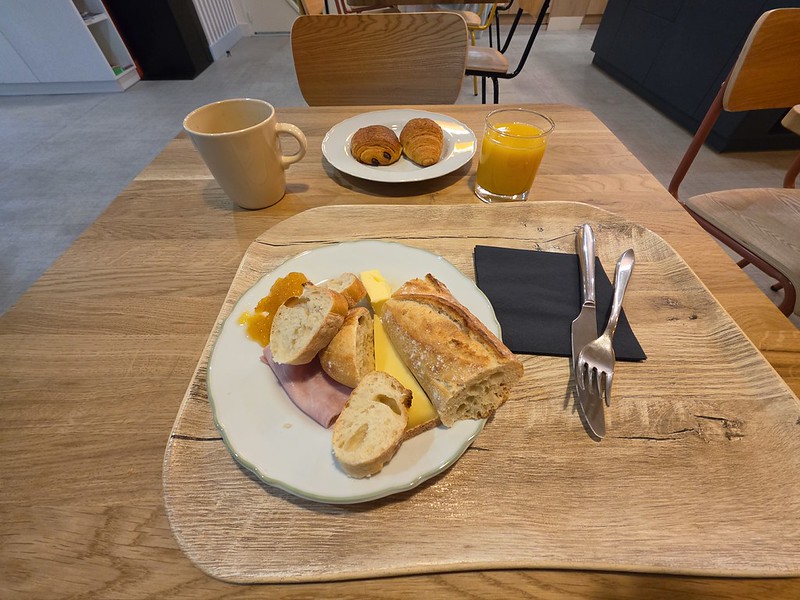
The breakfast was included in the room rate and there was plenty of space, although I did go down quite early on. When there’s a free breakfast, I don’t want to faff about.
This was some of the selection and that cheese was delicious and it took quite a hit. The ham was awful, although Accor hotels, especially at the cheaper end, rarely get that right.
I had a lot of bread and cheese, croissants and pastries, alongside fresh orange juice and coffees. This is the sort of breakfast of champions that is a positive start to the day, although I had to have a little post-breakfast rest so I might have overdone it. This is what happens when there is no responsible adult present to impose sensible limits on my access to bread and cheese. Continental breakfast freedom carries responsibilities, and I had plainly failed to exercise them.
There was quite a lot technically wrong with the hotel in terms of presentation, room design and its somewhat free-spirited approach to safety, but none of it particularly bothered me. The room was clean, the staff were friendly and there were no significant noise problems, either inside or outside. I had been allocated a room at the end of a corridor, which helped, as some rooms appeared to be positioned close enough to the noisy lift for guests to participate emotionally in every journey it made.
Overall, I rather liked the hotel. It was inexpensive, central and comfortable enough, the breakfast was excellent and the beer selection was far better than it had any need to be. I’d happily stay here again, but I can see that the lack of space in some rooms might not be ideal for some guests.
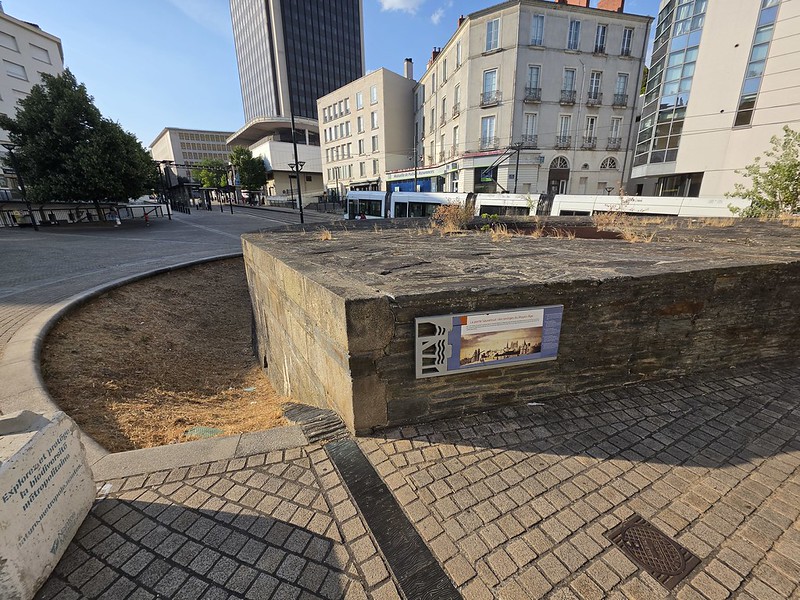
These rather modest remains belonged to Porte Sauvetout, once one of the principal entrances through the medieval walls of Nantes. Situated on the north-western side of the city, the gate controlled the routes towards Vannes and Rennes, so anyone arriving from that direction would have been required to pass through it rather than simply wandering into Nantes in search of craft beer. Thank goodness for freedom of movement is all I can note….
Porte Sauvetout was far more substantial than the remaining masonry arrangement might suggest. The main gateway stood between the Haut-le-Pied and Erdre towers, with a drawbridge and additional defensive works protecting the approach. The towers were rebuilt in 1482 and 1483 to accommodate gunpowder artillery, as medieval military technology had advanced beyond merely dropping unpleasant objects onto people from above.
Like most of Nantes’s medieval fortifications, the gate was largely dismantled from the mid-eighteenth century onwards as the city expanded and reshaped itself, with the last stretches disappearing in the early nineteenth century. Its base survived, and was properly investigated archaeologically around 1999, ahead of construction work for Nantes’s third tramway line. The dig, lasting a couple of months, confirmed that the tower was in remarkably good condition below ground. It has a horseshoe-shaped plan, still measuring around 14 metres by 12.6 metres, and is preserved to a height of about 3.5 metres on its northern side.
As the photograph shows, steps lead down into the heart of the tower, although access is closed. This is perhaps fitting for what was once a defensive structure, as the original policy of discouraging casual entry appears to remain in force. It was still pleasing to see such a substantial fragment of medieval Nantes preserved among the modern streets and I liked that it had a little information board so I knew what I was looking at.
It was obviously too hot in Nantes as I decided to sit outside, something which I try to avoid whenever possible to avoid cigarette smoke, insects and the risk of others displaying joviality nearby. This was MADE Burger, which had excellent online ratings and looked sufficiently appealing to justify a proper investigation rather than my usual approach of staring through the window and making several unnecessary circuits of the block to find something which meets my needs.
Ordering was simple enough and I liked the provision of buzzers so that I know when food arrives, it’s always a slight faff if they’re trying to call out food orders in a language I don’t know. The buzzer meant that I could sit outside in peace, confident that it would eventually summon me rather than the food quietly cooling on a counter while a member of staff repeatedly called for someone who sounded a little like “Julien”.
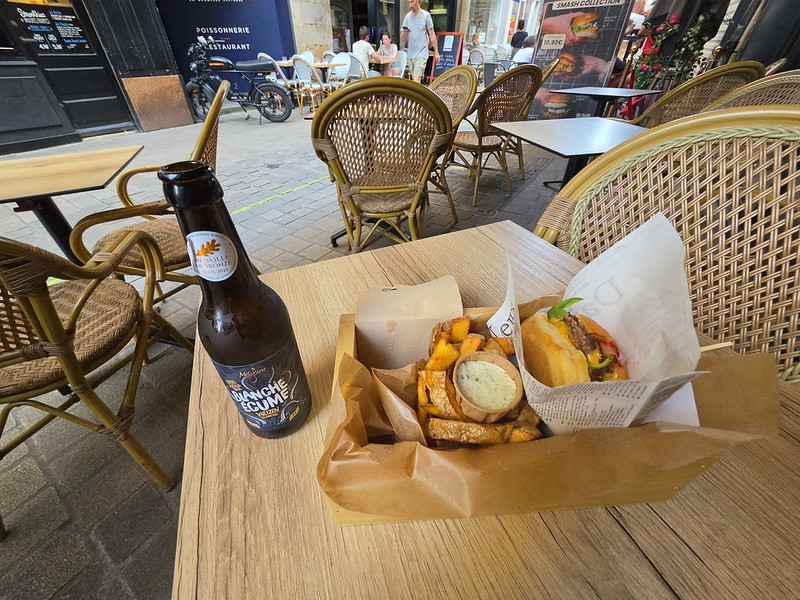
This is their standard smash burger with cheese and bacon and the presentation seemed carefully thought through. The burger was juicy and had a depth of flavour, actually tasting of beef which is always positive. I would have preferred the bacon to be cooked more, although I accept that my enthusiasm for nearly cremated bacon is a matter of personal taste rather than a failure of the kitchen. The bun was soft and the chips were particularly good, crisp on the outside and soft and fluffy within, which is exactly what chips are meant to achieve despite the number of establishments that continue to treat this as an optional ambition
The beer is the Blanche Écume from Brasserie Mélusine, a quite fruity wheat beer, successfully completing the whole arrangement. Indeed, on the beer front, I was pleased that there was a choice of three different local beers, none of which I’d had before.
The venue was all rather on-trend and it was heavy on the branding and perhaps slightly formulaic, but as long as the food quality is high then I’m absolutely fine with that. It got a little busier outside whilst I was there, but fortunately there was no-one smoking, no insects and the frivolity level remained relatively low. I’m also pleased to note that the large canopy meant that the temperature of the outside area remained cool, as I might not have mentioned, but it was too hot in Nantes.
I was pleased to discover that there were numerous craft beer bar options in Nantes, certainly sufficient for my one night stay. This was Amère, which combines a craft beer shop with a bar and therefore allows customers both to drink beer immediately and to purchase additional beer for later, a business model based on understanding people properly.
The selection of cans and this seemed well curated with local and international breweries. I like the combination of familiar and entirely new to me, although it was too hot for me to traipse any of these cans around the city for later.
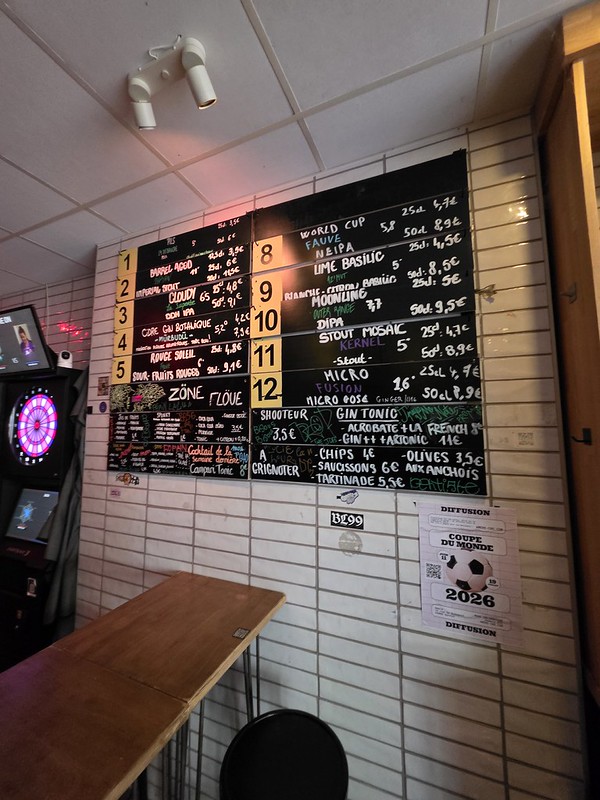
The beer board offered another respectable selection, although this was also when I discovered that my phone had no signal. This made checking Untappd to establish which beers I had already tried rather more difficult and required me to rely upon memory, instinct and the vague recognition of colourful labels. These are essentially the methods used by humanity before mobile data, although it is hard to imagine how civilisation survived without being able to confirm immediately that a beer had been rated 3.74 by 486 strangers. Many people just don’t understand the stress of ordering a beer without Untappd.
Despite the lack of Internet, I correctly guessed that I hadn’t had this beer before and it’s the Rouge Soleil from Fauve which is a small French brewer. It was a gently tart beer with cherries and fruit, all rather agreeable.
The bar area was clean and bright, with the service being friendly and prompt, although the lack of air conditioning meant that the temperature was on the hotter side. The outside seats were all full, which did limit my options somewhat. The venue also has a darts board cutting right across it, which is perhaps the only thing that was a little uncomfortable, but I liked the whole vibe in general.
Anyway, I liked this bar and the whole atmosphere of the arrangement, it’s always lovely to see craft beer done well. The venue is Untappd verified but they don’t display their craft beer list on the app which is a little unusual, but I was pleased with the options that there were. The only significant difficulty was leaving after one drink, but Nantes contained several more craft beer bars and I had responsibilities to the wider research project.
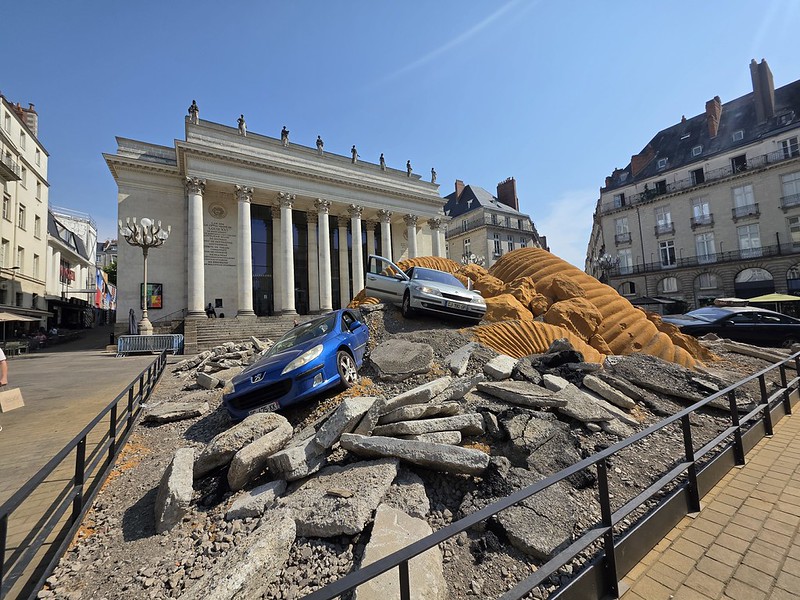
Outside the elegant neoclassical Théâtre Graslin, artist Théo Mercier has installed Fossil Opera, an enormous landscape of compacted sand, rubble and partially buried cars. And, no, this is not a art installation about Richard’s driving, but instead it’s meant to show an unusually selective earthquake which has destroyed the city but spared the opera house so that the survivors can still enjoy Carmen.
The installation was created for the 2026 edition of Le Voyage à Nantes and uses around 600 tonnes of sand, together with debris taken from local building sites and cars supplied by a nearby repair business. The cars also recall the relatively recent period when Place Graslin was open to traffic, ensuring that the motor vehicle has progressed from dominating public space to being buried beneath it, which is perhaps the most decisive pedestrianisation scheme yet attempted and I support the enthusiasm. Other cities might wish to adopt the same approach, particularly for vehicles parked across pavements, but I digress….
The work has predictably divided opinion, with some residents finding it imaginative and thought provoking and others apparently preferring their prominent city squares without simulated geological catastrophe. It has also attracted criticism because the sand requires regular watering during a period of exceptional heat (have I mentioned it was too hot in Nantes?), which adds an intriguing extra layer to an artwork partly concerned with environmental change. Once the exhibition ends, the sand, rubble and vehicles are intended to return to their original sources, leaving Place Graslin intact once again. But I’m very pleased to have seen this, I think that it’s one of my favourite large-scale art installations.
This memorial was created to confront Nantes’ history as France’s leading slave trading port, while honouring both the victims of slavery and those who campaigned against it. The project developed from the city’s broader examination of this uncomfortable past during the 1990s, with the City Council approving plans for a permanent memorial in 1998 and choosing the winning design in 2002. Construction began in 2010 and the completed memorial opened to the public on 25 March 2012.
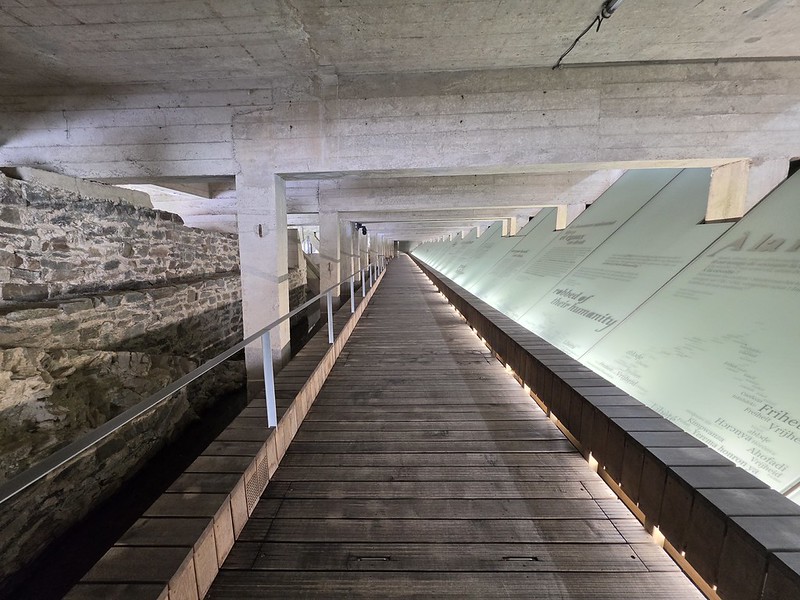
Steps lead down beneath the promenade into a long, confined passage containing texts about slavery, resistance, abolition and human rights. The design is deliberately stark, with old stonework, bare concrete and a wooden walkway running through the space. It feels less like a conventional museum and more like entering the concealed structure beneath the city’s prosperity, which is presumably the point.
Along the Quai de la Fosse are around 2,000 glass plaques naming slave ships and the ports involved in the trade. They are embedded discreetly into the ground, meaning that visitors walk among the evidence rather than being presented with a single monument which can be admired briefly before everyone moves on to somewhere selling coffee. The setting beside the Loire is calm and attractive, but that is precisely what makes it effective: the peaceful modern waterfront sits directly above the place from which ships once departed on voyages built around the treatment of human beings as cargo. It was a vast system of kidnapping, forced transportation, violence and exploitation, with consequences that lasted long after abolition.
The displays beneath the riverside promenade set out the long and deeply uncomfortable chronology of the Atlantic slave trade, including the repeated attempts to abolish it and the repeated determination of those profiting from it to find reasons why abolition should perhaps wait a little longer. Nantes was France’s leading slave trading port during the eighteenth century, and the exhibition makes no attempt to disguise that history. France abolished slavery more than once, only for Napoleon to restore it in the French colonies in 1802, placing imperial and financial interests above the freedom that had briefly been granted. It was finally abolished permanently in 1848.
Individual plaques record the names of ships such as Le Saint-Jacques, which left Nantes in 1767. A ship’s name can otherwise sound rather romantic, suggesting distant ports, brave sailors and an adventurous life at sea, so the description “navire négrier” is an important corrective to any temptation to become sentimental. There are a fair number of online reviews noting that the memorial makes no mention of the Barbary slave trade. I cannot say that I noticed anything about it either, although much of the material was of course in French, so it is entirely possible that I missed it.
The memorial was free of charge, thoughtfully designed and was conveniently cool which was handy given the extreme heat in Nantes when I was visiting. There is perhaps a little more that they can do here, as I only found out more about the memorial after having visited and there were many more stories that could be told.
I have long thought that you can tell a fair amount about a country given the transportation arrangements at the airport. If you have an airport where taxi drivers are allowed to roam the terminal attempting to scam passengers, then there’s either widespread corruption or airport management taking a very relaxed view of its responsibilities. And if you have an airport where there’s an obvious convenient option which is more expensive and some complex and packed service which is cheaper, then that’s not a city in need of tourists. And there are cities that can manage to put up clear signage and others where they decide that passengers need to complete an informal intelligence test.
Nantes made a broadly encouraging first impression. Nantes didn’t have taxi drivers roaming free and it had excellent signage, so it felt like an adult had been in charge of the arrangements. The airport was, however, very keen to guide passengers towards the direct bus costing €10, while being rather less enthusiastic about advertising the number 38 bus, which cost just under €2. The cheaper option was not exactly concealed, but it had been placed in the category of information available primarily to people who had already discovered it.
I obviously wanted the cheaper of the two buses and I was pleased to note that the tickets were sold at the same machine and the process was clear only for those who had read up in advance. However, the driver of this bus fended off over ten different customer groups, using his knowledge of French, German and English, because passengers were muddled up over how the buses worked. I thought that the local bus company was price gouging, there was no need for the €10 fare when evidently the rest of the network works with fares that are a fifth of that.
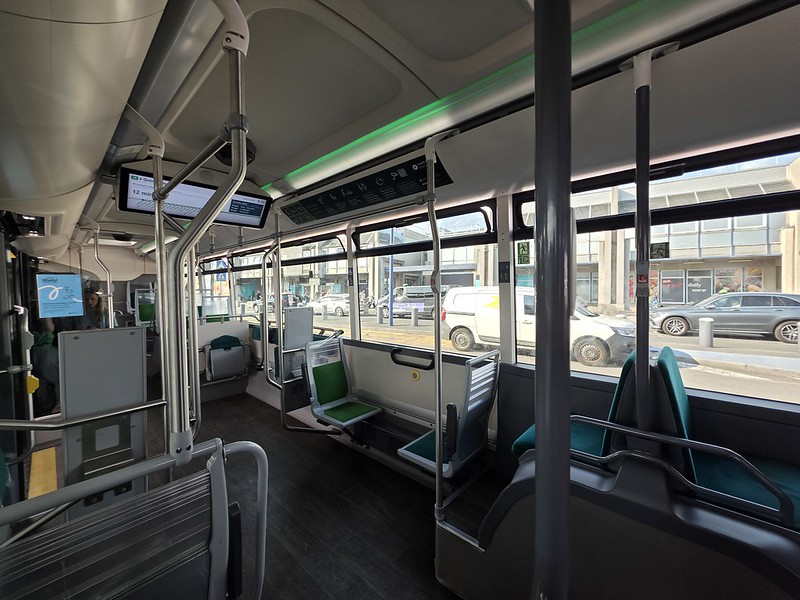
But, I had my front row seat and I was pleased that the journey into a relatively central part of Nantes took just over 35 minutes. The bus was clean, comfortable and professional driven and I was pleased at my thrifty ticket which cost me under €2. And not everywhere can compete with cities such as Wrocław, Warsaw and Gdańsk, where ordinary public transport reaches the airport without the authorities deciding that the final few kilometres require a special financial contribution. Those cities appear to regard an airport as part of the transport network rather than a captive market with runways, but I mustn’t sound like I’m complaining as the service I did catch was affordable, timely, clean and with a friendly driver.
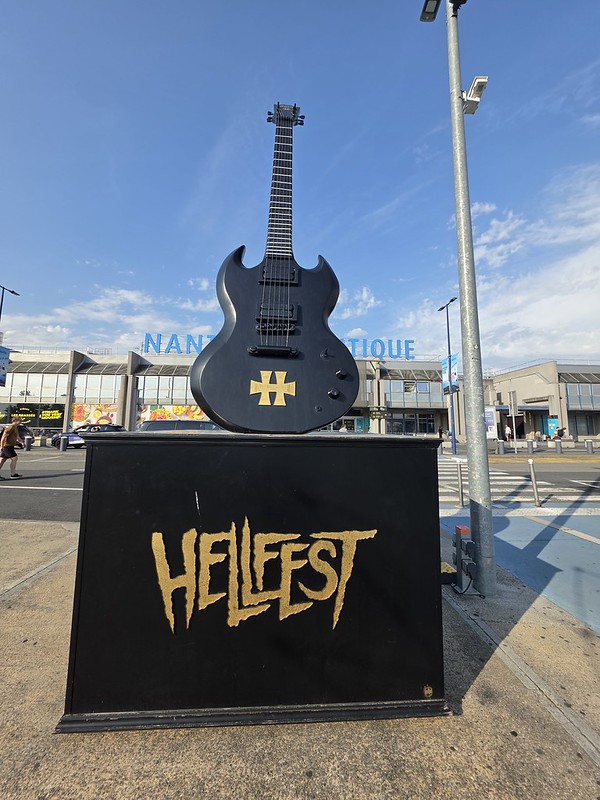
I mentioned this to some of my friends who like heavy metal type music and they had heard of this event, although it’s not really within the realms of my musical knowledge which becomes uncertain when it gets loud.
Located around 30 kilometres south-east of Nantes is Clisson, home of Hellfest, France’s largest extreme music festival and one of the biggest metal events in Europe. Founded in 2006, it now attracts more than 280,000 visitors across four days, with stages devoted to metal, hard rock, punk and hardcore music. For most of the year Clisson is an attractive little town of vineyards, medieval buildings and riverside scenery, before June arrives and it is temporarily occupied by several hundred thousand people wearing black T-shirts and discussing which form of screaming is the most musically sophisticated.
I’m sure it’s very lovely and I had a look at the food vendors at this year’s festival and they seemed quite appealing. At least that’s something that I would have properly understood.
The gate was called which meant it was time to traipse off to the furthest part of the airport which is where all my Ryanair flights seem to depart from. I suppose that the airport charges them a cheaper rate per gate for flights that depart from the very boundary of the terminal.
Ryanair aircraft everywhere, waiting patiently to transport people across Europe for less than the cost of buying lunch in the airport.
Gate 34, the same gate as I boarded from a couple of weeks ago and I’m not sure it’s possible to get a gate further away from the main terminal with a shuttle bus and an overnight expedition. Boarding was a little muddled, they didn’t put the “boarding” line on the screen and a confused gate agent came over to ask why people weren’t boarding. She said that she had been shouting, but as she was around 20 metres away, it wasn’t entirely a surprise that no-one heard her. A passenger then had an argument with her about the whole arrangement, just to add a little drama to proceedings.
We were then held up as another passenger was trying to take a backpack that looked like she had somehow fitted a hippo into it. The gate staff, who were letting some quite large bags go through, could hardly turn a blind eye to that and so that was another £60 for the airline in fees.
The walk to the aircraft, during which there was ample opportunity to reflect on whether Nantes was actually closer than the departure gate.
I’d never noticed this on the side of an aircraft before and Wikipedia tells me that “they measure undisturbed ambient atmospheric pressure. It is a vital component of the pitot-static system, supplying static air pressure data to the altimeter, vertical speed indicator (VSI), and airspeed indicator”.
I asked AI to explain this to me as though I were an idiot, which is a setting I have already spent considerable time training it to use. It replied that they were basically measuring altitude, so that was another aviation mystery comprehensively resolved without the inconvenience of obtaining a pilot’s licence.
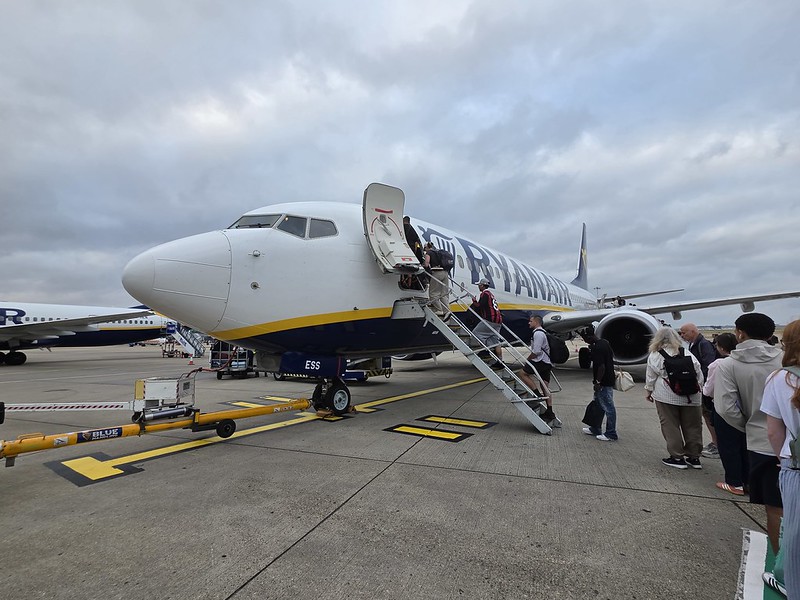
As always, I like these steps that fold into the aircraft before departure. The aircraft is EI-ESS and I looked at how many flights that completed today and it’s eight, which shows considerable efficiency. By comparison, I had managed to get myself from Luton Airport’s waiting area to Gate 34 and already felt that I had achieved enough.
As I hadn’t had any sleep I was getting a little tired by this point and was slightly pre-annoyed that the seating Gods had given me a middle seat.
Fortunately, there was no-one in the window seat and so I was able to move across. The flight was around 30% empty and so it seems the only reason I had been allocated a middle seat was to encourage me to pay to move to a window or aisle. In fairness to Wizz Air, they don’t seem to try that tactic on me, which is sensible as it doesn’t work on me at least.
I’m sure that there was a reason that I took this photo, although I can’t now remember what it was. So, here are some fields to look at. They appear to be functioning correctly in that role.
And safely landed on time into a very hot Nantes. The fare was more than I’d usually pay at £15, but the whole arrangement was efficient, the crew members were friendly, the aircraft was clean and everything went as I had expected. A smooth flight gives me less material for this blog, but it is probably best for all concerned and I remain entirely satisfied with Ryanair.