
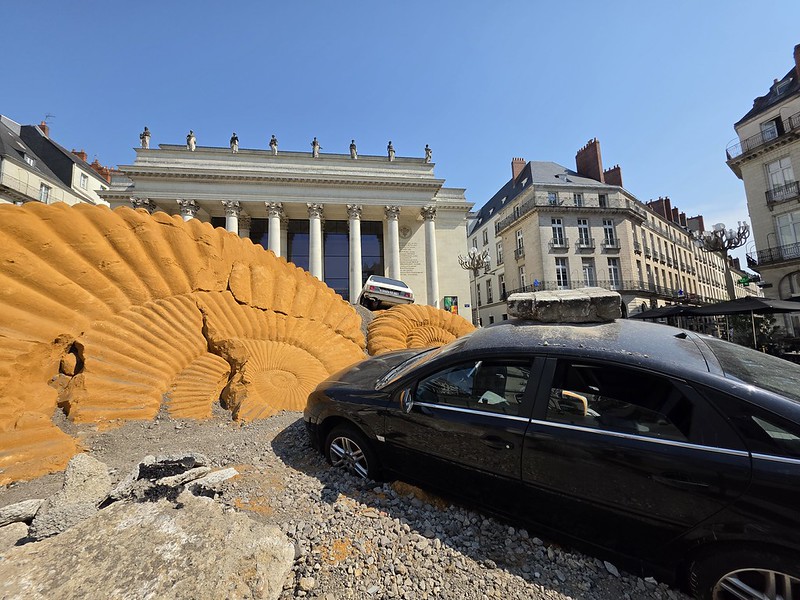
Outside the elegant neoclassical Théâtre Graslin, artist Théo Mercier has installed Fossil Opera, an enormous landscape of compacted sand, rubble and partially buried cars. And, no, this is not a art installation about Richard’s driving, but instead it’s meant to show an unusually selective earthquake which has destroyed the city but spared the opera house so that the survivors can still enjoy Carmen.
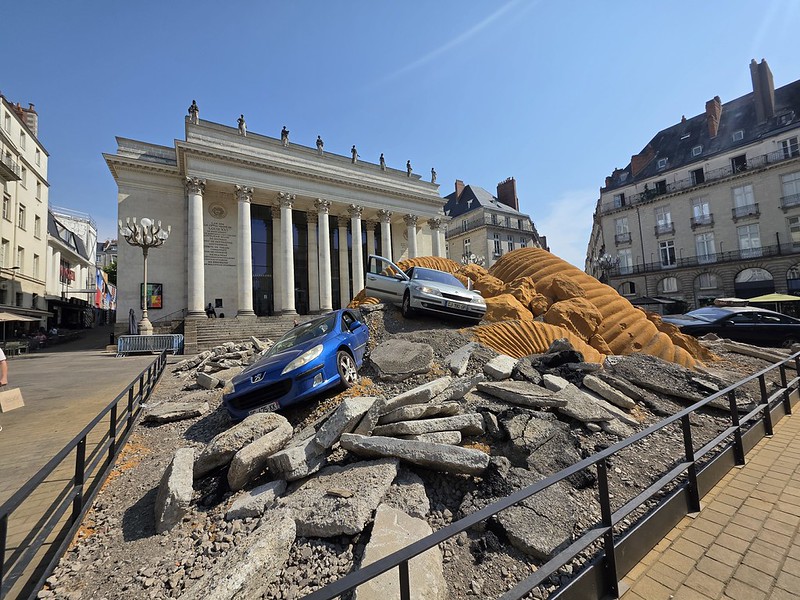
The installation was created for the 2026 edition of Le Voyage à Nantes and uses around 600 tonnes of sand, together with debris taken from local building sites and cars supplied by a nearby repair business. The cars also recall the relatively recent period when Place Graslin was open to traffic, ensuring that the motor vehicle has progressed from dominating public space to being buried beneath it, which is perhaps the most decisive pedestrianisation scheme yet attempted and I support the enthusiasm. Other cities might wish to adopt the same approach, particularly for vehicles parked across pavements, but I digress….
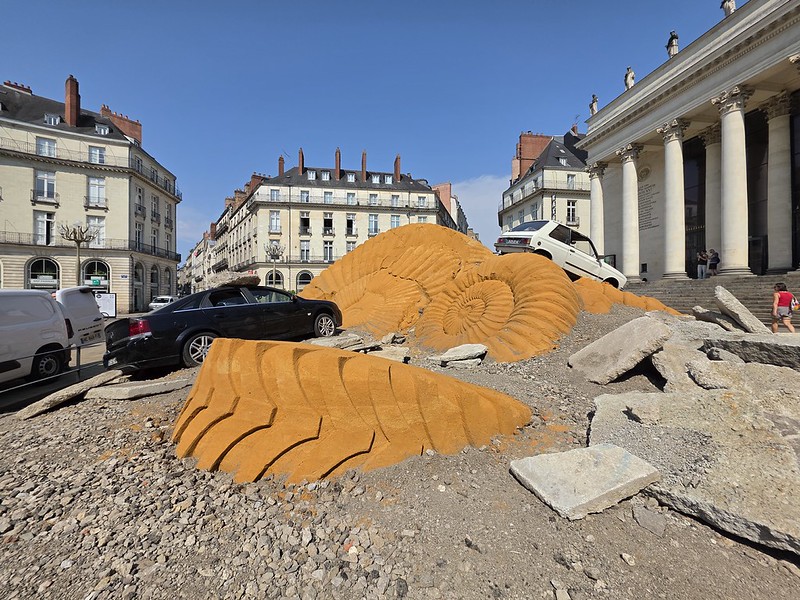
The work has predictably divided opinion, with some residents finding it imaginative and thought provoking and others apparently preferring their prominent city squares without simulated geological catastrophe. It has also attracted criticism because the sand requires regular watering during a period of exceptional heat (have I mentioned it was too hot in Nantes?), which adds an intriguing extra layer to an artwork partly concerned with environmental change. Once the exhibition ends, the sand, rubble and vehicles are intended to return to their original sources, leaving Place Graslin intact once again. But I’m very pleased to have seen this, I think that it’s one of my favourite large-scale art installations.