
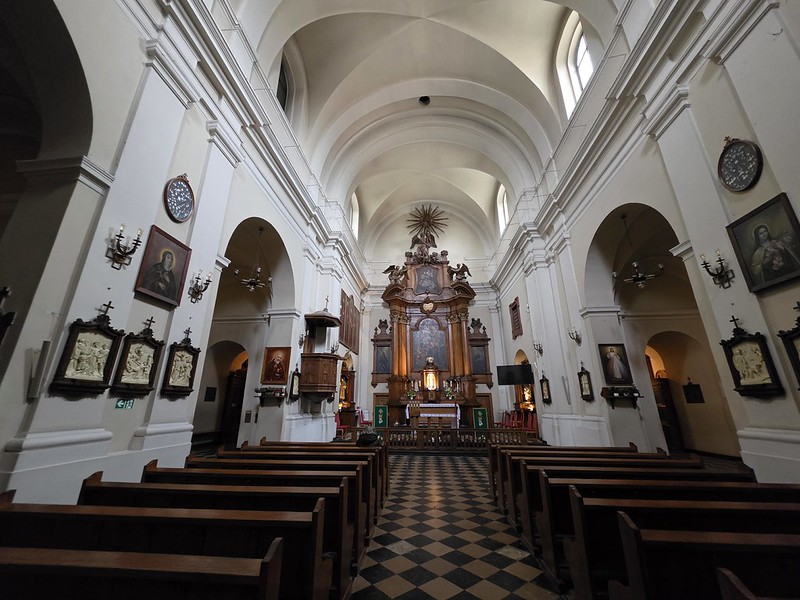
Of the several churches I wandered into during my time in Lublin, this was probably my favourite. The Church of St Peter and St Paul (Kościół św. Piotra i Pawła) stands on Krakowskie Przedmieście, close to Plac Litewski, and felt rather more homely than some of the grander churches in the city. I’ve never been particularly keen on religious bling, so the relatively restrained interior suited me nicely, particularly the extensive use of wood.
The church was built between 1726 and 1733 for the Capuchin order, with funding from Prince Paweł Karol Sanguszko and his wife Marianna Lubomirska. The white walls, barrel-vaulted ceiling, wooden pews and black and white tiled floor give the building a pleasing simplicity, although the main altar is rather more elaborate. The church suffered a serious fire in 1768, which destroyed the roof and much of the original interior, before being restored whilst keeping the traditions of the original.
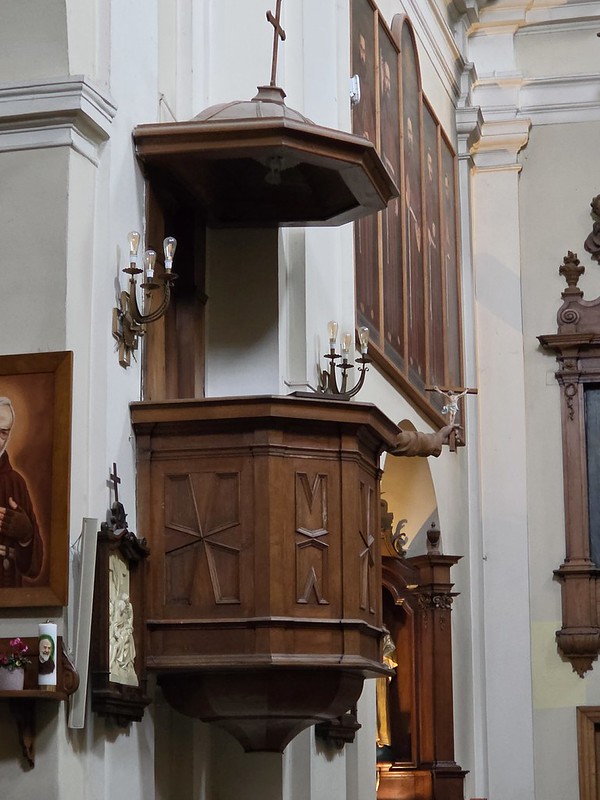
I rather liked this substantial wooden pulpit, with its carved crosses and enormous sounding board above. It contrasts nicely with the white walls and looks suitably imposing. Observant readers of the blog might notice the element that caught my eye.
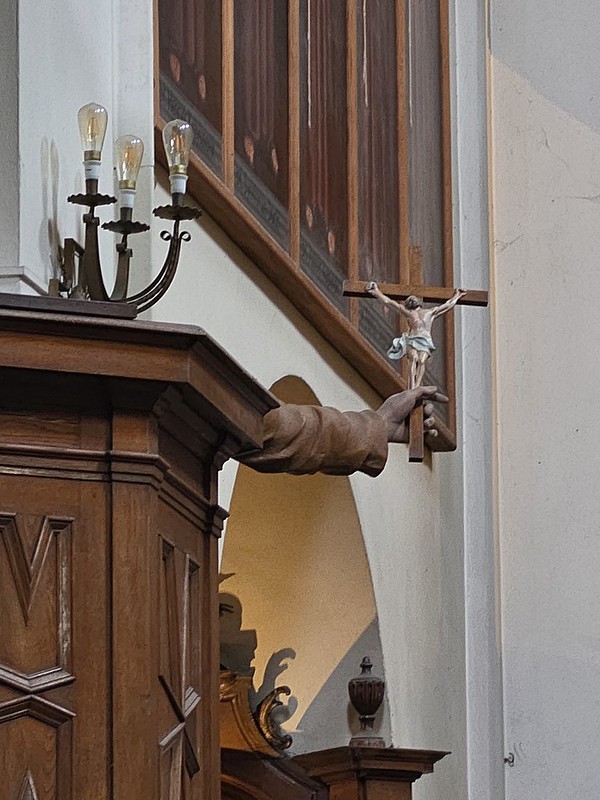
The pulpit also has this rather peculiar carved arm emerging from its side, holding a small crucifix. I’ve seen plenty of elaborate church pulpits over the years, but I don’t recall encountering anything quite like this before. It’s an interesting arrangement, although I can’t quite decide whether it’s rather charming or just a little peculiar.
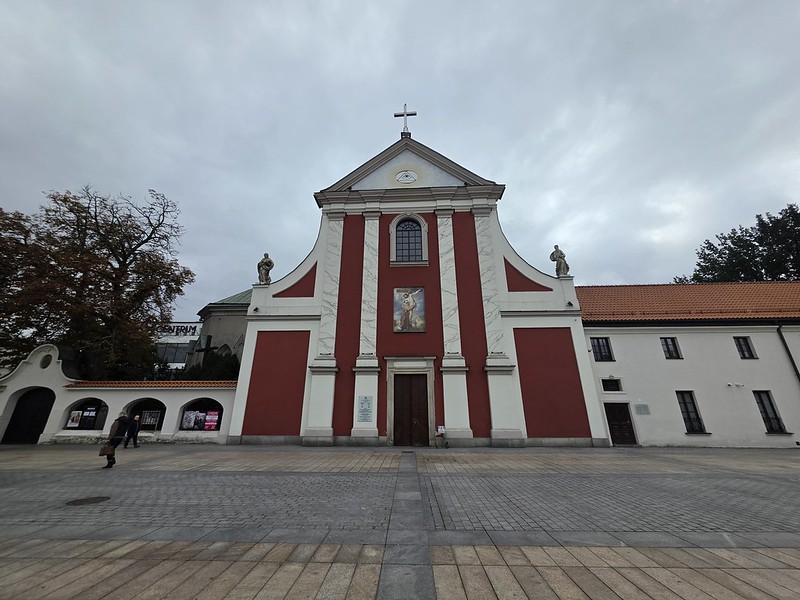
The exterior is rather more colourful than the interior, with its red and cream Baroque façade facing the open space beside Plac Litewski. The church is attributed to the architect Karol Bay, with a relatively simple frontage featuring pilasters, a triangular pediment and statues of St Peter and St Paul. The adjoining monastery buildings extend along the right-hand side of the photograph. The Capuchins were expelled from Lublin in 1864, when the Russian authorities suppressed the monastery, although the order returned in 1919. I rather liked the contrast between the colourful exterior and the much more restrained interior. It might not be the grandest church in Lublin, but it was certainly the one where I felt most comfortable.