
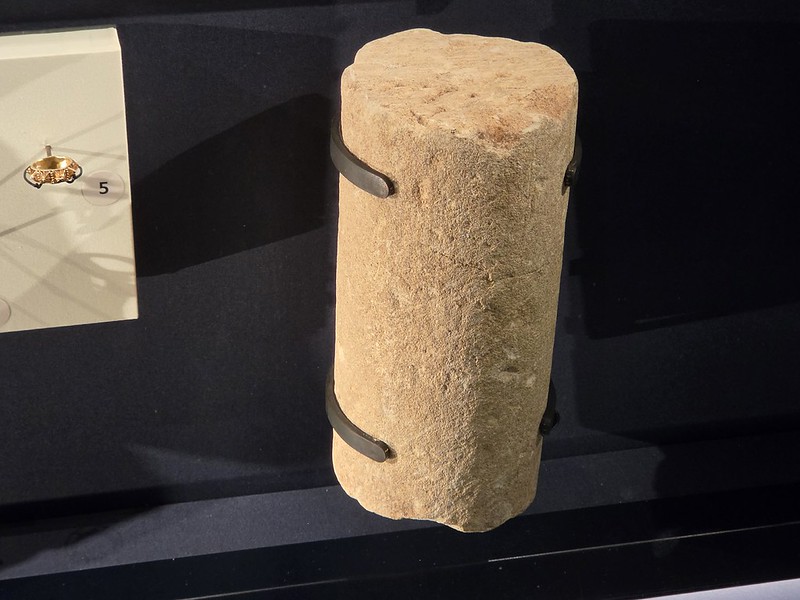
I mainly associate London Street in Norwich with Greggs, which probably says more about my interests than it does about the street. This fragment in the medieval gallery at Norwich Castle Museum offers a rather different story about London Street. It might not look that decadent at first glance, but it’s a limestone mould dating from between 1200 and 1300, found in London Street and showing a scene from the Massacre of the Innocents. There’s a considerable amount of history beneath somewhere I generally visit in search of a sausage roll.
The subject comes from St Matthew’s Gospel. After learning that Jesus had been born as the King of the Jews, Herod orders the killing of boys aged two and under in Bethlehem. The mould depicts soldiers carrying out that slaughter, so it’s not the most cheerful of arrangements.
The subject has an uncomfortable connection with Norwich’s own medieval history. In 1144, a boy called William was found dead in woods outside the city. His death became the basis of a false accusation that Norwich’s Jews had murdered him as part of a religious ritual. A monk at the Cathedral Priory, Thomas of Monmouth, subsequently developed the story in his account of William’s life and miracles. This became the earliest recorded medieval blood libel, with similar false allegations later spreading across Europe.
The biblical account and the story constructed around William are separate, and this fragment doesn’t establish that its maker or owner had any connection with William’s cult. What it does do is to provide a surviving example of the religious imagery circulating in the city. Stories of innocent children being killed could be powerful sources of devotion, but Norwich’s history also shows how an accusation of child murder could be directed against a living community as it doesn’t take much for hate to spread.
There’s a further local connection in seeing the object inside the Castle. Jewish residents took refuge here during the anti-Jewish violence of 1190, when others were killed in their homes. The building in which I’m looking at this fragment was itself a place of protection for people threatened by persecution. That makes the history feel rather closer than it might in a display somewhere else.
Left to my own devices, my professional archaeological assessment would have been that it was a bit of stone. Knowing where it was found and what it depicts connects it to streets I know and a part of Norwich’s history that deserves attention. It’s a rather lovely reason to spend a little longer in the museum.