
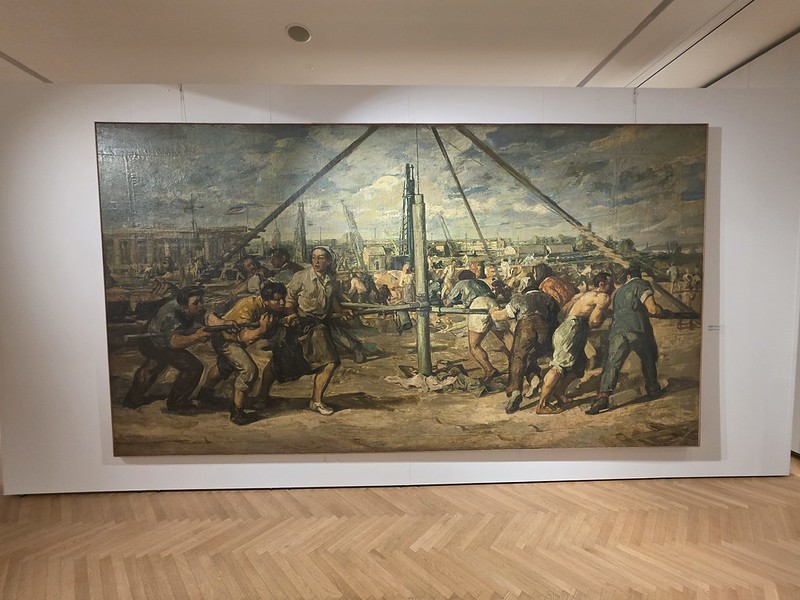
Now I’m sort of caught up with this blog, I felt the need to go back and fill in a few gaps before the next little adventure. This sizeable painting is Testing the Terrain in New Belgrade, painted by Boža Ilić (1919-1993) in 1948. Even the initial business of finding out what was beneath the ground appears exhausting and I’m fairly sure that I would have needed a nap after something like this. This all meant that I was entirely content to assess the arrangement from the relatively undemanding position of standing in a gallery.
This feels like propaganda because the workers are being shown as a united, purposeful group with their physical effort turned into an uplifting image of a nation building its socialist future. Workers lean into the bars of a drilling apparatus, backs bent and hands gripping tightly, while the construction site stretches away behind them.
New Belgrade, or Novi Beograd, is the large planned urban area of the Serbian capital across the River Sava from its historic centre, extending towards Zemun. There had been plans to develop this area of marshy and sandy ground before the Second World War, with a contract for reclamation work signed in 1938, but the postwar Yugoslav Government made the project an integral part of its much wider programme of redevelopment and improvements.
11 April 1948 is the date commemorated as the official beginning of construction, although preparatory work and initial building activity were already firmly under way in 1947. Civil engineers went in to plan the whole new city arrangement, and likely drink plenty of tea, and large amounts of sand had to be brought from the Sava and Danube rivers to raise the level of the marshy ground. Young people were invited from across Yugoslavia to work in organised labour groups, joining a project which relied heavily on manual effort.
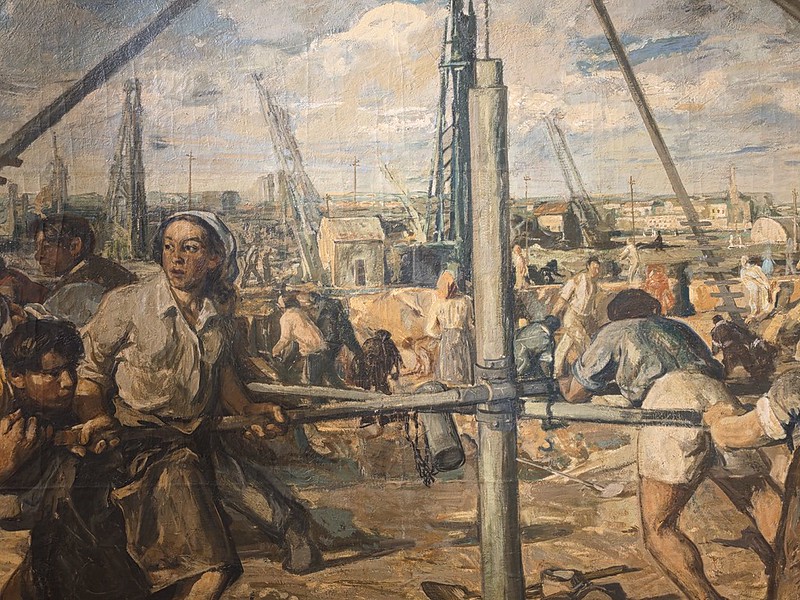
It’s the relevance of this history which is why I rather liked this artwork as it shows the start of something new. It’s easy to describe the foundation and growth of a city through its architects and plans, but Ilić brings this to life. Some of the faces of the workers are visible, others are turned away or lowered towards the task in hand. The woman just left of centre has her head turned to the side, but she’s perhaps given prominence to show how this was a project that everyone was involved with.
The bus from the airport goes through this area with its long straight roads and there’s something rather decadent about contemplating all that manual labour from a bus seat, but that’s probably how I’ll be doing it.