
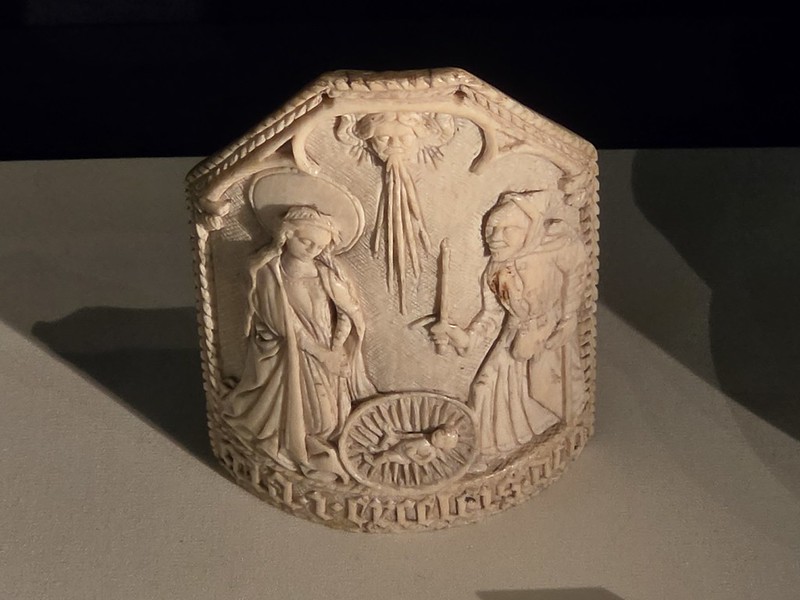
I accept that I’m now entering my occasional rather niche series of posts although, to be fair, I’m rarely in danger of going viral. Anyway, I’m accustomed to looking at objects in museums and readily accepting that I’m not supposed to touch them. This little ivory carving in the medieval gallery at Norwich Castle Museum adds a further complication, as it was specifically intended to be kissed which all seems a little frivolous. I limited myself to taking a photograph, which seemed the arrangement most likely to meet with everyone’s approval.
The museum notes that this was made in the Netherlands between 1475 and 1525 and this is a pax board. Its name comes from the Latin for ‘peace’, and during Mass it was kissed by the priest before being offered to members of the congregation to kiss in turn. It passed on the symbolic kiss of peace through a shared object, giving worshippers a physical part in the ceremony. I suppose that would help keep them awake and it was a rather more demanding form of participation than putting something in the collection plate. These tablets could be made from various materials, including wood, ivory and precious metals.
The carving shows the Virgin Mary and the infant Christ being visited by a shepherd, with a Latin inscription meaning ‘Glory to God in the Highest’. The infant lies at the bottom of the scene enjoying a little nap. I rather admire the carving, but someone attending Mass five centuries ago would have encountered it very differently. It was brought to them as part of worship, something familiar that they could approach and kiss.
There’s a comparison here with Orthodox Christian worship, where icons are kissed as an expression of devotion. Some are protected by glass, so the kiss lands on the covering rather than directly on the painted surface. The glass allows that physical gesture to continue while protecting the image beneath. I’ve seen this regularly on my travels and it always looks like a very different form of worship to what I see in western Europe.
I wonder how many people kissed this particular board, and what was occupying their minds as they waited for it to reach them. We have a date range, a place of manufacture and the carved scene, but very little of those individual encounters. For an object now sitting quietly behind glass, it once had a remarkably sociable role. But, for me, I’d rather just give a little respectful nod, I can’t be doing with all this raucous behaviour.