Category: Norfolk

  • Norwich – The End of Debenhams

    Norwich – The End of Debenhams

    That’s the end of Debenhams in Norwich, they’ve been boarding up (or metalling up, whatever the phrase is) the entrances of this large building all week. It’s not somewhere that I’ve been for years, it has felt old fashioned and under-resourced for a long time.

    This boarding up has meant that the recessed areas where the homeless have been sleeping have been made inaccessible, with the tents just moved to the outside now. I’m not sure that this is entirely ideal.

    It’s a far cry from 1955 when this building was being built, then known as Curls (or Curl Brothers) and replacing a war damaged building. There’s a photo on Photo Norfolk of what the site looked like following the end of the Second World War, with Debenhams now being located where that pool of water is.

    Debenhams purchased Curls in the 1960s, but it continued to trade under its old name until the 1970s. What will happen to the building is anyone’s guess, but I suspect part will be turned into residential flats and there will likely be some coffee shop or the like added to it. The future for large department stores doesn’t look entirely bright, although I suppose this will be useful for nearby Jarrolds who might benefit from the trade.

  • Norwich – Old Library Wood Accident

    Norwich – Old Library Wood Accident

    This is the approach to Old Library Wood in Norwich (where I’ve written about the rather excellent sculptures before) just after I returned from my rather brave camping adventure this weekend. Visible at the rear of the photo is an Openreach van, located there as a Royal Mail van managed to plough into the wood’s wall yesterday and destroy a chunk of it.

    The wall from inside Old Library Wood, a situation I’d suggest isn’t entirely ideal. I hadn’t realised before, but there was a mural at this spot, now nearly entirely demolished. But, no-one was hurt and that’s the main thing.

  • Greater Anglia : Norwich to London Liverpool Street

    Greater Anglia : Norwich to London Liverpool Street

    This is my first rail journey of 2021 and it’s certainly a step-up from the bus travel that I’ve been limited to for the last few months. It wasn’t busy at Norwich railway station with just a few people walking around the concourse, a couple peering into the M&S that has remained closed since March 2020. I still think that should have been a Greggs, but I don’t go on about it…..

    This is one of the Greater Anglia fleet that has no tables, as passenger surveys have apparently told them that customers don’t like them. I make no comment….. Anyway, the train was clean, shiny and nearly completely empty. Everything on the train was working though, including the power and even all the toilets were functional. How lovely.

    One of the slight problems with the rail journey into London is that it stopped at Witham, one of the few towns in Essex that I haven’t visited. I looked at TripAdvisor to see the top four rated attractions in the town and they are (i) a walk by the river, (ii) the library, (iii) the statue of Dorothy L Sayers and (iv) the town hall information centre. Given that, and with respect to the denizens of the town, I might wait just a little longer before making a proper visit.

    Anyway, there were plenty of Greater Anglia staff to guide customers onto the buses which would take us to Newbury Park. I’m not sure where Greater Anglia had found these staff, but they were particularly friendly and engaging, all a really organised effort.

    I try not to complain about things, but on my bus travels in recent years I’ve discovered that just about every vehicle has no more than four seats across. This is because there is only space for four seats and an aisle between them. But, no, this bus company has decided that more is better and have crammed in five seats across. I accept that if all the passengers were five years old, then this would be a perfectly sensible transportation move. But, the rail passengers were all above 18, which presented me with an interesting time watching them try to fit into the space provided, which was made more exciting as the bus company have given customers no real amount of leg room either. One man looked positively annoyed. I’d add that wasn’t me.

    I moved to the back of the bus to get some space, and I’m pleased to say that unlike the Inbetweeners, I wasn’t moved off those seats by anyone. The fortunate thing is that social distancing means that customers are kept apart, so there were only about 12 of us on the vehicle. About 105 seats, but only 12 people sitting on them.

    The rail replacement bus arrived into Newbury Park, where we were politely told to get on the Central Line into London. I asked the gateline staff if I was allowed to continue travelling down the Central Line to Oxford Circus, or whether I needed to get off at London Liverpool Street. To cut a long story short, he told me that I should really get off at London Liverpool Street, but that wasn’t what he recommended I should do. He suggested winging it with the gateline staff at Oxford Circus as that would be much quicker. He mentioned though that this was all at my own risk. Indeed, he mentioned that three times.

    I worry if I don’t have the right ticket, so I decided not to spend an hour worrying and I got off at London Liverpool Street. That also meant I didn’t have to try and enter into protracted negotiations with the gateline staff at Oxford Circus, which didn’t sound an exciting game to play. I had to faff about finding a member of gateline staff to let me out of London Liverpool underground station, and he looked slightly annoyed to watch me then go back through from where I had come from around thirty seconds later. But, my journey was now fully compliant with railway rules and I didn’t have to fear any TFL ticket inspectors. And more excitingly, I was back in London after way too many months.

  • Hopton – St. Margaret’s Church

    Hopton – St. Margaret’s Church

    This is the ruined church of St. Margaret’s in Norfolk, although until 1974 this was actually in Suffolk (they moved the county boundaries, not the church). What remains of the structure is primarily from the fourteenth century, but there was an earlier church on this site, from somewhere around 1050 and there’s some documentary evidence that there might have been a wooden Saxon church here as well.

    The church was lost in 1865, following a devastating fire. Smoke was spotted coming from the church shortly after the congregation had left from their service, but the fire took hold quickly and there was little that they could do to save it. The thatched roof was ablaze and was chucking lumps of hot thatch on those below (which wasn’t ideal), although huge attempts were made to save the organ from within the building. The organ had been presented to the church by Mrs Orde of Hopton Hall, but it was soon realised that they couldn’t fit it through the porch and so efforts were abandoned quickly.

    The local press noted that:

    “The fire originated either from the overheating of the stove, the funnel of which led through the roof, or from a spark lighting on the roof from the pipe, and igniting the thatch”.

    Following the fire, it was decided not to repair the structure, but to instead build a replacement church nearby with the £500 insurance money. The decision to move the church was to ensure that it was located nearer to the centre of population that had built up, although it seemed a shame to abandon a site that had remained in religious usage for over a millennium.

    It is only recently that the site has been tidied up and made secure so that people can visit and walking inside the surviving structure. They’ve done a really good job here, they’ve added benches, information boards and give the whole site a peaceful feel rather than the huge “keep out” signs and fences that were here for decades. George Plunkett has a photo of the site from 1998.

    Inside the church, looking towards the tower.

    Inside the church, looking towards the altar and chancel.

    The remain of the porch. During the restoration work on the church the archaeologists found 29 pieces of medieval floor tile, 2 fragments of roof tile, an early brick fragment and a Caen limestone sundial fragment.

    A blocked doorway in the base of the tower.

    The tower section is still closed off, but it’s still in surprisingly decent condition given what its gone through. The tower is likely a little later than the rest of the church, dating from the early fifteenth century.

    Although the destruction of old buildings is unfortunate, it has though allowed the history of the church to show through in other ways. The location of old niches, stoops and piscinas has become more evident, although most of the memorials and tablets were destroyed during the fire.

    The remains of an old window at the chancel end of the church.

    The base of what I assume were the rood stairs, although there appears to have been minimal other separation between the nave and the chancel.

    A rather beautiful plaque, which reads:

    “Be still, for this is sacred ground,

    A place to stand and pause. Reflect

    Upon the pathway here

    The lesson learned, the gifts received

    Be still, and listen to God’s voice

    That sings a song of unity,

    Blessing the journey still to come

    With love and deep humility”

  • Weston Longville – All Saints Church

    Weston Longville – All Saints Church

    It started to pour with rain when Richard and I arrived at All Saints church in Weston Longville, which was unfortunately locked and even the porch wasn’t accessible. Perhaps it was just the rain, but it all felt a little stark and unwelcoming. Hopefully I will be able to visit the interior of this Grade I listed church in the future, as there are medieval wall paintings, a painted screen and a memorial to Parson Woodforde.

    The tower is the oldest part of the church, dating from the thirteenth century. It once had a steeple as well, but it fell off in 1602, which I can imagine annoyed the locals.

    The nave and the chancel are from the fourteenth century, when the previous structure was substantially rebuilt, but it’s likely that there was a church on this site during the late Saxon period.

    The church is perhaps best known for Parson James Woodforde, who was rector here between 1776 and 1803 and wrote numerous diaries which are a snapshot of rural England in the late eighteenth century.

    The fifteenth century porch, with the shield above the empty niche being that of the Company of French Merchant Adventurers.

    The porch was modernised in the 1970s and this plan is in the Church of England archives.

    The priest’s door.

    The window at the end of the aisle was blocked up before 1718, which is the date of the memorial tablet on the other side of the wall.

    This stone on the exterior of the porch is in a poor state of repair and I can’t imagine that it’ll last for that much longer. It’s a shame that it can’t somehow be preserved.

    This illustration is by Robert Ladbrooke and is from the middle of the nineteenth century, with the now damaged stone visible on the exterior of the porch.

    The extensive graveyard is neat and tidy, with some efforts being made to support those stones which it’s fair to say aren’t all exactly standing upright.

    The sun started to shine through the rain just as we were leaving. George Plunkett took a photo of the church in 1939, but not much has really changed in the intervening period.

  • Yaxham – Yaxham Railway Station

    Yaxham – Yaxham Railway Station

    Yaxham railway station opened on 15 February 1847 and was located on the Wymondham to Dereham branch line and remained in use for passengers until 6 October 1969. It’s now in use by the Mid-Norfolk Railway as a heritage line, although there is the possibility that this could at some stage in the future be brought back into usage by the rail network. This is a marvellous thought, although I’m a little sceptical about whether funding will ever be raised for such a project. For a while, the centre of the heritage’s lines efforts were run from Yaxham, although the re-opening of Dereham railway station has meant they’ve moved back.

    The whole complex was quite extensive and some of the station buildings still stand, including the signal box, although they’re in private ownership. The inn marked on the map was the Bush, which was closed in the 1960s and is now a residential property. Nearby Dereham railway station once had a staff of ninety people and Yaxham had several full-time staff of its own, with the line being a busy one for freight. Its demise was far from ideal….

  • Yaxham – St. Peter’s Church

    Yaxham – St. Peter’s Church

    The entrance to St. Peter’s church in Yaxham is up a quiet little road and it doesn’t take much imagination to think of generations gone by meandering up here to attend a service.

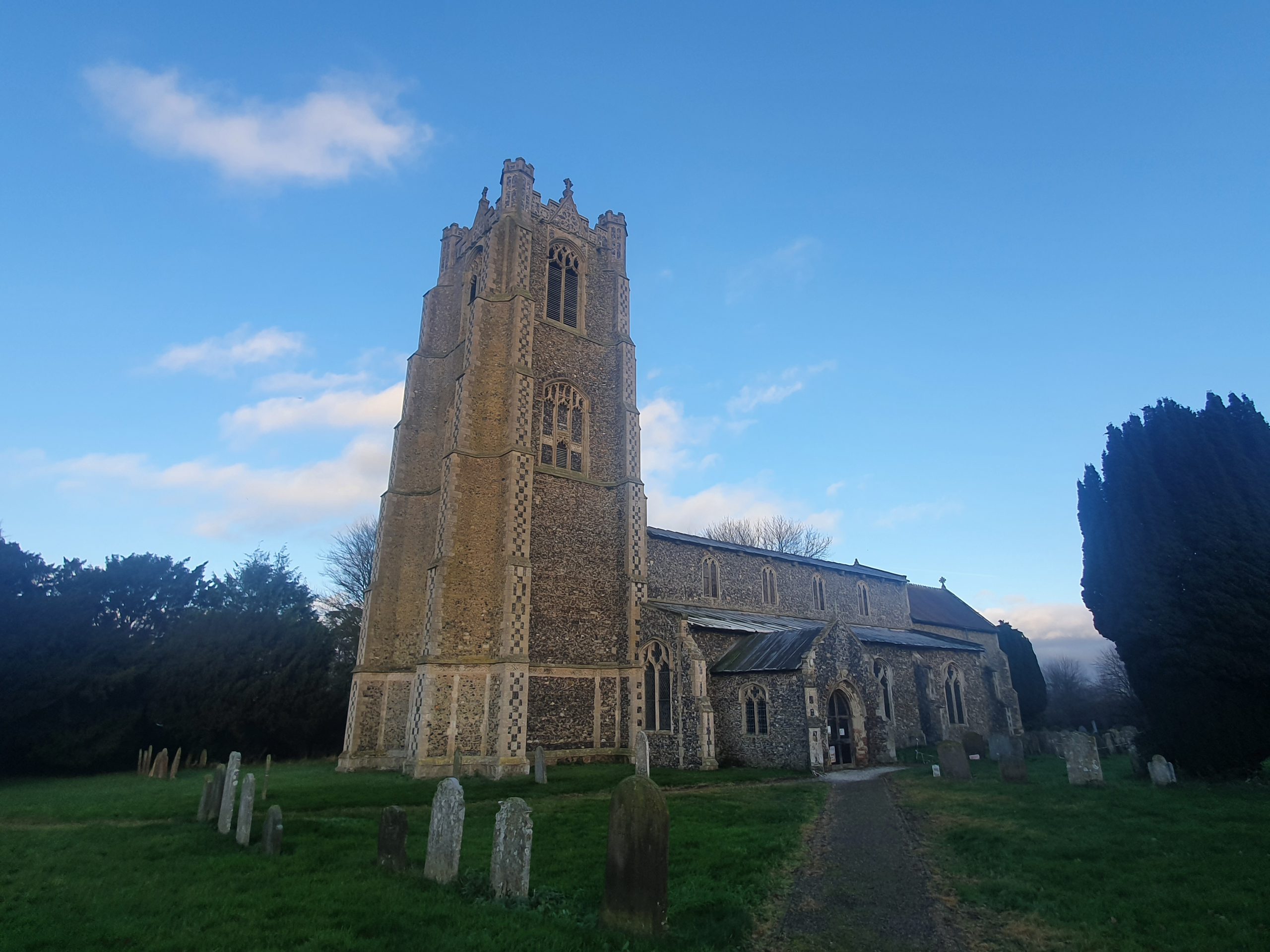
    Norfolk Heritage Explorer tells me that the banding on the church tower shows that it’s constructed of carstone and this helps date that part of the building to the late Saxon period. I’m still always impressed when reading dates like that, it means that the bottom of the tower was standing when William the Conqueror invaded England. The upper part of the tower is from the fourteenth century, with the bulk of the rest of the church being from the fourteenth and fifteenth centuries. Later that might be, but the vast majority of this church was standing when King Henry VIII decided that the Dissolution of the Monasteries was a good idea.

    The church viewed from the south east and it looks like the rood stairs have been added to the exterior where the nave and chancel meet. George Plunkett took a photo from near enough the same spot in 1937 and little has changed, with all the gravestones appearing to still be there. One change is that a small tree in the 1937 photo has now gone and it’s a reminder to myself that, although in a small way, the landscape can change over time even within a graveyard.

    Robert Ladbrooke’s illustration of the church from the mid-nineteenth century.

    The church viewed from the north east.

    The chancel end of the church, with this section, amongst others, being subject to Victorian restoration.

    Unfortunately, the church wasn’t open on the Saturday morning that I visited, although I had rather hoped it would be. There’s sometimes the misapprehension that damage to religious buildings is a recent thing, but in 1908 a number of local churches were smashed into and their collections stolen. The culprits were found, but Yaxham lost its money and its door was forced open.

    The graveyard is relatively large and it’s all well-kept, with a little woodland path through the trees. Although Yaxham is just a short distance from Dereham, it felt remote and peaceful and I suspect that little will change here in the next couple of hundred years.

  • Blickling – Blickling Hall Gardens

    Blickling – Blickling Hall Gardens

    This post is mainly photos of the gardens of Blickling Hall. I booked via the National Trust’s on-line reservation system a few days ago and although there was plenty of availability, it was busy when we arrived. The car park system was easy to navigate and there were no shortage of volunteers helping visitors find where to go. The volunteers also seemed to be knowledgeable and genuinely keen to help, which is all rather lovely.

    As a quick background, this property is often known as the birthplace of Anne Boleyn, and the location for her headless ghost. The property today isn’t contemporary to that period, it’s from the late sixteenth century and was extensively remodelled in the late eighteenth century. It came into the hands of the National Trust in 1940 following the death of the owner Philip Kerr, 11th Marquess of Lothian, who served as the British Ambassador to the United States until his death.

    There’s a basic map provided free of charge and some useful signage throughout the gardens. It’s possible to walk around the wider estate free of charge and the house is currently closed, but I understand that it will open again in a few weeks.

  • Norwich – The Garden House

    Norwich – The Garden House

    Before going in, we had decided that we would pre-judge the Garden House, which had been a marvellous pub and then Craft Union took it over. I haven’t been since that takeover, but Craft Union have in my experience been reliably terrible with clunky makeovers and a poor range of drinks. I’ve never been quite sure what the word Craft is doing in their name, trying to cash in on craft beer when that’s not something they have any focus on. So, my expectations really weren’t very high and I’m used to Craft Union not even offering real ale, so we were wondering whether we’d have to fall back on something like Guinness.

    The welcome offered at the entrance was excellent and verging on exceptional and I understand it was the landlord standing there taking charge of that. That was a positive first sign, as being made to feel welcome really is a skill that some pubs struggle to get right and it shouldn’t be that much of a challenge. The second positive sign was that list of real ales, as Theakston’s Old Peculier is what I consider to be a very good option to have, as is Timothy Taylor Landlord. It’s also really useful when pubs write down the beers that they have, as staff trying to remember what they have is not an ideal situation as it’s often poorly communicated. But here, there was clarity, friendliness and a self-assured service style all as part of the initial greeting, which is rather lovely.

    There’s a large beer garden and that is apparently the reason the pub was named the Garden House because of that rather useful feature, although for reasons unknown, the pub name was changed for a short period in the 1980s to ‘Fridays’. Today, the garden area is all organised and there’s an area with an external television and seating area. That the pub can show live sports is not much interest to me, but I can see that it’s a very useful thing to have to help them serve the community. The pub is using a clunky app provided by Craft Union, which reminds me of the Greene King app which really isn’t very focused on proper beer, as neither can cope very well with real ales. This wasn’t a problem here, a staff member was able to take our order as she confirmed real ale can’t be ordered using the app. As another little bonus, the prices charged for the ales, and indeed most drinks that I saw, was towards the lower end of the scale.

    This is my problem with the Craft Union name, it implies to new customers that they focus on craft beer. Their advertising is actually more focused on drinks such as this, which is entirely fine (and, a bit secretly, I wouldn’t turn any of those down…..) but not keep in fitting with their name. Craft Union is now part of Stonegate, who are probably going to do a better job than the complete disaster that Enterprise Inns made of most things when they operated it.

    Anyway, my issues with the national brand aside, this pub was very well run and the customer service was faultless. The beer was well kept, the choice was better than my expectations and the environment was comfortable. It’ll take me a while yet to be convinced about Craft Union, but this was a rather positive experience. It does show though that when they find an excellent operator that the concept they use (where the operator is self-employed but gets 18% of the take for themselves and to pay their staff) is one that can work.

    It’s a reminder also to us that we shouldn’t really pre-judge pubs as often they can surprise and delight.

  • Norwich – The York Pub

    Norwich – The York Pub

    This whole drinking outside only thing does rather reduce the quality of the photographs (it is a bit easier to take photos inside where there’s actually some light), but this is The York pub on Leicester Street in Norwich. I’m not sure why the owners have lost the Tavern bit from the name, but this was until recently known as the York Tavern. Customers enter via the front door (that sounds obvious, but often at the moment customers can get into pubs through some random side gates) and the process was all well managed for us. We had to provide details for the NHS app and then separately to the pub, which was slightly convoluted, but best for the pub to be careful.

    This is the pub’s sizeable beer garden, which used to be a bowling green. I wouldn’t have noticed that if I hadn’t been told, although the defined shape is a slight giveaway. An article in the Norfolk Chronicle in 1902 mentioned that the bowling club had been open for 27 years and that it was one of the oldest in the city. Today, there’s a large marquee on part of the lawn and then some picnic benches dotted about. And all credit to the pub owners over the years for not trying to sell this land off for housing, as it’d be possible to cram a new house in there.

    The clues to it being a former bowling green are though more evident with the structures at the side (I mean the club house thing, not Nathan). Norfolk Pubs notes that the pub opened in 1878 (which suggests that the bowling club was already there if the dates in the Norfolk Chronicle are to believed) and also that the landlord Albert Plane had been found dead at the bottom of the stairs in 1922 having gone to get his family all a cup of tea, which isn’t an ideal situation. This was the same landlord who refused to admit the police into his pub in 1916, a rather brave thing to do. The reasons for the police visit aren’t known to me, but Plane was involved in black market activities, so perhaps it was in relation to that.

    There wasn’t a particularly exciting range of real ales or craft beers, but there was Gamma Ray from Beavertown which was satisfactory. I wouldn’t go further than satisfactory, but it’s a reliable pale ale. I’m still vaguely on the lookout for Spresso, which is Beavertown’s imperial stout, although they might not even make it any more. The ordering is done on-line, and Nathan managed this without too many issues on his Nokia 3310 (or whatever it is that he has).

    Anyway, the pub’s garden is spacious and so the tables were suitably far apart from each other, and there was a one-way system in place inside to get to the toilets. That went via the pub’s internal stairs, which wasn’t entirely ideal now that I knew a previous landlord had died there. Although we arrived too late for it, the pub is doing food and the reviews for that seem positive and their chicken wings sound quite delicious.