This is week 22 of James and I eating at every food stall at Norwich Market, with this one being a new venue so we haven’t visited it before. Actually, as a side note, we actually checked the market today for other new openings or venues we’ve missed and we have eight more stalls left to visit this year. There are a couple in there that I really like, with none that I’m sceptical about, so the run-in to this year’s awards ceremony is getting rather exciting. I guess that I should get out more….
The food options are regular and large, which makes matters easier in the menu selection process. I decided that this lunchtime I wouldn’t be greedy, which isn’t a decision that I always make as I can go for gluttony given half a chance, but today I just went for regular.
There was a friendly welcome and lots of engagement with customers, with a feeling of real enthusiasm about their whole operation. The service was efficient and the venue takes both cash and cards.
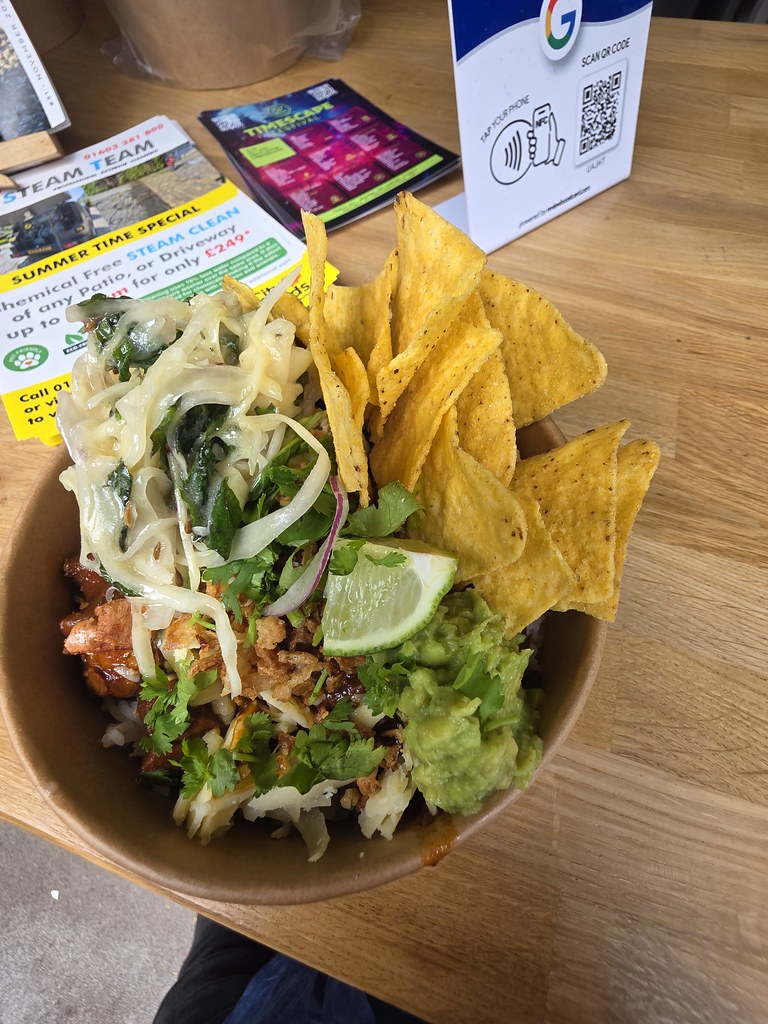
Firstly, I think I made the correct decision in just opting for the regular choice, as it was a generous portion and we saw how much food was in the large bowls that some other customers ordered. I very much like the variety of tastes and textures here, there’s plenty going on with the guacamole adding smoothness, the cheese adding flavour and the nachos adding texture. There’s mojito slaw on the top and rice underneath, with the beef pork mix having a richness to it with plenty of large pieces of meat. This did surprise and delight me, high quality, freshly prepared and reasonably priced.
There is a small seating area at the end of the stall, although we just propped ourselves up against the side as the seats were taken when we arrived. Everything was clean and organised, with the surfaces being dry and not sticky.
James had the same as me, although he didn’t really have much choice at this stall. I think it’s fair to say that he was also happy with the tastes, textures, flavours and the portion size, when he noted:
“The palate, the interplay of textures, the nuanced flavours, and the generosity of the portion pleased me”.
He’s getting positively lyrical now. We spent much of the walk back bumping into people that James knew, he’ll be signing autographs if this trend continues, he’s becoming the new Spudman….
Anyway, this is a contender for one of the top three spots I think, a combination of a great welcome, friendly service, decent value for money and high quality food. All really rather lovely.
This is week 21 of James and I eating at every food stall at Norwich Market, and this is when I visited here in 2023 when this expedition last happened. I went for one of my favourite dishes of black pepper chicken last time and this was one of the highest rated visits of the year, particularly with the enthusiastic and engaging service, so I was optimistic about today’s visit.
The second of the menu boards and there’s been a £1 price increase on food across the board from when we visited two years ago, which seems moderate and in keeping with the other stalls at the market. If I’m being honest, I caused some confusion here as I was loitering when trying to take a photo of the menu boards for this post and then I planned to choose what I wanted to order, but I suspect the team member thought that I was confused. I mean, I’m always confused, but it did cause the ordering process to be a little erratic in terms of my order being taken before James. But, the welcome was authentic and I liked that they were trying to ensure every customer was happy and not entirely confused. They have an unusual system here that they don’t charge until the food is served, so they have to trust the customer not to walk off in the interim, but despite initial impressions it really did seem organised. The stall also accepts cash and cards, although the cheaply priced £1 drinks I mentioned last time are now £1.50.
The team member had mentioned that there would be a ten minute wait and it was actually sixteen, but I think that’s sufficiently in the realms of a reasonable estimate and so I’ll take that. The stall was actually also genuinely busy, it wasn’t as though they were faffing about without reason and it’s positive of course that any stall is busy.
I’ll admit, I had high hopes for this one as it’s my go-to dish at Thai restaurants, usually a fragrant, fiery little number that packs a punch and leaves me feeling like I’ve made a wise and adventurous culinary life choice. Unfortunately, this version didn’t quite deliver on that promise. The sauce, while enthusiastic in quantity, seemed to have taken a vow of silence when it came to flavour and although it was described as the spiciest item on the menu, that felt like more of a motivational slogan than something that was actually delivered. But, having noted that, tastes vary and there were certainly some redeeming features. The chicken was tender and respectably moist, the rice was well-cooked, and the crispy onions did a lot of the heavy lifting as they brought texture, crunch and some extra flavour. The lettuce felt like it was in the wrong dish and I would have liked at least some more green to the colour of the curry and I don’t mean more lettuce. It wasn’t horrendous by any means, it’s just it didn’t reach my expectations of when I had eaten here before although maybe I just missed the MSG which they don’t use here.
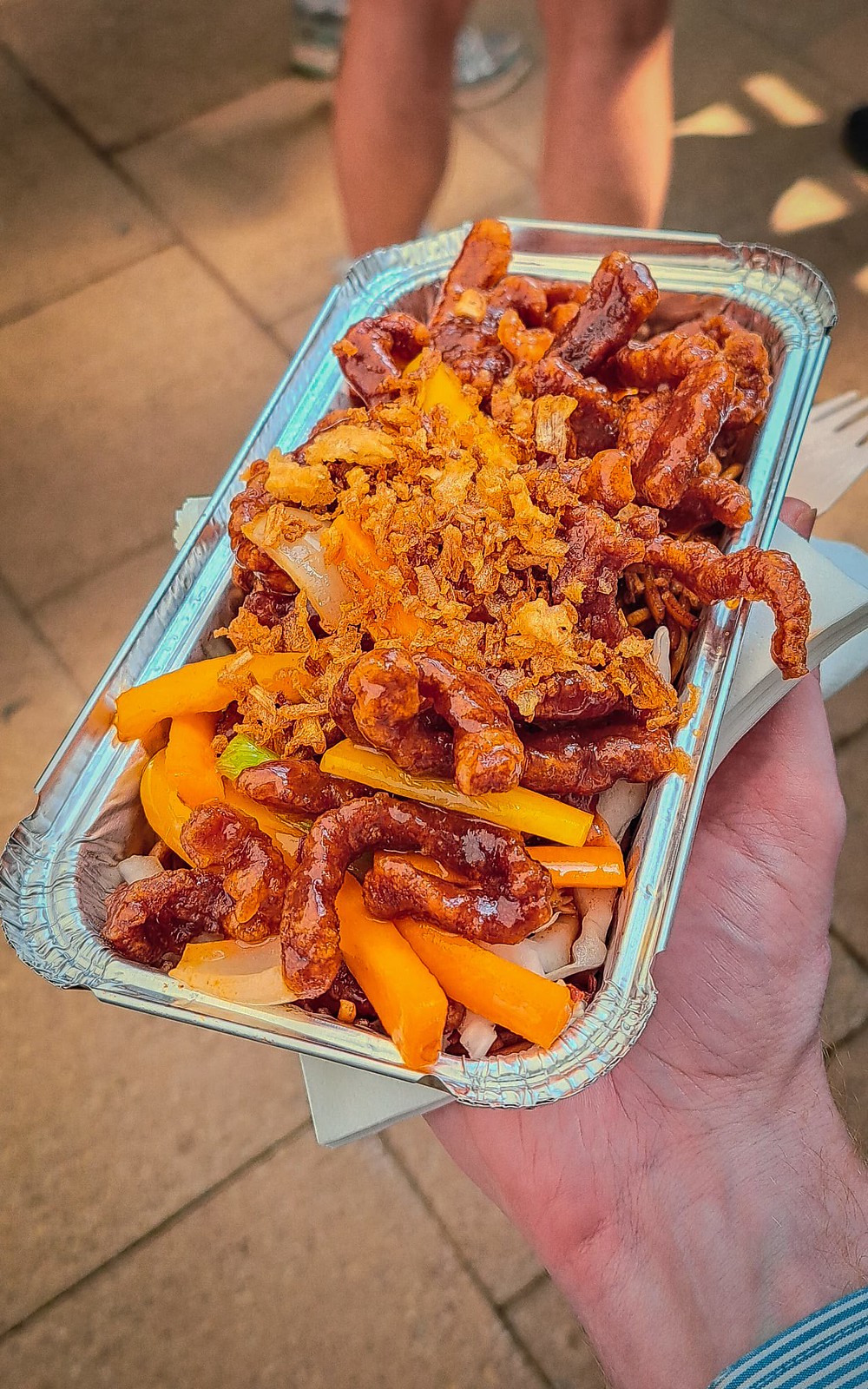
James went for the crispy chilli chicken with noodles, which he was relatively positive about, although he did regret not going for a smaller portion as he thought that the flavours weren’t enough to excite and delight him. We both felt found the ordering process very slightly more stressful (we’re used to Lucy’s chips if I’m being honest) than was entirely ideal and he had to rush back after lunch because he stops so many times talking to people he knows that we now have to add in twenty minutes in each direction to get to the market. There wasn’t anywhere to stand at the stall and as there were seagulls floating about nearby, we found a quiet part of the market which felt safe.
All told, the stall was busy when we arrived which suggests it’s a popular affair and I felt that they dealt with that queue in a professional and personable manner. The main chef of the arrangement is very engaging, warm and conversational, so he positively added to the whole visit. It was all OK, but I didn’t feel like we got the quality that I had experienced before, but I’m happy to go again on our next run of market stall visits and try something different. Or just that delicious black pepper chicken that I had last time and then perhaps I might get a free spring roll like before.
Firstly, it is insanely and intolerably hot today in Norwich (not that I complained of course), so James and I did really well in managing to visit another market stall in our quest to visit them all this year. This is a new outlet to the market, so we didn’t visit it when we did all of this food stall visiting in 2023. As it was so hot, apologies for the lack of photographs, but there’s a limit to my bravery. We have actually tried to come here before, but once it was closed and the other time every single item was marked as being out of stock, which seemed sub-optimal. There were a couple of items out of stock today, although you have to look closely to see the stickers.
I don’t normally buy drinks from the market, as James and I aren’t that decadent, but I desperately needed some refreshment so I acquired this whilst I waited for the food. The service at the stall was efficient and polite, not much engagement outside of the ordering process, but it felt welcoming. They accept cards and cash here, with the prices being towards the lower end for the market.
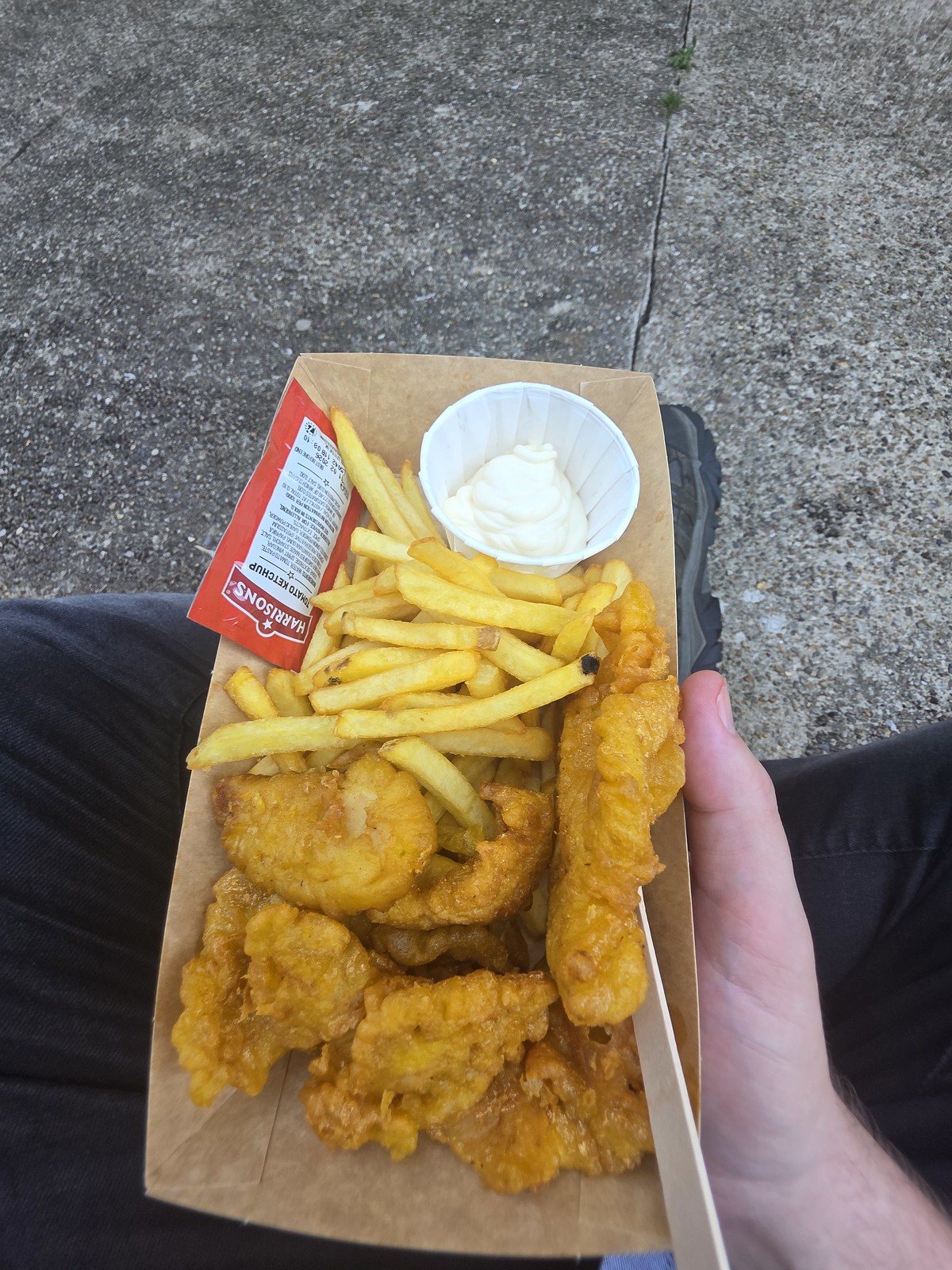
We found a bit of grass to sit on in the shade, which more suited me as I like being firmly in the cold, although James is quite middle class and was hoping for seating. He didn’t complain though, he had chicken. And, as James mentioned, this meal tasted like the chicken balls in Chinese takeaways, which to me and him is a very good thing indeed. I suppose there could have been just a few more fries, but I was happy with the number and they were freshly cooked. The chicken was served as a generous portion and the mayo and ketchup is supplied free of charge. Everything was at the appropriate hot temperature and I thought that there was an effort made with presentation bearing in mind it’s chicken and chips. I thought for £5 this was definitely comparable to other similar venues, with the can of drink being £1.50 which was also not unreasonable.
By sitting on the grass, James, ever the influencer, was able to carefully position his food so that it was beautifully photographed. He went for the spicy dirty fries, which I avoided as I didn’t fancy the cheese sauce, although it was really just grated cheese on top. The sauce was more tangy than spicy, but I was pleased with my rather more unadulterated affair.
For the value offered, we both thought that this was one of the better visits so far this year despite the solar adversity. The service was polite, there wasn’t much of a wait, it was keenly priced, the food had a depth of flavour and the portion size was reasonable. We’d likely both go back here, if we didn’t fancy Lucy’s chips, so what higher praise could we give it?
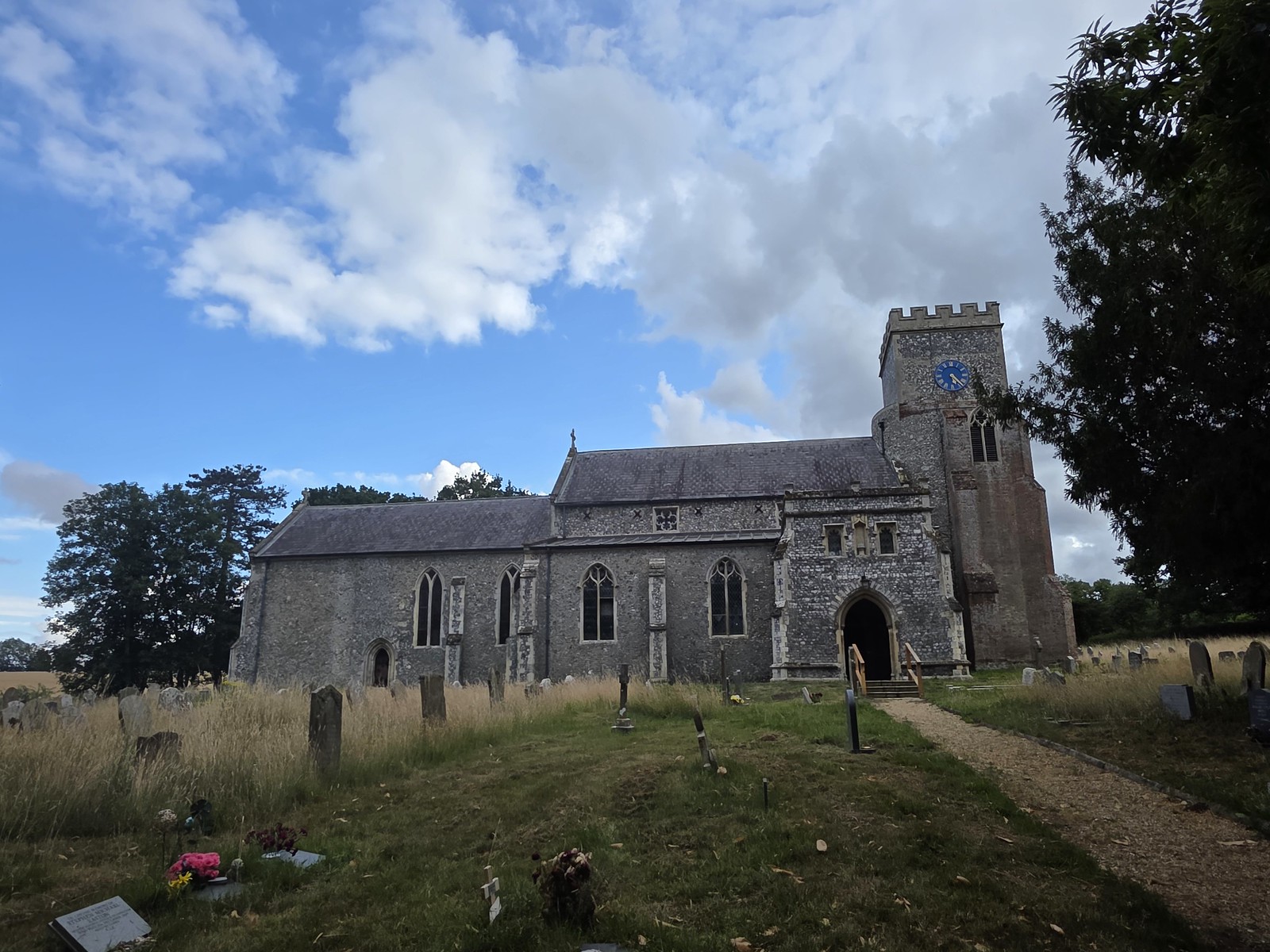
St Mary’s parish church in Denton, Norfolk sits rather quietly off the beaten track and it doesn’t even front onto a public road, it requires a walk (or drive in Richard’s car) past the rectory and then up some steps. There has though been some disabled access added to the church which avoids those steps. Denton is a village on the Norfolk and Suffolk border, with the name meaning ‘village in the valley’ in old English. The original Denton was located around the church, but it shifted after the plague in 1665 and the heart of the village is now a little to the north.
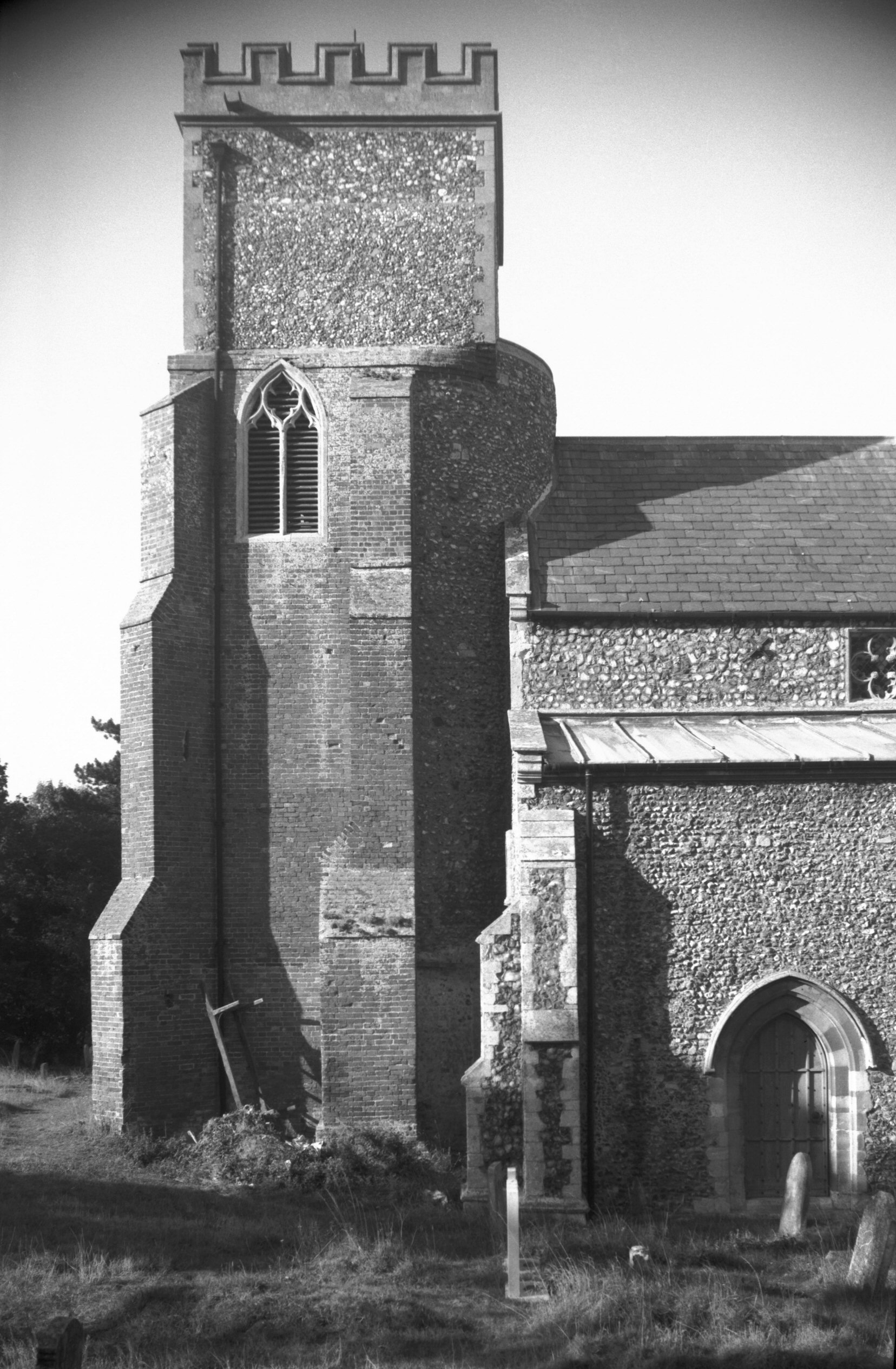
The first sight of the church is really rather memorable because of one of the more quirky tower arrangements that I’ve seen in Norfolk.
There was likely a religious building here during the Saxon period, but the Normans constructed a round tower, although this was rebuilt in something like the thirteenth century.
Then in the sixteenth century, there was the sub-optimal situation that most of the church tower fell down. This wasn’t a time when the church was the most wealthy or loved, so it took some time to fix the arrangement. In 1714, the locals finally built a square brick tower against what remained of the collapsed tower, leaving what would have been a slightly untidy arrangement, but at least one which let them have a complete tower and bells to put in it.
The entirely rebuilt section of tower.
In 1843, not wanting to be outdone by previous generations, the Victorians decided that they wanted to raise the height of the tower by around ten feet and later in the nineteenth century, they decided to shove a clock on it as well. As the church puts it, “a square tower in a round hole”, with the Round Tower Churches Society including it in their list.
The bulk of the rest of the church’s structure dates to the fourteenth and fifteenth centuries. George Plunkett has a photo of the church from 1976. Recently, the lead roof has been replaced with something that is terne coated steel that looks like lead but is rather less useful to any thieves who might be passing.
And there’s a rather glorious ceiling that I think is nineteenth century.
The chancel dates to the late thirteenth century, albeit that was also faffed around with in the nineteenth century.
The Perpendicular north porch is from the fifteenth century and rather grand with a room above, accessed from within the church, which was in the Victorian period used as a schoolroom for the local children, but was likely used to store church treasures when it was constructed. There’s a niche at the front of the porch that would have housed a statue of the Virgin Mary, but that has long gone.
Inside the impressive porch with its roof bosses.
The church has a sizeable chest, there would be no moving that in a hurry.
This is rather outdone by the Denton Chest, located in the chancel, which has medieval painted panels on it which likely date from the early sixteenth century. It’s not entirely known where these are from, but they are likely from the church’s rood screen, or potentially the rood loft. The paintwork has faded somewhat, the photograph makes these panels look much brighter than they actually are.
The fourteenth century chancel was ‘improved’ by the Victorians, under the influence of the rector, William Bouverie, with the floor being lifted up. The Victorians made lots of changes around the nave as well and, as ever, I’m not entirely sure they’ve really improved matters as there’s some heritage that feels like it has been knocked out.
This East Window in the chancel is an interesting arrangement and it comprises pieces of stained glass that were collected by Archdeacon Postlethwaite and they were then arranged by Joshua Price between 1716 to 1719, using a financial legacy left by the Archdeacon. It’s an impressive sight now, lots of bits of glass treasure and a fair amount of heraldic glass, with the whole arrangement thought to be the first of its type in the country. There’s more about the stained glass in the church at https://norfolkstainedglass.org/Denton/Denton.pdf.
The design which was completed for the church by John Brown of Norwich in 1839.
This is one of the most impressive churches that I’ve visited so far in Norfolk, there’s plenty of history here, but it’s also nice to come to a church which is left permanently open and that’s something they’ve done for over a decade. It feels a welcoming place, there’s an effort that has been made to explain the building’s history and everything feels in good order. It also feels like a loved church and that has been essential as a lot of repair work has been needed in recent years to protect the interior and exterior.
And in my series of random posts from newspapers of 200 years ago this week. This is the court report of the Norwich Mercury and the punishments issued.
“George Thurlow, convicted of stealing a quantity of lead from Rev. W. Manning, of Diss—2 years’ hard labour in the Castle. George Archer, convicted of receiving the same—14 years’ transportation. Wm. Bayes, convicted of fowl-stealing—2 years’ hard labour in the Castle. Robt. Dawes, an old offender—7 years’ transportation. Thomas Norgate, convicted of pig-stealing—18 calendar months’ hard labour in the Castle; and Robt. Pawley, convicted of receiving two of the same pigs—14 years’ transportation. Jonathan Forder, convicted of a violent assault on a child at Langley, pleaded guilty—to be imprisoned 6 calendar months. Chas. Dunham, convicted of stealing a quantity of butter from his master—2 years’ hard labour in the Castle.”
Note that the violent assault on a child received only six months in prison, whereas someone who received stolen lead was transported for fourteen years, although he stole it from a reverend which probably made matters worse in terms of his sentence.
With regards to George Archer who received this stolen lead, he was sent to New South Wales on the Sesostris, which had been launched in Hull in 1818. The ship set off on 23 November 1825 and arrived in Australia on 21 March 1826, but George had died en route on 11 December 1825.
From the Norwich Mercury 200 years ago this week was an article about Ivy Hall being for sale. The article read:
“TO BE SOLD BY AUCTION, BY WM. SPELMAN,
At the Greyhound Inn, Surry-street, Norwich, on Wednesday, the 20th day of July, 1825, at Four o’clock in the afternoon, in one Lot,
A Desirable ESTATE, called Ivy Hall; consisting of five dwelling-houses, fronting King-street, in the parish of St. Julian, Norwich, with gardens, privy, wash-house, and pump at the back thereof, in the several occupations of Messrs. Baldwin, Sainty, Haverstone, Mason, and Sheene.
The above Premises are Leasehold of the Dean and Chapter of Norwich for a term of 40 years, from the 7th day of June, 1825, renewable every 14 years, at the rent of 1s. per annum.
For particulars and conditions of sale apply to Mr. Alfred Barnard, solicitor, St. Andrew’s, or the Auctioneer, Duke’s Palace, Norwich.”
I hadn’t heard of this building, but after some checking it was previously the Hildebrands Hospital located on what is now Argyle Street, located just off King Street. The hospital had been founded in around 1200 and adjoined St. Edward Chapel, with the institution welcoming the poor, aged, travellers and pilgrims. It was passed to the Dean and Chapter of Norwich Cathedral after 1497 and as the advertisement above shows, they still owned it in 1825, although the church element was pulled down in 1547. There are, unfortunately, no traces of it remaining today, but it’s not a building that I had previously known about.
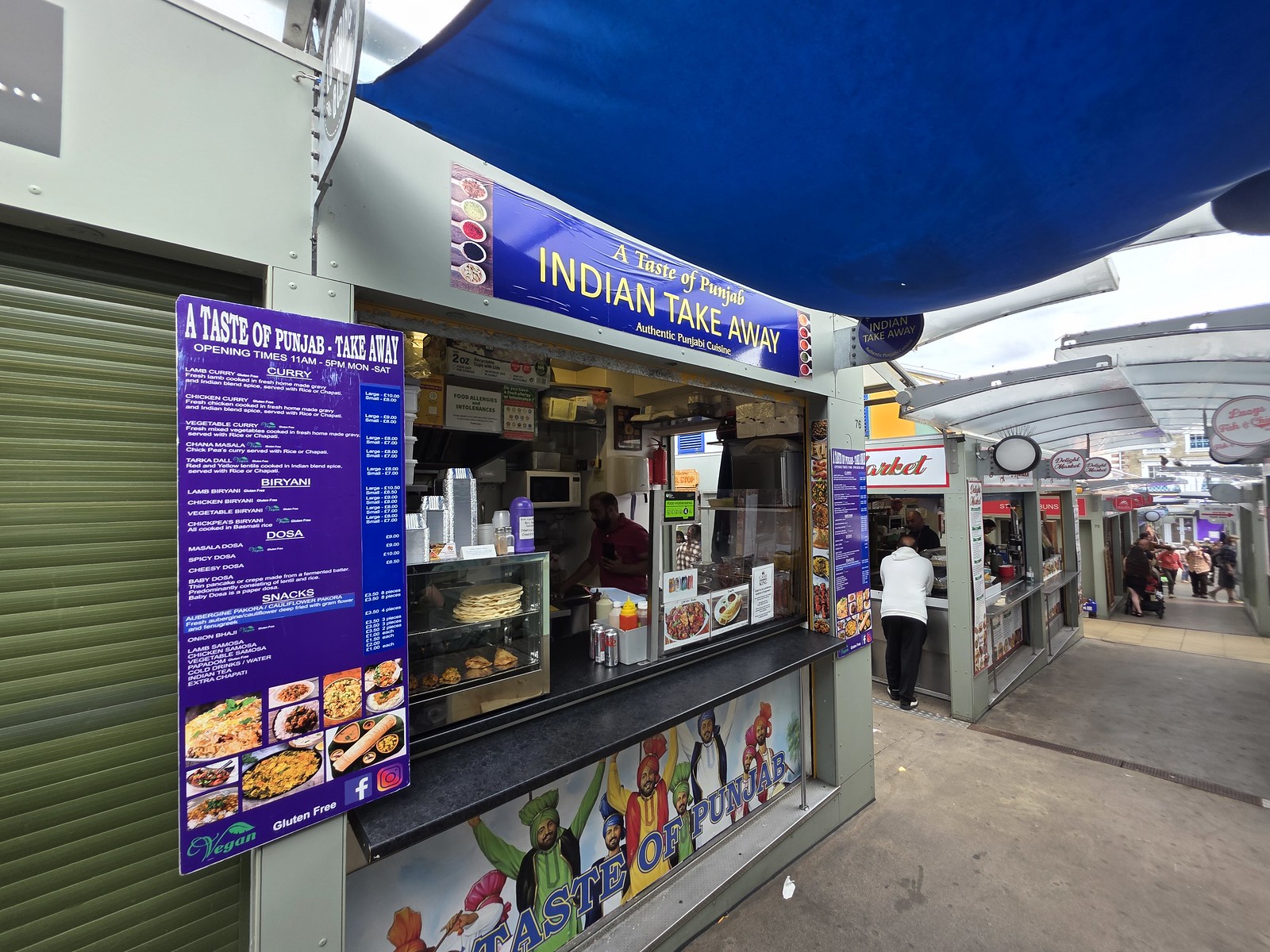
The stall and there were a few customers around when we arrived and it remained consistently busy. We were greeted by a friendly team member who smiled, made eye contact and was focused enough to take orders and remember what everyone had ordered when their food was cooked. Indeed, not only that, she was also cooking the food, a combination of things and level of multi-tasking that would have confused me.
The price increases here are the highest that I’ve seen so far, with nearly everything having increased by £2 or £2.50. Something like the Baby Dosa has increased from £4.50 to £6.50, which has taken this from being a keenly priced stall to one of the more expensive. Although now I’m sounding like I’m taking some sort of bold leap into “I remember when this was all fields” territory.
I’m not personally a fan of these as it makes anyone paying by card feel like they’re not supporting local businesses as much with signage worded like this. But, each to their own. To be helpful, I paid by cash, but noted that no other customer did. They can obviously put what they want, but a “cash preferred” sign would seem a little more welcoming than a suggestion that you don’t support local businesses by paying by card.
I had tarka dall when I visited before and thought it could have had a greater depth of flavour and I noted that next time I might have chicken biryani. Well, that moment came and that’s what I went for. They dished what James had ordered first and there wasn’t much information on mine, but it was served seven minutes later and I was surprised that a microwave was used with the rice. Anyway, the biryani was freshly made and it was decent. It was at the appropriate hot temperature, there was a generous amount of chicken, the rice had a firm texture, the chicken was tender and the lime was a useful citrus addition. The portion size was decent for the money, it was a filling meal and although the prices have risen, this is still not unreasonably priced.
Unlike my overhead food shot, James, ever the connoisseur, snapped a photo on a jaunty angle that he is best known for. Well, that, and seemingly knowing most of the middle class population of Norwich as we’re walking to lunch and he keeps getting recognised. James wasn’t unhappy with his lunchtime meal, but I don’t think that he was surprised and delighted with the food, it was served promptly, looked appetising and it was a large portion, but he thought it verged just a little on the bland side and lacked the depth of flavour he craved. He moaned about the price, but he did get a lot of chicken, but he’s right that this sort of cost is now pushing it towards being a treat rather than a routine lunch.
We decided to eat at the stall as they had a section of the counter that seemed appropriate to do so, although if it was busy we would have been in the way of the queue. They seemed to have some regular customers including a lady that took a lamb biryani away for her evening meal, so they seem to be doing well. I rather liked the whole arrangement and thought that the food had a depth of flavour and range of textures, with the portion size being sufficient. The prices are just a little punchy now, but they’re still reasonable and I’d come back here as there are still a number of dishes I’d like to try.
This is week 18 of James and I eating at every food stall at Norwich market and this is the former site of Cocina Mia which was honoured with third spot when we did this in 2023. It only closed a few weeks ago and there’s some hype about its replacement, City Taco. On this week’s ‘how many middle class people did we bump into that James knows?’ the tally was 5, including one actually at the food stand which I think is a first. At this rate, James will be hosting his own artisan networking brunch and LinkedIn masterclass by mid-July.
The menu is limited in size, but I think that’s very often a good thing. I’m not sure that there’s much here for vegetarians and I’m not sure if there are plans to expand the menu offering in the future, but everything looked tempting to me.
The service was excellent, engagement about the menu, general conversation and clear enthusiasm about the food. I think it’s really positive when there’s that excitement from the team members, it all bodes well. I did mention to James that it reminded me of the tacos that I’ve had in southern California, but reading on the stall’s social media, that’s understandable as the owner spent several years living there.
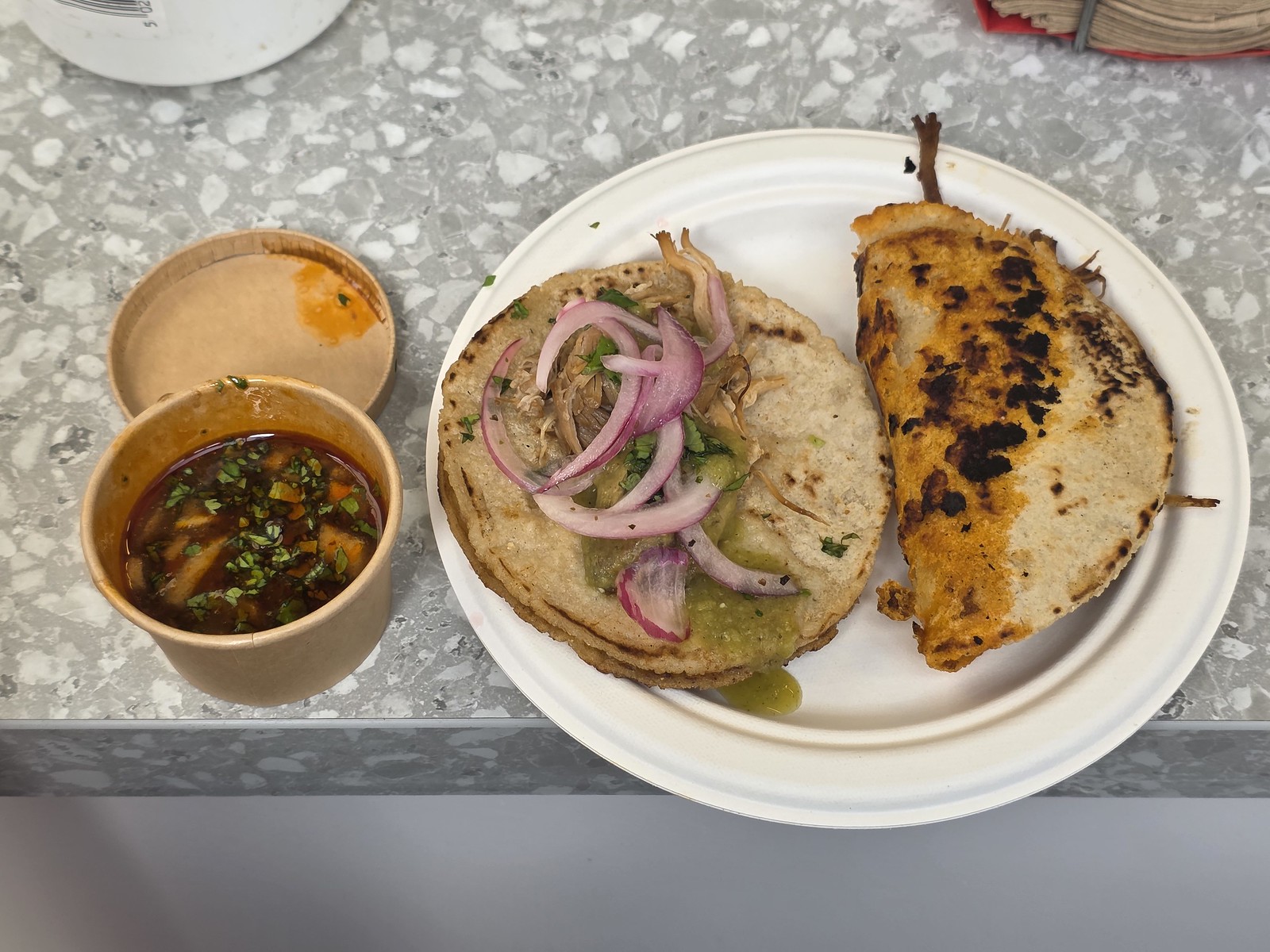
I couldn’t decide between them so I went for one carnitas taco and one beef taco, so a total of £6. James went for the same, but he’s often creatively inspired by me even if he doesn’t admit it. The pork one is on the left, the beef one on the right. The sauce in the pot is the consomme and the team member mentioned we could either use it as a dip or down it, which transpired to be a good suggestion as I tried it both ways. Both tacos had a depth of flavour to them, they were well presented and at the appropriate temperature. I enjoyed them both, but the delicate nature of the beef and dipped in the consomme was my favourite of the two.
James remembered to take a photo this time, which will save him having to draw the whole arrangement. He said something about enjoying them, being pleased about not spilling them down himself and also thinking they were a little small but still decent value. To avoid any bird attacks, we had our food whilst standing at the stall, as the neighbouring dining area shared by Toby’s Beers and formerly Cocina Mia now seems to be closed.
Although it’s a shame to have lost Cocina Mia, this seems a really quite decent replacement. The service was some of the best we’ve had yet and the food had a depth of taste and flavour. The pricing was reasonable as the food was surprisingly filling, with everything seemingly well managed. I look forwards to returning here and trying the burrito to get the full taste experience.
This is week 17 of James and I attempting to eat at every food stall at Norwich market. I visited this last time in 2023, on that occasion with Nathan, and it was a very positive experience where we thought we’d both likely visit again. I hadn’t noticed when taking the photo, but James is standing there looking studious whilst reading the menu. As usual, it took us several minutes to fend our way through all the people in Norwich who know him, nearly all of whom seem to be middle class or above. However, I don’t judge.
The menu which had plenty of choice. The prices seem reasonable for the market, there’s an inevitable cost to this sort of produce and making it fresh, but they’re not charging exorbitant prices. There’s a choice of eating in or taking away, fortunately there were seats and so we were able to dine in to get the full experience. The service was friendly and prompt, with the stall accepting cards and cash. The surfaces in the stall were clean and I noticed that they were cleaned again numerous times when we were there. The area was also a seagull free zone, which is a win for everyone. There’s talk of doing up the market, but I’d personally just like to see a few more of the food stalls have their own seating area, it adds to the experience.
The specials board (and those meatballs sound delicious), although when someone next to us tried to order they’d run out of a few things by that point. Although that is perhaps the excitement of specials, their very temporary nature. The selection available here really is quite impressive given the limited size of these stalls and the small food preparation area, but the whole process seemed efficient. Customers were always welcomed promptly, spoken to politely and their food and drink served after a reasonable period of time. It all felt like a competent set-up and I felt welcome throughout. Incidentally, they also have authentic Spanish food ingredients and drink which customers can take home with him, so it operates a bit like a deli arrangement as well.
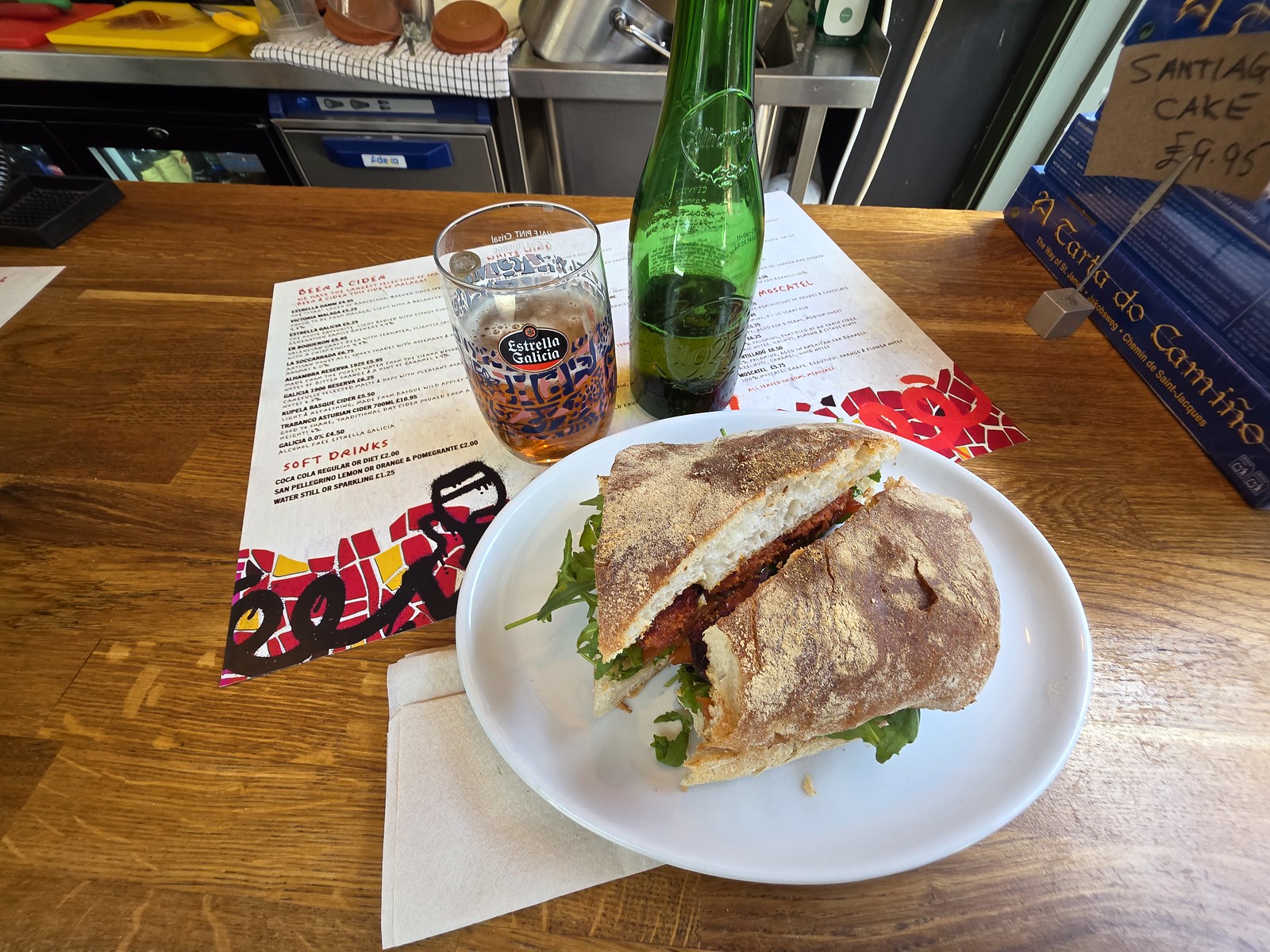
The food arrived and looked well presented, with the chorizo having a depth of flavour and it’s always a bonus to have it served fresh from the pan. The roll tasted fresh and of a high quality, James was particularly engaged with this. It was also filling, this wasn’t one of those times I’ve left a stall after eating feeling just as hungry as when I ordered.
I wasn’t going to have a drink, but as we found a seat and we were asked nicely if we wanted one, I thought I’d have an Alhambra Reserva 1925 which was malty, light and went down well with the chorizo. There aren’t a large number of stalls where you can get beer with the meal, so it seemed sensible to take advantage of the opportunity. They were a little low on beer stock as the first two I asked for they didn’t have, but I’m ever helpful in finding a beer based solution.
The kitchen area and the whole set-up felt authentic and there were vibes of being at a Spanish market, so full marks for the atmosphere.
James forgot to take a photo of his food, so he kindly did a drawing instead. It’s this kind of professionalism that has made this blog what it is today…. As mentioned, he very much liked the roll element, so he’s focused on that in the image. I suspect that he forgot what was inside, as that element of the drawing is quite vague, although when I helpfully mentioned this, he said it’s clear that it’s chorizo but that he had forgotten the beer and that was very vague indeed.
I very much enjoyed this visit and it’s up there as being one of the best so far this year. The service was friendly, the food was freshly prepared and had a depth of flavour, with the atmosphere feeling authentic and welcoming. The menu was broad, the stall was clean and there was a choice of different beers, so all rather lovely.
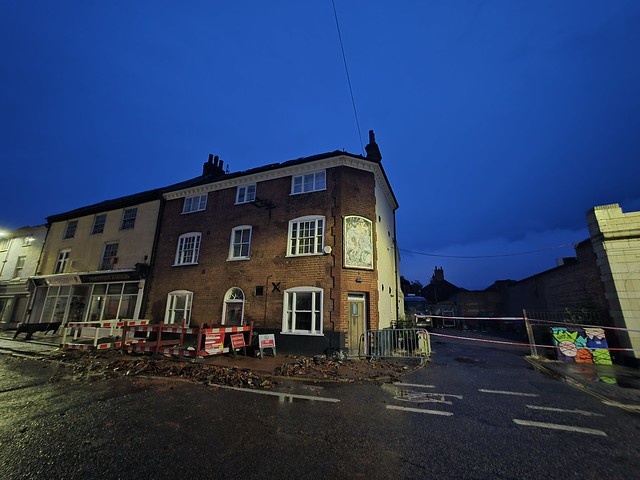
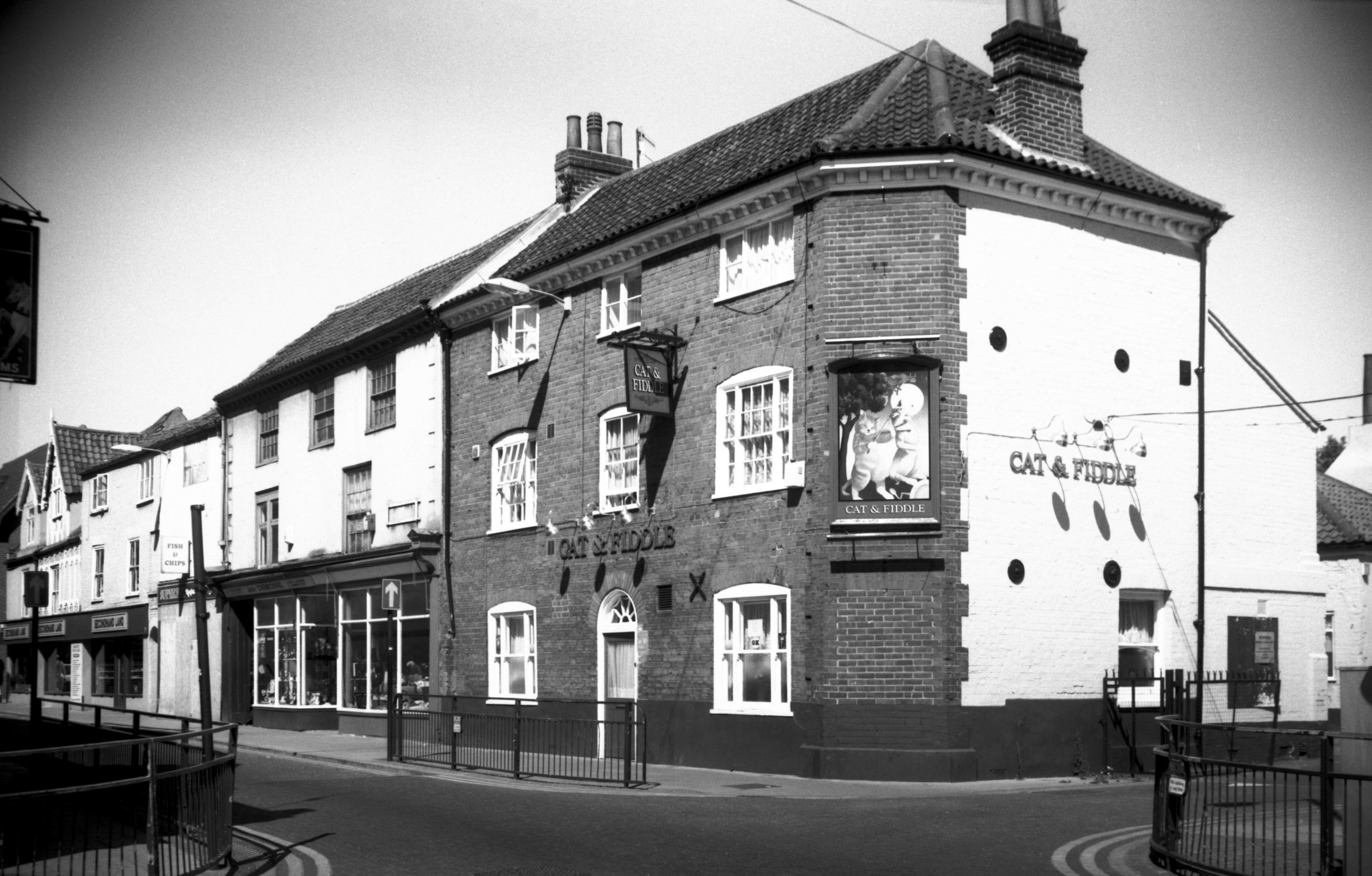
The scene at the Cat & Fiddle last week after a fire, caused by a cannabis farm getting a little over-heated on the top floor, caused significant damage to the former pub which had closed in 2011. It had been a pub since 1760 and, a little ironically perhaps, a few years after closing it found itself in the craft beer quarter along with the Malt & Mardle, the Artichoke, the Leopard, the Plasterers and the King’s Head. George Plunkett has a photo of the pub as it looked in 1997.
In terms of the pub name, there was a letter in 1902 sent to the media regarding the pub’s name.
“THE CAT AND FIDDLE.
Sir,—In “The History of Signboards,” by Larwood and Hotter, the following account is given: ” . . . The only connection between the animal and the instrument being that the strings are made from the cat’s entrails, and that a small fiddle is called a kit and a small cat a kitten. Besides, they have been united from time immemorial in the nursery rhyme,
Heigh diddle diddle, The cat and the fiddle.
Amongst other explanations offered is the one that it may have originated with the sign of a certain Caton Fidèle, a staunch Protestant in the reign of Queen Mary, and only have been changed into the cat and fiddle by corruption; but, if so, it must have lost its original appellation very soon, for as early as 1589 we find, ‘Henry Carr, Signe of the Catte and Fidle, in the Old Chaunge.’ Formerly there was a ‘Cat and Fiddle’ at Norwich, the cat being represented playing upon a fiddle, and a number of mice dancing round her.”
—Yours, etc., J. C. BURLEIGH. 13, Plynlimmon-terrace, West-hill, Hastings, Nov. 30.”
Well, there are some views on the history and it must be noted that the pub had a rather impressive sign, still visible in my photo at the top. There have historically been four pubs with the name Cat & Fiddle in Norwich (although nearly nothing is known about two of them), including one on Botolph Street which lasted until 1867, but the Cat & Fiddle Yard lasted until 1967. This map from the 1880s shows the confusion here that there must have been and indeed still us in trying to identify which pub is which when they’re referred to in the media.
Towards the bottom centre-left is the Cat & Fiddle Yard, although the pub here had closed a few years before. The pub on Magdalen Street is visible towards the centre-top of the map, with the Phoenix Brewery visible located opposite. Anyway, back to the Cat & Fiddle on Magdalen Street which is what I should be focusing on here.
The building doesn’t look it from the exterior, but it was likely built as a residential property in the early eighteenth century and was then used as a pub from around 1760. The rear range of the pub is older though, perhaps as early as 1600. Until the early twentieth century the pub was often referred to as the Cat & Fiddle Inn, because accommodation was available on the two upper floors. In the early nineteenth century, the pub advertised itself as a postal house, meaning that they kept horses that could be rented out, which transpired to be the forerunner of Post Offices. The pub was also the location for the annual meeting of the Taverham Association for Prosecuting Felons in the early 1830s and that sounds like an interesting little arrangement.
In 1859, there was an auction in the pub for the Phoenix Brewery which was located pretty much over the road, although the brewers didn’t own the pub itself. The brewery continued to trade for some time, before the building became the Phoenix Shoe Factory and was then knocked down when they decided to build Anglia Square. In 1886, the pub was something of a hub for the Conservative Party at an election with numerous posters up, something the other Julian would no doubt be thrilled about. There were numerous allegations of treating voters and the whole matter came to the attention of the courts.
The pub landlord between 1882 and 1900 was James Alfred Morris, with his son, Leonard James Morris, taking over and announcing in the local press that the pub was under new management. The advert adds:
“The Cat & Fiddle Inn, livery and bait stables, with ample accommodation for horses and traps, wagonettes and brakes. Traps of every description available for hire, special attention given to all orders for cabs and weddings.”
Alfred Morris was though summoned to court for driving a horse and cab on St. Benedict’s in May 1904 without using a light, for which he was fined 2s 6d and warned never to do it again. The pub does appear in the media as something of a taxi company, including doing the transport for the Whippet and Terrier Coursing Club when it met out at the Blue Boar in Sprowston. In the 1930s, the pub was used as the headquarters of the Norwich Excelsior Cage Bird Society and earlier in the century, it was the home of the Piscatorial Society (I had to look that up, it’s a thing for fishermen). In 1932, George William Penny of Blackpool, using the pub as his home address, attempted to hold a fair on the street which would include a cake walk and music, but the magistrates were having none of it as the previous time bits of coconut ended up in someone’s garden and the local headteacher was most upset at the whole arrangement with kids running amok.
There’s a problem today in many hotels where tradespeople leave their van outside whilst they stay overnight, only to find that their tools have been pinched when they get back to go to work. There seems to have been an equivalent in 1912, when it was reported in the Cromer & North Norfolk Post that the warehouse of R Clarke who was the Hickling Carrier based at the pub, found that he had been broken into. He lost linen drapery, handkerchiefs, stockings and a firkin of butter. I was quite intrigued by butter being stored in the firkin, but this is a separate term for a small container of butter rather than my thought that they were using firkins of beer to shove butter in. That did sound like a lot of butter.
For most of its history, the Cat & Fiddle was owned by Steward & Co or later on Stewart & Patterson, before it was all purchased by Watney Mann. There were once numerous rooms internally, including a snug, but in 1983 these were all ripped out to create one large open space and a bar at the centre. I recall Julian telling me before that this arrangement was required by the magistrates, keen to ensure that the person behind the bar could see all of the premises from where they were standing. Convenient most certainly, but it must have significantly altered the character of the pub. It seems that at this time they changed the door from the corner of the building to something more central, along with some covering up of the fireplaces.
In 1997, the pub received national attention when Roger James Foster died of injuries which he received whilst in the pub. The pub landlord was arrested and charged with his murder along with a customer, but as they were found not guilty due to insufficient evidence I won’t name them. In the years after that, Tager Inns took the building over and I’ve noted before what happened to this company. In short, they built themselves up as an operator and they were then purchased by London Inn Group, who got themselves into trouble soon afterwards and went bust in some spectacular fashion with the administrators struggling to even work out what pubs they owned. Sub-optimal really.
Julian has likely visited many times as he’s spent a lot of his many years in pubs, but I visited it just once with my friend Ross, likely nearly around twenty years ago now. I recall that it had something of a reputation for being a vibrant venue and we were offered drugs, but that sort of thing is wasted on me, unless someone comes up with a load of Mullermilch and then I’m the buyer, although that isn’t really a drug and I’m not sure that a flavoured milk based drink from central Europe is usually pushed and touted around Norwich pubs. In June 2011, the pub shut its doors for the final time, by then the building was in need of substantial repair internally and the reputation really wasn’t the best.
Anyway, I digress. This was a sad loss as a pub, not least because of how the area has since improved and had it stayed open there would have been an opportunity for more custom when the new residential properties open at whatever replaces Anglia Square. I imagine that if it was still trading, this might have become something of a craft beer bar, all rather on-trend. I assume that they will be rebuilding the structure soon enough, but I can’t imagine that it will have a pub on the ground floor again, although I think it’d be rather nice if they did.