Category: Bilbao

  • Bilbao – Metro Journey from Abando to Aretta

    Bilbao – Metro Journey from Abando to Aretta

    I might actually get a chance to finish off all the Bilbao posts that I wanted to make, rather than leaving matters in their usual half finished state. Anyway, I have a slight obsession with metro systems and I felt the need to use the one in Bilbao.

    The network is relatively new, opening on 11 November 1995, but it has developed as a very useful rapid transport system for the city. The first line connected Bilbao with communities along the right bank of the estuary, reusing parts of older suburban railway routes, before later extensions pushed the network further through the metropolitan area. Its most famous design feature is the work of Norman Foster, whose glass station entrances became known as “Fosteritos”, or, in short, an entrance to a hole in the ground.

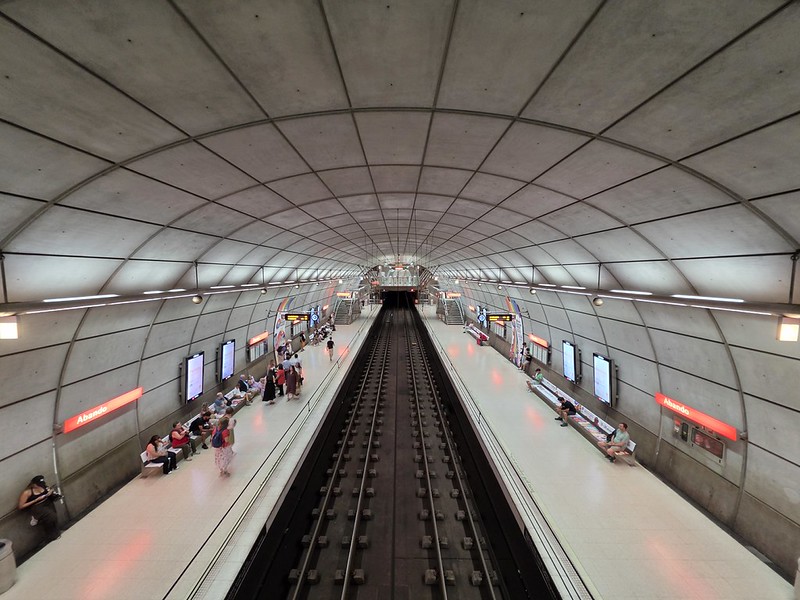
    I rather like this photo and its perspective, it’s rare to be able to get a vantage point such as this. I suspect that I enjoy transport infrastructure a little more than is socially necessary, but it is too late to build a more normal personality now.

    The station was functional and clean. My journey was from the central railway station’s metro stop at Abando to Areeta, which was on Metro Line 1.

    The trains ran on a regular basis every five or six minutes, so I didn’t have long to wait for this one. There was also plenty of seating for waiting passengers, so it was all sufficiently comfortable. It did feel like a transport system that was designed on the radical assumption that people might want to use it.

    The network felt relatively busy and it took me a little while to get a seat.

    And safely at Areeta station which serves the Getxo area of the city, near the transporter bridge which is what I was aiming to visit. It was all efficient and organised, but perhaps the main thing to note is that the journey cost just over €1 which is a third of the price that it would be on the overpriced London Underground. There’s a wider question about why London transport pricing is now almost out of control, people should be able to afford to use public transport although this is perhaps a little political for this blog.
  • Bilbao – Museum of Fine Arts (Etel Adnan – Untitled Artwork)

    Bilbao – Museum of Fine Arts (Etel Adnan – Untitled Artwork)

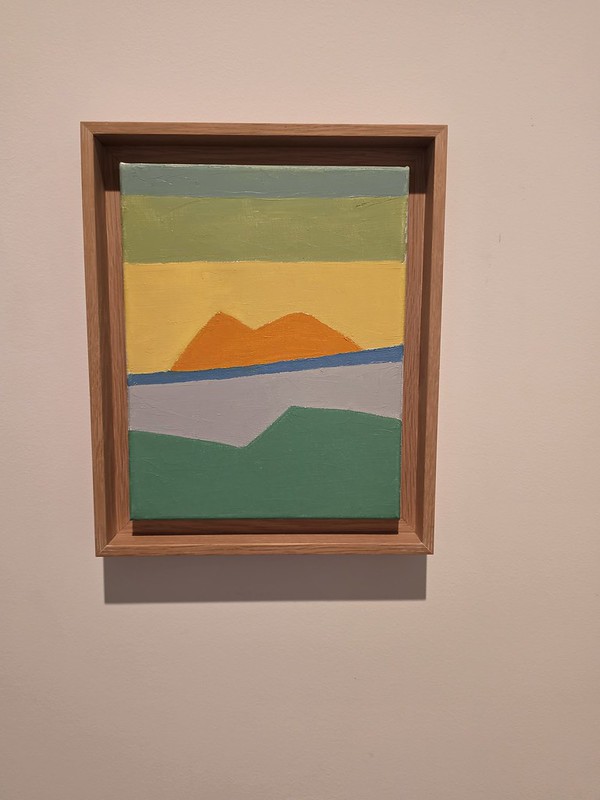
    This untitled work by Etel Adnan was painted in 2014 and I had absolutely no idea what it was meant to be. It appears to be little more than bands of colour, two orange hills, a blue line and a green foreground. That completes my art review and I think we can all agree it has been an intellectually demanding paragraph.

    As an aside, this is precisely the sort of thing that actually invites slightly dangerous thoughts in my mind which are mostly relating to ideas that I could have painted this If I had attempted something similar, I suspect I would have felt a growing need to add a tree, then a little bird, then perhaps a path, then possibly a distant cottage, until the whole thing had turned into a confused countryside scene with a slightly badly drawn craft beer bar in it. Adnan, by contrast, knew when to stop.

    Adnan (1925-2021) was a Lebanese-American artist and she was known for artworks in this style. It’s a rather lovely looking painting in many ways if I don’t try and understand it, using bold colours and minimising on the faffing around. But it was the artist who I found particularly interesting and there’s a limit of what I can write about this artwork anyway.

    She was born in Beirut to a Syrian Muslim father and Greek Orthodox mother, grew up across languages and cultures, studied philosophy in Paris, Berkeley and Harvard, then taught philosophy in California from 1958 to 1972. She also worked as a journalist and cultural editor for Al Safa in Beirut, writing political editorials and she also wrote for The Post-Apollo Press. I’d say that’s a high achiever.

    That feels like quite a mix of different talents and I rather like that she taught philosophy for many years. It’s quite an appealing artwork in many ways, simplistic as it might be, but it was created by someone who clearly had a formidable talent. And it probably didn’t need a little bird, cottage or a craft beer bar.

  • Bilbao – Bizkaia Bridge (Video of Crossing)

    Bilbao – Bizkaia Bridge (Video of Crossing)

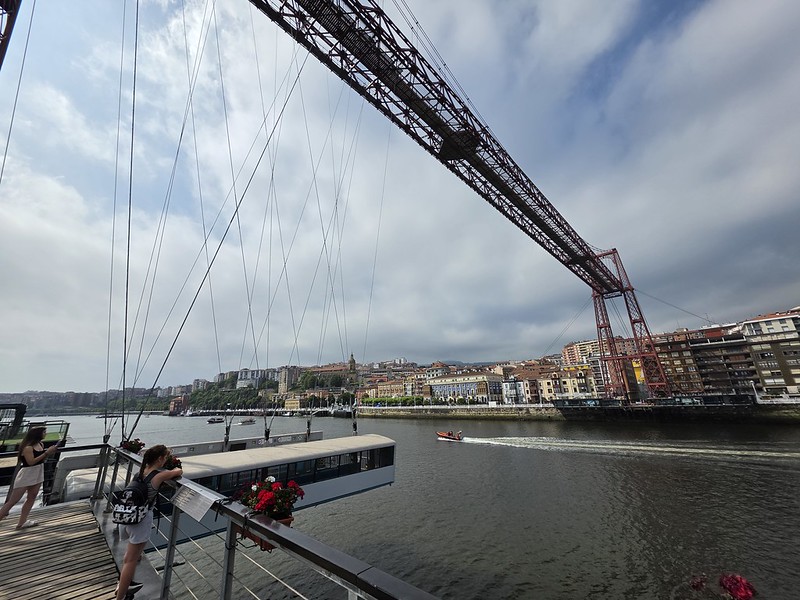
    As it was so cheap to cross the Bizkaia Bridge in Bilbao, around 85p, I thought that I’d try the experience. There’s an option to walk across the top for €10, but I was content with my choice. It only takes a minute or so and it all feels smooth. It can also carry a surprising amount of weight including relatively large numbers of pedestrians and also cars.

    And here’s the riveting video of the crossing. I appreciate that a short film of a bridge moving sideways across water may not trouble the awards season, but it does at least document the event for my two loyal blog readers, who I am sure have been waiting patiently for more suspended transporter bridge content.

  • Bilbao – Museum of Fine Arts (Eduardo Zamacois – A Memory)

    Bilbao – Museum of Fine Arts (Eduardo Zamacois – A Memory)

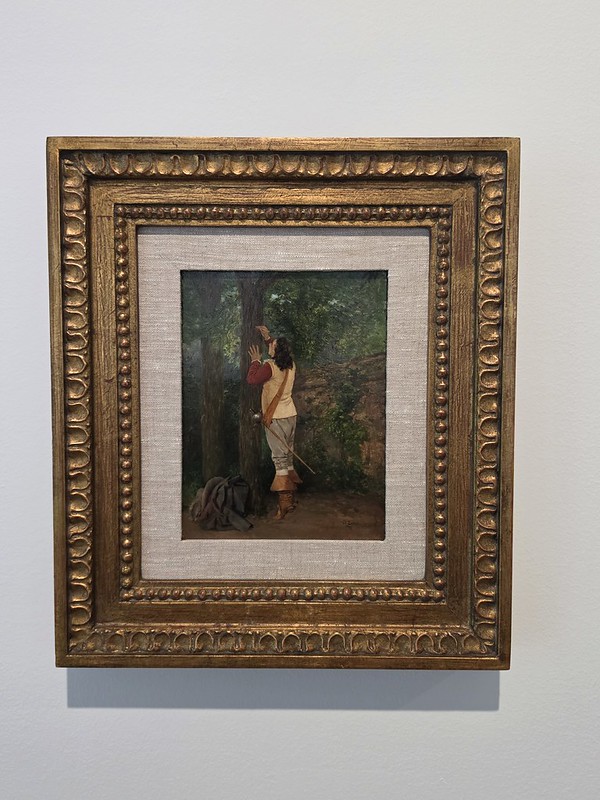
    This small painting is ‘A Memory’ by Eduardo Zamacois (1841-1871), painted in 1864, and it is easy at first to treat it as a modest little work in a rather splendid frame. And that’s fairly accurate, as the artist specialised in these little paintings, although the frame feels as if it had somewhat grander ambitions.

    As is rather obvious to anyone looking at it, which I find is often a useful feature in art, the painting shows a figure standing beside a tree, apparently carving or marking something into the bark, with the title suggesting remembrance, affection or loss. It also seems to me, with my limited artistic knowledge and considerable confidence in deploying it, like a rather more modern painting than it actually is.

    What makes it perhaps more poignant is the artist’s own short life. Zamacois was born in Bilbao in 1841, trained in Madrid and then moved to Paris, where he became successful at a notably young age. He was part of that nineteenth-century world of ambitious painters, salons, commissions and carefully observed genre scenes, and he seemed to be building exactly the sort of career that might have made him a much more prominent figure in European art. Then, rather inconveniently for art history and indeed even more inconveniently for himself, he died in Madrid in 1871 at the age of just 29.

    If he had lived into middle age, he might have developed into a major Spanish or Basque painter of genre scenes, or perhaps moved in new directions as the art world changed around him. Perhaps this makes the title of the artwork even more poignant.

    Conscious of the limitations of using AI, I wanted to use it here to see what the main character of the artwork might have looked like in the artist’s mind. I’d say that seems to be a good approximation although the graffiti seems a bit cruder than in the original.

  • Wizz Air (Bilbao to London Luton)

    Wizz Air (Bilbao to London Luton)

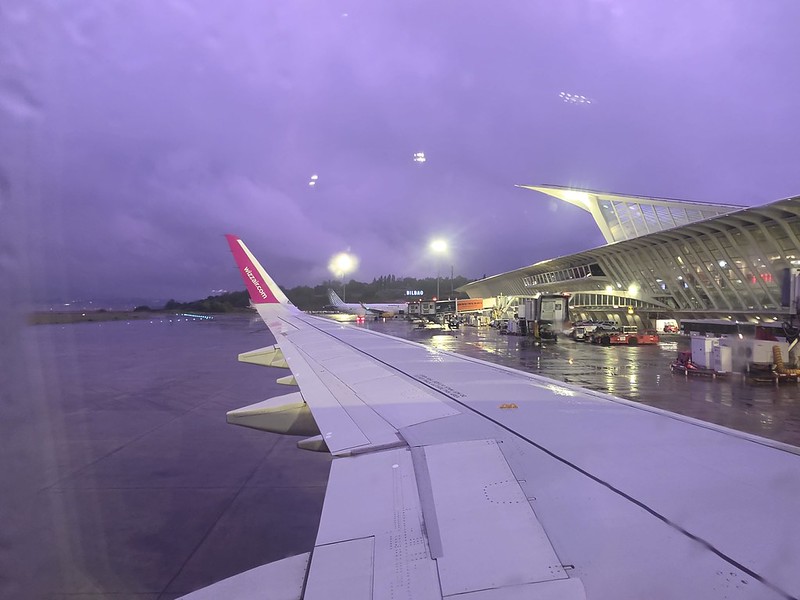
    I arrived safely at Bilbao Airport after some faffing about working out the airport bus. The temperature was much cooler than when I had arrived and there were a few brief moments of rain, as might be evident from the grey sky. At least it prepared me for what the weather was likely going to be like in the UK.

    The terminal felt quite busy and there was a limited amount of seating available in the main section.

    There was one of the quickest airport security processes to go through, it took under three minutes from walking into the area to leaving it.

    I noticed that there was a VIP lane into security for decadent passengers such as Richard.

    After a visit to the lounge, which I wrote about separately, I discovered that there was still no gate for my flight so I pottered about exploring the now relatively quiet airport. At least that meant I was able to examine a lot of airport infrastructure, although I did wonder whether I should have just spent another thirty minutes in the lounge eating chorizo.

    This was a bit confusing, it’s the line for border control and there’s one agent dealing with passengers on the left and one agent behind four kiosks on the right. I thought I’d try the kiosk and it scanned my passport before stating “invalid passport”, so I assumed it was just for EU passports despite the number of people using it. I went back to the queue and the agent called over that I could just walk through and he’d open the gate. I wasn’t sure if EES was working and just reporting a failure, or whether they were bypassing it. Either way I haven’t got a stamp in my passport, although that appears to be quite random now at the EU borders, presumably to keep collectors of passport stamps emotionally unsettled.

    As usual for Wizz Air, I found the boarding process to be well managed and it was clear which queue to get in.

    As might be evident, the seating Gods gave me a window seat and I was very comfortable during the flight.

    The outskirts of London somewhere. The flight itself was peaceful, the crew were friendly, no-one annoyed me, nothing fell off the aircraft and I spent two hours playing games on my phone instead of sleeping. This might not have been the most sensible life choice, but it kept me amused. The announcements from the pilots were clear, we landed on time and this was once again excellent value for £9 using my Wizz Air Multipass. For that amount, I require a seat, basic structural integrity and a landing broadly in the advertised country. All were achieved.

    We boarded via an air bridge in Bilbao, so this is back in London Luton. The aircraft is G-WUKR which I’ve been on before when it brought me back to London Luton from Tallinn. I’m not sure why I am pleased to meet an aircraft again as I doubt it remembers me.

    And the aircraft looking very lovely there in the middle.

    There were long queues at London Luton as if they hadn’t expected some planes to land there, but the whole process took just under half an hour which ultimately wasn’t too bad. I then had an exciting few hours in the airport before getting a coach to Stansted and then a train to Norwich, but that riveting commentary can come in the next post as I would not want to overwhelm my two loyal blog readers with too much inter-airport glamour all at once.

  • Bilbao Airport – Bilbao Airport Lounge (Sala VIP)

    Bilbao Airport – Bilbao Airport Lounge (Sala VIP)

    This isn’t the ideal thing to see when arriving at an airport lounge, although it is in keeping with my comments a few days ago about how busy these areas are becoming. However, modern travel does like to introduce little tests of character before granting access to the crisps, so I’m quite patient with these matters.

    Fortunately, there was a wait of only around five minutes, and the staff were being proactive at getting customers in, so the situation never developed into full lounge-based civil unrest.

    I was asked if it would be OK if I sat at the high seating at the rear where there was more space. This wasn’t just OK, this was positively optimal. There were lots of power points, seats and space, this was one for the win and all that.

    It was much better than all that low down seating.

    This is the other end of the lounge and I took this photo on the way out when this area became quieter.

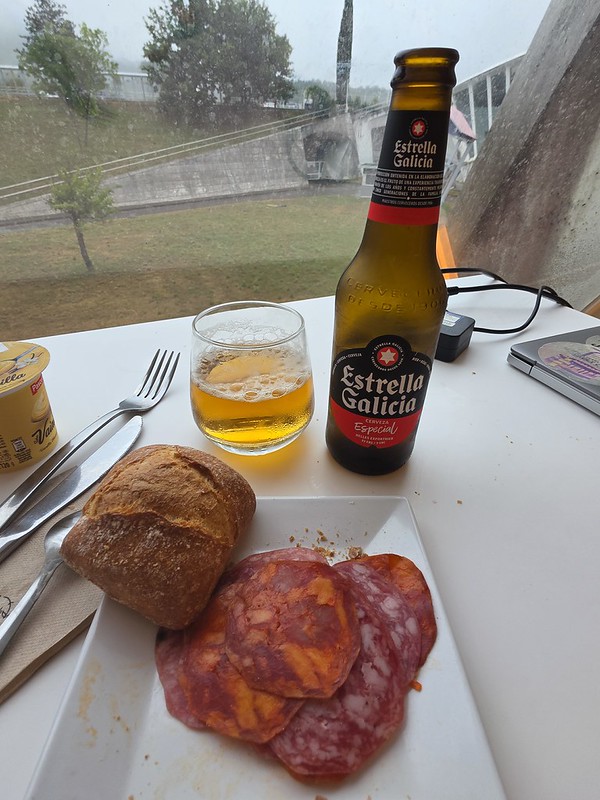
    I tried not to be greedy, but I struggled to control my chorizo consumption if I’m being honest.

    Later on, they brought out pizza, which I thought was most agreeable, as there are few travel problems that cannot at least be partially improved by the sudden appearance of carbohydrates.

    There were five different beers available, and I tried them all in the interests of research, although none troubled my Untappd high scoring section. But there are definitely worse ways to wait for an aircraft than with bread, chorizo and beer.

    Oh, and cheese, crisps, olives and pastries because apparently I had accidentally embarked on a full Mediterranean grazing strategy. But this is what happens when I’m left unattended and not supervised.

    The entrance to the lounge was much quieter than when I arrived. With that, it was time to go and hunt for my gate. My flight was half an hour late, something which the staff member told me on entry but which wasn’t updated for some time on the screens, and I could have stayed in the lounge for longer but I still had to go through border control.

    The lounge doesn’t get the best of reviews, but I liked it and thought that it seemed well managed. When it was very busy they were getting a little behind, but they soon caught up with cleanliness and food restocking, with the choice of food and drink being agreeable. Walk-up entrance would be £38.50 which feels rather high, but isn’t entirely unreasonable given that the lounge is comfortable and the dining options are acceptable. I used my annual Priority Pass card as usual so I didn’t have to dwell on the value for money arrangement.

  • Bilbao City Centre to Bilbao Airport

    Bilbao City Centre to Bilbao Airport

    I mentioned that getting the bus from Bilbao airport to the city centre was more complex than I would have liked, with the tourist information office explaining to me that the information on Google was incorrect. Most bus companies might respond to this by correcting the information, but evidently some prefer a more adventurous approach to public transport. Anyway, I thought that it would be easier coming back, which was a touching little moment of optimism.

    This sign made no sense to me. It appeared to be the airport bus stop, and therefore the sort of place where an airport bus might reasonably stop. But on the little plan, it seemed to suggest that the bus actually stopped on the other side of the road. I decided this must just be me failing to interpret local bus signage correctly, so as I was early (well, obviously for me, I was heading to the airport), I walked the ten minutes to the next bus stop back along the route.

    At the next stop, I was pleased to see three separate passenger groups with big bags who were evidently going to the airport. I decided to ask one of them if they were going to the airport and the friendly guy said yes and I was reassured that he was Spanish and so seemed to know what he was doing.

    Anyway, the bus turns up and the driver says “this isn’t the airport stop”. I did wonder why a decision had been made to put the airport bus sign up at this location given that, but I didn’t want to sound like I was querying the local transport authorities. There were some discussions in Spanish and the outcome was that the driver said that the actual stop was 100 metres down the road and on the other side of the road. We got there and there was absolutely no airport bus signage there, but there was the airport bus and so that was a result.

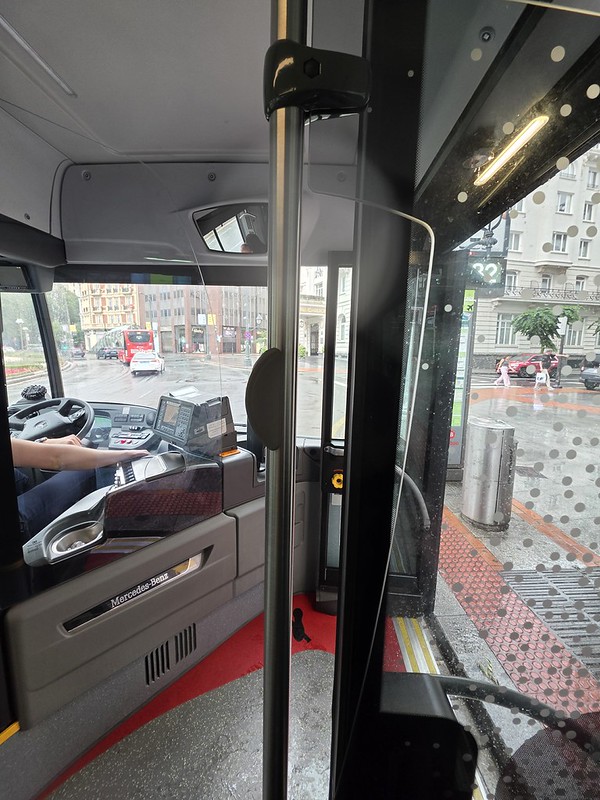
    The driver was very friendly and I got my favoured seat at the front, so all was well. But they wonder why people miss buses, it really shouldn’t be that difficult to put bus stop signs up at the right place and have buses stop at them. If it had just been myself that was muddled up, I would have assumed I was an idiot, but it was evident that others were also confused. Anyway, that meant that I was safely back at Bilbao Airport….

  • Bilbao – Heart of Mary Square Archaeological Site (Convent Church of St. Francis)

    Bilbao – Heart of Mary Square Archaeological Site (Convent Church of St. Francis)

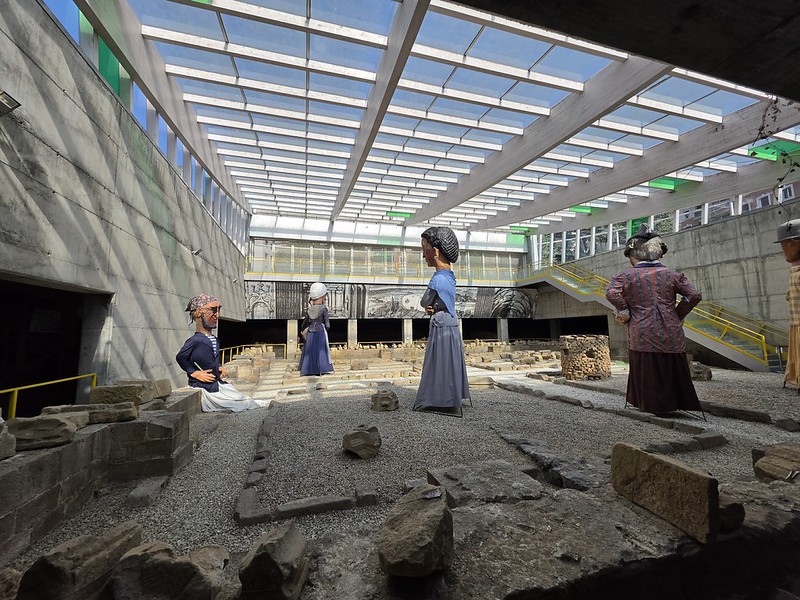
    This is the former convent church of St. Francis and these are the oldest parts of the site. Most of this stonework dates from the fifteenth century and the only element not exposed is the apse. That remains underneath the current Civic Centre, and the authorities have apparently decided not to demolish an entire public building in the interests of archaeological completeness. This feels restrained, if slightly disappointing for those of us who enjoy history but do not have to manage civic budgets.

    I’m standing on a raised platform here that would have been within the church and those rectangles are graves which were placed in the nave, in the chapels and also outside the church. There was a single nave which was 13 metres wide, with six chapels on either side and they seem to have used all of the space available.

    The side chapels were paid for by wealthier members of Bilbao society, who evidently wanted a little posthumous exclusivity and a good spiritual position for the afterlife. In the Catholic world of the period, burial close to altars and sacred spaces mattered, and the church was not about fairness, it was about money.

    The remains of the original pillars are still visible, and it is striking how deep some of the tombs once went. There is just enough here to understand the scale of the church, but it has been changed so much, and indeed nearly entirely demolished, which makes interpretation just a little more difficult.

  • Bilbao – Heart of Mary Square Archaeological Site

    Bilbao – Heart of Mary Square Archaeological Site

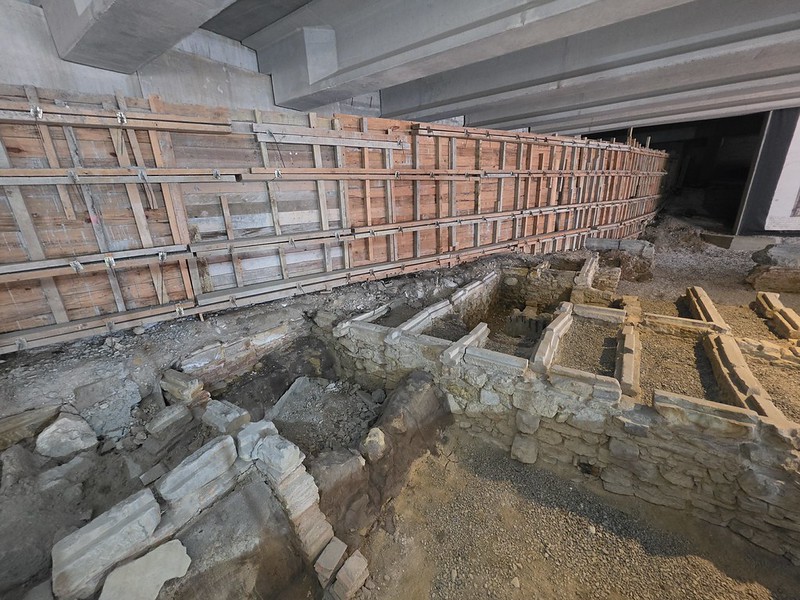
    I was encouraged by the Reproductions Museum to visit the nearby archaeological site at Heart of Mary Square in Bilbao, and I am pleased to report that I obeyed. It wasn’t clear to me if this site is routinely open to the public, I showed a ticket I was given and was escorted to this rather interesting little arrangement. This is the site of the old Convent of San Francisco, founded in 1498, including parts of its Gothic church, one of its cloisters and the Tertiary Room.

    The convent did not have a quiet retirement after its closure in 1821 as the site was then used as a cemetery and a hospital, with the religious complex being mostly demolished over the next few decades. In 1865, the Cuartel del Príncipe Alfonso was built on the same site, replacing the vanished convent with military architecture and giving the ground yet another role in Bilbao’s history.

    However, in 2005, the archaeological remains of the religious site were excavated and all remains of the former barracks, as well as the school buildings constructed in 1931 were removed. These photos show the former cloisters area and the survival of this helps give a shape to the rest of the remains.

    I will come back to the ‘Giants and Bigheads’ in another post, because they deserve separate treatment and also because it is not every day that archaeology is interrupted by what appear to be enormous ceremonial people waiting patiently indoors.

  • Bilbao – Museum of Fine Arts (Agustín Ibarrola – Industrial Assembly at the Shipyard)

    Bilbao – Museum of Fine Arts (Agustín Ibarrola – Industrial Assembly at the Shipyard)

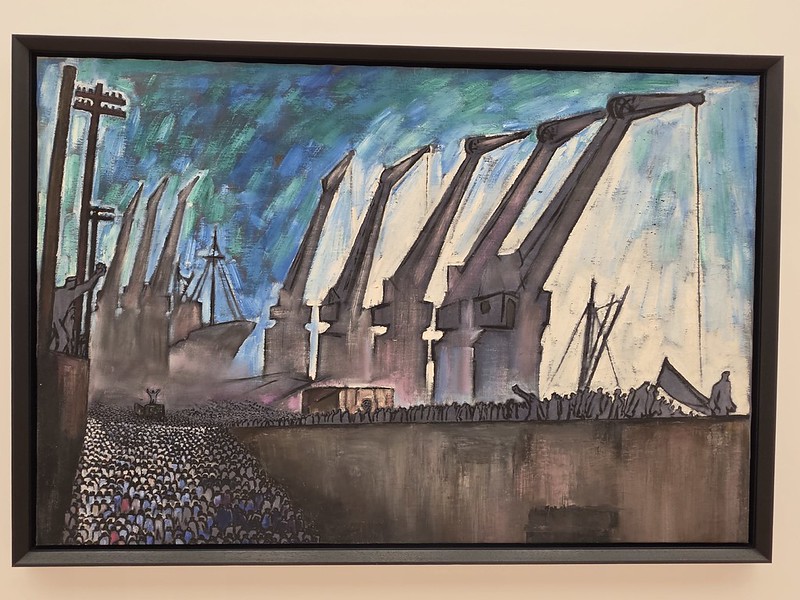
    This artwork is titled ‘Industrial Assembly at the Shipyard’ and was painted by Agustín Ibarrola (1930-2023) in around 1965. This is, I think, a political painting which shows a scene of a mass of workers gathered beside a shipyard, with cranes towering above them and a ship emerging through the smoke and shadow. It is not a gentle maritime scene of ropes, sails and someone looking wistfully out to sea. This is heavier than that, it’s a statement about workers and their importance to the economy. It was also one of my favourite paintings in the galleries, it felt like it had a meaning that I could understand which is always handy in an art gallery.

    I’m mentioning this political angle as the artist seems something of a character. He was a committed anti-Franco activist and member of the Communist Party who was arrested in 1962, tried by a military court and was imprisoned for several years at Burgos jail. His art was closely bound up with workers’ struggles, repression and resistance to the dictatorship, which helps explain why ‘Industrial Assembly at the Shipyard’ feels less like a decorative dockside scene and more like a political statement with cranes.

    Later in life, his politics shifted towards outspoken opposition to ETA and support for civic anti-terrorist movements, so his career was marked by a long and rather costly commitment to political liberty, expressed through paint and evidently a notable refusal to keep quiet. ETA might have ceased their campaign of terror, but anyone prepared to stand up to them at the time was certainly brave.